114 résultats
186411025Washington: Towers for the Union Congressional Committee 1864. 7 1pp. Loosened caption title as issued. Light wear and soil Good. <br/><br/> An appeal for the votes of the troops "the working hands by which the nation's honor and manhood have been vindicated" in the upcoming presidential election. "Through four years of dread war in bright and dark days you have carried the Union in your hearts and on your bayonets." Opposing the Democrat-Copperhead platform as treasonous this pamphlet exhorts "If ever there was a time when Union bayonets were called on to think it is now. The crisis of the war when our armies have the rebellion in their grasp and are preparing to deal its death-blow finds the country precipitated into the turmoil of a Presidential election." FIRST EDITION. Sabin 24237. Towers for the Union Congressional Committee unknown books
18489627np 1848. 16pp disbound and stitched minor scattered spotting. Very Good. <br/><br/> NUC attributes authorship to Adams identified here only as "a Whig of the Free States." He is appalled at his Party's impending nomination of Zachary Taylor for the presidency. Taylor a Louisiana slaveholder had never voted or participated in civil affairs. His military career most recently in the Mexican War which northern Whigs had generally opposed as an unconstitutional land-grab for slavery was his only public activity. <br/> "He is a Military Chieftain-- and he is a Slave owner and in favor of the Extension of Slavery over new territories." Webster deserves the nomination: "Let there be no wavering none of the contemptible expediency doctrine which leads men to declare in one breath that Mr. Webster is their first choice and to say the next moment that they are ready to vote for General Taylor." <br/>FIRST EDITION. Sabin 55816. 3 NUC 0062491. Not in Miles LCP Eberstadt Decker Dumond. unknown books
184819816Washington: Published Under Authority of the National and Jackson Democratic Association Committee 1848. 16pp untrimmed and folded blank top edge chipped. Toned. Good or so. <br/><br/> Stewart a Whig had charged that Cass the Democrats' 1848 presidential nominee had picked the taxpayers' pockets while Governor of the Michigan Territory and Superintendent of Indian Affairs. Stewart issued a pamphlet that included Cass's expense accounts and other documents to back up his charges. <br/> Defending Cass this pamphlet accuses the Whigs and Stewart of "making up a gross statement against General Cass and suppressing the truth in regard to the accounts of General Taylor." Taylor say the Democrats is guilty of even greater malfeasance than that which has been falsely charged against Cass. <br/>Sabin 91633n. 111 Eberstadt 113. Published Under Authority of the National and Jackson Democratic Association Committee unknown books
1896200371896. n.p. 1896. 4 pp folded. Caption title as issued. Chipped at blank foremargin Good. A Republican campaign leaflet supporting the Republicans' gold standard against the free silver policy of William Jennings Bryan and the Democrats. Not located on OCLC. unknown books
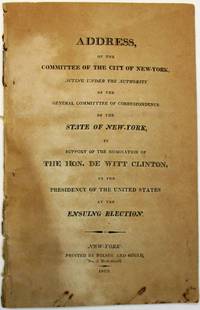
181228331New York: Pelsue and Gould 1812. 28pp disbound. Some toning light wear. Good.<br/><br/> Fueled by jealousy of Virginia's near-monopoly on the presidency New Yorkers urge the nomination of De Witt Clinton in order to deny President Madison a second term. The dangers of jealousy among the States require that "Virginia herself as she values the confederation should abdicate a situation which she cannot retain without wounding the feelings of her associates and weakening their attachment for our union."<br/> The Committee objects to nominations by "congressional caucus" which favors Madison. The Constitution requires that the President be chosen "by the States composing the Union in their separate sovereign capacities each state voting in the ratio of its population." The Committee also criticizes Madison's conduct of the War of 1812. The Address is signed in type at the end by 16 New Yorkers.<br/>AI 25250 7 26pp. Pelsue and Gould unknown books
179321First Edition. 20pp. 8vo disbound; browning to text. Philadelphia: John Binns 1812.<br/><br/> The Committee of Correspondence consisted of Republican Pennsylvanian state legislators. Address is for the re-election of James Madison and against the candidacy of De Witt Clinton. Last page lists the names of the Pennsylvania Electoral Ticket. S&S 25254.<br/><br/> unknown books
181225965New York 1812. 12pp lightly tanned and light spotting faint numerical rubberstamp in blank margin of page 3. Top edge partly uncut. Good. Bound in modern quarter morocco and marbled boards bookplate on front pastedown. <br/><br/> Fueled by jealousy of Virginia's near-monopoly on the presidency New York Republicans urge the nomination of De Witt Clinton in order to deny President Madison a second term. "We are not aware of any advantage that can result by establishing the rule that every President who is not extremely disapproved of shall be re-elected." The Committee citing constitutional precedent reminds fellow Republicans that "the chief magistrate is to be chosen by the States in their seperate sic sovereign capacities" not by congressional caucuses who favor Madison. <br/> The Committee criticizes Madison's conduct of the War of 1812 particularly his failure to bring the army to a state of readiness. "Where are the marks of system or preparation" A Clinton presidency will relieve us "from the evils of an inefficient administration and of an inadequately conducted war." The Address is signed in type at the end by 17 New York City Republicans. <br/>AI 25251 3. unknown books
184834739Newport 1848. 24pp. Disbound printed in two columns per page. Light wear faint blindstamp on final leaf. Good<br/><br/> On "the wisdom and good policy" of the Whigs' 1848 nomination of Zachary Taylor and Millard Fillmore for the presidency. The pamphlet soothes the wounds of the failed candidates and their supporters: Winfield Scott the "noble old chief who had just carried the eagles of our Republic in triumph over the mountains of Mexico;" Henry Clay "the gallant chivalrous and accomplished statesman of the West;" Webster "the strong towering giant defender of the constitution of the North." <br/> "Circumstances demanded the nomination of another patriotic whig as the standard bearer of our party." Taylor is a man of "TRUTH JUSTICE INTEGRITY FIDELITY and a NOBLE GENEROSITY." In this complicated election the Whigs had to contend not only with the Democrats and their nominee Lewis Cass but also with former President Martin Van Buren and his Free Soil Party. Seeking to hold the votes of anti-slavery Whigs this pamphlet derides Van Buren's last-minute conversion: his record shows a complete subservience to the Slave Power. <br/>Sabin 70526. OCLC 25797641 5 as of March 2018. unknown books
184817436Boston: Eastburn's Press 1848. Stitched 11pp. Scattered foxing blank top margin of title page cut down with no text affected upper blank forecorner chewed. Good. Massachusetts Whigs put forth a valiant but unsuccessful effort in behalf of Daniel Webster's candidacy for the Whig presidential nomination in He is "A man who respecting all the 'arrangements and compromises of the Constitution' and the rights of all under them will yet never suffer them to be extended or increased to the destruction of our political equality." FIRST EDITION. 4 NUC 0070701 2. Not in Sabin Eberstadt Decker Miles. Eastburn's Press unknown books
184015487Albany N.Y. 1840. pp 89-96 large folded folio sheet printed in triple columns. Caption title as issued scattered light foxing Very Good. <br/><br/> An Extra denominated No. 12 from the Rough-Hewer a Democratic Party campaign publication published from February - December The Address supports the Democrats' presidential candidate and New York's favorite son Martin Van Buren against the Whig candidate William Henry Harrison. The Whigs descendants of the aristocratic Federalists are "constantly struggling to create distinctions in society by legislation for the special benefit of individuals and classes thereby throwing into their hands a power and influence strong enough to control the suffrages of the people or set them at defiance." Resolutions and discussion of the issues all presented with great passion ensue. <br/>FIRST EDITION. AI 40-5891 5. Lomazow 392. Not in Mott. unknown books
182334261Raleigh 1823. 15 1 blank pp. Caption title as issued. Disbound. Scattered light and moderate foxing. Good. <br/><br/> Signed at the end in type: "November 1823. CAROLINA." An extremely scarce pro-Calhoun anti-Crawford piece for the 1824 presidential election. When Calhoun decided to seek the presidency in 1824 "both Crawford and Adams the acknowledged front-runners felt betrayed" Crawford because Calhoun had reportedly assured him that he would defer to the older man and wait his turn; and Adams because Calhoun had said that "for the good of the country.the next President should come from the North." Peterson THE GREAT TRIUMVIRATE 116. <br/>Miles 3. Thornton 1750. AI 12071 1- DLC. OCLC 42212191 3- NYHS Duke UNC as of February 2021. unknown books
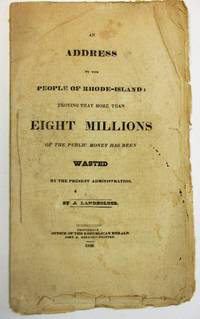
182836773Providence: Office of the Republican Herald 1828. 28pp stitched untrimmed lightly worn Very Good.<br/><br/> American Imprints but not Bartlett attributes authorship to Wilkins Updike. This is a high-pitched attack on the alleged profligacy of the Adams administration and a call for the election of Andrew Jackson. <br/> "A suffering people cry for reform" the author says. "Did one of you ever dream that the funds of this Government were expended in the purchase of BILLIARD TABLES BILLIARD BALLS CHESS BOARDS AND CHESS MEN and other toys to gratify the gambling propensities of the cabinet" A Jackson presidency will bring back "the days of good old President Jefferson." <br/>FIRST EDITION. AI 36986 7. Bartlett 8. Office of the Republican Herald unknown books
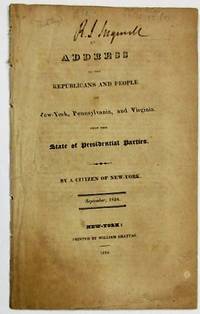
182434265New York: William Grattan 1824. 23 1 blank pp. Disbound and loosening. Signature of R.J. Ingersoll on front wrapper probably the Connecticut politician and lawyer who was Speaker of the Connecticut House of Representatives at the time of this publication and later an anti-Jackson Congressman. Except as noted Very Good. <br/><br/> An interesting scarce analysis of the 1824 election with an eye on the impact of the electoral college written during the campaign. This was the most complicated presidential election in our history there being four strong candidates. Jackson is a man "of temper so violent and uncontrolable and of conduct so arbitrary" that he "would scarcely be restrained by the inconvenient limits of the constitution and laws." Adams and Crawford the beneficiaries of an unfortunate political tradition of elevating Cabinet officers to the Presidency are no match for Clay whose integrity and spirit of unity and compromise render him acceptable to all sections. <br/>Wise & Cronin 138. Not in Miles. Sabin 441 later variant. William Grattan unknown books
18811336103Washington: U.S. G.P.O. 1881. Hardcover. Octavo xii 281 pages; VG-; 3/4 bound in black leather red marbled boards gilt lettering to spine; marbled endpapers; moderate rubbing to hinges edges of boards head and tail of spine; 26 folding plates in rear; "March 3 1881.--Laid on the table and ordered to be printed."; name written on second free endpaper; Shelved in case 8 1/2. 1336103. Shelved Dupont Bookstore. [U.S. G.P.O.] hardcover books
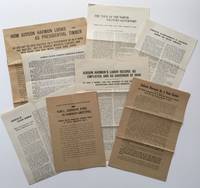
1912371Columbus Oh 1912. About very good. Eight pieces including one 12pp. pamphlet and seven broadsides and bifolia. Old folds light wear. Several items evenly tanned. An informative group of eight extremely scarce or unrecorded pieces promoting the presidential campaign of Ohio Governor and former U.S. Attorney General Judson Harmon in 1912. Harmon eventually lost out to Woodrow Wilson at the Democratic National Convention. The most substantial piece a twelve-page pamphlet concerning Harmon's "presidential timber" located only at the Ohio History Center lavishes praise upon his character and provides a lengthy discussion and defense of his legislative record as Governor. The remaining pieces are not recorded by OCLC and include an endorsement from the late mayor of Cleveland Tom L. Johnson a broadside comparing Harmon's record with Wilson's a four-page endorsement by Charles H. Wirmel leader of the Ohio Steam Engineers Union a broadside printing of endorsements from Progressive leaders in the Democratic Party and two printings of remarks made by Harmon before Democratic Party gatherings. Scarce and ephemeral material on the Democratic contest for the presidential nomination in 1912. unknown books
193624942<p>This sheet contains five rough sketches of graphics calling on the workers and voters of America to support Franklin D. Roosevelt's reelection in 1936. They did in record numbers.</p> <b>PRESIDENTIAL ELECTION OF 1936.</b>Typed Document Signed. Artwork by Franz Felix and Ideas and Copy by Richard Barron "Set of Rough Sketches Containing Some Suggested Promotion Ideas to be Used in the 1936 Democratic Presidential Campaign" July 2 1936. 1 p. 12 x 10½ in.<p><b><br /></b></p><p><b>Excerpts:</b></p><p>"<i>1. Sounding the call against 'economic royalists' in the spirit of 1776.</i>"</p><p>"<i>2. Appropriating the well-known symbol of violence</i> upraised fist<i> diverting it to peaceful democratic use. To include the farmer phrase the appeal: TOILERS OF AMERICA – UNITE FOR ROOSEVELT.</i>"</p><p>"<i>3. The statue of 'The Thinker' as a symbol of the man today who thinks the toiler with brawn and brain.everyman.</i>"</p><p>"<i>4. Direct appeal to radical labor and leftists in general.</i>"</p><p>"<i>5. Another way of appealing to the working class men and women.</i>"</p><p>"<i>This collaborative effort respectfully submitted for consideration to the Chairman of the Democratic National Committee Mr. James A. Farley.</i>"</p><p><b>Historical Background</b></p><p>After unseating incumbent Republican President Herbert Hoover in 1932 President Franklin D. Roosevelt ran for reelection in 1936. His Republican opponent was Governor Alf Landon of Kansas. Although the Great Depression had entered its eighth year Roosevelt's New Deal policies were broadly popular. He won the highest share of the popular and electoral vote since the uncontested 1820 election. Roosevelt attracted more than 60 percent of the popular vote and won the electoral votes of 46 states; Landon won the electoral votes of only Maine and Vermont.</p><p>Democratic Party chairman James Farley had predicted that Roosevelt would lose only Maine and Vermont. After the results of the 1936 election Farley quipped that the nation needed to revise the conventional political wisdom of "As Maine goes so goes the nation" to "As Maine goes so goes Vermont."</p><p>These ideas for campaign imagery employed or modified common images to support Roosevelt's campaign. One drew on the imagery of artist Archibald Willard's 1875 painting <i>The Spirit of '76</i> and employed three figures of workers to match the subjects of Willard's image. Another appropriated the upraised fist as a symbol of violence and repurposed it as a symbol of defiant unity against "<i>economic royalists</i>." A third used an image of <i>The Thinker</i>by French sculptor Auguste Rodin 1840-1917 to appeal to thinking voters. Another image appeals to the fears of radicals that the alternative to Roosevelt is "<i>Reaction</i>."</p><p>Richard Barron and artist Franz Felix submitted these ideas to Democratic National Committee chairman James A. Farley on July 2 1936 three weeks before the Democratic Party held its convention in Philadelphia. There is no evidence that these images were used in the campaign and it is possible that Farley rejected them. At the end of the campaign the Democratic National Committee had a campaign deficit of approximately $850000. To help offset those expenses the treasurer convinced President Roosevelt to sign 2500 brief Forewords which were bound into <i>The Democratic Book 1936</i> and sent to donors of $250. Purchases brought in more than $400000 for the party and led Republicans to charge corrupt practices for allowing corporations to contribute to the campaign by buying copies.</p><p><b>Franz Felix</b> 1892-1967 was born in Vienna Austria and developed an ability as a child to draw portraits in charcoal. He studied portraiture in Vienna and immigrated to the United States shortly after World War I. He settled in San Francisco where he established himself as a portrait artist and commercial illustrator. In the late 1920s he moved to New York and established a studio in the suburb of Spring Valley where he produced book and magazine illustrations. During World War II he painted a series of murals of wartime activities of Spring Valley residents.</p><p><b>James A. Farley</b> 1888-1976 was born in New York into an Irish Catholic family. After his father died he helped his mother with a small business to support the family. After graduating from Packard Business College in New York City where he studied bookkeeping and other business skills Farley got a job with the U.S. Gypsum Corporation. He served as a Democratic town clerk in Stony Point New York and became chairman of the county's Democratic Party in 1918. He organized upstate Democrats and helped elect Alfred E. Smith as Governor that year. He served in the New York State Assembly in 1923 but was defeated at the next election for supporting the repeal of Prohibition. As chair of the state Athletic Commission Farley fought for the civil rights of African American athletes. Farley founded he General Builders Corporation from smaller firms to become New York City's largest building supply company. Farley directed Franklin D. Roosevelt's narrowly successful New York gubernatorial campaign in 1928 and his reelection in 1930. Farley served as chairman of the New York State Democratic Committee from 1930 to 1944 and helped build the national New Deal coalition that elected Roosevelt to the Presidency four times. In 1932 Farley became the chairman of the Democratic National Committee and in 1933 U.S. Postmaster General. He held both positions until 1940. Farley and Roosevelt broke on the two-term tradition of the Presidency in 1940 and he later helped propose the 22nd Amendment to the U.S. Constitution limiting a person to two elections as president approved by Congress in 1947 and ratified in 1951. Farley became chairman of the board of the Coca-Cola Export Corporation in 1940 and held that position for more than thirty years.</p> books
1840273086Washington 1840. unbound. 2 pages front and back 10 x 8 inches written by George Folts of Washington City to his brother James at Albany New York October 3rd 1840 concerning their misguided notion that Martin Van Buren the Democratic Party nominee for President would win the State of Ohio in the Presidential election despite the fact that his Whig opponent William Henry Harrison resides there in part: ".We have assurances from the best sources that Ohio will be ours in November.at all events from present appearances our chance seems much the best. All eyes are turned towards the Empire State it is the battle ground if she will prove true to her best interests and all will be well. Mr. Durham the bearer of this formerly of Albany now a Clerk in this office leaves tomorrow. He is a clever fellow and a good Democrat." Note: George Folts received his Clerks job in Washington through the patronage system. Usual folds plus some pencil underlining; very good- condition.<br/><br/> "We have assurances from the best sources that Ohio will be ours in November"<br/><br/> unknown books
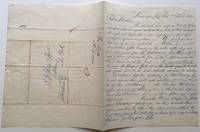
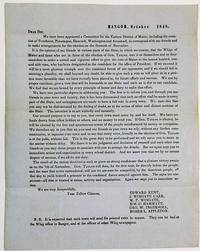
184834421Bangor 1848. Folio sheet folded to 7-3/4" x 10". Printed on first page only; second page blank; third page with a manuscript letter urging the recipient whose last name is Chandler to campaign vigorously for the Taylor-Whig ticket. Very Good.<br/><br/> A plea to get out the vote for Taylor. "If Gen. Taylor is elected he will be elected by the free and spontaneous action of the people uninfluenced by money or corruption.The signs are auspicious-- all that is wanted is union activity and organization." The printed letter is signed in type by Edward Kent J. Wingate Carr W.P. Wingate Wm. C. Hammatt Geo. W. Ingersoll and Moses L. Appleton. unknown books
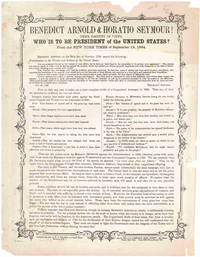
1868WRCAM48472Brooklyn: D.S. Holmes 1868. Broadside 13 x 10 inches. Some small tears chipping and loss at top and right edges. Minor foxing. Very good. Broadside printed for the U.S. Presidential Campaign of 1868 which pitted former New York governor Horatio Seymour against Gen. Ulysses S. Grant. This broadside points out Seymour's Copperhead tendencies and statements made by him in 1864 linking him to similar sentiments made by the notorious traitor Benedict Arnold. Seymour's Copperhead utterances during the war haunted his campaign and he lost decisively to Grant. The text printed here strives to demonstrate: <br> <br> ".the points made by Horatio Seymour against the Administration in 1864 are identical point by point with those made by Benedict Arnold against Washington and the Continental Congress in 1780.The Copperhead chiefs of these times who draw so lavishly upon the sophistries and fallacies of 1780 for the furtherance of their factious designs cannot too well understand that the sequel to all this is endless disgrace. They must not expect to fight the Government with weapons of the Tories and of the blue-light Federalists without sharing the same fate." D.S. Holmes unknown books
185623950Washington 1856. 16pp disbound printed in double columns. Last leaf browned else Very Good. This is one of several variant titles-- the first two clauses appear identical in all versions-- charging Fremont the first Republican presidential candidate with financial improprieties while disbursing officer in California in the 1840's. This one also accuses him of exaggerating his military achievements which were minimal at best. Cowan 222. Rocq 16684. LCP 1239. unknown books
185619546Washington 1856. 14 2 blank pp. Disbound partly loosened. Tanned with some foxing and light wear. Good. <br/><br/> "Principally of his frauds in the purchase of horses in 1846 and 1847 while disbursing officer in California." Cowan. "Carelessness recklessness favoritism and connivance with the claimants." That's the verdict on Fremont. The pamphlet examines "the chief dealings of Colonel Fremont as a disbursing officer during the campaign in California whilst he commanded the volunteers" during 1846-1847. Tables facts figures are produced and analyzed. <br/>FIRST EDITION. Cowan 222. Rocq 16684. Not in Eberstadt Decker. unknown books
186033068Washington City: Issued by the National Democratic Executive Committee 1860. 8pp caption title as issued. Disbound tanned light dustsoiling. Good.<br/><br/> Breckinridge Buchanan's Vice President was the 1860 presidential standard-bearer of the Southern Rights branch of the Democratic Party which had split with Stephen Douglas supporters during the 1860 nominating convention. Douglas had defied Buchanan and broken with him over the Kansas issue. This campaign piece demonstrating Northern support for the Breckinridge-Lane ticket charges the Douglas faction with unfairness hypocrisy and illegal attempts to silence the Southern Democrats at the abortive Democratic Convention at Baltimore. <br/>LCP 4504. Issued by the National Democratic Executive Committee unknown books
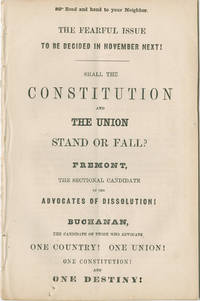
185624482<p>"<i>What a Combination! Seward Greeley Bennet Watson Webb H. Ward Beecher &c. There can be no doubt that this goodly company will speedily be increased by the addition of Fred. Douglass and his black republicans… The only candidate to arrest this tide of demoralization and sectionalism is James Buchanan.</i>"</p><p>This pro-Buchanan election of 1856 pamphlet attacks the first Republican presidential candidate John C. Frémont. Quoting from the speeches and writings of William Lloyd Garrison Horace Greeley Wendell Phillips Salmon P. Chase Henry Ward Beecher William H. Seward Joshua R. Giddings this pamphlet ignores distinctions between abolitionists racial egalitarians more limited opponents just of the expansion of slavery into the territories or those who fought the kidnapping of free African Americans under the Fugitive Slave Law. It paints all with the same broad brush as "Black Republican" extreme abolitionists who were willing to destroy the Union rather than remain in it with slaveholders.</p> <b>ELECTION OF 1856.</b>Printed Document. <i>The Fearful Issue to Be Decided in November Next! Shall the Constitution and the Union Stand or Fall Fremont The Sectional Candidate of the Advocates of Dissolution! Buchanan The Candidate of Those Who Advocate One Country! One Union! One Constitution! and One Destiny!</i> 1856. 24 pp. 5 x 8½ in.<p><b><br /></b></p><p><b>Excerpts:</b></p><p>Before Title: "<i>Read and hand to your Neighbor.</i>"</p><p>"<i>We propose showing by indubitable testimony that John C. Fremont's leading friends are now the open enemies of the Federal Constitution… the enemies of one-half of the States of the Union; the enemies of the laws of Congress; and the enemies to equality of the States.</i>" 3</p><p>"<i>In a speech delivered at the New England Anti-Slavery Convention on the 29th of May 1856 by Wm. Lloyd Garrison we have a flood of light shed on the relation between abolitionism and republicanism which divests the subject of all doubt or uncertainty.</i>" 4</p><p>"<i>William H. Seward was known at the Abolition Convention at Philadelphia… as one of Fremont's warmest supporters. Indeed it is well known that to Chase Seward and Greeley Fremont is mainly indebted for his nomination: they defeated McLean.</i>" 7</p><p>"<i>Nathaniel P. Banks Abolitionist and Disunionist was elected Speaker of the House by a solid sectional vote: he did not get one vote from the South.No man has exhibited such ferocious hostility to the fugitive slave law to the compromise measures and to the Federal Constitution. His speeches full of treason and of war would fill a volume.</i>" 8 and 9</p><p>"<i>Every leading committee has an Abolition Disunionist for chairman and a Disunion majority! There some thirty-five committees in the House… Black Republicans monopolized all the great committees. Thus was the work of Disunion formally begun in the Congress of the United States! This monstrous act unprecedented in all our history was the deliberate work of the men who now surround Fremont.</i>" 10</p><p>"<i>The reverend agitator Ward Beecher is out for Fremont in the last number of his 'Independent.' He is probably next to Garrison and Phillips the most profligate calumniator of the Constitution and the Union.</i>" 19</p><p>"<i>What a Combination! Seward Greeley Bennet Watson Webb H. Ward Beecher &c. There can be no doubt that this goodly company will speedily be increased by the addition of Fred. Douglass and his black republicans. Every Black Republican in Congress from New York is now the earnest advocate of Fremont.</i>" 20</p><p>"<i>We aver that there is not an Abolitionist or Disunionist in Pennsylvania who is not an active and open friend of John C. Fremont for the Presidency. David Wilmot and William F. Johnston lead the motley crew both recreants from the Democratic party because the Democratic party respected the Constitution of the United States and would not desert its injunctions… The only candidate to arrest this tide of demoralization and sectionalism is James Buchanan. It is against him and against the Constitution that this combination has been formed.</i>" 23</p><p>"<i>in the South every vote thrown for Mr. Fillmore is more or less an aid to John C. Fremont to the extent that it may weaken James Buchanan.</i>" 24</p><p>"<i>We would speak of Mr. Fillmore with entire respect. His speech at Albany was patriotic and forcible but it cannot be denied that out of New York in the North all those who pretend to support him will be called upon in the State elections to unite against the Democratic party with the friends of Fremont otherwise known as the Black Republicans.</i>" 24</p><p><b>Historical Background</b></p><p>James Buchanan won with 1.8 million votes and 174 electoral votes from 19 states. Fremont received 1.3 million votes winning 11 northern states with 114 electoral votes. American Party "Know Nothing" candidate and former President Millard Fillmore received 873000 votes winning Maryland's 8 electoral votes. Frémont received no votes at all in 10 of the 14 slave states and fewer than 1200 votes total in the other 4 slave states.</p><p><b>John C. Frémont</b> 1813-1890 "the Pathfinder" was a legendary explorer who achieved military victories in California during the Mexican War. He entered politics as California's first senator and then became the first Republican presidential candidate in 1856. During the Civil War Lincoln removed Frémont from command in Missouri after he unilaterally declared martial law and threatened to confiscate all property including slaves of Southern sympathizers. Lincoln gave Frémont command of an army in western Virginia where he was defeated by Stonewall Jackson in the Battle of Cross Keys. After Frémont refused to serve under General John Pope Lincoln never again gave him a field command contributing to a personal grudge. In 1864 Frémont abandoned his third-party campaign for the presidency in September after Lincoln agreed to remove U.S. Postmaster General Montgomery Blair from office.</p><p><b>Condition</b></p><p>Disbound minor pin holes very good.</p> books
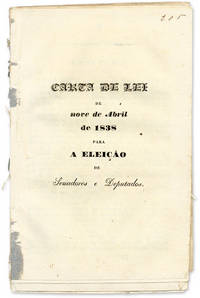
1838609821838. Portugal Election Law. Carta De Lei De Nove De Abril De 1838 Para E Eleicao de Senadores E Deputados Half-title. Porto: Imprensa Constitucional 1838. 33 pp. Folding table. Disbound stab-stitched pamphlet. Light toning foxing to a few leaves early hand-lettered page numbers to upper corners of leaves. $75. The Portuguese law of 1838 governing national elections containing 92 articles with numerous statistical tables relating to district representation. unknown books
187215895np 1872. 8pp. Folded with caption title as issued. Light wear trimmed closely at the top without loss of text but affecting several page numbers. Good. Demonstating the abuses heaped upon our great presidents beginning with George Washington and ending with Grant. Charles Sumner whose criticisms of corrupt practices in the first Grant Administration were particularly sharp is excoriated. unknown books