Constitution, ArizonaBiblio.com
264 résultats
1019477075.Ghardcover. Good. Access codes and supplements are not guaranteed with used items. May be an ex-library book. hardcover
133478177X.Gpaperback. Good. Access codes and supplements are not guaranteed with used items. May be an ex-library book. paperback
18256784Paris: Dondey-Dupre Pere et Fils 1825. Hardcover — Tapa dura. 133x80mm. 5¼x3¼". Paris Dondey-Dupre Pere et Fils 1825. En 12º 133 x 80mm. 110 pp. 1 h. Encuadernación de la época en piel. Primera edición francesa. La Constitución Federal de los Estados Unidos Mexicanos de 1824 entró en vigor el 4 de octubre de ese año después del Imperio Mexicano de AgustÃn de Iturbide. En la nueva Constitución la República tomaba el nombre de Estados Unidos Mexicanos y era definida como una República Federal Representativa. Esta traducción francesa es rara en comercio. Dondey-Dupre Pere et Fils hardcover
1017036888.Ghardcover. Good. Access codes and supplements are not guaranteed with used items. May be an ex-library book. hardcover
101813235X.Ghardcover. Good. Access codes and supplements are not guaranteed with used items. May be an ex-library book. hardcover
1358919321.Ghardcover. Good. Access codes and supplements are not guaranteed with used items. May be an ex-library book. hardcover
1378073223.Gpaperback. Good. Access codes and supplements are not guaranteed with used items. May be an ex-library book. paperback
18501229871850. First Edition. CONSTITUTION SPOONER Lysander. A Defence for Fugitive Slaves Against the Acts of Congress of February 12 1793 and September 18 1850. Boston: Bela Marsh 1850. Octavo original wrappers; pp. 1-2 3-4. i-iv 5 6-72. $3200.First edition of the rogue abolitionist's provocative call for ""vigorous"" public resistance to a pattern in the 1793 and 1850 Acts and court decisions such as Prigg v. Pennsylvania that demonstrated the government's refusal ""to champion liberty or justice"" especially elusive in original wrappers.The 1850 Fugitive Slave Act ""exposed the futility of antislavery constitutionalism grounded in a commitment to the 'proper rules of interpretation'"" Knowles Seeing the Light 544. It ""evinced a clear congressional policy favoring harsh and summary enforcement of the rendition policy over any solicitude for procedural or substantive rights of alleged fugitives"" Cover Justice Accused 121. Spooner crafted his answer to this in a ""devastating critique"" of both the 1793 and 1850 laws Smith Lysander Spooner. Defence one of his most elusive and provocative works offers ""significant evidence of the ways in which the passage of the 1850 Fugitive Slave Act shook his faith in the ability of the nation's courts to interpret the constitution in a manner consistent with the dictates of natural justice"" Knowles 546. Closely analyzing ""reasons why the 1793 and 1850 laws were unconstitutional he made it very clear why the passage of the 1850 law pushed him away from the 'quiet argument' of the courtroom to 'more vigorous'"" public action. In Defence while he continued to argue the importance of ""procedural objections to the laws Spooner spent far greater time 1 explaining why the courts would not actually strike down either of the laws and 2 outlining 'The Right of Resistance': ways in which 'The People' could respond to what he now recognized as the 'ugly reality' of proslavery constitutionalism."" He notably pointed to ""the 1842 decision in Prigg v. Pennsylvania in which the Supreme Court held that under the Constitution's Supremacy Clause the 1793 Fugitive Slave Act trumped Pennsylvania's personal liberty law which had made it far more difficult for slaveholders to recover individuals they alleged were fugitive slaves In the face of this judicial reality and to ensure the 'maintenance' of the Constitution Spooner encouraged popular resistance"" arguing the Second Amendment ""gave 'The People' an absolute and unqualified' Constitutional 'right' to do so."" By 1860 he would utterly lose ""faith in the ability or willingness of the government especially the courts to champion either liberty or justice"" Knowles 545 552. First edition: as issued with printing of 1793 Act of Congress and 1850 Fugitive Slave Act preceding title page; front and rear wrapper interior with publisher's advertisements. Sabin 89607. Work 335. Text very fresh a few minor stains to front wrapper expert repairs to wraps on the spine. Near-fine. paperback
1024252329.Ghardcover. Good. Access codes and supplements are not guaranteed with used items. May be an ex-library book. hardcover
1024256537.Gpaperback. Good. Access codes and supplements are not guaranteed with used items. May be an ex-library book. paperback
1175996009.Gpaperback. Good. Access codes and supplements are not guaranteed with used items. May be an ex-library book. paperback
036503519X.Gpaperback. Good. Access codes and supplements are not guaranteed with used items. May be an ex-library book. paperback
1024400425.Ghardcover. Good. Access codes and supplements are not guaranteed with used items. May be an ex-library book. hardcover
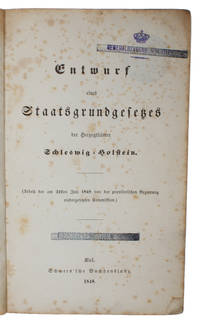
184859828Kiel Schmers'sche Buchhandlung 1848. 8vo. In the original blank blue wrappers. Provisional repair with tape to spine. Front-wrapper missing upper inner corner. Two stamps to half-title title-page and verso of title-page. Upper outer corner of half-title missing far from affecting text. Occassional brownspotting throughout. 34 pp. with a blank leaf inserted between every printed leaf giving a total of 33 ff. including the blanks. <br/><br/><em>The rare first printing of the drafting of the constitution by the provisional government for the Duchies of Schleswig-Holstein. In 1848 the Schleswig-Holsteiners decided to establish a provisional government and oust the Danish king. The subsequent war 1848-1851 achieved a status quo until a permanent solution between Denmark and Germany was reached in 1920. The 1848-1852 events in Schleswig-Holstein were a Danish-German confrontation. The underlying issues were complex: The kingdom of Denmark and the duchies of Schleswig and Holstein were component parts of the Danish Monarchy and were united in the person of the king/duke. Schleswig was a Danish fief Holstein a member of the German Confederation. A 1665 law introduced succession through the female line in Denmark with the survival of Salic law in the duchies held in abeyance. Schleswig had a strong Danish element in the north Holstein was German. "With the extinction of the male royal line in the offing Christian VIII declared in 1846 that the 1665 law applied to Schleswig and with some reservation to Holstein. Protests in the duchies had not been resolved when in the wake of the February revolution the liberals in Copenhagen took over and moved toward the annexation of Schleswig. In defiance the estates of Schleswig and Holstein set up a provisional government on March 24. Being composed of liberals and conservatives it obtained popular and official support in Germany and with Prussian military support gained control of most of the duchies by midsummer. But then Britain and Prussia intervened pressuring Prussia to make a truce with Denmark at Malmö August 26 1848 a truce which caused a parliamentary crisis in Frankfurt. In a short time Schleswig-Holstein had become the national issue and by acceding to the Malmö truce the Frankfurt Assembly severely damaged its political credit.Fighting resumed in 1849 and was ended by a July truce. After losing German military support the duchies were defeated in the 1850 campaign. The government abdicated on February 1 1851 and the Danish authorities took over a year later. In the final settlement the powers restored the Danish monarchy with the succession in the duchies to follow that of the kingdom Second London Protocol of May 8 1852. In separate notes the Danish government agreed to preserve the status of Schleswig and to abstain from steps leading to its incorporation. While the agreements restored the balance of power the relations between Danes and Germans suffered eroding popular sentiment for the Danish monarchy. Also Schleswig became a matter of outside concern permitting Prussian intervention in the case of Danish non-compliance." Ohio Univerty; Lawrence D. Steefel Sleswig-Holstein Question. </em> unknown
1931113753Addis Abeba 1931. In 8° bross. orig. con tracce d'uso ma integra pp. 2 n.n. 16 16 2 n.n. Testo in lingua etiope seguito da testo in lingua francese. Datato 16 luglio 1931 raro Addis Abeba unknown
1331337305.Gpaperback. Good. Access codes and supplements are not guaranteed with used items. May be an ex-library book. paperback
1527734684.Gpaperback. Good. Access codes and supplements are not guaranteed with used items. May be an ex-library book. paperback
1021472727.Gpaperback. Good. Access codes and supplements are not guaranteed with used items. May be an ex-library book. paperback
1019921307.Ghardcover. Good. Access codes and supplements are not guaranteed with used items. May be an ex-library book. hardcover
171947102Sans lieu d'édition 1719. Bonded Leather. <b>Livre en français</b>. Couverture rigide. Seconde édition revue corrigée et augmentée où l'on répond à ce qu'il y a de plus spécieux dans les avertissements de Soissons. Reliure plein veau d'époque dos manquant. 279 pages. Mouillure à une dizaine de pages. Petite tache d'encre à la marge inférieure. <i>ref. 47102</i> Sans lieu d'édition hardcover
18651260191865. First Edition. CONSTITUTION. Journal of the House of Delegates of the State of Virginia. for the Session of 18645. Alexandria: D. Turner 1865. Octavo original front printed wrapper respined renewed rear wrapper original string stitching; pp. 1-3 4-83 1. Housed in a custom chemise and clamshell box. $4500.First edition one of 500 copies of the momentous Journal featuring its February 9 1865 entry on the Alexandria Virginia government's passage of the 13th Amendment mere days after the U.S. Congress the first of the four Unionist southern states to pass the Amendment also featuring the governor's Message noting: ""though we have in inherited from our fathers of the revolution the blessings of a great nation yet they also left to us an inheritance of African slavery which has proved a bitter dreg in our cup of freedom"" a vital record of forces for constitutional change near the end of the Civil War.Soon after the 1860 election amidst southern secession ""the great questions of union or disunion war or peace hung in the balance. Probably the crucial weight on the scale was Virginia as long as the federal government did not seek to coerce the states Virginia secessionists were unable to achieve a majority. When Lincoln responded with force to the attack on Fort Sumter however the vote in Virginia went in favor of secession."" Subsequently a Virginia convention ""met in Wheeling on May 13 1861 it elected as Governor Francis Pierpont a western Virginian and ardent Unionist and arranged for the creation of a legislature to replace the body sitting in Richmond in July 1861 the new legislature met at the 'Restored Virginia' capital of Wheeling in a special session called by Pierpont."" Against its ""claim to represent a majority of Virginians"" a new state of West Virginia was created in 1863 and Pierpont's government moved to Alexandria to govern areas of Virginia under Union occupation Harrison Lawfulness of the Reconstruction Amendments 380-83.Scholars observe that the 13th Amendment its fellow amendments and Reconstruction as ""both a political process made possible by military successes and constitutional thought grew from wartime as well as post-Appomattox developments"" Hyman and Wiecek Equal Justice 247. This rare first edition of Journal of the House of Delegates substantiates that in documenting passage of the 13th Amendment by Pierpont's Virginia government mere days after the U.S. Congress passed the Amendment on January 31 1865. With that Virginia became the first of the four Unionist southern states that ratified the 13th Amendment. Of those Louisiana followed on February 17 with Arkansas and Tennessee that April. The 13th Amendment is the focus of the Journal's entry for February 9 1865 which states: ""Mr. Brownley called up Senate bill No. 12 entitled 'An Act to ratify the joint resolution of Congress passed January 31 1865 proposing an amendment to the Constitution of the United States.' The bill was read the first and second time and the rules were suspended and the bill read the third time and the bill passed."" Also notable herein is the complete printing of Governor Pierpont's opening Message where he notes: ""though we inherited from our fathers of the revolution the blessings of a great nation yet they also left to us an inheritance of African slavery which has proved a bitter dreg in our cup of freedom."" He speaks at length of the rights due people of color and the abolition of laws such as those that prohibit ""negro testimony"" or proscribe a ""different punishment for persons of African dissent"" from that of ""white persons.""""The legislature met for its second session on December 5 1864 The governor's message was a long and important document and indicated the changes of opinion that the war was bringing about. Pierpont gave his views upon the all-important negro question. He congratulated the constitutional convention which had met in the spring on the abolition of slavery in Virginia and advocated sweeping changes in the laws concerning negroes. The act prescribing different punishments for blacks should he said be altered in accordance with the amended constitution as well as the law for apprenticing them. The law prohibiting the education of negroes should be abolished His language was on the whole very moderate. He advised the legalizing of the marital relations of negroes and most important the establishment of public schools Notwithstanding the governor's advice no acts of great importance passed the legislature On February 9 1865 the assembly ratified the 13th Amendment to the Constitution of the United States. It adjourned on March 7"" Eckenrode Political History of Virginia During the Reconstruction. Faint ""U.N.C. Duplicate"" stamp to front wrapper.Text fine; just a bit of faint soiling and a tide line to fragile front wrapper. An excellent copy of this elusive item. unknown
1017186251.Ghardcover. Good. Access codes and supplements are not guaranteed with used items. May be an ex-library book. hardcover
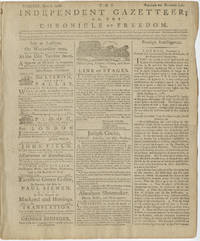
178830007.003Philadelphia PA 1788. No binding. Fine. Independent Gazetteer; or The Chronicle of Freedom. Newspaper. Independent Gazetteer; or The Chronicle of Freedom Philadelphia Pa. May 6 1788. 4 pp. 9 1/2 x 11 1/2 in. The Maryland ratifying convention suggests some amendments along with their approval of the Constitution. ExcerptsFrom page 3:""From the MARYLAND GAZETTE or April 29 1788. The CONVENTION of this state on Saturday last determined to ratify the proposed plan of Federal Government. -YEAS 63 NAYS 11-And then appointed a committee of thirteen members to consider and report amendments to be recommended to the people. -The following amendments were proposed by a member and referred to the committee who are now sitting-And it is hoped that the great and essential rights of the people will be declared and secured.- PROPOSED AMENDMENTS.Wherefore whenever the ends of Government are perverted and public liberty manifestedly endangered and all other means of redress are ineffectual the people may and of right ought to object to reform the old or establish a new Government-that the doctrine of nonresistance against arbitrary power and oppression is absurd slavish and destructive of the good and happiness of mankind. All imposts and duties laid by Congress shall be placed to the credit of the state in which the same be collected. That there shall be no national religion established by law; but that all persons be equally entitled to protection in their religious liberty. That the Supreme Federal Courts shall not admit to fictions to extend its jurisdiction; nor shall citizens of the same state having controversies with each other be suffered to make collusive assignments of their rights to the citizens of another state for the purpose of defeating the jurisdiction of the State Courts; nor shall any matter or question already determined in the State Courts be revived or agitated in the Federal Courts. That Congress have no power to lay a Poll-Tax. That the people have a right to freedom of speech of writing and publishing their sentiments and therefore that the freedom of the PRESS ought not to be restrained and the printing presses ought to be free to examine the proceedings of Government and the conduct of its officers.""From page 2: Protesting the Slave Trade by Boycotting West Indian Produce""A CAUTION.WHEREAS in the year 1787 some vessels were fitted out at the port of Philadelphia for the iniquitous purpose of stealing the inhabitants of Africa from all the endearments of domestic life; one of which vessels has succeeded in obtaining a number of poor blacks and has taken the to a port in the West Indies where they are under the iron hand of oppression. From this shameful traffic this horrid source the proprietors of the vessel have purchased some West India produce which after landing at Wilmington they have brought up to this city and offered for sale. It is a grateful circumstance to the supporters of the common rights of mankind that the virtuous inhabitants of the city reprobate the horrid idea.-A correspondent hopes that the citizens will further testify their disapprobation of the practice by turning with indignation from the purchase of any property thus basely procured by men so lost to the common feelings of humanity; notwithstanding the patriotic convention at which Washington presided have declared that this abominable traffic shall be continued for TWENTY years by the people of America.From page 1:An advertisement with engraving for a ""Line of Stages"" between Philadelphia and New York started by four partners who split off from an established stage line and promising better service. From page 4:An advertisement for another different ""New Line of Stages."" And a report on the creation of a Philadelphia committee for the relief of the nearly 100 Americans captured by Algerian corsairs and Barbary pirates. unknown
1333824513.Gpaperback. Good. Access codes and supplements are not guaranteed with used items. May be an ex-library book. paperback