US ConstitutionBiblio.com
264 résultats
17892601011London: Annual Register 1789. early. hardcover. good. One of the earliest British printings of the US Constitution. Printed for J. Dodsley in Pall-Mall London 1789. Book good wear to covers gutters cracked front free end paper has two tears former owner's name stamp to 2nd front free end paper. Annual Register unknown
193534966Montevideo Imprenta Nacional 1935. Paperback. Good. lii 235p. wrps tall 4to wrps chipped; back wrps and errata leaves marginally chipped and detached. Includes provisional constitution. Montevideo, Imprenta Nacional paperback
1926184330Montevideo : Claudio Garcia 1926. 1st Edition in this form. Paperback. Very good paperback copy; edges slightly dust-dulled and nicked. Rounded corners. Remains particularly and surprisingly well-preserved overall; tight bright clean and especially sharp-cornered.; 8vo 8"" - 9"" tall; 91 pages; Description: 91p. 19cm. Subjects: Uruguay - Constitution - Constitutional law. Series: Coleccion de manuales de derecho y legislacion. ""La bolsa de los libros - Montevideo"" stamp to front cover and title. Language: Spanish. [Montevideo] : Claudio Garcia paperback
200062807Washington DC: U.S. Government Printing Office 2000. Presumed first edition/first printing. Wraps. Good. No dust jacket as issued. Cover has some wear and soiling. iv 90 p. Serial No. 120. H.R. 4292 was part of the late-term abortion debate. U.S. Government Printing Office paperback
0844405604.Gpaperback. Good. Access codes and supplements are not guaranteed with used items. May be an ex-library book. paperback
178767677London: Printed for D. Henry 1787. UNITED STATES CONSTITUTION; URBAN Sylvanus. One of The First Means by Which The British People Learned of The Enactment of The Constitution of The United States of America<br> <br> UNITED STATES CONSTITUTION subject. URBAN Sylvanus editor. The Gentleman's Magazine "New Constitution of the United States of America". Printed by John Nichols for D. Henry November December 1787.<br> <br> First edition of these November and December 1787 issues. Two small octavo volumes 8 1/2 x 5 1/8 inches; 215 x 130 mm. 941-1035 1; 1037-1131 1 pp. With woodcut text illustration on front wrapper of each volume. November issue with one fold-out plate and lacking plate I entitled "S.W. View of Aconbury Chapel 5 Miles from Here." The December issue with two plates plate II and Supp. but lacking plate I Illustrations of the Royal Charter School Near Dublin Clontarfe Castle Dublin and others. Text of American Constitution on pp. 1008-1011; 1110-1112.<br> <br> Self-wrappered. Newer stitching. Some very minor toning and light occasional spotting. Overall very good.<br> <br> This is the first English magazine printing of the U.S. Constitution. The November issue on pages 1008-1011 prints George Washington's Letter and the first Article. The December issue on pages 1110-1112 contains articles two through seven and the delegates names.<br> <br> "The following is the new Plan of the Constitution of the United States of America upon which the Convention of all the most distinguished men in the States have been deliberating for several months and by which if finally adopted the Constitution of the Union is totally changed." From the introduction<br> <br> Einaudi. Goldsmiths'. Howes. Howes. Kress. Streeter. Streeter.<br> <br> HBS 67677.<br> <br> $1500. Printed for D. Henry unknown
178769121London: Sold by T. Wilkie 1787. UNITED STATES CONSTITUTION. The London Chronicle "The New Plan for the Constitution of the United States of America". Vo. LXII. No. 4834-4835. From Saturday October 27 to Tuesday October 30 1787 and From Tuesday October 30 to Thursday November 1 1787. Pages 409-424. London: Sold by T. Wilkie 1787.<br> <br> Likely the first public printing of the United States Constitution in England. This newspaper printing precedes the know first edition pamphlet published by Debrett as well as the first magazine printing in "The Gentleman's Magazine." It is broadly stated that news of the United States Constitution hit England early in November however the dates of the Chronicle precede this by a few days. This copy also contains the preliminary cover letter from George Washington to the president of Congress which is usually included with early printings of the Constitution and which states Washington's strong support of ratification. "The Plan" is printed in its entirety without comment or explanation from the publisher.<br> <br> Together two issues no. 4834 and 4834. Each issue self bound along left margin. 11 3/8 x 8 5/8 inches; 288 x 222 mm. Number 4834 is four leaves pages 409-416 and number 4835 is four leaves pages 417-424. The first part of the Constitution is printed on pages 413-414 of the first part with the end stating "To be concluded in our next" and the second part is printed on pages 420-421. Both issues very good with just some slight toning. Page 421-422 trimmed close at top margin just touching header. A small red stamp on verso of first leaf of each issue along bottom margin. Overall about fine. We could find no other copies of this or any earlier British newspaper containing the US Constitution on Rare Book Hub. We could not locate any copies on OCLC or ESTC. Housed in a custom quarter red morocco clamshell.<br> <br> At the time of the Constitutional Convention John Adams was living in England as a diplomat. In a letter to John Adams from Elbridge Gerry dated September 20th 1787 just one day after the first newspapers in America printed the Constitution he states "The proceedings of the Convention being this day published I embrace the Oppertunity of transmitting them by a Vessel which is to sail this morning for London." According to the National Archives "Gerry enclosed a copy of the new U.S. Constitution. Gerry likely sent this letter to John Adams via the Prince George Capt. Strong which departed New York City in late September and arrived in London on 3 Nov. New York Independent Journal 1 Sept. 1787 2 Feb. 1788." This shows that it would have been impossible for news of the Constitution to arrive in England much before this date of November 3rd. Lengthy searches turn up no indication that any other British publication has a copy of the US Constitution before this London Chronicle printing. The National Archives go on to state "The U.S. Constitution was adopted on 17 Sept. 1787 and British newspapers first published the text in late autumn. The London Chronicle printed the preamble and the first article in its 27-30 Oct. issue and the remaining articles and signatures in its 30 Oct. - 1 Nov. issue. "<br> <br> The London Chronicle was a thrice weekly newspaper also known for being " one of the first to break the news that the United States had declared independence from the British Empire reporting on the event in its 13 August 1776 edition. It was also one of the first to publish the declaration in its entirety in the 15-17 August 1776 edition but containing no explanation or comment as to what it was" Wikipedia. This holds true for their publication of the Constitution as well.<br> <br> United States Constitution now the longest continuing charter of a national government in the world and "the product of a revolution in political thought at least as important and far-reaching as the winning of American independence from Great Britain and the culmination of the intellectual ferment and political experimentation in the new republic" Richard B. Bernstein Are We to Be a Nation.<br> <br> HBS 69121.<br> <br> $20000. Sold by T. Wilkie unknown
200663994Washington DC: U.S. Government Printing Office 2006. Presumed first edition/first printing. Wraps. Good. No dust jacket as issued. Volume II ONLY. iii 1155-2307 p. Serial No. 109-84 Volume II. This volume includes affidavits from women who have had abortions inserted by Congressman Franks. These were compiled by The Justice Foundation. Also included is "Confession of an Ex-Abortionish by Dr. Bernard Nathanson; a statement by Nancy Keenan President of NARAL; and A statement submitted by Vicki Saporta of the National Abortion Federation. U.S. Government Printing Office paperback
193781566Philadelphia:: The Historical Society of Pennsylvania 1937. First edition. publisher's printed wrappers. Slight tanning to wrappers with a crease at one corner; some staining and damage to the additional items. Folio. With 4 p. engraved invitation from the Philadelphia Mayor to the One Hundred Fiftieth Anniversary Ceremonies tan stain at the right edge; another such invitation from The Historical Society of Pennsylvania; and a chipped and stained facsimile of The Pennsylvania Packet 1787 printing of the Constitution. The Historical Society of Pennsylvania, unknown
200676532Washington DC: U. S. Government Printing Office 2006. Presumed First Edition First printing. Wraps. Good. iv 1580 pages. Illustrations. Occasional footnotes. Serial No. 109-70. Format is approximately 5.75 inches by 9.25 inches. Cover has some wear and soiling. This is the first of a series of hearings that the Subcommittee planned to hold examining the Voting Rights Act also known as the VRA. It had been 25 years since Congress last extended the number of the temporary provisions of the VRA. Six provisions were scheduled to expire in 2007 including sections 4 5 6 7 8 and 203. These hearings will examine the impact of the Voting Rights Act over the last several decades and its continued role in protecting minority voting rights. The ability of our citizens to cast a ballot for their preferred candidate ensures that every voice is heard most importantly the right to vote safeguards our freedoms and all other rights enshrined in the Constitution. The sacredness of the right to vote is reflected in the protection afforded by the 15th amendment which States ''the right of citizens of the United States to vote shall not be denied or or abridged by the United States or by any State on account of race color or previous condition of servitude.'' For too many of our fellow citizens in our history this has not always been the case. Our country has had a troubled history of invidious and disparate treatment in the most fundamental process of a democracy namely voting. The VRA pushed back against this history and challenged racial discrimination from a number of different angles. U. S. Government Printing Office paperback
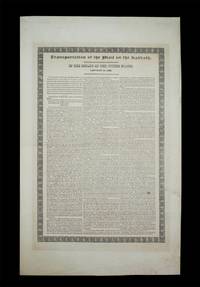
182969246Kentucky 1829. UNITED STATES CONSTITUTION; BROADSIDE. BROADSIDE. Transportation of the Mail on the Sabbath. In the Senate of the United States. Kentucky: 1829.<br> <br> Full Description:<br> <br> UNITED STATES CONSTITUTION. BROADSIDE. Transportation of the Mail on the Sabbath. In the Senate of the United States. Kentucky: January 19 1829.<br> <br> An important and interesting broadside supporting the separate of church in state in so as it applies to the delivery of mail on Sunday the Sabbath. Broadside folio 16 3/4 x 10 1/2 inches; 428 x 266 mm. With a caption title printed above three columns separated by rules. All within a decorative woodcut border. Mounted at the top edge within a portfolio mat. Some minor toning and a few small spots of dampstaining. A One and one half-inch closed tear at right-hand margin just touching the border. Overall very good.<br> <br> This is a significant document in the history of the United States Constitution in relation to the concept of the separation of church and state. Christian leaders demanded that the Government institution of the Postal Office not work on Sunday as their God had deemed this the Sabbath. The following document discusses that while many Christians observe the Sabbath on Sunday others including their Jewish neighbors observe the Sabbath on Saturday. Demanding that the government institution not work on Sunday for religious reasons goes directly against the Constitution. The report states "With these different religious views the committee are of opinion that congress cannot interfere.-It is not the legitimate province of the legislature to determine what religion is true or what false. Our government is a civil and not a religious institution. Our constitution recognizes in every person the right to choose his own religion and to enjoy it freely without molestation. Whatever may be the religious sentiments of citizens and however variant they are alike entitled to protection from the government so long as they do not invade the rights of others." It goes on to powerfully state "Extensive religious combinations to effect a political object are in the opinion of the committee always dangerous. This first effort of the kind calls for the establishment of a principle which in the opinion of the committee would lay the foundation for dangerous innovations upon the spirit of the Constitution and upon the religious rights of the citizens. If admitted it may be justly apprehended that the future measures of government will be strongly marked if not eventually controlled by the same influence. All religious despotism commences by combination and influence; and when that influence begins to operate upon the political institutions of a country the civil power soon bends under it and the catastrophe of other nations furnishes an awful warning of the consequence."<br> <br> The five-person committee for this report consisted of Richard Johnson of Kentucky who later went on to serve as the country's 9th vice president under Martin Van Buren as well as future President John Tyler of Virgina Ellis of Mississippi Silsbee of Massachusetts and Johnson of Louisiana.<br> <br> "The opening of post offices on Sunday led to a national debate about the relationship of the federal government to the Sabbath day. The argument which raged from 1810 to 1830 involved whether the national government would exist as a secular commercial republic committed to a separation of church and state or as a Christian commonwealth. The U.S. postmaster general Gideon Granger responded by persuading Congress in 1810 to pass legislation to open all 2300 post offices seven days a week and transport mail every day. Congress immediately began to receive petitions from numerous religious denominations urging repeal of the law. Under strong public pressure House and Senate committees formed to study the postal law. While the chair of the House committee waffled on the subject the head of the Senate committee swayed Congress to keep the law. Gen. Richard M. Johnson of Kentucky a devout Baptist wrote in the committee's 1829 report that congressional action to stop Sunday mail would be unconstitutional. Johnson reminded Americans that they had religious freedom and that government had no right to coerce the religious homage of anyone. The invention of the telegraph in 1844 ultimately spelled the end of Sunday mail. It was now possible to get market information without the mail system. By the 1850s postmaster generals were eliminating the movement of most mail on Sunday." Free Speech Center Caryn E. Neumann.<br> <br> HBS 69246.<br> <br> $1750. Kentucky unknown
200676448Washington DC: U. S. Government Printing Office 2006. Presumed First Edition First printing. Wraps. Good. iii 1 302. 6 pages. Illustrations. Occasional footnotes. Some bottom corners curved at front and back. The chairman stated: Today we will examine the impact that Federal examiners and observers have had on increasing minority participation in the political process and the continued need for these provisions in the future. The Voting Rights Act of 1965 is a landmark piece of federal legislation in the United States that prohibits racial discrimination in voting.78 It was signed into law by President Lyndon B. Johnson during the height of the Civil Rights Movement on August 6 1965 and Congress later amended the Act five times to expand its protections.7 Designed to enforce the voting rights guaranteed by the Fourteenth and Fifteenth Amendments to the United States Constitution the Act secured the right to vote for racial minorities throughout the country especially in the South. According to the U.S. Department of Justice the Act is considered to be the most effective piece of federal civil rights legislation ever enacted in the country. U. S. Government Printing Office paperback
200676534Washington DC: U. S. Government Printing Office 2006. Presumed First Edition First printing. Wraps. Good. Serial No. 109-79. Volume I ONLY. Volume I v 1 1684 6 pages. During this hearing Representative John Lewis of Georgia stated "The Voting Rights Act helped expand our democracy and open up our democracy to elect hundreds of thousands and millions of our citizens who had been kept out let them in. The Voting Rights Act was needed then and it is needed now. The purpose of section 5 is very unique and very important. It prevents discriminatory plans from being enacted in the first place. It put the burden on the judiciary to show that the plan does not discriminate against minority voters. Congress Lewis continued "Prior to section 5 the burden was on the minority voters to challenge the voting practice; and every section was good at coming up with different procedures that had the same result discrimination. Anita Earls' testimony talks in some detail about the recent example how this is still happening. The difference is that we have section 5 to prevent these practices from harming minority voters. Many people like the court said that we have come a long ways; and again today I would say that we've come a distance. We've come a long way and that is true. We're not the same Nation that we were 40 years ago but it's clear today that we have not come far enough. Section 5 is still needed. Today section 5 prevents discrimination and redistricting and changes that move voting locations out of minority neighborhoods into less accessible areas. These are issues that are different from the fight to register to vote but they are no less fundamental." U. S. Government Printing Office paperback
200676537Washington DC: U. S. Government Printing Office 2006. Presumed First Edition First printing. Wraps. Good. Serial No. 109-103. 4 volume set. Volume I v 1 1453 5 pages. Volume II v 1. 1455-2388 2. Volume III v 1 2389-4296. Volume IV v 1 4297-5711 3 pages. Footnotes. Illustrations. The Subcommittee will be holding its tenth hearing examining the Voting Rights Act of 1965 and the temporary provisions that are to expire. They're set to expire in 2007 unless we reauthorize by Congress which I think most of us anticipate will occur. The Subcommittee examined each of the expiring provisions in great detail. This afternoon we examine the evidence of continued discrimination against racial and language minority citizens since 1982 that have been compiled by a number of non-governmental organizations who will be testifying. I'd thank these organizations for the time and effort that they have put into completing these reports and in making sure that this Committee and Congress has before it a complete and accurate record of discrimination over the last 25 years. In continuing to reauthorize the temporary provisions Congress on four separate occasions examined the extent to which discrimination continued to exist by analyzing information such as enforcement statistics minority voter registration rates minority voter turnout and litigation pursued to protect minority voting rights. Federal agencies such as the United States Commission on Civil Rights were instrumental in investigating analyzing and reporting back to Congress on the state of minority voting during each consideration. Each time Congress concluded based upon the evidence presented that the exceptional conditions which existed in 1966 continued to exist in 1970 1975 1982 and in 1992 when it was last reauthorized. This afternoon the Committee continues to examine whether the exceptional conditions warranting the extension of the temporary provisions continue to exist in 2006. U. S. Government Printing Office paperback
200676533Washington DC: U. S. Government Printing Office 2006. Presumed First Edition First printing. Wraps. Good. Serial No. 109-79. Two volumes. Volume I v 1 1684 6 pages Volume II v 1 1685-3375 pages. During this hearing Representative John Lewis of Georgia stated "The Voting Rights Act helped expand our democracy and open up our democracy to elect hundreds of thousands and millions of our citizens who had been kept out let them in. The Voting Rights Act was needed then and it is needed now. The purpose of section 5 is very unique and very important. It prevents discriminatory plans from being enacted in the first place. It put the burden on the judiciary to show that the plan does not discriminate against minority voters. Congress Lewis continued "Prior to section 5 the burden was on the minority voters to challenge the voting practice; and every section was good at coming up with different procedures that had the same result discrimination. Anita Earls' testimony talks in some detail about the recent example how this is still happening. The difference is that we have section 5 to prevent these practices from harming minority voters. Many people like the court said that we have come a long ways; and again today I would say that we've come a distance. We've come a long way and that is true. We're not the same Nation that we were 40 years ago but it's clear today that we have not come far enough. Section 5 is still needed. Today section 5 prevents discrimination and redistricting and changes that move voting locations out of minority neighborhoods into less accessible areas. These are issues that are different from the fight to register to vote but they are no less fundamental." U. S. Government Printing Office paperback
200676535Washington DC: U. S. Government Printing Office 2006. Presumed First Edition First printing. Wraps. Good. Serial No. 109-83. Part I ONLY. Volume I iv 1446 22 pages. This Committee will focus on section 203 the provision authorizing bilingual language assistance to American citizens who are members of covered language minority groups and who have limited English proficiency. Section 203 has not been revisited by Congress since 1992 and like the sections that we have discussed in previous hearings is set to expire in 2007 unless reauthorized. The Voting Rights Act was enacted in 1965 in response to a history of racial discrimination against some of our Nation's citizens. In 1975 Congress expanded the Voting Rights Act to include section 203 and its companion section 4f. Section 203 requires certain jurisdictions to provide bilingual election assistance-including notices instructions information and ballots-to citizens who are members of a designated language minority group and who have limited English proficiency. As cited in the 1975 House Report section 203 was added in response to ''an extensive evidentiary record demonstrating the prevalence of voting discrimination and high illiteracy rates among language minorities.'' This record revealed that similar discrimination patterns and practices that had been used to prevent African-Americans from voting were being administered against Asian-Americans American Indians Native Alaskans and citizens of Hispanic origin. These citizens are more than likely to live in environments in which the dominant language is other than English. Section 203 breaks down these barriers by providing citizens in a language minority group with the assistance necessary to participate in the political process. Section 203 has enabled an increased number of minority citizens to register and cast ballots as revealed in the last Census and latest election records. U. S. Government Printing Office paperback
200676538Washington DC: U. S. Government Printing Office 2006. Presumed First Edition First printing. Wraps. Good. Serial No. 109-103. Volume IV ONLY. Volume IV v 1 4297-5711 3 pages. Footnotes. Illustrations. This volume contains the Appendix to Hearings: Table of Contents and Appendix Materials Continued from the National Commission on the Voting Rights Act. The Subcommittee will be holding its tenth hearing examining the Voting Rights Act of 1965 and the temporary provisions that are to expire. They're set to expire in 2007 unless we reauthorize by Congress which I think most of us anticipate will occur. The Subcommittee examined each of the expiring provisions in great detail. This afternoon we examine the evidence of continued discrimination against racial and language minority citizens since 1982 that have been compiled by a number of non-governmental organizations who will be testifying. I'd thank these organizations for completing these reports and in making sure that this Committee has before it a complete and accurate record of discrimination over the last 25 years. In continuing to reauthorize the temporary provisions Congress on four separate occasions examined the extent to which discrimination continued to exist by analyzing information such as enforcement statistics minority voter registration rates minority voter turnout and litigation pursued to protect minority voting rights. Federal agencies such as the United States Commission on Civil Rights were instrumental in investigating analyzing and reporting back to Congress on the state of minority voting during each consideration. Each time Congress concluded based upon the evidence presented that the exceptional conditions which existed in 1966 continued to exist in 1970 1975 1982 and in 1992 when it was last reauthorized. This afternoon the Committee continues to examine whether the exceptional conditions warranting the extension of the temporary provisions continue to exist in 2006. U. S. Government Printing Office paperback
200676619Washington DC: U. S. Government Printing Office 2006. Presumed First Edition First printing. Wraps. Good. Serial No. 109-103. 3 of 4 volume set. Volume I v 1 1453 5 pages. Volume II v 1. 1455-2388 2. Volume III v 1 2389-4296. Volume IV NOT PRESENT. Footnotes. Illustrations. The Subcommittee will be holding its tenth hearing examining the Voting Rights Act of 1965 and the temporary provisions that are to expire. They're set to expire in 2007 unless we reauthorize by Congress which I think most of us anticipate will occur. The Subcommittee examined each of the expiring provisions in great detail. This afternoon we examine the evidence of continued discrimination against racial and language minority citizens since 1982 that have been compiled by a number of non-governmental organizations who will be testifying. I'd thank these organizations for the time and effort that they have put into completing these reports and in making sure that this Committee and Congress has before it a complete and accurate record of discrimination over the last 25 years. In continuing to reauthorize the temporary provisions Congress on four separate occasions examined the extent to which discrimination continued to exist by analyzing information such as enforcement statistics minority voter registration rates minority voter turnout and litigation pursued to protect minority voting rights. Federal agencies such as the United States Commission on Civil Rights were instrumental in investigating analyzing and reporting back to Congress on the state of minority voting during each consideration. Each time Congress concluded based upon the evidence presented that the exceptional conditions which existed in 1966 continued to exist in 1970 1975 1982 and in 1992 when it was last reauthorized. This afternoon the Committee continues to examine whether the exceptional conditions warranting the extension of the temporary provisions continue to exist in 2006. U. S. Government Printing Office paperback
1334866511.Gpaperback. Good. Access codes and supplements are not guaranteed with used items. May be an ex-library book. paperback
133098577X.Gpaperback. Good. Access codes and supplements are not guaranteed with used items. May be an ex-library book. paperback
19602083002116204335Tokushima Prefecture Constitution Memorial Hall Ebizuka Shirobei 1960. Soft Cover. Fine. The book is in fine condition. Tokushima Prefecture Constitution Memorial Hall Ebizuka Shirobei paperback
19472083002116207174Tokushima Constitution Memorial Hall Construction Committee 1947. Soft Cover. Fine. The book is in fine condition. Tokushima Constitution Memorial Hall Construction Committee paperback
19522083002116203484Tokushima Constitution Museum Shoichi Maeda 1952. Soft Cover. Fine. The book is in fine condition. Tokushima Constitution Museum Shoichi Maeda paperback
1527953378.Gpaperback. Good. Access codes and supplements are not guaranteed with used items. May be an ex-library book. paperback
1334587698.Gpaperback. Good. Access codes and supplements are not guaranteed with used items. May be an ex-library book. paperback