UNITED STATES CONSTITUTIONBiblio.com
264 résultats
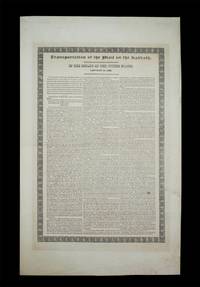
182969246Kentucky 1829. UNITED STATES CONSTITUTION; BROADSIDE. BROADSIDE. Transportation of the Mail on the Sabbath. In the Senate of the United States. Kentucky: 1829.<br> <br> Full Description:<br> <br> UNITED STATES CONSTITUTION. BROADSIDE. Transportation of the Mail on the Sabbath. In the Senate of the United States. Kentucky: January 19 1829.<br> <br> An important and interesting broadside supporting the separate of church in state in so as it applies to the delivery of mail on Sunday the Sabbath. Broadside folio 16 3/4 x 10 1/2 inches; 428 x 266 mm. With a caption title printed above three columns separated by rules. All within a decorative woodcut border. Mounted at the top edge within a portfolio mat. Some minor toning and a few small spots of dampstaining. A One and one half-inch closed tear at right-hand margin just touching the border. Overall very good.<br> <br> This is a significant document in the history of the United States Constitution in relation to the concept of the separation of church and state. Christian leaders demanded that the Government institution of the Postal Office not work on Sunday as their God had deemed this the Sabbath. The following document discusses that while many Christians observe the Sabbath on Sunday others including their Jewish neighbors observe the Sabbath on Saturday. Demanding that the government institution not work on Sunday for religious reasons goes directly against the Constitution. The report states "With these different religious views the committee are of opinion that congress cannot interfere.-It is not the legitimate province of the legislature to determine what religion is true or what false. Our government is a civil and not a religious institution. Our constitution recognizes in every person the right to choose his own religion and to enjoy it freely without molestation. Whatever may be the religious sentiments of citizens and however variant they are alike entitled to protection from the government so long as they do not invade the rights of others." It goes on to powerfully state "Extensive religious combinations to effect a political object are in the opinion of the committee always dangerous. This first effort of the kind calls for the establishment of a principle which in the opinion of the committee would lay the foundation for dangerous innovations upon the spirit of the Constitution and upon the religious rights of the citizens. If admitted it may be justly apprehended that the future measures of government will be strongly marked if not eventually controlled by the same influence. All religious despotism commences by combination and influence; and when that influence begins to operate upon the political institutions of a country the civil power soon bends under it and the catastrophe of other nations furnishes an awful warning of the consequence."<br> <br> The five-person committee for this report consisted of Richard Johnson of Kentucky who later went on to serve as the country's 9th vice president under Martin Van Buren as well as future President John Tyler of Virgina Ellis of Mississippi Silsbee of Massachusetts and Johnson of Louisiana.<br> <br> "The opening of post offices on Sunday led to a national debate about the relationship of the federal government to the Sabbath day. The argument which raged from 1810 to 1830 involved whether the national government would exist as a secular commercial republic committed to a separation of church and state or as a Christian commonwealth. The U.S. postmaster general Gideon Granger responded by persuading Congress in 1810 to pass legislation to open all 2300 post offices seven days a week and transport mail every day. Congress immediately began to receive petitions from numerous religious denominations urging repeal of the law. Under strong public pressure House and Senate committees formed to study the postal law. While the chair of the House committee waffled on the subject the head of the Senate committee swayed Congress to keep the law. Gen. Richard M. Johnson of Kentucky a devout Baptist wrote in the committee's 1829 report that congressional action to stop Sunday mail would be unconstitutional. Johnson reminded Americans that they had religious freedom and that government had no right to coerce the religious homage of anyone. The invention of the telegraph in 1844 ultimately spelled the end of Sunday mail. It was now possible to get market information without the mail system. By the 1850s postmaster generals were eliminating the movement of most mail on Sunday." Free Speech Center Caryn E. Neumann.<br> <br> HBS 69246.<br> <br> $1750. Kentucky unknown
18256784Paris: Dondey-Dupre Pere et Fils 1825. Hardcover — Tapa dura. 133x80mm. 5¼x3¼". Paris Dondey-Dupre Pere et Fils 1825. En 12º 133 x 80mm. 110 pp. 1 h. Encuadernación de la época en piel. Primera edición francesa. La Constitución Federal de los Estados Unidos Mexicanos de 1824 entró en vigor el 4 de octubre de ese año después del Imperio Mexicano de AgustÃn de Iturbide. En la nueva Constitución la República tomaba el nombre de Estados Unidos Mexicanos y era definida como una República Federal Representativa. Esta traducción francesa es rara en comercio. Dondey-Dupre Pere et Fils hardcover
18341215671834. First Edition. DORR Thomas Wilson. An Address to the People of Rhode-Island From the Convention Assembled at Providence on the 22nd Day of February and Again on the 12th Day of March 1834 to Promote the Establishment of a State Constitution. Providence: Cranston & Hammond 1834. Octavo period-style half diced calf gilt marbled boards pp. i-v 6-60. $2400.First edition of Dorr's foundational Address prompting his role as instigator and leader of the Dorr Rebellion placing him ""in the front rank of the political reformers of Jacksonian America.Born into privilege Rhode Island's Thomas Dorr became ""a political insurrectionary who hastened the demise of the royal charter of 1663 and the adoption of a written constitution"" Wiecek Peculiar Conservatism 242. Following the American Revolution by the 1820s Rhode Island remained the only state that clung to its colonial charter which ""restricted suffrage to white men who possessed real estate valued at a minimum of $134"" Chaput Proslavery and Antislavey Politics 662-63. It had ""evolved from the most to the least democratic state"" Lemons Rhode Island's Ten Turning Points 62. ""Dorr's political goals'free suffrage' with no discrimination against the foreign-born 'one-man one-vote' an independent judiciary a more powerful and dynamic executive the secret ballotthough not permanently achieved in Rhode Island during his lifetime placed him in the front rank of the political reformers of Jacksonian America"" ANB.In 1834 Dorr ""asked the General Assembly to call a convention to revise the state constitution in favor of taxpayer-militia suffrage and to adopt 'equal representation'"" Wiecek 242. In this major Address delivered at that convention and ""composed primarily by Dorr"" Conley Democracy in Decline 255 he states: ""No form of a Constitution can be worth much if in this State the Legislative power is in the hands of less than one third part of the qualified voters. A few political managers rule the whole State as they please against the will of two thirds of the freeman and three fourths of the people"" emphasis in original."" To Dorr the state's ""strange adherence to the charter"" left Rhode Island with an ""inequality of representation too unjust to be much longer tolerated."" In 1841 after Dorr was elected ""the People's governor"" under the state's ""People's Constitution"" he became the leader of the 1842 Dorr rebellion which historian Sean Wilentz calls ""'a striking and exceptional case in the history of American democratization before the Civil War' calling it no less than 'a deadly serious test of democracy's meaning and democracy's future.'"" The Dorr Rebellion increasingly viewed as the ""most significant political and constitutional event between the Age of Jackson and the election of Lincoln Dorr's constitutional understanding had roots not only in the Revolution and the post-Revolutionary era; it remained a vibrant part of American constitutionalism"" Chaput Rhode Island Question 55-56. Sabin 70537. American Imprints 26527. Text generally fresh with light scattered foxing. hardcover
200676537Washington DC: U. S. Government Printing Office 2006. Presumed First Edition First printing. Wraps. Good. Serial No. 109-103. 4 volume set. Volume I v 1 1453 5 pages. Volume II v 1. 1455-2388 2. Volume III v 1 2389-4296. Volume IV v 1 4297-5711 3 pages. Footnotes. Illustrations. The Subcommittee will be holding its tenth hearing examining the Voting Rights Act of 1965 and the temporary provisions that are to expire. They're set to expire in 2007 unless we reauthorize by Congress which I think most of us anticipate will occur. The Subcommittee examined each of the expiring provisions in great detail. This afternoon we examine the evidence of continued discrimination against racial and language minority citizens since 1982 that have been compiled by a number of non-governmental organizations who will be testifying. I'd thank these organizations for the time and effort that they have put into completing these reports and in making sure that this Committee and Congress has before it a complete and accurate record of discrimination over the last 25 years. In continuing to reauthorize the temporary provisions Congress on four separate occasions examined the extent to which discrimination continued to exist by analyzing information such as enforcement statistics minority voter registration rates minority voter turnout and litigation pursued to protect minority voting rights. Federal agencies such as the United States Commission on Civil Rights were instrumental in investigating analyzing and reporting back to Congress on the state of minority voting during each consideration. Each time Congress concluded based upon the evidence presented that the exceptional conditions which existed in 1966 continued to exist in 1970 1975 1982 and in 1992 when it was last reauthorized. This afternoon the Committee continues to examine whether the exceptional conditions warranting the extension of the temporary provisions continue to exist in 2006. U. S. Government Printing Office paperback
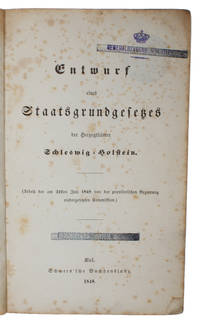
184859828Kiel Schmers'sche Buchhandlung 1848. 8vo. In the original blank blue wrappers. Provisional repair with tape to spine. Front-wrapper missing upper inner corner. Two stamps to half-title title-page and verso of title-page. Upper outer corner of half-title missing far from affecting text. Occassional brownspotting throughout. 34 pp. with a blank leaf inserted between every printed leaf giving a total of 33 ff. including the blanks. <br/><br/><em>The rare first printing of the drafting of the constitution by the provisional government for the Duchies of Schleswig-Holstein. In 1848 the Schleswig-Holsteiners decided to establish a provisional government and oust the Danish king. The subsequent war 1848-1851 achieved a status quo until a permanent solution between Denmark and Germany was reached in 1920. The 1848-1852 events in Schleswig-Holstein were a Danish-German confrontation. The underlying issues were complex: The kingdom of Denmark and the duchies of Schleswig and Holstein were component parts of the Danish Monarchy and were united in the person of the king/duke. Schleswig was a Danish fief Holstein a member of the German Confederation. A 1665 law introduced succession through the female line in Denmark with the survival of Salic law in the duchies held in abeyance. Schleswig had a strong Danish element in the north Holstein was German. "With the extinction of the male royal line in the offing Christian VIII declared in 1846 that the 1665 law applied to Schleswig and with some reservation to Holstein. Protests in the duchies had not been resolved when in the wake of the February revolution the liberals in Copenhagen took over and moved toward the annexation of Schleswig. In defiance the estates of Schleswig and Holstein set up a provisional government on March 24. Being composed of liberals and conservatives it obtained popular and official support in Germany and with Prussian military support gained control of most of the duchies by midsummer. But then Britain and Prussia intervened pressuring Prussia to make a truce with Denmark at Malmö August 26 1848 a truce which caused a parliamentary crisis in Frankfurt. In a short time Schleswig-Holstein had become the national issue and by acceding to the Malmö truce the Frankfurt Assembly severely damaged its political credit.Fighting resumed in 1849 and was ended by a July truce. After losing German military support the duchies were defeated in the 1850 campaign. The government abdicated on February 1 1851 and the Danish authorities took over a year later. In the final settlement the powers restored the Danish monarchy with the succession in the duchies to follow that of the kingdom Second London Protocol of May 8 1852. In separate notes the Danish government agreed to preserve the status of Schleswig and to abstain from steps leading to its incorporation. While the agreements restored the balance of power the relations between Danes and Germans suffered eroding popular sentiment for the Danish monarchy. Also Schleswig became a matter of outside concern permitting Prussian intervention in the case of Danish non-compliance." Ohio Univerty; Lawrence D. Steefel Sleswig-Holstein Question. </em> unknown
179276952Paris 1792. First French edition of the 1787 Federal Constitution in addition to the thirteen state constitutions the Declaration d'Independance Articles de Confederation; and several treaties. . old marbled wrappers with ms. paper labels on spines preserved in a utilitarian portfolio. . This was Kenneth Nebenzahl's copy with his book label inside the portfolio. An uncut copy in very attractive original condition. 8vo. Howes C-716. Translated and published at the suggestion of Benjamin Franklin who likely contributed footnotes. He wrote in late 1783: "The extravagant Misrepresentations of our Political State in foreign Countries made it appear necessary to give them better information which I though could not be more efectually and authentically done than by publishing a Translation into French." unknown
18501229871850. First Edition. CONSTITUTION SPOONER Lysander. A Defence for Fugitive Slaves Against the Acts of Congress of February 12 1793 and September 18 1850. Boston: Bela Marsh 1850. Octavo original wrappers; pp. 1-2 3-4. i-iv 5 6-72. $3200.First edition of the rogue abolitionist's provocative call for ""vigorous"" public resistance to a pattern in the 1793 and 1850 Acts and court decisions such as Prigg v. Pennsylvania that demonstrated the government's refusal ""to champion liberty or justice"" especially elusive in original wrappers.The 1850 Fugitive Slave Act ""exposed the futility of antislavery constitutionalism grounded in a commitment to the 'proper rules of interpretation'"" Knowles Seeing the Light 544. It ""evinced a clear congressional policy favoring harsh and summary enforcement of the rendition policy over any solicitude for procedural or substantive rights of alleged fugitives"" Cover Justice Accused 121. Spooner crafted his answer to this in a ""devastating critique"" of both the 1793 and 1850 laws Smith Lysander Spooner. Defence one of his most elusive and provocative works offers ""significant evidence of the ways in which the passage of the 1850 Fugitive Slave Act shook his faith in the ability of the nation's courts to interpret the constitution in a manner consistent with the dictates of natural justice"" Knowles 546. Closely analyzing ""reasons why the 1793 and 1850 laws were unconstitutional he made it very clear why the passage of the 1850 law pushed him away from the 'quiet argument' of the courtroom to 'more vigorous'"" public action. In Defence while he continued to argue the importance of ""procedural objections to the laws Spooner spent far greater time 1 explaining why the courts would not actually strike down either of the laws and 2 outlining 'The Right of Resistance': ways in which 'The People' could respond to what he now recognized as the 'ugly reality' of proslavery constitutionalism."" He notably pointed to ""the 1842 decision in Prigg v. Pennsylvania in which the Supreme Court held that under the Constitution's Supremacy Clause the 1793 Fugitive Slave Act trumped Pennsylvania's personal liberty law which had made it far more difficult for slaveholders to recover individuals they alleged were fugitive slaves In the face of this judicial reality and to ensure the 'maintenance' of the Constitution Spooner encouraged popular resistance"" arguing the Second Amendment ""gave 'The People' an absolute and unqualified' Constitutional 'right' to do so."" By 1860 he would utterly lose ""faith in the ability or willingness of the government especially the courts to champion either liberty or justice"" Knowles 545 552. First edition: as issued with printing of 1793 Act of Congress and 1850 Fugitive Slave Act preceding title page; front and rear wrapper interior with publisher's advertisements. Sabin 89607. Work 335. Text very fresh a few minor stains to front wrapper expert repairs to wraps on the spine. Near-fine. paperback
16821206631682. CONSTITUTION SOMERS John. The Security of English-Mens Lives Or the Trust Power and Duty of the Grand Jurys of England. London: Printed for Benj. Alsop 1682. Small octavo 4 by 6-1/2 inches 18th-century brown morocco raised bands marbled endpapers all edges gilt; pp. 1-2 3-168. $3400.1682 edition of Somers' profoundly influential work on the power of the grand jury the second of only two 17th-century editions issued the year after the first""one of the fundamental foundations of the common law in the American colonies""prompting revolution with Somers' invoking the grand jury and its protection of secrecy as key in opposing ""corrupt Ministers of State"" and those who ""abuse or oppress the People in the form and course of Justice"" seminal in the creation of the Constitution's Fifth Amendment with Jefferson calling grand juries ""the true tribunal of the people.""British statesman Baron John Somers' most famous and influential work is Grand Jurys. ""Of the legal scholars writing about the grand jury in the late 17th century Somers is not only representative but eminent having been read in both England and the colonies"" Kadish Behind the Locked Door 5-10. Grand Jurys is considered a seminal influence on Locke and America's Founding Fathers and it is ""likely that Locke knew Somers by the early 1680s The opposition of absolute monarchy to the security provided by 'impartial law' was structurally central to Locke's Second Treatise 1689 which attacked the threat to life liberty and property posed by a loss of 'impartial justice' Locke's arguments are a logical extension of the arguments that juries provided the only security of life"" Marshall John Locke 52. To Somers similarly the grand jury offers ""security"" from the ""Ill Designs of corrupt Minsters of State"" and those who ""dare to abuse or oppress the People."" Somers' Grand Jurys is ""a classic statement of political freedom. He works his way through a number of themes that will be frequently repeated by others."" Chief among these is his argument that ""the independent grand jury is the linchpin of the entire criminal justice system. It brings offenders to justice and protects the innocent from false accusation guaranteeing the traditional rights of Englishmen particularly their political rights in relation to the Crown and joins Parliament as a counterweight to the arbitrary power of the monarch and his judges"" Shapiro Beyond Reasonable Doubt 67. With its origins found deep within English legal history the grand jury was ""eulogized by Coke and Blackstone and crossed the Atlantic as one of the fundamental foundations of the common law in the American colonies"" Roots If It's Not a Runaway. ""Indeed there is an important sense in which the jury issue united not only America's revolutionary period and Founding era but also the 'settlement' years immediately following 1789"" Stimson Juries and American Revolutionary Jurisprudence 34-5.As American ""opposition to the British became more overt grand juries became more sympathetic to the colonists the famous case of John Peter Zenger is a prime example as two separate N.Y. grand juries refused to indict him for criminal libel. Further in 1765 a Boston grand jury refused to find an indictment against the leaders of the Stamp Act Riots"" Paule Perversion of the Historic Function 304. ""Perhaps the best known case of grand jury independence involved the twice-unsuccessful efforts to indict former Vice President Aaron Burr for attempting to involve the U.S. in a war with Spain Burr was finally indicted when a grand jury was convened in Virginia the stronghold of Burr's enemy Thomas Jefferson. Despite Jefferson's best efforts Burr was acquitted at trial in part because the judge gave such a narrow jury instruction and made evidentiary rulings so favorable to the defense that conviction was nearly impossible. The trial judge was John Marshall one of Jefferson's rivals"" Leopold Why Grand Juries 286.""The framers of the Constitution perceived the function of the grand jury as so essential to liberty that they specifically provided for it"" in the Fifth Amendment Paule 305. ""With its Grand Jury Clause insuring that 'no person shall be held to answer for a capital or otherwise infamous crime unless on a presentment or indictment of a Grand Jury' the Clause protected the people against arbitrary and overzealous government by protecting 'against hasty malicious and oppressive prosecution.' Secrecy in grand jury proceedings played a role in that protection."" For Somers in particular the secrecy requirement was absolute. In Grand Jurys he describes ""how grand jurors were sworn not to disclose the subjects of the inquiry the witnesses or any of the evidence. In addition grand jurors were sworn not to reveal their own personal knowledge the knowledge of their fellow jurors their investigative plans or their deliberations according to Somers secrecy made possible the discovery of truth and protected individuals from malicious or hateful prosecution. In sum neither the king the general public nor the individual accused could benefit by making public the proceedings of a grand jury. The Grand Jury Clause of the Fifth Amendment made grand jury secrecy an implicit part of American criminal procedure"" Kadish 5-16. ""In a petition to the General Assembly of the Commonwealth of Virginia Jefferson once termed the Anglo-Saxon tradition of trial by grand and petit jury 'the true tribunal of the people'"" Shannon Grand Jury 141. Jefferson owned and held two other works by Somers in his library. Preceded only by the 1681 first edition. Anonymously issued with Wing identifying Somers as author. Precedes the 1773 American edition. Pages 156-167 containing Latin and English text printed on opposite pages; final text page with ""Finis."" ESTC R10363. Wing S4643. Sweet & Maxwell I:378 34. See Sowerby 2015 2712. Early owner signature above title page.Text very fresh expert restoration to handsome binding. A very good copy. hardcover
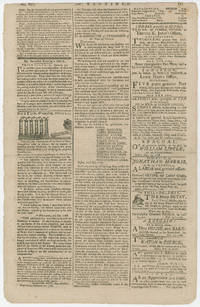
178824836Boston MA 1788. No binding. Condition: Fine. Massachusetts Centinel illustrator. Newspaper. Massachusetts Centinel February 13 1788 Volume VIII pp. 171-174. Boston: Benjamin Russell. 4 pp. 9 5/8 x 14 7/8 in. This newspaper is replete with Constitution-related content including minutes from the debates of Massachusetts' State Ratifying Convention - everything from discourse on standing armies to Fisher Ames' hearkening back to 1775 with "WE MUST UNITE OR DIE"; a poem to Washington on his birthday; a fictional dialogue The Federal Anti-Federalist Returned to His Neighbours; a rare example of one of Benjamin Russell's famed 'Pillars' illustration series; and a great deal of reporting on the popular reception of the news of ratification expressed in particular by an enormous parade and surrounding celebrations. The Massachusetts Centinel employed the Federal Pillars political imagery to announce the ratification of the Constitution by successive states. In this issue the Centinel announces the pending ratification by New Hampshire. "This day the Convention of the State of New Hampshire meet at Exeter for the purpose of erecting another PILLAR to support the great Federal Superstructure; by ratifying the proposed Constitution." On February 6 1788 Massachusetts ratified the United States Constitution by a vote of 187 to 168 the sixth and largest state to do so. Two days later the people of Boston engaged in a grand procession led by the "Mechanicks" and Tradesmen of Boston "to express their approbation of the conduct of the Gentlemen who represented this town in the late Convention" p3/c2. A sampling of the groups of marchers most of whom carried implements and tools of their professions festooned for the occasion as detailed here p4c1-2: 73 Blacksmiths; 43 Shipwrights; 75 Rope-makers with part of a rope-walk on a sled and martial music; 30 Mast-makers; 36 Sail-makers; 34 Ship-joiners; 30 Block-makers pulley makers; 6 Mathematical Instrument Makers makers of navigation equipment etc.; 53 Coopers; 20 Boat-builders; 6 Pewterers; 40 Bakers 50 Shoe-makers; 56 Taylors; 26 Hatters; 20 Ship-builders; 136 Carpenters; 70 Masons; 30 Wheelwrights; 15 Printers; as well as a dozen other tradegroups such Bookbinders; Goldsmiths and Jewelers Saddlers Tobacconists Tanners Curriers Leather-dressers Cabinetmakers Carvers Painters Tinsmiths Coppersmiths and 250 of the "principal merchants in the town." Toward the middle of this assemblage thirteen horses pulled the ship "FEDERAL CONSTITUTION" manned by a crew of thirteen. A subtext of much of this was an emphasis on domestic manufactures as well as a celebration of Boston's power and potential in maritime trade.At this event "WE THE PEOPLE" of Boston "in GRAND PROCESSION MOVING" passed an ordinance to rename Long Lane as Federal Street in commemoration of the site where the convention had sat. The ordinance concluded "GIVEN under our auspices.the FIRST YEAR of OUR real political federal existence.GOD SPEED THE CONSTITUTION!" p1/c1. That night a long boat called "the Old Confederation" which had been exhibited during the parade was drawn to the Common and condemned "as unfit for any further service." The boat was immediately burned "in presence of an applauding concourse of citizens" p3/c2. On February 12 the twelve delegates who represented Boston in the ratifying convention including John Hancock and Samuel Adams responded to the procession in a letter to "the Committee of Tradesmen of the Town of Boston." Excerpt: "We endeavoured that our conduct in the late Convention should be governed by the magnitude of our subject:-And after the most mature deliberation we severally decided according to the best light of our understandings and the dictates of our consciences." "We are happy to find that our decisions have so fully corresponded with the sentiments and wishes of our constituents."
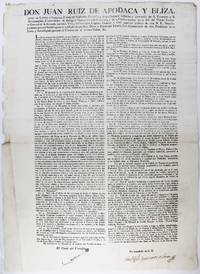
18203330Mexico City: July 11 1820. About very good. Large double-sheet broadside approximately 23.5 x 17 inches. Two sheets joined at central horizontal fold. Five chips at left edge not affecting text and some additional minor edge wear; otherwise light toning and dust soiling. Two contemporary manuscript signatures at foot; contemporary duty stamps on blank verso. Fascinating and otherwise unrecorded broadside that dictates the organization and process for the 1820 election of Mexican deputies to the Spanish Cortes during the second and last period of constitutional monarchy in Mexico. Colonial Mexico first achieved some representation in the Spanish government under the liberal Constitution of 1812 which lasted for two years before being revoked by Ferdinand VII upon his return to power in 1814. The reinstatement of the liberal constitution and the Cortes of Cadiz in 1820 however was not enough to prevent Mexico from obtaining full independence one year later. This broadside promulgated in Mexico on July 11 1820 by the colonial Viceroy Juan Ruiz de Apodaca y Eliza announces the renewed representation via regional elections to select Provincial Deputies for the Cortes and contains eight articles delineating the process by which these elections are to be held. In brief these articles order representation be apportioned according to the population as approximated from the 1792 census; divides Mexico into provinces for the purposes of the election; and places parameters on representation for each province. In all a very interesting window onto the formation of the brief final period of Spanish colonial rule in Mexico. July 11 unknown
18651260191865. First Edition. CONSTITUTION. Journal of the House of Delegates of the State of Virginia. for the Session of 18645. Alexandria: D. Turner 1865. Octavo original front printed wrapper respined renewed rear wrapper original string stitching; pp. 1-3 4-83 1. Housed in a custom chemise and clamshell box. $4500.First edition one of 500 copies of the momentous Journal featuring its February 9 1865 entry on the Alexandria Virginia government's passage of the 13th Amendment mere days after the U.S. Congress the first of the four Unionist southern states to pass the Amendment also featuring the governor's Message noting: ""though we have in inherited from our fathers of the revolution the blessings of a great nation yet they also left to us an inheritance of African slavery which has proved a bitter dreg in our cup of freedom"" a vital record of forces for constitutional change near the end of the Civil War.Soon after the 1860 election amidst southern secession ""the great questions of union or disunion war or peace hung in the balance. Probably the crucial weight on the scale was Virginia as long as the federal government did not seek to coerce the states Virginia secessionists were unable to achieve a majority. When Lincoln responded with force to the attack on Fort Sumter however the vote in Virginia went in favor of secession."" Subsequently a Virginia convention ""met in Wheeling on May 13 1861 it elected as Governor Francis Pierpont a western Virginian and ardent Unionist and arranged for the creation of a legislature to replace the body sitting in Richmond in July 1861 the new legislature met at the 'Restored Virginia' capital of Wheeling in a special session called by Pierpont."" Against its ""claim to represent a majority of Virginians"" a new state of West Virginia was created in 1863 and Pierpont's government moved to Alexandria to govern areas of Virginia under Union occupation Harrison Lawfulness of the Reconstruction Amendments 380-83.Scholars observe that the 13th Amendment its fellow amendments and Reconstruction as ""both a political process made possible by military successes and constitutional thought grew from wartime as well as post-Appomattox developments"" Hyman and Wiecek Equal Justice 247. This rare first edition of Journal of the House of Delegates substantiates that in documenting passage of the 13th Amendment by Pierpont's Virginia government mere days after the U.S. Congress passed the Amendment on January 31 1865. With that Virginia became the first of the four Unionist southern states that ratified the 13th Amendment. Of those Louisiana followed on February 17 with Arkansas and Tennessee that April. The 13th Amendment is the focus of the Journal's entry for February 9 1865 which states: ""Mr. Brownley called up Senate bill No. 12 entitled 'An Act to ratify the joint resolution of Congress passed January 31 1865 proposing an amendment to the Constitution of the United States.' The bill was read the first and second time and the rules were suspended and the bill read the third time and the bill passed."" Also notable herein is the complete printing of Governor Pierpont's opening Message where he notes: ""though we inherited from our fathers of the revolution the blessings of a great nation yet they also left to us an inheritance of African slavery which has proved a bitter dreg in our cup of freedom."" He speaks at length of the rights due people of color and the abolition of laws such as those that prohibit ""negro testimony"" or proscribe a ""different punishment for persons of African dissent"" from that of ""white persons.""""The legislature met for its second session on December 5 1864 The governor's message was a long and important document and indicated the changes of opinion that the war was bringing about. Pierpont gave his views upon the all-important negro question. He congratulated the constitutional convention which had met in the spring on the abolition of slavery in Virginia and advocated sweeping changes in the laws concerning negroes. The act prescribing different punishments for blacks should he said be altered in accordance with the amended constitution as well as the law for apprenticing them. The law prohibiting the education of negroes should be abolished His language was on the whole very moderate. He advised the legalizing of the marital relations of negroes and most important the establishment of public schools Notwithstanding the governor's advice no acts of great importance passed the legislature On February 9 1865 the assembly ratified the 13th Amendment to the Constitution of the United States. It adjourned on March 7"" Eckenrode Political History of Virginia During the Reconstruction. Faint ""U.N.C. Duplicate"" stamp to front wrapper.Text fine; just a bit of faint soiling and a tide line to fragile front wrapper. An excellent copy of this elusive item. unknown
1791262411Paris: Baudoin 1791. hardcover. near fine. 2 37 4 4 151 82 pages. 12mo handsomely bound in full contemporary mottled calf chipped at top of spine; gilt-stamped spine with leather spine labels; marbled end-papers. Paris: Baudouin Imprimeur de L'Assemblee Nationale 1791.<br/> <br/> First written constitution of France. Many different printings appeared within days of the original folio edition this is likely the first 12mo edition. Included in this volume with separate paginations are: Message du Roi a l'Assemblee 13 Set. 1791; Discours et Serment du Roi. 14 Sept 1791; La Declaration des Droits de L'Homme et du Citoyen Includes comparison of the laws of many peoples ancient and modern and particularly the declarations of different American states Paris l'an troisieme de la liberte. Also Bound-in is another copy of the Declaration des Droits de l"Homme Paris: Chez Baudoin 1790.<br/> <br/> Baudoin unknown
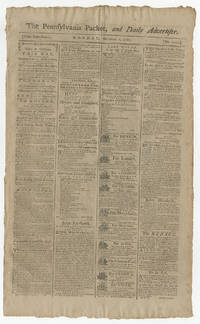
178724135<p><b>U.S. CONSTITUTION.</b>Newspaper. <i>The Pennsylvania Packet and Daily Advertiser</i>. October 1 1787 No. 2700 Philadelphia: John Dunlap and David C. Claypoole including the September 28 resolution of the Confederation Congress to send to the states for ratification the recently completed U. S. Constitution. 4 pp. 12 x 18¾ in. </p><br />"<i>The United States in Congress Assembled. Friday September 28 1787.</i><p><i>CONGRESS having received the Report of the CONVENTION lately assembled in Philadelphia</i></p><p><i>Resolved unanimously THAT the said report with the resolutions and letter accompanying the same be transmitted to the several legislatures in order to be submitted to a convention of delegates chose in each state by the people thereof in conformity to the resolves of the convention made and provided in that case. CHARLES THOMSON Secretary.</i>" p2/c3</p><p>The convention called to revise the Articles of Confederation met in the Pennsylvania's State House in Philadelphia starting on May 25 1787. After many delegates agreed that the Articles could not be sufficiently improved they started to draft an entirely new structure. Maintaining their pledge of secrecy after months of private deliberations over trade defense taxation representation separation of powers the election of a president the slave trade international relations and many other issues the proposed United States Constitution was signed by thirty-nine of the fifty-five delegates on September 17.</p><p>Two days later the Constitution was first published by the <i>Pennsylvania Packet</i>and four other Philadelphia newspapers. The cover letter sent by George Washington president of what came to be called the Constitutional Convention submitting the plan to Arthur St. Clair the President of the Congress of the Confederation in New York was also printed then.</p><p>Congress received and read the proposed Constitution on September 20th. As a sampling of their deliberations William Grayson of Virginia thought it was too weak while Richard Henry Lee of Virginia and Nathan Dane of Massachusetts thought it was too strong.</p><p>On September 27 Virginia's Richard Henry Lee proposed that the Constitution be sent to the executives of each of the states. A Delaware representative quickly added "in order to be by them submitted to conventions of delegates to be chosen agreeably to the said resolutions of the convention." Ten of the twelve states then represented in Congress voted in favor. Before Congress adjourned for the day the majority of Virginia's representatives and a minority of New York's representatives also indicated their support. On September 28 Federalists holding out for a unanimous vote found a way to compromise with anti-Federalists: Congress unanimously resolved to send the Constitution to the states but without any recommendation or approval.</p><p>Arider from New York City arrived in Philadelphia with the resolution that same day.</p><p>George Clymer presented his own resolution to the Pennsylvania Assembly noting that "<i>the late Federal Convention has digested a plan of government for the United States and recommended that it should be referred to the consideration of State Conventions…</i>" After a "<i>very long and animated debate</i>" Clymer's resolution passed by a vote of 43 to 19 and adjourned until 4:00 p.m. But only 44 members returned falling two shy of the necessary quorum. The Assembly's sergeant-at-arms was sent to show the resolution to absent members. Two who still refused to attend were seized by the public dragged through the streets and thrust into the assembly room. The involuntarily completed quorum voted that "<i>it is the sense of great numbers of the grand people of this state already signified in petitions & declarations to this house that the earliest steps should be taken to assemble a convention within the state for the purpose of deliberating and determining on the said constitution.</i>" They called for the election of deputies who would assemble for that purpose "<i>on the third Tuesday of November at the State-house in the city of Philadelphia…</i>" p2/c3-4</p><p>Other articles of interest in this issue include news from Europe and a brief piece against Indians "<i>from the western country</i> who <i>still continue their depredations on the whites…</i>" p2/c3</p><p><b><i>The Pennsylvania Packet or the General Advertiser</i></b>1771-1839 was founded by John Dunlap in late 1771 as a weekly newspaper in Philadelphia though it relocated to Lancaster during the British occupation of Philadelphia in 1777-1778. On May 30 1783 Benjamin Towne turned the <i>Pennsylvania Evening Post</i> into the first daily newspaper in the United States. However with Towne branded a traitor and forced to hawk his own papers on the street the newspaper collapsed the following year. John Dunlap and David Claypoole then made their <i>Pennsylvania Packet</i> the first successful daily on September 21 1784. It underwent numerous name changes in the 1790s until sold in 1800 and renamed <i>Poulson's American Daily Advertiser</i>.</p> John Dunlap and David C. Claypoole
178769121London: Sold by T. Wilkie 1787. UNITED STATES CONSTITUTION. The London Chronicle "The New Plan for the Constitution of the United States of America". Vo. LXII. No. 4834-4835. From Saturday October 27 to Tuesday October 30 1787 and From Tuesday October 30 to Thursday November 1 1787. Pages 409-424. London: Sold by T. Wilkie 1787.<br> <br> Likely the first public printing of the United States Constitution in England. This newspaper printing precedes the know first edition pamphlet published by Debrett as well as the first magazine printing in "The Gentleman's Magazine." It is broadly stated that news of the United States Constitution hit England early in November however the dates of the Chronicle precede this by a few days. This copy also contains the preliminary cover letter from George Washington to the president of Congress which is usually included with early printings of the Constitution and which states Washington's strong support of ratification. "The Plan" is printed in its entirety without comment or explanation from the publisher.<br> <br> Together two issues no. 4834 and 4834. Each issue self bound along left margin. 11 3/8 x 8 5/8 inches; 288 x 222 mm. Number 4834 is four leaves pages 409-416 and number 4835 is four leaves pages 417-424. The first part of the Constitution is printed on pages 413-414 of the first part with the end stating "To be concluded in our next" and the second part is printed on pages 420-421. Both issues very good with just some slight toning. Page 421-422 trimmed close at top margin just touching header. A small red stamp on verso of first leaf of each issue along bottom margin. Overall about fine. We could find no other copies of this or any earlier British newspaper containing the US Constitution on Rare Book Hub. We could not locate any copies on OCLC or ESTC. Housed in a custom quarter red morocco clamshell.<br> <br> At the time of the Constitutional Convention John Adams was living in England as a diplomat. In a letter to John Adams from Elbridge Gerry dated September 20th 1787 just one day after the first newspapers in America printed the Constitution he states "The proceedings of the Convention being this day published I embrace the Oppertunity of transmitting them by a Vessel which is to sail this morning for London." According to the National Archives "Gerry enclosed a copy of the new U.S. Constitution. Gerry likely sent this letter to John Adams via the Prince George Capt. Strong which departed New York City in late September and arrived in London on 3 Nov. New York Independent Journal 1 Sept. 1787 2 Feb. 1788." This shows that it would have been impossible for news of the Constitution to arrive in England much before this date of November 3rd. Lengthy searches turn up no indication that any other British publication has a copy of the US Constitution before this London Chronicle printing. The National Archives go on to state "The U.S. Constitution was adopted on 17 Sept. 1787 and British newspapers first published the text in late autumn. The London Chronicle printed the preamble and the first article in its 27-30 Oct. issue and the remaining articles and signatures in its 30 Oct. - 1 Nov. issue. "<br> <br> The London Chronicle was a thrice weekly newspaper also known for being " one of the first to break the news that the United States had declared independence from the British Empire reporting on the event in its 13 August 1776 edition. It was also one of the first to publish the declaration in its entirety in the 15-17 August 1776 edition but containing no explanation or comment as to what it was" Wikipedia. This holds true for their publication of the Constitution as well.<br> <br> United States Constitution now the longest continuing charter of a national government in the world and "the product of a revolution in political thought at least as important and far-reaching as the winning of American independence from Great Britain and the culmination of the intellectual ferment and political experimentation in the new republic" Richard B. Bernstein Are We to Be a Nation.<br> <br> HBS 69121.<br> <br> $20000. Sold by T. Wilkie unknown