Livre Rare Book
123 résultats
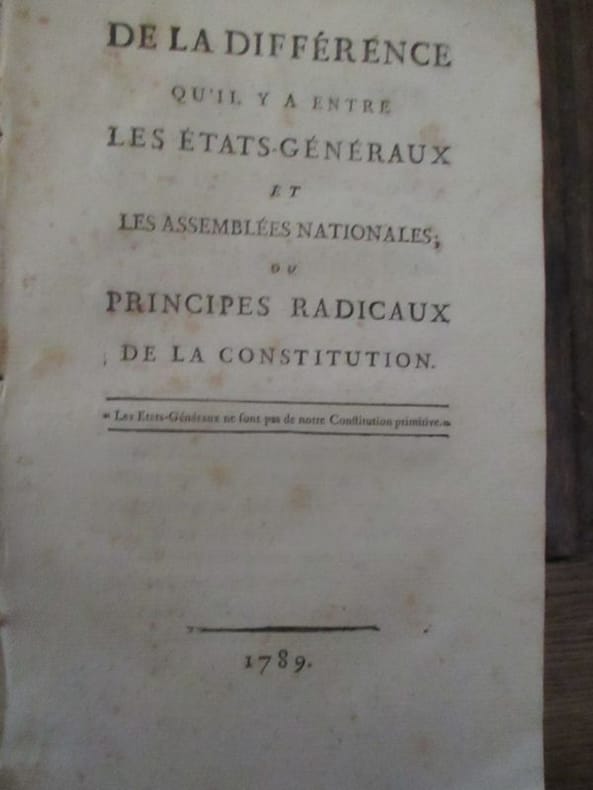
178978151789 Sans lieu 1789 In8 broché 41 pages
1791109661791 Un volume in-8 pleine veau, dos à nerfs orné de fleurons dorés, pièce de titre en maroquin rouge, roulette dorée sur les coupes. Recueil de plaquettes de 1791 imprimées à Paris principalement, concernant la Constitution Civile du Clergé. Infimes manques aux coiffes, bel exemplaire.
1791117509Didot jeune 1791 A Paris, De l'Imprimerie de Didot jeune, 1791, 1 volume in-quarto de 170x265 mm environ, VII, 118 pages. Reliure postérieure, demi chagrin vert bouteille, dos à cinq nerfs portant titres et tomaisons dorés, fers dorés, gardes marbrées. Menus frottements sur le dos, mors interne fendillé, coins frottés, des rousseurs, bon état général malgré les défauts signalés.
1776230861776 Paris c impr. de C. Simon d 1776 ,in 12 , XXIV-402 pages,pleine Basane marbrée , dos à nerfs richement orné . Reliure de l'époque . Très beau frontispice ( portrait du Frère Jean du Houssaie , mort en odeur de sainteté en 1609 ) .
1771CCC-151944. Edition 1771, reliure ( frottée) demi-chagrin marron. Des annotations au stylo dans le texte. 71 pages, coins émoussés, tranches rouges
1783480681Turin, J. M. Briolus, 1783. 4to. 4 Bl., 378 S. Defekte Interimskartonage d. Zeit.
1800374113Hudson: Printed and sold by Ashbel Stoddard 1800. 36pp. Some interleaving with contemporary manuscript annotations recording weather deaths etc. 12mo. Stitched final leaf trimmed close with minor loss to final line on H2r staining and chipping at fore-edge other minor chips and tears. 36pp. Some interleaving with contemporary manuscript annotations recording weather deaths etc. 12mo. With a printing of the U.S. Constitution and the Bill of Rights on the final 12 pages. This almanac calculated by Beers Hutchins died in 1782. Evans 37670; ESTC W33544; Drake 6126 Printed and sold by Ashbel Stoddard unknown
1787365066Philadelphia: Seddon Spotswood Cist and Trenchard 1787. 3 618-674. Without 2 plates. 8vo. Disbound fire damage at edges leaves detached. 3 618-674. Without 2 plates. 8vo. Along with a printing in the American Magazine among the earliest printings of the Constitution in a periodical. "One of the best of the eighteenth century magazines was the Columbian of Philadelphia. Considered from beginning to end the Columbian Magazine with its sequel the Universal Asylum affords an extremely valuable treasury of materials which reflect its own times and the war years immediately preceding. it was the handsomest American magazine of its century" Mott. Seddon, Spotswood, Cist and Trenchard unknown
1793307937En Suisse, 1793. XVI, 286 S. Späteres Bibliothekshalbleinen.
175495953Paris, Herissant, 1754. 6 Bl., 721 S. Leder d. Zeit (berieben u. stärker bestoßen, Gelenke eingerissen). [2 Warenabbildungen]
1774125857(Rostock), 1774. 4to. 68 S. Rückenfalz.
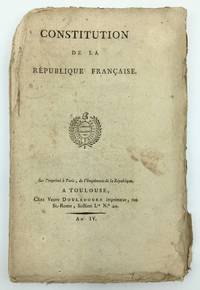
17951507Toulouse: Douladoure. An. IV. 1795. Octavo. Stitched without wrappers likely as issued. Page edges untrimmed. Woodcut device emblematic of the French Republic to the title page. 62pp. A good copy with nibbling/loss to the top left-hand corner not affecting the text and a few minor marks to the title page and rear blank verso. The contents remain clean and in very good order. A scarce provincial printing of the Constitution of the Year III Constitution de l'an III the constitution of the French First Republic which established the Directory regime following the fall of Robespierre.</p><p>Adopted by the convention on 5 Fructidor Year III 22nd August 1795 and approved by plebiscite on 6th September its preamble formed the Declaration of the Rights and Duties of Man and of the Citizen of 1789. Largely the work of political theorist Pierre Daunou it established a bicameral legislature made all taxpaying French males over 25 eligible to vote in primary elections enfranchising around one million more citizens than the 1791 Constitution and contained an explicit ban on slavery.</p><p>It remained in effect until the coup of 18 Brumaire 9th November 1799 which effectively ended the Revolutionary period and began the rise to power of Napoleon Bonaparte. </p><p>A pleasing unsophisticated copy remaining in the same form as it would have been when it reached the hands of ordinary Frenchmen in year that it was issued. Toulouse: Douladoure. unknown
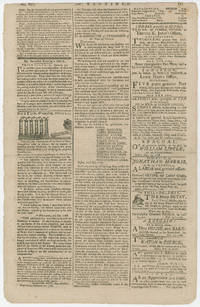
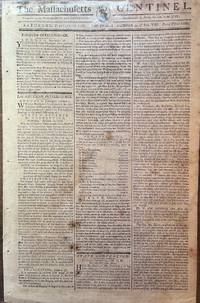
178824836Boston MA 1788. No binding. Condition: Fine. Massachusetts Centinel illustrator. Newspaper. Massachusetts Centinel February 13 1788 Volume VIII pp. 171-174. Boston: Benjamin Russell. 4 pp. 9 5/8 x 14 7/8 in. This newspaper is replete with Constitution-related content including minutes from the debates of Massachusetts' State Ratifying Convention - everything from discourse on standing armies to Fisher Ames' hearkening back to 1775 with "WE MUST UNITE OR DIE"; a poem to Washington on his birthday; a fictional dialogue The Federal Anti-Federalist Returned to His Neighbours; a rare example of one of Benjamin Russell's famed 'Pillars' illustration series; and a great deal of reporting on the popular reception of the news of ratification expressed in particular by an enormous parade and surrounding celebrations. The Massachusetts Centinel employed the Federal Pillars political imagery to announce the ratification of the Constitution by successive states. In this issue the Centinel announces the pending ratification by New Hampshire. "This day the Convention of the State of New Hampshire meet at Exeter for the purpose of erecting another PILLAR to support the great Federal Superstructure; by ratifying the proposed Constitution." On February 6 1788 Massachusetts ratified the United States Constitution by a vote of 187 to 168 the sixth and largest state to do so. Two days later the people of Boston engaged in a grand procession led by the "Mechanicks" and Tradesmen of Boston "to express their approbation of the conduct of the Gentlemen who represented this town in the late Convention" p3/c2. A sampling of the groups of marchers most of whom carried implements and tools of their professions festooned for the occasion as detailed here p4c1-2: 73 Blacksmiths; 43 Shipwrights; 75 Rope-makers with part of a rope-walk on a sled and martial music; 30 Mast-makers; 36 Sail-makers; 34 Ship-joiners; 30 Block-makers pulley makers; 6 Mathematical Instrument Makers makers of navigation equipment etc.; 53 Coopers; 20 Boat-builders; 6 Pewterers; 40 Bakers 50 Shoe-makers; 56 Taylors; 26 Hatters; 20 Ship-builders; 136 Carpenters; 70 Masons; 30 Wheelwrights; 15 Printers; as well as a dozen other tradegroups such Bookbinders; Goldsmiths and Jewelers Saddlers Tobacconists Tanners Curriers Leather-dressers Cabinetmakers Carvers Painters Tinsmiths Coppersmiths and 250 of the "principal merchants in the town." Toward the middle of this assemblage thirteen horses pulled the ship "FEDERAL CONSTITUTION" manned by a crew of thirteen. A subtext of much of this was an emphasis on domestic manufactures as well as a celebration of Boston's power and potential in maritime trade.At this event "WE THE PEOPLE" of Boston "in GRAND PROCESSION MOVING" passed an ordinance to rename Long Lane as Federal Street in commemoration of the site where the convention had sat. The ordinance concluded "GIVEN under our auspices.the FIRST YEAR of OUR real political federal existence.GOD SPEED THE CONSTITUTION!" p1/c1. That night a long boat called "the Old Confederation" which had been exhibited during the parade was drawn to the Common and condemned "as unfit for any further service." The boat was immediately burned "in presence of an applauding concourse of citizens" p3/c2. On February 12 the twelve delegates who represented Boston in the ratifying convention including John Hancock and Samuel Adams responded to the procession in a letter to "the Committee of Tradesmen of the Town of Boston." Excerpt: "We endeavoured that our conduct in the late Convention should be governed by the magnitude of our subject:-And after the most mature deliberation we severally decided according to the best light of our understandings and the dictates of our consciences." "We are happy to find that our decisions have so fully corresponded with the sentiments and wishes of our constituents."
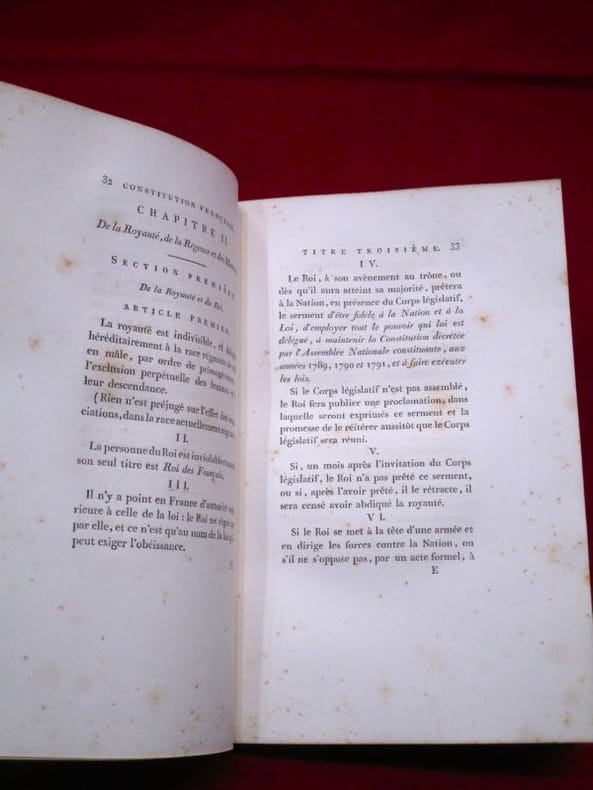
179116684reliées en un volume in-24 (91x56mm), veau marbré, dos lisse à faux nerfs, décors et titre dorés, roulette décorative d'encadrement, roulette sur les coupes, tranches jaunes (reliure du tout début du XIXe) ; 1- La Constitution Française, décrétée par l'Assemblée Nationale Constituante, aux années 1789, 1790 et 1791 ; acceptée par le Roi le 14 septembre 1791. Paris, imprimerie de Didot Jeune, chez Garnery, 1791 ; 160 pp. (Précedée de la Déclaration des Droits de l'Homme et du Citoyen ; en 17 articles). 2- Acte Constitutionnel, décrété par la Convention nationale de France, en 1793, et présenté à l'acceptation du Peuple Français ; précédé du Rapport fait sur ce sujet, par Hérault-Séchelles, membre du corps constituant. Paris, Lepetit, 1793 (imprimerie de Rochette) ; 96 pp. Contient le Rapport sur la Constitution du peuple français, la Déclaration des Droits de l'Homme et du Citoyen (en 35 articles), la Constitution Républicaine. 3- Constitution de la République Française. Paris, chez Et. Gidde, imp. de Crapelet, an IV (1795) ; 159 pp. 4- Constitution de la République Française, avec les lois organiques. Paris, imp. de Munier ; chez Lepetit, jeune, an VIII ; 63 pp.
170428809le croisic 1704 1 document de 4 pages (1 feuillet plié en deux) manuscrites à l'encre brune sur papier vergé ligné et filigrané " , format : 33 x 21 cm, signature in-fine : Chessée, Notaire royal à guerande) , QUITANCE DE FRANCHISSEMENT POUR LE SIEUR JULIEN RIELLE, MAITRE DE BARQUES, VEUF DE JEANNE RENEE LARAGON, PORTANT CONSTITUTION D'UNE RENTE AU PROFIT DE SES HONORABLES BELLE-FILLES : JEANNE ET CATHERINE MICHEL, DE CINQ CENT LIVRES DE PRINCIPAL, FAIT AU CROISIC, LE 30 OCTOBRE 1704,
176011598Lyon, P. Valfray, 1760 ; 2 parties en 1 volume in-12 ; plein veau blond moucheté, dos à cinq nerfs orné d'une colombe dorée répétée, pièce de titre en maroquin rouge, triple filet doré d'encadrement des plats, armes dorées au centre, roulette décorative dorée sur les coupes, tranches rouges ; XIX, (5) de table, 241, 76 pp.
179124532Paris MERCURE DE FRANCE 1791 -in-12 broché un journal (original d'époque), broché bleu-gris in-douze Editeur (paperback duodecimo editor)(19 x 11,5 cm), dos muet, couverture imprimée en noir, brochure d'origine non rognée, texte imprimé sur papier velin, ligné et filigrané, sans illustrations (no illustration), mouillures anciennes, couverture fanée, pagination (17ff. chiffrées de la page 123 à la page 156 et 41 ff. chiffrées de la page 253 à la page 336), Journal du samedi 24 Septembre 1791 (n°39) Paris MERCURE DE FRANCE Editeur,
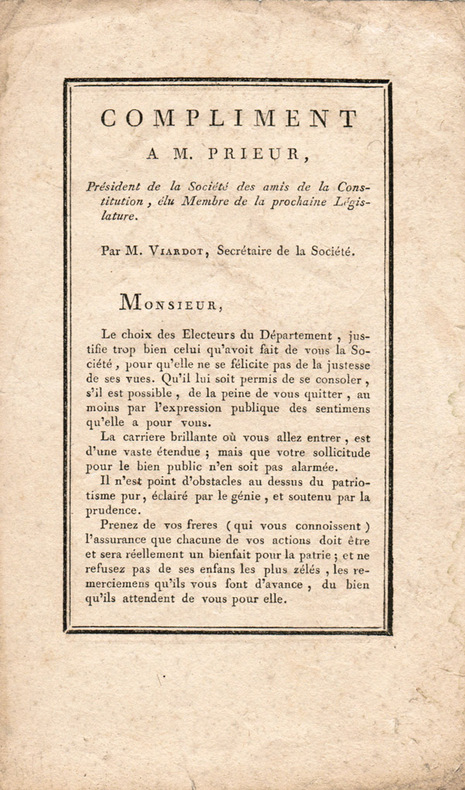
179121491791 Tract de 1 p. in-8 (20,5 x 12 cm), slnd [Dijon, 1791].
179111994RELIE ENSUITE : Opinion de M. Salle, député du département de la Meurthe, sur les événements du 21 juin 1791, prononcée à la tribune de l’Assemblée à la séance du 15 juillet. RELIE ENSUITE : Opinion de M. Barnave, prononcée à la séance du 15 juillet. Ensemble in-4, broché ; Bourg, Imprimerie C.C.G. Philipon, (1791) ; 16 ; 15, (1 bl.) ; 20 pp.
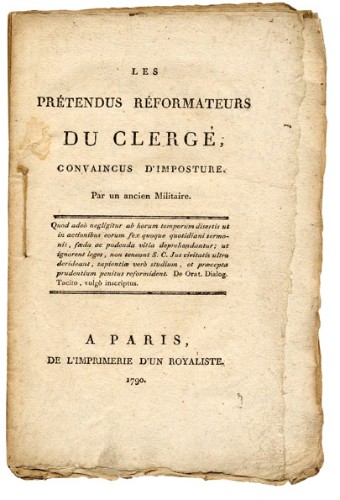
179011282Paris, Imprimerie d'un Royaliste, 1790 ; in-8, broché ; 59 pp.
1767105368Londres, MDCCLXVII 1767 Tome 1er seul. In-8 22,5 x 14 cm. Broché, couverture d’attente, VIII-426 pp. Etat correct.
178836781Boston: Benjamin Russell 1788. First Edition. Newspaper. Good. Newspaper. Single issue removed from larger gathering. Paper measures proximately 15" x 9.5". 4 pages. Stitched holes on the left margin. Scattered brown spots. Light toning to the paper.<br /> <br /> Contents include the latest "American Intelligence". Including the front page news article titled: "Augusta Georgia January 5. We have the pleasure to announce to the publick that on Wednesday last the Convention of this State unanimously ratified the Federal Constitution in the words following viz. <br /> <br /> State of Georgia. In Convention Wednesday January 2 1788. We the Delegates of the people of the State of Georgia in Convention met having taken into serious consideration the Federal Constitution agreed upon and proposed by the Deputies of the United States in General Convention held in the city of Philadelphia on the 17th day of September in the year of our Lord one thousand seven hundred and eighty seven Have assented to ratified and adopted and by these presents do in virtue of the powers and authority to us given by the people of the said State for the purpose for and in behalf of ourselves and our constituents fully and entirely assent to ratify and adopt the said Constitution which is hereunto annexed under the great seal of said State. Done in Convention at Augusta in the said State on the second day of January in the year of our Lord one thousand and seventy eight and of the Independence of the United States the twelfth." <br /> <br /> Other items from the paper includes news from Charleston S. C.; Wilmington Delaware; Philadelphia; New York; Massachusetts; and Europe. Much of the Massachusetts news concerns the newly adopted Constitution. [Benjamin Russell] unknown
179276952Paris 1792. First French edition of the 1787 Federal Constitution in addition to the thirteen state constitutions the Declaration d'Independance Articles de Confederation; and several treaties. . old marbled wrappers with ms. paper labels on spines preserved in a utilitarian portfolio. . This was Kenneth Nebenzahl's copy with his book label inside the portfolio. An uncut copy in very attractive original condition. 8vo. Howes C-716. Translated and published at the suggestion of Benjamin Franklin who likely contributed footnotes. He wrote in late 1783: "The extravagant Misrepresentations of our Political State in foreign Countries made it appear necessary to give them better information which I though could not be more efectually and authentically done than by publishing a Translation into French." unknown
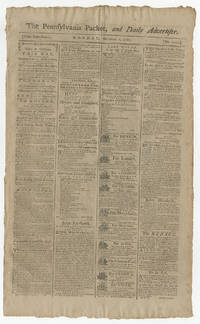
178724135<p><b>U.S. CONSTITUTION.</b>Newspaper. <i>The Pennsylvania Packet and Daily Advertiser</i>. October 1 1787 No. 2700 Philadelphia: John Dunlap and David C. Claypoole including the September 28 resolution of the Confederation Congress to send to the states for ratification the recently completed U. S. Constitution. 4 pp. 12 x 18¾ in. </p><br />"<i>The United States in Congress Assembled. Friday September 28 1787.</i><p><i>CONGRESS having received the Report of the CONVENTION lately assembled in Philadelphia</i></p><p><i>Resolved unanimously THAT the said report with the resolutions and letter accompanying the same be transmitted to the several legislatures in order to be submitted to a convention of delegates chose in each state by the people thereof in conformity to the resolves of the convention made and provided in that case. CHARLES THOMSON Secretary.</i>" p2/c3</p><p>The convention called to revise the Articles of Confederation met in the Pennsylvania's State House in Philadelphia starting on May 25 1787. After many delegates agreed that the Articles could not be sufficiently improved they started to draft an entirely new structure. Maintaining their pledge of secrecy after months of private deliberations over trade defense taxation representation separation of powers the election of a president the slave trade international relations and many other issues the proposed United States Constitution was signed by thirty-nine of the fifty-five delegates on September 17.</p><p>Two days later the Constitution was first published by the <i>Pennsylvania Packet</i>and four other Philadelphia newspapers. The cover letter sent by George Washington president of what came to be called the Constitutional Convention submitting the plan to Arthur St. Clair the President of the Congress of the Confederation in New York was also printed then.</p><p>Congress received and read the proposed Constitution on September 20th. As a sampling of their deliberations William Grayson of Virginia thought it was too weak while Richard Henry Lee of Virginia and Nathan Dane of Massachusetts thought it was too strong.</p><p>On September 27 Virginia's Richard Henry Lee proposed that the Constitution be sent to the executives of each of the states. A Delaware representative quickly added "in order to be by them submitted to conventions of delegates to be chosen agreeably to the said resolutions of the convention." Ten of the twelve states then represented in Congress voted in favor. Before Congress adjourned for the day the majority of Virginia's representatives and a minority of New York's representatives also indicated their support. On September 28 Federalists holding out for a unanimous vote found a way to compromise with anti-Federalists: Congress unanimously resolved to send the Constitution to the states but without any recommendation or approval.</p><p>Arider from New York City arrived in Philadelphia with the resolution that same day.</p><p>George Clymer presented his own resolution to the Pennsylvania Assembly noting that "<i>the late Federal Convention has digested a plan of government for the United States and recommended that it should be referred to the consideration of State Conventions…</i>" After a "<i>very long and animated debate</i>" Clymer's resolution passed by a vote of 43 to 19 and adjourned until 4:00 p.m. But only 44 members returned falling two shy of the necessary quorum. The Assembly's sergeant-at-arms was sent to show the resolution to absent members. Two who still refused to attend were seized by the public dragged through the streets and thrust into the assembly room. The involuntarily completed quorum voted that "<i>it is the sense of great numbers of the grand people of this state already signified in petitions & declarations to this house that the earliest steps should be taken to assemble a convention within the state for the purpose of deliberating and determining on the said constitution.</i>" They called for the election of deputies who would assemble for that purpose "<i>on the third Tuesday of November at the State-house in the city of Philadelphia…</i>" p2/c3-4</p><p>Other articles of interest in this issue include news from Europe and a brief piece against Indians "<i>from the western country</i> who <i>still continue their depredations on the whites…</i>" p2/c3</p><p><b><i>The Pennsylvania Packet or the General Advertiser</i></b>1771-1839 was founded by John Dunlap in late 1771 as a weekly newspaper in Philadelphia though it relocated to Lancaster during the British occupation of Philadelphia in 1777-1778. On May 30 1783 Benjamin Towne turned the <i>Pennsylvania Evening Post</i> into the first daily newspaper in the United States. However with Towne branded a traitor and forced to hawk his own papers on the street the newspaper collapsed the following year. John Dunlap and David Claypoole then made their <i>Pennsylvania Packet</i> the first successful daily on September 21 1784. It underwent numerous name changes in the 1790s until sold in 1800 and renamed <i>Poulson's American Daily Advertiser</i>.</p> John Dunlap and David C. Claypoole
17675532Dublin: G Faulkner 1767. 220 x 143 mm. Very Good. pp 22 2 In very good condition with old staining to head of pages in modern blue card wrappers with title label to upper cover. Very Good 1767 G Faulkner unknown