WESSELING, Peter (praes) u. J. J. EVERT (resp.)Antiquariat.de

123 résultats
1736478620Utrecht, van Megen, 1736. 4to. 3 Bl., 34 S. In Rohbögen.
1727131377Nürnberg u. Leipzig, Lehmann, 1727. 16 Bl., 518 S., 61 Bl., 269 S., 8 Bl. Mit gestochener Titelvignette. Halbleder d. Zeit (etwas beschabt, Ecken u. Kanten stark bestoßen). [2 Warenabbildungen]
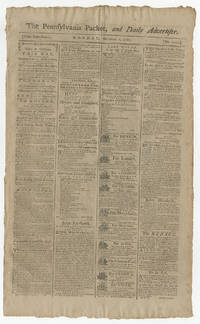
178724135<p><b>U.S. CONSTITUTION.</b>Newspaper. <i>The Pennsylvania Packet and Daily Advertiser</i>. October 1 1787 No. 2700 Philadelphia: John Dunlap and David C. Claypoole including the September 28 resolution of the Confederation Congress to send to the states for ratification the recently completed U. S. Constitution. 4 pp. 12 x 18¾ in. </p><br />"<i>The United States in Congress Assembled. Friday September 28 1787.</i><p><i>CONGRESS having received the Report of the CONVENTION lately assembled in Philadelphia</i></p><p><i>Resolved unanimously THAT the said report with the resolutions and letter accompanying the same be transmitted to the several legislatures in order to be submitted to a convention of delegates chose in each state by the people thereof in conformity to the resolves of the convention made and provided in that case. CHARLES THOMSON Secretary.</i>" p2/c3</p><p>The convention called to revise the Articles of Confederation met in the Pennsylvania's State House in Philadelphia starting on May 25 1787. After many delegates agreed that the Articles could not be sufficiently improved they started to draft an entirely new structure. Maintaining their pledge of secrecy after months of private deliberations over trade defense taxation representation separation of powers the election of a president the slave trade international relations and many other issues the proposed United States Constitution was signed by thirty-nine of the fifty-five delegates on September 17.</p><p>Two days later the Constitution was first published by the <i>Pennsylvania Packet</i>and four other Philadelphia newspapers. The cover letter sent by George Washington president of what came to be called the Constitutional Convention submitting the plan to Arthur St. Clair the President of the Congress of the Confederation in New York was also printed then.</p><p>Congress received and read the proposed Constitution on September 20th. As a sampling of their deliberations William Grayson of Virginia thought it was too weak while Richard Henry Lee of Virginia and Nathan Dane of Massachusetts thought it was too strong.</p><p>On September 27 Virginia's Richard Henry Lee proposed that the Constitution be sent to the executives of each of the states. A Delaware representative quickly added "in order to be by them submitted to conventions of delegates to be chosen agreeably to the said resolutions of the convention." Ten of the twelve states then represented in Congress voted in favor. Before Congress adjourned for the day the majority of Virginia's representatives and a minority of New York's representatives also indicated their support. On September 28 Federalists holding out for a unanimous vote found a way to compromise with anti-Federalists: Congress unanimously resolved to send the Constitution to the states but without any recommendation or approval.</p><p>Arider from New York City arrived in Philadelphia with the resolution that same day.</p><p>George Clymer presented his own resolution to the Pennsylvania Assembly noting that "<i>the late Federal Convention has digested a plan of government for the United States and recommended that it should be referred to the consideration of State Conventions…</i>" After a "<i>very long and animated debate</i>" Clymer's resolution passed by a vote of 43 to 19 and adjourned until 4:00 p.m. But only 44 members returned falling two shy of the necessary quorum. The Assembly's sergeant-at-arms was sent to show the resolution to absent members. Two who still refused to attend were seized by the public dragged through the streets and thrust into the assembly room. The involuntarily completed quorum voted that "<i>it is the sense of great numbers of the grand people of this state already signified in petitions & declarations to this house that the earliest steps should be taken to assemble a convention within the state for the purpose of deliberating and determining on the said constitution.</i>" They called for the election of deputies who would assemble for that purpose "<i>on the third Tuesday of November at the State-house in the city of Philadelphia…</i>" p2/c3-4</p><p>Other articles of interest in this issue include news from Europe and a brief piece against Indians "<i>from the western country</i> who <i>still continue their depredations on the whites…</i>" p2/c3</p><p><b><i>The Pennsylvania Packet or the General Advertiser</i></b>1771-1839 was founded by John Dunlap in late 1771 as a weekly newspaper in Philadelphia though it relocated to Lancaster during the British occupation of Philadelphia in 1777-1778. On May 30 1783 Benjamin Towne turned the <i>Pennsylvania Evening Post</i> into the first daily newspaper in the United States. However with Towne branded a traitor and forced to hawk his own papers on the street the newspaper collapsed the following year. John Dunlap and David Claypoole then made their <i>Pennsylvania Packet</i> the first successful daily on September 21 1784. It underwent numerous name changes in the 1790s until sold in 1800 and renamed <i>Poulson's American Daily Advertiser</i>.</p> John Dunlap and David C. Claypoole books
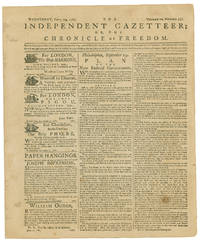
178721085.99<p>"<i>We the People of the United States…</i>"</p><p>This rare complete printing of the Constitution appeared on the first day it was publicly available Wednesday September 19 1787. That same morning the Constitution was published by four other papers the <i>Pennsylvania Packet and Daily Advertiser</i> <i>Pennsylvania Journal Pennsylvania Gazette</i> and <i>Freeman's Journal.</i> The <i>Independent Gazetteer</i>is unique in that it is the only one of the five first-day printings whose type was evidently not used to print another stand-alone edition.</p> <b>U.S. CONSTITUTION.</b>Newspaper. <i>The Independent Gazetteer or the Chronicle of Freedom</i>. Philadelphia: Eleazer Oswald September 19 1787. 4 pp.<p><b><br /></b></p><p><b>Historical Background</b></p><p>This issue of <i>The Independent Gazetteer and Chronicle of Freedom</i> a daily Anti-Federalist newspaper prints the "<i>Plan of the New Federal Government</i>" in full followed by the Federal Convention's resolution submitting the Constitution to Congress and the accompanying transmittal letter. All three are signed in type by George Washington as president of the Convention.</p><p>The Constitution was approved by the Convention on Monday September 17. The text of the official version was set that evening and a very limited number were printed for the use of the delegates. After being drafted in complete secrecy the Constitution was first made public on the morning of Tuesday September 18 when it was read before the Pennsylvania General Assembly. The next morning Wednesday September 19 the five newspapers mentioned above all published the Constitution. It is often assumed that the <i>Pennsylvania Packet</i> was the first public printing as the publishers Dunlap and Claypoole were the official printers to the Constitutional Convention. In fact there is no evidence that the <i>Packet</i> actually was published first or appeared on the streets of Philadelphia that day any earlier than its four rivals. All five are considered first editions with surviving copies of the <i>Packet</i> the most common.</p><p>The dissemination of the Constitution in newspapers is of considerable interest and importance as it was through this medium that most Americans became familiar with the new form of government proposed by the Convention. One careful researcher Leonard Rapport of the National Archives has identified four Philadelphia newspapers which also carried the text of the Constitution on the same day this was after all news of the highest importance and one the Philadelphia <i>Evening Chronicle</i> which may <i>hypothetically</i> have carried the text in an issue dated 18 September "Printing the Constitution" pp. 69-90. But to date no copy of the <i>Evening Chronicle</i> of that date is known to be extant see Rapport's other article "Newspaper Printings of the Constitution".</p><p>The <i>Pennsylvania Packet</i> printing has been accorded primacy for two principal reasons. First the <i>Packet</i>was printed by John Dunlap and David C. Claypoole official printers to the Convention itself. Together as partners or separately Claypoole may originally have been a junior partner they had printed nearly everything issued by Congress since 1775 including the 1776 Declaration of Independence. Second with the exception of the Constitution's six-line preamble "We the people…" the text is <i>entirely printed from the same setting of type used for the official Congressional printing.</i>As Rapport notes the 5000 words of the Constitution represented "nearly one man-day of composition time" for the printer so sensibly to make use of the wider margins of the <i>Packet's</i> larger sheets they reset the preamble in large type with a large capital "W" below the masthead and simply reimposed the rest of their standing type to fit onto the paper's four larger-size pages. The case might be summed up by emphasizing that the present <i>Pennsylvania Packet</i> text of the Constitution was struck from the identical setting of lead type that had printed the sheets of the official Congressional printings sheets that Jacob Shallus calligrapher used when he copied onto parchment the engrossed document to which the delegates signed their names.</p><p>"By October 6 only twenty days after the Federal Convention at least fifty-five of the approximately eighty newspapers of the period had printed the.Constitution." Rapport "Printing the Constitution" p.89. With the text of the Constitution before the people thanks to a free press the great debate on its ratification would begin a debate which continued until ratification by the original thirteen states was completed in 1790 and culminated in 1791 by the adoption of the Bill of Rights. Despite the tremendous changes since 1787 in the nation and the people governed by the Constitution Bernstein meaningfully notes "the evolution of American politics and society continues to be shaped by the Constitution and by the principles and doctrines built into it by the men who drafted it. That the Constitution has worked as well as it has is a tribute to its flexibility and to the foresight of those who created it. That it may still be defective or capable of improvement is a challenge to us to equal the courage imagination and versatility of the Revolutionary generation of Americans" <i>Are We To Be A Nation</i> p.272.</p> Eleazer Oswald books
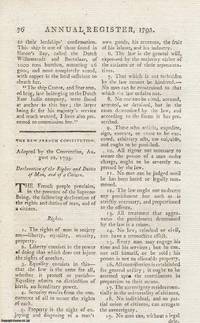
17892601011London: Annual Register 1789. early. hardcover. good. One of the earliest British printings of the US Constitution. Printed for J. Dodsley in Pall-Mall London 1789. Book good wear to covers gutters cracked front free end paper has two tears former owner's name stamp to 2nd front free end paper. Annual Register unknown
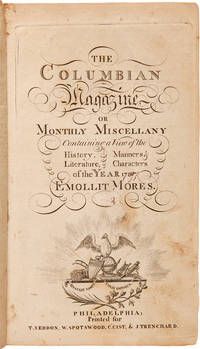
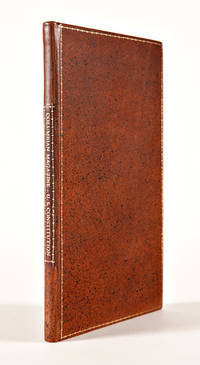
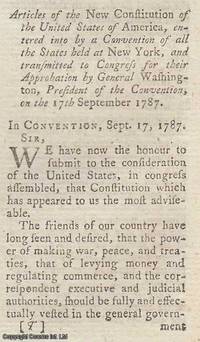
1787WRCAM55477APhiladelphia: Printed for Seddon Spotswood Cist and Trenchard 1787. 2615-674pp. plus one plate of two. Lacks folding table. Engraved and letterpress titlepages. Later blue wrappers with facsimile of printed volume titlepage mounted on front wrapper. Moderate soiling to wrappers. Minor toning and foxing to text closed marginal repair to one leaf. About very good. The first periodical printing of the United States Constitution probably issued within a week of its release as a broadside. The Constitutional Convention ratified its final draft on Monday Sept. 17 1787. The following day the broadside version issued for members of the Convention was printed by Dunlap and Claypoole the official printers. On September 19 the same printers issued the first public printing of the Constitution in their newspaper THE PENNSYLVANIA PACKET. The present magazine was probably printed late in the week and the final signature containing the Constitution and recent news was probably printed on Saturday September 22. This is the latest internal date on the last page and actually refers to an event that took place on the 17th as "Monday last." From a survey of Mott's HISTORY OF AMERICAN MAGAZINES in the period it seems that it was common practice to issue monthly publications by the last week of every month. This issue would seem to have been out and in general circulation by Monday the 24th one week after the end of the Convention. Its version of the Constitution was executed most likely on the 22nd four days after the official broadside and three days after the first public newspaper appearance. This issue also contains the text of John Quincy Adams's Harvard commencement address he finished second in a class of fifty-one which was given in Cambridge on July 18 1787. It is his first published writing. This copy contains one of the two plates published in this issue lacking the folding plate of the Natural Bridge in Virginia and the folding table of meteorological observations. <br> <br> THE COLUMBIAN MAGAZINE was a distinguished publication of the period. Mott calls it one of the best 18th-century American magazines. It began in September 1786 and was well established with Mathew Carey's AMERICAN MUSEUM as one of the two major periodicals then being issued in Philadelphia or for that matter the country at the time. Since the magazine probably had wider circulation than the newspapers issued in Philadelphia it is likely that this printing was one of the chief means of disseminating the Constitution immediately after its first publication. <br> <br> An exceptionally early and important printing of the Constitution. MOTT HISTORY OF AMERICAN MAGAZINES I pp.94-9. EVANS 20280. Wilbur T. Roberts "They Printed the Declaration and the Constitution" in THE MENTOR July 1928 pp.52-54. Leonard A. Rapport "Printing the Constitution" in PROLOGUE: THE JOURNAL OF THE NATIONAL ARCHIVES Fall 1970 pp.69-89. Printed for Seddon, Spotswood, Cist, and Trenchard unknown books
1787WRCAM55477Philadelphia: Printed for Seddon Spotswood Cist and Trenchard 1787. pp.615-674 plus two plates one folding and a folding table of Meteorological Observations. Antique-style calf gilt ornamental border on boards gilt leather label. Moderate foxing and toning. Extensive annotations in light pencil. Very good overall. The first periodical printing of the United States Constitution probably issued within a week of its release as a broadside. The Constitutional Convention ratified its final draft on Monday Sept. 17 1787. The following day Sept. 18 the broadside version issued for members of the Convention was printed by Dunlap and Claypoole the official printers. On Sept. 19 the same printers issued the first public printing of the Constitution in their newspaper THE PENNSYLVANIA PACKET. The present magazine was probably printed late in the week and the final signature containing the Constitution and recent news was probably printed on Saturday Sept. 22. This is the last internal date on the last page and actually refers to an event that took place on the 17th as "Monday last." From a survey of Mott's HISTORY OF AMERICAN MAGAZINES in the period it seems that it was common practice to issue monthly publications by the last week of every month. This issue would seem to have been out and in general circulation by Monday the 24th one week after the end of the Convention. Its version of the Constitution was executed most likely on the 22nd four days after the official broadside and three days after the first public newspaper appearance. This issue also contains the text of John Quincy Adams's Harvard commencement address he finished second in a class of fifty-one which was given in Cambridge on July 18 1787. It is his first published writing. <br> <br> THE COLUMBIAN MAGAZINE was a distinguished publication of the period. Mott calls it one of the best 18th-century American magazines. It began in September 1786 and was well established with Mathew Carey's AMERICAN MUSEUM as one of the two major periodicals then being issued in Philadelphia or for that matter the country at the time. Since the magazine probably had wider circulation than the newspapers issued in Philadelphia it is likely that this printing was one of the chief means of disseminating the Constitution immediately after its first publication. <br> <br> An exceptionally early and important printing of the Constitution. MOTT HISTORY OF AMERICAN MAGAZINES I pp.94-9. EVANS 20280. Wilbur T. Roberts "They Printed the Declaration and the Constitution" in THE MENTOR July 1928 pp.52-54. Leonard A. Rapport "Printing the Constitution" in PROLOGUE: THE JOURNAL OF THE NATIONAL ARCHIVES Fall 1970 pp.69-89. Printed for Seddon, Spotswood, Cist, and Trenchard hardcover books
178767677London: Printed for D. Henry 1787. UNITED STATES CONSTITUTION; URBAN Sylvanus. One of The First Means by Which The British People Learned of The Enactment of The Constitution of The United States of America<br> <br> UNITED STATES CONSTITUTION subject. URBAN Sylvanus editor. The Gentleman's Magazine "New Constitution of the United States of America". Printed by John Nichols for D. Henry November December 1787.<br> <br> First edition of these November and December 1787 issues. Two small octavo volumes 8 1/2 x 5 1/8 inches; 215 x 130 mm. 941-1035 1; 1037-1131 1 pp. With woodcut text illustration on front wrapper of each volume. November issue with one fold-out plate and lacking plate I entitled "S.W. View of Aconbury Chapel 5 Miles from Here." The December issue with two plates plate II and Supp. but lacking plate I Illustrations of the Royal Charter School Near Dublin Clontarfe Castle Dublin and others. Text of American Constitution on pp. 1008-1011; 1110-1112.<br> <br> Self-wrappered. Newer stitching. Some very minor toning and light occasional spotting. Overall very good.<br> <br> This is the first English magazine printing of the U.S. Constitution. The November issue on pages 1008-1011 prints George Washington's Letter and the first Article. The December issue on pages 1110-1112 contains articles two through seven and the delegates names.<br> <br> "The following is the new Plan of the Constitution of the United States of America upon which the Convention of all the most distinguished men in the States have been deliberating for several months and by which if finally adopted the Constitution of the Union is totally changed." From the introduction<br> <br> Einaudi. Goldsmiths'. Howes. Howes. Kress. Streeter. Streeter.<br> <br> HBS 67677.<br> <br> $1500. Printed for D. Henry unknown
178769121London: Sold by T. Wilkie 1787. UNITED STATES CONSTITUTION. The London Chronicle "The New Plan for the Constitution of the United States of America". Vo. LXII. No. 4834-4835. From Saturday October 27 to Tuesday October 30 1787 and From Tuesday October 30 to Thursday November 1 1787. Pages 409-424. London: Sold by T. Wilkie 1787.<br> <br> Likely the first public printing of the United States Constitution in England. This newspaper printing precedes the know first edition pamphlet published by Debrett as well as the first magazine printing in "The Gentleman's Magazine." It is broadly stated that news of the United States Constitution hit England early in November however the dates of the Chronicle precede this by a few days. This copy also contains the preliminary cover letter from George Washington to the president of Congress which is usually included with early printings of the Constitution and which states Washington's strong support of ratification. "The Plan" is printed in its entirety without comment or explanation from the publisher.<br> <br> Together two issues no. 4834 and 4834. Each issue self bound along left margin. 11 3/8 x 8 5/8 inches; 288 x 222 mm. Number 4834 is four leaves pages 409-416 and number 4835 is four leaves pages 417-424. The first part of the Constitution is printed on pages 413-414 of the first part with the end stating "To be concluded in our next" and the second part is printed on pages 420-421. Both issues very good with just some slight toning. Page 421-422 trimmed close at top margin just touching header. A small red stamp on verso of first leaf of each issue along bottom margin. Overall about fine. We could find no other copies of this or any earlier British newspaper containing the US Constitution on Rare Book Hub. We could not locate any copies on OCLC or ESTC. Housed in a custom quarter red morocco clamshell.<br> <br> At the time of the Constitutional Convention John Adams was living in England as a diplomat. In a letter to John Adams from Elbridge Gerry dated September 20th 1787 just one day after the first newspapers in America printed the Constitution he states "The proceedings of the Convention being this day published I embrace the Oppertunity of transmitting them by a Vessel which is to sail this morning for London." According to the National Archives "Gerry enclosed a copy of the new U.S. Constitution. Gerry likely sent this letter to John Adams via the Prince George Capt. Strong which departed New York City in late September and arrived in London on 3 Nov. New York Independent Journal 1 Sept. 1787 2 Feb. 1788." This shows that it would have been impossible for news of the Constitution to arrive in England much before this date of November 3rd. Lengthy searches turn up no indication that any other British publication has a copy of the US Constitution before this London Chronicle printing. The National Archives go on to state "The U.S. Constitution was adopted on 17 Sept. 1787 and British newspapers first published the text in late autumn. The London Chronicle printed the preamble and the first article in its 27-30 Oct. issue and the remaining articles and signatures in its 30 Oct. - 1 Nov. issue. "<br> <br> The London Chronicle was a thrice weekly newspaper also known for being " one of the first to break the news that the United States had declared independence from the British Empire reporting on the event in its 13 August 1776 edition. It was also one of the first to publish the declaration in its entirety in the 15-17 August 1776 edition but containing no explanation or comment as to what it was" Wikipedia. This holds true for their publication of the Constitution as well.<br> <br> United States Constitution now the longest continuing charter of a national government in the world and "the product of a revolution in political thought at least as important and far-reaching as the winning of American independence from Great Britain and the culmination of the intellectual ferment and political experimentation in the new republic" Richard B. Bernstein Are We to Be a Nation.<br> <br> HBS 69121.<br> <br> $20000. Sold by T. Wilkie unknown
17863327131Poson, Landerer, 1786. 3 nn. Bl., 122 S. Leder der Zeit.
1735128407Langenheim, 1735. 3 Bl., 43 S., 3 Bl. Übliche Interimsheftung.
1787358416Annual Register London 1787. Booklet - Unbound Pages. Very Good Condition. 11 pages. An authentic standalone article extracted from a larger volume. Not a reprint or reproduction but an original work in its own right. Preserved in a modern card cover prepared for practicality - an unassuming but serviceable presentation that favours function over finery. Size: 13 x 20 cms. Category: Annual Register; Printed before 1800; New Arrivals; This item may require more postage than the rates shown for delivery outside the UK. If extra postage is required we will contact you before processing your order and you will be given the details and option to decline the extra cost. Annual Register unknown
1795358514Annual Register London 1795. Booklet - Unbound Pages. Very Good Condition. 29 pages. An authentic standalone article extracted from a larger volume. Not a reprint or reproduction but an original work in its own right. Preserved in a modern card cover prepared for practicality - an unassuming but serviceable presentation that favours function over finery. Size: 13 x 20 cms. Category: Annual Register; Printed before 1800; New Arrivals; This item may require more postage than the rates shown for delivery outside the UK. If extra postage is required we will contact you before processing your order and you will be given the details and option to decline the extra cost. Annual Register unknown
179939795Knoxville 1799. 7 works bound together octavo. 7 3/8 x 4 5/8 inches. First work lacks titlepage contemporary ownership inscription on first leaf present. Light foxing A few leaves trimmed closely at bottom edge affecting text. Contemporary calf spine gilt with red morocco label skillful repair to joints and corners. Housed within a black modern full morocco box.<br/> <br/>Provenance: J. Hamilton two signatures<br/> <br/>Possibly the greatest single volume of early Tennessee material with the second known complete copy of the First Tennessee Constitution in fine original condition.<br/> <br/>Seven works from the earliest pioneer press of Tennessee including the first printing of the National Constitution printed in the state as well as the first State Constitution here in the second known complete copy. Such imprints have not appeared on the market since World War II. In February 1790 North Carolina ceded its western land holdings to the United States. A few months later the area became the newly created Territory of the United States South of the River Ohio. William Blount was appointed territorial governor by President Washington and in 1795 he called a meeting of the territorial legislature to request a referendum for statehood. Thus the state of Tennessee was born on June 1 1796. George Roulstone the first printer in Tennessee began a newspaper in Knoxville in late 1791. The earliest Tennessee imprint noted by McMurtrie is a set of acts passed by the territorial government printed after March 25th 1793. Since then two earlier items have come to light; a broadside owned by Thomas W. Streeter dated Jan. 28 1793 and a broadside dated March 13 1793. The earliest dateable book present here was issued in 1794. The Tennessee State Constitution here in the first of three editions; it was to be revisited in 1835 and 1869 was created by Congress at the time Tennessee was admitted as a state and became effective on June 1 1796 when Tennessee entered the Union. It was not universally well received although Thomas Jefferson described it as the "least imperfect and most republican of the state constitutions." The first leaf and one title have the early ownership inscription of J. Hamilton possibly James Hamilton Jr. congressman and governor of South Carolina who read law in Charleston and was admitted to the bar in 1810. The individual titles are as follows: 1 Acts Passed at the First Session of the General Assembly of the Territory of the United States of America South of the River Ohio. Began and Held at Knoxville on Monday the Twenty Fifth day of August MDCCXCIV. Knoxville: George Roulstone 1794. 3-101pp. Lacks titlepage and preliminary viii pp. containing "Acts and ordinances of the governor and judges.as issued by William Blount." Evans accords this item its own number however so it is possible that it wasn't issued as a part of this copy. Copies noted by ESTC and Allen at Harvard Law the Huntington Library of Congress State Library of Tennessee and University of Tennessee. Allen 7; ESTC W9956; Evans 27724; McMurtrie 5. 2 Acts Passed at the Second Session of the First General Assembly of the Territory of the United States of America South of the River Ohio. Begun and Held at Knoxville on Monday the Twenty Ninth day of June 1795. Knoxville: George Roulstone 1795. 31pp. Copies noted by ESTC and Allen at Harvard Law the Huntington Library of Congress and University of Tennessee. Allen 15; ESTC W5409; Evans 29551; McMurtrie 8. 3 The Constitution of the United States of America. to which is Prefixed the Constitution of the State of Tennessee. Knoxville: Roulstone & Parrington 1799. 30pp. Copies noted by ESTC and Allen at State Library of Tennessee and University of Tennessee lacking titlepage.Allen 45; ESTC W30527; Evans 36404; McMurtrie 30. 4 Acts Passed at the Second Session of the Second General Assembly of the State of Tennessee. Knoxville: Roulstone & Parrington 1798. 70pp. The Table of Contents comprising the last ten pages and present here not present in two of the four recorded copies which may have been issued without it. Copies noted by ESTC and Allen at Library of Congress Harvard Law New York Public Library State Library of Tennessee and University of Tennessee. Allen 38; ESTC W23338; Evans 36403; McMurtrie 27. 5 Acts Passed at the First General Assembly of the State of Tennessee. Knoxville: George Roulstone 1796. 78pp. Copies noted by ESTC and Allen at Library of Congress Knoxville Public Library and University of Tennessee. Allen 21; ESTC W23331; Evans 31277; McMurtrie 21 6 Acts Passed at the Second Session of the First General Assembly of the State of Tennessee. Knoxville: George Roulstone 1796. 13pp. Copies noted by ESTC and Allen at Harvard Law University of Tennessee and Centre College of Kentucky. Allen 22; Bristol B9722; ESTC W23332; McMurtrie 22; Shipton & Mooney 47935. 7 Acts Passed at the First Session of the Second General Assembly of the State of Tennessee. Knoxville: George Roulstone 1797. 120pp. Copies noted by ESTC and Allen at American Antiquarian Society Library of Congress Harvard Law Knoxville Public Library and State Library of Tennessee. Allen 33; ESTC W9891; Evans 32913; McMurtrie 24. These works are essentially unprocurable and this volume provides a rare opportunity to acquire seven significant imprints from the first press in Tennessee. All are of the utmost rarity in any condition.<br/> <br/>Check List of Tennessee Imprints 5 8 30 27 21 22 24. unknown books
1727124876Jena, Fischer, 1727. 8 Bl., 752 S., 24 Bl. Pergament d. Zeit (fleckig, Spiegelbezug des Vorderdeckels an den Kanten aufgeplatzt). [2 Warenabbildungen]
1740356294Gießen, J. P. Krieger, 1740. 60, 630 S., 21 Bl. Mit Kupferporträt als Frontispiz. Pergament d. Zeit (leicht fleckig). [2 Warenabbildungen]
1734116312Ingolstadt, J. A. de la Haye, 1734. Folio. Mit gestochenem Frontispiz u. 8 allegorischen Kupfertiteln. Pergament d. Zeit (fleckig, Innengelenke gebrochen). [3 Warenabbildungen]
1727627626Frankfurt u. Leipzig, Fritsch, 1727. 15 Bl., 1760 S., 16 Bl. Mit Kupferporträt Kaiser Karls IV. Pergament d. Zeit (fleckig). [2 Warenabbildungen]
1746627967Leipzig, Gleditsch, 1746. 8 Bl., 256 S. Mit gestochener Titelvignette. Pappband d. Zeit (fleckig u. etwas bestoßen, Gelenke angebrochen). [2 Warenabbildungen]
1782111429Göttingen, Vandenhoeck Witwe, 1782. 7 Bl., 370 S. Leder d. Zeit (beschabt u. bestoßen, Gelenke gebrochen). [2 Warenabbildungen]
1744455788Leipzig, Gleditsch, 1744. 864 S., 56 Bl. Pappband d. Zeit mit Rückenschild (berieben u. bestoßen). [2 Warenabbildungen]
1778WOC-145Mise en ordre & augmentées par Monseigneur Jean D'Aranthon D'Alex, et nouvellement par Monseigneur Jean-Pierre Biord, ses successeurs dans le même Evêché.Anneci, De l'imprimerie de J. B.Burdet,1778.In-12(17x10cm)relié plein veau d'époque, dos à faux-nerfs orné de caissons dorés et de fleurons, tranches rouges.XXIJ,388pp.+1f de Fautes à corrigés+10pp. de Formule. Blason de la page de titre.
1742315144Altenburg, Richter, 1742. 4to. 16 Bl., 324, 638 S., 50 Bl. Index. Mit Titelkupfer (Wappen). Leder d. Zeit (stark beschabt, Ecken u. Kapitale bestoßen, Rückenschild mit Abplatzungen). [2 Warenabbildungen]
1741450935Gotha, Mevius, (1741). 4to. 375 nn. Bl. (d.l.w.). Leder d. Zeit mit marmorierten Spiegeln (beschabt, Rückenbezug unten mit kurzem Einriß). [3 Warenabbildungen]
1753634235Göttingen, Witwe Vandenhoeck, 1753. 8vo. 24 Bl., 405 S., 7 Bl. Moderner Pappband mit goldgeprägtem Rückenschild.