1 369 résultats
1767105368Londres, MDCCLXVII 1767 Tome 1er seul. In-8 22,5 x 14 cm. Broché, couverture d’attente, VIII-426 pp. Etat correct.
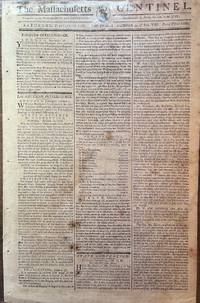
178836781Boston: Benjamin Russell 1788. First Edition. Newspaper. Good. Newspaper. Single issue removed from larger gathering. Paper measures proximately 15" x 9.5". 4 pages. Stitched holes on the left margin. Scattered brown spots. Light toning to the paper.<br /> <br /> Contents include the latest "American Intelligence". Including the front page news article titled: "Augusta Georgia January 5. We have the pleasure to announce to the publick that on Wednesday last the Convention of this State unanimously ratified the Federal Constitution in the words following viz. <br /> <br /> State of Georgia. In Convention Wednesday January 2 1788. We the Delegates of the people of the State of Georgia in Convention met having taken into serious consideration the Federal Constitution agreed upon and proposed by the Deputies of the United States in General Convention held in the city of Philadelphia on the 17th day of September in the year of our Lord one thousand seven hundred and eighty seven Have assented to ratified and adopted and by these presents do in virtue of the powers and authority to us given by the people of the said State for the purpose for and in behalf of ourselves and our constituents fully and entirely assent to ratify and adopt the said Constitution which is hereunto annexed under the great seal of said State. Done in Convention at Augusta in the said State on the second day of January in the year of our Lord one thousand and seventy eight and of the Independence of the United States the twelfth." <br /> <br /> Other items from the paper includes news from Charleston S. C.; Wilmington Delaware; Philadelphia; New York; Massachusetts; and Europe. Much of the Massachusetts news concerns the newly adopted Constitution. [Benjamin Russell] unknown
179276952Paris 1792. First French edition of the 1787 Federal Constitution in addition to the thirteen state constitutions the Declaration d'Independance Articles de Confederation; and several treaties. . old marbled wrappers with ms. paper labels on spines preserved in a utilitarian portfolio. . This was Kenneth Nebenzahl's copy with his book label inside the portfolio. An uncut copy in very attractive original condition. 8vo. Howes C-716. Translated and published at the suggestion of Benjamin Franklin who likely contributed footnotes. He wrote in late 1783: "The extravagant Misrepresentations of our Political State in foreign Countries made it appear necessary to give them better information which I though could not be more efectually and authentically done than by publishing a Translation into French." unknown
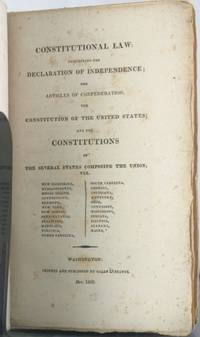
1820SP561Gales and Seaton 1820. Second Edition. Hardcover. Good. Washington 1820. 12mo iv 409 pp. Contemporary paper covered boards. Expanded to include 23 states including Alabama and North Carolina. The first edition published a year earlier included just 21 states. A good copy with fraying and chipping to paper at spine foxing to contents and contemporary ownership marks to endpapers. Contents complete. Please contact us for additional pictures or information. Seven copies in OCLC. Cohen Bibliography of Early American Law 3014. Gales and Seaton hardcover
180435986Philadelphia: Printed by William Duane 1804. First Edition. Wraps. Good. Wraps. 158 pages. Disbound stitched wraps. Title page 1. Blank rear wrap. Remnants of a leather spine. Light toning and scattered brown spots to the contents. Some lower corner page corner creases. Good condition. <br /> <br /> Contents concern a resolution amending the United States Constitution regarding electors from the States. The language is is printed on pages 34 and 5. The debate on the amendment is recorded in this report. On pages 157 and 158 are the "yeas" and "nays" from the individual Senators and Representatives. The proposed amendment become the Twelfth Amendment to the United States Constitution. The 12th amendment changed how the President and Vice President were elected in the United States. This amendment was in place when Thomas Jefferson was elected President and George Clinton was elected as Vice President. <br /> <br /> Printed on page 1 "Resolved by the Senate and House of Representatives on the United States of America in Congress assembled Two thirds of the Houses concurring That the following amendment to the constitution of the United States which when ratified by three fourths of the said legislatures shall be valid to all intents and purposes as part of said constitution to Wit: That the third paragraph of the first person section of the second article of the constitution of the United States in the words following to wit: "The electors shall meet in their respective states and vote by ballot for two persons of whom one at least shall be an inhabitant of the same state with themselves: And they shall make a list of all the persons voted for and of the number of votes for each which list they shall sign and certify and transmit sealed to the seat of Government of the United States directed to the President of the Senate."<br /> <br /> Sabin 20992. Printed by William Duane unknown
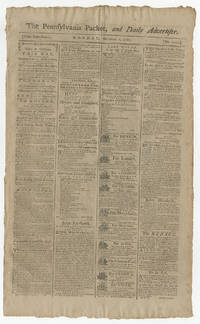
178724135<p><b>U.S. CONSTITUTION.</b>Newspaper. <i>The Pennsylvania Packet and Daily Advertiser</i>. October 1 1787 No. 2700 Philadelphia: John Dunlap and David C. Claypoole including the September 28 resolution of the Confederation Congress to send to the states for ratification the recently completed U. S. Constitution. 4 pp. 12 x 18¾ in. </p><br />"<i>The United States in Congress Assembled. Friday September 28 1787.</i><p><i>CONGRESS having received the Report of the CONVENTION lately assembled in Philadelphia</i></p><p><i>Resolved unanimously THAT the said report with the resolutions and letter accompanying the same be transmitted to the several legislatures in order to be submitted to a convention of delegates chose in each state by the people thereof in conformity to the resolves of the convention made and provided in that case. CHARLES THOMSON Secretary.</i>" p2/c3</p><p>The convention called to revise the Articles of Confederation met in the Pennsylvania's State House in Philadelphia starting on May 25 1787. After many delegates agreed that the Articles could not be sufficiently improved they started to draft an entirely new structure. Maintaining their pledge of secrecy after months of private deliberations over trade defense taxation representation separation of powers the election of a president the slave trade international relations and many other issues the proposed United States Constitution was signed by thirty-nine of the fifty-five delegates on September 17.</p><p>Two days later the Constitution was first published by the <i>Pennsylvania Packet</i>and four other Philadelphia newspapers. The cover letter sent by George Washington president of what came to be called the Constitutional Convention submitting the plan to Arthur St. Clair the President of the Congress of the Confederation in New York was also printed then.</p><p>Congress received and read the proposed Constitution on September 20th. As a sampling of their deliberations William Grayson of Virginia thought it was too weak while Richard Henry Lee of Virginia and Nathan Dane of Massachusetts thought it was too strong.</p><p>On September 27 Virginia's Richard Henry Lee proposed that the Constitution be sent to the executives of each of the states. A Delaware representative quickly added "in order to be by them submitted to conventions of delegates to be chosen agreeably to the said resolutions of the convention." Ten of the twelve states then represented in Congress voted in favor. Before Congress adjourned for the day the majority of Virginia's representatives and a minority of New York's representatives also indicated their support. On September 28 Federalists holding out for a unanimous vote found a way to compromise with anti-Federalists: Congress unanimously resolved to send the Constitution to the states but without any recommendation or approval.</p><p>Arider from New York City arrived in Philadelphia with the resolution that same day.</p><p>George Clymer presented his own resolution to the Pennsylvania Assembly noting that "<i>the late Federal Convention has digested a plan of government for the United States and recommended that it should be referred to the consideration of State Conventions…</i>" After a "<i>very long and animated debate</i>" Clymer's resolution passed by a vote of 43 to 19 and adjourned until 4:00 p.m. But only 44 members returned falling two shy of the necessary quorum. The Assembly's sergeant-at-arms was sent to show the resolution to absent members. Two who still refused to attend were seized by the public dragged through the streets and thrust into the assembly room. The involuntarily completed quorum voted that "<i>it is the sense of great numbers of the grand people of this state already signified in petitions & declarations to this house that the earliest steps should be taken to assemble a convention within the state for the purpose of deliberating and determining on the said constitution.</i>" They called for the election of deputies who would assemble for that purpose "<i>on the third Tuesday of November at the State-house in the city of Philadelphia…</i>" p2/c3-4</p><p>Other articles of interest in this issue include news from Europe and a brief piece against Indians "<i>from the western country</i> who <i>still continue their depredations on the whites…</i>" p2/c3</p><p><b><i>The Pennsylvania Packet or the General Advertiser</i></b>1771-1839 was founded by John Dunlap in late 1771 as a weekly newspaper in Philadelphia though it relocated to Lancaster during the British occupation of Philadelphia in 1777-1778. On May 30 1783 Benjamin Towne turned the <i>Pennsylvania Evening Post</i> into the first daily newspaper in the United States. However with Towne branded a traitor and forced to hawk his own papers on the street the newspaper collapsed the following year. John Dunlap and David Claypoole then made their <i>Pennsylvania Packet</i> the first successful daily on September 21 1784. It underwent numerous name changes in the 1790s until sold in 1800 and renamed <i>Poulson's American Daily Advertiser</i>.</p> John Dunlap and David C. Claypoole
003265London: Printed for Charles Harper William Crooke and Richard Tonson at the Flower-de-Luce in Fleetstreet at the Green Dragon without Temple Barr and at Grays-Inn Gate next Grays-Inn Lane 1688. Hardcover. Very Good. Folio. xvipp. 215ff. xxviiipp. Modern half calf over marbled boards. With the bookplate of William S. Johnson one of the signers of the American Constitution. ESTC R4204; Wing 2nd ed. K134. <br/> <br/> London: Printed for Charles Harper, William Crooke and Richard Tonson, at the Flower-de-Luce in Fleetstreet, at the Green Dragon hardcover
1332708102.Gpaperback. Good. Access codes and supplements are not guaranteed with used items. May be an ex-library book. paperback
17675532Dublin: G Faulkner 1767. 220 x 143 mm. Very Good. pp 22 2 In very good condition with old staining to head of pages in modern blue card wrappers with title label to upper cover. Very Good 1767 G Faulkner unknown
173311867London: J. Peele. Very Good with no dust jacket. 1733. First Edition; First Printing. Softcover. Stapled inside heavy card covers. No lib marks on the pamplet itself. ; Ex-Library; 12mo 7" - 7½" tall; 61 pages . J. Peele paperback
Mm 145x220 Brossura originale priva del dorso, 164 pagine. Segni del tempo ai margini esterni e tenui fioriture in apertura e chiusura del tomo, peraltro le condizioni sono buone. Spedizione in 24 ore dalla conferma dell'ordine.
1781629730Göttingen, Vandenhoeck & Ruprecht, 1781-85. 8 Bl., 366 S.; 1 Bl., S. 367-682, 1 Bl. Marmorierter Pappband d. Zeit mit Rückenschild (etwas berieben, 1 Ecke bestoßen). [2 Warenabbildungen]
1971601921München, Beck, 1971. 87 S. OKart.
1970179337München, Beck, 1970. XXIII, 242 S. OKart.
1793167251793 A PARIS BARBOU, (1793.) .in 32mo.reliure pleine basane epoque,dos lisse titre,manque de cuir bas dos et charnieres,texte frais,pagination: 64+64+30 p.,tres rare- le 24 juin 1793, la Convention adopte et promulgue la Constitution de l’An I, la première Constitution républicaine et sociale française. Dans le préambule est énoncée la Déclaration des droits complétant celle du 26 août 1789. Assurément, la Constitution montagnarde de 1793 se singularise par l’élargissement des droits. En effet, aux simples droits formels individuels bourgeois proclamés en 1789, la Constitution de 1793 inclut les droits économiques et sociaux réels, tels que le droit au travail, le droit à la protection sociale, le droit à l’instruction.
19193335272Stuttgart, Kohlhammer, 1919. 233 S. Lwd.
1957634957Wien, Springer, 1957. XV, 485 S. Originalumschlag (fleckig, Rücken mit Bibliothekssignatur, Titel verso gestempelt).
1845454080Paris, Clere, 1845. 323 S. Ppbd (berieben, Stempel auf Titel, Bibliotheks-Rückenschild).
18453454080Paris, Clere, 1845. 323 S. Ppbd (berieben, Stempel auf Titel, Bibliotheks-Rückenschild).
Very Good French Original journals. Folio. (32 x 25 cm). In French. 3 issues: (4 p.; 4 p.; 8 p.). Ahmet Riza Bey was an Ottoman-born Turkish political activist, scientist, statesman, educational reformer and a prominent member of the Young Turks, during the Second Constitutional Era of the Ottoman Empire. In 1908 he became the first President of the revived Chamber of Deputies, the lower house of the Ottoman Parliament, and in 1912, he was appointed as the President of the Senate (the upper house) as well. He also served as Minister of Education from the Liberal Union party, the main opposition party to the ruling Committee of Union and Progress. In 1908, his name was among the candidates' list for the next Grand Vizier. He was the leading negotiator during the failed agreement of coalition between the Ottoman Empire, France, and Britain for World War I. Ahmet Riza has been described as a polymath by some authors. He was born in Istanbul in 1858, the son of Ali Riza Bey. His father was nicknamed Ingiliz ("Englishman") because of his command of the English language and admiration of the British Empire. His mother, Fraulein Turban, was born in Munich but was of Hungarian origin. She moved to Vienna, where she met Ingiliz, and converted to Islam to marry him, taking the name Naile Sabika Hanim. He graduated from Galatasaray High School in Istanbul and subsequently studied agriculture in France. As a young man, he sought to improve the condition of the peasantry in the Empire. He was concerned with the conditions of the farmers and wanted to implement agricultural methods, supporting the ideas of the French sociologist, Auguste Comte. In 1894, he published a series of publications on unification of Islamic and Ottoman traditions of consultation. In 1895, Mesveret (Meshveret, or, Mechveret), the journal that he published, became a locus of the exiled Young Turks movement. Ahmet Riza opposed the maverick Prince Sabahaddin's calls for revolution and European intervention in the empire at the 1902 Congress of Ottoman Opposition in Paris. According to a customized book in 1889, on the pretext of participating in the exhibition organized for the centenary of the French Revolution, there was a customized letter, which indicated he escaped to Paris and did not return. He became an interpreter as he learned French. At the University of Paris, he continued his lectures on positivism, taught by mathematician Pierre Laffitte, as he was influenced by Laffitte's thoughts about Islam and Eastern civilization in particular. Laffitte believed that Islam was the most advanced religion, so it was easy for Muslims to pass through positivism. Ahmet Riza became one of the most active members of the Société Positiviste (Positivist Society), and since 1905 he has appeared as a "representative of Muslim communities" in the Comité Positif Occidental, establishing the spread of positivist international platitudes. During his first years in Paris, he attempted to respond to various newspapers and magazines, which were writing unfavourably about the Ottoman Empire. In 1891, he wrote a letter to the postal and telegraph chronicle in Istanbul as he did not obey the instructions of the center of Paris to return to his country due to his use of the expression "liberty" in a lecture on Ottoman women and stated that he did not belong to any secret cemetery. Ahmet Riza sent his thoughts to Sultan Abdul Hamid II in 1893. He continued to send sheets upon the request of his encouraging response and continuation; he tried to convince him that the constitutional regime was not a bad thing. In the case of sending the sixth party, he began to write political writings in French, which was published by the former Syrian deputy Halil Ganem. (Source: Wikipedia).
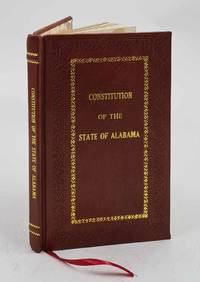
2022BIBSD0158408972022. Full Leather Bound. NEW. Size: 14.60 x 22.86 cms A Unique Premium Leather-Bound book for elite readers/collectors of old rare books. An Original Leather is being used for binding this book with Golden Leaf Printing and designing on Spine front and Back of the book with edge gilding. WE HAVE MULTIPLE OPTIONS IN COLOR OF LEATHER RED GREEN BLUE MAGENTA TAN PURPLE DEEP BROWN BLACK AND WITH DIFFERENT COLOR LABELS. YOU MAY CHOOSE ANY COLOR OF YOUR CHOICE AND MAIL US. This service is chargeable. Original edition was published in 1901 and this unique edition is Reprinted in 2022 with the help of original edition. Black & white printing on high quality natural shade paper with sewing binding for longer life professionally processed without changing its contents. As these are old books we processed each page manually on computer and make them readable. We give our best to give you the best book but in some cases we have to adjust few pages which are blur or missing or black spots. If it is multi volume set then it is only single volume. We hope that you understand these issues in these old treasure. This is an important book for the readers who want to know more about our old treasure. Our dedicated team is trying to bring these rare books back to the shelves. We are also giving service of printing the hard-to-find books which are not listed in our store. Hope you will like it and give your comments and suggestions. Lang: - English Pages 90. Product Disclaimer: Please be aware that because leather is a natural material slight discoloration or change in texture may be visible. FOLIO EDITION Size 12x19 Inches IS ALSO AVAILABLE ON REQUEST. Please Note - Text break hardcover
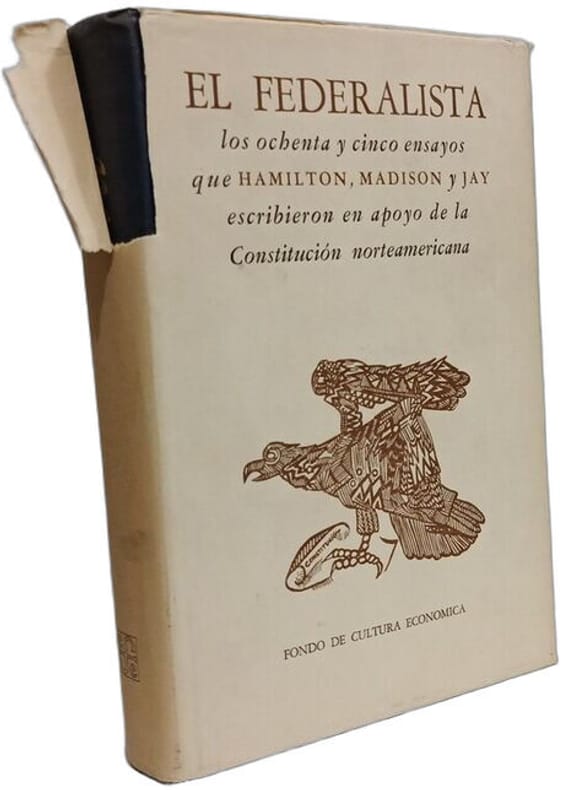
1957100145278Fondo de Cultura Económica 1957 in8. 1957. Cartonné. Le Fédéraliste est une série d'essais écrits sous le pseudonyme Publius par Alexander Hamilton James Madison et John Jay pour défendre et promouvoir la ratification de la nouvelle Constitution des États-Unis après la Révolution américaine. L'ouvrage présente une analyse approfondie des principes constitutionnels des arguments pour un gouvernement central fort et des réponses aux critiques de l'époque
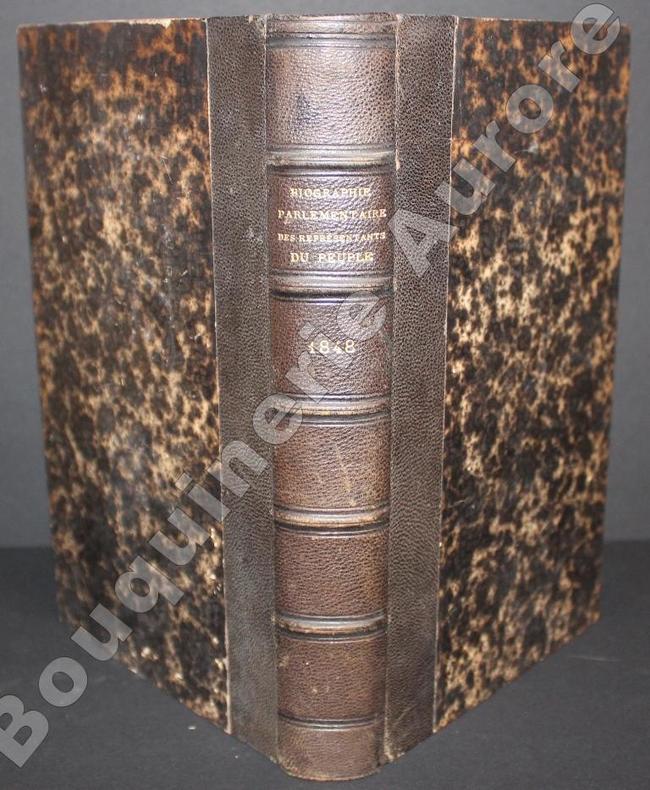
1848119651848 P., Mme Ve Louis Janet, s.d. (1848), 1 vol. in-8° (220 x 135) relié 1/2 chagrin marron, dos à 5 nerfs, palts de papier marbré, de XXIV - 510 pp. - (1) p.Rares rousseurs, très bel exemplaire bien relié.
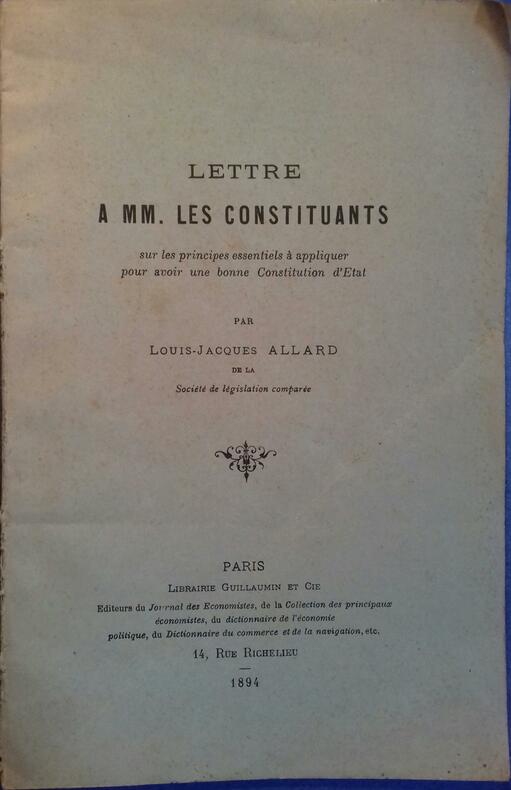
189474420Couverture souple. Broché. 70 pages. Papier bruni.
0332077284.Gpaperback. Good. Access codes and supplements are not guaranteed with used items. May be an ex-library book. paperback