CONSTITUTION UNIGENITUSBiblio.com

1 370 résultats
171947102Sans lieu d'édition 1719. Bonded Leather. <b>Livre en français</b>. Couverture rigide. Seconde édition revue corrigée et augmentée où l'on répond à ce qu'il y a de plus spécieux dans les avertissements de Soissons. Reliure plein veau d'époque dos manquant. 279 pages. Mouillure à une dizaine de pages. Petite tache d'encre à la marge inférieure. <i>ref. 47102</i> Sans lieu d'édition hardcover
18651260191865. First Edition. CONSTITUTION. Journal of the House of Delegates of the State of Virginia. for the Session of 18645. Alexandria: D. Turner 1865. Octavo original front printed wrapper respined renewed rear wrapper original string stitching; pp. 1-3 4-83 1. Housed in a custom chemise and clamshell box. $4500.First edition one of 500 copies of the momentous Journal featuring its February 9 1865 entry on the Alexandria Virginia government's passage of the 13th Amendment mere days after the U.S. Congress the first of the four Unionist southern states to pass the Amendment also featuring the governor's Message noting: ""though we have in inherited from our fathers of the revolution the blessings of a great nation yet they also left to us an inheritance of African slavery which has proved a bitter dreg in our cup of freedom"" a vital record of forces for constitutional change near the end of the Civil War.Soon after the 1860 election amidst southern secession ""the great questions of union or disunion war or peace hung in the balance. Probably the crucial weight on the scale was Virginia as long as the federal government did not seek to coerce the states Virginia secessionists were unable to achieve a majority. When Lincoln responded with force to the attack on Fort Sumter however the vote in Virginia went in favor of secession."" Subsequently a Virginia convention ""met in Wheeling on May 13 1861 it elected as Governor Francis Pierpont a western Virginian and ardent Unionist and arranged for the creation of a legislature to replace the body sitting in Richmond in July 1861 the new legislature met at the 'Restored Virginia' capital of Wheeling in a special session called by Pierpont."" Against its ""claim to represent a majority of Virginians"" a new state of West Virginia was created in 1863 and Pierpont's government moved to Alexandria to govern areas of Virginia under Union occupation Harrison Lawfulness of the Reconstruction Amendments 380-83.Scholars observe that the 13th Amendment its fellow amendments and Reconstruction as ""both a political process made possible by military successes and constitutional thought grew from wartime as well as post-Appomattox developments"" Hyman and Wiecek Equal Justice 247. This rare first edition of Journal of the House of Delegates substantiates that in documenting passage of the 13th Amendment by Pierpont's Virginia government mere days after the U.S. Congress passed the Amendment on January 31 1865. With that Virginia became the first of the four Unionist southern states that ratified the 13th Amendment. Of those Louisiana followed on February 17 with Arkansas and Tennessee that April. The 13th Amendment is the focus of the Journal's entry for February 9 1865 which states: ""Mr. Brownley called up Senate bill No. 12 entitled 'An Act to ratify the joint resolution of Congress passed January 31 1865 proposing an amendment to the Constitution of the United States.' The bill was read the first and second time and the rules were suspended and the bill read the third time and the bill passed."" Also notable herein is the complete printing of Governor Pierpont's opening Message where he notes: ""though we inherited from our fathers of the revolution the blessings of a great nation yet they also left to us an inheritance of African slavery which has proved a bitter dreg in our cup of freedom."" He speaks at length of the rights due people of color and the abolition of laws such as those that prohibit ""negro testimony"" or proscribe a ""different punishment for persons of African dissent"" from that of ""white persons.""""The legislature met for its second session on December 5 1864 The governor's message was a long and important document and indicated the changes of opinion that the war was bringing about. Pierpont gave his views upon the all-important negro question. He congratulated the constitutional convention which had met in the spring on the abolition of slavery in Virginia and advocated sweeping changes in the laws concerning negroes. The act prescribing different punishments for blacks should he said be altered in accordance with the amended constitution as well as the law for apprenticing them. The law prohibiting the education of negroes should be abolished His language was on the whole very moderate. He advised the legalizing of the marital relations of negroes and most important the establishment of public schools Notwithstanding the governor's advice no acts of great importance passed the legislature On February 9 1865 the assembly ratified the 13th Amendment to the Constitution of the United States. It adjourned on March 7"" Eckenrode Political History of Virginia During the Reconstruction. Faint ""U.N.C. Duplicate"" stamp to front wrapper.Text fine; just a bit of faint soiling and a tide line to fragile front wrapper. An excellent copy of this elusive item. unknown
1017186251.Ghardcover. Good. Access codes and supplements are not guaranteed with used items. May be an ex-library book. hardcover
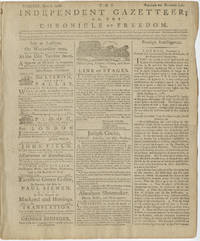
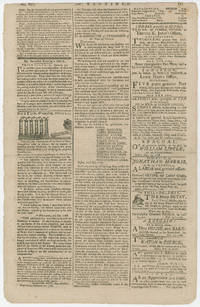
178830007.003Philadelphia PA 1788. No binding. Fine. Independent Gazetteer; or The Chronicle of Freedom. Newspaper. Independent Gazetteer; or The Chronicle of Freedom Philadelphia Pa. May 6 1788. 4 pp. 9 1/2 x 11 1/2 in. The Maryland ratifying convention suggests some amendments along with their approval of the Constitution. ExcerptsFrom page 3:""From the MARYLAND GAZETTE or April 29 1788. The CONVENTION of this state on Saturday last determined to ratify the proposed plan of Federal Government. -YEAS 63 NAYS 11-And then appointed a committee of thirteen members to consider and report amendments to be recommended to the people. -The following amendments were proposed by a member and referred to the committee who are now sitting-And it is hoped that the great and essential rights of the people will be declared and secured.- PROPOSED AMENDMENTS.Wherefore whenever the ends of Government are perverted and public liberty manifestedly endangered and all other means of redress are ineffectual the people may and of right ought to object to reform the old or establish a new Government-that the doctrine of nonresistance against arbitrary power and oppression is absurd slavish and destructive of the good and happiness of mankind. All imposts and duties laid by Congress shall be placed to the credit of the state in which the same be collected. That there shall be no national religion established by law; but that all persons be equally entitled to protection in their religious liberty. That the Supreme Federal Courts shall not admit to fictions to extend its jurisdiction; nor shall citizens of the same state having controversies with each other be suffered to make collusive assignments of their rights to the citizens of another state for the purpose of defeating the jurisdiction of the State Courts; nor shall any matter or question already determined in the State Courts be revived or agitated in the Federal Courts. That Congress have no power to lay a Poll-Tax. That the people have a right to freedom of speech of writing and publishing their sentiments and therefore that the freedom of the PRESS ought not to be restrained and the printing presses ought to be free to examine the proceedings of Government and the conduct of its officers.""From page 2: Protesting the Slave Trade by Boycotting West Indian Produce""A CAUTION.WHEREAS in the year 1787 some vessels were fitted out at the port of Philadelphia for the iniquitous purpose of stealing the inhabitants of Africa from all the endearments of domestic life; one of which vessels has succeeded in obtaining a number of poor blacks and has taken the to a port in the West Indies where they are under the iron hand of oppression. From this shameful traffic this horrid source the proprietors of the vessel have purchased some West India produce which after landing at Wilmington they have brought up to this city and offered for sale. It is a grateful circumstance to the supporters of the common rights of mankind that the virtuous inhabitants of the city reprobate the horrid idea.-A correspondent hopes that the citizens will further testify their disapprobation of the practice by turning with indignation from the purchase of any property thus basely procured by men so lost to the common feelings of humanity; notwithstanding the patriotic convention at which Washington presided have declared that this abominable traffic shall be continued for TWENTY years by the people of America.From page 1:An advertisement with engraving for a ""Line of Stages"" between Philadelphia and New York started by four partners who split off from an established stage line and promising better service. From page 4:An advertisement for another different ""New Line of Stages."" And a report on the creation of a Philadelphia committee for the relief of the nearly 100 Americans captured by Algerian corsairs and Barbary pirates. unknown
1333824513.Gpaperback. Good. Access codes and supplements are not guaranteed with used items. May be an ex-library book. paperback
0143024981New. Brand new and still unused unknown
0267072996.Ghardcover. Good. Access codes and supplements are not guaranteed with used items. May be an ex-library book. hardcover
1333933819.Gpaperback. Good. Access codes and supplements are not guaranteed with used items. May be an ex-library book. paperback
18471239761847. First Edition. CONSTITUTION PHILLIPS Wendell. Review of Lysander Spooner's Essay on the Unconstitutionality of Slavery. Reprinted from the ""Anti-Slavery Standard"" With Additions. Boston: Andrews & Prentiss 1847. Octavo modern half calf gilt marbled boards; pp. 1-3 4-95 1. $1600.First edition in book form of Phillips' bold and influential antebellum work on the U.S. Constitution and the question of slavery revised and ""with additions"" to its serialization in the Anti-Slavery Standard.Controversy over slavery ""was the most important single influence on American constitutional development before the Civil War"" Wiecek Sources 15. Leaders in that controversy were William Lloyd Garrison Wendell Phillips and Lysander Spooner. As an anti-constitutionalist Phillips deemed ""Prophet of Liberty Champion of the Slave"" made his ""first public pronouncement that the Constitution should be abandoned"" when in 1842 he asserted the ""'spirit of liberty' is 'chained down in the iron links of the United States Constitution'"" and subsequently argued the Constitution was a ""'compromise' between freedom and slavery"" Knowles Securing the 'Blessings'"" 41. Phillips' 1844 work Constitution: A Pro-Slavery Compact prompted Spooner to author Unconstitutionality of Slavery First Part: 1845 Second Part: 1847 arguing it was instead slavery that was unconstitutional not the founding document. Phillips quickly countered with this Review.""Phillips insisted the only path to justice 'is over the Constitution trampling it under foot'. and raised pertinent questions about the processes of constitutionalism. Must a just person reject an imperfect constitution or even one that sanctioned and protected an evil like slavery to work effectively for constitutional reform and to abolish injustice Or was it possible to regard the constitution as an imperfect but amendable instrument the only thing available in the here and now of a heterogeneous secular society that can serve as a means of changing a society's goals and structuring"" Wiecek 246. To Phillips Spooner's approach essentially ""leaves every one to do 'what is right in his own eyes.'"" Spooner and Phillips also disagreed on remedies to immoral laws. ""Spooner did not consider an immoral contract binding"" and argued for example that judges rely instead on natural law for their decisions. Phillips felt that in such circumstances a judge should resign. In this Review Phillips also offers ""a new area in which antislavery and anarchy"" could be connected when he describes Spooner's ""antislavery constitutionalism as 'the first step toward anarchy'"" Perry Radical Abolitionism 165-66. First edition first printing. Serialized earlier the same year in the Anti-Slavery Standard the official weekly newspaper of the American Anti-Slavery Society which was co-founded by William Lloyd Garrison and Arthur Tappen. Sabin 62524. Dumond 93. Not in Blockson. Text fresh and about-fine. hardcover
1019235578.Ghardcover. Good. Access codes and supplements are not guaranteed with used items. May be an ex-library book. hardcover
16821206631682. CONSTITUTION SOMERS John. The Security of English-Mens Lives Or the Trust Power and Duty of the Grand Jurys of England. London: Printed for Benj. Alsop 1682. Small octavo 4 by 6-1/2 inches 18th-century brown morocco raised bands marbled endpapers all edges gilt; pp. 1-2 3-168. $3400.1682 edition of Somers' profoundly influential work on the power of the grand jury the second of only two 17th-century editions issued the year after the first""one of the fundamental foundations of the common law in the American colonies""prompting revolution with Somers' invoking the grand jury and its protection of secrecy as key in opposing ""corrupt Ministers of State"" and those who ""abuse or oppress the People in the form and course of Justice"" seminal in the creation of the Constitution's Fifth Amendment with Jefferson calling grand juries ""the true tribunal of the people.""British statesman Baron John Somers' most famous and influential work is Grand Jurys. ""Of the legal scholars writing about the grand jury in the late 17th century Somers is not only representative but eminent having been read in both England and the colonies"" Kadish Behind the Locked Door 5-10. Grand Jurys is considered a seminal influence on Locke and America's Founding Fathers and it is ""likely that Locke knew Somers by the early 1680s The opposition of absolute monarchy to the security provided by 'impartial law' was structurally central to Locke's Second Treatise 1689 which attacked the threat to life liberty and property posed by a loss of 'impartial justice' Locke's arguments are a logical extension of the arguments that juries provided the only security of life"" Marshall John Locke 52. To Somers similarly the grand jury offers ""security"" from the ""Ill Designs of corrupt Minsters of State"" and those who ""dare to abuse or oppress the People."" Somers' Grand Jurys is ""a classic statement of political freedom. He works his way through a number of themes that will be frequently repeated by others."" Chief among these is his argument that ""the independent grand jury is the linchpin of the entire criminal justice system. It brings offenders to justice and protects the innocent from false accusation guaranteeing the traditional rights of Englishmen particularly their political rights in relation to the Crown and joins Parliament as a counterweight to the arbitrary power of the monarch and his judges"" Shapiro Beyond Reasonable Doubt 67. With its origins found deep within English legal history the grand jury was ""eulogized by Coke and Blackstone and crossed the Atlantic as one of the fundamental foundations of the common law in the American colonies"" Roots If It's Not a Runaway. ""Indeed there is an important sense in which the jury issue united not only America's revolutionary period and Founding era but also the 'settlement' years immediately following 1789"" Stimson Juries and American Revolutionary Jurisprudence 34-5.As American ""opposition to the British became more overt grand juries became more sympathetic to the colonists the famous case of John Peter Zenger is a prime example as two separate N.Y. grand juries refused to indict him for criminal libel. Further in 1765 a Boston grand jury refused to find an indictment against the leaders of the Stamp Act Riots"" Paule Perversion of the Historic Function 304. ""Perhaps the best known case of grand jury independence involved the twice-unsuccessful efforts to indict former Vice President Aaron Burr for attempting to involve the U.S. in a war with Spain Burr was finally indicted when a grand jury was convened in Virginia the stronghold of Burr's enemy Thomas Jefferson. Despite Jefferson's best efforts Burr was acquitted at trial in part because the judge gave such a narrow jury instruction and made evidentiary rulings so favorable to the defense that conviction was nearly impossible. The trial judge was John Marshall one of Jefferson's rivals"" Leopold Why Grand Juries 286.""The framers of the Constitution perceived the function of the grand jury as so essential to liberty that they specifically provided for it"" in the Fifth Amendment Paule 305. ""With its Grand Jury Clause insuring that 'no person shall be held to answer for a capital or otherwise infamous crime unless on a presentment or indictment of a Grand Jury' the Clause protected the people against arbitrary and overzealous government by protecting 'against hasty malicious and oppressive prosecution.' Secrecy in grand jury proceedings played a role in that protection."" For Somers in particular the secrecy requirement was absolute. In Grand Jurys he describes ""how grand jurors were sworn not to disclose the subjects of the inquiry the witnesses or any of the evidence. In addition grand jurors were sworn not to reveal their own personal knowledge the knowledge of their fellow jurors their investigative plans or their deliberations according to Somers secrecy made possible the discovery of truth and protected individuals from malicious or hateful prosecution. In sum neither the king the general public nor the individual accused could benefit by making public the proceedings of a grand jury. The Grand Jury Clause of the Fifth Amendment made grand jury secrecy an implicit part of American criminal procedure"" Kadish 5-16. ""In a petition to the General Assembly of the Commonwealth of Virginia Jefferson once termed the Anglo-Saxon tradition of trial by grand and petit jury 'the true tribunal of the people'"" Shannon Grand Jury 141. Jefferson owned and held two other works by Somers in his library. Preceded only by the 1681 first edition. Anonymously issued with Wing identifying Somers as author. Precedes the 1773 American edition. Pages 156-167 containing Latin and English text printed on opposite pages; final text page with ""Finis."" ESTC R10363. Wing S4643. Sweet & Maxwell I:378 34. See Sowerby 2015 2712. Early owner signature above title page.Text very fresh expert restoration to handsome binding. A very good copy. hardcover
1898337605Authority Of The General Assembly 1898. Hardcover. Good-. . 6x9. GOOD-. Red Half Leather - spine and corners bound in leather with white boards. Frontispiece with wax paper protector. Approx. 6'' x 9''. Heavy wear and chips to edges and corners. Some slight discoloration and moderate soiling to leather and boards. Few chips and white stains to front cover. Possible liquid stains to edges of inside covers and end papers. Light pencil writing to top of 1st blank page. Clean inner pages with bright text.<p> Once Read Books cover scan available - just ask OnceReadBooks com<p> Orders shipped via USPS. Authority Of The General Assembly hardcover
1390446441.Gpaperback. Good. Access codes and supplements are not guaranteed with used items. May be an ex-library book. paperback
042817485X.Gpaperback. Good. Access codes and supplements are not guaranteed with used items. May be an ex-library book. paperback
1789100147<p>8vo later calf backed marbled boards 320 202 pp. Edges and covers rubbed occasional bit of foxing but overall very good. The most important feature of this collection is an early British printing of the United States Constitution p.289-300. Also contains a curious description of two Negro children with some unusual physical markings see p.53-55. Very interesting coverage of a few executions including a woman who was hanged for forgery is also provided.</p> J. Dodsley hardcover
43930596-nnew. unknown
101825126X.Ghardcover. Good. Access codes and supplements are not guaranteed with used items. May be an ex-library book. hardcover
1355911354.Ghardcover. Good. Access codes and supplements are not guaranteed with used items. May be an ex-library book. hardcover
101991372X.Ghardcover. Good. Access codes and supplements are not guaranteed with used items. May be an ex-library book. hardcover
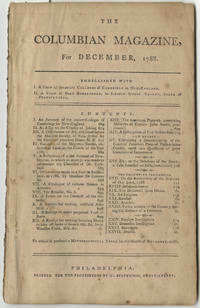
178830007.048Philadelphia PA 1788. Softcover. Fine. The Columbian Magazine. Magazine. The Columbian Magazine Philadelphia Pa. December 1788. 52 pp. 5 x 8 in. Lacking plates. This title has the honor of being the first successful American magazine having begun in September 1786 and lasting until December 1792. Although many titles existed earlier none enjoyed the success of lasting beyond a few issues or a couple of years.Opens with five pages on ""An Account of the Ancient Colleges at Cambridge in New England."" that being Harvard University. pp. 669-673.A recipe for making artificial Asses milk p. 698.With ""The American Plutarch - Memoirs of Captain John Smith"" pp. 699-703 continued for a previous issue and concluded in the next.A section on ""American Intelligence"" pp. 715-718 with the latest news reports including an item from Edenton North Carolina:""a new convention be recommended for the purpose of reconsidering the new constitution held out by the federal convention as a government for the United States."" p. 716.With a ""List of Senators of the United States Already Chosen"" by state pp. 717-718.Also mention of the officers for the Masonic Lodge at Philadelphia p. 716. paperback books
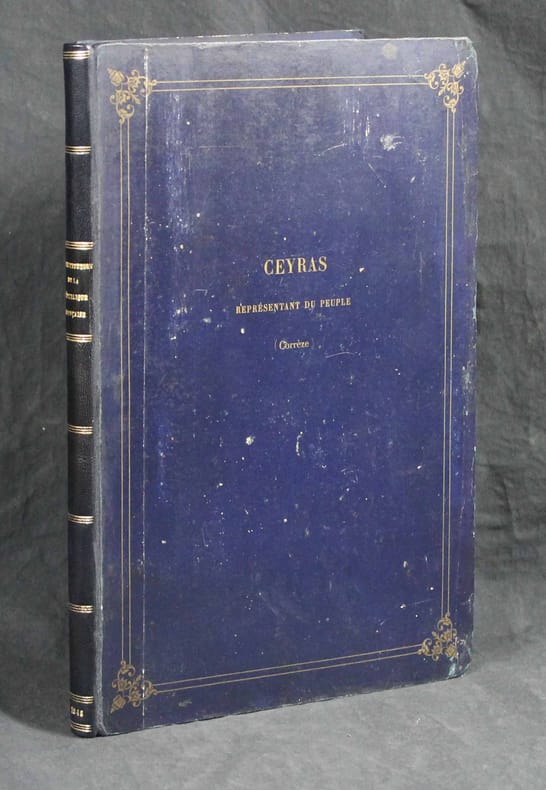
2834P ., Imprimerie Nationale, (An II) (1794). In 4° de 6 pp.
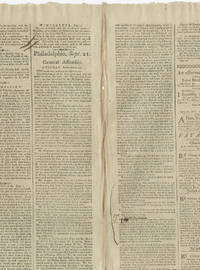
178721449.18Philadelphia PA 1787. No binding. Fine. Pennsylvania Packet and General Advertiser. Newspaper. Pennsylvania Packet and General Advertiser September 21 1787. John Dunlap Philadelphia Pa. 4 pp. 12 x 18 3/4 in. Pennsylvania's representatives to the Constitutional Convention including Benjamin Franklin present the Constitution to the Representatives of the Pennsylvania State legislature. A contemporary report of the end result of the Philadelphia Convention's efforts over the summer of 1787 less than a week after the Convention concluded. ""Sir we have now the honor to present to this house the plan of government for the United States which has been determined upon by the federal convention. As soon as the speaker had concluded Dr. Franklin rose and delivered a letter from the delegates to the house which being read consisted of a recommendation to the legislature."" p. 2 col. 4Reports on the proposal of the Constitution to Pennsylvania. ""To the Honorable the Representatives of the Freemen of the Commonwealth of Pennsylvania.your petitioners have seen with great pleasure the proposed constitution of the United States and as they conceive it to be wisely calculated to form a perfect union of the states as well as to secure to themselves and posterity the blessings of peace liberty and safety they have taken this method of expressing their earnest desires that the said constitution may be adopted as speedily as possible by the state of Pennsylvania."" p. 3 col.1.Contains a section entitled: ""Origin of the Island of Nantucket. An Indian Tradition."" ""On the west end of Martha's Vineyard are high cliffs of variegated coloured earths known by the name Gayhead.The Indians who live about this spot have a tradition that a certain deity resided there before the Europeans came into America."" p. 3 col.4.Benjamin Franklin 1706-1790 Born in Boston he originally worked as a printer for his older brother. After moving to Philadelphia he started his own newspaper the Pennsylvania Gazette in which he published his ideas in support of American independence. He was very involved in the writing of the Declaration of Independence and during the Revolutionary War was appointed Ambassador to France where he negotiated the important alliance between the two nations. Franklin was also known for his science experiments most notably with regards to electricity.ConditionNear fine books
17163Paris, Imprimerie Nationale, 1848.
178824836Boston MA 1788. No binding. Condition: Fine. Massachusetts Centinel illustrator. Newspaper. Massachusetts Centinel February 13 1788 Volume VIII pp. 171-174. Boston: Benjamin Russell. 4 pp. 9 5/8 x 14 7/8 in. This newspaper is replete with Constitution-related content including minutes from the debates of Massachusetts' State Ratifying Convention - everything from discourse on standing armies to Fisher Ames' hearkening back to 1775 with "WE MUST UNITE OR DIE"; a poem to Washington on his birthday; a fictional dialogue The Federal Anti-Federalist Returned to His Neighbours; a rare example of one of Benjamin Russell's famed 'Pillars' illustration series; and a great deal of reporting on the popular reception of the news of ratification expressed in particular by an enormous parade and surrounding celebrations. The Massachusetts Centinel employed the Federal Pillars political imagery to announce the ratification of the Constitution by successive states. In this issue the Centinel announces the pending ratification by New Hampshire. "This day the Convention of the State of New Hampshire meet at Exeter for the purpose of erecting another PILLAR to support the great Federal Superstructure; by ratifying the proposed Constitution." On February 6 1788 Massachusetts ratified the United States Constitution by a vote of 187 to 168 the sixth and largest state to do so. Two days later the people of Boston engaged in a grand procession led by the "Mechanicks" and Tradesmen of Boston "to express their approbation of the conduct of the Gentlemen who represented this town in the late Convention" p3/c2. A sampling of the groups of marchers most of whom carried implements and tools of their professions festooned for the occasion as detailed here p4c1-2: 73 Blacksmiths; 43 Shipwrights; 75 Rope-makers with part of a rope-walk on a sled and martial music; 30 Mast-makers; 36 Sail-makers; 34 Ship-joiners; 30 Block-makers pulley makers; 6 Mathematical Instrument Makers makers of navigation equipment etc.; 53 Coopers; 20 Boat-builders; 6 Pewterers; 40 Bakers 50 Shoe-makers; 56 Taylors; 26 Hatters; 20 Ship-builders; 136 Carpenters; 70 Masons; 30 Wheelwrights; 15 Printers; as well as a dozen other tradegroups such Bookbinders; Goldsmiths and Jewelers Saddlers Tobacconists Tanners Curriers Leather-dressers Cabinetmakers Carvers Painters Tinsmiths Coppersmiths and 250 of the "principal merchants in the town." Toward the middle of this assemblage thirteen horses pulled the ship "FEDERAL CONSTITUTION" manned by a crew of thirteen. A subtext of much of this was an emphasis on domestic manufactures as well as a celebration of Boston's power and potential in maritime trade.At this event "WE THE PEOPLE" of Boston "in GRAND PROCESSION MOVING" passed an ordinance to rename Long Lane as Federal Street in commemoration of the site where the convention had sat. The ordinance concluded "GIVEN under our auspices.the FIRST YEAR of OUR real political federal existence.GOD SPEED THE CONSTITUTION!" p1/c1. That night a long boat called "the Old Confederation" which had been exhibited during the parade was drawn to the Common and condemned "as unfit for any further service." The boat was immediately burned "in presence of an applauding concourse of citizens" p3/c2. On February 12 the twelve delegates who represented Boston in the ratifying convention including John Hancock and Samuel Adams responded to the procession in a letter to "the Committee of Tradesmen of the Town of Boston." Excerpt: "We endeavoured that our conduct in the late Convention should be governed by the magnitude of our subject:-And after the most mature deliberation we severally decided according to the best light of our understandings and the dictates of our consciences." "We are happy to find that our decisions have so fully corresponded with the sentiments and wishes of our constituents."<br /> books
178830007.003Philadelphia PA 1788. No binding. Fine. Independent Gazetteer; or The Chronicle of Freedom. Newspaper. Independent Gazetteer; or The Chronicle of Freedom Philadelphia Pa. May 6 1788. 4 pp. 9 1/2 x 11 1/2 in. The Maryland ratifying convention suggests some amendments along with their approval of the Constitution. ExcerptsFrom page 3:""From the MARYLAND GAZETTE or April 29 1788. The CONVENTION of this state on Saturday last determined to ratify the proposed plan of Federal Government. -YEAS 63 NAYS 11-And then appointed a committee of thirteen members to consider and report amendments to be recommended to the people. -The following amendments were proposed by a member and referred to the committee who are now sitting-And it is hoped that the great and essential rights of the people will be declared and secured.- PROPOSED AMENDMENTS.Wherefore whenever the ends of Government are perverted and public liberty manifestedly endangered and all other means of redress are ineffectual the people may and of right ought to object to reform the old or establish a new Government-that the doctrine of nonresistance against arbitrary power and oppression is absurd slavish and destructive of the good and happiness of mankind. All imposts and duties laid by Congress shall be placed to the credit of the state in which the same be collected. That there shall be no national religion established by law; but that all persons be equally entitled to protection in their religious liberty. That the Supreme Federal Courts shall not admit to fictions to extend its jurisdiction; nor shall citizens of the same state having controversies with each other be suffered to make collusive assignments of their rights to the citizens of another state for the purpose of defeating the jurisdiction of the State Courts; nor shall any matter or question already determined in the State Courts be revived or agitated in the Federal Courts. That Congress have no power to lay a Poll-Tax. That the people have a right to freedom of speech of writing and publishing their sentiments and therefore that the freedom of the PRESS ought not to be restrained and the printing presses ought to be free to examine the proceedings of Government and the conduct of its officers.""From page 2: Protesting the Slave Trade by Boycotting West Indian Produce""A CAUTION.WHEREAS in the year 1787 some vessels were fitted out at the port of Philadelphia for the iniquitous purpose of stealing the inhabitants of Africa from all the endearments of domestic life; one of which vessels has succeeded in obtaining a number of poor blacks and has taken the to a port in the West Indies where they are under the iron hand of oppression. From this shameful traffic this horrid source the proprietors of the vessel have purchased some West India produce which after landing at Wilmington they have brought up to this city and offered for sale. It is a grateful circumstance to the supporters of the common rights of mankind that the virtuous inhabitants of the city reprobate the horrid idea.-A correspondent hopes that the citizens will further testify their disapprobation of the practice by turning with indignation from the purchase of any property thus basely procured by men so lost to the common feelings of humanity; notwithstanding the patriotic convention at which Washington presided have declared that this abominable traffic shall be continued for TWENTY years by the people of America.From page 1:An advertisement with engraving for a ""Line of Stages"" between Philadelphia and New York started by four partners who split off from an established stage line and promising better service. From page 4:An advertisement for another different ""New Line of Stages."" And a report on the creation of a Philadelphia committee for the relief of the nearly 100 Americans captured by Algerian corsairs and Barbary pirates. unknown books