ZOEPFL, HeinrichAntiquariat.de

209 résultats
1863439633Leipzig, Winter, 1863. XXIII, 780 S., 1 Bl.; XXII, 965 S. Halbleder d. Zeit (berieben u. bestoßen, Gelenke von Band 1 eingerissen, Rücken mit Spuren von Bibliotheksetiketten). [2 Warenabbildungen]
1852634169Berlin, Decker, 1852. XII, 667 S. Bibliothekshalbleinen.
1892635331Zürich, Füßli, 1892. VIII, 475 S. Halbleder d. Zeit mit Rückenvergoldung (Rücken teilw. leicht verblaßt).
1848493464Frankfurt am Main, Sauerländer, 1848-49. Zusammen 6886 S. Neue einheitliche Ppbde.
18713338427Heidelberg, Emmerling, 1871. XXXIII, 507 S. OLwd.
1872356508Berlin, Lüderitz, 1872. 36, 45 S. Hlwd der Zeit (mit vereinzelten farbigen Anstreichungen).
18483497276Basel, Schweighauser, 1848. VIII, 636, 231 S. Urkundenbuch zu Bd 2. Mit 1 Karte. Halbleder der Zeit.
18873462421London, Rivingtons, 1887. VI, 349 S. OLwd (Stempel auf Titel, Bibliotheks-Rückenschild).
181431241Moronval A Paris, Moronval 1814. In-8 en feuillets de 13 pages.
1865462580Duisburg, Falk und Volmer, 1865. 266 S., 1 Bl., 2 Bl. Anzeigen. Halbleder d. Zeit (berieben). [2 Warenabbildungen]
1878462429Leiden, 1878. 172 S. Hlwd der Zeit (Stempel auf Titel, Bibliotheks-Rückenschild).
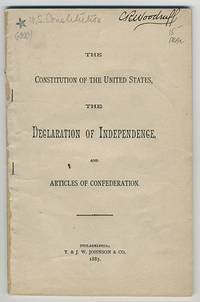
188721542Philadelphia: T. & J. W. Johnson & Co. 1887. 8vo. 46 pp. <br><br>Original wrappers are missing; stapled. Ownership inscription on title-page. Ex-library with rubber-stamp of six-digit inventory number on page 1. T. & J. W. Johnson & Co. unknown books
1814WRCAM44673Milan: Presso Sonzogno e Compagni 1814. 44pp. 19th-century marbled wrappers. Modern bookplate inside front wrapper. A bit of light foxing. Very good. Untrimmed. In a half morocco and cloth folding case spine gilt. Early Italian printing of the United States Constitution preceded in this volume by the Articles of Confederation. This appears to be one of the earliest Italian printings of the Constitution possibly preceded only by a 1797 "Filadelphia" printing. Presso Sonzogno e Compagni hardcover books
1805WRCAM20263ARichmond 1805. viii477pp. 20th-century tan buckram gilt leather labels. Institutional ink stamp and contemporary ink inscription on titlepage ink signature on first page of main text some toning and foxing. Good. Second edition of the Virginia convention to ratify the federal constitution. An important document in the passing and implementation of the U.S. Constitution. Scarce. SHAW & SHOEMAKER 9665 3 copies. hardcover books
1805WRCAM20263Richmond 1805. viii477pp. Original calf worn hinges broken. Minor staining. A sound copy. Second edition of the Virginia convention to ratify the federal constitution. An important document in the passing and implementation of the U.S. Constitution. Scarce. SHAW & SHOEMAKER 9665 3 copies. unknown books
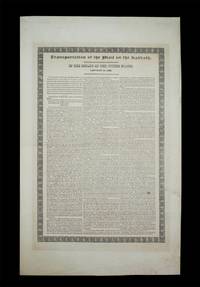
182969246Kentucky 1829. UNITED STATES CONSTITUTION; BROADSIDE. BROADSIDE. Transportation of the Mail on the Sabbath. In the Senate of the United States. Kentucky: 1829.<br> <br> Full Description:<br> <br> UNITED STATES CONSTITUTION. BROADSIDE. Transportation of the Mail on the Sabbath. In the Senate of the United States. Kentucky: January 19 1829.<br> <br> An important and interesting broadside supporting the separate of church in state in so as it applies to the delivery of mail on Sunday the Sabbath. Broadside folio 16 3/4 x 10 1/2 inches; 428 x 266 mm. With a caption title printed above three columns separated by rules. All within a decorative woodcut border. Mounted at the top edge within a portfolio mat. Some minor toning and a few small spots of dampstaining. A One and one half-inch closed tear at right-hand margin just touching the border. Overall very good.<br> <br> This is a significant document in the history of the United States Constitution in relation to the concept of the separation of church and state. Christian leaders demanded that the Government institution of the Postal Office not work on Sunday as their God had deemed this the Sabbath. The following document discusses that while many Christians observe the Sabbath on Sunday others including their Jewish neighbors observe the Sabbath on Saturday. Demanding that the government institution not work on Sunday for religious reasons goes directly against the Constitution. The report states "With these different religious views the committee are of opinion that congress cannot interfere.-It is not the legitimate province of the legislature to determine what religion is true or what false. Our government is a civil and not a religious institution. Our constitution recognizes in every person the right to choose his own religion and to enjoy it freely without molestation. Whatever may be the religious sentiments of citizens and however variant they are alike entitled to protection from the government so long as they do not invade the rights of others." It goes on to powerfully state "Extensive religious combinations to effect a political object are in the opinion of the committee always dangerous. This first effort of the kind calls for the establishment of a principle which in the opinion of the committee would lay the foundation for dangerous innovations upon the spirit of the Constitution and upon the religious rights of the citizens. If admitted it may be justly apprehended that the future measures of government will be strongly marked if not eventually controlled by the same influence. All religious despotism commences by combination and influence; and when that influence begins to operate upon the political institutions of a country the civil power soon bends under it and the catastrophe of other nations furnishes an awful warning of the consequence."<br> <br> The five-person committee for this report consisted of Richard Johnson of Kentucky who later went on to serve as the country's 9th vice president under Martin Van Buren as well as future President John Tyler of Virgina Ellis of Mississippi Silsbee of Massachusetts and Johnson of Louisiana.<br> <br> "The opening of post offices on Sunday led to a national debate about the relationship of the federal government to the Sabbath day. The argument which raged from 1810 to 1830 involved whether the national government would exist as a secular commercial republic committed to a separation of church and state or as a Christian commonwealth. The U.S. postmaster general Gideon Granger responded by persuading Congress in 1810 to pass legislation to open all 2300 post offices seven days a week and transport mail every day. Congress immediately began to receive petitions from numerous religious denominations urging repeal of the law. Under strong public pressure House and Senate committees formed to study the postal law. While the chair of the House committee waffled on the subject the head of the Senate committee swayed Congress to keep the law. Gen. Richard M. Johnson of Kentucky a devout Baptist wrote in the committee's 1829 report that congressional action to stop Sunday mail would be unconstitutional. Johnson reminded Americans that they had religious freedom and that government had no right to coerce the religious homage of anyone. The invention of the telegraph in 1844 ultimately spelled the end of Sunday mail. It was now possible to get market information without the mail system. By the 1850s postmaster generals were eliminating the movement of most mail on Sunday." Free Speech Center Caryn E. Neumann.<br> <br> HBS 69246.<br> <br> $1750. Kentucky unknown
1862129555Zürich, Bürkli, 1862. XVI, 634; XII, 714 S. Neuer Halbleineneinband.
189112319Mayer & Müller, Berlin 1891. 2 Bl., VIII, 342 Seiten mit 56 Holzschnittabbildungen. Halbleder der Zeit. Gering berieben, Kanten beschabt. Etwas gebräunt. Gutes Exemplar. William Thomson (1824-1907), später Lord Kelvin, war einer der herausragenden Physiker des 19. Jahrhunderts. Er führte u.a. die nach ihm benannte Kelvin-Skala ein. Von dem dreibändigen Werk "Popular Lectures and Addresses" ist auf Deutsch nur der erste Ba
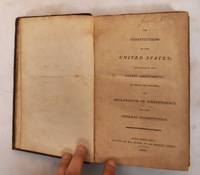
1806184040Philadelphia PA: Wm. Duane 1806. Hardcover. Good- front board nearly split yet firmly held; rattled. boards edge-worn & rubbed; moisture spotted. portion of spine top missing & chipped; tail rubbed torn at edge & flapped. pastedowns & endpapers tanned & foxed w/ pencil notations & names; front pastedown has paper remnants & dampstaining; back pastedown & endpaper has dampstaining to upper edges. pgs 264 to closing have tanned dampstaining to upper edge. leather boards w/ gilt ruled spine & maroon leather gilt printed title plate. 307 pgs. Narrow previous owner's name label to spine. Some instances of dampstaining to lower page edges. Page 166 has black ink spattering to lower text and page edge A few pages darkly tanned with higher concentrations of foxing. Instances of light to moderate foxing throughout; text dark. An uncommon 1806 edition. Wm. Duane hardcover books
1806184040Philadelphia PA: Wm. Duane 1806. Hardcover. Good- front board nearly split yet firmly held; rattled. boards edge-worn & rubbed; moisture spotted. portion of spine top missing & chipped; tail rubbed torn at edge & flapped. pastedowns & endpapers tanned & foxed w/ pencil notations & names; front pastedown has paper remnants & dampstaining; back pastedown & endpaper has dampstaining to upper edges. pgs 264 to closing have tanned dampstaining to upper edge. leather boards w/ gilt ruled spine & maroon leather gilt printed title plate. 307 pgs. Narrow previous owner's name label to spine. Some instances of dampstaining to lower page edges. Page 166 has black ink spattering to lower text and page edge A few pages darkly tanned with higher concentrations of foxing. Instances of light to moderate foxing throughout; text dark. An uncommon 1806 edition. Wm. Duane hardcover
1847CCC-885116. edition Paris, Firmin-Didot, 1847. in-8, 383 pages, broche a faire relie, avec son portrait en frontispice (tache) et un fac-similé depliant de l'art. 92 de la constitution de l'an VIII, bon exemplaire pour l'interieur, couverture abimee et dos dechire, A faire Relie. Taillandier et les anciens amis de Daunou (1761-1840) retrouvèrent dans ses papiers un ouvrage dont ce dernier n'avait rédigé que les deux premiers chapitres. Ils sont publiés dans cette présente édition (pp. 287-309) sous le titre Mémoires pour servir à l'histoire de la Convention nationale augmentés ? par rapport à la précédente de 1841 ? d'un autre texte resté inédit : des Extraits d'un mémoire destiné à ses commettants (pp. 310-61), rédigés alors que Daunou était en prison, qui renferment une histoire de la Convention jusqu'à la chute de Robespierre. Ces fragments seront repris par Barrière en 1848 dans sa Bibliothèque des Mémoires relatifs à l'Histoire de France pendant le XVIIIe siècle. Photos possible
1897307821Basel, Reich, 1897. IV, 80 S. Kart.
18763124925Oxford, Clarendon Press, 1876. XII, 552, 32 S. OLwd (Stempel auf Titel, Bibliotheks-Rückenschild, beide Gelenke angebrochen).
1844434179Bern, Huber (Körber), 1844. VI, 104 S. Hlwd.
18443434179Bern, Huber (Körber), 1844. VI, 104 S. Hlwd.