KLÜBER, Johann LudwigAntiquariat.de

210 résultats
183166668Frankfurt, Andreäische Buchhandlung, 1831. Gr.-8vo. XX, 880 S., 1 Bl. Interimshalbleinen d. Zeit (gelockert, berieben u. bestoßen). [2 Warenabbildungen]
18993454716Paris, Larose et Forcel, 1899. XXVIII, 235 S. Halbleder (mit eingebundener OBroschur) (Stempel auf Titel, Rücken fehlt).
1850610707Braunschweig, Vieweg, 1850-57. XIII S., 1 Bl., 523 S.; VIII S., 1 Bl., 501 S.; X, 734 S. Marmorierte Pappbände d. Zeit mit grünem Rückenschild u. etwas Rückenvergoldung (berieben, Ecken bestoßen, Rückenbezug verblaßt). [2 Warenabbildungen]
188922085Paris Plon, Nourrit et Cie 1889 In-12 XII- 302 pp
1847426390Neubrandenburg, Brünslow, 1847. 82 S. OBroschur (letztes Blatt ausgebessert). .
18473426390Neubrandenburg, Brünslow, 1847. 82 S. OBroschur (letztes Blatt ausgebessert). .
18803150140Wien, Konegen, 1880. X, 341 S. Halbleder der Zeit (Exlibris).
1867486525Tübingen, Fues, 1867. 28 S. Provisorisch geheftet . Gr.-8vo. (Stempel auf Titel).
1878106101Leipzig, Duncker und Humblot, 1878. XX, 355 S. Lwd (Stempel auf Titel).
1818168421München, in der Expedition des Gesetz- und Allgemeinen Intelligenzblattes, 1818. 414 S., 1 Bl. Marmorierter Halbleder d. Zeit mit goldgeprägtem Rückentitel (gering berieben). [2 Warenabbildungen]
188181791Hamburg, Druck von H. Ph. Birkmann, ( 1881). 41 S. 12mo. 14 cm. Bedruckter Karton d. Zt..
180716802Berlin u. Leipzig, (Sander), 1807. XIV, 400 S. Umschlag d. Zeit (berieben, Rückenbezug gebrochen, Buchblock am Schluß lose). [2 Warenabbildungen]
18323093482Leipzig, Kummer, 1832. 251 S. Interimsbroschur (ungeschnitten, Stempel auf Titel).
18489256Paris Michel Lévy Frères 1848 In-16 63 pp, 4ème de couv. salie, dos légèrement frotté, rares rousseurs.
181431241Moronval A Paris, Moronval 1814. In-8 en feuillets de 13 pages.
1825392894Berlin, Duncker & Humblot, 1825. XV, 350 S. Moderner Halbleineneinband im Stil der Zeit (Originalumschlag mit eingebunden, Umschlag mit Spuren von Bibliotheksschild)
1844426375Breslau, Korn, 1844. 60 S. Originalbroschur.
18443426375Breslau, Korn, 1844. 60 S. Originalbroschur.
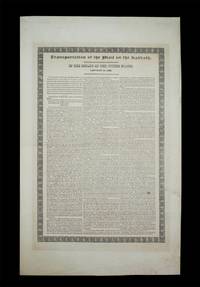
182969246Kentucky 1829. UNITED STATES CONSTITUTION; BROADSIDE. BROADSIDE. Transportation of the Mail on the Sabbath. In the Senate of the United States. Kentucky: 1829.<br> <br> Full Description:<br> <br> UNITED STATES CONSTITUTION. BROADSIDE. Transportation of the Mail on the Sabbath. In the Senate of the United States. Kentucky: January 19 1829.<br> <br> An important and interesting broadside supporting the separate of church in state in so as it applies to the delivery of mail on Sunday the Sabbath. Broadside folio 16 3/4 x 10 1/2 inches; 428 x 266 mm. With a caption title printed above three columns separated by rules. All within a decorative woodcut border. Mounted at the top edge within a portfolio mat. Some minor toning and a few small spots of dampstaining. A One and one half-inch closed tear at right-hand margin just touching the border. Overall very good.<br> <br> This is a significant document in the history of the United States Constitution in relation to the concept of the separation of church and state. Christian leaders demanded that the Government institution of the Postal Office not work on Sunday as their God had deemed this the Sabbath. The following document discusses that while many Christians observe the Sabbath on Sunday others including their Jewish neighbors observe the Sabbath on Saturday. Demanding that the government institution not work on Sunday for religious reasons goes directly against the Constitution. The report states "With these different religious views the committee are of opinion that congress cannot interfere.-It is not the legitimate province of the legislature to determine what religion is true or what false. Our government is a civil and not a religious institution. Our constitution recognizes in every person the right to choose his own religion and to enjoy it freely without molestation. Whatever may be the religious sentiments of citizens and however variant they are alike entitled to protection from the government so long as they do not invade the rights of others." It goes on to powerfully state "Extensive religious combinations to effect a political object are in the opinion of the committee always dangerous. This first effort of the kind calls for the establishment of a principle which in the opinion of the committee would lay the foundation for dangerous innovations upon the spirit of the Constitution and upon the religious rights of the citizens. If admitted it may be justly apprehended that the future measures of government will be strongly marked if not eventually controlled by the same influence. All religious despotism commences by combination and influence; and when that influence begins to operate upon the political institutions of a country the civil power soon bends under it and the catastrophe of other nations furnishes an awful warning of the consequence."<br> <br> The five-person committee for this report consisted of Richard Johnson of Kentucky who later went on to serve as the country's 9th vice president under Martin Van Buren as well as future President John Tyler of Virgina Ellis of Mississippi Silsbee of Massachusetts and Johnson of Louisiana.<br> <br> "The opening of post offices on Sunday led to a national debate about the relationship of the federal government to the Sabbath day. The argument which raged from 1810 to 1830 involved whether the national government would exist as a secular commercial republic committed to a separation of church and state or as a Christian commonwealth. The U.S. postmaster general Gideon Granger responded by persuading Congress in 1810 to pass legislation to open all 2300 post offices seven days a week and transport mail every day. Congress immediately began to receive petitions from numerous religious denominations urging repeal of the law. Under strong public pressure House and Senate committees formed to study the postal law. While the chair of the House committee waffled on the subject the head of the Senate committee swayed Congress to keep the law. Gen. Richard M. Johnson of Kentucky a devout Baptist wrote in the committee's 1829 report that congressional action to stop Sunday mail would be unconstitutional. Johnson reminded Americans that they had religious freedom and that government had no right to coerce the religious homage of anyone. The invention of the telegraph in 1844 ultimately spelled the end of Sunday mail. It was now possible to get market information without the mail system. By the 1850s postmaster generals were eliminating the movement of most mail on Sunday." Free Speech Center Caryn E. Neumann.<br> <br> HBS 69246.<br> <br> $1750. Kentucky unknown
1885488691Paris, Pichon, 1885. VI, 933 S. Halbleder der Zeit (Stempel auf Titel, Rücken fehlt).
1862HIST0222Prag, Tempsky 1862. 44 S., Priv. Buntpapiereinbd., geringe Gebrauchsspuren, Innentit. gestemp. Stellungnahme zum Februarpatent womit man die Verfassung im Kaisertum Österreich aus dem Jahr 1861 bezeichnet.
1825ALEX238Printed by John S. Wiestling Harrisburg: . 1825 pp. 2 i-v 1 9-384 iv Index. Foxed. Browned. Light dampstain on top margins. Uncut. Deckle edges. Tall 8vo. 235 mm. Original paper boards binding stained; boards detached; spine perished. Title continues: 'Together With The Charter To William Penn The Constitutions of 1776 and 1790 And A View Of The Proceedings Of The Convention Of 1776 And The Council Of Censors.' 'The object of the compilers of this volume is to present to the people of Pennsylvania the constitutions of the province and the commonwealth and the mode and manner in which the several changes in the frame of government were made.' Aid in compiling this important historical survey was rendered by the printer publisher John S. Wiestling and Francis Rawn Shunk who served as Governor of PA 1845 to 1848. Its parts includes: a reprint of the Charter granted to William Penn; Early government frames from 1682 1683 1696 and 1701 and laws agreed upon in England in 1682; the Convention of 1776; the later Convention of 1789-1790 the first and second sessions and the Constitution of 1790. The final part reprints the Act of the 28th March 1825 for ascertaining the opinion of the people of this commonwealth relative to the call of a new constitutional convention'. Hardbound. Text good. S&S/AI 21819. PAIMP 22. Hardcover. Printed by John S. Wiestling, Harrisburg: . hardcover
18943462420London, Parker, 1894. XIII, 226 S. Mit Falttafel. OLwd (Stempel auf Titel, Bibliotheks-Rückenschild).
1897462409New York, MacMillan, 1897. XXIII, 534 S. OLwd (Stempel auf Titel, Bibliotheks-Rückenschild).
18953462301London, Sampson Low Marston, 1895. VIII, 552 S. OLwd (Stempel auf Titel, Bibliotheks-Rückenschild).