Wisconsin ConstitutionBiblio.com
264 résultats
1168701112.Ghardcover. Good. Access codes and supplements are not guaranteed with used items. May be an ex-library book. hardcover
1169010210.Ghardcover. Good. Access codes and supplements are not guaranteed with used items. May be an ex-library book. hardcover
0656402067.Ghardcover. Good. Access codes and supplements are not guaranteed with used items. May be an ex-library book. hardcover
20032090202118106027Iwanami Shoten Iwanami Shinsho 2003. Soft Cover. Fine. The book is in fine condition. Iwanami Shoten Iwanami Shinsho paperback
0332559637.Ghardcover. Good. Access codes and supplements are not guaranteed with used items. May be an ex-library book. hardcover
0332559467.Gpaperback. Good. Access codes and supplements are not guaranteed with used items. May be an ex-library book. paperback
1168180805.Ghardcover. Good. Access codes and supplements are not guaranteed with used items. May be an ex-library book. hardcover
1378073223.Gpaperback. Good. Access codes and supplements are not guaranteed with used items. May be an ex-library book. paperback
1334444986.Gpaperback. Good. Access codes and supplements are not guaranteed with used items. May be an ex-library book. paperback
18501229871850. First Edition. CONSTITUTION SPOONER Lysander. A Defence for Fugitive Slaves Against the Acts of Congress of February 12 1793 and September 18 1850. Boston: Bela Marsh 1850. Octavo original wrappers; pp. 1-2 3-4. i-iv 5 6-72. $3200.First edition of the rogue abolitionist's provocative call for ""vigorous"" public resistance to a pattern in the 1793 and 1850 Acts and court decisions such as Prigg v. Pennsylvania that demonstrated the government's refusal ""to champion liberty or justice"" especially elusive in original wrappers.The 1850 Fugitive Slave Act ""exposed the futility of antislavery constitutionalism grounded in a commitment to the 'proper rules of interpretation'"" Knowles Seeing the Light 544. It ""evinced a clear congressional policy favoring harsh and summary enforcement of the rendition policy over any solicitude for procedural or substantive rights of alleged fugitives"" Cover Justice Accused 121. Spooner crafted his answer to this in a ""devastating critique"" of both the 1793 and 1850 laws Smith Lysander Spooner. Defence one of his most elusive and provocative works offers ""significant evidence of the ways in which the passage of the 1850 Fugitive Slave Act shook his faith in the ability of the nation's courts to interpret the constitution in a manner consistent with the dictates of natural justice"" Knowles 546. Closely analyzing ""reasons why the 1793 and 1850 laws were unconstitutional he made it very clear why the passage of the 1850 law pushed him away from the 'quiet argument' of the courtroom to 'more vigorous'"" public action. In Defence while he continued to argue the importance of ""procedural objections to the laws Spooner spent far greater time 1 explaining why the courts would not actually strike down either of the laws and 2 outlining 'The Right of Resistance': ways in which 'The People' could respond to what he now recognized as the 'ugly reality' of proslavery constitutionalism."" He notably pointed to ""the 1842 decision in Prigg v. Pennsylvania in which the Supreme Court held that under the Constitution's Supremacy Clause the 1793 Fugitive Slave Act trumped Pennsylvania's personal liberty law which had made it far more difficult for slaveholders to recover individuals they alleged were fugitive slaves In the face of this judicial reality and to ensure the 'maintenance' of the Constitution Spooner encouraged popular resistance"" arguing the Second Amendment ""gave 'The People' an absolute and unqualified' Constitutional 'right' to do so."" By 1860 he would utterly lose ""faith in the ability or willingness of the government especially the courts to champion either liberty or justice"" Knowles 545 552. First edition: as issued with printing of 1793 Act of Congress and 1850 Fugitive Slave Act preceding title page; front and rear wrapper interior with publisher's advertisements. Sabin 89607. Work 335. Text very fresh a few minor stains to front wrapper expert repairs to wraps on the spine. Near-fine. paperback
1390628493.Gpaperback. Good. Access codes and supplements are not guaranteed with used items. May be an ex-library book. paperback
1024252329.Ghardcover. Good. Access codes and supplements are not guaranteed with used items. May be an ex-library book. hardcover
1024256537.Gpaperback. Good. Access codes and supplements are not guaranteed with used items. May be an ex-library book. paperback
1175996009.Gpaperback. Good. Access codes and supplements are not guaranteed with used items. May be an ex-library book. paperback
036503519X.Gpaperback. Good. Access codes and supplements are not guaranteed with used items. May be an ex-library book. paperback
0365036587.Ghardcover. Good. Access codes and supplements are not guaranteed with used items. May be an ex-library book. hardcover
1024400425.Ghardcover. Good. Access codes and supplements are not guaranteed with used items. May be an ex-library book. hardcover
19962090502113707457Not Available 1996. Soft Cover. Fine. The book is in fine condition. Not Available paperback
20062090502113717137Not Available 2006. Soft Cover. Fine. The book is in fine condition. Not Available paperback
20062090502113717135Not Available 2006. Soft Cover. Fine. The book is in fine condition. Not Available paperback
1396202870.Ghardcover. Good. Access codes and supplements are not guaranteed with used items. May be an ex-library book. hardcover
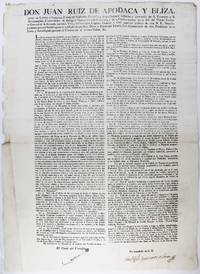
18203330Mexico City: July 11 1820. About very good. Large double-sheet broadside approximately 23.5 x 17 inches. Two sheets joined at central horizontal fold. Five chips at left edge not affecting text and some additional minor edge wear; otherwise light toning and dust soiling. Two contemporary manuscript signatures at foot; contemporary duty stamps on blank verso. Fascinating and otherwise unrecorded broadside that dictates the organization and process for the 1820 election of Mexican deputies to the Spanish Cortes during the second and last period of constitutional monarchy in Mexico. Colonial Mexico first achieved some representation in the Spanish government under the liberal Constitution of 1812 which lasted for two years before being revoked by Ferdinand VII upon his return to power in 1814. The reinstatement of the liberal constitution and the Cortes of Cadiz in 1820 however was not enough to prevent Mexico from obtaining full independence one year later. This broadside promulgated in Mexico on July 11 1820 by the colonial Viceroy Juan Ruiz de Apodaca y Eliza announces the renewed representation via regional elections to select Provincial Deputies for the Cortes and contains eight articles delineating the process by which these elections are to be held. In brief these articles order representation be apportioned according to the population as approximated from the 1792 census; divides Mexico into provinces for the purposes of the election; and places parameters on representation for each province. In all a very interesting window onto the formation of the brief final period of Spanish colonial rule in Mexico. July 11 unknown