385 résultats
58 pages. This very special issue contains part 1 (of 2) of "I Killed the Czar - at last the truth of history's most famous and mystery-shrouded massacre - On his deathbed one of the actual assassins (Peter Zacharovitch Ermakov) breaks his long silence". Fortuitously, when we acquired this copy we were thrilled to discover that laid-in are pages 39-48 of the August 3, 1935 issue, containing the entirety of part 2 of this important article. Other features include: Public Sweetheart Number One - Part III; The Case of the Caretaker's Cat - Part VII; Inside the Number Racket - what lies behind America's most amazing case of gambling fever?; Times Have Changed in Tennis - now it's a spotlight for chiselers!. Short stories include: The God-Inspired Idiot; The Donkey with a Lion's Heart; Love Letters of a Prizefighter and a Hollywood Extra; Flight. Many ofther features. Ads include: Wrigley's Gum, Spud Cigarettes; Pontiac Six (very nostalgic red and black one-page ad), Goodyear tires, Dentyne Gum; Pennzoil; Nice color back cover ad for Chesterfield Cigarettes features Turkish girl preparing tobacco leaves for baling. Above-average wear. Contents yellowed with age. A worthy copy of this historically important issue. Book
62 pages. Features: Nice one-page photo ad for the Dodge Six car; Are You Taxe Exempt? - editorial argues against Canada's 'soak the rich' income tax system in favour of broadening the tax base as is done in Great Britain, resulting in 'the most intelligent citizenship within the empire'; Gaston B. Means - Master Bad Man - The Whole Inside Story of One of the Most Bizarre and Baffling Careers of Crime; Diamonds are Dangerous (short story); The Open Heart (romantic fiction); Nice one-page photo ad for the 1937 Studebakers; Love-Song for Supper (romantic fiction); From Invalid to Champion - Alice Marble, the new queen of tennis, tells her story; It Can Happen Again - Fascinating article by George Sylvester Viereck relies upon his information from former Kaiser Wilhelm (with photo) to warn that "behind the scenes in Europe's capitals the same elements (as in WWI) are conspiring to plunge civilization into the hell of a general war."; To the Ladies; News of Kitchener (military fiction); Why Glamour-Girls Don't Marry Great Lovers - And Vice Versa; Nice two-colour ad for the Easy Vacuum-Cup Washer; Bojangles of Harlem - Meet Bill Robinson, grandson of a slave who has earned $1,000,000 - article with photo; Secret Child (part 3); Great vintage photo ad for Feen-a-mint laxative chewing gum; Unusual two-color Kleenex ad shows wife scolding husband (who has cold) for soiling so many cloth handkerchiefs; Discretion Be Damned (fiction); Back cover ad for Goodrich tires features photo of S.S. Van Dine; and more. Moderate wear. Crossword partially completed in light pencil on page 56. Binding intact. A sound copy of this great vintage issue. Magazine
54 pages. Features: Attractive cover illustration of lady in swimwear; Let's Have Direct Relief for Our Real Forgotten Man - Editorial against high real estate taxes; Death Looks for Cinderella (part 1); Is Father Coughlin Anti-Semitic? - His Own Answer - article with photo; Country Club Scandal (short story); I Was a Showman Too - Volatile Ex-New York Mayor James J. Walker talks of brass bands and ballyhoo; Hearts in Danger (fiction); How to Win Sick Friends and Influence Them - flowers are lovely but show a little originality!; The Good Earth Answers (pioneer family fiction); Purge in Hot Springs (conclusion); Matinee Today (short story); To the Ladies; Hell's Bargainers - Traitors to the Law - Sam Leibowitz exposes the method of lawyer-criminals; Rancher-Artist Augustus (Gus) Kenderdine - candidate for the Canadian Hall of Fame (article with photo); Tennis is a Dub's Game - words of cheer from champion Helen Hull Jacobs; Toronto's Royal York Hotel is featured prominently inside back cover; Colour back cover ad for the Physical Culture Hotel, Dansville, New York. Somewhat above-average external wear. Light pencil doodling to cartoon on page 46 and art contest blank on page 51. Binding intact. A sound copy of this wonderful vintage issue. Magazine
20066216Actes Sud Fort Volume broché format 13x24cm , couverture illustrée de la maison , ensemble dense, 670 pages. Très bon état.
2006780962006 Editions Actes Sud 2006 - In-8 broché - 669 pages
363 pages. Signed and inscribed by author atop half-title page. Text in French. First edition of what was printed in English in 1935 with the title Black Hand Over Europe. "... An appalling expose of the situation of the national minorities in the Balkans and in Central Europe (which) tried heroically to call to the attention of the French people the dangers to which France and all Europe were exposing themselves should France continue to finance and support the criminal and ambitious political parties of the Little Entente, and especially of Yugoslavia... The book is prohibited in the Little Entente, Greece and Turkey, and in Yugoslavia; any government official or employee apprehended reading the book is given five years of hard labour." - from Translator's note to the English Edition. "Two months after the publication of my book the Supreme Court of Belgrade sentenced me by default to twenty years of hard labour and the White Hand (the Panserb terrorist and military organization) sentenced me to death." - from Author's Preface to the English Edition. Prior owner's name and date pencilled atop title page. Average wear. Binding intact. A sound copy of this important work. Book
18999Les éditions félix, 2000. Fort volume dans une reliure forte cartonnée illustrée noire, 693 pages. Très bon état à neuf.
2016899842016 Editions L'Archipel, 2016 - In-8 broché - 499 pages
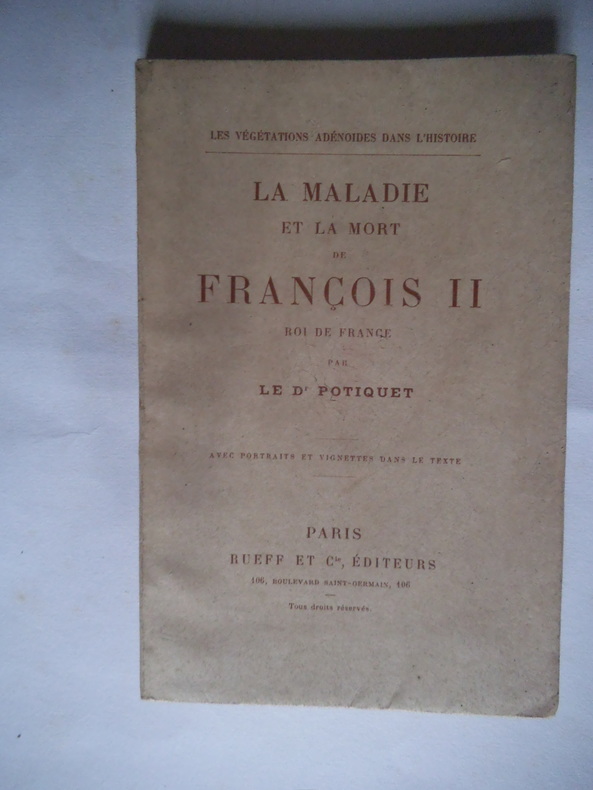
11704In 12 broché, couverture rempliée, faux-titre, titre, IV, 103 pages, portraits et vignettes dans le texe Paris Rueff & Cie éditeur, sans date. Très bon état.
44362Les Belles Lettres.1989.In-8,cartonnage éditeur. TBE.
1979100149561Editions du Thabor 1979 in8. 1979. Broché. Cet ouvrage historique d'Yves du Menga examine la Conjuration bretonne de 1791 présentée comme l'origine de la Chouannerie. L'auteur affirme que ce soulèvement breton distinct de la Vendée fut proche de la victoire et que Jean Chouan en était un acteur. Le livre se présente comme une révélation d'une vérité occultée par les récits officiels
1st UK edition. VG paperback. 40475. eng
137 pages. Signed and inscribed by author inside front cover. "An in-depth look at the Jewish and Israel Identity Question from a Scriptural and Historical perspective." - subtitle. Prior owner's name atop front cover. Some underlining. Average wear. Binding intact. A sound copy. Book
752 pages including index. Former owner's inkstamp upon title page. Offers sensational new evidence and expert witnesses to contradict The Journal of the American Medical Association articles that have attempted to bolster the long discredited conclusions reached by the Warren Commission. In perhaps the most stunning revelation, this book presents a shocking case against certain well-known assassination researchers for fraud and misrepresentation that has aided the cover-up. Details the actual nature of the conspiracy that killed President Kennedy and names those who orchestrated it. Book
[Storia Kennedy](cm. 17.8) brossura editoriale figurata, -pp. 662+ 2 inserti fotografici con diverse immagini in nero di personaggi coinvolti nella vicenda dell'assassinio del presidente Kennedy. La prima pagine contiene l'immagine fotografica del Presidente prima dell'autopsia, fu mostrata negli stati uniti in televisione per la prima volta nel 1988. nel testo anche una mappa della zona dove avvenne l'omicidio e un immagine che mostra il punto della nuca dove fu colpito. Esaustiva indagine su dettagli trascurati che potrebbero far pensare ad una cospirazione. Minimi segni del tempo, dorso in ottime condizioni nonostante lo spessore piuttosto alto. Testo in inglese. [n32] Libro
322 pages. Translated from the first Russian edition. Contents include: Jews in the land of Kiev Russia and the Moscow State; The first Jews in Russia; The further growth rate of Jews in Russia; Politics of the Russian Government with regard to the Jewish question; How Jewish capital was created in Russia; The social structure of Russian Jewry; Jewish participation and their role in the cultural life of Russia; Jews in Russian literature and criticism; Jews - Russian lawyers; Russian Jewry at the beginning of the twentieth century; The Balis Affair; The Jewish question from February to October 1917; Jews in USSR; Personal-national autonomy; Thirty-year total; The war years; The post-war period; The state of Israel and the problem of double citizenship; Supplements I and II. Apparently the author self-published a first English edition in New York in 1967. This copy may be a later reprint as a small Truth Seeker address label has been placed over original text on the copyright page. Regardless, this copy appears to be circa 1970s or prior. Brown stains to lower portion of back cover modestly affect last three pages - text unaffected. Binding intact. Unmarked. A sound copy. Book
12mo; 1st edition. Original paper wrappers, 12mo, 255 pages. 20 cm. Singerman 0118: This set is "The most well-known American contribution to the literature of anti-Semitism." Henry Ford, a noted anti-semite, had a close association with Dearborn, MI. Ford did not write the articles. He expressed his opinions verbally to his executive secretary, Ernest Liebold, and to William J. Cameron. Cameron had the main responsibility for expanding these opinions into article form. Liebold was responsible for collecting more material to support the articles. The Dearborn Independent, also known as The Ford International Weekly, was a weekly newspaper established in 1901, and published by Henry Ford from 1919 through 1927. The paper reached a circulation of 900,000 by 1925, second only to the New York Daily News, largely due to a quota system for promotion imposed on Ford dealers. Lawsuits regarding antisemitic material published in the paper caused Ford to close it, and the last issue was published in December 1927. The publication's title was derived from the Detroit suburb of Dearborn, Michigan. Derived largely from information found posted on line: Convinced that "bankers" and "the Jews" were responsible for a whole range of things he didn't like, from the world war to short skirts to jazz music, Henry Ford used his newspaper, the Dearborn Independent, to carry on an active anti-Semitic campaign. Between 1920 and 1922 a series of articles denounced all things Jewish. While officially apologizing for the articles in 1927, Ford's anti-Jewish sentiments ran deep. In January 1919, Henry Ford began publication of the Dearborn Independent, a small community weekly he had purchased the previous year. Carrying the subtitle, The Chronicler of the Neglected Truth, the paper primarily served as a forum for Henry Ford's views. Each issue of the Independent carried "Mr. Ford's Own Page," an editorial expressing his opinions, written by William J. Cameron. The Ford Motor Company pressured car dealers to buy multiple subscriptions and hand out copies to customers. The newspaper was popular, and circulation reached 900,000 in 1926. The Dearborn Independent would, most likely, have remained a sidebar in Ford's biography were it not for a controversial series that began on May 22, 1920 and lasted for several years. Appearing on the front page every week, "The International Jew: The World's Problem" examined a purported conspiracy launched by Jewish groups to achieve world domination. The basis for the articles was a notorious forgery, The Protocols of the Elders of Zion, an anti-Semitic hoax, first published in Russia in 1903. Many have accused Ford's personal secretary, Ernest Liebold, of being the source of the campaign, and Liebold's anti-Semitic views are well documented. William Cameron, editor of the Independent, was an enthusiastic supporter of the publication of the anti-Semitic diatribes. However, Ford's own attitudes towards Jews were the major reason for the publication of "The International Jew." His anti-Semitic beliefs formed along several strands from his upbringing, attitudes, and personal beliefs. A common stereotype at the time led some people to assume that Jews controlled the international banking system; that belief may have fed his anti-Jewish feelings. The publication of "The International Jew" caused an uproar. In some quarters, such as anti-immigrant and nativist groups, the series confirmed their own beliefs. Others were appalled by the series, published demands for a retraction, removed the paper from public libraries, and promoted a boycott of Ford automobiles. Some Ford dealers refused to carry the paper. Responding to this pressure, Ford halted publication of the anti-Jewish series in January 1922, only to start it up again less than a year later. Some wear at spine, about Very Good- condition. (HOLO2-63-21A)
12mo; 1st edition. Original green cloth, 12mo, 255 pages. 20 cm. Singerman 0118: This set is "The most well-known American contribution to the literature of anti-Semitism." Henry Ford, a noted anti-semite, had a close association with Dearborn, MI. Ford did not write the articles. He expressed his opinions verbally to his executive secretary, Ernest Liebold, and to William J. Cameron. Cameron had the main responsibility for expanding these opinions into article form. Liebold was responsible for collecting more material to support the articles. The Dearborn Independent, also known as The Ford International Weekly, was a weekly newspaper established in 1901, and published by Henry Ford from 1919 through 1927. The paper reached a circulation of 900,000 by 1925, second only to the New York Daily News, largely due to a quota system for promotion imposed on Ford dealers. Lawsuits regarding antisemitic material published in the paper caused Ford to close it, and the last issue was published in December 1927. The publication's title was derived from the Detroit suburb of Dearborn, Michigan. Derived largely from information found posted on line: Convinced that "bankers" and "the Jews" were responsible for a whole range of things he didn't like, from the world war to short skirts to jazz music, Henry Ford used his newspaper, the Dearborn Independent, to carry on an active anti-Semitic campaign. Between 1920 and 1922 a series of articles denounced all things Jewish. While officially apologizing for the articles in 1927, Ford's anti-Jewish sentiments ran deep. In January 1919, Henry Ford began publication of the Dearborn Independent, a small community weekly he had purchased the previous year. Carrying the subtitle, The Chronicler of the Neglected Truth, the paper primarily served as a forum for Henry Ford's views. Each issue of the Independent carried "Mr. Ford's Own Page," an editorial expressing his opinions, written by William J. Cameron. The Ford Motor Company pressured car dealers to buy multiple subscriptions and hand out copies to customers. The newspaper was popular, and circulation reached 900,000 in 1926. The Dearborn Independent would, most likely, have remained a sidebar in Ford's biography were it not for a controversial series that began on May 22, 1920 and lasted for several years. Appearing on the front page every week, "The International Jew: The World's Problem" examined a purported conspiracy launched by Jewish groups to achieve world domination. The basis for the articles was a notorious forgery, The Protocols of the Elders of Zion, an anti-Semitic hoax, first published in Russia in 1903. Many have accused Ford's personal secretary, Ernest Liebold, of being the source of the campaign, and Liebold's anti-Semitic views are well documented. William Cameron, editor of the Independent, was an enthusiastic supporter of the publication of the anti-Semitic diatribes. However, Ford's own attitudes towards Jews were the major reason for the publication of "The International Jew." His anti-Semitic beliefs formed along several strands from his upbringing, attitudes, and personal beliefs. A common stereotype at the time led some people to assume that Jews controlled the international banking system; that belief may have fed his anti-Jewish feelings. The publication of "The International Jew" caused an uproar. In some quarters, such as anti-immigrant and nativist groups, the series confirmed their own beliefs. Others were appalled by the series, published demands for a retraction, removed the paper from public libraries, and promoted a boycott of Ford automobiles. Some Ford dealers refused to carry the paper. Responding to this pressure, Ford halted publication of the anti-Jewish series in January 1922, only to start it up again less than a year later. Small spine label, library bookplate, pocket on rear blank pastedown, light wear to cloth, Text pages all very clean, no other markings, Gery Good- Condition. (HOLO2-63-21G)
19102092902140314607Moto Makoto-sha 1910. Soft Cover. Fine. Number of books: 2 Moto Makoto-sha paperback
19062092902140314609Moto Makoto-sha 1906. Soft Cover. Fine. Number of books: 2 Moto Makoto-sha paperback
19082092902140309242Moto Makoto-sha 1908. Soft Cover. Fine. Number of books: 2 Moto Makoto-sha paperback
19102092902140314606Moto Makoto-sha 1910. Soft Cover. Fine. Number of books: 2 Moto Makoto-sha paperback
19112080502106601848Moto Makoto-sha 1911. Soft Cover. Fine. Number of books: 2 Moto Makoto-sha paperback
19112092902140314608Moto Makoto-sha 1911. Soft Cover. Fine. Number of books: 2 Moto Makoto-sha paperback
xiv, 280 p. col. front., illus. (plans) plates, ports., fascims. 24 cm. Hardcover Very good condition