185 résultats
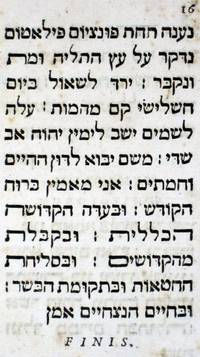
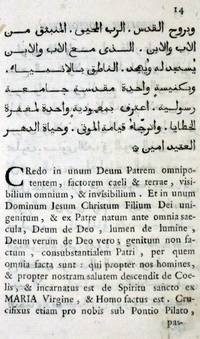
17871004671787. Rome Typis. Sac. Cong. de Propaganda Fide 1787. xvi including one blank leaf 62pp. With one folding plate and several decorative woodcut ornaments and initials. All texts within decorative borders. Later marbled boards with green titleshield on spine. Edges stained red. Several pages browned but a very good and clean copy. Lacks the last leaf. The Alphabetum is written by Melchior Carpanius here revised by Cajetanus Mantegatius and the introduction by the editor Johannes Christopher Amaduzzi. Second edition first 1776 of the first work to be printed in Burmese characters. The types were partly recast in this edition. Birrell & Garnett 21. Cordier BI 351. Herbert & Milner: "South-East Asia. Languages and literatures" pp. 9. Smitskamp PO 209. hardcover
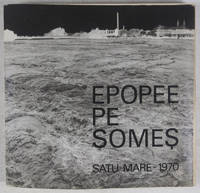
197141621Oradea: Crisana 1971. First edition. Softcover. f to vg. Large octavo 8 1/2 x 8 3/4". Unpaginated. Original photo-illustrated wrappers.<br /> <br /> Gripping photo-illustrated chronicle of the May 1970 disastrous flooding which occured in Satu Mare the capital of Satu Mare county in Nortwest Romania on the Somes River. The natural disaster caused the death of over 200 people thousands of livestock and damaged and destroyed many homes industrial plants agricultural lands tools and infrastructure.<br /> <br /> Some creasing to wrappers. Slight age-toning along paper margin. Text and captions in Romanian Summary text at rear in English French German and Russian. Wrappers in overall fair to good- interior in good to very good condition. Crisana unknown
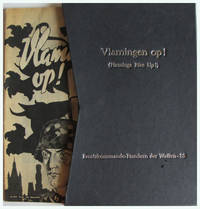
19401867n/a: Publisher: SS Propaganda Kompanie Franz von Immerseel 1940s 1940. Soft cover. Very Good. Vlamingen op! Flemings Rise up! Waffen-SS Recruitment booklet for Flanders Belgium. Publisher: SS Propaganda Kompanie Franz von Immerseel 1940s. Illustrated card covers size 15 x 23 cms 30 pages of text illustrations and b/w photographs. Original edition in very good condition. A08.1086. Nr.1867. <br/> <br/> Publisher: SS Propaganda Kompanie Franz von Immerseel, 1940s paperback
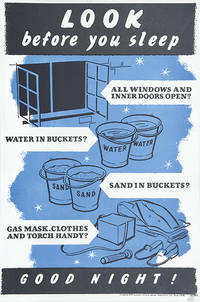
1941173613London: Printed for H.M. Stationery Office by Johnson Riddle & Co. Ltd 1941. A poster produced during the Blitz to remind civilians to be ready each night for their home being hit by bombs - to leave windows open to escape have water and sand in buckets ready to fight fire and to have gas masks clothes and a torch ready. Offset lithograph 379 x 253 mm. Inky finger-print at bottom right. In very good condition. hardcover
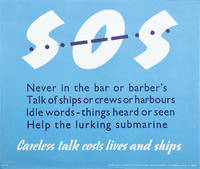
1939173607London: Printed for H.M. Stationery Office by Lowe & Brydone Printers Ltd 1939. One of the series of "careless talk" posters produced by the British government during the Second World War appealing for the public to avoid discussing shipping: "Never in the bar of barber's talk of ships or crews or harbours. Idle words things heard or seen help the lurking submarine". Offset lithograph 298 x 252 mm. Very light rubbing and creasing. An excellent copy. unknown
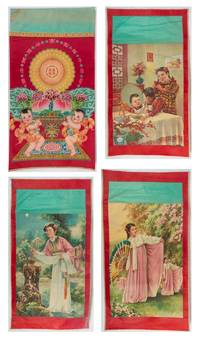
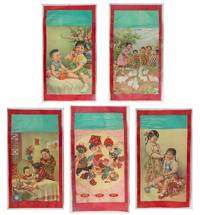
1960217263Circa1960s. Collection of four colour-printed Nianhua posters three of the central images onlaid within a stiff red paper border with a thin cream paper frame worn and discoloured and at the top of each a fine aqua paper border one without a red border; the sheets a little creased one of the images with a visible tide-mark minor edge tears not affecting the images strengthened neatly on the verso with washi three approx. 93 x 51.5cms sheet size one slightly smaller 58 x 43.5cms in good condition. Four Nianhua posters at least one dating from the Great Leap Forward. In this example a sister braids her hair whilst minding her crawling toddler brother "Sweet Heart". On the wall a poster depicts the industrialisation of agriculture "Agriculture is the foundation of the national economy and grain is the foundation" caption. Two others feature traditional narrative tales and one other features a pair of chubby toddlers holding a tray of peaches and flowers symbols of longevity and abundance. . unknown
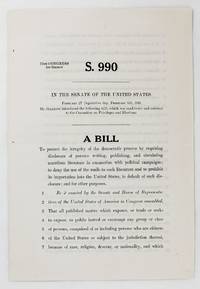
19415699Washington DC 1941. Very good plus. 51pp. Original self wrappers. Soft horizontal crease. A slip-bill printing of the Gillette Propaganda Exposure Bill of 1941 proposed by Iowa Senator Guy Gillette. The bill sought "to protect the integrity of the democratic process by requiring disclosure of persons writing publishing and circulating scurrilous literature in connection with political campaigns; to deny the use of the mails to such literature and to prohibit its importation into the United States in default of such disclosure; and for other purposes." The text of the bill opens by attempting to outlaw "all published matter" which causes "public hatred or contempt" for any American citizen "because of race religion descent or nationality" during national elections and those in Hawaii Alaska and Puerto Rico. The bill also sought to establish an Office of Minority Relations to enforce the law and provided penalties to anyone breaking the new law. The final line of the bill states that it should be referred to as the "Propaganda Exposure Act 1941." Calling for honesty fairness and equal treatment in American political elections It'll never pass and it didn't. unknown
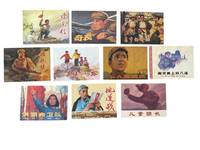
1963233101963. Post-Revolution ChinaCommunism PRC Cultural Revolution propaganda set of 10 lianhuanhua graphic novel booklets issued by the PRC propaganda press system between 1963 and 1984 centered on the culture revolution model soldiers anti-Japanese resistance and child heroism. The covers name campaigns and exemplary figures through titles including Chicken Feather Letter Surprise Attack Tunnel Warfare Honghu Red Guards Good Eighth Company on Nanjing Road Heroic Little Eighth Route and Capture the Enemy Flag while the interior pages state explicitly political morals like "The deepest source of the power of war lies among the masses" followed by "Revolutionary war is a mass war." Another photographed page frames sacrifice as Maoist instruction declaring: "Thousands upon thousands of martyrs for the interests of the people laid down their lives heroically before us; let us hold high their banner and advance along the path marked by their blood!"<br /> Illustrated PRC propaganda comic booklets. China: various provincial PRC presses 1963-1984. Set of 10 illustrated booklets each approximately 4 x 5 inches ranging from about 60 to 200 pages. Titles include Chicken Feather Letter Surprise Attack Tunnel Warfare Honghu Red Guards Good Eighth Company on Nanjing Road Heroic Little Eighth Route and Capture the Enemy Flag. The photographed title and colophon pages place the group across multiple provincial publishing systems including presses in Beijing Shanghai Zhejiang Shandong Tianjin Liaoning and Shaanxi. The booklets were designed for mass distribution using narrative episodes of soldier heroes and youth protagonists to glorify CCP ideology.<br /> These booklets were a central tool through which the PRC circulated revolutionary history and Maoist political language to mass readers especially younger readers in cheap durable heavily illustrated form. The concentration here on anti-Japanese struggle disciplined PLA units local militia action and heroic children gives the set a distinct documentary value as evidence of CCP socialist pedagogy across two decades. Clean complete and in very good condition. These 10 booklets preserve the language and narratives by which the Cultural Revolution propaganda system distributed CCP ideology to mass readership. unknown
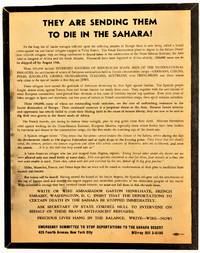
1941189981941. Broadside issued in 1941 by the Emergency Committee to Stop Deportations to the Sahara Desert articulating an urgent appeal against the forced deportation of anti-fascist refugees by the Vichy French government during the early years of the Second World War. Written by Edward K. Barsky a leading figure in the Joint Anti-Fascist Refugee Committee the document calls on American citizens to intervene diplomatically by contacting both the French Embassy in Washington D.C. and the U.S. Secretary of State. The broadside documents contemporary awareness of mass deportations and forced labor policies under the Pétain regime describing plans to remove large numbers of refugees-including veterans of the Spanish Civil War members of the International Brigades and political exiles from across Europe-to labor camps connected to the Trans-Saharan Railroad. The text situates these actions within broader patterns of repression highlighting the targeting of anti-fascist populations and the international composition of those affected. As such the document provides primary-source evidence of early wartime advocacy efforts in the United States responding to refugee persecution and authoritarian policies in Vichy-controlled territories.<br /> <br /> Single-page printed broadside. New York: Emergency Committee to Stop Deportations to the Sahara Desert 1941. Measuring approximately 10.25 x 8 inches. Printed in black text within a ruled border on brown paper. The text consists of a headline explanatory statement and direct appeal for public action including instructions to contact diplomatic officials.<br /> <br /> Light wear consistent with age; text clear and legible; overall very good condition. A scarce wartime advocacy document reflecting early American engagement with the European refugee crisis under Vichy rule. unknown
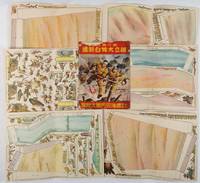
1933214182東京. Tokyo.: 博文館. Hakubunkan. Showa 81933. Six colour card cutout sheets folded as issued 39 x 27cm original wrapper with instructions 28 x 21cm. Paper wrapper chipped and torn with a little loss now neatly repaired with washi. Instructions are complete and the card sheets are in very good condition. This papercraft diorama kit was issued as a supplement to the children’s magazine Tankai in April 1933. The kit recreates scenes from the Japanese attack outside Shanghai in February 1932. During the mission to break through the Chinese defence line three Japanese soldiers were killed and subsequently celebrated as national war heroes known as 爆弾三勇士 The Three Brave Bombing Soldiers. Their bravery was highly revered and they became symbols of courage and sacrifice. <br> <br>The kit includes six platforms that when combined create a rising scene from the creek bed section. It depicts Japanese soldiers attacking Chinese buildings positioned on a hill supported by artillery and tanks. The set features numerous cutouts of Japanese soldiers in action while a smaller number of cutouts portray frightened Chinese fighters. Through this diorama young children learned about the conflict by recreating battle scenes and identifying with the war heroes during play. The kit not only served as a form of entertainment but also as a tool for instilling nationalistic pride and wartime ideology in the younger generation. . 博文館. [Hakubunkan]. unknown
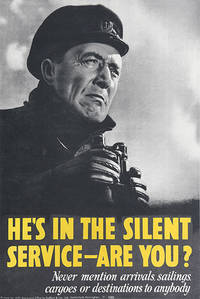
1942173606Nottingham: Printed for H.M. Stationery Office by Stafford & Co. Ltd 1942. One of the series of "careless talk" posters produced by the British government during the Second World War presenting a tight-lipped heroic sailor with the appeal to "never mention arrivals sailings cargoes or destinations to anybody". The British government feared both that enemy agents may hear vital secrets and that rumours may spread and undermine the war effort. Offset lithograph 370 x 249 mm. In fine condition. unknown
17711001881771. Romae Typis. Sac. Congregationis de Propag. Fide 1771. Woodcut vignette on titlepage. 16pp. some foxing. 19th century blue wrappers. One of the rare publications of the Propagande Fide that was established in 1626 for propaganda among the Eastern peoples. Ferdinand II presented Illyrian types for a missal and the Mediciean and other Oriental types from the Stamperia Vaticana were added to its stock while Stefano Paolini engraved others. It continued its existence throughout the XVIIth and XVIIIth centuries: Bodoni received his early training here. In 1789 most of the types were taken to Paris where in 1805 an edition of the Lord's Prayer in 150 languages was printed as a compliment at the time of Napoleon's coronation. Much of the type still remains at the Imprimerie Nationale. c.f. Birrell & Garnett 14. unknown
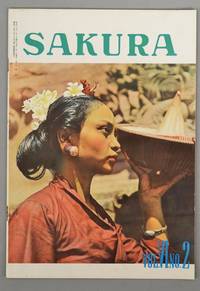
1944888911944. JAPANESE PROPAGANDA Asahi Shimbunsha. SAKURA. Volume 6 #2 #31 overall. Large wrappered staple bound illustrated photomagazine in the tradition of FRONT and HOMELIFE. This number published in February of 1944 celebrated the plans for a cross continental railway to cross Eurasia from Tokyo to Berlin complete with an undersea tunnel from Japan to the mainland. SAKURA magazine was written in English Chinese and French. The whole world seems to lay at the feet of the Axis in this rosy scenario as sketched throughout the magazine. East Asia under the guidance of Imperial Japan is on the march to build a new world. Yet by February of 1944 the Red Army was in Poland and the Ukraine Sevastopol was cut off times were bleak for the 1000 year Reich indeed. Closer to home the Allies had "turned the corner" in the Western Pacific had isolated the large Japanese force at Rabaul and were headed north towards the homeland. At some point during the war reality and appearance began a rapid divergence and as the end approached it became all pure delusion. All of which does not obviate what an amazing visual feast SAKURA is from the covers to the ads a consistent message of normalcy progress and steadfast purpose in a great task. unknown
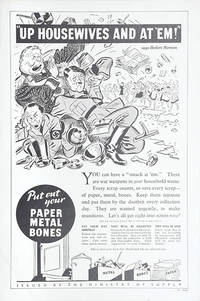
1940173612London: Issued by the Ministry of Supply 1940. A striking British wartime poster appealing for salvage showing Hitler Goebbels and Goering cowering under a barrage of newspapers pots and bones thrown by a mob of British housewives. The poster tells housewives that "you can have a 'smack at 'em'. There are war weapons in your household waste". It instructs them to separate out paper metal and bones from their house waste to be collected and used in munition manufacturing. The title is a quote from Herbert Morrison which was also used for a Pathé newsreel and a popular song. Offset lithograph 379 x 252 mm. Tiny chip at foot light crease at head. In very good condition. unknown
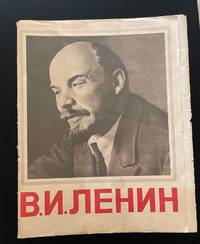
1969013792Moscow 1969. Soft cover. Very Good. Printed in the former USSR in 1969. Paper portfolio with cover photograph of Lenin measuring approx. 17.5 x 22" containing 31 pictures of various sizes on 18 sheets depicting all aspects of Lenin's life as student father one of the people and founder of the republic. Images presumably "suitable for framing" to be used in offices public buildings schools etc both as government issued "art" and history lessons. Some wear to paper portfolio along edges; sheets fine. unknown
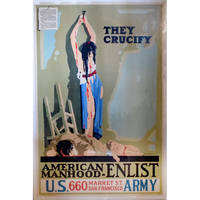
19172999<p>27 x 41 inch broadside backed with linen 29 x 43 inches. Color lithograph printed in green blue black and red. Three semicircles of loss to upper margin not affecting image; pinholes to corners of linen backing. Very Good.</p><p>A gruesome WWI recruitment poster depicting German wartime atrocities in Belgium specifically the crucifixion and possible rape of a woman and the killing of her husband and baby. Prominently displayed below this image is the address of San Francisco's Army recruitment office located at 660 Market St.</p><p>According to the explanation printed in the upper corner "'They Crucify' portrays an actual incident of the war witnessed by Sergeant Albert Goad formerly of the Seaforth Highlanders but since stationed with the British recruiting Mission in San Francisco. The atrocity was perpetrated in Blegium in a shell shattered cottage where Sergeant Goad found a murdered husband a mother nailed to the wall and a babe mutilated by bayonet. The Sergeant told of this experience to the artist M. Hoyle of San Francisco who in turn painted it for the San Francisco Army Recruiting District adhering conscientiously to the facts."</p><p>We note holdings at UC Berkeley the Imperial War Museum the Hoover and the Canadian War Museum.</p> Louis Roesch Co, Lith.
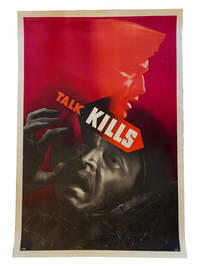
1943004937London 1943. Printed poster approximately 530mm x 775mm in size. Once folded now backed with linen one or two tiny amounts of colour loss to surface otherwise quite bright and clean. Designed by Abram Games 1914-1996 and printed by Henry Hildesley Limited. Games designed many British wartime propaganda and information posters over the course of his military service with the Royal Engineers. In 1942 he was appointed Official War Poster Artist. He produced two versions of this poster showing the possible consequences of disclosing sensitive information about the war - one coloured green that suggested a death at sea and another coloured red which suggested a death on land From the National Army Museum website. First Edition. Unbound. Good. Illus. by Games A.bram. Double Elephant. Poster. Paperback
1797100416<p>1797. Rome Propaganda Fide 1797. 15pp. Unbound. Woodcut vignette on titlepage and one vignette in the text. One of the rare publications of the Propagande Fide that was established in 1626 for propaganda among the Eastern peoples. Ferdinand II presented Illyrian types for a missal and the Mediciean and other Oriental types from the Stamperia Vaticana were added to its stock while Stefano Paolini engraved others. It continued its existence throughout the seventeenth and eighteenth centuries: Bodoni received his early training here. In 1789 most of the types were taken to Paris where in 1805 an edition of the Lord's Prayer in 150 languages was printed as a compliment at the time of Napoleon's coronation. Much of the type still remains at the Imprimerie Nationale. Not in Birrell & Garnett Smitskamp PO 216; Brunet I 197.</p>
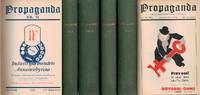
1087851928-32. Stor 8vo. Flere pagineringer. Rikt illustr. annonser bilag noen i farger. Bundet i fire samtidige fine helsjirtingb. med en del av de originale for- og bakomslagene medbundet særlig for 1928 de øvrige årgangene kun sporadisk. Fin rekke. Propaganda ble utgitt frem til 1960. . unknown
1958055782Cairo: The USSR Embassy Press Office in the United Arab Republic UAR 1958. 1st Edition . Hardcover. Very Good. 8vo - over 7¾ - 9¾" tall. Contemporary full green cloth in Egyptian style contemporary white endpapers gilt lettering of title on front board and gilt decorations on spine. Original pictorial cover saved inside. Roy. 8vo. 24 x 17 cm. In Arabic. 88 p. 12 b/w ills. including drawings and reproduced photographic plates. Extremely rare unrecorded first issue of this Soviet propaganda organ published in Cairo the centre of the UAR by the USSR Propaganda Press Office with a striking cover design depicting the Sputniks in space celebrating the third anniversary of the Kosmicheskaya programma SSSR. The content begins with a comparison between the Soviet and American satellites. A full-paged photograph shows the Muscovites reading newspapers about the launch of the third Soviet satellite into space. In the periodical many details such as the construction processes and technical specifications of the satellites are explained as well as a striking history of the Soviet Space Program. Relations between Russia and Egypt have a long history dating back to before the 16th century. In the 1950s Gamal Abdel Nasser's independent and anti-imperialist policy earned him enthusiastic support from the Communist government of the USSR. In 1955 Egypt made a major arm deal with the Soviet Union and from then teams of Egyptian officers were trained in Eastern Bloc countries. Czechoslovak instructors also came in 1956 to train Egyptian personnel in the use of Soviet weapons. When France attacked Egypt during the Suez Crisis the USSR threatened to use destructive weapons i.e. nuclear weapons for the defence of Egypt. The degree of the Soviet approval of the Egyptian leader's policies culminated rather controversially in the award of the highest Soviet decoration the star of the Hero of the Soviet Union with the Order of Lenin to Nasser during Nikita Khrushchev's visit to the country in 1964. Kosmicheskaya programma SSSR i.e. The Soviet Space Program was the national space program of the Union of Soviet Socialist Republics USSR active from 1955 until the dissolution of the Soviet Union in 1991. After WWII the Soviet and US space programs both utilized German technology in their early efforts. Eventually the program was managed under Sergei Korolev who led the program based on unique ideas derived by Konstantin Tsiolkovsky sometimes known as the father of theoretical astronautics. Contrary to its American European and Chinese competitors who had their programs run under a single coordinating agency the Soviet space program was divided and split among several internally competing design bureaus led by Korolev Kerimov Keldysh Yangel Glushko Chelomey Makeyev Chertok and Reshetnev. The Soviet space program served as an important marker of Soviet claims to its global superpower status. Wikipedia. As of May 2024 not in OCLC and KVK. <br/> <br/> The USSR Embassy Press Office in the United Arab Republic (UAR) hardcover
1960217261Circa1960s. Collection of five colour-printed Nianhua posters each of the central images onlaid within a stiff red paper border with a thin cream paper frame worn and discoloured and at the top of each a fine aqua paper border; the sheets a little creased two images with a visible tide-mark minor edge tears not affecting the images strengthened neatly on the verso with washi one with an early paper repair to the top margin all approx. 93 x 51.5cms sheet size in good condition. Five examples of "new" Nianhua posters dating from the Great Leap Forward all featuring babies and children symbolizing happiness prosperity and the promise of a thriving future. In one a sister braids her hair whilst minding her crawling toddler brother "Sweet Heart". On the wall a poster proclaiming the industrialisation of agriculture "Agriculture is the foundation of the national economy and grain is the foundation" caption; in another five toddlers dance in a circle their flags and lanterns captioned "The Great Leap Forward" and "Long Live Mao". Ephemeral examples of folk art and the use to which it was put for political purpose. . unknown
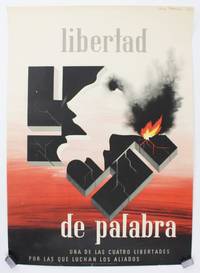
19424754Washington DC: El Coordinador de Asuntos Interamericanos 1942. Very good. Pictorial lithograph 20 x 14.25 inches printed in red gray yellow and black. Minor surface wear mild creasing light dust-soiling a few pinholes. A rare poster issued by the Office of the Coordinator of Inter-American Affairs CIAA during World War II attempting to sway public opinion in Latin America to the Allied side. The CIAA was established by executive order in July 1941 in order to distribute news advertising film reels and more to and from Latin America to counter Italian and German propaganda campaigns in the region. The text of the present poster translates from the Spanish as "Freedom of Speech. One of the four freedoms for which the Allies are fighting." The central image features an open-mouthed face breaking open a large swastika which is itself on fire. A mildly subtle message that free speech destroys fascism. The poster was designed by noted Russian-American graphic designer and photographer Alexey Brodovitch whose printed credit appears at top right; Brodovitch is most well-known for his art direction of Harper's Bazaar from 1934 to 1958. A powerful visual display with only one copy reported in OCLC at MOMA though we also find two other institutional holdings at the United States Holocaust Museum and the Hoover Institute. El Coordinador de Asuntos Interamericanos unknown
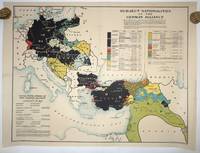
191728118London: Stanford's Geographical Establishment 1917. First printing. Map. Fine condition. A large format map illustrating the geopolitics of Europe after W.W.I. Intended to persuade viewers about the threat presented by the Central Powers of Germany Austro-Hungary Bulgaria and Turkey it color-codes them in black to emphasize the danger they might pose to the fledgling League of Nations. <br /> <br /> The solution is stated on the map which quotes from the Allies' war aims as articulated to President Wilson in 1916: "The civilized world knows that the aims of the Allies include-the reorganization of Europe guaranteed by a stable settlement based alike upon the principle of nationalities and on the right which all peoples whether small or great have to the enjoyment of full security and free economic development."<br /> <br /> The efforts to secure the peace in Europe dictated the division of nations cultures and tribes has continued to plague the world for over 100 years sellers' opinion. These groups include Greek pockets within Turkey Armenians in three pockets and Kurds Arabs which includes Jewish Colonies in Palestine. Also of note and marked on the map are the "Expropriations of the German Ansiedelungs Commission" an 1886 German proclamation that allowed Prussian settlers to appropriate Polish sovereign land. <br /> <br /> Printed at The Dangerfield Printing Co. Ltd. OCLC 9876563; Persuasive Maps: PJ Mode Collection #1188. Color lithograph 28" x 36 1/2". Backed on acid free linen supporting some tiny closed splits along the central & one other fold with one triangle of added margin not affecting the map. Very bright color and overall in very good condition. Stanford's Geographical Establishment unknown
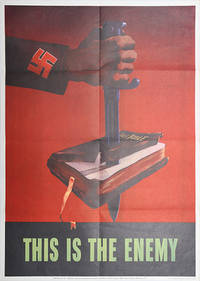
1943175357Washington DC: Office of War Information 1943. Deliver us from evil One of the most striking American wartime propaganda posters depicting a Nazi fist stabbing through the Bible against a vivid red background. "This is the Enemy" was the slogan of various American posters focusing on the evils of Nazi ideology and actions here presenting their attack on freedom of religion and their threat to Christian civilization. The artist Barbara Marks was a Californian art student. The Office of War Information solicited entries from the public for poster designs and received over 2000. Her original slogan was "deliver us from evil". Offset lithograph 710 x 560 mm. Light creases where formerly folded and a couple of tiny chips at intersections. A near-fine copy. unknown
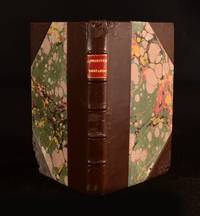
1773664L4Romae: Sacra Congregatio de Propaganda Fide 1773. Leather. Very Good. 7" by 4.5". None. A very scarce example of the Tibetan Alphabetum issued by the Sacra Congregatio de Propaganda Fide. The Alphabetum series was one of the first to print the script of different languages. Written in Latin and Tibetan. A first thus of this work. 'The Alphabetum' was created as a reference text for Catholic missionaries who travelled worldwide to promote God's message. The Sacra Congregatio de Propaganda Fide printing press was established by The Vatican in 1622. The press held the largest collection of printing types from languages and scripts worldwide. They quickly produced these booklets of exotic languages which included Arabic Greek Iberian Syrian among many other languages. Presented in a handy pocket sized format the Alphabetums were a marvel of printing at the time. It demonstrated printing of characters not seen by western audiences. Ex library stamps contemporary to the work to the rear of title page for Biblioth Regia Berolinensi. With the vignette seal of the Congregation. This work includes the Lord's prayer the Ave Maria the Apostles' creed and the Ten commandments in Tibetan and Latin. The Tibetan Alphabetum was the first time that there was a western publication on the Tibetan language. It is based on information sent back by missionaries from the Capuchin mission at Lhasa. The work was first published under the name 'Alphabetum Tibetanum' and it would appear that this 1773 printing is the first time that the work appeared under the title 'Alphabetum Tangutanum sive Tibetanum'. The folding plate is provided in facsimile. An important work in print development and language education. In a half calf binding with marbled boards. Damage to the head of spine and to the outer corner to the bottom of both boards. Loss to the leather resulting in the minor damage and loss to the bottom corner of pages not affecting text. Contemporary library stamp to the verso of title page and contemporary inscription to the head of title page 'Ax J 6'. Pages are bright and clean. Very Good Sacra Congregatio de Propaganda Fide hardcover