B Sergei IVANOV ] Fighting PencilLivre Rare Book

4 064 résultats
1974126399Leningrad, 1974. Affiche couleurs Leningrad, 1974. Affiche couleurs au format 42 * 56 cm et provenant de l'album "L'éducation" du groupe Fighting Pencil (Beovoy Karendash) de Leningrad. Petite manque en bord et à l'angle droit inférieur. C'est au cours de Décembre 1939 ques des artistes de leningrad décident de créer le groupe Fighting pencil et produisent des affiches de propagande ou des affiches de caricature. Ses membres fondateurs étaient les artistes graphiques Ivan Astapov, Orest Vireysky, Valentin Kirdov, Vladimir Galba, Nikolai Muratov et Boris Semionov. La première affiche collective a été publié sur le sujet de la Guerre d' Hiver contre la Finlande," arbre de Noël..." et entièrrment peinte à la main. La première période de la "Bataille des Crayon" a pris fin avec la fin de la guerre avec la Finlande au printemps de 1940. En Octobre 1943, la première exposition du groupe Fighting Pencil s'ouvre à Moscou, à la Bibliothèque Lénine. Elle gagne l'attention du public, à la fois à Moscou et à Kouibychev ou l'exposition a été transporté. Après un arrêt de quelques années, le groupe reprend ses activités en 1956. Il produit à cette période, des affiches de satires sociales et politiques sur la vie interne en URSS et contre "l'impérialisme mondial", pour mener à bien la propagande politique visant à augmenter les taux de production et de la discipline du travail; à populariser le sport, l'hygiène et les règles de circulation; et la satire de la vie privée. L'association a continué à travailler jusqu'au début des années 1990, rejointe par des artistes tels que MS Belomlinsky, VA Galba, JV Efimovsky, VA Zavyalov, GV Kovenchuk, YP Lobachev et YV Trunev... D'autres affiches sont disponibles, envoi de photos sur demande.
Leningrad, 1974. Affiche couleurs au format 42 * 56 cm et provenant de l'album "L'éducation" du groupe Fighting Pencil (Beovoy Karendash) de Leningrad. Petite manque en bord et à l'angle droit inférieur. C'est au cours de Décembre 1939 ques des artistes de leningrad décident de créer le groupe Fighting pencil et produisent des affiches de propagande ou des affiches de caricature. Ses membres fondateurs étaient les artistes graphiques Ivan Astapov, Orest Vireysky, Valentin Kirdov, Vladimir Galba, Nikolai Muratov et Boris Semionov. La première affiche collective a été publié sur le sujet de la Guerre d' Hiver contre la Finlande," arbre de Noël..." et entièrrment peinte à la main. La première période de la "Bataille des Crayon" a pris fin avec la fin de la guerre avec la Finlande au printemps de 1940. En Octobre 1943, la première exposition du groupe Fighting Pencil s'ouvre à Moscou, à la Bibliothèque Lénine. Elle gagne l'attention du public, à la fois à Moscou et à Kouibychev ou l'exposition a été transporté. Après un arrêt de quelques années, le groupe reprend ses activités en 1956. Il produit à cette période, des affiches de satires sociales et politiques sur la vie interne en URSS et contre "l'impérialisme mondial", pour mener à bien la propagande politique visant à augmenter les taux de production et de la discipline du travail; à populariser le sport, l'hygiène et les règles de circulation; et la satire de la vie privée. L'association a continué à travailler jusqu'au début des années 1990, rejointe par des artistes tels que MS Belomlinsky, VA Galba, JV Efimovsky, VA Zavyalov, GV Kovenchuk, YP Lobachev et YV Trunev... D'autres affiches sont disponibles, envoi de photos sur demande.
In 8° (118x11,7 cm); (8), 184 pp. Legatura coeva in piena pergamena molle. Stemma xilografico al frontespizio. Tagli spruzzati. Un piccolo tarletto nel margine bianco del volume mai fastidioso o importante e nel complesso, esemplare in buone-ottime condizioni di conservazione. Terza edizione, anche se in realtà è conosciuta solo un’altra edizione antecedente questa, edita sempre dalla Propaganda Fide nel 1717, di questa celeberrima grammatica ebraica compilata dal noto professore francese, Jean Bouget (1692-1775) a lungo insegnante di lingua greca ed ebraica nell’ “Accademia Salmuriense”. L’opera è scritta in ebraico e latino. Bouget, nato a Saumur, da una famiglia di umili origini, il padre era un barcaiolo, fu uno degli orientalisti più apprezzati della prima metà del settecento. Fine conoscitore e traduttore dall’ebraico (oltre che dal greco), le sue grammatiche rappresentarono uno dei testi base dell’insegnamento della lingua ebraica nel corso di tutto il settecento. Rif. Bibl.: IT\ICCU\TO0E\041565.
194252489Paris : [s.n.] 1942. 63 S. : mit zahlreichen s/w. Tiefdruck-Abbildungen im Text und auf Tafeln; 16 cm kart., Broschiert
In 8 (cm 17 x 24,5), pp. (2 bianche) + (8) + 152 + (2) + (2) di indice. Illustrazioni infantili intercalate al testo che ritraggono Mussolini. Gora al piatto anteriore, alla prima carta di sguardia e al taglio esterno del frontespizio. Brossura editoriale illustrata da Lucio Venna al piatto anteriore. Rara pubblicazione, con prefazione di Augusto Turati, in cui Dolores Mingozzi, maestra di Molinella, raccoglie e commenta i pensieri su Mussolini degli alunni e delle alunne della scuola elementare, giudizi che risentono della letteratura apologetica e propagandistica sulla figura del duce. L'immagine di onnipotenza propagandata dal regime alimentava il mito del superuomo dotato di poteri straordinari. Le qualita' sovrumane di Mussolini dettero origine all'immagine del duce come valoroso, impavido, eroico e capace di affrontare e riuscire in varie attivita' piu' o meno audaci. Tra i giudizi dei piccoli intervistati si legge: "Lavora sempre, e non dorme mai, o quasi. Chiude gli occhi ogni dieci minuti, poi si desta, si da' una bella lavata, e torna subito subito a lavorare che e' fresco come una rosa"; "Lui fa tutto, capisce tutto, sa tutto. Si mette a parlare con gli scienziati di tutte le cose piu' difficili e fa sempre la prima figura. Provano d'ammazzarlo e non son mai buoni di prenderci..."; "Mussolini hanno sempre tentato di ucciderlo, ma non vi sono mai riusciti. Dicono che abbia la camicia della Madonna. Ed e' proprio cosi'..." (S. Falasca Zamponi, "Lo spettacolo del Fascismo", 2003, p. 113; N. Turi, "Raccontare la guerra. I conflitti bellici e la modernita'", 2017; C. Berneri, "Mussolini, Psicologia di un dittatore, 1966).
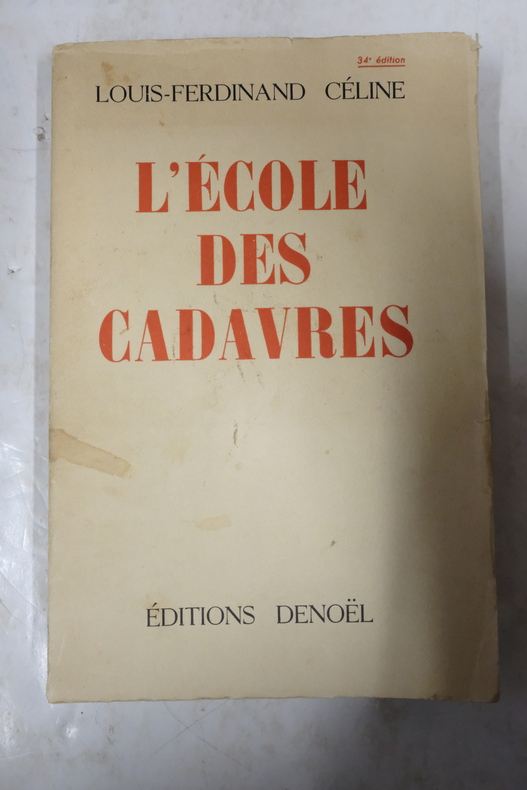
1938LIT9579MBroché, 305 pages, 34e tirage ordinaire de l'édition originale de chez Denoël paru en 1938, 19 rue Amélie, Paris. Très bonne conservation générale malgré de légères marques d'usages visibles sur les photos, intérieur encore frais. L'ECOLE DES CADAVRES n'est pas dirigée contre personnes. Elle attaque une politique. Afin de couper court a tout polémique particulière, l'auteur et l'éditeur de ce livre ont résolu, d'accord, de supprimer les pages 17 et 18, 121 et 122, 301 et 302 de cette édition et de toutes celles qui suivront. Frais de port offert vers l'UE, envoi suivi et assuré.
193458724ABNeustadt-Aisch, Verlag Georg Aupperle, 1934. 8° (20x14), 109 S., 3 S. Geleitwort in Handschriftfaksimile, mit Textillustrationen und KartenSkizzen von S. Groh, sowie 53 fotograf Aufnahmen auf 30 Tafeln, 2 doppelseitige Flugbild-Tafeln, 1 montiertes 10-teiliges Panorama (La Basse 1917) auf letzem Blatt und hinterem Innenspiegel montiert, Oln mit roter TitelPrägug. 1. Aufl. (1.-5. Tsd.) Rücken mit Etiketten-Schatten, wohl leeres fliegendes Vorsatzblatt sauber entfernt, Panorama mit Fehlfalzungen und in den Falzen berieben, sonst sauber und ordentliches Belegexemplar,
1934032255Gerhard Stalling, Oldenburg i/o 1934. Hardcover Sehr gut
329 pages. Index. Referrences. List of primary sources. Reproductions of black and white photos. "John Grierson, documentary film pioneer and founder of the National Film Board of Canada was a self-proclaimed propagandist who offered himself to Canada in the Second World War and won a place as director of Canada's official propaganda machine... But after the crisis had passed, Grierson and his idealistic associates ran up against the emerging pragmatic and functional policy approach of Mackenzie King's government." - from dust jacket. Moderate wear. Binding intact. Usual library markings. A sound copy. Book
62 pages. Features: Mr. Keynes Has a Plan - super photo-illustrated article on this influential economist; Josephine Baker - star of the music halls - steps down; Rescue In the Arctic - the two-year drift of the Soviet icebreaker "Sedov" and its dramatic rescue; The Lives of Cabaret Girls - featuring Eileen O'Mahony, Barbara Wood, Marie Rennie, Bette Farrar, Baby Bradshaw and Freda Fairchild; British Propaganda Bombs are Duds - reflections on Look magazine's suggested improvements for British propaganda; The Story of Actor-Playwright Emlyn Willians; Volunteers for Finland - with photos and brief write-ups on George Ford, Pat McGee, John Hurman, Col. Kermit Roosevelt, Peter Farragut, Harry Connolly, Peter Broad and Edward Graham; Goose on the Loose - nice photos of the Goose of Montmartre on a walk through Paris; Diary of the War, #27 - The Twenty-Fifth Week; Cartoon by Low mocks Britain's lack of economic leadership; Are Economics Really Everything?; Nice two-colour ad for Bird's Custard on back cover. Many other wonderfully nostalgic ads. Clean and unmarked with light wear. A lovely vintage copy. Magazine
30 pages. 7.25" x 5.6". Text in English. Each page charmingly illustrated in colour. Ten-year-old Ah-wu, his dog Blackie, and friend Ah-hsiao live on Hainan Island which has been occupied by the Japanese Army in 1939. Tells the dramatic tale of how the trio captures a Japanese soldier, then delivers him and his rifle to the guerrillas. Unmarked with light wear and soiling. A quality copy of this charming vintage work. Book
1942KIBU2693Gütersloh, Bertelsmann [1935-1942]. Je Heft 32 S. mit einigen s/w Abb. von Karl Mühlmeister, OBrosch mit farb. OUmschl., Heftumschläge teilw. mit Gebrauchsspuren Die Heftreihe erschien von 1925-1942 in 126 Heften, sie wurde nach dem Krieg in entnazifizierter Form weitergeführt. - Hopster S. 2142 ff. Vorhanden sind die Nrn. 2, 3, 8, 9, 10, 11, 14, 17-23, 25-27, 29, 30, 32-35, 38-42, 44-46,54-56, 58, 60, 62, 65, 67, 68, 73, 75, 76, 79, 80, 82, 86, 87, 94, 96, 118 [3 Warenabbildungen]
19341199595Brunnen Verlag / Willi Bischoff; Berlin, 1934. 227 Seiten; viele Illustrationen (Fotografie); 22,5 cm; fadengeh., illustr. Orig.-Pappband.
194149034Die Wehrmacht, Bln. 1941. Mit sehr zahlreichen s/w Abbildungen. Folio. OBrosch. Bei Heft 1 der Umschlag stärker beschädigt. Heft 18 mit Einrissen im unteren Rand. Sonst nur kleinere Gebrauchspuren.
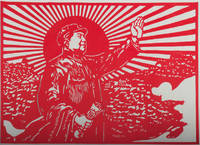
163369No place of publication.: No details of publisher. No date. Late 20th century. Large striking Chinese propaganda papercut on red paper loosely presented on paper backing. The central image shows Mao waving to the crowd in the distance while holding a scrolled newspaper in the other hand the sun and its rays extending behind him. Very good. No text. Papercut measures 51 x 71cm. . No details of publisher. unknown
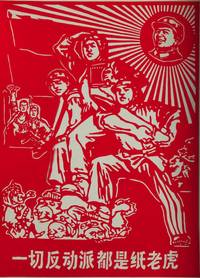
163338No place of publication.: No details of publisher. No date. Late 20th Century. Large Chinese Propaganda Papercut on red paper with paper backing. In very good condition. Sheet measures 70 x 50.9cm. he papercut illustrates three Chinese soldiers determinedly crushing the reactionaries with their feet. A head and shoulders image of Chairman Mao upper right corner the sun and its rays extending behind him. . No details of publisher. unknown
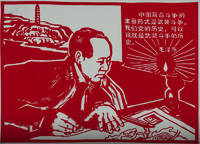
163353No place of publication.: No details of publisher. No date Late 20th century. A large Chinese Propaganda papercut on red paper loosely presented on paper backing. Features a concentrated Mao sitting at a desk writing. A view of Baotashan in Yan'an Revolutionary Base 1936 -1947 is in the background. Block of text upper right section in Chinese. Very good. Sheet measures 49.3 x 70.1cm. . No details of publisher. unknown
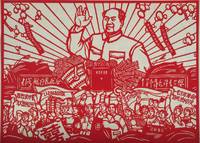
163319No publication details. No date. Late 20th Century. Large striking Chinese propaganda papercut on red paper loosely presented on paper backing. Chairman Mao waves benevolently at huge crowd the sun with its bold rays extending behind him. The crowd consists of peasants workers and soldiers. One worker in the centre wears a apron with the character "loyalty" on it. He is holding a huge copy of Mao's Selected Works high above his head with one hand while holding another pocket size copy of Mao's quotations in the other. <br> <br>In very good condition text in Chinese papercut sheet measures 51.4 x 71cm. Two lines of the revolutionary song 大海航行靠舵手Sailing the Seas Depends on the Helmsman and 干革命靠毛泽东思想 Carrying Forth Revolution Depends on Mao Zedong Thought are quoted on right and left sections. Banners lifted by balloons quote revolutionary slogans such as: "Long Live the Invincible Mao Zedong Thought" "Long Live the Great Mentor Chairman Mao" "Long Live the Communist Party of China" . No publication details. unknown
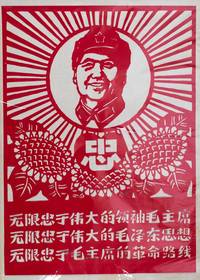
160389No place of publication.: No publication details. No date. Late 20th Century. A striking Chinese Cultural Revolution papercut on red paper loosely presented on paper backing. An image of Mao's head and collar is highlighted centrally and fits snugly into the sun the bold rays extends behind him drawing a clear analogy between the sun and Mao. Three sunflowers and a Chinese character "Loyalty" 忠 are featured under Mao's portrait. Very good. Blocks of text in Chinese lower section. Papercut measures 70.1 x 49.9cm. This papercut represents the phenomenon of Mao cult one of the most visible feature of the Chinese Cultural Revolution. Every one of the slogans on this papercut echo the theme of unconditional praise and admiration of Chairman Mao. <br> <br>Three propaganda slogans lower section translate as: <br>"Boundless loyalty to the great leader Chairman Mao." <br>"Boundless loyalty to the great Mao Zedong Thought." <br>"Boundless loyalty to the Chairman Mao's revolutionary line." . No publication details. unknown
19199135CHamburg:, Korps Lettow., [ca. 1919]. (ca. 32 x 21 cm). 1 Blatt (Fraktur). Original-Flugblatt mit Titel im oberen Bereich. Blatt wurde mittig gefaltet, sonst wohlerhalten. Altersentsprechend sehr guter Zustand.
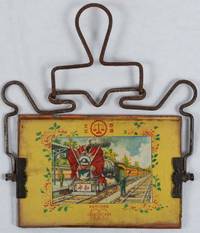
1940224121Shanghai.: 上海裝鏡工業第二联營所. Shanghai jinggongye di'er lianyingsuo. Circa1940s - 1950s. Mirror with attached coloured image on paper under glass on reverse 10.5 x 15cm metal handle 15.5 x 17.5cm. Mirror a little stained and clouded at edges image browned at edges hanger rusty but still very functional. An interesting piece of 1950s propaganda. This portable travel mirror is a useful and decorative example of the sort of mass produced consumer items made in the early 1950s in small local workshops that were organised into collectives. Travel mirrors could be hung up or propped up for use by a moveable handle. On the reverse is a colour socialist-realist illustration of a red flag-draped locomotive a symbol of modern progress patriotism and peace. The colourful image of the train with its 天平商标 logo could be displayed when not in use or replaced with a photo with the mirror behind it. <br> <br>In 1952 when China built its first domestically designed locomotive it was called the "Peace" series which we see written on the front of this engine with the image of a dove. China's involvement in the Korean War to 'resist US aggression and assist Korea' depended on strong logistical supply lines to the front. Trains therefore became symbolic of national unity strength and China's ability to protect regional peace. Many such travel mirrors were bought as gifts and given as morale boosting items to the Chinese troops who could insert family photographs under glass on the backs of their travel mirrors. . 上海裝鏡工業第二联營所. Shanghai jinggongye di'er lianyingsuo. unknown
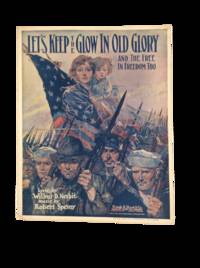
1918229271918. Nesbit Wilbur D. and Robert Speroy. Let's Keep the Glow in Old Glory And the Free in Freedom Too 1918 documents American patriotic culture during the final year of World War I when popular music functioned as a vehicle for national unity and wartime morale. Issued for domestic performance the piece supports research into American propaganda music history and visual culture demonstrating how commercial sheet music reinforced loyalty to the nation and framed military service as a collective moral obligation. The work situates the American flag as a central symbolic object linking civilian identity to wartime sacrifice and national purpose.<br /> <br /> Nesbit Wilbur D. Lyrics. Speroy Robert. Music. Let's Keep the Glow in Old Glory And the Free in Freedom Too. Chicago and New York: McKinley Music Company / Frank K. Root & Co. 1918. Folio. Illustrated sheet music. The cover features an allegorical composition of a woman draped in the American flag holding a child positioned above advancing soldiers with fixed bayonets visually combining maternal imagery with military action. Interior pages present musical notation marked Tempo di Marcia aligning the composition with the rhythm of a military march. Lyrics call for national unity and vigilance with lines invoking "Columbia" and urging preservation of the "Red White and Blue" emphasizing honor sacrifice and global perception of the United States. The structure and presentation reflect the integration of visual symbolism and musical form to convey patriotic messaging to a broad audience in homes and community settings.<br /> Folio format. Illustrated throughout. Moderate edge wear and corner softening light toning across sheets with scattered small stains and minor surface abrasions more visible at margins; interior pages clean and legible with strong notation and text clarity; overall good condition. Produced at a moment when music publishers actively contributed to wartime messaging the sheet provides material evidence of how popular song participated in shaping public sentiment offering value for the study of nationalism propaganda and cultural production in early twentieth-century America. unknown
194393686FBo.O. [Woburn Abbey; London:], o.V. [Political Warefare Executive], [1943]. (36) Seiten, szenisch illustrierte OHftg., 10,5 x 13 cm (quer).
193914128Berlin, G.Schönfeld s Verlagsbuchhandlung Richard Carl Schmidt, (=Das Schicksalsbuch des Deutschen Volkes Band 2), 1939. Mit 176 Bildtafeln und dazugehörigem Text sowie Federzeichnungen von Walter Heiland und mehreren Tabellen. n., 334 / 20 S., Gr.8°