Ahrens, AdolfAntiquariat.de
Dokumente der fünften Kolonne - 1. Folge,
19508969CBohne Ort, ohne Verlag, 1950. gr.8°, 16 S., original Heft, Erstausgabe schönes, sauberes Exemplar (vo2gla)

Antiquariat Orban und Streu GbR · DE - Frankfurt am Main35,00 €
4 064 résultats
194062424ABBerlin, Steiniger, 1940. 201. bis 300 Tsd. 179 S. Ill. Halbleinen. guter, altersgemäßer Zustand., Vortitel gebräunt. 300
Very Good Turkish Original satyric periodical. Folio. (32 x 24 cm). In Turkish. 17, [1] p., color, and b/w ills. A satyric Turkish magazine titled "Akbaba" with attractive cover art of "Iki inatçi keçi" [i.e. Two stubborn goats], published two years before the declaration of World War II, 1937, illustrated by a famous Turkish master cartoonist Cemal Nadir (1902-1947), showing two stubborn Nazi and Soviet goats butting heads on a narrow bridge buttressed with rifles and bayonets. The Nazi goat stands on the European side while the Soviet goat stands Asian side. The text: "Komünizm - Çekil yolumdan!.. Avrupa'ya geçecegim. Fasizm - Çekil yolumdan!.. Asya'ya geçecegim!.." [i.e. Communism: Get out of my way! I will cross over to Europe! Fascism: Get out of my way! I will cross over to Asia!]. Cemal Nadir [Güler] was a famous Turkish cartoonist. Güler is the surname he assumed after the Surname Law of 1934. Cemal Nadir was born in Bursa, Ottoman Empire on 13 July 1902. His father Sevket was a calligraphist (Turkish: Hattat) employed in courts. After finishing high school, he began working as a sign painter in Bursa. He also created cartoons, and his first cartoon appeared in Diken (literally: "The Thorn") periodical. Although he moved to Istanbul and tried to be a full-time cartoonist, he could not make it and he returned to Bursa. The Alphabet Reform of 1929 gave Cemal Nadir a second chance to show his talent. When Turkey adopted the Latin alphabet replacing the Ottoman Turkish alphabet in Arabic script, all signboards were necessarily changed, and he worked hard to meet the demand. In the same year, he moved once more to Istanbul to work for the daily Aksam. Later, he also drew for the newspaper Son Posta, as well as for the satirical magazines such as Akbaba. During this period, he published the satirical magazine Amcabey. During World war II, he drew anti-Nazism cartoons in the daily Cumhuriyet. In 1946, the Republican People's Party (CHP) invited him to run for a seat in the parliament. However, he refused the invitation, he said that with political affiliation he would not be able to create cartoons. He used his conflicting cartoon characters to criticize the social problems of that time in the country. (Ak'la Kara ("Black and White")., Dede ile Torun ("The Grandpa and the Grandson")., Dalkavuk ("The Sycophant")., Yeni Zengin ("Nouveau riche")., Salamon).
Very Good Turkish Original color illustrated cover. Folio. (32 x 24 cm). In Turkish. 17, [1] p., color, and b/w ills. Anti-propaganda of Japan in 1936. An amazing cover illustration of Japanese anti-propaganda and USSR (Soviets). It's seen a yellow octopus wrapped around the world complete with its arms and with a treacherous smile on its face. A Japanese anti-propaganda. "Sari tehlike: Dünyayi kizil tehlikeden koruyacagim!" [i.e. Yellow hazard: I will protect the world from the Red hazard]. This great cover was illustrated by Cemal Nadir [Güler], (1902-1947). He was a Turkish cartoonist. Güler is the surname he assumed after the Surname Law of 1934. Cemal Nadir was born in Bursa, Ottoman Empire on 13 July 1902. His father Sevket was a calligraphist (Turkish: Hattat) employed in courts. After finishing high school, he began working as a sign painter in Bursa. He also created cartoons, and his first cartoon appeared in Diken (literally: "The Thorn") periodical. Although he moved to Istanbul and tried to be a full-time cartoonist, he could not make it and he returned to Bursa. The Alphabet Reform of 1929 gave Cemal Nadir a second chance to show his talent. When Turkey adopted the Latin alphabet replacing the Ottoman Turkish alphabet in Arabic script, all signboards were necessarily changed, and he worked hard to meet the demand. In the same year, he moved once more to Istanbul to work for the daily Aksam. Later, he also drew for the newspaper Son Posta, as well as for the satirical magazines such as Akbaba. During this period, he published the satirical magazine Amcabey. During World war II, he drew anti-Nazism cartoons in the daily Cumhuriyet. In 1946, the Republican People's Party (CHP) invited him to run for a seat in the parliament. However, he refused the invitation, he said that with political affiliation he would not be able to create cartoons. He used his conflicting cartoon characters to criticize the social problems of that time in the country. (Ak'la Kara ("Black and White")., Dede ile Torun ("The Grandpa and the Grandson")., Dalkavuk ("The Sycophant")., Yeni Zengin ("Nouveau riche")., Salamon).
19508969CBohne Ort, ohne Verlag, 1950. gr.8°, 16 S., original Heft, Erstausgabe schönes, sauberes Exemplar (vo2gla)
Barcelona, Mateu, 1971 4to. menor; 67 pp., 1 h. Cubiertas originales.
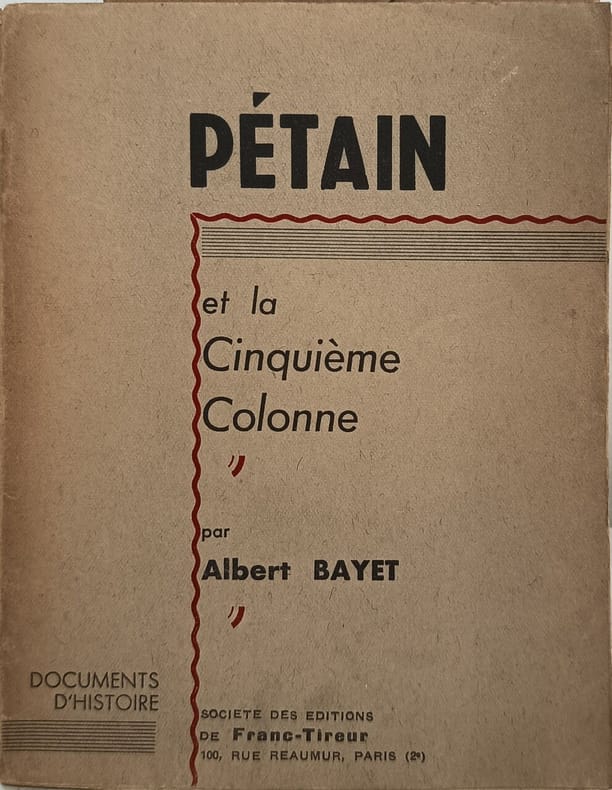
19447673Société des Editions de Franc-Tireur 1944 98 pages in12. 1944. broché. 98 pages. Ouvrage publié en 1944 par Albert Bayet intellectuel résistant qui analyse le rôle du maréchal Pétain et dénonce son régime comme une 'cinquième colonne' au service de l'occupant nazi. Ce pamphlet s'inscrit dans la littérature de la Résistance française pendant la Seconde Guerre mondiale
193040522Berlin, Jacques Albachary, 1930. Illustrierte Original-Leinwand; Gr. 8°; 400 Seiten; 1 gefaltete Tafel.
Brossura, cm15x21, pp 59 (5); illustrazioni in nero nt, due carte geografiche a colori ft di cui una ripiegata (legata al contrario). Raro libretto propagandistico, con carta della Tripolitania e Cirenaica di G. De Alberti.
Very Good German n modern aesthetic full leather bdg. Folio. (32 x 24 cm). Bilingual in German and Turkish. 103, [1] p., b/w plates. Includes exhibition booklet (15 pp., b/w ills.), and text of the speech of German ambassador (Franz von Papen) for this exhibition (4 pp.). "The New German Architectural Exhibition opened in Ankara Exhibition House between 31st January and 15th February 1943 was one of the exhibitions opened during World War II. This exhibition occupied a distinctive place on the public agenda due to its size and effect in media on that date. A great number of Turkish authorities, foreign diplomatic representatives, and journalists attended the exhibition, which was opened with great efforts, and the leading role of the German Ambassador in Ankara, Franz von Papen, and such a situation caused the exhibition to attract attention. Even though the civil architectural and engineering works stopped completely in Germany during the War and some of the projects were draft and incomplete, they tried to be exhibited to give the impression of Nazi Germany's "great power" with the aim of propaganda. In Turkey's press, great praises were presented in writings towards the magnificence and architects of German architecture. Not only axis powers but also allied powers tried to attract the attention of the Turkish Government and the public agenda in Turkey using propaganda methods. As a result of such attempts, the UK opened exhibitions in 1944 on English architecture in Ankara first and then in Istanbul. Similar praises spent for German architecture were also presented to that of the UK. At this point, it may be stated that as for the War, Turkey followed a policy of active neutrality, Turkish media also followed the same policy." (Source: Küçük, Evren: An Example of Nazi Germany's Propaganda in Turkey: German Architectural Exhibitions in Ankara and Istanbul).
DISPONIBILITÀ GARANTITA AL 99%; SPEDIZIONE ENTRO 12 ORE DALL'ORDINE. OTTIME CONDIZIONI GENERALI, MACCHIETTE/FIORITURE, LIEVI SEGNI DEL TEMPO. I principali argomenti a favore delle conquiste coloniali sono comparsi in modo evidente e ripetuto in molti dei libri presentati nelle diverse sezioni: le colonie potevano costituire uno sbocco per l'eccedenza demografica; compito degli italiani fin dall'antica Roma era la "missione civilizzatrice" nei confronti di popolazioni "barbare"; l'Italia poteva trarre vantaggi economici dallo sfruttamento delle ricchezze presenti nelle colonie. Qualcuno riconosceva che un elemento determinante era anche la volontà di diventare una grande potenza. Nel 1942, quando l'Africa orientale era già perduta, insiste nell'affermare il «destino preciso» e i diritti dell'Italia in Africa. L'autore era stato nominato nel 1941 direttore dell'Ufficio Studi e Propaganda sulla Razza del Ministero per la Cultura Popolare. Descrizione bibliografica Titolo: Popolarità dell'Affrica in Italia Autore: Alberto Luchini Editore: Roma: I.N.C.F., a. XX dell'E.F. [1941-1942] Istituto nazionale di cultura fascista. Lunghezza: 48 pagine; 21 cm Collana: Quaderni di cultura politica. Serie 12, N. 2; Supplemento a: Civiltà fascista, n. 8 (agosto 1942), Lire 6 Soggetti: Storia contemporanea, Fascismo, Colonialismo, Politica estera, Colonizzazione africana, Amministrazione, Burocrazia, Politica coloniale, 1863-1879, 1939-1945, Africa, Colonie italiane, Italia, Novecento, Imperialismo, Opinione pubblica, Propaganda, Cultura, Destino affricano del popolo italiano, Anticolonialismo, Questione ebraica, Razzismo, Antisemitismo, Ideologia, Ideologie politiche, Diplomazia, Relazioni internazionali, Geopolitica, Impero, Considerazioni politico-militari sopra due anni di guerra, Negus, Governatori, Crispi, Benito Mussolini, Duce, Collezionismo, Da collezione, Libri rari, Rarità, Libri Vintage Fuori catalogo, Anni quaranta, Seconda Guerra Mondiale, Campagne militari, Battaglie, Conquiste, Consenso, Dissenso, Risorgimento, Cesare Correnti, Regno d'Italia, Ottocento, Stampa, Editoria, Litografie, Roma, Savoia, Alberto Oriani, Intelletuali, Scrittori, Esploratori, Viaggio, Carlo Cuca, Assab, Saba, Berto Ricci, Società delle Nazioni, Dio, Popolo, Razza, Posto al Sole, Asse, Potenze, Tripartito, Giarabub, Gondar, Tobruk, Etiopia, Eritrea, Libia, Abissinia, Viceré, Irredentismo, Eroismo, Viceré, Giuseppe Bottai, Adua, Guerra libica, Quaderno africano, Galliano, Baldissera, Gustavo Fara, Agordat, Oreste Baratieri, Roberto Bracco, Africanella, Canzoni, Faccetta nera, Carlo Clausetti, Canzoni, Motti, Giornali, Illustrazioni, Iconografia, Amba Alagi, Coatit, Senafé, Treves, Pubblicazioni, Asmara, Somalia, Cristoforo Negri, Agricoltura, Terre incolte, Ministri, Bersaglieri, Generali, Corte, Antiafricanismo, Benadir, Accordi, Mogadiscio, Carlo Zavagli, Pietro Sacconi, Commercio, Don Eugenio dei Principi Ruspoli, Cristianizzazione, Evangelizzazione, Maurizio Sacchi, Geografi, Antonio Cecchi, Francesco Mongiardini, Ferdinando Maffei, Tribù, Uadau, Dogali, Tommaso De Cristoforis, Beccari, Spedizioni, Traffici, Trafficanti, Espansione coloniale, Tripoli, Emigrazione, élite, Classe dirigente, Epopea Africana, Opuscoli, Indigeni, Tripolitania, Ferruccio Caressa, Contemporary history, Fascism, Colonialism, Foreign policy, African colonization, Administration, Bureaucracy, Colonial policy, Italian colonies, Italy, Twentieth century, Imperialism, Public opinion, Culture, African fate of the Italian people, Anticolonialism, Jewish question, Racism, Anti-Semitism, Ideology, Political ideologies, Diplomacy, International relations, Geopolitics, Empire, Political-military considerations over two years of war, Collectibles, Collectables, Rare books, Rarities, Out of print books, Forties, Second World War, Military campaigns, Battles, Conquests, Consent, Dissent, Kingdom of Italy, Nineteenth century, Press, Publishing, Lithographs, Rome, Savoy, Intellectuals, Writers, Explorers, Journey, League of Nations, God, People, Race, Place in the Sun, Axis, Powers, Tripartite, Ethiopia, Libya, Abyssinia, Viceroy, Irredentism, Heroism, Viceroy, Libyan war, African notebook, Songs, Black face, Mottos, Newspapers, Illustrations, Iconography, Publications, Agriculture, Uncultivated lands, Ministers, Bersaglieri, Generals, Court, Anti-Africanism, Agreements, Mogadishu, Commerce, Christianization, Evangelization, Geographers, Tribes, Customs, Shipping, Trafficking, Traffickers, Expansion colonial, Tripoli, Emigration, Ruling class, African Epic, Brochures, Indigenous Parole e frasi comuni Abissinia Adua Affrica affricana Baratieri Bianchi capitano capo Carlo caso civile colonnello combattente combattimento Conte costa Crispi Italia destino Destino affricano diplomatico diritto Dogali esploratore Etiopia europea fascista fondo forma forte forza francese Francia Galla Garibaldi garibaldino generale genere giornalista giorno Giovanni Giuseppe Governo Granduca di Toscana Guerra Imperatore inglese italiana italiano Africa lavoro Luigi Maggiore mano marzo Massaua memorialista mente militare mondo morale morire morto Mussolini naturalista nazionale nazioni nome orientale Pietro popolo porto Presidente principio razza regime Risorgimento ritorno rivoluzionario Rivoluzione romana Rosso sangue scrittore colonialista secolo soldati spedizione storia storica storiografo Sultano tenente terra tradizione Trattato Tunisia ufficiali umano uomo politico Vittorio Civiltà fascista. - A. 1, n. 1 (gen. 1934)-[1945]. - Firenze : Le Monnier, 1934-1945. - volumi ; 26 cm. ((Mensile. - Il complemento del titolo varia. - Da: n. 1 (gen 1935) l'ed. varia in: Roma : Cremonese; da: n. 1 (gen. 1936) in: Istituto nazionale fascista di cultura; da: n. 12 (dic. 1936) in: Istituto nazionale di cultura fascista. - Termina nel 1945.
1941615611Nordland Verlag, Berlin. 2. Auflage 1941. 21,5 x 14 cm. Originalbroschur. Die Deckblätter mit stärkeren Gebrauchsspuren; vorne Einriss ca. 7 cm und kleiner Eckabriss. 111, (1) Seiten. Seite 43 mit kleineren Fleckchen im Randbereich, ansonsten nur schwach gebräunt, die Seiten fest.
Milano, 1941, stralcio con copertina posticcia muta, pp. 31/40 con fotografie e un facsimile (di un discorso di Mussolini) . - !! ATTENZIONE !!: Con il termine estratto (o stralcio) intendiamo riferirci ad un fascicolo contenente un articolo di rivista, sia che esso sia stato stampato a parte utilizzando la stessa composizione sia che provenga direttamente da una rivista. Le pagine sono indicate come "da/a", ad esempio: 229/231 significa che il testo è composto da tre pagine. Quando la rivista di provenienza non viene indicata é perchè ci è sconosciuta. - !! ATTENTION !!: : NOT A BOOK : “estratto” or “stralcio” means simply a few pages, original nonetheless, printed in a magazine. Pages are indicated as in "from” “to", for example: 229/231 means the text comprises three pages (229, 230 and 231). If the magazine that contained the pages is not mentioned, it is because it is unknown to us.
Mm 170x240 Catalogo originale della importante Mostra tenutasi nella capitale d'Italia nel Primo Decennale della Marcia su Roma. Copertina rigida con il ritratto del Duce e scritte a due colori, 262 pp. con un fac-simile dell'autografo di Benito Mussolini in apertura, 257 illustrazioni in nero nel testo e dodici tavole a colori fuori testo. Esemplare in ottimo stato di conservazione, protetto da rivestimento in pvc. SPEDIZIONE IN 24 ORE DALLA CONFERMA DELL'ORDINE.
53995P., Les Editions de France, 1942, in 12 broché, VII-111 pages ; quelques rousseurs, surtout à la couverture.
19391208421939 Edition Alliance Nationale, Paris - Février 1939. 1 brochure de dimensions 27 x 21 cm - 8 pages - Illustrations comparatives de la natalité en Allemagne, au Japon, en Grande-Bretagne, en Italie et en France en 1939
53997P., Les Editions de France, 1942, in 12 broché, III-117 pages ; taches (de café ?) à quelques pages ; cachets.
8065Paris, Editions de France, 1940 12 x 19, 268 pp., broché, bon état
7261Paris, Edition de France, 1940, in 12, broché, III-268 pages ; couverture illustrée.
1940vb2960Editions de France Broché 1940 In-12 (12 x 18,7 cm), broché, 249 pages ; pliures au dos, coin supérieur du quatrième plat corné, papier bruni, par ailleurs assez bon état général. Livraison a domicile (La Poste) ou en Mondial Relay sur simple demande.
53996P., Les Editions de France, 1941, in 12 broché, IV-119 pages ; tache sur la page de titre.
192 p. A warning about future warfare. Hardcover Good condition in worn d.j. fair
12733Allied Propaganda Leaflet telling Germans that the war is lost and they have no leadership. These flyers were usually dropped by allied planes on German territory to get German soldiers to surrender. Interestingly the leaflet reproduces artwork from a 1940 German Red Cross Relief card drawn by Georg Sluyterman von Langeweyde. 4" x 6". Great piece of WW II History. Creased tiny burn marks at the bottom not affecting text. unknown books
1945263275Oelde, Eigenverlag, 1945.
1945263271Oelde, Eigenverlag, 1945.
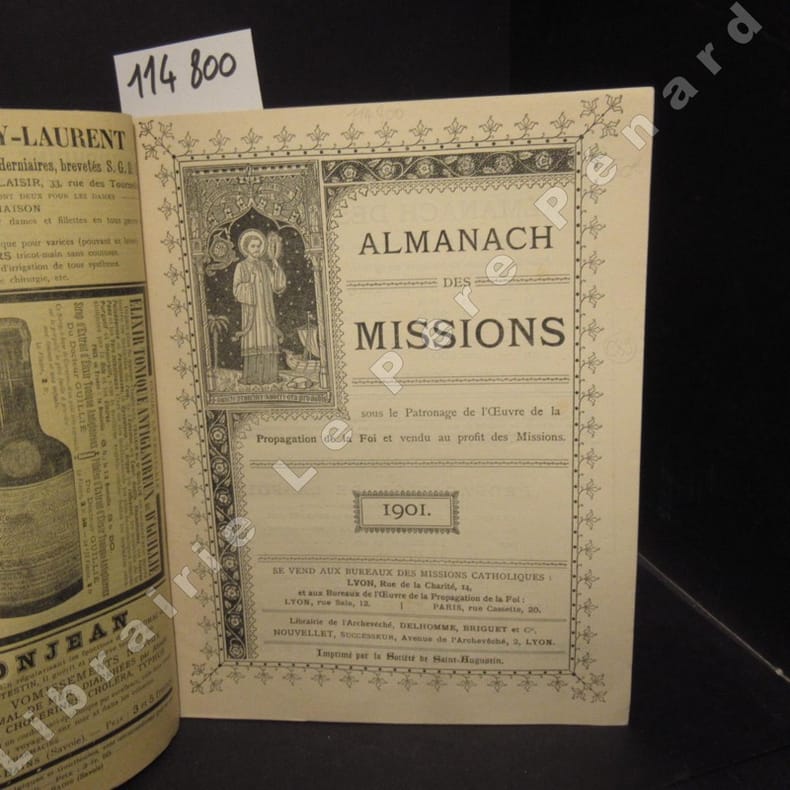
19011148001901 Année 1901 - Imprimé par la Société de Saint-Augustin - Librairie de l'Archevêché, Delhomme, Briguet et Cie, Nouvellet, Successeur, Lyon - Petit in-4, broché couverture illustrée en couleurs - 64 pages - Nombreuses illustrations en N&B in et hors texte + Une chromolithographie en couleurs hors texte