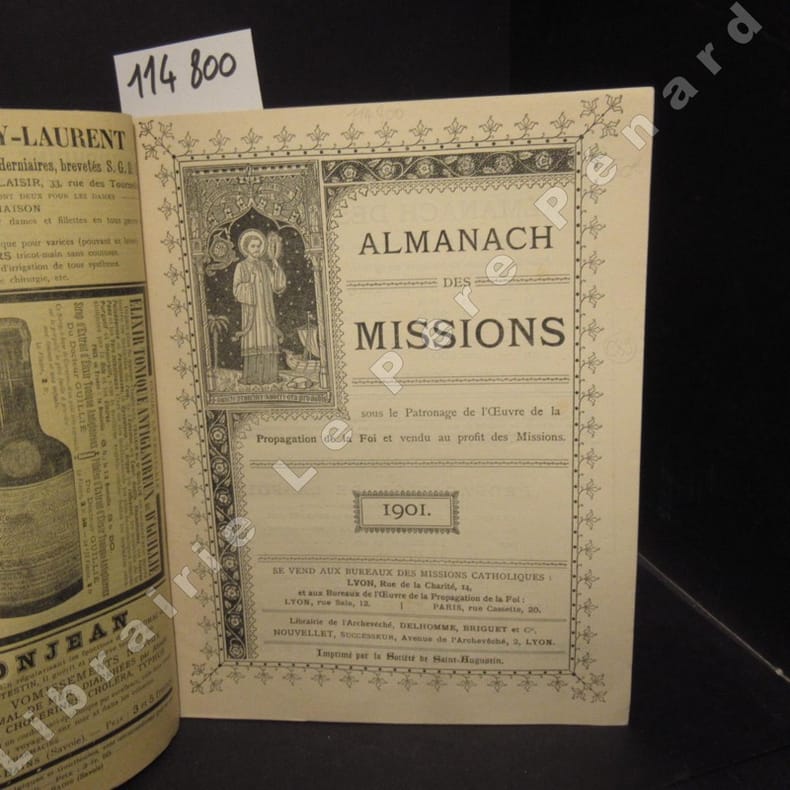
Almanach des Missions sous le Patronage de l'Oeuvre de la Propagation de la Foi et vendu au profit des MissionsLivre Rare Book
4 065 résultats
19011148001901 Année 1901 - Imprimé par la Société de Saint-Augustin - Librairie de l'Archevêché, Delhomme, Briguet et Cie, Nouvellet, Successeur, Lyon - Petit in-4, broché couverture illustrée en couleurs - 64 pages - Nombreuses illustrations en N&B in et hors texte + Une chromolithographie en couleurs hors texte
New English Paperback. 4to. (28 x 23 cm). In English and Turkish. 300 p., color ills. and b/w photos. The alphabet reform which came into effect in Turkey on November 1st, 1928, made reading and writing in Turkish easier compared to the system based on the Arabic script, and it also constituted the new face of Early Republic modernization, which defined its political rhetoric through a break from its Ottoman past. The National Schools (Millet Mektepleri) played a vital role in the campaign for teaching reading and writing with the new alphabet, while the press regime structured in 1934 under the direction of the General Directorate of the Press (Matbuat Umum Müdürlügü) played a key role in the formation of a culture of national press in the country. Just like its counterparts pursued in the 1930s in Europe, in the United States, and in the Soviet Union, the press regime that was in effect in Turkey during the Early Republic period was an efficient cultural management policy, because it utilized centralized policies to shape official and private publishing that was under the control of political powers and because it got masses to adopt the ideology of modernization through publishing that reached rural areas. In the 1930s, the common goal of the press regimes of socialist, fascist, or liberal government systems, which played an active role in mass communication and education policies was the transformation of the official ideology of modernization into social culture.
In-8°, 24pp, legatura in carta semplice In-8°, 24pp, paper binding
In-8°, 24pp, legatura in carta semplice, intonso In-8°, 24pp, paper binding, uncut
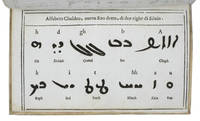
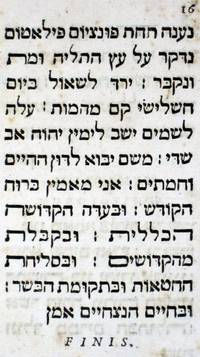
16365CHGGG01U79ORome 1636. Oblong 8vo 11 x 17 cm. Propaganda Fide Contemporary vellum with the spine at the head of the leaves. A complete set of 12 leaves published without a title-page printed on rectos only each page with a frame of double rules and an additional single rule built up from short rules delineating a panel at the head that contains the title of the leaf 10 of the 12 beginning Alfabeto . and showing woodcut 3 or typographic 7 alphabets the latter showing Hebrew meruba & rabbinical Samaritan majuscule and Syriac estrangela & serto types. The other 2 leaves show a woodcut illustration of an inscription in stone and an interpretation of it including a smaller woodcut. 12 ll. Rare publication of the Propaganda Fide in Rome showing alphabets of non-Latin scripts published without a title-page and printed on the rectos only with 7 of the 12 leaves showing alphabets of the Propaganda Fides printing types for Hebrew 3 sizes of meruba square and 1 of rabbinical semi-cursive Samaritan majuscule and Syriac estrangela and serto. The Syriac language bears no relation to modern Syria but is a form of Aramaic spoken by many early Christians in the Middle East and still surviving today. The Propaganda Fide apparently had some of these types cut exclusively for their use and the present publication shows complete alphabets including some variant forms for 6 of the 7 in most cases also with a few words or lines of text it shows only the first half of the alphabet - alaph to kaph - for the very large serto Syriac. This provides an especially valuable overview of the founts.The present publication collates: A-C4 = 12 ll. with quire signatures on leaves 1-2 of each quire each leaf printed on the recto with a title at the head:A1: Alfabeto del protoparente Adamo I. delineato nella libraria Vaticana. woodcut charactersA2: Alfabeto II. di Adamo secondo che riferisce il P. Giacomo Bonavent. Scozese dell'Ordine di S. Francesco di Paolo nel suo alfabetario intitolato Virga aurea. woodcut charactersA3: Alfabeto III. di Adamo cavato dal libro di Lorenzo Schradero stampato in Helmstatt l'anno 1592. woodcut charactersA4: Alfabeto Hebreo detto Soprasilvio. meruba square Hebrew typeB1: Alfabeto Hebreo detto Testo. meruba square Hebrew typeB2:Alfabeto Hebreo detto Garamone. meruba square Hebrew typeB3: Alfabeto Hebreo rabbinico detto Garamone. rabbinical semi-cursive Hebrew typeB4: Lettere cavata dal P. Tomaso da Navara che si trovano sculpite in una pietra piccola posta à piedi del Monte Oreb dove Dio N.S. diede la legge. woodcut of the Mount Horeb inscriptionC1: Analysi dell'antecedente carattere conforme alla dispositione del P. Atanasio Kircher nel Prodromo Copto approvata da' molti. interpretation of the Mount Horeb inscriptionC2: Alfabeto Samaritano detto Testo. majuscule Samaritan type 1636C3: Alfabeto Estranghelo overo Chaldeo antico detto Testo. estrangela Syriac type Coakley S7 1636C4: Alfabeto Chaldeo overo Siro detto di due righe di Silvio. serto Syriac type Coakley W12 large size 1618 bought by the Propaganda Fide 1653Nearly all references describe this book as an oblong 8vo but this appears to be an error. The two copies we have examined are both oblong 4tos with the chain-lines vertical in the oblong leaves and the watermarks divided at the heads of the leaves in the middle of a long edge. Several leaves with the double rule at the foot shaved not effecting the text or quire signatures otherwise in good condition. A rare collection of non-Latin alphabets including the Propaganda Fides Hebrew Samaritan and Syriac types.l Amaduzzi Catalogus librorum . Propaganda Fide 1773 p. 7; Birrell & Garnett 1928 4; Coakley Typography of Syriac W12 & S7; Philologia orientalis 199; D. Stolzenberg Egyptian Oedipus: antiquarianism oriental studies . in the work of Athanasius Kircher Thesis Stanford Univ. 2004 pp. 118 & 121; WorldCat 11 copies in 9 entries. hardcover
17871004671787. Rome Typis. Sac. Cong. de Propaganda Fide 1787. xvi including one blank leaf 62pp. With one folding plate and several decorative woodcut ornaments and initials. All texts within decorative borders. Later marbled boards with green titleshield on spine. Edges stained red. Several pages browned but a very good and clean copy. Lacks the last leaf. The Alphabetum is written by Melchior Carpanius here revised by Cajetanus Mantegatius and the introduction by the editor Johannes Christopher Amaduzzi. Second edition first 1776 of the first work to be printed in Burmese characters. The types were partly recast in this edition. Birrell & Garnett 21. Cordier BI 351. Herbert & Milner: "South-East Asia. Languages and literatures" pp. 9. Smitskamp PO 209. hardcover
17711001881771. Romae Typis. Sac. Congregationis de Propag. Fide 1771. Woodcut vignette on titlepage. 16pp. some foxing. 19th century blue wrappers. One of the rare publications of the Propagande Fide that was established in 1626 for propaganda among the Eastern peoples. Ferdinand II presented Illyrian types for a missal and the Mediciean and other Oriental types from the Stamperia Vaticana were added to its stock while Stefano Paolini engraved others. It continued its existence throughout the XVIIth and XVIIIth centuries: Bodoni received his early training here. In 1789 most of the types were taken to Paris where in 1805 an edition of the Lord's Prayer in 150 languages was printed as a compliment at the time of Napoleon's coronation. Much of the type still remains at the Imprimerie Nationale. c.f. Birrell & Garnett 14. unknown
1797100416<p>1797. Rome Propaganda Fide 1797. 15pp. Unbound. Woodcut vignette on titlepage and one vignette in the text. One of the rare publications of the Propagande Fide that was established in 1626 for propaganda among the Eastern peoples. Ferdinand II presented Illyrian types for a missal and the Mediciean and other Oriental types from the Stamperia Vaticana were added to its stock while Stefano Paolini engraved others. It continued its existence throughout the seventeenth and eighteenth centuries: Bodoni received his early training here. In 1789 most of the types were taken to Paris where in 1805 an edition of the Lord's Prayer in 150 languages was printed as a compliment at the time of Napoleon's coronation. Much of the type still remains at the Imprimerie Nationale. Not in Birrell & Garnett Smitskamp PO 216; Brunet I 197.</p>
B9781169055292New. unknown
116905529X.Ghardcover. Good. Access codes and supplements are not guaranteed with used items. May be an ex-library book. hardcover
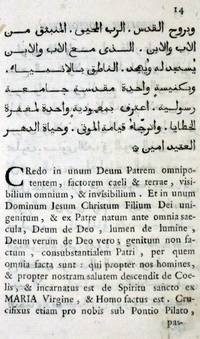
1773664L4Romae: Sacra Congregatio de Propaganda Fide 1773. Leather. Very Good. 7" by 4.5". None. A very scarce example of the Tibetan Alphabetum issued by the Sacra Congregatio de Propaganda Fide. The Alphabetum series was one of the first to print the script of different languages. Written in Latin and Tibetan. A first thus of this work. 'The Alphabetum' was created as a reference text for Catholic missionaries who travelled worldwide to promote God's message. The Sacra Congregatio de Propaganda Fide printing press was established by The Vatican in 1622. The press held the largest collection of printing types from languages and scripts worldwide. They quickly produced these booklets of exotic languages which included Arabic Greek Iberian Syrian among many other languages. Presented in a handy pocket sized format the Alphabetums were a marvel of printing at the time. It demonstrated printing of characters not seen by western audiences. Ex library stamps contemporary to the work to the rear of title page for Biblioth Regia Berolinensi. With the vignette seal of the Congregation. This work includes the Lord's prayer the Ave Maria the Apostles' creed and the Ten commandments in Tibetan and Latin. The Tibetan Alphabetum was the first time that there was a western publication on the Tibetan language. It is based on information sent back by missionaries from the Capuchin mission at Lhasa. The work was first published under the name 'Alphabetum Tibetanum' and it would appear that this 1773 printing is the first time that the work appeared under the title 'Alphabetum Tangutanum sive Tibetanum'. The folding plate is provided in facsimile. An important work in print development and language education. In a half calf binding with marbled boards. Damage to the head of spine and to the outer corner to the bottom of both boards. Loss to the leather resulting in the minor damage and loss to the bottom corner of pages not affecting text. Contemporary library stamp to the verso of title page and contemporary inscription to the head of title page 'Ax J 6'. Pages are bright and clean. Very Good Sacra Congregatio de Propaganda Fide hardcover
In-8°, (1), XX, 152, (1), legatura in carta semplice In-8°, (1), XX, 152, (1), paper binding, uncut.
In-8°, (1), XX, 152, (1), legatura in cartonato In-8°, (1), XX, 152, (1), cardboard binding
In-8°, 4pp, legatura in carta semplice, intonso In-8°, 4pp, paper binding, uncut
In-8°, 8pp, legatura in cartoncino decorato In-8°, 8pp, decorated cardboard
In-8°, XXVIII, 100pp, 8 tavole numerate, 1 non numerata (tutte fuori testo), legatura in carta semplice, intonso In-8°, XXVIII, 100pp, 8 numbered plates, 1 plate not numbered (all inset plates), paper binding, uncut.
In-8°, 30pp, una tavola ripiegata, legatura in carta semplice, intonso In-8°, 30pp, one folded plate, paper binding, uncut.
In-8°, XVI, 138, una tavola ripiegata, legatura in carta semplice, intonso In-8°, XVI, 138, one folded plate, paper binding, uncut.
193610491München, Ludendorffs Verlag, 1935/1936. mit sehr vielen fot. Tafeln in monochromem Kupfertiefdruck. OLn.d.Zt., 992 S., (Kopfrotschnitt), Gr.8°
193810492München, Ludendorffs Verlag, 1937/1938. mit sehr vielen fot. Tafeln in monochromem Kupfertiefdruck. OLn.d.Zt., 976 S., (Kopfrotschnitt), Gr.8°
1915S842Berlin, Hoffmann & Campe, 1915. Kartoniert, 4° (24 x 32 cm ), 128 S., von der Zeit des Burenkrieges bis zur Gegenwart, Texte von Johannes Trojan, Paul Warncke, Max Friedlaender u.a., mit Zeichnungen von Gustav Brandt, Arthur Johnson, Ludwig Stutz, Willibald Krain, Ernst Retemeyer, Arthur Krüger, W. Hahmann u.a.
193112924San Francisco: Farallon Press 1931. First Limited Edition. Number 91 of an unspecified limitation. Hand-numbered and signed by the author on copyright page. Large octavo 25cm; original gilt-blocked cloth; dustjacket; 171pp; illus. Brief ownership inscription to front endpaper else a tight fine copy. In the original dustjacket toned on spine and margins with a few short closed tears to extremities Very Good. The author a hydroelectric engineer presents the results of his first-hand survey of Soviet electrification projects in 1930. He concludes that Individualism has and will continue to trump Collectivism on the path to progress. Well-illustrated with halftones and three mounted color plates reproducing Soviet poster designs; two maps. Farallon Press unknown
193112924San Francisco: Farallon Press 1931. First Limited Edition. Number 91 of an unspecified limitation. Hand-numbered and signed by the author on copyright page. Large octavo 25cm; original gilt-blocked cloth; dustjacket; 171pp; illus. Brief ownership inscription to front endpaper else a tight fine copy. In the original dustjacket toned on spine and margins with a few short closed tears to extremities Very Good. The author a hydroelectric engineer presents the results of his first-hand survey of Soviet electrification projects in 1930. He concludes that Individualism has and will continue to trump Collectivism on the path to progress. Well-illustrated with halftones and three mounted color plates reproducing Soviet poster designs; two maps. Farallon Press unknown books
160 pages. Features: Castro's War on Capitalism in Cuba; Counting Heads - the first U.S. census was no easy job; Juvenile Integrity Starts in the Home; The Korean Myth - Misconceptions Americans have about Korea; 1960 Version of "The Little Red Hen"; Cold War in International Athletics - opposing Communist athletes intent on propaganda; The Tenth Man - baseball's most important player can be the groundskeeper; Facts Russia Does Not Tell; School Teaching Beats Working for a Living; The Truly Satisfying Life; The China Clipper; Who are the Metrocrats?; Listen to This; Honey - Nutritious Nostrum; Who Wants to Abolish the HUAC (House Un-American Activities Committee)?; They Tamed the Wild Missouri River; Is There Free Speech?; The greatest Train Robbery; Walter, The Adaptable Weasel; A Kentucky Political Education; Don't Let your Shoulder Freeze; This Is Christianity - Young Korean Joon Gon Kim's Ministry to Communists; You Can Do Something; Those Modern Eskimos; A Return to Common Sense in Education - Pennsylvania teacher shuns methods that produce illiterate blockheads; The Organization Mother; January-June 1960 Index. Back cover Flag Day coverage features lovely photo of youngsters Kay and Tony of the Dario Politella family of Lindenhurst, Long Island. Unmarked with moderate wear. A sound vintage copy. Book
2015232482München ; Berlin ; Zürich : Piper, 2015. 399 S. 21 cm Bibliothekseinband, gebundene Ausgabe, Lesebändchen.