(British Acts of Parliament)Biblio.com
256 résultats
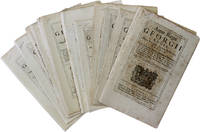
1760339119London: John Baskett; Thomas Baskett; and others 1760. Together approx. 35 Acts each with separate title with Royal arms. Small folio. Disbound. Some with foxing some trimmed a few leaves detached. Overall very good. A couple in duplicate. Together approx. 35 Acts each with separate title with Royal arms. Small folio. Includes the following:<br /> <br /> An Act for the Continuing the Liberty of Exporting Irish Linen Cloth to the British Plantations in Amerca Duty-free 1717<br /> An Act for Importing Salt from Europe into the Province of Pensilvania in America 1727<br /> An Act for the better Preservation of His Majesty's Woods in America 1729<br /> An Act for Importing Salt from Europe into the Colony of New York in America 1730<br /> An Act for importing from his Majesty's Plantations in America directly into Ireland Goods not enumerated in any Act of Parliament 1731<br /> An Act to explain and Act . intituled An Act for importing from his Majesty's Plantations in America 1732<br /> An Act for the more easy Recovery of Debts in His Majesty's Plantations and Colonies in America 1732<br /> An Act for granting a Liberty to carry Sugars of the Growth Produce or Manufacture of any of His Majesty's Sugar Colonies in America 1739<br /> An Act for the more effectual securing and encouraging the Trade of His Majesty's British Subjects to America 1739<br /> An Act for the more easy and effectual Conviction of Offenders found at large within the Kingdom of Great Britain after they have been ordered for Transportartion to America 1742<br /> An Act for further regulating the Plantation Trade 1742<br /> An Act to revive several Acts . relating to Rice to Frauds in Customs to the clandestine running of Goods and to Copper Ore of the British Plantations 1742<br /> An Act for continuing several LAws relating to the Allowance upon the Exportation of British made Gunpowder; to the Importation of Naval Stores from the British Colonies in America 1743<br /> An Act to continue Two Acts of Parliament . for encouraging the Growth of Coffee . for the better securing and encouraging the Trade of His Majesty's Sugar Colonies in America 1746<br /> An Act for the better encouragement of the Trade of His Majesty's Sugar Colonies in America 1746<br /> An Act to extend the Provisions of an Act . for Naturalizing Foreign Protestants . in America 1747 two copies<br /> An Act for encouraging the making of Indico in the British Plantations in America 1748<br /> An Act for encouraging the People known by the name of Unitas Fratrum or United Brethren to settle in . America 1749 three copies<br /> An Act to encourage the Importation of Pig and Bar Iron from His Majesty's Colonies in America 1750<br /> An Act for encouraging the Growth and Culture of Raw Silk in . America. 1750<br /> An Act for encouraging the making of Pott Ashes and Pearl Ashes in . America 1750<br /> An Act for continuing several Laws . upon the importation of Masts 1751<br /> An Act for avoiding and putting and end to certain doubts and questions . concerning Real Estates . in America. 1752<br /> An Act for reducing the number of Directors of the Corportatioin of the Governor and Company of Merchants of Great Britain trading to the South Seas and other parts of America 1753<br /> An Act for continuing several Laws . and for the encourging the trade of the Sugar Colonies in America 1753<br /> An Act for continuing an Act . for encouraging the making of Indico in the British Plantations in America 1755<br /> An Act for extending the Act . as shall serve on Board His Majesty's Ships or Vessels employed upon the Lakes Great Waters or Rivers in North America 1756<br /> An Act to enable His Majesty to grant Commissions to a certain number of Foreign Protestants . in America 1756<br /> An Act to extend the Liberty . of importing Bar Iron from His Majesty's Colonies in America 1757<br /> An Act to prohibit for a limited time the exportation of corn grain meal malt flour bread biscuit starch beef pork bacon . from His Majesty's Colonies and Plantations in America 1757<br /> An Act to continue . a Liberty to carry sugars of the growth produce or manufacture of any of His Majesty's Sugar Colonies in America 1758<br /> An Act for continuing certain laws . and to the Encouragement of the Trade of the Sugar Colonies in America 1758<br /> An Act to continue several laws . to the encouraging the growth of Coffee in His Majesty's Plantations in America 1759<br /> An Act to continue several laws . to the granting Liberty to carry Rice from his Majesty's Province of Carolina in America 1760. John Baskett; Thomas Baskett; [and others] unknown
17671098111767. First Edition. CUSTOMS COMMISSIONERS ACT. Act to enable His Majesty to put the Customs and other Duties in the British Dominions in America and the Execution of the Laws relating to Trade there under the Management of Commissioners. London: Mark Baskett 1767. Folio 20th-century marbled stiff paper boards. $3200.Rare first printing of the 1767 Customs Commissioners Act one of the controversial Townshend Acts that united patriot opposition to British rule and provoked the Boston Massacre.Following the Stamp Act which had united colonial opinion against British authority ""as no issue before a new period of agitation began in 1767 with the passage of the Townshend Acts"" Morison Sources xv. Engineered by Charles Townshend Chancellor of the Exchequer these were intended to raise revenue from the American colonies by imposing duties on goods Americans were already forced to import only from England punish New York's opposition to the Quartering Act and establish a board of customs commissioners in America. This is the first printing of that Customs Commissioners Act. ""To guarantee that colonial duties raised as much money as he had promised to Parliament Townshend was tightening control over America's slack customs procedures"" by appointing commissioners in England and sending them to Boston ""with broad powers. Since colonial jurors rarely convicted a local merchant of smuggling Townshend's acts set up new admiralty courts that could try smugglers without a jury. And the acts made it easier for customs officials to obtain writs of assistance"" Langguth 93. In addition ""the moneys thus raised in the colonies were to be used to render the royal governors and judges independent of colonial assemblies"" Morison xv. To Samuel Adams ""these new commissioners of customs were 'the greatest political curses that could be sent amongst us From the time the acts took effect November 20 1767 many Bostonians had been boycotting luxury goods from Britain by signing a 'nonimportation agreement Stricter enforcement at the customs offices was drawing off hard currency from America and bad times were spreading across the colonies"" Langguth 94 102-103. With increased colonial opposition to the Customs Commissioners Act and other Townshend laws ""the customs administration to enforce them became especially in ports like Boston increasingly militarized"" provoking merchants such as John Hancock into ""calling one of his sloops Liberty and flaunting his intention of 'running Madeira ashore"" Schama History of Britain II:463. The day after the Liberty was seized by customs officials Sam Adams was overheard challenging the crowd ""If you are men behave like men. Let us take up arms immediately and be free and seize all the king's officers"" Langguth 98. With the Board of Commissioners of the Customs headquartered in Boston the city became the ""rowdiest of all the centers of protest"" and those who broke the boycott were often tarred and feathered. As tempers grew shorter and customs officers were accused of bribery and extortion matters often ""got completely out of control. On 23 February 1770 an eleven-year-old boy Christopher Seider joined by a noisy protest of schoolboys and apprentices outside the shop of an importer was shot dead by a customs officer"" and his funeral turned into a mass protest led by Sam Adams. Only one month later on March 5th amidst these already heightened tensions ""a wigmaker's apprentice ragged a soldier all the way to the Custom House for an allegedly unpaid bill. When a guard struck the pursuing youth a tocsin normally used as a fire alarm was sounded and mobilized a large and angry crowd"" Schama History of Britain II 463. In the melee that followed the redcoats opened fire killing fiveamong them Crispus Attucksand the day would be memorialized in history as the Boston Massacre. Printed in gothic type indicative of the first edition. This first printing excised from the Sessional Volumes of Parliament pages 563-66 precedes all American printings. Minor rubbing spine. Very nearly fine condition. hardcover
1730102277Bound volume of 89 acts folio 11 3/4" x 7" period full calf 446 pp. Various paginations actual page count is done by hand and a manuscript index at the front lists the acts and indicates the page it is on. Binding is worn backstrip is gone hinges are cracked covers almost detached and some signatures are loose some early ink notations and page numbering are on top of pages it appears there are some remnants of wax seals on the margin of the last page some soiling at endpapers normal aging and browning but internally pretty clean; despite the mentioned flaws the contents are in very good shape but the binding needs work. While this collection of Acts passed under George II and George III is not sequential a previous owner has provided a useful index as to the contents and location of various acts. The laws cover a very broad area of issues from the more mundane such as dog stealing punishments for disorderly houses and preventing abuses in making bricks and tiles to more important issues including the raising and training of the militia regulating the price of corn preservation of public highways and the punishment for selling ale and apiarist without a license. Other important acts include regulating places of entertainment regulating the trials of controverted elections establishing trade agreements in the East Indies changing some of the rules passed by Queen Elizabeth on providing relief to the poor and wildlife preservation. A fascinating glimpse at another time and issues of the day. Charles Eyre and William Strahan, Mark Baskett & Others,
1730102277Bound volume of 89 acts folio 11 3/4" x 7" period full calf 446 pp. Various paginations actual page count is done by hand and a manuscript index at the front lists the acts and indicates the page it is on. Binding is worn backstrip is gone hinges are cracked covers almost detached and some signatures are loose some early ink notations and page numbering are on top of pages it appears there are some remnants of wax seals on the margin of the last page some soiling at endpapers normal aging and browning but internally pretty clean; despite the mentioned flaws the contents are in very good shape but the binding needs work. While this collection of Acts passed under George II and George III is not sequential a previous owner has provided a useful index as to the contents and location of various acts. The laws cover a very broad area of issues from the more mundane such as dog stealing punishments for disorderly houses and preventing abuses in making bricks and tiles to more important issues including the raising and training of the militia regulating the price of corn preservation of public highways and the punishment for selling ale and apiarist without a license. Other important acts include regulating places of entertainment regulating the trials of controverted elections establishing trade agreements in the East Indies changing some of the rules passed by Queen Elizabeth on providing relief to the poor and wildlife preservation. A fascinating glimpse at another time and issues of the day. Charles Eyre and William Strahan, Mark Baskett & Others, books
17131394685London: Printed by John Baskett 1713-1717. First Editions. Hardcover. Folio 61-174 2179-191 6 203-206 2 211-218 2 223-270 2 275-357 3 361-362 2 367-382 2 387-422 4. In Good minus condition. Bound in full contemporary calf with banded spine and tooling to boards. Boards show moderate wear to edges moderate plus wear and bumping to corners and several gouges to the front board. Cracking to leather along joint of front board. A clear lacquer appears to have been applied to the boards. Text block has light age toning to edges. Ex-Library institutional plate appears on front paste down. Ex libris of former owner appears on front pastedown. Several ink "doodles" in an 18th-century hand appear on the front paste down and front free end page. Square-inch tear to fore-edge of front free end page. Pages tightly trimmed by binder impacting some of the printed marginal annotations. BB Consignment. Shelved in Room A Oversized. Appears to contain two collections of public statutes passed in 1713 and 1714 but printed between 1713 and 1717 each with a closing contents page. The first collection contains Acts II - XVIII of 18 acts and the second contains Acts II - XXIII of 23 acts. The acts cover a range of topics including duties tariffs and taxes; the paying and management of military personnel and militias; and the management of churches. The most significant of the acts however is Act 15 of the second set of acts entitled "An Act for Providing a Publick Reward for such Person or Persons as shall Discover the Longitude at Sea". This formally established the Commissioners of the Longitude and the reward of £20000 for "the first Author or Authors Discoverer or Discoverers of any such method ." that to the satisfaction of the committee accurately determined a ship's longitude at sea accurate to within 20 geographical miles. This reward would not be claimed until 1765 when clockmaker John Harrison developed his "time-keeper" or marine chronometer. 1394685. Special Collections. Printed by John Baskett hardcover
176535551London: Mark Baskett 1765. Folio. 12 x 7 7/8 inches. 2 279-310pp. 5 George III cap. XII. Disbound. Housed in a blue full morocco box.<br/> <br/>Very rare first official printing of the Stamp Act: an exceptionally important document in American history.<br/> <br/>The passage of the Stamp Act was one of the signal events in the history of the United States. After its successful effort in the French and Indian War the British government was saddled with a massive debt. Added to this was the cost of administering its new lands in Canada and the necessity of protecting colonists on the American frontier from Indian attacks. In order to raise funds for border defenses the British Parliament decided to levy a tax directly on the colonists rather than relying on colonial legislatures to raise the funds themselves. Over the protests of colonial agents in London including Benjamin Franklin from Pennsylvania and Jared Ingersoll of Connecticut a tax was levied on all legal and commercial papers pamphlets newspapers almanacs cards and dice. Nine pages in the present act are taken up with descriptions of what type of printed materials would be subject to the tax. A Stamp Office was created in Britain and Stamp Inspectors were to be assigned to each colonial district. Colonists wishing to purchase or use any of the materials covered in the Act would be required to buy a stamp. The outrage in the colonies at this form of taxation was immediate and overwhelming and the Stamp Act was repealed in 1766. The bitterness engendered by the Act lingered on and coupled with subsequent British laws including the Intolerable Acts and the Townshend Acts became some of the many grievances enunciated in the Declaration of Independence. "This is the original folio edition of the famous or infamous Stamp Act by which the American colonies were taxed in and on their business papers" Church. "The importance of this act to our history needs no comment" Streeter. Sabin and Howes note an octavo edition of sixty-six pages also printed by Baskett in London in 1765. This momentous law was reprinted several times in the American colonies in 1765 in editions in Boston New York Philadelphia Annapolis New London and Woodbridge New Jersey.<br/> <br/>Sweet & Maxwell II:176; Church 1054; Stevens 6; Howes A285; Sabin 1606. Mark Baskett unknown books


