LINGUET (Simon-Nicolas-Henri)Livre Rare Book

6 711 résultats
1769PHO-1488Paris, Quillau et Le Breton,1769-1770, in-4, 53pp.-254pp.-2ff.-199pp., relié plein veau granité d’époque, dos à nerfs ornés avec pièce de titre verte, triple filets aux plats, tranches marbrées bleues, début de fente, coins usés, une coiffe absente.
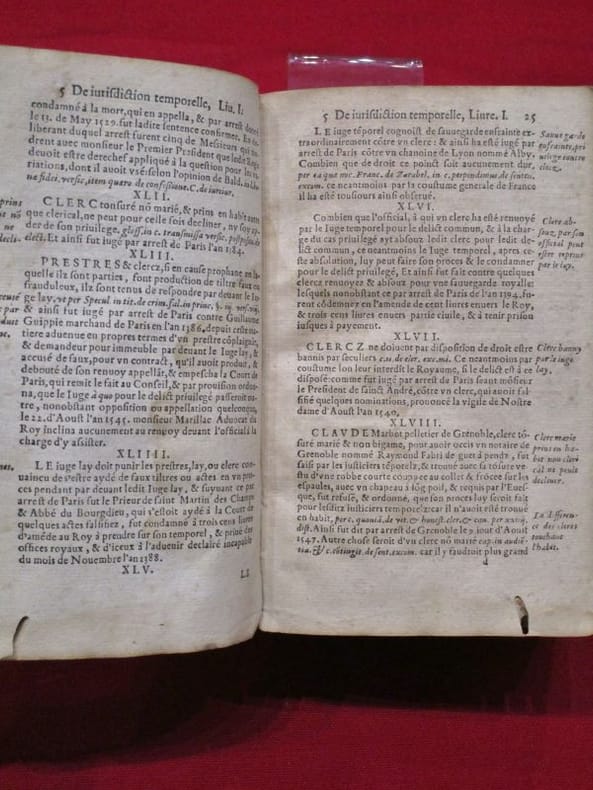
158422411Paris, Abel L'Angelier, 1584 ; in-8°, veau marbré, titre en long, roulette sur les coupes et d'intérieur (reliure ancienne postérieure) ; [12], le dernier blanc, 174 ff. ; armes gravées sur bois, de Philippes Hurault, vicomte de Cheverny, Chancelier de France ; bandeaux et lettrines gravés sur bois.
114448Chez Jacques Macé, à l'enseigne de la Pyramide, 1567, 1 volume in-12 de 100 x170 mm environ, (2) ff., (16) ff., 532 feuillets numérotés, (51) ff. (répertoire alphabétique), (1) f. Reliure plein vélin crème d'époque, nom manuscrit au dos, nombreuses lettrines ornées et bandeaux. Ouvrage en partie dérelié, quelques défauts sur le vélin, des mouillures, galeries de vers dans les marges (dans le texte sur le répertoire), notes manuscrites anciennes sur les gardes blanches.
18155No place, (1764). 4 works bound in 1 volume. 22 pp.; 40 pp.; 118 pp.; (2), 66 pp. Small 8vo. Contemporary marbled calf, spine gilt with raised bands, red edges. None in Conlon. The principal object of these works is to protest against the Edicts of April 1763 and deal with taxes, weighing so heavily on the people. At head of the third piece, page 3: PRECIS de ce qui s'est passé au Parlement de Rouen depuis le 14 mars 1763, jour de sa rentrée.
1927110981927 DIJON, Alfred Bellais Lib. - 1927 - In-4 - Broché - Sous emboitage - Couverture rempliée illustrée - Tirage limité à 530 exemplaires, un des 20 exemplaires numérotés sur Hollande van gelder vergé, N° 14 - Planches d'armoiries in fine, avec un double de chaque planche joint - Index - 412 pages - Très bon exemplaire
DIJON, Alfred Bellais Lib. - 1927 - In-4 - Broché - Sous emboitage - Couverture rempliée illustrée - Tirage limité à 530 exemplaires, un des 20 exemplaires numérotés sur Hollande van gelder vergé, N° 14 - Planches d'armoiries in fine, avec un double de chaque planche joint - Index - 412 pages - Très bon exemplaire
18549579Lyon, Imprimerie Louis Perrin, 1854 ; in-8 ; cartonnage beige de l'éditeur, auteur et titre imprimés au dos en gros caractères gothiques enluminés marron, rouge et bleu ; (1) f. blanc, (6), 460, (2) pp. (la pagination passe de 244 à [251] avec (1) f. de faux-titre entre, sans manque : il s'agit de 2 ff. de blasons vides qui ont été coupés à la fabrication) ; carte rempliée en début d'ouvrage, 1 pl. hors-texte lithographiée en couleurs, 1 gravure sur cuivre hors-texte, 2 vues de Trévoux en-tête, 7 bandeaux et culs-de-lampe par Louis Perrin et en tout 258 blasons identifiés et 15 noms sans blason.
4365Chez Pierre Garnier, Rennes, 1684. Deux tomes en un volume in-4 plein vélin ivoire, dos muet (trace de titre manuscrit), T.I: 1f. de titre, 2ff. d'épitre, 4ff. d'avertissement, 6ff. de table, 496pp., 39pp. d'additions; T.II: 1f. de titre, 5ff. de tables, 472pp. (pagination continue). Vélin fatigué avec manque sur le premier plat, mouillures et travail de vers marginal sur les premiers feuillets sans atteinte au texte.
pp. [2], 55. Signatures: A^(4)(-A1) B-G^(4) H2. There are two settings of this same edition known (no priority as to first issue, and many copies contain mixed formes). This setting has the title page with a small version of the royal arms; and on the verso a large, full page, engraved version; and the last line of D4v begins: as ever'. **Short contemporary Ms. note on title: 'This p'lament began Apr. 16, 1640 & was dissolved May 5 folowing.' Small 4to. 190 mm. Later blue boards binding; leather title strip lettered in gilt. Clean and attractive copy. Charles I (1600-1649), King of Great Britain and Ireland. In his early disputes, arguments, and battles with the Scots, tried a new tool. He resolved to call an English parliament, and to ask for means to enable him to make war effectually upon Scotland. The discovery of an attempt made by the Scottish leaders to open negotiations with the king of France led him to hope that the national English feeling would be touched. In the meanwhile the English privy councillors offered him a loan which would enable him at least to gather an army without parliamentary aid. The Short parliament of 1640 was opened by the King on 13 April with a few words indicative of the gravity of the situation, the task of more fully setting forth the royal wishes and intentions being devolved upon the Lord Keeper (Baron Finch). Under Pym's leadership the Parliament showed itself disposed to ask for redress of grievances as a condition of a grant of supply, and it subsequently refused to give money unless peace were made with the Scots. On 5 May Charles dissolved parliament by means of this Declaration. Getting money by irregular means, he proceeded to push on the war, and formed an Irish army to join the mutinous and un-warlike Royal army. Terrified and exasperated Englishmen, believed that this army would be used in England to crush their liberties. The Scots knew that the opinion in England was in their favour, and they had already entered into communication with the parliamentary leaders. On 20 Aug. they crossed the Tweed, defeated part of the royal army at Newburn on the 28th, and soon afterwards occupied Newcastle and Durham. Charles's money was by this time almost exhausted, and he was obliged to summon the English peers to meet him in a great council at York, as there was no time to get together a full parliament. The great council met on 24 Sept. It at once insisted on opening negotiations with the Scots, and sent some of its members to London to obtain a loan to support the army during the progress of the treaty. Charles had now agreed to summon another parliament, and the negotiations opened at Ripon were adjourned to London. Possibly written by John Finch, Baron Finch of Fordwich (1584-1660), Speaker of the House of Commons and Lord Keeper. STC (2nd ed.) 9262; Thomason, E.203[1]; Lincoln's Inn. Catalogue of Pamphlets, 1506-1700. The attractive First Edition of a scarce and important pamphlet. KING CHARLES I DISSOLVES THE "SHORT PARLIAMENT". **PRICE JUST REDUCED! STC 2
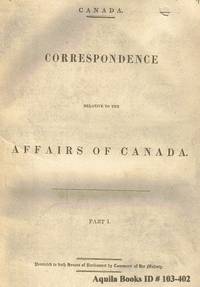
1840103402Printed for H. M. S. O. by Clowes & Sons 1840. Softcover. good to very good. v207;227;60pp. Folio. Part I sewn as issued lacking wrappers soiled with some wear to titlepage from erasure; Part II in original blue wrappers with large piece of rear corner missing; Part IV in original blue wrappers. good to very good Reference: TPL 7572-7574. Contents: Pt. 1. Lower Canada -- Pt. 2. Upper Canada political -- Pt. 4. Upper Canada. 1840 Printed for H. M. S. O. by Clowes & Sons paperback
60542Published by Authority. Gibraltar Garrison Library. 1839. Folio. Comprising 39 Statutes WITH separate Title and Index PLUS 4 additional Statutes added these from 1 & 2 Vict. 1838. New cloth a very good copy. The Statutes range from An Act for consolidating and amending Laws relative to Jurors and Juries 6 Geo.4 c.50 1825 to An Act for abolishing the Punishment of Death in certain Cases 1 Vict. c.91 1837 and including certain very important Acts viz. for Regulating Schools of Anatomy 2 & 3 W.4 c.75 1832;. to abolish the Practice of hanging the Bodies of Criminals in Chains 4 & 5 W.4 c.26 1834;. for abolishing Capital Punishments in Cases of Letter Stealing and Sacrilege. 5 & 6 W.4 c.81 1835. COPAC does not record a copy of this title. Published by Authority. Gibraltar Garrison Library. 1839. Folio. hardcover
18337535Printed by George Eyre and Andrew Spottiswoode Printers to the King's most Excellent Majesty 1833. 12pp. sm. folio with fine woodcut arms of William IV on front page; disbound an exceptionally crisp virtually spotless copy ideal for display or presentation. 3 Gulielmi IV. Cap. 9; granted royal assent 6 May 1833. This is the Act of Parliament formally incorporating the Seaman's Hospital Society establishing and naming its first governors and prescribing its powers and scope of operations. By way of context its military equivalent the Royal Hospital at Chelsea was founded in 1692. The world's first charitable society for the relief of distressed seamen was established in London in March 1821. Initially it aimed to cater for those in the Port of London 'who at that time were very numerous in the Metropolis' and fittingly for the world's leading maritime nation did not differentiate on nationality or any other grounds other than disability and hardship. The motivating principles seem to have been partly public gratitude in the aftermath of the Napoleonic wars in which the Royal Navy in particular had played a fundamental role in achieving victory and partly increased recognition of the helplessness of private seamen and the strength of their cause. The society was supported entirely by donations subscriptions and legacies and by the loan by government of a hospital ship HMS Dreadnought moored at Greenwich. In its first twelve years the society provided relief and support to upwards of twenty-three thousand sick and distressed seamen 'many of whom might otherwise have perished'. With the case clearly made it was time for a more formal and robust body with increased remit and governance; accordingly the Seaman's Hospital Society was given royal assent on 6 May 1833. Its significant extra powers included the rights to possess property receive bequests purchase lands and canvass donations; most important of all it was granted 'perpetual succession'. The original HMS Dreadnought continued in use until 1870 when the Admiralty made available at nominal rent the infirmary at Greenwich where the 'Dreadnought' hospital continues to this day. AN ACT OF FUNDAMENTAL IMPORTANCE TO THE WELFARE AND WELL-BEING OF SEAMEN IN BRITAIN AND A SIGNIFICANT DEVELOPMENT IN BRITISH MARITIME HISTORY. VERY SCARCE ESPECIALLY IN THIS CONDITION. [Printed by George Eyre and Andrew Spottiswoode, Printers to the King's most Excellent Majesty, unknown
12pp., sm. folio, with fine woodcut arms of William IV on front page; disbound, an exceptionally crisp, virtually spotless copy ideal for display or presentation. 3 Gulielmi IV. Cap. 9; granted royal assent, 6 May 1833. This is the Act of Parliament formally incorporating the Seaman's Hospital Society, establishing and naming its first governors and prescribing its powers and scope of operations. By way of context its military equivalent, the Royal Hospital at Chelsea, was founded in 1692. The world's first charitable society for the relief of distressed seamen was established in London in March 1821. Initially it aimed to cater for those in the Port of London ('who at that time were very numerous in the Metropolis') and, fittingly for the world's leading maritime nation, did not differentiate on nationality or any other grounds other than disability and hardship. The motivating principles seem to have been partly public gratitude in the aftermath of the Napoleonic wars, in which the Royal Navy in particular had played a fundamental role in achieving victory, and partly increased recognition of the helplessness of private seamen and the strength of their cause. The society was supported entirely by donations, subscriptions and legacies, and by the loan by government of a hospital ship (HMS Dreadnought) moored at Greenwich. In its first twelve years the society provided relief and support to upwards of twenty-three thousand sick and distressed seamen, 'many of whom might otherwise have perished'. With the case clearly made it was time for a more formal and robust body with increased remit and governance; accordingly the Seaman's Hospital Society was given royal assent on 6 May 1833. Its significant extra powers included the rights to possess property, receive bequests, purchase lands and canvass donations; most important of all it was granted 'perpetual succession'. The original HMS Dreadnought continued in use until 1870 when the Admiralty made available at nominal rent the infirmary at Greenwich where the 'Dreadnought' hospital continues to this day. AN ACT OF FUNDAMENTAL IMPORTANCE TO THE WELFARE AND WELL-BEING OF SEAMEN IN BRITAIN, AND A SIGNIFICANT DEVELOPMENT IN BRITISH MARITIME HISTORY. VERY SCARCE, ESPECIALLY IN THIS CONDITION.
40524Paris.Robert Fouet.1612.In-4 de 1165 pages + Table des Matières. BE.Reliure en veau moucheté.Tranches mouchetées.Dos à 5 nerfs avec larges caissons décorés et pièce de titre.
47297Textes XVIIème dans une reliure peignée XIXème.Ex-libris.2 cachets discrets sous les pièces de titre. Rare.Bon état.
1874104564London: Printed by William Clowes & Sons. for Her Majesty's Stationery Office 1874. Softcover. good to very good. 1st printing. ii266pp. Folio disbound with all edges green. Some light dampstaining affecting top edge and upper right hand margin edges. Manuscript pagination added in upper right hand margin. good to very good Very scarce. This folio parliamentary paper was a very early report to both Houses of Parliament on the first attempt to finance and build the first Canadian Trans Continental Railway. This attempt failed and helped to bring down John A. MacDonalds government. 1874 Printed by William Clowes & Sons,.. for Her Majesty's Stationery Office paperback
1868106207London: Printed by George Edward Eyre and William Spottiswoode 1868. Softcover. good to very good. 150pp. Folio 33 x 21 cm. in original blue wrappers with folding colour map. Wrappers detached chipped some minor soiling to contents. good to very good Transmitted with the Blue Books for the Year 1866. 1868 Printed by George Edward Eyre and William Spottiswoode paperback
1767411280London : publisher not identified 1767. First Edition. Hardcover. Good copies finely bound in the original full aniline calf. Raised bands with red and black gilt-blocked leather label. Spine compartments uniformly tooled in gilt. Spine bands and panel edges slightly rubbed and dulled as with age. Hinges starting and some board starting to detach. Remains quite well-preserved overall; internally bright and clean. Further scans images and additional bibliographical material available on request. Physical description; 2 vol. ; 21 cm. Notes; Contains ""An historical essay on the legislative power of England . By George St. Amand"": at the at end of vol. 2. with a separate titlepage pagination cxxvii p. and register the essay was also issued separately. Has been attributed to Almon John 1737-1805. Includes index. Contents; vol. 1 1242-1724 -- vol. 2 1725-1772. Subjects; Great Britain. Parliament. House of Lords. Constitutional history Great Britain ; Sources. Great Britain Politics and government 1216-1760 ; Sources. London : publisher not identified hardcover
Due volumi in folio imperiale legati in mezza pelle, titolo ai dorsi decorati in oro, sguardie, frontespizio al primo volume, pagine da 1 a 706 e da 1441 a 2134. Trattasi dei resoconti ufficiali della Camera dei Deputati in seduta con la trascrizione esatta dei diversi interventi. Uno spaccato assolutamente inconsueto sulla politica e sulla vita stessa dello Stato. Da segnalare le infinite notizie riguardanti l'economia, il gioco politico, la guerra, i trattati interstatali e quant'altro si vuol sottolineare, con il resoconto degli interventi di coloro che (Da Cavour a Minghetti a Boncompagni) ebbero la ventura d'assistere alla nascita della Nazione italiana. Inutile discettare sull'importanza e sulla scarsa reperibilità di tanto documento, resta da dire solo che la conservazione è ottima.
1783113275No place: no printer identified 1783. Pro bono work First and apparently only edition of this speech promoting the establishment in Toulouse of an order of lawyers offering free legal representation to the poor a "league of generous defenders of the oppressed and destitute". When Maître Gez c.1700-1792 gave this speech to his peers at the Parlement in Toulouse he had already constituted a group of thirty-two lawyers providing free counsel to the poor. The group was divided into two chambers according to seniority and met monthly. Appealing to the generosity of his peers to form a society of men dedicated to the pursuit of justice and set free from the "domination of greed" Gez cites as models to follow Montesquieu Beccaria and Servan as well as the Bareau of the city of Nancy which had already implemented a similar system. Jean Nicolas Joseph Abraham Gez had a long career at the Bar and was made a member of the Académie des Sciences Inscriptions et Belles Lettres de Toulouse in 1785. Quarto 238 x 190 mm 21 pp. Engraved vignette at head of first leaf. Disbound and stab sewn through the original stab holes. Small marginal stain to first leaf top corner with small stain; a very good copy. unknown
1745100736Pamphlet format small folio disbound each act with its own title. One act with 2 pages separated some minor dampstaining; otherwise very good plus. The lengthiest act relating to the raising of money makes several specific references to colonial Georgia including the provisioning of the garrisons commissioning of troops of Highland Rangers with schooners and granting money to the trustees of Georgia for the improvement of the colony. Another act provides for a speedy trial for those who commit treason against the king. Also included is an act to indemnify those individuals who defended the king concerning the "Scottish Rebellion." Thomas Baskett unknown
1745100736Pamphlet format small folio disbound each act with its own title. One act with 2 pages separated some minor dampstaining; otherwise very good plus. The lengthiest act relating to the raising of money makes several specific references to colonial Georgia including the provisioning of the garrisons commissioning of troops of Highland Rangers with schooners and granting money to the trustees of Georgia for the improvement of the colony. Another act provides for a speedy trial for those who commit treason against the king. Also included is an act to indemnify those individuals who defended the king concerning the "Scottish Rebellion." Thomas Baskett unknown books
174116585London 1741. 8vo 19.7 cm 7.75". 16 pp. <br><br>Register prepared for the 1741 general election with notations regarding how M.P.s voted on the Convention and on Walpole's proposed Excise Bill a tax on tobacco and wine. The current U.K. Parliament website sums up the terms thusly: "The Lords Spiritual are made up of the Archbishops of Canterbury and of York the Bishops of London Durham and Winchester as well as specific bishops of the Church of England. The Lords Temporal are made up of Hereditary Peers elected under Standing Orders Life Peers Law Lords the earl Marshal and the Lord Great Chamberlain."<br>Â Â Â Â ESTC locates only four copies none of which are in the U.S. A search of WorldCat finds the copy at the Kress Library at Harvard. <br>Â Â Â Â <br>Â Â Â Â ESTC T26238; Goldsmiths'-Kress 7877.5. Recent marbled papercovered boards spine with gilt-stamped leather title-label. Pages age-toned with some dust-soiling. hardcover books
1641707281641. London: Printed for William Cooke 1641. London: Printed for William Cooke 1641. The Long Parliament Establishes Fundamental English Liberties Great Britain. Parliament. Speeches and Passages of the Great and Happy Parliament From the Third of November 1640 To this Instant June 1641. Collected into One Volume And According to the Most Perfect Originalls Exactly Published. London: Printed for William Cooke 1641. 8 24 152 159-174 169-184 177-240 205-220 8 233-351 1 351-358 321-335 1 385-440 455-459 500-534 24 2 6 14; ii 46 pp. Pagination irregular text complete. Final two sections have their own dated title pages reading Mr. Speakers Speech With His Majesties Speech to Both Houses of Parliament At the Passage of the Bill for Tonnage and Poundage. and An Argument of Law Concerning the Bill of Attainder of High-Treason of Thomas Earle of Strafford. Quarto 7-1/4" x 5-3/4". Contemporary calf with later rebacking diced spine with raised bands lettering piece and gilt ornaments endpapers renewed hinges reinforced. Some rubbing and light gatoring to boards heavier rubbing to extremities with some wear to spine ends and corners hinges cracked front free endpaper and title page partially detached but secure. Moderate toning occasional faint dampspotting faint dampstaining to fore-edges of final 38 leaves chips to edges of a few leaves edgewear to endleaves small holes to leaf H2 pp. 53-54 due to paper flaw with minor loss to text legibility not affected light soiling and some edgewear and owner signature in tiny hand H.E. Cullen Jr. 1928 to title page. $500. Only edition. Opposed to King Charles I the Long Parliament sat from 1640 to 1660. Its duration lasted until the end Civil War and the close of the Interregnum. Speeches and Passages is a record of that Parliament's momentous first months. During that time it abolished the Star Chamber and High Commission and passed the Habeas Corpus and Triennial Acts which was intended to prevent kings from ruling without Parliament something Charles I did from 1629 and 1640. The final section An Argument of Law concerns a controversial decision. The Earl of Strafford was a leading supporter and advisor of King Charles I. Scapegoated by Parliament for his "treasonous" role in the Second Bishops' War one of the preliminary stages of the Civil War he was condemned to dea. unknown books
1969297423Shannon Ireland: Irish University Press 1969. Facsimile Edition. Quarter Leather. Very Good binding. Two large quarto volumes; quarter bound in green morocco with raised bands and titled in gilt over green cloth; 324 pages; 10 8 53-495 pages; the two volumes are clean and have no ownership marks of any kind in them.~~It should be noted that the second volume is tab indexed and that the labels on the indented tabs are missing. Overall an attractive set in two volumes and uncommon as such. Very Good binding. Irish University Press unknown