6 711 résultats
191663494London: Harrison and Sons 1916. Presumed first edition/first printing. Wraps. Fair. No dust jacket as issued. Ink notation at the bottom of page 1. Tear noted on pages 7/8. ii 25 p. Cd. 8322. Presented to both Houses of Parliament by Command of His Majesty. August 1916. Printed under the Authority of His Majesty's Stationery Office. Harrison and Sons paperback
191662863London: Harrison and Sons 1916. Presumed first edition/first printing. Trade paperback. Good. No dust jacket as issued. Ex-library. Librariy marking stamp at bottom of front page. This has been folded. Ink number at bottom of page 1. 2 4 p. Cd. 8260. This was printed under the Authority of His Majesty's Stationery Office. This item was presented to both Houses of Parliament by Command of His Majesty. June 1916. Harrison and Sons paperback
191663477London: Harrison and Sons 1916. Presumed first edition/first printing. Wraps. Good. No dust jacket as issued. 27 p. With the Compliments of Sir Gilbert Parker card laid in. Ink number at bottom of page 2. Cd. 8348. Presented to both Houses of Parliament by Command of His Majesty. September 1916. Printed under the authority of His Majesty's Stationery Office. Harrison and Sons paperback
191765026London: His Majesty's Stationery Office 1917. Presumed first edtion/first printing. Wraps. Good. No dust jacket as issued. Ink number at bottom of third page. Page 3-4 creased. 4 p. Cd. 8439. Presented to both Houses of Parliament by Command of His Majesty. January 1917. His Majesty's Stationery Office paperback
191663488London: Harrison and Sons 1916. Presumed first edition/first printing. Wraps. Good. No dust jacket as issued. Ink notation at the bottom of page 1. i 6 p. Cd. 8352. PResented to both Houses of Parliament by Command of His Majesty. November 1916. Printed by authority of His Majesty's Stationery Office. Harrison and Sons paperback
191765986London: His Majesty's Stationery Office 1917. Presumed first edition/first printing. Wraps. Good. 2 29 pages. Occasional footnotes. Ink notation on first page. Presented to both Houses of Parliament by Command of His Majesty. March 1917. Cd. 8477. From Wikipedia: The situation of World War I prisoners of war in Germany is an aspect of the conflict little covered by historical research. However the number of soldiers imprisoned reached a little over seven million for all the belligerents of whom around 2400000 were held by Germany. Starting in 1915 the German authorities put in place a system of camps nearly three hundred in all and did not hesitate to resort to denutrition punishments and psychological mobbing; incarceration was also combined with methodical exploitation of the prisoners. However the captivity organized by the German military authorities also contributed to creating exchanges among peoples and led a number of prisoners to reflect on their involvement in the war and relation with their homeland. Soldiers were not the only ones made prisoner during the war; civilian populations were also impacted. Historian Annette Becker has extensively studied this aspect of the war. After the invasion the German Army started by taking hostages first of all the towns' leading citizens. Several invaded countries were affected by civilian deportations: France Belgium Romania Russia etc. 100000 were deported from France and Belgium. From 1914 both male and female civilians aged 14 and over from the occupied zones were forced to work quite often on projects related to the war effort such as the rebuilding of infrastructure destroyed by fighting roads rail tracks etc. In short order the civilians began to be deported to forced labor camps. There they formed the Zivilarbeiter-Bataillone civilian workers' battalions and wore a distinctive mark: a red armband. Becker indicates that their living conditions resembled those of the prisoners - that is they were harsh. The hostages were sent to camps in Prussia or Lithuania and some of them remained prisoners until 1918. Like the military prisoners civilians were subject to exchanges and a bureau for the repatriation of civilian detainees was created at Bern in 1916. At the end of the war civilian prisoners formed an association the Union nationale des prisonniers civils de guerre. His Majesty's Stationery Office paperback
191664719London: Harrison and Sons 1916. Presumed first edition/first printing. Wraps. Good. No dust jacket. Number in ink at bottom of page 3. 7 1 p. Cd. 8353. Printed under the Authority of His Majesty's Stationery Office. Harrison and Sons paperback
191663090London: Harrison and Sons 1916. Presumed first edition/first printing. Wraps. Good. No dust jacket as issued. Ink notation at bottom of page 1. Has some wear especially at edges and soiling. 2 4 p. Presented to both Houses of Parliament by Command of His Majesty. July 1916. Printed by Authority of His Majesty's Stationery Office. Harrison and Sons paperback
191663079London: Harrison and Sons 1916. Presumed first edition/first printing. Wraps. Good. No dust jacket as issued. Stamps and ink notation on front page. 2 9 p. Cd. 8262. This was Presented to both Houses of Parliament by Command of His Majesty. July 1916. Printed under the Authority of His Majesty's Stationery Office. Harrison and Sons paperback
191664721London: Harrison and Sons 1916. Presumed first edition/first printing. Wraps. Fair. No dust jacket. Historical society stamp on front page. Number in ink at bottom of front page. Some damp staining at bottom. 21 1 p. Cd. 8233. Printed under the Authority of His Majesty's Stationery Office. Harrison and Sons paperback
191662794London: Harrison and Sons 1916. Presumed first edition/first printing. Wraps. Fair. No dust jacket as issued. Ex-library. Historical Society stamp on front. Ink number at bottom of front page. Front two pages have long tear. iv 89 1 p. Cd. 8235. Printed under the AUthority of His Majesty's Sattionery Office. Harrison and Sons paperback
191663908London: Harrison and Sons 1916. Presumed first edition/first printing. Wraps. Good. No dust jacket as issued. Ex-library. Usual library markings. Number in ink written at the bottom of the first page. 7 1 p. Cd. 8223. This was presented to both Houses of Parliament by Command of His Majesty. April 1916. Printed under the authority of His Majesty's Stationery Office. Harrison and Sons paperback
191764992London: His Majesty's Stationery Office 1917. Presumed first edition/first printing. Wraps. Good. No dust jacket. Number in ink at bottom of page 3. 10 p. Cd. 8438. This is a continuation of a discourse between the belligerent powers England and France and the neutral United States over percieved interference with neutral maritime commerce and inspection of mail and cargo for contraband. Printed by Harrison and Sons. His Majesty's Stationery Office paperback
191662327London: Harrison and Sons 1916. Presumed first edition/first printing. Wraps. Good. No dust jacket as issued. Ex-library. Library stamps on front page. Number in ink at bottom of front page. 32 p. "With the Compliments of Sir Gilbert Parker" slip laid in at p. 19. Table. Cd. 8234. Printed under the Authority of His Majesty's Stationery Office. Harrison and Sons paperback
191865952London: His Majesty's Stationery Office 1918. Wraps. Good. 53 pages. Ex-library. Usual library marking. Chip to front page. Fold marks. Damp stains at fore-edge. Cd. 8984. This was presented to both Houses of Parliament by Command of His Majesty. February 1918. Includes statements by various British military personnel. From Wikipedia: The situation of World War I prisoners of war in Germany is an aspect of the conflict little covered by historical research. However the number of soldiers imprisoned reached a little over seven million for all the belligerents of whom around 2400000 were held by Germany. Starting in 1915 the German authorities put in place a system of camps nearly three hundred in all and did not hesitate to resort to denutrition punishments and psychological mobbing; incarceration was also combined with methodical exploitation of the prisoners. However the captivity organized by the German military authorities also contributed to creating exchanges among peoples and led a number of prisoners to reflect on their involvement in the war and relation with their homeland. Soldiers were not the only ones made prisoner during the war; civilian populations were also impacted. Historian Annette Becker has extensively studied this aspect of the war. After the invasion the German Army started by taking hostages first of all the towns' leading citizens. Several invaded countries were affected by civilian deportations: France Belgium Romania Russia etc. 100000 were deported from France and Belgium. From 1914 both male and female civilians aged 14 and over from the occupied zones were forced to work quite often on projects related to the war effort such as the rebuilding of infrastructure destroyed by fighting roads rail tracks etc. In short order the civilians began to be deported to forced labor camps. There they formed the Zivilarbeiter-Bataillone civilian workers' battalions and wore a distinctive mark: a red armband. Becker indicates that their living conditions resembled those of the prisoners - that is they were harsh. The hostages were sent to camps in Prussia or Lithuania and some of them remained prisoners until 1918. Like the military prisoners civilians were subject to exchanges and a bureau for the repatriation of civilian detainees was created at Bern in 1916. At the end of the war civilian prisoners formed an association the Union nationale des prisonniers civils de guerre. His Majesty's Stationery Office paperback
191662803London: Harrison and Sons 1916. Presumed first edition/first printing. Wraps. Good. No dust jacket as issued. Ex-library. Historical Society stamp on front. Number at ink at bottom of front page. 12 p. Cd. 8259. Presented to both Houses of Parliament by Command of His Majesty. June 1916. Printed under the Authority of His Majesty's Stationery Office. Dr. Taylor spent ten days examining the conditions at the camp at Ruhleben. On group in the words of Dr. Taylor could be "rougly termed Jewish". A food chart is presented. Ruhleben was a civil internment camp. Harrison and Sons paperback
191655647London: HMSO 1916. good. 8.25" x 13" 7 wraps appendices staple bound entire document folded in thirds horizontally small creases to front cover edges. Small soiled/discolored areas on front cover stamps of the Bangor Historical Society on front cover small ink number at bottom of front cover. Presented to both Houses of Parliament by Command of His Majesty April 1916 Cd. 8283. Contains a memorandum respecting the case of Horst von der Goltz and the sworn statement by Horst von der Goltz. Appendix A contains addresses of persons taken from a note-book found among von der Goltz's effects; Appendix B contains letter and telegrams in German and in English translation found among von der Goltz's papers. HMSO paperback
51p. Folio. Original full blue printed wraps. Rear cover has small loss at bottom rear wrap. Remains of album mountings on rear wrap. Nice copy. Very scarce. WWI 13
1873165641873. Women Employment Labor LawMr. Mundella's Bill for Limiting the Hours of Labour in Factories. Observations of the Employers upon the Speech of Mr. Mundella M.P. made in the House of Commons U.K on Wednesday the 11th of June 1873. Manchester: John Heywood Excelsior Printing Works 1873. 32 pages. First edition. 8 1/4 x 5 in. Original paper wrappers. Includes three data tables in appendix regarding worker mortality rates. Liberal Party politician A.J. Mundella famous for his defense of safety bills and public education for all children speaks on unsafe working conditions and "shameful treatment" of laborers; he cites high mortality rates for women and child workers and includes mortality rate information on newborn infants who suffered neglect when their mothers were forced to return to work days after giving birth: "the return of the mother to the mill was a sentence of death on the child." In this document factory owners counter the speech given by Mundella cite statistics that claim quality of life is improving for these factory workers; while marginal gains had been made in recent decades factory labor was still very dangerous and politicians like Mundella ensured the health and safety for thousands of the least represented workers in England. Very good condition. unknown
191711359London: HMSO 1917. fair to good. Quarto 26 wraps folded in quarters stamps on front cover. HMSO paperback
191611360London: HMSO 1916. fair to good. Quarto 6 wraps creases and small stains in margins entire document creased stamps on front cover. This document deals with the transfer to Switzerland of British and German wounded and sick combatant prisoners of war. HMSO paperback
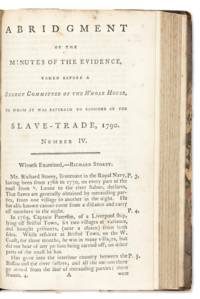
1789187101789. Committee of the Whole House of the British Parliament investigation into the Atlantic slave trade recorded in Abridgment of the Minutes of the Evidence Taken Before a Committee of the Whole House to Whom It Was Referred to Consider of the Slave Trade published 1789 to 1791 presenting one of the earliest parliamentary documentary compilations addressing the operation and human consequences of the transatlantic slave trade. The volumes preserve testimony gathered during parliamentary inquiries that examined the practices of British slave traders and the treatment of enslaved Africans transported across the Atlantic. These proceedings formed part of the political campaign in Britain that eventually culminated in the abolition of the British slave trade in 1807. The collected evidence includes statements from ship surgeons naval officers merchants and other witnesses whose accounts describe the conditions experienced by enslaved Africans during capture transport and plantation labor.<br /> <br /> Abridgment of the Minutes of the Evidence Taken Before a Committee of the Whole House To Whom It Was Referred to Consider of the Slave Trade. London: 1789-1791. First edition first printing. Four volumes bound in two books. The compilation reproduces testimony presented before Parliament concerning the organization and operation of the slave trade and includes firsthand statements describing the physical suffering and resistance of enslaved Africans during transport. Surgeon Alexander Falcon-Bridge who had firsthand experience aboard slave ships described acts of despair among captives: he "Has known several enslaved persons to refuse sustenance with a design to starve themselves. refusing to take medicines when sick because they wished to die. Many other slaves expressed the same." Another witness Royal Navy surgeon Thomas Trotter recorded the emotional trauma experienced by captives during embarkation noting that "Slaves on being brought on board showed signs of extreme distress and despair from a feeling of their situation and regret at being torn from friends and connections." The volumes therefore preserve testimony that exposed the violence and human suffering embedded within the Atlantic slave trading system.<br /> <br /> During the eighteenth century European and American traders transported millions of Africans across the Atlantic through a commercial system that relied on maritime networks linking West Africa the Caribbean and the Americas. Parliamentary investigations of the slave trade in the late eighteenth century were fueled in part by abolitionist activism and public campaigns demanding government inquiry into the practice. Publications of witness testimony such as this abridged parliamentary record circulated evidence used by reformers advocating the end of the trade. Four volumes bound in two books with folding table in the fourth volume. Octavo format. Contemporary marbled quarter calf bindings with modern bookplates on the front past down. Wear present with most spine titles lacking and foxing primarily affecting the title pages; text remains clear. Overall condition very good. unknown
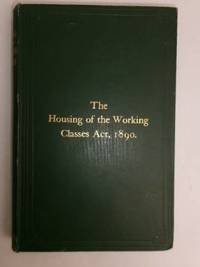
414465Knight & co 90 Fleet Street. Hardcover. Good. THERE ARE NO TARIFFS OR CUSTOMS DUTIES ON BOOKS. The Housing of the Working Classes Act 1890 empowered local authorities to clear slums provide new housing and manage unhealthy areas marking a significant step in public housing."The Housing of the Working Classes Act 1890 Book" refers to the actual legislation and the subsequent legal publications that interpreted and guided its implementation. This is an original publication 1890 Green cloth embossed boards with gilded titles to front and spine. Knight & co, 90, Fleet Street hardcover
1956GI-K42U-K2XNJan 01 1956. Hardcover. Very Good. hardcover
1871161381871. Great Britain. Parliament. House of Commons. Select Committee on Protection of Infant Life Report from the Select Committee on Protection of Infant Life 1871 documents the parliamentary investigation of infant welfare paid infant care mortality and state regulation in Victorian Britain. The report documents the emerging system of infant life protection through committee proceedings witness testimony appendices and an index revealing how legislators gathered medical legal and social evidence to define infant neglect as a matter requiring public oversight. Produced one year before the Infant Life Protection Act of 1872 the volume provides primary-source evidence for the study of child welfare law women's labor and caregiving economies public health regulation infant mortality and the legal history of "baby farming" a term used in nineteenth-century debates over paid care for infants. The 1872 legislation has been identified by historians as Britain's first infant life protection legislation making this parliamentary report important to the documentary record behind early state intervention in private infant care.<br /> <br /> Great Britain. Parliament. House of Commons. Select Committee on Protection of Infant Life. Report from the Select Committee on Protection of Infant Life together with the Proceedings of the Committee Minutes of Evidence Appendix and Index. London: Ordered by the House of Commons to be Printed 20 July 1871. First edition. 328 pp. Rebound in modern cloth. The report includes the committee's formal proceedings minutes of evidence appendix and index giving the volume a structured evidentiary record rather than a general policy summary. Its contents outline testimony and documentary material on infant care outside the immediate family social conditions affecting infant survival legal deficiencies and the need for enforceable protections. As a government publication it shows the mechanisms of parliamentary fact-finding in practice: evidence was collected organized indexed and converted into a legislative record that helped frame infant protection as a matter of law public health and social administration.<br /> <br /> The report belongs to the broader nineteenth-century movement toward state scrutiny of child welfare women's caregiving labor and domestic arrangements previously treated as private matters. Its timing matters because it precedes the 1872 Act and captures the evidentiary process by which infant mortality and paid infant nursing entered the legislative sphere. First few pages including title page with small loss at right page edge not affecting legibility; handwritten page numbers in upper right corners throughout; pages bright and clean; overall good. A substantial parliamentary source for research into Victorian child welfare infant mortality gendered labor public health law and the development of modern protective regulation. unknown