Act of ParliamentBiblio.com
6 711 résultats
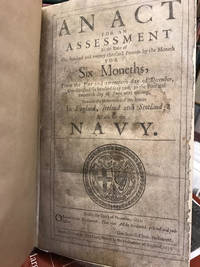
165258941London: Printed by John Field Printer to the Parliament of England 1652. Tall 8vo. 2 1829-1890 pp. Recent maroon cloth with gilt lettering to spine. New endpapers. Original wrapper bound in and repaired. Cloth clean. Internally clean. Black-letter text. Lacking final blank. ESTC : R209365 . Very Good. Cloth. 1652. Printed by John Field, Printer to the Parliament of England 1652 hardcover
180528475T Collins 1805. Sm. folio 28pp on laid paper with woodcut headpiece; disbound some mild age-staining else a very good bright crisp copy. 45 Geo III. The estates include Great Bardfield Bardfield Saling Blewgate Hall and others in Essex; and Brickstables near Mortlake and Deepden near Dorking in Surrey. T Collins, unknown
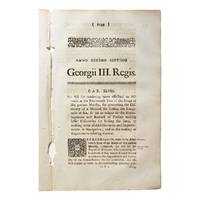
1777599<p>Anno Regni GEORGII III REGIS Magnae Britaniiae Franciae & Hiberniae DECIMO SEPTIMO. At the Parliament Begun and holden at Westminster the Twenty-ninth Day of November Anno Domini 1774 in the Fifteenth Year of our Sovereign Lord GEORGE the Third by the Grace of God of Great Britain France and Ireland King Defender of the Faith. </p><br /><p>FIRST EDITION 4 1039-1042 woodcut coat of arms on title woodcut floriated initial text in black letter unbound folio 320 x 200mm London Charles Eyre and William Strahan 1777</p><br /><p>This important act emphasised the Government's dedication to improving general science and navigation by offering rewards to those who could find an accurate method for determining longitude at sea. </p><br /><p>The first Longitude Act of 1714 was Parliament's response to the loss of 2000 lives in 1707 when four British navy ships ran aground after miscalculating the longitude. The Act offered prize money of £10000 reduced from £20000 for a reliable and accurate method of determining longitude at sea. Research and related experimentation were also encouraged and award money was made available for lesser discoveries and specific improvements. The competitions attracted the skill and imagination of the greatest scientific minds and mariners of the time.</p><p>The most prominent and successful competitor was John Harrison 1693-1776 who received disbursements of £22000 over a period of 35 years for his brilliant discoveries and invention of the marine chronometer. This was however not without a struggle for recognition. The marine chronometer was quicker but the preferred avenue of institutionalisation was the Lunar Distance Method. The Lunar Distance method was a method to determine longitude using certain astrological measurements and specific corrections marked in yearly almanacks. The Act of 1765 put caveats and conditions on the original act of 1714 and included stipulations that applied specifically to Harrison. It even named him in the opening language and described the current status of his contrariety with the board. Only with the relentless championing from his son and the personal intervention of King George III Harrison was awarded the monetary prize he was due. The Longitude Act 1777 reiterated specific goals of the program as revised by the 1774 Longitude Act and approved an additional £5000 for continued research work and experimentation and for awards to recognize lesser contributory discoveries as approved by the Commissioners of the Board of Longitude.</p><p>The Longitude at Sea program was successful in multiple ways and facilitated important advances in mathematics astronomy horology navigation and Arctic exploration. Over the life of the program a total of £53000 in prize money was awarded to more than sixty participants.</p><br /> Charles Eyre and William Strahan
631831815; 1825. 2 parts. Folio. pp. 1733-1744; 1541-1548. Disbound from the annual volumes otherwise in excellent condition as issued. See S. W. F. HOLLOWAY. The Apothecaries' Act 1815: a Reinterpretation. Medical History. 1966. Apr; 102: 107129. 1815; 1825. 2 parts. Folio. unknown
18246000004London: George Eyre and Andrew Strahan 1824. Folio pp ii added general title-page for the parliamentary year 737-756; unbound neat paper spine. <p><p>A crucial landmark in the creation of the Australian Agricultural Company and the first official use of the great company's name. Two months earlier the House of Commons had passed a bill incorporating "The Australian Company of London" which this overrides Ferguson 949.</p> <p>The Australian Agricultural Company or AACo played a huge role in shaping the early Australian economy. From its establishment in 1824 it was responsible for the development and expansion of the Hunter Valley and other regions. Surviving all the rural challenges - including droughts economic depressions and labour shortages - its long-term impact on early Australia was substantial in establishing agriculture as a primary industry and contributing to Australia's economy famously "riding on the sheep's back".</p> <p>AACo continues to be a significant player in today's agricultural sector today as Australia's largest integrated cattle and beef producer owning and operating approximately 7 million hectares of land in Queensland and the Northern Territory. This vast landholding represents roughly 1% of Australia's land mass highlighting the company's substantial presence in the country's agricultural landscape.</p> </p> . George Eyre and Andrew Strahan unknown
64907Royal Assent. 15 May 1822. . pp. 67 i. BOUND WITH : An Act To alter amend and enlarge the Powers of an Act passed in the Third Year of the Reign of His late Majesty King George the Fourth for regulating the Poor of the City of Bristol and for other purposes connected therewith. 1 WILL. IV. Royal Assent. 11 March 1831. pp. 31 i. Contemporary half calf and marbled boards front board detached piece cut from the top margin of the first leaf not affecting text else contents very good. Royal Assent. 15 May 1822. hardcover
1813749House of Commons 1813. 8vo. 44pp. on laid paper some black-letter with woodcut head-piece; disbound a remarkably crisp clean copy ideal for framing and display. 53 Geo. III cxlii; granted Royal Assent 3 June 1813. DARROCH & TAYLOR 4133 RECORDS THIS ACT AS THE FIRST SEPARATELY PUBLISHED REFERENCE TO THE TOWN. House of Commons, unknown
18183167House of Commons 1818. Sm. folio 20pp on laid paper; disbound a very good clean legible copy ideal for framing and display. 58 Geo.III: Session 1818; granted Royal Assent 23 May 1818. GODDARD p.55 RECORDS THIS ACT AS THE FIRST SEPARATELY PUBLISHED REFERENCE TO THE PARISH. House of Commons, unknown
18093171House of Commons 1809. Sm. folio 30pp on laid paper; disbound a very good clean crisp copy ideal for framing and display. 49 Geo. III; Session 1809. GODDARD RECORDS THIS ACT AS THE FIRST SEPARATELY PUBLISHED REFERENCE TO EACH OF THE THREE PARISHES; pp. 41 175 and 42 RESPECTIVELY. House of Commons, unknown
18143188House of Commons 1814. Sm. folio 46pp on laid paper with woodcut head-piece; sewed as issued but disbound a remarkably crisp clean copy ideal for framing and display. 54 Geo III xxxvi; Session 1814-14; granted Royal Assent 4 May 1814. DARROCH & TAYLOR 4355 RECORDS THIS ACT AS THE FIRST SEPARATELY PUBLISHED REFERENCE TO THE PARISH. House of Commons, unknown
18203166House of Commons 1820. Sm. folio 26pp on laid paper with woodcut head-piece; disbound a remarkably crisp clean copy ideal for framing and display. GODDARD p.73 RECORDS THIS ACT AS THE FIRST SEPARATELY PUBLISHED REFERENCE TO THE PARISH OF CHERHILL AND THE SECOND SUCH REFERENCE IN THE CASES OF THE OTHER PARISHES INCLUDED. House of Commons, unknown
18183189House of Commons 1818. Sm. folio 32pp on laid paper with woodcut head-piece; sewed as issued but disbound a remarkably crisp clean copy ideal for framing and display. 58 Geo. III xiv; Session 1818; granted Royal Assent 8 May 1818. Darroch & Taylor 4820. House of Commons, unknown
18193278House of Commons 1819. Sm. folio 26pp on laid paper with woodcut head-piece; disbound a very good clean crisp copy ideal for framing and display. Goddard p.108 records this act as the first separately published reference to the parish House of Commons, unknown
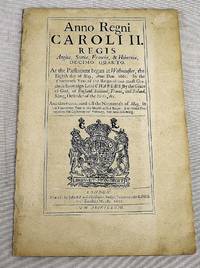
16622201280001London : Printed by John Bill and Christopher Barker printers to the Kings Most Excellent Majesty 1662. First Edition. Paperback. Very Good. Customs act 1662 Unbound. 2 209-242 p. : coat of arms ; 29 cm fol. Text in black letter. Ten-line decorated initial on first page. Royal arms on cover title page: approximately 8 x 6.5 cm. Crawford arms 66. See Crawford J.L.L. Bibliography of royal proclamations of the Tudor and Stuart sovereigns and of others published under authority 1485-1714 II page 511. Public General Acts. 1662. 14 Car.II.c.11. "Anno regni Caroli II. Regis Angliae Scotiae Franciae & Hiberniae decimo quarto. At the Parliament begun at Westminster the eighth day of May anno Dom. 1661. In the thirteenth year of the reign of our Most Gracious Soveraign Lord Charles by the grace of God of England Scotland France and Ireland King Defender of the Faith &c. And there continued till the nineteenth of May in the fourteenth year of His Majesties said reign : And thence prorogued to the eighteenth of February then next following London : Printed by John Bill and Christopher Barker, printers to the Kings Most Excellent Majesty paperback
165735345London: Printed by Henry Hills and John Field Printers to His Highness the Lord Protector 1657. First edition. Caption title woodcut illustration. 4 pp. 8vo. Disbound the two leaves separated along fold some offsetting and browning else very good. First edition. Caption title woodcut illustration. 4 pp. 8vo. Intended to raise monies to maintain the Army and Navy without raising the land tax. Kress Supplement S.1133; Wing E1113. Kress Supplement S.1133; Wing E1113 <br/><br/> Printed by Henry Hills and John Field, Printers to His Highness the Lord Protector unknown
181053128Publisher not identifiedLondon 1810. 1st editon. Sewn sheets VG 19pp edges untrimmed & a little rough slightly yellowed. At foot of docket title: 50 Geo. III. Sess. 1810. An act for the provision of a market place in the town of Halifax West Yorkshire - 'the passages along the publisc streets are greatly obstructed and rendered very inconvenient and dangerous to the Inhabitants of the said town and also to Travellers by reason of the number of stalls and standings placed upon the footpaths and highways of the said town'. The townsfolk had constructed a market place at thier own expense but needed an Act to remove nuisances & annoyances from the market place. [Publisher not identified][London] unknown
1747ZB499907London: Thomas Baskett printer 1747. tall quarto 10 leaves with text paginated as 591-607; paper darkening at spine sheets joined together at spine else disbound in self wrappers; . - If you are reading this this item is actually physically in our stock and ready for shipment once ordered. We are not bookjackers. Buyer is responsible for any additional duties taxes or fees required by recipient's country. London: Thomas Baskett, printer, unknown
18337535Printed by George Eyre and Andrew Spottiswoode Printers to the King's most Excellent Majesty 1833. 12pp. sm. folio with fine woodcut arms of William IV on front page; disbound an exceptionally crisp virtually spotless copy ideal for display or presentation. 3 Gulielmi IV. Cap. 9; granted royal assent 6 May 1833. This is the Act of Parliament formally incorporating the Seaman's Hospital Society establishing and naming its first governors and prescribing its powers and scope of operations. By way of context its military equivalent the Royal Hospital at Chelsea was founded in 1692. The world's first charitable society for the relief of distressed seamen was established in London in March 1821. Initially it aimed to cater for those in the Port of London 'who at that time were very numerous in the Metropolis' and fittingly for the world's leading maritime nation did not differentiate on nationality or any other grounds other than disability and hardship. The motivating principles seem to have been partly public gratitude in the aftermath of the Napoleonic wars in which the Royal Navy in particular had played a fundamental role in achieving victory and partly increased recognition of the helplessness of private seamen and the strength of their cause. The society was supported entirely by donations subscriptions and legacies and by the loan by government of a hospital ship HMS Dreadnought moored at Greenwich. In its first twelve years the society provided relief and support to upwards of twenty-three thousand sick and distressed seamen 'many of whom might otherwise have perished'. With the case clearly made it was time for a more formal and robust body with increased remit and governance; accordingly the Seaman's Hospital Society was given royal assent on 6 May 1833. Its significant extra powers included the rights to possess property receive bequests purchase lands and canvass donations; most important of all it was granted 'perpetual succession'. The original HMS Dreadnought continued in use until 1870 when the Admiralty made available at nominal rent the infirmary at Greenwich where the 'Dreadnought' hospital continues to this day. AN ACT OF FUNDAMENTAL IMPORTANCE TO THE WELFARE AND WELL-BEING OF SEAMEN IN BRITAIN AND A SIGNIFICANT DEVELOPMENT IN BRITISH MARITIME HISTORY. VERY SCARCE ESPECIALLY IN THIS CONDITION. [Printed by George Eyre and Andrew Spottiswoode, Printers to the King's most Excellent Majesty, unknown
1825740471-93 75 pages index and appendices to rear pages unopened Printed by Printed by George Eyre and Andrew Strahan hardcover
16976159Printed by Charles Bill and the Executrix of Thomas Newcomb deceas'd Printers to the King's most Excellent Majesty 1697. Sm. folio 51 leaves BLACK-LETTER with fine woodcut arms of William III on front cover woodcut head-piece neat contemporary signature on front cover front cover a little dusty and age-soiled; sewed as issued extracted from bound volume a remarkably bright crisp clean copy ideal for framing and display. 8 & 9 Gulielmi III. Printed by Charles Bill, and the Executrix of Thomas Newcomb, deceas'd, Printers to the King's most Excellent Majesty, unknown
RGW168244pp. folio disbound now in plain wrappers unknown
16973184Printed for Charles Bill and the Executrix of Thomas Newcomb deceas'd Printers to the King's most Excellent Majesty 1697. Sm. folio 10pp BLACK-LETTER sewed as issued but disbound fine woodblock royal arms of William III on front cover uncut a remarkably crisp clean copy ideal for framing and display. 8 & 9 Gulielmi III. Printed for Charles Bill, and the Executrix of Thomas Newcomb deceas'd, Printers to the King's most Excellent Majesty, unknown
1776750Charles Eyre and William Strahan 1776. 8vo. 34pp. on laid paper BLACK-LETTER with fine woodblock arms of George III on front cover woodblock head-piece; disbound a remarkably bright crisp copy ideal for framing and display. 16 Geo. III 9. DARROCH & TAYLOR 4159 RECORDS THIS ACT AS THE FIRST SEPARATELY PUBLISHED REFERENCE TO THE HUNDRED Charles Eyre and William Strahan unknown
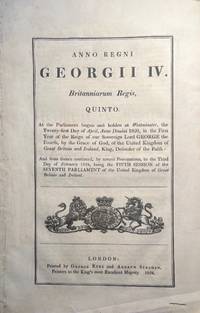
18305168Printed by George Eyre and Andrew Strahan Printers to the King's most Excellent Majesty 1830. Sm. folio 2 leaves with fine woodblock arms of George IV at head; disbound a crisp clean copy ideal for framing and display. 10 Georgii IV Cap. 10; granted Royal Assent 8 April 1830 Printed by George Eyre and Andrew Strahan, Printers to the King's most Excellent Majesty, unknown
19105595Eyre & Spottiswoode 1910. 4to. 34 leaves with fine woodblock arms of Edward VII at head; sewed as issued a remarkably bright clean copy ideal for framing and display. 10 Edw. 7 & 1 Geo. 5. The Wimbledon and Sutton Railway Company Ltd. incorporated in law by the present Act continued in operation from 1910 to 1925. When in 1923 the Southern Railway Company was formed by merging the five major southern lines and several smaller operators the Wimbledon & Sutton fought to stay apart. It was one of the last to remain independent before its inevitable absorption in 1925. VERY SCARCE ESPECIALLY IN THIS CONDITION. Not in Ottley. Eyre & Spottiswoode, unknown