585 résultats
190818717St. Petersburg, Marineministerium, 1908. Die zwanzig Hefte sind wie folgt tituliert: 1. Apercu historique et description de Cronstadt. 2. Précis historique de la Classe et de l'Ecole des Torpilleurs 1874 - 1908. Cronstadt. 3. Classe des Officiers d'Artillerie. Cronstadt. 4. L'Ecole des ingénieurs de la Marine de l'Impereur Nicolas I. Cronstadt. 5. Das maritime astronomische und Kompass-Observatorium Cronstadt. 6. L'Ecole des mécaniciens de la flotte de la Baltique. Cronstadt. 7. L'Ecole des scaphandriers et les travaux sous-marins. 8. Apercu sommaire du développement de la navigation sous-marine en Russie et à l étranger. 9. Les Usines d'Ijora. 10. L'Usine d'Oboukoff. 11. Chantiers navals et Usines mécaniques de la Baltique. 12. Les constructions navales militaires sur les chantiers de l'Etat. St. Pétersbourg. 13. Le Musée de la Marine St. Pétersbourg. 14. Corps de Marine et Académie navale Nicolas. St. Pétersbourg. 15. Apercu historique sur le développement du Service du pilotage en Russie. 16. L' Administration Générale de l'Hydrographie. 17. Die Werkstatt für nautische Instrumente bei der Hydrographischen Hauptverwaltung. 18. Les ateliers pour la reproduction de la Section Cartographique de l'Administration générale hydrographique. 19. Exploration hydrographique des mers russes. Cartes et instructions nautiques. 20. Apercu historique du Service des phares en Russie. Insgesamt 382 Seiten, und zahlreiche Tafeln. 20 Hefte (vollständig) in bedruckter Flügelmappe aus Pappe, die Mappe innen fleckig. Mappentitel: Hommage du Ministère de la Marine à M.M. les Membres du XI. Congrès International de Navigation tenu à St. Petersbourg en 1908.
Good Turkish, Ottoman (1500-1928) Original wrappers. Tear on the upper left side of front cover, chippings on extremities. A good copy. Roy. 8vo. (24 x 17 cm). In Bulgarian. 107 p. First and only edition of this scarce early book in Bulgarian, printed in Constantinople (Macedonian Printing House) on the history of the Archbishopric of Ohrid, also known as the Bulgarian Archbishopric of Ohrid, which was an autocephalous Eastern Orthodox Church established following the Byzantine conquest of Bulgaria in 1018 by lowering the rank of the autocephalous Bulgarian Patriarchate due to its subjugation to the Byzantines. In 1767, the Archbishopric's autocephaly was abolished, and the Archbishopric was placed under the tutelage of the Patriarchate of Constantinople. 13 copies in OCLC: 793578483, 48911077.
18862409170278xbvkKronstadt, Druck von Joh. Gött & Sohn Heinr., 1886. (10) 196 (1) Seiten. - Grüner Originalumschlag mit Deckeltitel; 4to.(ca. 28 x 20,5).
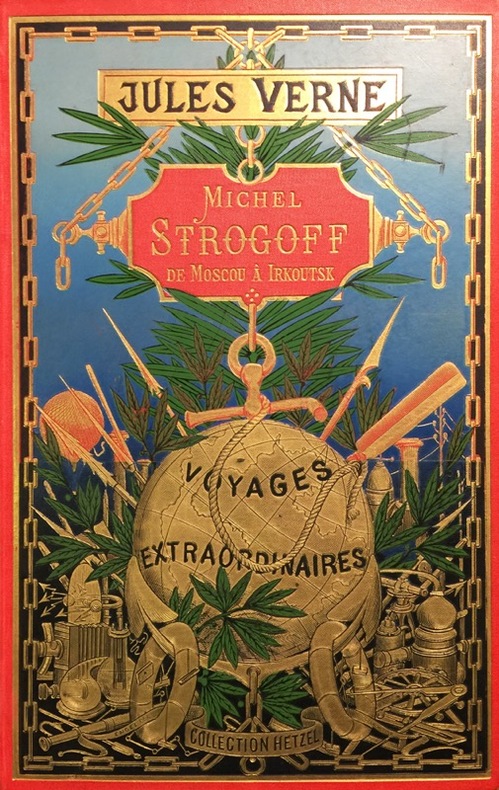
LIT9660MNon daté. J. Hetzel & Cie. Reliure bleu nuit, deux éléphants, difficulté à s'ouvrir suite à des restaurations hasardeuses, dos assez usé, la tranche de face a perdu sa dorure, reste en bon état général, l'intérieur est frais.
Good Turkish Missing covers with original end-papers. Slight tears on end-papers. Overall a good copy. Roy. 8vo. (24 x 16 cm). In Gagauz Turkish. 40, 4 p., b/w ills. First edition of this extremely rare translation in book form, which is the first comprehensive book on the Bessarabian Gagauz people, translated from the magazine "Viata Bessarabiei" in 1933... Ciachir worked for the Romanian magazine titled "Viata Basarabiei" [i.e. The life of Bessarabia] between 1933-34. Mihail Ciachir (or Çakir) was a Protoiereus and educator in the Gagauz language, and the first publisher of Gagauz books in the erstwhile Russian Empire and in the Soviet Union. Ciachir was born in the Bessarabian village of Ceadîr-Lunga, in a Gagauz deacon's family. Bessarabia is a historical region in Eastern Europe, bounded by the Dniester river on the east and the Prut river on the west. About two-thirds of Bessarabia lies within modern-day Moldova, with the Ukrainian Budjak region covering the southern coastal region and part of the Ukrainian Chernivtsi Oblast covering a small area in the north. In the aftermath of the Russo-Turkish War (1806-1812), and the ensuing Peace of Bucharest, the eastern parts of the Principality of Moldavia, an Ottoman vassal, along with some areas formerly under direct Ottoman rule, were ceded to Imperial Russia. The acquisition was among the Empire's last territorial acquisitions in Europe. The newly acquired territories were organized as the Bessarabia Governorate of the Russian Empire, adopting a name previously used for the southern plains between the Dniester and the Danube rivers. Following the Crimean War, in 1856, the southern areas of Bessarabia were returned to Moldavian rule; Russian rule was restored over the whole of the region in 1878, when Romania, the result of Moldavia's union with Wallachia, was pressured into exchanging those territories for the Dobruja. In 1917, in the wake of the Russian Revolution, the area constituted itself as the Moldavian Democratic Republic, an autonomous republic part of a proposed federative Russian state. Bolshevik agitation in late 1917 and early 1918 resulted in the intervention of the Romanian Army, ostensibly to pacify the region. Soon after, the parliamentary assembly declared independence, and then union with the Kingdom of Romania. However, the legality of these acts was disputed, most prominently by the Soviet Union, which regarded the area as a territory occupied by Romania. The Gagauz people is living mostly in southern Moldova (Gagauzia, Taraclia District, Basarabeasca District) and southwestern Ukraine (Budjak). Gagauz is mostly Eastern Orthodox Christians. The term Gagauz is also often used as a collective naming of Turkic people living in the Balkans, speaking Balkan Gagauz Turkish. The origin of the Gagauz is obscure. At the beginning of the 20th century, a Bulgarian historian counted 19 different theories about their origin. A few decades later the Gagauz ethnologist M. N. Guboglo increases the number to 21. In some of those theories, the Gagauz people are presented as descendants of the Pechenegs, Cumans-Kipchaks, or a clan of Seljuk Turks, or a mix of all. The fact that their confession is Eastern Orthodox Christianity may suggest that their ancestors already lived in the Balkans prior to the Ottoman conquest in the late 14th century. (Wikipedia). Not in OCLC.
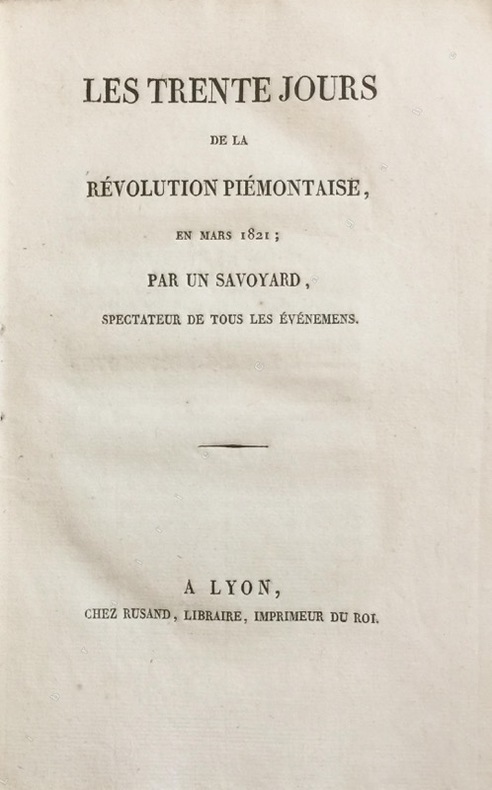
20786Lyon, Rusand, [s.d.] ; in-8, broché, 59 pp., couverture gris-bleu muette.
1718238501718 A Paris, chez Joseph Mongé ... M.DCC.XVIII., 1718. in-12 (9,5x16,5cm),[6], 72, 83, [12], 339, [12] p, [1] pl.-bl pp., 3 parties reliées en un volume.: "L'histoire abrégée de la Moscovie, des Czars ou Empereurs qui y ont regne, jusques a present", "La relation de ce que Pierre Alexeowitz, a present regnant, a fait de plus remarquable dans ses Etats" - Nouvelle édition française, rare. Illustrée d'un portrait au frontispice de Pierre 1er et d'une grande carte dépliante. Réimpression de l'originale française parue en 1717 chez Jean Boudot. Reliure en pleine basane brune d'époque. Dos à nerfs orné. Coiffes de tête et queue en partie élimées. Epidermures sur les plats. Frottements au coiffes et bordures,tranches rouges.Texte et ill.fraiches.
48588Pierre Laffitte. 3 vols.in-8 demi-reliés,à coins. 1/ Le mystère de la chambre jaune.2 parties.1920.Le parfum de la dame en noir.2 parties.1920.2 / Rouletabille chez le tsar.2 parties.1921.Le château noir.Le coeur d'Ivana.2 parties.1922.3 /Les étranges noces de Rouletabille.2 parties.1922.Rouletabille chez Krupp. 1922. Belle collection. Dos à 5 nerfs ornés.Caractères dorés..Couvertures conservées.Illustrations en noir.
Features: More Queer Fixes - A Meeting with a Meteor, In the Dark with a Mamba; A Night Attack; The Shot-Pickers; The Underground Pirates; Housekeeping Troubles in Annam; "In the Name of the Czar!" - I - A Subterranean Duel; Across Africa By Boat - I; Cupid and the Wire; Fallen Among Thieves; Remarkable "Follies"; Through the Black Canyon; Across Australia on a Bicycle; The Crop that Failed; Eight Days on an African Farm; Across Africa by Boat - II; More Queer Fixes - A Ride With Death - Sixteen Days Entombed - Lost in a Swamp; On the Roof of the Western World; Black Magic - A Weird Experience - Tambooze the Zulu; Life in the Sulphur Mines of Sicily; A Fight for Life Under Water; Through New Ontario on a "Jigger"; The Present that Went Astray; The Menace of the "Black Hand"; The Wreck of the "Dundonald"; The Experiences of a "Jackaroo"; The Story of Jasper Brown; Sporting Stories - A Brush with Elephants - The Senator's Tiger - A Ride on a Rhino; Buried Treasures in England; Six Months on a Drifting Ice-Floe; Through New Ontario on a "Jigger" - II; A Deal in Diamonds; Elk-Hunting in Sweden; How I Found My Wife; Across Africa by Boat - III; More Queer Fixes - an up and down affair - a battle with a shark; The Romance of Hermann Ochs; The "Night Riders" of Kentucky; "Captain Starlight"; More Queer Fixes - Imprisoned Under a Ship's Keel - A Motor-Boat in a Cyclone - An Uninvited Guest; A War Against a River; A Railway Stowaway; The Kauri Timber Industry; "Who Am I?"; My Ascent of Aconcagua; Running the Gauntlet; Eight Years in Babylonia - I; The Secret of the Castle; Ruined!; An Island in the Making; A Duel of Brains; Across Africa by Boat - IV; An Encounter with a Waterspout; The Ship that Disappeared; A Mountain of Gold; The "Vultures of Paris"; Eight Years in Babylonia - II; Our Adventures at "Simplicity Hall" - I; Caribou-Hunting in Newfoundland; More Queer Fixes - An Actor's Adventure - A Shifted Cargo; Through France in a Yacht; The Keeper of the Light; Flooded Out; The Bridge-Builders; Five Days in a Blizzard; A Holiday in Crete; A Short Cut; A Lion-Hunt in a Sewer; The Carriers of the Thames; How I Visited the Gouliot Caves; A Day with the South Sea Prince; More Queer Fixes - A Race Against a Leak - Two Hours in a Crevasse - The Millionaire's Messenger; The Perchten Dancers of Salzburg; The Wassmann Diamond; On the Frontier at Gibraltar;; A Romance of Two Islands - I; A Railway Smash to Order; The Ghost of the San Jose Mine; Up the Athabasca with the Fur-Traders; Our Adventures at "Simplicity Hall" - II. Average wear. Modest lean to spine. A sound copy. Book
16 pages. Features: George Viereck responds to alleged inaccuracies in the New York Times; German Brutality - Louvain (Leuven), Belgium; Where the Jews Stand - Leon Sanders writes about the Czar; The Expansionn of Russia - by David S. Levy; S.C. Nukerji, President of the Independent Hindusthan Society, offers sympathy to the people of Germany and Austria; Are the Germans justified in punishing Antwerp?; H.G. Wells and the War, by R.L. Orchelle; The Treason - a poem by Ernest Bruncken; Illustration of an imagined conversation between the Kaiser and Uncle Sam; Four Weeks of German Strategy - a review of events of the war; Prof. John W. Burgess Champions Germany (part 1); What other publications are saying about us; Average wear. Unmarked. Binding intact. A sound copy of this rare early issue. Magazine
58 pages. This very special issue contains part 1 (of 2) of "I Killed the Czar - at last the truth of history's most famous and mystery-shrouded massacre - On his deathbed one of the actual assassins (Peter Zacharovitch Ermakov) breaks his long silence". Fortuitously, when we acquired this copy we were thrilled to discover that laid-in are pages 39-48 of the August 3, 1935 issue, containing the entirety of part 2 of this important article. Other features include: Public Sweetheart Number One - Part III; The Case of the Caretaker's Cat - Part VII; Inside the Number Racket - what lies behind America's most amazing case of gambling fever?; Times Have Changed in Tennis - now it's a spotlight for chiselers!. Short stories include: The God-Inspired Idiot; The Donkey with a Lion's Heart; Love Letters of a Prizefighter and a Hollywood Extra; Flight. Many ofther features. Ads include: Wrigley's Gum, Spud Cigarettes; Pontiac Six (very nostalgic red and black one-page ad), Goodyear tires, Dentyne Gum; Pennzoil; Nice color back cover ad for Chesterfield Cigarettes features Turkish girl preparing tobacco leaves for baling. Above-average wear. Contents yellowed with age. A worthy copy of this historically important issue. Book
191622028Paris, Librairie Hachette, 1916 ; cartonnage rouge-orangé double in-8 du type "à un éléphant", dos type F, dit "au phare", deuxième plat de type "R", toutes tranches dorées ; [8], 368 pp. et six hors-texte en noir et blanc.
012380Xenia Alexandrovna (1875-1960), grande-duchesse de Russie, soeur du tsar Nicolas II. L.A.S. et aquarelle, sd, 1p in-12. A Marcelo et/ou Hortensia Anchorena (pas de mention de destinataire mais provient de leurs papiers). Quelques mots autographes « avec mes meilleurs voeux. X. » d'un côté et « Xenia » de l'autre. Sur ce second côté se trouve une petite aquarelle de Xenia. Rare [109-2]
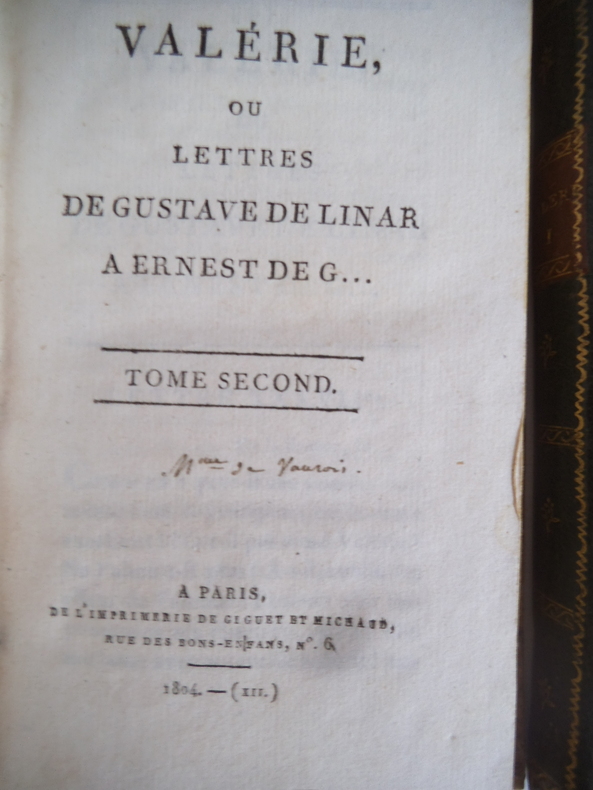
14587Von KRÜDENER Barbara Juliane Valérie ou lettres de Gustave LINAR çà Ernest G…. A Paris de l’imprimerie de GIGUET et MARECHAUD 1804 ( An XII) Deux tomes en deux volumes in 12 demi cuir vert, titre, fers, tomaison, roulette, filets dorés. Tome premier titre, 261 pages. Tome second titre, 208 pages, 1 page d’errata. Pâle mouillure circulaire en marge extérieure, en fin de volume page 160à la fin. Rare édition originale bien complet de sa feuille d’errata en fin du volume deux. Roman épistolaire, en partie autobiographique publié à l’aide de CHATEAUBRIAND et qui fit qualifié de petit chef d’ouvre par SAINT BEUVE. Rare édition originale bien complet de sa feuille d’errata en fin du volume deux. D’origine Livonienne et à la vie aventureuse, elle vécut à Paris pendant la Révolution, influença BERARDIN de SAINT PIERRE et se lia avec Madame de STAEL, Mme RECAMIER et CHATEAUBRIAND. Devenue mystique, elle se pénétra de l’œuvre de SWEDENBORG et subjugua le TSAR par son exaltation religieuse. Inspiré de sa liaison avec Alexandre de SKATIEFF, ce roman sentimental et frénétique et unanimement reconnu comme un des chefs d’œuvre du pré-romantisme. Seule œuvre romantique de la Baronne Beat, Barbara, Juliane Von KRÜDENER
1878534418Oakland Calif.: Smith & Elliott Lith 1878. Near Fine. Original color lithograph. Measures 13½†x 10¾†to the inside edges of a mat frame neatly housed inside a glazed wood frame 18 ¾†x 16 ½â€. Slight toning near fine. A beautiful early landscape view of John Weinberger’s ranch and vineyard drawn by the American artist and cartographer Czar James Dyer. A bright well-preserved lithographic plate in a handsome frame removed from Illustrations of Napa County California published by Smith & Elliott in 1878. Smith & Elliott, Lith unknown
012381Xenia Alexandrovna (1875-1960), grande-duchesse de Russie, soeur du tsar Nicolas II. L.A.S., 30 mars 1954, 1p in-8. A Hortensia Anchorena. « Chère Madame, ma fille vient d'arriver m'apportant vos cadeaux : mon parfum favori ! Et le beau châle. Je suis très touchée et vous en remercie de tout coeur. Mes amitiés à tous deux. Xenia ». Jolie lettre amicale. Rare [109-2]
012382Xenia Alexandrovna (1875-1960), grande-duchesse de Russie, soeur du tsar Nicolas II. L.A.S.,22 décembre 1949, 1p in-12 oblong. Timbre en relief avec l'aigle impérial. A Hortensia Anchorena. « Avec mes meilleurs voeux pour Noël et la nouvelle année en vous remerciant de tout coeur pour la belle gerbe. Xenia ». Jolie lettre amicale. Rare [109-2]
2009DADAX0131008463Pearson 2009-02-25. 5. hardcover. New. 8.20x2.10x10.10. Buy with confidence. Excellent Customer Service & Return policy. Pearson hardcover
177216548Riga, Hartknoch, 1772. 88 S. Kl.-8°. Mod. HPgmt. mit Rückenschild (etw. fleckig). [5 Warenabbildungen]
187018-0-60Moskau, , o.J. (um 1870). Blattgröße: ca. 39,50 x 33,5 cm; Fotogröße: ca. 27,5 x 21,5 cm
Very Good French An 18th-century hand-colored copper engraved map of Ukraine and the Black Sea in a fine impression with original hand-coloring in its period. 52x62 cm. In French. Scale: 1/2750000. Slight stains on the upper margin. Faded on paper. Otherwise a very good map. Rare in original color showing the Black Sea and its surroundings, of the little Tartary and the Black Sea of Delisle republished by Renier and Joshua Ottens. Can be seen on the map, Moldavia, Bulgaria, Natolia, Little Tartarie, Ukraine, and Crimea with contiguous regions and hinterland. In the century when this map was prepared (18th century), firstly, the territory of Crimea was controlled by the Crimean Khanate, then it was annexed by the Russian Empire on 19 April [O.S. 8 April] 1783. The period before the annexation was marked by Russian interference in Crimean affairs, a series of revolts by Crimean Tatars, and Ottoman ambivalence. The annexation began 134 years of rule by the Russian Empire, which ended with the Russian Revolution of 1917. Guillaume Delisle was a French cartographer known for his popular and accurate maps of Europe and the newly explored Americas. At 27, Delisle was admitted into the French Académie Royale des Sciences, an institution financed by the French state. After that date, he signed his maps with the title of "Géographe de l'Académie". Five years later, he moved to the Quai de l'Horloge in Paris, a true publishing hub where his business prospered. Delisle's progress culminated in 1718 when he received the title of Premier Géographe du Roi.? He was appointed to teach geography to the Dauphin, King Louis XIV's son, a task for which he received a salary. Again, his father's reputation as a man of science probably helped the younger Delisle. In Delisle's case, it could be said that his accomplishments surpassed his father's. Up to that point, he had drawn maps not only of European countries, such as Italy, Spain, Germany, Great Britain, and Poland, and regions such as the Duchy of Burgundy, but he had also contributed to the empire's claims to recently explored continents of Africa and the Americas. Publisher: Jan Barend Elwe (177-1815), was a Dutch publisher and bookseller who reissued maps by De l'Isle and Ottens and some other cartographers in the late 18th century. His famous map "Amerique Septentrionale Divisee en ses Principales Parties" was derived mainly from Sanson's and Jaillot's maps of 1656 and 1676. This map was published in 1792 in an Atlas which included 37 other maps of different countries and regions.
Very Good Turkish, Ottoman (1500-1928) Contemporary cloth bdg., marbled boards. Cr. 8vo. (19 x 14 cm). In Ottoman script (Old Turkish with Arabic letters). [2], 130 p. Exceedingly rare first edition of the most comprehensive biographical book of the Crimean Khans and Khanate, including 44 biographies starting from the founder of the khanate, Hadji Geray (1397-1466), each khan period has been handled separately, including narrations of the wars with Tsarist Russia and other important events. In the beginning, the genealogy of the Crimean khans dating back to Genghis Khan is also given. In the book, the dates of the expeditions of these rulers of Crimea, their reigns, and wars were tried to be determined meticulously. Some important events are mentioned, albeit briefly, like the Fire of Moscow occurred on May 24, 1571, when the Crimean and Ottoman armies led by the khan of Crimea Devlet I Giray, bypassed the Serpukhov defensive fortifications on the Oka River, crossed the Ugra River, and rounded the flank of the 60,000-man Russian army. The last biography in the work was the author's father and Baht Geray Han (d. 1801). Özege 6373.; TBTK 12314.
Good Turkish, Ottoman (1500-1928) Contemporary non-aesthetic burgundy cloth bdg. Demy 8vo. (22 x 14,5 cm). In Ottoman script (Old Turkish with Arabic letters). 299, [6] p. Fading on cloth, minor repairs on some pages, otherwise a good copy. Lithographed edition. First and only Turkish edition of this uncommon and very scarce early book of the history of Russia under the rule of Peter the Great. This book was published during the Crimean War, which was a military conflict fought from October 1853 to February 1856 in which Russia lost to an alliance of the Ottoman Empire, France, the United Kingdom, and Piedmont-Sardinia. The first four chapters describe the general political and social history of Russia at the time of Peter the Great. The following chapters narrate important events like the new revolution in Sofia, the first diplomatic relations with China in the period and the first agreement between the Russian and Chinese Empires, The Siege of Azov Fortress, the agreement with the Saxony, Peter the Great's travels to Europe, rebuild of St. Petersburg, The Battle of Narva and the Siege of Narva, return of the Great Tsar to Russia from France, commerce in Russia in the period of the Peter the Great's rule, etc. Peter I, most commonly known as Peter the Great, was a monarch of Russia who modernized it and made it a European power. He ruled the Tsardom of Russia from 7 May [O.S. 27 April] 1682 to 1721 and subsequently the Russian Empire until his death in 1725, jointly ruling before 1696 with his elder half-brother, Ivan V. To improve his nation's position on the seas, Peter sought more maritime outlets. His only outlet at the time was the White Sea at Arkhangelsk. The Baltic Sea was at the time controlled by Sweden in the north, while the Black Sea and the Caspian Sea were controlled by the Ottoman Empire and Safavid Empire respectively in the south. Peter attempted to acquire control of the Black Sea, which would require expelling the Tatars from the surrounding areas. As part of an agreement with Poland that ceded Kyiv to Russia, Peter was forced to wage war against the Crimean Khan and against the Khan's overlord, the Ottoman Sultan. Peter's primary objective became the capture of the Ottoman fortress of Azov, near the Don River. In the summer of 1695, Peter organized the Azov campaigns to take the fortress, but his attempts ended in failure. Through a number of successful wars, he captured ports at Azov and the Baltic Sea, laying the groundwork for the Imperial Russian Navy, ending uncontested Swedish supremacy in the Baltic, and beginning the Tsardom's expansion into a much larger empire that became a major European power. He led a cultural revolution that replaced some of the traditionalist and medieval social and political systems with ones that were modern, scientific, Westernised, and based on the Enlightenment. Shuvalov was called the Maecenas of the Russian Enlightenment and the first Russian Minister of Education. Russia's first theatre, university, and Academy of Arts were instituted with his active participation. He was born in Moscow, the only son of Ivan Menshoi Shuvalov, an army captain who died when the boy was ten, and Tatiana Rodionovna. The Shuvalov family fortunes changed drastically in 1741 when Empress Elizaveta Petrovna ascended to the Russian throne with help from Ivan's powerful cousins - Peter Shuvalov and Alexander Shuvalov. The following year, they had the fourteen-year-old Ivan attached to the imperial court as a page. Complete title: "Büyük Petro'nun eyyâm-i hükümetinde Rusya'da cereyân eden ahvâl-i dahiliyye ve umûr-i hâriciyyeye ve husûsiyle nizâmât-i mevzûa-i cecdîdeye ve oralarda bulunan milel ve akvâm-i muhtelifenin ahlâk ve âdâb ve fünûn ve sanâyilerine dair Büyük Petro'nun kizi Elizabete'nin kurenâsindan Sovalef nâm zâtin bazi resâil-i mevsûka ve senedât-i sahîhadan vukûf ve ittilâi hâsil olan ahvâl ve keyfiyâti nakil ve hikâyeye mübâseret olunmustur." Özege 17170.
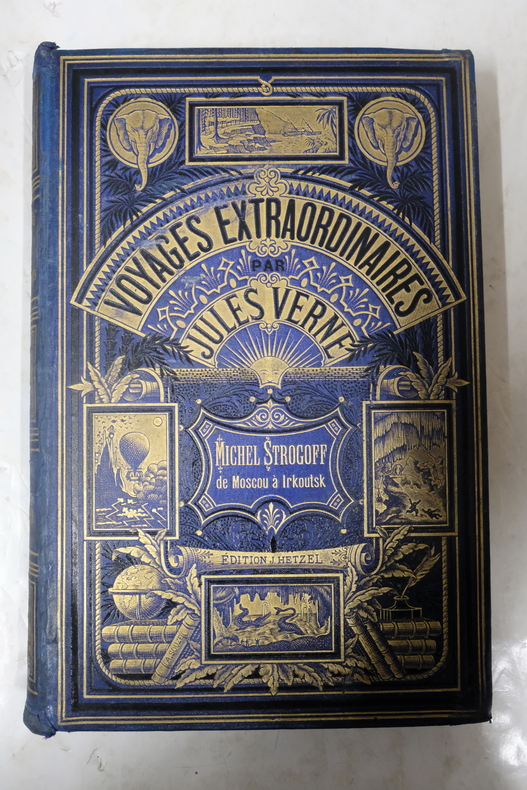
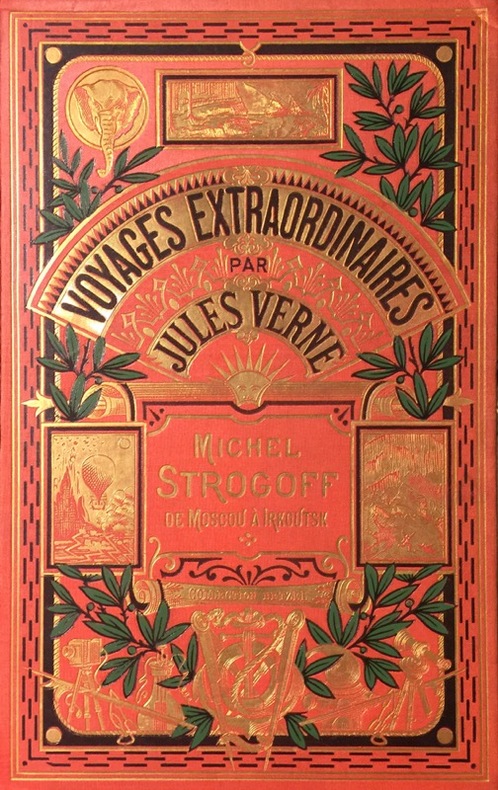
189422131Paris, Bibliothèque d'Education et de Récréation, J. Hetzel, [1894] ; in-8, cartonnage "à la Mappemonde", 2e plat type "P", dos type "F" ; 4, 370 pp., catalogue HF de nouveautés pour 1894-1895, 8 pp.
Very Good Turkish, Ottoman (1500-1928) Original autograph manuscript on paper. Oblong: (17x21 cm). In Ottoman script (Old Turkish with Arabic letters). 8 lines on 1 page. Folded in half. An important historically significant document of the credentials of the Provisional National Government of the Southwestern Caucasus, or the Kars Republic, established in 1918. It was a short-lived nominally-independent provisional government based in Kars, northeastern Turkey. Born in the wake of the Armistice of Mudros that ended World War I in the Middle East, it existed from December 1, 1918, until April 19, 1919, when it was abolished by British High Commissioner Admiral Somerset Arthur Gough-Calthorpe. Some historians claim that the Republic of Kars was a puppet state of the Ottoman Empire. The government, headed by Fahrettin Pirioglu, containing the territory to be the predominantly Muslim-inhabited regions of Kars and Batumi, parts of Yerevan Province, and the Akhaltsikhe and Akhalkalaki districts of Tiflis (Tbilisi) Province. In practical terms, however, the government was confined to Kars Province and existed alongside the British governorship created during the Entente's intervention in Transcaucasia. English translation of the script: "Our government (Cenûb-i Garbî Caucasus), which is formed with the aim and aim to follow the Social Democrat Principle, is to protect our border in the agreement, to defend our nationality in every way, and to be in a position to protect our national authority. Timur Pasha Khimshiashvili (Hamshizâda) from Adjara, having the authority to be included in the general conference, has made our public power of attorney, which has been appointed and commissioned by our government, to this trustee... Deputy Head of the Government of the Republic, Minister of Internal Affairs Ali Riza". Timur Pasha Khimshiashvili from the Adjara region of Georgia was a descendant of a Georgian noble family and he was an Ottoman soldier and statesman. He and his subordinates also took on the duty of protection in the Eastern campaign of Nuri (Killigil) Pasha, the commander of the Caucasian Turkish-Islamic Army, which was established by Halil Pasha upon the directive of Enver Pasha, and prevented possible future assassinations. Turkish transcription: "Sosyal Demokrat Prensibini takip eylemek gaye ve emeliyle tesekkül eden (Cenûb-i Garbî Kafkas) hükûmetimizi ol babdaki hududnâmedeki hudûdumuzu muhafaza, hukûk-u milliyemizi her sûretle müdafâa ve düvel-i muazzama sefîr ve murahhaslariyla menâfî-i milliyemiz dâhilinde mükâlemette bulunmak ve sulh-u umûmî konferansina dâhil olmak salâhiyetini hâiz olmak üzere Acarali Hemsizâde Timur Pasa, hükûmetimiz tarafindan murahhas tâyin ve intihab kilinmis oldugunu hâvî vekâlet-i ammemizi câmî is bu itimadnâmemiz bilintizam mîr-i mümâileyh yeddine itâ kilindi. Hükûmet-i Cumhûriye Reisi Vekili, Dâhiliye Nâziri Ali Riza".