Lazovsky, G [Tsar Nicholas II]Biblio.com
579 résultats
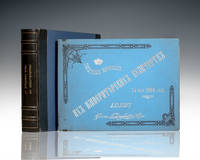
1896147804Kiev 1896. Rare portfolio of photographs by G. Lazovsky depicting the coronation of Tsar Nicholas II. Quarto original publisher's blue cloth with black and silver titles and tooling to the front panel 31 albumen prints on card mounts with the embossed blind stamp of the photographer and the mounts captioned in Cyrillic with printed slips each image 6.25 inches by 9.125 inches. The series of photographs in this album cover the coronation festivities from the 10th to the 26th of May 1896. Only two of the images are from the Coronation day itself the 12th which are of the procession as there was likely no photography in the cathedral where the coronation proper was held. Portfolio in very good condition. Photographs in near fine condition. The piece measures 10 inches by 13.75 inches. Housed in a custom half morocco clamshell box. We have never seen another set. The coronation of Tsar Nicholas II took place on May 26 1896 May 14 Old Style in the Dormition Cathedral within the Kremlin Moscow. As the last Emperor of Russia Nicholas II’s coronation was a grand and highly ritualized event symbolizing the divine right of the monarchy. The ceremony followed traditional Orthodox customs including anointment with holy oil and the placing of the Imperial Crown on his own head signifying his supreme authority. However the event was overshadowed by the Khodynka Tragedy where over a thousand people died in a stampede during public celebrations. This disaster foreshadowed the instability of his reign which ultimately ended with the fall of the Russian Empire in 1917. hardcover
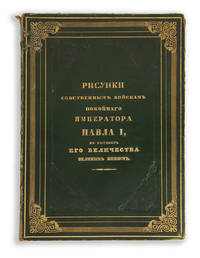
109898St. Petersburg Lithographic Department of the Military Settlement 1835. . First edition small folio 31 x 22 cm; lithographic title and 10 unnumbered coloured by contemporary hand title soiled at foot where mark of ownership erased bottom corners of leaves with very light staining pl. 7 with printed Russian caption and early manuscript German translation; contemporary green Russian morocco upper cover lettered in gilt both covers with elaborate panelling in gilt and blind flat spine in gilt panels gilt turn-ins blue endpapers gilt edges extremities rubbed tiny split in joint at head of spine a fine copy.<br /> Remarkably fine series of hand-coloured prints of military costumes after Paul I in an exceptional contemporary Russian binding. The book was printed at the personal bequest of his son Tsar Nicholas I in an incredibly small edition. The short reign of Paul I ended with his murder in 1801 and was marked by his obsession with dress uniforms. All ten of the figures in this rare suite are drawn in the same posture at attention with arms firmly clasped to sides and though this gives them a slightly doll-like quality they are painstakingly and beautifully coloured by a contemporary hand. Nicholas I viewed his father with deep reverence and also admired the pomp and order of the Imperial army this publication was an attempt to honour his father's legacy.<br /> [St. Petersburg], Lithographic Department of the Military Settlement, 1835. unknown
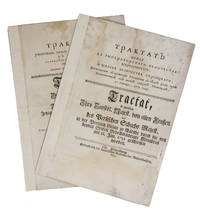
1729K1VE5E3V8EEQSt. Petersburg 1729. Small folio 27.5 x 19.5 cm. Imperial Academy of Sciences Disbound. Two treaties between Russia and the Safavid Empire in Russian and German in 2 parallel columns. 10; 12 pp. Ad 1: Very rare first and only edition of the Treaty of Rasht a peace treaty between the Russian Empire and the Persian Safavid Empire concluded between the very young Tsar Peter II and Shah Ashraf who would both die a year later. After the Russian Tsar Peter the Great died in 1725 Russia faced difficulties in retaining the newly conquered lands around the Caspian Sea. The Safavids wished to push the Russians back from all Persian territory and after some minor battles they agreed to a truce in 1727 which was signed at Rasht in 1729. "The treaty incorporated a number of provisions that seemed to resolve all the outstanding issues between Russia and Persia but as a practical matter it was never put into effect. By the time the pact was signed Ashraf's regime was already on the verge of being overthrown by Nadir Quli Khan. . Having successfully disposed the Afghans i.e. Ashraf Nadir then turned his attention to the restoration of the Persian lands seized earlier by the Ottomans and the Russians" Sicker.Ad 2: Second copy located of the first and only edition of a new peace treaty between the new rulers of the Russian and the Safavid Empire concluded between Tsarina Anna and Shah Tahmasp II just a few months before the latter was deposed by Nadir Quli Khan the future Nader Shah.Upon restoring both treaties the title-pages were switched; both have their spines strengthened some restorations to the fore-edge margins and some waterstains but all text is present and clearly legible; fair copies of two very rare treaties.l Ad 1: Catalogue de la section des Russica 820; WorldCat 3 copies; Ad 2: WorldCat 1 copy; cf. G. Mirfendereski A diplomatic history of the Caspian Sea 2001 pp. 14-15; M. Sicker The Islamic world in decline 2001 p. 57-58. unknown
Very Good Turkish, Ottoman (1500-1928) Original lithographed proclamation on thin paper. (40x29 cm). In Ottoman script (Old Turkish with Arabic letters). 35 lines on one page. Heavily stained paper, slightly chipped extremities, overall a good copy. Extremely rare copy of this superb lithographed propaganda proclamation by the Russian naval forces, distributed to the "libertarian Ottoman nation", probably in Ottoman cities like Sinop, Trabzon, and Constantinople, against the Germans during World War I, written on July 5, 1917, in Sevastopol. It's printed from the original manuscript copy in a primitive riq'a script, translated into Ottoman script by probably the Russian army. Although the year is written as Hijri (1333) in the document, the day and month are specified as Gregorian. Interesting propaganda text in this proclamation prepared by the Russian government during the July Days and in a very complicated period between the February Bourgeois Democratic Revolution and the iconic October Revolution in 1917, against the counter-propaganda activities of Germany (such as Tovarish) and other Allied Powers during World War I. The text, translated into Ottoman Turkish, briefly tells that "the Russian nation is freed from the captivity of the tsars and has chosen to live in peace with soldiers, workers and peasants altogether" and the Ottoman nation and army should not cooperate with Germany. The document, prepared in the days when Russia's Galician Offensive began, predicts that the Russian army will undoubtedly be victorious on this front and that later also libertarian America will join the war on the side of the Allied Powers. SUPPORT BY THE US NAVY (AMERICAN CONNECTION) The defeats and losses at the battlefronts of the First World War, not least mounting economic pressures and food shortages at home, steadily reduced the authority of the tsarist government. When Nicholas II abdicated on 15 March 1917, the creation of a provisional government failed to stabilize the situation. A wave of political activity followed across Russia. Unsurprisingly, Sevastopol did not remain immune from such developments. On 19 March elections for a soviet (council) of deputies took place in the city. At the same time, sailors' committees were formed on the ships of the Black Sea Fleet, commanded by Vice Admiral Alexander Kolchak. Alexander Vasilyevich Kolchak (1874 -1920) was an Imperial Russian admiral, military leader, and polar explorer who served in the Imperial Russian Navy and fought in the Russo-Japanese War of 1904-1905 and the First World War. During the Russian Civil War of 1917-1922, he established an anti-communist government in Siberia - later the Provisional All-Russian Government - and became recognized as the "Supreme Leader and Commander-in-Chief of All Russian Land and Naval Forces" by the other leaders of the White movement from 1918 to 1920. His government was based in Omsk, in southwestern Siberia. Bending to the demands of the crews, on 13 May Kolchak ordered the renaming of battleships with imperial names such as Imperator Alexander III, which became the Volya (Will). By the early summer, discipline within the Black Sea Fleet was fast breaking down. On 20 June a delegation from the United States navy, headed by Rear Admiral James H. Glennon, visited Sevastopol, an important port of call on a tour of naval bases to determine how best to support the Russian war effort against Germany. This American support on June 20, probably, reflects the content which included the American sympathy in the document. In this situation, this document might be prepared by Kolchak and his supporters around him. The complete English translation of the text is below: Proclamation to the Ottoman nation by the libertarian Russian navy: This dreadful warfare, which has been going on for three years has shed the blood of the nations and destroyed their properties. Is this necessary? The Russian nation is freed from the captivity of the sultans (tsars). Russ
1798132180St Petersburg: A l'Academie Imperiale des Sciences 1798. First and only edition. Single location on WorldCat at BL KVK adds a copy in the Austrian National Library lacking 2 plates; and copies in the Zentralbibliothek der Bundeswehr Düsseldorf and Universitäts- und Landesbibliothek Sachsen-Anhalt Halle. Decidedly uncommon infantry manual for the Imperial Russian Army from the brief reign of Tsar Paul I r.1796-1801. Paul had travelled extensively in Europe and had developed a taste for French and Italian architecture and Prussian military practice taking immense pleasure in rigidly drilling his private brigade of troops in the Versailles-inspired grounds of his estate at Gatchina. When he ascended the throne he attempted to remodel the army along Prussian lines introducing entirely impractical uniforms a regime of elaborate ceremonials and parades and as shown here the implementation of rigourous regulations and drill. The present manual was directly translated into French from its Prussian equivalent the words of command also being given in phonetically rendered Russian. Paul was assassinated by a group of disaffected army officers after just 4 years on the throne. Octavo 196 x 110 mm. 13 folding plates at the rear; somewhat erratically numbered no plate 1 2 plans numbered 4 but apparently complete. Recent mottled sheep-backed marbled boards by G. Gauché Paris red morocco label gilt rules to the spine. Spine lightly sunned light soiling to the title page pale toning to the text-block throughout overall very good. hardcover
1801J4AL0ZX7PQRKSt Petersburg: Imperial Printing Office 1801. Loose bifolia and 1 singleton leaf never sewn or bound. Folio 29.5 x 21.5 cm. Treaty between Russia and Prussia in Russian and French in 2 parallel columns in cyrillic left and roman right types each with incidental italic. With a decorated rule built up from cast units. Rare first and only edition in Russian and French of a defensive alliance concluded at St Petersburg between Tsar Pavel I of Russia and King Friedrich Wilhelm III of Prussia on 28 July 1800 16 July by the Julian calendar used in Russia until the Revolution revising that concluded on 27 July/7 August 1792 following the Polish-Russian War. The 1792 treaty allied was drawn up when the parties were subjugating the once great and powerful Polish-Lithuanian Commonwealth dissolved with its third partition in 1795. Nine months after Napoleon seized power in a coup d'état these allies faced a much more dangerous foe. In spite of the greatly different political and military context the treaty largely repeated the XIV articles of the 1792 treaty but added a new article VIII concerning the governance and provisioning of the army and revised articles I VII XXII-XIV this last group becoming XXIII-XV. We have found no other copy outside the Russian State Library in Moscow.Slightly browned and with an occasional minor marginal stain or tattered edge and the gutter folds somewhat weak but otherwise in very good condition. Rare first and only edition in Russian and French of an 1800 treaty between Russia and Prussia revising their 1792 treaty in the new political situation.l KVK & WorldCat State Library Moscow only; not in G.F. von Martens Recueil des principaux traités . Imperial Printing Office, unknown
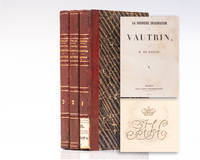
1848145572Paris: Chez Louis Chlendowski 1848. Finely bound edition of the final volume of 'La Comédie Humaine' from the library of Czar Alexander II of Russia. Octavo three volumes bound in half crushed morocco over marbled boards with gilt titles and ruling to the spines in five compartments. In very condition with some rubbing to the spines and bookplates to the front pastedown of each volume royal bookplate 'A.H.' to the pastedown of each volume loss to the spine of volume I with Russian lettering exposed underneath. From the library of Emperor of Russia King of Congress Poland and Grand Duke of Finland ÐлекÑаÌндр II ÐиколаÌевич or Alexander II. Alexander's most significant reform as emperor was the emancipation of Russia's serfs in 1861 for which he earned the title Alexander the Liberator. Other reforms of his included reorganizing the judicial system setting up elected local judges abolishing corporal punishment promoting local self-government through the zemstvo system imposing universal military service removing some privileges of the nobility and promoting university education. He was also unique in his foreign policy mainly his pacifism his support of the United States and his opposition of Great Britain; Alexander backed the Union during the American Civil War and sent warships to New York Harbor and San Francisco Bay to deter attacks by the Confederate Navy and sold Alaska to the United States in 1867 fearing the remote colony would fall into British hands if there were another war. The Tsar's assassination by revolutionaries in 1881 triggered the major suppression of civil liberties in Russia and the return of police brutality. His plans for a parliamentary body and constitution were then also abandoned by his son Alexander III. Honoré de Balzac was a French novelist and playwright considered one of the founders of realism in European literature. Full of personality and humanity Balzac imbued life into all of the characters and settings in his writing. His magnum opus 'La Comédie Humaine' a vast series of interconnected novels presents a panorama of post-Napoleonic French life. The character whose name appears in the title of this work 'Vautrin' whose real name is Jacques Collin appears in several novels of 'La Comédie humaine' inspired by the historical character of Eugène-François Vidocq a former criminal who later became chief of the Paris police. In prison Collin earns the nickname 'Trompe-la-Mort' 'Cheats Death' creating a life as 'Vautrin' after his escape. Although he was a supporter of the Crown Balzac paints the revolutionaries of the 'Comédie' series in a sympathetic light - even though they are the center of the book's most brutal scenes. This was the first book Balzac released under his own name and it gave him what one critic called "passage into the Promised Land"establishing him as an author of note and providing him with a name outside his past pseudonyms. Chez Louis Chlendowski hardcover
Very Good Turkish, Ottoman (1500-1928) Original six albumen print photographs. Each 12x9 cm. Fine photographs in its original feuille in very good condition. Very early, unique and historically significant six albumen prints, showing the mass executions of Turkish soldiers by the Russian army on the Caucasus Front (probably in Bayazid region) during the Russo-Turkish War of 1877-1878, in its original feuille of Gewaert - "Blaustern" Papier (L. Gewaert & Cie.) in Berlin and Vienna, with the seal of photographer "Michael Vogel; Zemen" on verso. All photos focus on the executions on death rows taken from different angles. In the Turkish village where the events took place, military barracks, mosques in the background, snowy ground in winter, Russian soldiers and captive Turkish soldiers are clearly visible. 'War of '93', named for the year 1293 in the Islamic calendar; (Russko-Turetskaya Voyna, or "Russian-Turkish War) was a conflict between the Ottoman Empire and a coalition led by the Russian Empire, and including Bulgaria, Romania, Serbia, and Montenegro. Fought in the Balkans and in the Caucasus, it originated in emerging 19th century Balkan nationalism. Additional factors included the Russian goals of recovering territorial losses endured during the Crimean War of 1853-56, re-establishing itself in the Black Sea and supporting the political movement attempting to free Balkan nations from the Ottoman Empire. The Russian-led coalition won the war, pushing the Ottomans back all the way to the gates of Constantinople, leading to the intervention of the western European great powers. As a result, Russia succeeded in claiming provinces in the Caucasus, namely Kars and Batum, and also annexed the Budjak region. The principalities of Romania, Serbia, and Montenegro, each of which had had de facto sovereignty for some years, formally proclaimed independence from the Ottoman Empire. After almost five centuries of Ottoman domination (1396-1878), an autonomous Bulgarian state emerged with the help and military intervention of Russia: the Principality of Bulgaria, covering the land between the Danube River and the Balkan Mountains (except Northern Dobruja which was given to Romania), as well as the region of Sofia, which became the new state's capital. The Congress of Berlin in 1878 also allowed Austria-Hungary to occupy Bosnia and Herzegovina and Great Britain to take over Cyprus. The initial Treaty of San Stefano, signed on 3 March 1878, is today celebrated on Liberation Day in Bulgaria, although the occasion somewhat fell out of favour during the years of Communist rule. The Russian Caucasus Corps was stationed in Georgia and Armenia, composed of approximately 50,000 men and 202 guns under the overall command of Grand Duke Michael Nikolaevich, Governor General of the Caucasus. The Russian force stood opposed by an Ottoman Army of 100,000 men led by General Ahmed Muhtar Pasha. While the Russian army was better prepared for the fighting in the region, it lagged behind technologically in certain areas such as heavy artillery and was outgunned, for example, by the superior long-range Krupp artillery that Germany had supplied to the Ottomans. The Caucasus Corps was led by a quartet of Armenian commanders: Generals Mikhail Loris-Melikov, Arshak Ter-Gukasov (Ter-Ghukasov/Ter-Ghukasyan), Ivan Lazarev and Beybut Shelkovnikov. Forces under Lieutenant-General Ter-Gukasov, stationed near Yerevan, commenced the first assault into Ottoman territory by capturing the town of Bayazid on 27 April 1877. Capitalizing on Ter-Gukasov's victory there, Russian forces advanced, taking the region of Ardahan on 17 May; Russian units also besieged the city of Kars in the final week of May, although Ottoman reinforcements lifted the siege and drove them back. Bolstered by reinforcements, in November 1877 General Lazarev launched a new attack on Kars, suppressing the southern forts leading to the city and capturing Kars itself on 18 November. On 19 February 1878, the strategic fortress to
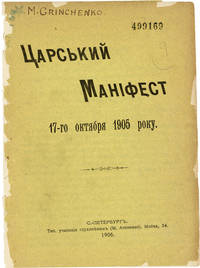
190643341S.-Petersburg': Tip. Uchilishcha Glukhonimikh' M. Alenevoi 1906. 12mo 17cm.; publisher's yellow wrappers; 16pp. Wrappers both separated but present stock exceedingly brittle with shallow losses and light toning along extremities ownership signature and rubberstamps to upper cover; textblock disbound. Good only though internal leaves remain fresh. This edition unlocated in OCLC as of January 2019. Quite a scarce and early popular edition of the October Manifesto and the only such to have been published under this title. The Manifesto was issued by Tsar Nicholas II in response to a wave of violence and worker strikes. The success of the Manifesto which offered the population the promise of basic civilian rights was shortlived. This edition published by a Ukrainian and presumably imperialist publisher in St. Petersburg. Tip. Uchilishcha Glukhonimikh' (M. Alenevoi) unknown books
Very Good Turkish, Ottoman (1500-1928) Original autograph manuscript on paper. Oblong: (17x21 cm). In Ottoman script (Old Turkish with Arabic letters). 8 lines on 1 page. Folded in half. An important historically significant document of the credentials of the Provisional National Government of the Southwestern Caucasus, or the Kars Republic, established in 1918. It was a short-lived nominally-independent provisional government based in Kars, northeastern Turkey. Born in the wake of the Armistice of Mudros that ended World War I in the Middle East, it existed from December 1, 1918, until April 19, 1919, when it was abolished by British High Commissioner Admiral Somerset Arthur Gough-Calthorpe. Some historians claim that the Republic of Kars was a puppet state of the Ottoman Empire. The government, headed by Fahrettin Pirioglu, containing the territory to be the predominantly Muslim-inhabited regions of Kars and Batumi, parts of Yerevan Province, and the Akhaltsikhe and Akhalkalaki districts of Tiflis (Tbilisi) Province. In practical terms, however, the government was confined to Kars Province and existed alongside the British governorship created during the Entente's intervention in Transcaucasia. English translation of the script: "Our government (Cenûb-i Garbî Caucasus), which is formed with the aim and aim to follow the Social Democrat Principle, is to protect our border in the agreement, to defend our nationality in every way, and to be in a position to protect our national authority. Timur Pasha Khimshiashvili (Hamshizâda) from Adjara, having the authority to be included in the general conference, has made our public power of attorney, which has been appointed and commissioned by our government, to this trustee... Deputy Head of the Government of the Republic, Minister of Internal Affairs Ali Riza". Timur Pasha Khimshiashvili from the Adjara region of Georgia was a descendant of a Georgian noble family and he was an Ottoman soldier and statesman. He and his subordinates also took on the duty of protection in the Eastern campaign of Nuri (Killigil) Pasha, the commander of the Caucasian Turkish-Islamic Army, which was established by Halil Pasha upon the directive of Enver Pasha, and prevented possible future assassinations. Turkish transcription: "Sosyal Demokrat Prensibini takip eylemek gaye ve emeliyle tesekkül eden (Cenûb-i Garbî Kafkas) hükûmetimizi ol babdaki hududnâmedeki hudûdumuzu muhafaza, hukûk-u milliyemizi her sûretle müdafâa ve düvel-i muazzama sefîr ve murahhaslariyla menâfî-i milliyemiz dâhilinde mükâlemette bulunmak ve sulh-u umûmî konferansina dâhil olmak salâhiyetini hâiz olmak üzere Acarali Hemsizâde Timur Pasa, hükûmetimiz tarafindan murahhas tâyin ve intihab kilinmis oldugunu hâvî vekâlet-i ammemizi câmî is bu itimadnâmemiz bilintizam mîr-i mümâileyh yeddine itâ kilindi. Hükûmet-i Cumhûriye Reisi Vekili, Dâhiliye Nâziri Ali Riza".
Very Good Arabic Contemporary non-aesthetic cloth bdg. Wear and cracked on hinges, dusty stains on boards, fading and stains on some pages, overall a good copy. 4to. (27 x 19 cm). Title in Kazan-Tatar language, text in Arabic. 423, [1] p. Exceedingly rare early quarto-sized Qur'an printed in Kazan, with "haraka" in usual typography peculiar to the Qazan imprints. Marginal texts addressing variant readings (qirâ'ât), verse divisions, commentary on the text, and rare elucidation in Tatar and Arabic, concludes chapter (sûrah) headings alongside page numbers of their respective openings, as well as the table of errata. "The Russian Emperor Paul gave permission for the printing in Qazan city of secular books in Tatar, in Arabic script, but the realization of this called for tireless efforts on the part of enlightened Tatars, with the support of the scholars of Qazan State University, whose publishing house relied financially on the income from Tatar editions. First Qur'an was printed in 1803 in Qazan in Tatar printing houses. In the year of the opening of the Qazan Public Library (1865), various presses in Qazan city printed 34 Tatar books. In the second half of the nineteenth century, 3.300 books were published in a total of 26,864,000 copies. In some years, as many as two million copies of Tatar books were printed. These were not only works of a religious-theological and folklore character, but also dictionaries, manuals for self-tuition, and grammar books of Tatar. In the nineteenth and twentieth centuries, Kazan city was one of the most important centers of publishing in the world. The works of Tatar authors which were published in Qazan city in Arabic, Turkish and Farsi were distributed widely in Central Asia and could be found in India, Chinese Turkistan, Turkey, Persia, Afghanistan, and the Near East." (Source: About Kazan online). Three copies of "Kalam-i Sharif" printed in Qazan can be traced, however, this edition is not in WorldCat.
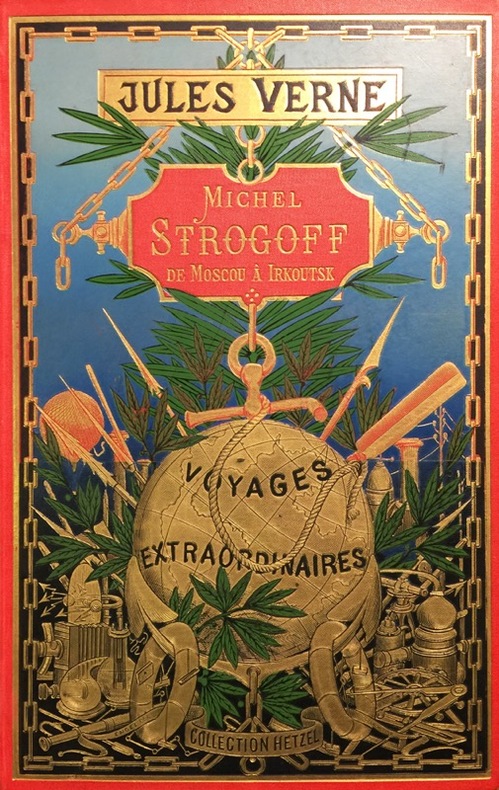
189422131Paris, Bibliothèque d'Education et de Récréation, J. Hetzel, [1894] ; in-8, cartonnage "à la Mappemonde", 2e plat type "P", dos type "F" ; 4, 370 pp., catalogue HF de nouveautés pour 1894-1895, 8 pp.
Very Good French An 18th-century hand-colored copper engraved map of Ukraine and the Black Sea in a fine impression with original hand-coloring in its period. 52x62 cm. In French. Scale: 1/2750000. Slight stains on the upper margin. Faded on paper. Otherwise a very good map. Rare in original color showing the Black Sea and its surroundings, of the little Tartary and the Black Sea of Delisle republished by Renier and Joshua Ottens. Can be seen on the map, Moldavia, Bulgaria, Natolia, Little Tartarie, Ukraine, and Crimea with contiguous regions and hinterland. In the century when this map was prepared (18th century), firstly, the territory of Crimea was controlled by the Crimean Khanate, then it was annexed by the Russian Empire on 19 April [O.S. 8 April] 1783. The period before the annexation was marked by Russian interference in Crimean affairs, a series of revolts by Crimean Tatars, and Ottoman ambivalence. The annexation began 134 years of rule by the Russian Empire, which ended with the Russian Revolution of 1917. Guillaume Delisle was a French cartographer known for his popular and accurate maps of Europe and the newly explored Americas. At 27, Delisle was admitted into the French Académie Royale des Sciences, an institution financed by the French state. After that date, he signed his maps with the title of "Géographe de l'Académie". Five years later, he moved to the Quai de l'Horloge in Paris, a true publishing hub where his business prospered. Delisle's progress culminated in 1718 when he received the title of Premier Géographe du Roi.? He was appointed to teach geography to the Dauphin, King Louis XIV's son, a task for which he received a salary. Again, his father's reputation as a man of science probably helped the younger Delisle. In Delisle's case, it could be said that his accomplishments surpassed his father's. Up to that point, he had drawn maps not only of European countries, such as Italy, Spain, Germany, Great Britain, and Poland, and regions such as the Duchy of Burgundy, but he had also contributed to the empire's claims to recently explored continents of Africa and the Americas. Publisher: Jan Barend Elwe (177-1815), was a Dutch publisher and bookseller who reissued maps by De l'Isle and Ottens and some other cartographers in the late 18th century. His famous map "Amerique Septentrionale Divisee en ses Principales Parties" was derived mainly from Sanson's and Jaillot's maps of 1656 and 1676. This map was published in 1792 in an Atlas which included 37 other maps of different countries and regions.
Very Good Turkish, Ottoman (1500-1928) Contemporary cloth bdg., marbled boards. Cr. 8vo. (19 x 14 cm). In Ottoman script (Old Turkish with Arabic letters). [2], 130 p. Exceedingly rare first edition of the most comprehensive biographical book of the Crimean Khans and Khanate, including 44 biographies starting from the founder of the khanate, Hadji Geray (1397-1466), each khan period has been handled separately, including narrations of the wars with Tsarist Russia and other important events. In the beginning, the genealogy of the Crimean khans dating back to Genghis Khan is also given. In the book, the dates of the expeditions of these rulers of Crimea, their reigns, and wars were tried to be determined meticulously. Some important events are mentioned, albeit briefly, like the Fire of Moscow occurred on May 24, 1571, when the Crimean and Ottoman armies led by the khan of Crimea Devlet I Giray, bypassed the Serpukhov defensive fortifications on the Oka River, crossed the Ugra River, and rounded the flank of the 60,000-man Russian army. The last biography in the work was the author's father and Baht Geray Han (d. 1801). Özege 6373.; TBTK 12314.
Good Turkish, Ottoman (1500-1928) Contemporary non-aesthetic burgundy cloth bdg. Demy 8vo. (22 x 14,5 cm). In Ottoman script (Old Turkish with Arabic letters). 299, [6] p. Fading on cloth, minor repairs on some pages, otherwise a good copy. Lithographed edition. First and only Turkish edition of this uncommon and very scarce early book of the history of Russia under the rule of Peter the Great. This book was published during the Crimean War, which was a military conflict fought from October 1853 to February 1856 in which Russia lost to an alliance of the Ottoman Empire, France, the United Kingdom, and Piedmont-Sardinia. The first four chapters describe the general political and social history of Russia at the time of Peter the Great. The following chapters narrate important events like the new revolution in Sofia, the first diplomatic relations with China in the period and the first agreement between the Russian and Chinese Empires, The Siege of Azov Fortress, the agreement with the Saxony, Peter the Great's travels to Europe, rebuild of St. Petersburg, The Battle of Narva and the Siege of Narva, return of the Great Tsar to Russia from France, commerce in Russia in the period of the Peter the Great's rule, etc. Peter I, most commonly known as Peter the Great, was a monarch of Russia who modernized it and made it a European power. He ruled the Tsardom of Russia from 7 May [O.S. 27 April] 1682 to 1721 and subsequently the Russian Empire until his death in 1725, jointly ruling before 1696 with his elder half-brother, Ivan V. To improve his nation's position on the seas, Peter sought more maritime outlets. His only outlet at the time was the White Sea at Arkhangelsk. The Baltic Sea was at the time controlled by Sweden in the north, while the Black Sea and the Caspian Sea were controlled by the Ottoman Empire and Safavid Empire respectively in the south. Peter attempted to acquire control of the Black Sea, which would require expelling the Tatars from the surrounding areas. As part of an agreement with Poland that ceded Kyiv to Russia, Peter was forced to wage war against the Crimean Khan and against the Khan's overlord, the Ottoman Sultan. Peter's primary objective became the capture of the Ottoman fortress of Azov, near the Don River. In the summer of 1695, Peter organized the Azov campaigns to take the fortress, but his attempts ended in failure. Through a number of successful wars, he captured ports at Azov and the Baltic Sea, laying the groundwork for the Imperial Russian Navy, ending uncontested Swedish supremacy in the Baltic, and beginning the Tsardom's expansion into a much larger empire that became a major European power. He led a cultural revolution that replaced some of the traditionalist and medieval social and political systems with ones that were modern, scientific, Westernised, and based on the Enlightenment. Shuvalov was called the Maecenas of the Russian Enlightenment and the first Russian Minister of Education. Russia's first theatre, university, and Academy of Arts were instituted with his active participation. He was born in Moscow, the only son of Ivan Menshoi Shuvalov, an army captain who died when the boy was ten, and Tatiana Rodionovna. The Shuvalov family fortunes changed drastically in 1741 when Empress Elizaveta Petrovna ascended to the Russian throne with help from Ivan's powerful cousins - Peter Shuvalov and Alexander Shuvalov. The following year, they had the fourteen-year-old Ivan attached to the imperial court as a page. Complete title: "Büyük Petro'nun eyyâm-i hükümetinde Rusya'da cereyân eden ahvâl-i dahiliyye ve umûr-i hâriciyyeye ve husûsiyle nizâmât-i mevzûa-i cecdîdeye ve oralarda bulunan milel ve akvâm-i muhtelifenin ahlâk ve âdâb ve fünûn ve sanâyilerine dair Büyük Petro'nun kizi Elizabete'nin kurenâsindan Sovalef nâm zâtin bazi resâil-i mevsûka ve senedât-i sahîhadan vukûf ve ittilâi hâsil olan ahvâl ve keyfiyâti nakil ve hikâyeye mübâseret olunmustur." Özege 17170.
187018-0-60Moskau, , o.J. (um 1870). Blattgröße: ca. 39,50 x 33,5 cm; Fotogröße: ca. 27,5 x 21,5 cm
177216548Riga, Hartknoch, 1772. 88 S. Kl.-8°. Mod. HPgmt. mit Rückenschild (etw. fleckig). [5 Warenabbildungen]
2009DADAX0131008463Pearson 2009-02-25. 5. hardcover. New. 8.20x2.10x10.10. Buy with confidence. Excellent Customer Service & Return policy. Pearson hardcover
012381Xenia Alexandrovna (1875-1960), grande-duchesse de Russie, soeur du tsar Nicolas II. L.A.S., 30 mars 1954, 1p in-8. A Hortensia Anchorena. « Chère Madame, ma fille vient d'arriver m'apportant vos cadeaux : mon parfum favori ! Et le beau châle. Je suis très touchée et vous en remercie de tout coeur. Mes amitiés à tous deux. Xenia ». Jolie lettre amicale. Rare [109-2]
012382Xenia Alexandrovna (1875-1960), grande-duchesse de Russie, soeur du tsar Nicolas II. L.A.S.,22 décembre 1949, 1p in-12 oblong. Timbre en relief avec l'aigle impérial. A Hortensia Anchorena. « Avec mes meilleurs voeux pour Noël et la nouvelle année en vous remerciant de tout coeur pour la belle gerbe. Xenia ». Jolie lettre amicale. Rare [109-2]
1878534418Oakland Calif.: Smith & Elliott Lith 1878. Near Fine. Original color lithograph. Measures 13½†x 10¾†to the inside edges of a mat frame neatly housed inside a glazed wood frame 18 ¾†x 16 ½â€. Slight toning near fine. A beautiful early landscape view of John Weinberger’s ranch and vineyard drawn by the American artist and cartographer Czar James Dyer. A bright well-preserved lithographic plate in a handsome frame removed from Illustrations of Napa County California published by Smith & Elliott in 1878. Smith & Elliott, Lith unknown
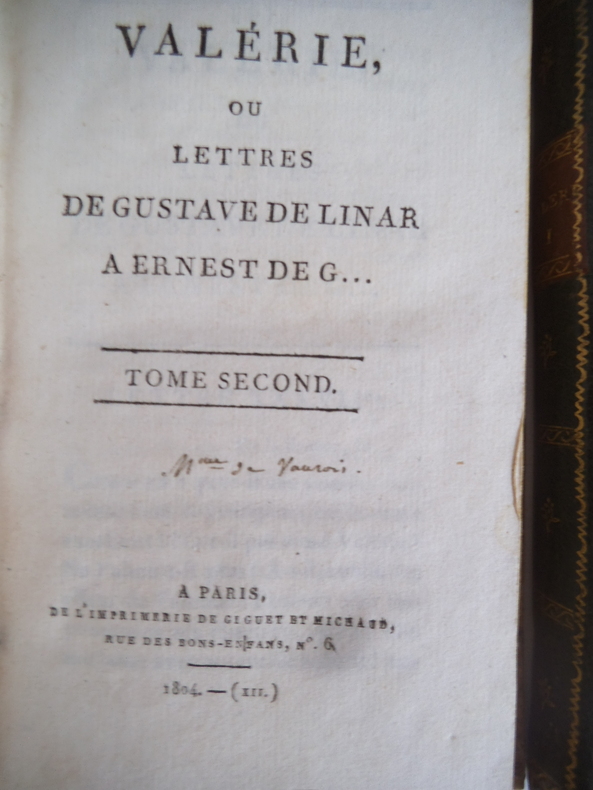
14587Von KRÜDENER Barbara Juliane Valérie ou lettres de Gustave LINAR çà Ernest G…. A Paris de l’imprimerie de GIGUET et MARECHAUD 1804 ( An XII) Deux tomes en deux volumes in 12 demi cuir vert, titre, fers, tomaison, roulette, filets dorés. Tome premier titre, 261 pages. Tome second titre, 208 pages, 1 page d’errata. Pâle mouillure circulaire en marge extérieure, en fin de volume page 160à la fin. Rare édition originale bien complet de sa feuille d’errata en fin du volume deux. Roman épistolaire, en partie autobiographique publié à l’aide de CHATEAUBRIAND et qui fit qualifié de petit chef d’ouvre par SAINT BEUVE. Rare édition originale bien complet de sa feuille d’errata en fin du volume deux. D’origine Livonienne et à la vie aventureuse, elle vécut à Paris pendant la Révolution, influença BERARDIN de SAINT PIERRE et se lia avec Madame de STAEL, Mme RECAMIER et CHATEAUBRIAND. Devenue mystique, elle se pénétra de l’œuvre de SWEDENBORG et subjugua le TSAR par son exaltation religieuse. Inspiré de sa liaison avec Alexandre de SKATIEFF, ce roman sentimental et frénétique et unanimement reconnu comme un des chefs d’œuvre du pré-romantisme. Seule œuvre romantique de la Baronne Beat, Barbara, Juliane Von KRÜDENER
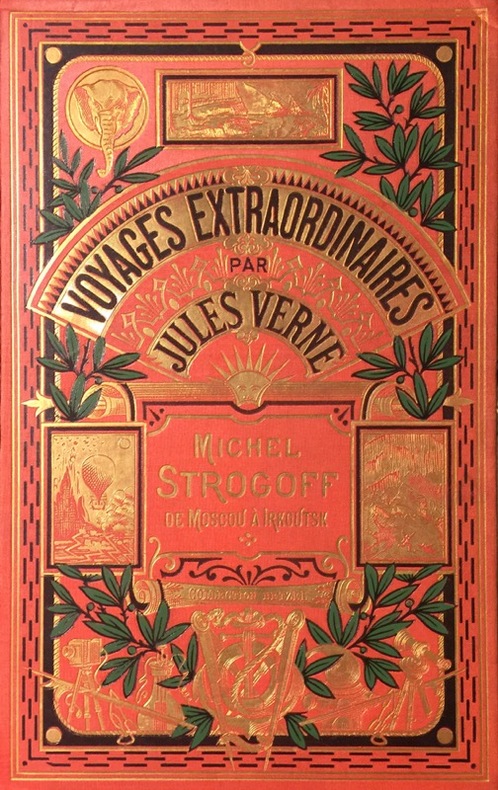
191622028Paris, Librairie Hachette, 1916 ; cartonnage rouge-orangé double in-8 du type "à un éléphant", dos type F, dit "au phare", deuxième plat de type "R", toutes tranches dorées ; [8], 368 pp. et six hors-texte en noir et blanc.
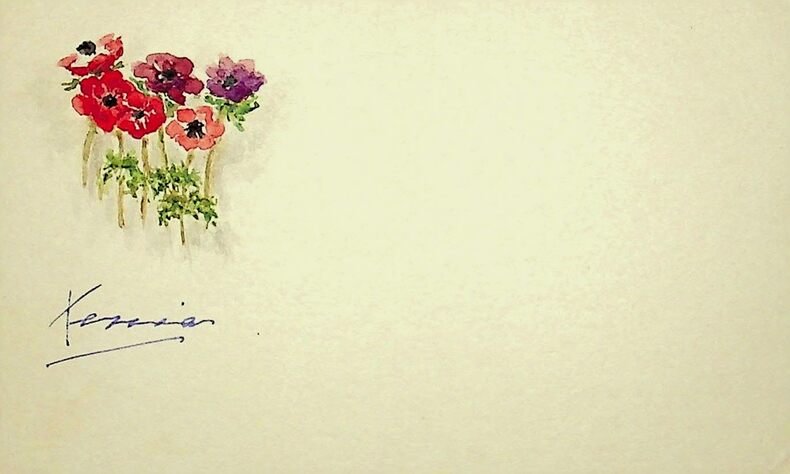
012380Xenia Alexandrovna (1875-1960), grande-duchesse de Russie, soeur du tsar Nicolas II. L.A.S. et aquarelle, sd, 1p in-12. A Marcelo et/ou Hortensia Anchorena (pas de mention de destinataire mais provient de leurs papiers). Quelques mots autographes « avec mes meilleurs voeux. X. » d'un côté et « Xenia » de l'autre. Sur ce second côté se trouve une petite aquarelle de Xenia. Rare [109-2]
58 pages. This very special issue contains part 1 (of 2) of "I Killed the Czar - at last the truth of history's most famous and mystery-shrouded massacre - On his deathbed one of the actual assassins (Peter Zacharovitch Ermakov) breaks his long silence". Fortuitously, when we acquired this copy we were thrilled to discover that laid-in are pages 39-48 of the August 3, 1935 issue, containing the entirety of part 2 of this important article. Other features include: Public Sweetheart Number One - Part III; The Case of the Caretaker's Cat - Part VII; Inside the Number Racket - what lies behind America's most amazing case of gambling fever?; Times Have Changed in Tennis - now it's a spotlight for chiselers!. Short stories include: The God-Inspired Idiot; The Donkey with a Lion's Heart; Love Letters of a Prizefighter and a Hollywood Extra; Flight. Many ofther features. Ads include: Wrigley's Gum, Spud Cigarettes; Pontiac Six (very nostalgic red and black one-page ad), Goodyear tires, Dentyne Gum; Pennzoil; Nice color back cover ad for Chesterfield Cigarettes features Turkish girl preparing tobacco leaves for baling. Above-average wear. Contents yellowed with age. A worthy copy of this historically important issue. Book