Rogers, William P [Richard Nixon]Biblio.com
1 280 résultats
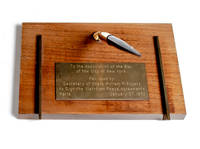
1973145329Paris January 27 1973. The original pen used by Secretary of State William P. Rogers to sign the Vietnam Peace Agreement ending the Vietnam War Paris 27 January 1973. Sheaffer fountain pen with 14 karat gold tip housed in an adjustable gold pen holder wooden base brass hardware including etched plaque. The plaque reads "To the Association of the Bar of the City of New York / Pen used by Secretary of State William P. Rogers to Sign the Viet-Nam Peace Agreements / Paris January 27 1973." During his tenure as Secretary of State under President Nixon William P. Rogers was involved in multiple matters of foreign policy including negotiations leading up to the signing of the Paris Peace Accords in 1973 after years of negotiations and secret talks. On 27 January 1973 representatives of the South Vietnamese communist forces North Vietnam South Vietnam and the United States gathered in Paris to sign the Paris Peace Accords and officially end the United States' involvement in the Vietnam War. The ceasefire took effect the next day on January 28 1973 and the last U.S. troops left Vietnam in March 1973. In very good condition. A unique piece of world history. In 1955 conflict between North and South Vietnam began. Fearing the spread of communism in Southeast Asia the United States entered the war in the early 1960s providing financial aid military advisors and eventually combat troops in support of South Vietnam. As the conflict escalated and anti-war sentiment grew talks about ending United States military intervention began in 1968 proceeding for years until an agreement in 1973. Fighting reignited almost immediately after US departure and continued for two more years before the Fall of Saigon and the end of the war. Eric Caren proprietor of the most significant private collection of historical documents in the United States notes that this item "represented the most tragic element of the 1960s inspiring the collective rebellion on university campuses and the combined rights for women and Blacks that led to the most positive changes in the most interesting decade. There is rare and there is unique this pen is obviously both." unknown
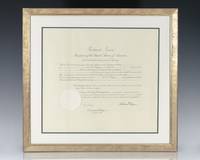
197095202Washington D.C 1970. Rare Richard Nixon Presidential Commission appointing Baseball Hall of Famer Joe DiMaggio as a "Member of the Conference on Physical Fitness and Sports." Dated September 25th 1970 the appointment is signed by President Richard Nixon and Secretary of State William Rogers with the Presidential seal. Double matted and framed. In fine condition. From the personal collection of Joe DiMaggio. Included is letter of provenance from DiMaggio's estate signed by his two granddaughters. An exceptional association linking two American icons. Double matted and framed. President Richard Nixon was an avid baseball fan he attended 11 games while serving in office and in 1985 he arbitrated the dispute between the Major League Baseball owners and umpires over expanded league playoff bonuses. Nixon made headlines when on June 22 1972 a reporter covering the upcoming national election asked the President to name his all-time favorite ballplayers. Nixon's long list of great players inspired the reporter to make a unique request: the first ever presidential All-Star team. With the assistance of his son-in-law David Eisenhower Nixon put together the team and it appeared in national newspapers on June 30 1972. American baseball legend Joe DiMaggio is widely considered one of the greatest baseball players of all time and is best known for his 56-game hitting streak May 15 - July 16 1941 a record that still stands. DiMaggio was one of the first sportsmen recognized in the Presidential Sports Award Program created by Richard Nixon in 1972. unknown books
1969713822/01/1969. <div class=""first""><p><strong><big>I</big>n February 1953 Henry Cabot Lodge was named U.S. Ambassador to the United Nations by President Eisenhower with his office elevated to Cabinet level rank. </strong>The position then was high profile and Lodge often engaged in debates with the UN representatives of the Soviet Union that were broadcast or covered on television. On the front lines in the Cold War in 1959 he escorted Soviet leader Nikita Khrushchev on a highly-publicized tour of the United States. Lodge left the ambassadorship during the election of 1960 to run for Vice President on the Republican ticket headed by Richard Nixon. Nixon selected Lodge because the latter had made a name for himself at the United Nations as a foreign-policy expert.</p><p>President Kennedy appointed Lodge to the position of Ambassador to South Vietnam which showed the import U.S. policymakers were coming to place on that nation. Lodge held the post from 1963 to 1964 and again from 1965 to 1967. As ambassador there Lodge supported President Johnson's decision to escalate American involvement in the Vietnam War believing that a Communist takeover in the South would be disastrous for U.S. foreign policy goals.</p><blockquote><p>The original appointment of <em>“Henry Cabot Lodge of Massachusettsâ€</em>_as <em>“Ambassador to head the United States Delegation at the Paris Meetings on Vietnam.â€</em></p></blockquote></div><p><!--break--></p><p>President Johnson and American military leaders had long insisted that the Vietnam War was going well and that they could see the light at the end of the tunnel. But in the aftermath of the Tet Offensive in February 1968 when the Communists were able to initiate coordinated attacks on all the regional capitals throughout Vietnam even in the American compound in Saigon itself Secretary of Defense Clark Clifford issued a report to the President in mid-March that the United States could not win the war. Johnson was stunned and he in turn stunned a nationwide audience on March 311968 announcing he would cease bombing north of the 20th parallel initiate peace talks to end the war and not seek renomination or reelection in 1968. The peace talks commenced in Paris on May 10 1968 with W. Averill Harriman leading the U.S. delegation.</p><p>From the outset the talks were fraught with difficulties. The U.S. insisted on mutual withdrawal of American and North Vietnamese forces which would leave the Saigon government in control. The North Vietnamese refused to negotiate anything until all bombing of North Vietnam was halted. When the U.S. finally agreed to that condition the Johnson administration was unable to persuade cajole or coerce South Vietnam and its leader President Thieu to participate unless it was recognized as a legitimate party by its foes. It was alleged at the time that both candidates in the 1968 election were using the talks as a political football with Hubert Humphrey seeking to appeal to pro-peace voters by insisting that the South Vietnamese participate and more germanely with Nixon leading the South Vietnamese to understand that his administration would give them a better deal if they would continue to delay. Formal negotiations would not begin until January 18 1969 two days before Nixon took office.</p><p>In the immediate aftermath of the 1968 election it seems that Lodge was Nixon’s foremost advisor on Vietnam. He urged Nixon to appoint a man of stature to negotiate in Paris and warned him away from a trip to Saigon for strategic reasons. Nixon adopted these suggestions. In fact on January 5 1969 fifteen days before his inauguration President-elect Nixon named Lodge himself to succeed Harriman as chief U.S. negotiator at the Paris talks. This signaled that Nixon was likely to take a hard line in the talks considering Lodge’s background as a proponent of American policy in Vietnam as promulgated by President Johnson and his chief military commander Gen. William Westmoreland.</p><p><strong>Document Signed</strong> as President Washington January 22 1969 just two days after his inauguration being the original appointment of <em>“Henry Cabot Lodge of Massachusettsâ€</em>_as <em>“Ambassador to head the United States Delegation at the Paris Meetings on Vietnam.â€</em> The wording here is highly politically indicative showing that Nixon avoided using the terms “peaceâ€_“talks†“negotiations†or “war.†These were simply “Meetings on Vietnam†nothing more to be implied. The document is countersigned by Secretary of State William P. Rogers.</p><p>On January 25 the first fully attended meeting of the formal Paris peace talks was held. Ambassador Lodge urged an immediate restoration of a genuine Demilitarized Zone as the first ""practical move toward peace."" He also suggested a mutual withdrawal of ""external"" military forces and an early release of prisoners of war. Tran Buu Kiem and Xuan Thuy heads of the National Liberation Front and North Vietnamese delegations respectively refused Lodge's proposals and condemned American ""aggression.""</p><p>Meanwhile Henry Kissinger Nixon’s National Security Advisor developed a two-track policy whereunder the Paris negotiators would discuss military matters while the real political decisions would be made privately out of the public eye by the leadership in Washington and Hanoi directly. This would avoid public pressure from all directions while also preventing the junior partners on either side South Vietnam and the National Liberation Front from exercising power to preclude a deal from happening. Nixon liked the idea and determined that political negotiations would emanate from the White House. So as Lodge continued treating with the North Vietnamese in Paris starting in early August Kissinger was secretly meeting with North Vietnam’s Le Duc Tho. As the summer turned to fall however Kissinger’s approaches to Hanoi failed to elicit an acceptable response and Nixon adopted a get tough policy to force an accommodation on his terms. In early October the President told Lodge to break off the talks by staging a walk-out at the October 23 plenary session. On the appointed day Lodge insisted that the talks be adjourned which they were immediately. Lodge himself had not favored this action and he suggested that the President use him as a personal intermediary to Hanoi’s leaders who were frequently in Paris. Nixon declined.</p><p>The only official public negotiations to end the Vietnam War were over never to resume. Nixon went directly to Camp David to work on a foreign policy address to the nation which he delivered on November 3. Dubbed the Silent Majority speech in it he asked the American people to support his decision to continue the war until the North Vietnamese would accept “honorable†peace terms. On November 20 1969 seeing no role remaining for a peace negotiator Lodge resigned. The war did not end until January 23 1973 four years and one day after Nixon had appointed Lodge to help end the conflict.</p> unknown
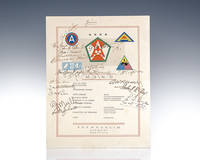
1945148763Germany: Bad Nauheim November 11 1945. Rare original dinner menu from George S. Patton's 60th birthday celebration at the Spa Hotel in Bad Nauheim Germany on November 11 1945. Octavo featuring colorful hand-decorated double ruled borders four-star rank and unit insignia designs. Boldly signed under the four-star rank insignia by Patton "G. S. Patton Jr." Additionally signed by eighteen attendees including: Robert B. Patterson recently elevated to Secretary of War; Hobart R. Gay Patton's Chief-of Staff; Paul D. Harkins deputy Chief-of-Staff and later Vietnam-era commander; Geoffrey Keyes; and Thomas H. Nixon. In near fine condition. General George S. Patton’s 60th birthday celebration was a day-long event that served both as a reunion with fellow veterans of the Third and Seventh Armies and as a farewell before his planned departure for the United States on December 10 1945. The occasion offered a brief moment of joy amid the turbulence of Patton’s final months. In September just weeks earlier he had been relieved of his positions as commander of the Third Army and military governor of Bavaria by General Eisenhower following controversial remarks in which he compared former Nazi Party members to Democrats and Republicans in the U.S. Reassigned to lead the Fifteenth Army a unit tasked with compiling the official history of the war Patton found little satisfaction in the new role. He disagreed with American denazification efforts and believed U.S. forces should remain strong in Europe to counter any future threat from the Soviet Union. With no reassignment to the Pacific forthcoming Patton hoped simply to return home—a journey he would never complete. On December 9 a truck collided with his jeep resulting in a broken neck and paralysis; he died in a hospital in Heidelberg on December 21 1945. Bad Nauheim unknown
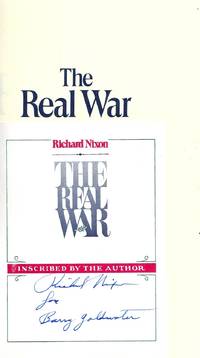
1980019025New York: Warner Books 1980. First Edition. Hardcover. Near Fine in a Very Good dustwrapper with a closed tear and crease at the rear. INSCRIBED and SIGNED by Nixon as usual for this book on a tipped-in publisher's bookplate. This copy however is INSCRIBED to Barry Goldwater. <br/><br/>Barry Goldwater a five-term United States Senator from Arizona 1953-1965 1969-1987 and the Republican Party's nominee for President in the 1964 election is the politician most often credited for sparking the resurgence of the American conservative political movement in the 1960s. His landslide defeat to Lyndon Johnson which also brought down many other Republican candidates opened the door for Johnson and a Congress dominated by Democrats to pass the Great Society programs. Goldwater returned to the Senate in 1969 but his role as a leader of the conservative movement had been transferred to Ronald Reagan. In 1974 Goldwater successfully urged President Richard Nixon whom he called "the most dishonest individual I have ever met in my life" to resign at the height of the Watergate scandal. Goldwater retired in 1987 and was succeeded in office by John McCain. Acquired from the Goldwater family. Warner Books hardcover
196025343E1960. Original Autograph Letter Signed by former U.S. President Harry S. Truman to Dean Acheson who served as his Secretary of State from 1949 to 1953 regarding the 1960 presidential election between John F. Kennedy and Richard M. Nixon. With an Autograph Letter from Dean Acheson to Harry S. Truman. Both letters are written and dated before the 1960 Democratic National Convention and concern how how to handle the press. The first is a 4 page letter from Dean Acheson to Truman handwritten on yellow legal paper 8 inches by 12 5/8 inches double-spaced single-side only dated June 28 1960. In the letter Acheson who was arguably Truman’s greatest admirer and devoted friend writes to clarify for Truman the positive benefit to the party and the nation in favoring Kennedy over the other likely contenders including California Governor Pat Brown former Illinois Governor Adlai Stevenson Senator Hubert Humphrey of Minnesota and Senator Lyndon B. Johnson of Texas. He begins: “Dear Boss As the Convention approaches we partisans are likely to become shall we say emphatic in our statements to the press. Could we make a treaty on what we shall not sayâ€. In his conclusion he writes “We have got to beat Nixon. We shall probably have to do it with Kennedy.†On July 2 1960 a week before Truman’s written reply he spoke at a dramatic televised press conference at the Truman library during which he lashed out at Kennedy citing his relative inexperience specifically doing exactly what Acheson had urged him never to do. After the press conference on a 2 page letter dated July 9 1960 written on his imprinted personal stationery Truman writes in part to Acheson: “Dear Dean:- You’ll never know how very much I appreciated your call and good letter. I tried my best to profit by both. Whether I did or not is up to you to decide. Anyway it looks as if things have to some extent slowed down and the band wagon isn’t running so fast. I’ve never been so wrought up and if you and the ‘Madam’ - the ‘Boss’ had not put the brakes on I’d have blown my top - maybe!†The letter closes with “Again thanks to a real friend and a real standby. My best to Alice Sincerely Harryâ€. In response to Truman’s criticism Kennedy responded noting that if fourteen years in major elective office was insufficient experience then that would have ruled out all but a handful of presidents including Wilson Roosevelt and Truman himself. In the end Truman opted to support Kennedy and his running mate Lyndon B. Johnson campaigning for them across nine states making thirteen speeches. These letters make a remarkable association referencing an historic moment in American presidential history. unknown
1959884698Washington D.C. 1959. To columnist and television reporter of Meet the Press Lawrence E. Spivak on Vice Presidential stationery with a 5 page memo carbon unsigned describing his recent meeting with Fidel Castro. Nixon admires Castro's charisma and bravery here in this memorandum summarizing his discussion with the Cuban leader on April 19 1959. Nixon characterizes him as having" those indefinable qualities which make him a leader of men." But there was also much that disturbed him. Everything that Castro was doing from suspending elections to the executions of political opponents he justified as carrying out "the will of the people." Nixon says: "this almost slavish subservience to prevailing majority opinion - the voice of the mob - rather than his naive attitude toward Communism and his obvious lack of understanding of even the most elementary economic principles which concerned me most in evaluating what kind of a leader he might eventually turn out to be." In his conclusion Nixon says that because Castro has "the power to lead.we have no choice but at least to try to orient him in the right direction." Together 6 pages attached memo on carbons with some small glue remnant on the lower left corners fifth page of memo laid down with some glue residue showing. An historically important set of documents. 4to. unknown
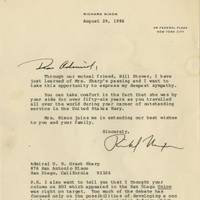
1986941029/08/1986. <blockquote><p>""Too much of the debate has focused only on the possibilities of developing a one hundred percent leak-proof population defense which even the strongest proponents agree could not be developed until next century.""</p></blockquote><p>President Nixon made his mark in the area of foreign policy. Although he had made his own career as a militant opponent of Communism Nixon saw opportunities to reduce the temperature of the Cold War by improving relations with the Soviet Union.</p><p>One of these was the Strategic Arms Limitation Talks negotiations which were a series of meetings beginning in Helsinki that lasted from November 17 1969 until May 1972. After a long deadlock the first results of SALT I came in May 1971 when an agreement was reached over anti-ballistic missiles systems. Further discussion brought the negotiations to an end in Moscow on May 26 1972 when Richard Nixon and Leonid Brezhnev signed both the Anti-Ballistic Missile Treaty and the Interim Agreement Between The United States of America and The Union of Soviet Socialist Republics on Certain Measures With Respect to the Limitation of Strategic Offensive Arms. These served to slow the growth in nuclear weapons and halt extensive proliferation.</p><p>A premise of the Cold War mutually assured destruction meant simply that neither the US nor the USSR would attack the other because it would ensure that both would be obliterated. You could get the first shot in but unless you wiped out the entire capacity of the other side in one blow you would ensure your own demise. In 1969 Nixon announced an anti-ballistic missile defense system called Safeguard which aimed to protect the deterrent nuclear force of the United States its missile fields to maintain that deterrent capacity. This happened at the same time as the country was publicly debating the possibility of protecting entire US cities in a shield the technology of which did not exist. Safeguard never fully operated at its intended capacity and in fact was shut down soon after it launched.</p><p>Ronald Reagan was not an active proponent of mutually assured destruction MAD. In 1983 he proposed the Strategic Defense Initiative SDI to use ground-based and space-based systems to protect the United States from attack by ballistic strategic nuclear weapons. The initiative focused on strategic defense rather than the prior strategic offense doctrine of MAD. It was dubbed ""Star Wars"" by critics. The goal was to neutralize the Soviets' nuclear capacity regardless of the success of ongoing negotiations. The Soviets strongly opposed the Strategic Defense Initiative as they could not afford to match the U.S. in this area and they felt that if successful the concept of mutually assured destruction would be lost and the U.S. would be in a dominant position.</p><p>In November of 1985 Gorbachev and Reagan were to meet in Geneva for a major summit. Both the Soviet Union and the United States were seeking to cut the number of nuclear weapons with the Soviets seeking to halve the number of nuclear-equipped bombers and missiles and the U.S. desiring to ensure that neither side gained a first-strike advantage and to protect rights to the Strategic Defense Initiative. These ideas of arms limitations and strategic defense were the cornerstones to the Cold War negotiations between the two global powers in a bi-polar world.</p><p>One of those who joined the debate was U.S. Grant Sharp a 4-star admiral who was Commander in Chief of the US Pacific Fleet and of US Pacific Command including during the Gulf of Tonkin Incident. He wrote a piece in the San Diego papers which advocated the protection of US-based counter-force assets which touched on a subject central to Nixon's presidency and close to his heart missiles that would serve as a first-strike deterrent.</p><p><strong>Typed letter signed</strong> August 29 1986 New York City to Admiral U.S. Grant Sharp. <em>""Through our mutual friend Bill Stover I have just learned of Mrs. Sharp's passing and I want to take this opportunity to express my deepest sympathy. You can take comfort in the fact that she was by your side for over fifty-six years as you traveled all over the world during your career of outstanding service in the United States Navy. Mrs. Nixon joins me in extending our best wishes to you and your family. Sincerely Richard Nixon.</em></p><p>""P.S. I also want to you that I thought your column on SDI which appeared in the San Diego Union was right on target. Too much of the debate has focused only on the possibilities of developing a one hundred percent leak-proof population defense which even the strongest proponents agree could not be developed until next century. On the other hand a defense of our counter-force missile silos which presently are vulnerable to a first strike from Soviet Union's SS-18s could be deployed in the near future. Unless the Soviet Union agrees to offensive cuts which would remove its first-strike capability we have no choice but to go forward with an SDI program which would deny them that capacity.""</p> unknown
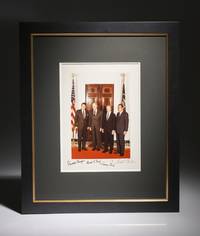
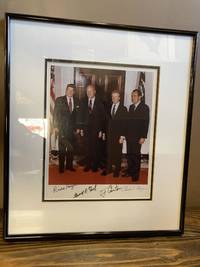
19811882Washington DC: The White House 1981. Framed. Fine. White House Photograph signed by President Ronald Reagan Jimmy Carter Gerald Ford and Richard Nixon. With the assassination of Egyptian President Anwar Sadat there was concern that sending a sitting United States President would be too dangerous. Protocol demanded that a high level delegation from the United States was needed for the trip but sending less senior officials would be viewed as a lack of engagement by the United States. Secretary of State Alexander Haig suggested that the 3 former living Presidents attend which all three accepted. With Richard Nixon in political exile since Watergate President Carter having just lost an election and President Ford getting pressure from his family to avoid dangerous situations all three had their reasons not to attend. This trip also marked a thawing in relations between the living former presidents with President Carter and President Ford striking up a lifelong friendship afterwards. This photograph marked the first time that 4 sitting Presidents had joined together at the White House. Photograph signed by President Ronald Reagan along with former presidents Jimmy Carter Gerald R. Ford and Richard Nixon. Framed in contemporary black frame gold edge museum archival glass. A fine signed copy. Provenance: From the office of Katherine Shepherd White House Correspondence office staff. Known as "Charley" Ms. Shepherd had a long career in Washington DC from Capitol Hill to the White House. In the 1980s she worked in the White House Correspondence office and was tasked outreach for President Reagan to constituents in his native Illinois and California. The White House unknown books
19811339121n.d. 1981. Other. Group photograph of the Presidents of the United States. 8 by 10 inch photo of Presidents Reagan Ford Carter and Nixon at the White House in frame 13.5 by 15.5 inches. Signed by Presidents Ronald Reagan 1911-2004 Gerald R. Ford 1913-2006 Jimmy Carter b. 1924 and Richard Nixon 1913-1994. A view of the four living US Presidents gathered at the White House in 1981 prior to departing for Egypt to attend the funeral of Anwar Sadat. SG consignment;. 1339121. Shelved Dupont Bookstore. unknown books
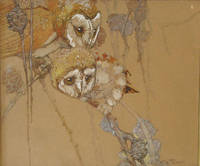
1930132091930. Watercolor and pencil heightened with white signed "K. Nixon". Matted and framed. 1 vols. Image 10-1/2 x 12-3/4 inches. Matted and framed. Watercolor and pencil heightened with white signed "K. Nixon". Matted and framed. 1 vols. Image 10-1/2 x 12-3/4 inches. Nixon was a talented British animal illustrator noted for an orientalist approach and sharp clarity to the subject reminiscent of Japanese woodblock prints. She lived in India for 25 years where she illustrated for The Time of India Press designed 30 nature posters for the Indian State Railways painted horse portraits and a mural of wild ducks for the Bombay Natural History Museum. After returning to England she wrote and illustrated numerous children's animal stories and painted animal portraits. She was the recipient of many awards and medals and made an 'academic of Italy with Gold Medal' in 1980. unknown books
1930132091930. Watercolor and pencil heightened with white signed "K. Nixon". Matted and framed. 1 vols. Image 10-1/2 x 12-3/4 inches. Matted and framed. Watercolor and pencil heightened with white signed "K. Nixon". Matted and framed. 1 vols. Image 10-1/2 x 12-3/4 inches. Nixon was a talented British animal illustrator noted for an orientalist approach and sharp clarity to the subject reminiscent of Japanese woodblock prints. She lived in India for 25 years where she illustrated for The Time of India Press designed 30 nature posters for the Indian State Railways painted horse portraits and a mural of wild ducks for the Bombay Natural History Museum. After returning to England she wrote and illustrated numerous children's animal stories and painted animal portraits. She was the recipient of many awards and medals and made an 'academic of Italy with Gold Medal' in 1980. unknown
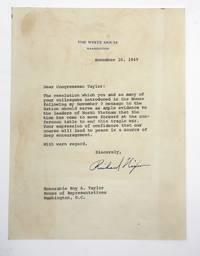
196930511969. Very Good. Contents Summary: A call to end the Vietnam war based on a resolution Roy A. Taylor and his colleagues introduced to the House following President Richard Nixon’s November 3rd message to the Nation.<br /> <br /> Typed Letter Signed ‘Richard Nixon’ in black ink. One Page 6 ¾†x 8 7/8†Blind stamped of official seal ‘THE WHITE HOUSE WASHINGTON’. Dated: November 10 1969. Slightly toned. 1†crease top left. Back stained from glue application visible from front. Very Good<br /> <br /> Letter in full:<br /> <br /> "Dear Congressman Taylor:<br /> <br /> The resolution which you and so many of your colleagues introduced in the House following my November 3 message to the Nation should serve as ample evidence to the leaders of North Vietnam that the time has come to move forward at the conference table to end this tragic war. Your expression of confidence that our course will lead to peace is a source of deep encouragement.<br /> <br /> With warm regard<br /> <br /> Sincerely<br /> Richard Nixon<br /> <br /> Honorable Roy A. Taylor<br /> House of Representatives<br /> Washington D.C."<br /> <br /> no envelope. unknown
198313413JNew York: Privately Printed 1983. First Edition. Limited to 1000 copies. Signed in full by Nixon in blue ink. Actor Randolph Scott's copy with an original Typed Letter Signed from Nixon signed in blue ink “Dick†on Nixon’s personal stationery in which he presents the book to Scott. “October 10 1983. Mr. Randolph Scott. Dear Randy This is one of 1000 copies of the private limited edition of Real Peace: A Strategy for the West. Copies are being sent to a select group of government officials and opinion leaders in the United States and abroad. Little Brown and Company will publish and distribute the book in the United States and Canada in January 1984. I trust it may contribute to a better understanding of where we have been where we are and where we should go in our relations with the Soviet Union China Japan Europe and the Third World. With warm regards. Sincerely Dick.†Fine in a near fine dust jacket with slight fading to spine and one short tear. Randolph Scott was a noted Hollywood actor of the Golden Age best remembered for a series of sophisticated westerns. Randolph Scott has recently received a great deal of attention with the release and restoration of Seven Men from Now 1956 directed by Budd Boetticher and produced by John Wayne which has been unavailable for decades and the restoration and release on DVD of Ride the High Country 1962 directed by Sam Peckinpah both of which are considered among the great classics of western film. Nixon was an admirer of Scott’s films and he and Scott were long time friends. Nixon invited Scott to the White House to visit. When the Apollo Eleven astronauts first landed on the moon Scott was Nixon’s guest at the dinner Nixon held in Los Angeles to honor the astronauts return. An excellent association copy. Privately Printed unknown books
198313413JNew York: Privately Printed 1983. First Edition. Limited to 1000 copies. Signed in full by Nixon in blue ink. Actor Randolph Scott's copy with an original Typed Letter Signed from Nixon signed in blue ink “Dick†on Nixon’s personal stationery in which he presents the book to Scott. “October 10 1983. Mr. Randolph Scott. Dear Randy This is one of 1000 copies of the private limited edition of Real Peace: A Strategy for the West. Copies are being sent to a select group of government officials and opinion leaders in the United States and abroad. Little Brown and Company will publish and distribute the book in the United States and Canada in January 1984. I trust it may contribute to a better understanding of where we have been where we are and where we should go in our relations with the Soviet Union China Japan Europe and the Third World. With warm regards. Sincerely Dick.†Fine in a near fine dust jacket with slight fading to spine and one short tear. Randolph Scott was a noted Hollywood actor of the Golden Age best remembered for a series of sophisticated westerns. Randolph Scott has recently received a great deal of attention with the release and restoration of Seven Men from Now 1956 directed by Budd Boetticher and produced by John Wayne which has been unavailable for decades and the restoration and release on DVD of Ride the High Country 1962 directed by Sam Peckinpah both of which are considered among the great classics of western film. Nixon was an admirer of Scott’s films and he and Scott were long time friends. Nixon invited Scott to the White House to visit. When the Apollo Eleven astronauts first landed on the moon Scott was Nixon’s guest at the dinner Nixon held in Los Angeles to honor the astronauts return. An excellent association copy. Privately Printed unknown
197883913New York: Grosset & Dunlap 1978. First Printing Stated. Hardcover in Slipcase. Very good. xii 1120 4 pages. Illus. index Slipcase. Signed on fep. Some spine and slipcase fading. With Letter of Authenticity. Richard Milhous Nixon January 9 1913 - April 22 1994 was the 37th president of the United States serving from 1969 until 1974. Nixon previously served as the 36th vice president from 1953 to 1961 having risen to prominence as a representative and senator. After five years in the White House that saw the conclusion to the U.S. involvement in the Vietnam War détente with the Soviet Union and China and the establishment of the Environmental Protection Agency he became the only president to resign from the office following the Watergate scandal. He graduated from Duke University School of Law in 1937 and returned to California to practice law. He and his wife Pat moved to Washington in 1942 to work for the federal government. He served on active duty in the Navy Reserve during World War II. He was elected to the House of Representatives in 1946. His pursuit of the Hiss Case established his reputation as a leading anti-Communist which elevated him to national prominence. In 1950 he was elected to the Senate. He was the running mate of Dwight D. Eisenhower subsequently serving for eight years as the vice president. In 1968 he ran for the presidency and was elected defeating Hubert Humphrey and George Wallace in a close election. Nixon ended American involvement in Vietnam in 1973 ending the military draft that same year. Nixon's visit to China in 1972 eventually led to diplomatic relations and he gained the Anti-Ballistic Missile Treaty with the Soviet Union. Four years after the Watergate scandal forced him to resign the presidency President Nixon began another comeback through the publication of this book RN: The Memoirs of Richard Nixon in 1978. The book Nixon writes is based on not only on his public papers but also on some 20000 pages of his "extensive handwritten notes" about his "ideas conversations activities and speeches" diaries that he dictated as Vice President and later as President and significantly the infamous Watergate tapes. In the book Nixon recounts his life his political successes and failures and the foreign and domestic events of his time including those leading up to his resignation as President on August 9 1974. This is a stated first printing and thus the first edition of the book published by Grosset & Dunlap. It is the publisher's deluxe cloth signed edition not the common trade edition. It is covered in dark blue buckram and embossed in gold printing on the cover and the spine. The accompanying slipcase is covered in matching dark blue buckram. In the 20 years between his presidency and his death Nixon wrote nine books and reestablished himself as a respected statesman. Nixon has signed this book in black on a page that the publisher bound between the blue front free endpaper and the half title page. Derived from a Kirkus review: "I intended to play the role of the President right to the hilt and right to the end." Thus RN whose words read less like memos here than they did in the newspaper excerpts and more like the last will and testament of a fighter who never willingly gave ground. Had he been urged to resign he avers he would have rebelled; and his review of the two occasions - the "secret fund" crisis the second v.p. nomination - when he felt himself crowded and didn't cave in back up his claim. "And tell them I know something about politics too!" he quotes himself as shouting over the phone in the first instance to a wheedling dissembling Tom Dewey. He was a mere freshman senator then built up by the Hiss case but always had ideas of his own. Not public affairs: He had nothing against communism he says until Churchill's Iron Curtain speech. So it's when he's talking politics that his celebrated caginess becomes an asset and his acumen is in evidence; and only then too is he interesting about people. Poor Rose Mary Woods for instance turns up unheralded whereas Bob Haldeman scores for spotting the potential of campaigning-by-TV not whistle-stop train. By the same token while the extensive travels are dull the final days are distinctly not: Intent on being a leader from the time when four years out of law school he was president of every organization in sight he is fully aware of what's slipping away. He records the silence - instead of the usual applause - that greeted his entrance to the last Cabinet meeting the "sober noncommittal" faces as he thanks his aides for their support; and like a prospective suicide he imagines the effect his farewell cables will have on Chou and Chairman Mao "in Cairo and Tel Aviv in Damascus and Amman" - where "eight weeks ago I had been accorded unprecedented acclaim." How the mightiest fell: the pages carry weight. Grosset & Dunlap hardcover
199152958Harcourts / Wittenborn Distrib. . New. 1991. Paperback. 0815000170 . FREE UPGRADE to Courier/Priority Shipping Upon Request IN STOCK AND IMMEDIATELY AVAILABLE FOR SHIPMENT - FLAWLESS COPY BRAND NEW PRISTINE NEVER OPENED - 48 pp. 8.5 x 11 inches -- with a bonus offer-- . Harcourts / Wittenborn (Distrib. ) paperback
198291451Grand Central Publishing. New. 1982. Hardcover. 0446512494 . FREE UPGRADE to Courier/Priority Shipping Upon Request - IN STOCK AND IMMEDIATELY AVAILABLE FOR SHIPMENT - Flawless copy brand new pristine never opened -- 371 pages. -- with a bonus offer-- . Grand Central Publishing hardcover
198053639Warner Books. As New. 1980. Hardcover. 044651201X . FREE UPGRADE to Courier/Priority Shipping Upon Request IN STOCK AND IMMEDIATELY AVAILABLE FOR SHIPMENT - AS NEW THE TEXT BLOCK IS PRISTINE CLEAN UNMARKED AND IN EXCELLENT CONDITION - - 341 pages. -- with a bonus offer-- . Warner Books hardcover
19936037321993. "Dick" in black fountain pen ink on his engraved Richard Nixon 577 Chestnut Ridge Road Woodcliff Lake New Jersey letterhead November 14 1993. 7 1/4" x 10 1/2"' 1 page recto only. Very good. Together with the original typed mailing envelope metered and postmarked Hackensack N.J. November 17 1993. With Nixon's return address on the back flap. To Mrs. Betty Palmer 21967 Pacific Coast Highway Malibu California 90265 Nixon writes to his friend after the tragic Malibu fire of November 2nd 1993. In part: ".What a tragedy. Your. personal belongings all gone.I would like to help by sending.the special leather bound editions of all my books and a first edition copy of 'Six Crises'.". No Binding. Very Good. hardcover books
1956BIBLIO-48677Maggs Bros. London for the Broxbourne Library first edition 1956. Limited edition of 300 copies. Quarter vellum and cloth leather spine-label top edge gilt folio 35 cm. ix 1 250 1 pp ills some mounted some colour. 119 entries. A selection of bindings from the famous library of Albert Ehrman. This is one of Howard Nixon's most important catalogues since it focusses on previously unpublished bindings and aims to describe and illustrate as wide as possible a selection of typical styles so producing a history of taste and design in European bookbinding. Nixon provides a wealth of information which is not limited to the particular bindings described but often relates them to examples in the British Library collection. Printed by Brooke Crutchley at the Cambridge University Press. Boards slightly rubbed vellum somewhat darkened with some spotting spine-label showing some wear with some loss of gilt text contents Very Good. Maggs Bros., London, for the Broxbourne Library, first edition, 1956 hardcover
1987884715New York City 1987. One Page to New York Senator Daniel Patrick Moynihan the powerful Democrat who once served in the Nixon administration as an adviser on domestic affairs. In this superb and highly interesting letter the former President candidly reveals his thinking on welfare reform and race relations. In part: " The critics of welfare reform must face up to the fact that the division between blacks and whites is much worse than it was twenty years ago. The affluent blacks have moved upward and outward and have left the ghettos with virtually no hope for the future." In fine condition. unknown
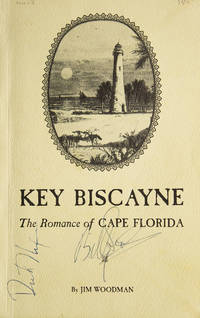
1967251650N.p. 1967. Third printing. 12 66 2 pp. Original printed card covers. Newspaper clippings pasted in. Very good. In a half morocco folder. Third printing. 12 66 2 pp. Souvenir of future President Richard Nixon's luncheon at Key Biscayne Florida signed by Nixon and the Rev. Billy Graham who was a guest at the event. The book also bears a presentation inscription to James Copley and many notes and drawings by a supporter at the event. An interesting and unique piece of Nixon memorabilia. unknown
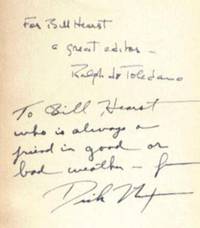
1956007931New York: Henry Holt and Company 1956. First Edition. Hardcover. Spine of book darkened. Very Good in a Near Fine price-clipped dustwrapper. The first study of this complicated man. INSCRIBED and SIGNED by both Toledano and Nixon to editor William Randolph Hearst Jr. son of William Randolph Hearst the newspaper despot and subject of Orson Welles's film CITIZEN KANE. It was Hearst who was largely responsible for the Hollywood image of the hard-drinking cynical reporter always in pursuit of breaking news. The younger Hearst shared the 1956 Pulitzer Prize for international reporting for his interviews with the new Russian leadership and in 1959 he would cover Nixon's visit to the Soviet Union. Nixon's inscription reads: "To Bill Hearst/who is always a/friend in good or/bad weather -- from/Dick Nixon." Over the course of time Nixon's attitude toward journalists became much less friendly. A fine association copy. <br/><br/> Henry Holt and Company hardcover
19836031001983. "RN" with holograph greeting "Dear Paul" in black fountain pen ink on his engraved Richard Nixon 26 Federal Plaza New York City letterhead February 28 1983. 7 1/4" x 10 1/2"; 1 page recto only. Very good. Together with a copy of a column by Patrick Buchanan "Whatever Became of God's Country" To producer Paul W. Keyes Paul W. Keyes Productions Incorporated 135 Screenland Drive Burbank California 91505 Interesting letter with Nixon commenting on Christopher Durany's play "Beyond Therapy" as "viciously obscene and trash.poisonous propaganda." Nixon rates Patrick Buchanan as producing "Some of the best writing on the Washington scene.". Soft cover. Very Good. paperback books