Rogers, William P [Richard Nixon]Biblio.com
4 303 résultats
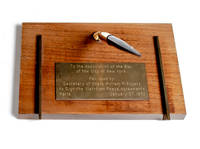
1973145329Paris January 27 1973. The original pen used by Secretary of State William P. Rogers to sign the Vietnam Peace Agreement ending the Vietnam War Paris 27 January 1973. Sheaffer fountain pen with 14 karat gold tip housed in an adjustable gold pen holder wooden base brass hardware including etched plaque. The plaque reads "To the Association of the Bar of the City of New York / Pen used by Secretary of State William P. Rogers to Sign the Viet-Nam Peace Agreements / Paris January 27 1973." During his tenure as Secretary of State under President Nixon William P. Rogers was involved in multiple matters of foreign policy including negotiations leading up to the signing of the Paris Peace Accords in 1973 after years of negotiations and secret talks. On 27 January 1973 representatives of the South Vietnamese communist forces North Vietnam South Vietnam and the United States gathered in Paris to sign the Paris Peace Accords and officially end the United States' involvement in the Vietnam War. The ceasefire took effect the next day on January 28 1973 and the last U.S. troops left Vietnam in March 1973. In very good condition. A unique piece of world history. In 1955 conflict between North and South Vietnam began. Fearing the spread of communism in Southeast Asia the United States entered the war in the early 1960s providing financial aid military advisors and eventually combat troops in support of South Vietnam. As the conflict escalated and anti-war sentiment grew talks about ending United States military intervention began in 1968 proceeding for years until an agreement in 1973. Fighting reignited almost immediately after US departure and continued for two more years before the Fall of Saigon and the end of the war. Eric Caren proprietor of the most significant private collection of historical documents in the United States notes that this item "represented the most tragic element of the 1960s inspiring the collective rebellion on university campuses and the combined rights for women and Blacks that led to the most positive changes in the most interesting decade. There is rare and there is unique this pen is obviously both." unknown
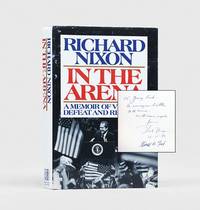
190684New York: Simon and Schuster 1990. Inscribed to the man he made President First edition an unequalled presentation copy inscribed by President Nixon to President Ford: "To Jerry Ford - a courageous battler in the arena - with warm regards from Dick Nixon 11-11-90" and signed by Ford underneath. It is no exaggeration to say that each was the most important man in the other's life - Nixon appointing Ford as Vice President resulted in Ford becoming President and Ford's pardoning of Nixon saved him from an ignominious trial and potential prison term. Their relationship was of profound consequence in American history. Nixon's choice of Vice President following Spiro Agnew's resignation in October 1973 needed confirmation by both Houses of Congress then controlled by Democrats. His need to choose a candidate who could attract bipartisan support resulted in Nixon appointing Ford a moderate Republican and House Minority Leader popular with both Houses and good friends with Nixon. Partly this choice can be attributed to the expectation that Ford would be quickly and decisively confirmed amid the escalating Watergate scandal as indeed happened. Nixon's resignation in August 1974 ensured Ford took the presidency - the only office holder to have not been elected to President or Vice President. It is generally accepted that Ford was unlikely to have otherwise ran for and won a popular presidential election. In the Arena is Nixon's account of his resignation pardon and the aftermath: "the most personal profound and revealing memoir ever written by a major political figure" jacket. Nixon recounts how after resigning the presidency he and his friends were being hounded that he was facing bankruptcy from legal fees if sent to trial and his reputation was trashed. Ford's pardon was his lifeline yet he knew it would hurt Ford politically. Consequently "Next to the resignation accepting the pardon was the most painful decision of my political career" p. 21. Ford's polling plummeted as a result of the pardon and his sacrifice may have cost him the 1976 presidential election. It is surely this to which Nixon refers when he inscribes to Ford as a "courageous battler in the arena". Octavo. Original blue quarter cloth spine lettered in gilt blue paper-covered sides red endpapers. With dust jacket. Housed in a blue quarter morocco box by the Chelsea Bindery. Unclipped jacket a little rubbed at extremities slight paperclip impression to front panel: a fine copy in near-fine jacket. hardcover
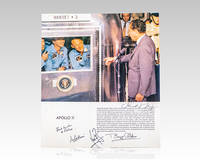
149952Rare Apollo XI quarantine image signed by President Richard Nixon and Apollo XI astronauts Neil Armstrong Buzz Aldrin and Michael Collins. The image shows Apollo XI crew members in quarantine being congratulated by President Nixon through a microphone. The oversized color photograph appears to be a blow-up of a contemporary magazine page complete with printed captions and is mounted on chipboard. Signed by Richard Nixon Neil Armstrong Buzz Aldrin and inscribed by Michael Collins "Best wishes to Felix - M Collins." The caption beneath the image reads: Once inside a special trailer where they began an eighteen-day period of quarantine to preclude contamination of the earth by potential moon germs the astronauts talked and joked by microphone with a jubilant President Nixon who was moved to acclaim their accomplishment as the greatest feat since the creation of the universe. Triple matted and framed. A very uncommon assemblage of signatures. Richard Nixon’s presidency became permanently entwined with Apollo 11 as the mission unfolded in July 1969 as both a scientific triumph and a powerful emblem of American leadership in the Cold War. Nixon followed the flight closely from the White House speaking repeatedly of the astronauts as representatives of the nation and after the lunar landing he placed a live telephone call to Neil Armstrong and Buzz Aldrin on the Moon—an unprecedented gesture he later described as the most historic phone call ever made. When Apollo 11 returned safely to Earth Nixon greeted Armstrong Aldrin and Michael Collins aboard the USS Hornet praising their achievement as a victory for “peaceful purposes†and for all mankind while also underscoring the technological and ideological stakes of the space race. He awarded the astronauts the Presidential Medal of Freedom and sent them on a global goodwill tour that functioned as cultural diplomacy projecting U.S. ingenuity and stability at a moment of domestic strain. In Nixon’s rhetoric and staging Apollo 11 was both a culmination of the Kennedy-era lunar goal and a visible affirmation of American prestige—an event he sought to frame as a unifying national milestone and a benchmark of what the country could accomplish. unknown
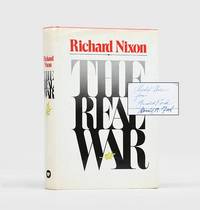
190686New York: Warner Books 1980. From one President to another First edition an unequalled presentation copy inscribed by President Nixon to President Ford: "Richard Nixon for Gerald Ford" and signed by Ford underneath. The relationship of Ford and Nixon was of profound consequence in American history. The pair were friends from early in their political careers. It is no exaggeration to say that each was the most important man in the other's life - Nixon appointing Ford as Vice President resulted in Ford becoming President and Ford's pardoning of Nixon saved him from an ignominious trial and potential prison term. Ford's pardon of Nixon may have ended "the long national nightmare" but also tanked Ford's own popularity and led to his defeat in the 1976 presidential election. In The Real War Nixon makes a case for the US to increase its assertion of power on the world stage both politically and economically especially to curtail the Soviet threat. The book presents Ford's presidency as a successful continuation of Nixon's policies but argues that both presidents were hamstrung by Congress; he argues that the Carter administration had since caused much deterioration in America's position. Nixon has inscribed on a presentation bookplate as standard for presentation copies of this title. Octavo. Original red cloth spine lettered in black and silver. With dust jacket. Housed in a blue quarter morocco box by the Chelsea Bindery. Neat ink shelfmark to front pastedown. Unclipped jacket somewhat soiled and toned with a few nicks to extremities: a fine copy in very good jacket. hardcover
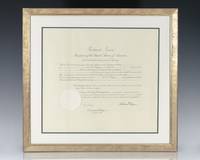
197095202Washington D.C 1970. Rare Richard Nixon Presidential Commission appointing Baseball Hall of Famer Joe DiMaggio as a "Member of the Conference on Physical Fitness and Sports." Dated September 25th 1970 the appointment is signed by President Richard Nixon and Secretary of State William Rogers with the Presidential seal. Double matted and framed. In fine condition. From the personal collection of Joe DiMaggio. Included is letter of provenance from DiMaggio's estate signed by his two granddaughters. An exceptional association linking two American icons. Double matted and framed. President Richard Nixon was an avid baseball fan he attended 11 games while serving in office and in 1985 he arbitrated the dispute between the Major League Baseball owners and umpires over expanded league playoff bonuses. Nixon made headlines when on June 22 1972 a reporter covering the upcoming national election asked the President to name his all-time favorite ballplayers. Nixon's long list of great players inspired the reporter to make a unique request: the first ever presidential All-Star team. With the assistance of his son-in-law David Eisenhower Nixon put together the team and it appeared in national newspapers on June 30 1972. American baseball legend Joe DiMaggio is widely considered one of the greatest baseball players of all time and is best known for his 56-game hitting streak May 15 - July 16 1941 a record that still stands. DiMaggio was one of the first sportsmen recognized in the Presidential Sports Award Program created by Richard Nixon in 1972. unknown books
95202Washington D.C 1970. Rare Richard Nixon Presidential Commission appointing Baseball Hall of Famer Joe DiMaggio as a "Member of the Conference on Physical Fitness and Sports." Dated September 25th 1970 the appointment is signed by President Richard Nixon and Secretary of State William Rogers with the Presidential seal. Double matted and framed. In fine condition. From the personal collection of Joe DiMaggio. Included is letter of provenance from DiMaggio's estate signed by his two granddaughters. An exceptional association linking two American icons. Double matted and framed. President Richard Nixon was an avid baseball fan he attended 11 games while serving in office and in 1985 he arbitrated the dispute between the Major League Baseball owners and umpires over expanded league playoff bonuses. Nixon made headlines when on June 22 1972 a reporter covering the upcoming national election asked the President to name his all-time favorite ballplayers. Nixon's long list of great players inspired the reporter to make a unique request: the first ever presidential All-Star team. With the assistance of his son-in-law David Eisenhower Nixon put together the team and it appeared in national newspapers on June 30 1972. American baseball legend Joe DiMaggio is widely considered one of the greatest baseball players of all time and is best known for his 56-game hitting streak May 15 – July 16 1941 a record that still stands. DiMaggio was one of the first sportsmen recognized in the Presidential Sports Award Program created by Richard Nixon in 1972. unknown
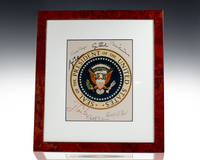
148492Rare photograph of the official seal of the president of the United States signed by seven American presidents. Color glossy photograph of the official seal of the president of the United States covering 40 consecutive years of presidential administrations. Boldly signed by Richard Nixon Gerald R. Ford Jimmy Carter Ronald Reagan George Bush Bill Clinton and George W. Bush. The Clinton and George W. Bush signatures were signed as president during their respective incumbencies. The signatures were all personally obtained by former California congressman James E. Rogan. A sheet to the frame backing lists the locations and dates of each signature: Richard Nixon New York September 15 1989 Gerald R. Ford Los Angeles April 12 1989 Jimmy Carter Plains Georgia July 9 1988 Ronald Reagan Beverly Hills May 28 1989 George Bush Sacramento October 15 1995 Bill Clinton The White House March 16 1997 and George W. Bush The White House March 30 2002. Matted and framed. In fine condition. The entire piece measures 15.25 inches by 17 inches. From the collection of California congressman James E. Rogan. The Seal of the President of the United States serves as a symbol of the executive authority and institutional continuity of the American presidency. Officially adopted in its current form by President Harry S. Truman in 1945 the seal features an American bald eagle clutching an olive branch and arrows signifying the nation's commitment to peace and readiness for defense. The eagle's head faces the olive branch reflecting a preference for diplomacy. Encircled by fifty stars representing the states the seal visually reinforces the president’s role as both a national leader and a representative of the federal union. While its design draws from the Great Seal of the United States the presidential seal has evolved in both form and function appearing on official documents lecterns and the presidential flag thereby reinforcing the ceremonial and symbolic stature of the office. unknown
1969713822/01/1969. <div class=""first""><p><strong><big>I</big>n February 1953 Henry Cabot Lodge was named U.S. Ambassador to the United Nations by President Eisenhower with his office elevated to Cabinet level rank. </strong>The position then was high profile and Lodge often engaged in debates with the UN representatives of the Soviet Union that were broadcast or covered on television. On the front lines in the Cold War in 1959 he escorted Soviet leader Nikita Khrushchev on a highly-publicized tour of the United States. Lodge left the ambassadorship during the election of 1960 to run for Vice President on the Republican ticket headed by Richard Nixon. Nixon selected Lodge because the latter had made a name for himself at the United Nations as a foreign-policy expert.</p><p>President Kennedy appointed Lodge to the position of Ambassador to South Vietnam which showed the import U.S. policymakers were coming to place on that nation. Lodge held the post from 1963 to 1964 and again from 1965 to 1967. As ambassador there Lodge supported President Johnson's decision to escalate American involvement in the Vietnam War believing that a Communist takeover in the South would be disastrous for U.S. foreign policy goals.</p><blockquote><p>The original appointment of <em>“Henry Cabot Lodge of Massachusettsâ€</em>_as <em>“Ambassador to head the United States Delegation at the Paris Meetings on Vietnam.â€</em></p></blockquote></div><p><!--break--></p><p>President Johnson and American military leaders had long insisted that the Vietnam War was going well and that they could see the light at the end of the tunnel. But in the aftermath of the Tet Offensive in February 1968 when the Communists were able to initiate coordinated attacks on all the regional capitals throughout Vietnam even in the American compound in Saigon itself Secretary of Defense Clark Clifford issued a report to the President in mid-March that the United States could not win the war. Johnson was stunned and he in turn stunned a nationwide audience on March 311968 announcing he would cease bombing north of the 20th parallel initiate peace talks to end the war and not seek renomination or reelection in 1968. The peace talks commenced in Paris on May 10 1968 with W. Averill Harriman leading the U.S. delegation.</p><p>From the outset the talks were fraught with difficulties. The U.S. insisted on mutual withdrawal of American and North Vietnamese forces which would leave the Saigon government in control. The North Vietnamese refused to negotiate anything until all bombing of North Vietnam was halted. When the U.S. finally agreed to that condition the Johnson administration was unable to persuade cajole or coerce South Vietnam and its leader President Thieu to participate unless it was recognized as a legitimate party by its foes. It was alleged at the time that both candidates in the 1968 election were using the talks as a political football with Hubert Humphrey seeking to appeal to pro-peace voters by insisting that the South Vietnamese participate and more germanely with Nixon leading the South Vietnamese to understand that his administration would give them a better deal if they would continue to delay. Formal negotiations would not begin until January 18 1969 two days before Nixon took office.</p><p>In the immediate aftermath of the 1968 election it seems that Lodge was Nixon’s foremost advisor on Vietnam. He urged Nixon to appoint a man of stature to negotiate in Paris and warned him away from a trip to Saigon for strategic reasons. Nixon adopted these suggestions. In fact on January 5 1969 fifteen days before his inauguration President-elect Nixon named Lodge himself to succeed Harriman as chief U.S. negotiator at the Paris talks. This signaled that Nixon was likely to take a hard line in the talks considering Lodge’s background as a proponent of American policy in Vietnam as promulgated by President Johnson and his chief military commander Gen. William Westmoreland.</p><p><strong>Document Signed</strong> as President Washington January 22 1969 just two days after his inauguration being the original appointment of <em>“Henry Cabot Lodge of Massachusettsâ€</em>_as <em>“Ambassador to head the United States Delegation at the Paris Meetings on Vietnam.â€</em> The wording here is highly politically indicative showing that Nixon avoided using the terms “peaceâ€_“talks†“negotiations†or “war.†These were simply “Meetings on Vietnam†nothing more to be implied. The document is countersigned by Secretary of State William P. Rogers.</p><p>On January 25 the first fully attended meeting of the formal Paris peace talks was held. Ambassador Lodge urged an immediate restoration of a genuine Demilitarized Zone as the first ""practical move toward peace."" He also suggested a mutual withdrawal of ""external"" military forces and an early release of prisoners of war. Tran Buu Kiem and Xuan Thuy heads of the National Liberation Front and North Vietnamese delegations respectively refused Lodge's proposals and condemned American ""aggression.""</p><p>Meanwhile Henry Kissinger Nixon’s National Security Advisor developed a two-track policy whereunder the Paris negotiators would discuss military matters while the real political decisions would be made privately out of the public eye by the leadership in Washington and Hanoi directly. This would avoid public pressure from all directions while also preventing the junior partners on either side South Vietnam and the National Liberation Front from exercising power to preclude a deal from happening. Nixon liked the idea and determined that political negotiations would emanate from the White House. So as Lodge continued treating with the North Vietnamese in Paris starting in early August Kissinger was secretly meeting with North Vietnam’s Le Duc Tho. As the summer turned to fall however Kissinger’s approaches to Hanoi failed to elicit an acceptable response and Nixon adopted a get tough policy to force an accommodation on his terms. In early October the President told Lodge to break off the talks by staging a walk-out at the October 23 plenary session. On the appointed day Lodge insisted that the talks be adjourned which they were immediately. Lodge himself had not favored this action and he suggested that the President use him as a personal intermediary to Hanoi’s leaders who were frequently in Paris. Nixon declined.</p><p>The only official public negotiations to end the Vietnam War were over never to resume. Nixon went directly to Camp David to work on a foreign policy address to the nation which he delivered on November 3. Dubbed the Silent Majority speech in it he asked the American people to support his decision to continue the war until the North Vietnamese would accept “honorable†peace terms. On November 20 1969 seeing no role remaining for a peace negotiator Lodge resigned. The war did not end until January 23 1973 four years and one day after Nixon had appointed Lodge to help end the conflict.</p> unknown
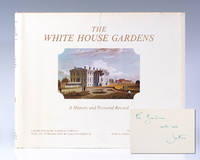
142435New York: Great American Editions 1973. First edition of the first book to trace the history of and fully illustrate the grounds of the White House gardens. Oblong quarto original cloth pictorial endpapers illustrated with color plates by Harold Sterner. Association copy inscribed by Jacqueline Kennedy on the half-title page "For Grandma with love Jackie." The recipient Rose Kennedy was the matriarch of the Kennedy family: the wife of Joseph P. Kennedy Sr. mother of John F. Kennedy and his eight siblings mother-in-law of Jacqueline Kennedy and grandmother of the children of John F. and Jacqueline Kennedy. She was a devout catholic and deeply embedded in the "lace curtain" Irish American community in Boston. After her son John was elected president in 1960 Rose "became a sort of quiet celebrity" and appeared on the International Best Dressed List. Most of her social activities consisted of involvement in charities and women's groups. Here Jackie refers to Rose and 'Grandma' as the book was given on her children's behalf to their grandmother. From the collection of Rose Kennedy. Near fine in a very good dust jacket. An exceptional association. The White House Gardens is the first book that traces both the history of the most famous gardens in the United States from the time of John Adams to the present and gives detailed illustrations on how they are planned and how they appear. Patricia Nixon states in the preface to the work: "This impressive volume is an artistic treasury . a comprehensive reference . a vital document. I invite you to experience the historic traditions which are so much a part of our national heritage." Great American Editions hardcover
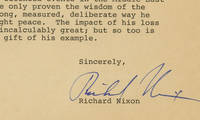
2145512/10/82. <p><strong>Nixon had himself played a key role in aiding the launch of the peace process mediating the Sinai I disengagement agreement between Egypt and Israel in 1974</strong></p><p>Israel and Egypt with its Arab allies had been engaged in hostilities for three decades and this resulted in four wars in twenty four years. The hatreds in the region were fierce and the constant conflicts seemed interminable. The last of these the Yom Kippur War in October 1973 was launched by the Arabs as a surprise and they had initial successes before Israel emerged victorious. Egyptian President Anwar el-Sadat’s own brother was killed in that war. No one foresaw peace as a possibility.</p><p>But President Sadat saw the wars as a disastrous drag on the Egyptian economy and knew that they stood as a barrier to its receiving aid from the United States and many NATO countries. They also tended to throw the Middle East into the arms of the Russians whom Sadat distrusted. Sadat had no intention of allowing Egypt to become a Soviet satellite.</p><p>Despite friction with his Syrian allies Sadat signed the Sinai I 1974 and Sinai II 1975 disengagement agreements with Israel which stated that the conflicts between the countries ""shall not be resolved by military force but by peaceful means†and led to the partial withdrawal of Israeli forces in the Sinai the creation of a U.N. buffer zone in their place and the implementation of multiple U.S. stations in the Sinai. The also secured for Egypt large foreign assistance commitments. The first of these agreements were mediated by President Richard M. Nixon and U.S. Secretary of State Henry Kissinger and the second by President Gerald R. Ford and Kissinger who with thus played key roles in aiding the launch of the peace process.</p><p>Jimmy Carter became President of the United States on January 20 1977. Israeli and Arab resistance was slowing Sadat’s hoped-for progress so on November 9 1977 Sadat made a stunning dramatic gesture one that left the world in shock: He would personally journey to Jerusalem to address the Israeli Knesset parliament to seek a permanent peace settlement between Israel and Egypt! The Israeli government led by Prime Minister Menachem Begin rose to the occasion and ignoring those who saw Sadat’s move as some kind of trick cordially invited him to address the Knesset in a message passed to Sadat via the US ambassador to Egypt. This was something of a surprise as Begin had a reputation as a hard-liner and some expected him to reject Sadat’s overture. On November 19 1977 Sadat arrived for the groundbreaking three-day visit which launched the first peace process between Israel and an Arab state. He met with Begin and spoke before Israel’s parliament as the world looked on in utter disbelief and glued to the television. The astonished approving reaction of ordinary Israelis and Egyptians who watched Sadat and Begin on live television was itself of importance. The sight of the two leaders facing each other in open honest debate changed attitudes at the street levels of both countries. Much of the change came from Sadat's choice of words. “The October War†he said “should be the last war.â€</p><p>The visit was however met with outrage in much of the Arab world. Despite this Sadat continued to pursue peace with Israel. However a reciprocal visit by Begin was unsuccessful and no progress was made toward peace. Then Rosalynn Carter the U.S. first lady suggested to her husband President Carter that he invite Sadat and Begin to Camp David where the relative privacy and seclusion might provide a setting for a breakthrough.</p><p>Both Sadat and Begin trusted the United States to be an honest broker and the two leaders accepted Carter’s invitation. The summit began on September 5 1978 and lasted for 13 days. Carter preferred that the three men work together in private sessions in a small office at Aspen his cabin at Camp David. Carter compiled a document that encompassed a resolution of the major issues presented the proposals to each leader in separate meetings assessed their comments and redrafted the manuscript some two dozen times shuttling the manuscript back and forth for their review. The Camp David Accords signed on September 17 were the first peace agreement between the state of Israel and one of its Arab neighbors and laid the groundwork for diplomatic and commercial relations.</p><p>In a ceremony at the White House on March 26 1979 Sadat and Begin signed the historic peace treaty; it was considered the diplomatic triumph of the the era. President Carter oversaw the signing and untold millions watched on television. The peace treaty formally ended the state of war that had existed between the two countries. Israel agreed to fully withdraw from Sinai and Egypt promised to establish normal diplomatic relations between the two countries and open the Suez Canal to Israeli ships which until then had been banned from the waterway. These provisions were duly carried out. Sadat was vilified for this in many Arab quarters and Egypt was expelled from the Arab League but Sadat was determined to end hostilities and move into a better future. He was well aware that his courage might well cost him his life as he received death threats and some predicted his assassination.</p><p>For their achievement Sadat and Begin were jointly awarded the 1978 Nobel Prize for Peace. Then on October 6 1981 extremists assassinated Sadat in Cairo. He is widely recognized today as a martyr to peace and when we hear the phrase “blessed are the peacemakers†his image immediately springs to mind. Despite the tragedy the peace process continued without Sadat and in 1982 Egypt formally established diplomatic relations with Israel. This led to among many other benefits increased tourism in the region.</p><p>Nixon who with Kissinger got this process going wrote this letter to Mrs. Sadat saying her husband is immortal. <strong>Typed letter signed</strong> on Nixon’s letterhead October 12 1982 with salutation in his hand to Sadat’s widow Jihan el-Sadat on the occasion of the honoring of President Sadat by the American Society of Travel Agents as Sadat’s efforts for peace did so much for tourism the region. He was to be awarded its 1st International Peace and Tourism Award. “I am honored to join in this tribute to Egypt’s great President and also to you his great First Lady.</p><p>“Men are mortal but the spirit of a man of peace is immortal because it lives on in the millions he has inspired. President Sadat was such a man. In the year since his voice was silenced events in the Middle East have only proven the wisdom of the strong measured deliberate way he sought peace. The impact of his loss is incalculably great; but so too is the gift of his example.â€</p><p>Donald Reynolds was executive director of the American Tourism Society later the American Society of Travel Agents. Under his leadership ATSA facilitated travel to Russia and the newly independent republics of the USSR and later expanded its outreach to the Middle East. His efforts in Egypt brought him in contact with Mrs. Sadat and they became friends. She gave this letter to him and we obtained it from his heirs. It has never before been offered for sale.</p> unknown
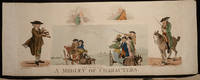
05543London: William Holland 1797. A Medley of Characters<br /> A Wonderful 'Frieze' by John Colley Nixon<br /> <br /> NIXON John Colley A Medley of Characters. Drawn by J. Nixon engraved by Ziegler. London: William Holland 31 January 1797.<br /> <br /> Oblong quarto 28 1/2 x 10 7/8 inches; 276 x 723 mm. Large landscape hand-colored aquatint engraving on four sheets. Total size 10 3/4 x 114 inches; 277 x 2892 mm. <br /> <br /> Four numbered sheets all with "Drawn by J. Nixon Esq.r' / A Medley of Characters / Engraved by Ziegler / London Pub. by Willm. Holland Cockspur Street". Small closed tear to blank margin of first plate not affecting image; neatly repaired 3 1/8 inch tear to lower right hand edge just touching image otherwise an excellent complete suite of this exceptionally rare panorama showing John Nixon's gentle satire. Chemised in a quarter black morocco clamshell case measuring 12 x 30 inches; 305 x 762 mm. spine with five raised bands ruled and lettered in gilt in compartments.<br /> <br /> This panorama works as a kind of frieze showing fifty-six characters including "A Whip Seller in Belfast"; "Ascot Heath Races"; "Enfield Races"; "An Irishman coming from Market"; "At a sale of Pictures" and "At a Concert".<br /> <br /> This is a rare survival of such material particularly given that the large landscape format would not have lent it readily to being stored in an album or chest options for smaller varieties of popular prints but instead to immediate display. The form was an innovation by Henry Bunbury whose landscape satire Long Minuet of 1787 proved very popular; this print is one of several which derives directly from it. Bunbury himself must have thought the print significant since he is pictured completing it in his portrait by Lawrence.<br /> <br /> Although the prints may date to around 1797 as suggested by William A. Gordon in his British Caricature no. BC-3 his example gives the place of publication as Oxford Street - our example with the place as Cockspur street most likely dates to around 1802 when Holland is documented as being at Cockspur street.<br /> <br /> OCLC & KVK locate no examples in libraries and institutions worldwide.<br /> <br /> Plate 1. "A Stick & Whip Seller in Belfast/Ascot Heath Races June 1791/Enfield Races Aug. 1791" 5 images 10 figures<br /> Plate 2. " 10 images 25 figures<br /> Plate 3. "An Irishman coming from Market" 9 images 11 figures<br /> Plate 4. " At a sale of Pictures / At a Concert" 9 images 10 figures<br /> <br /> John Colley Nixon ca. 1750 - 1818. "Nixon was a wealthy amateur caricaturist who flourished in the 1780s and 1790s. He was a close friend of Thomas Rowlandson and regularly socialized with his circle including Henry Angelo the actor Jack bannister JohnWolcot Peter Pindar and the well-known art collector Matthew Mitchell." He signed himself 'Esq.r' signaling his claim to middle-class gentility. He was a merchant of successful Irish mercantile stock yet with strong links to artistic and fashionable circles. His brothers Robert and James also dabbled in art and he exhibited at the Royal Academy between 1781-1813. His friends included the topographer and satirist Captain Francis Grose who accompanied him on one of the frequent trips to Ireland in which he combined business and the pleasures of sketching as he traveled. Like Grose he turned his hand also to a variety of genres illustrating Sterne's Tristram Shandy and turning particularly to topography informed by extensive travels in Britain and on the Continent. His work features in the series Seats of the Nobility and Gentry and he illustrated travel books such as Thomas Pennant's Journey from London to the Isle of Wight. He developed strong ties with that island and would eventually die in Ryde. <br /> <br /> William Holland fl. c. 1759-1815 published many of Nixon's satirical prints. Like other publishers such as Boydell Holland publicized his wares by mounting them as a kind of exhibition at his premises. Though this is a very innocent print Holland was not averse to taking risks: he was briefly imprisoned in 1793 for publishing a pamphlet by Thomas Paine and it has been suggested that he also published under the pseudonyms Paddy Whack and Jacob Douce.<br /> <br /> Gordon. British Caricature BC-3. Oxford Street 1797. London: William Holland, 1797 unknown
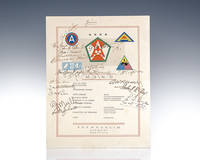
1945148763Germany: Bad Nauheim November 11 1945. Rare original dinner menu from George S. Patton's 60th birthday celebration at the Spa Hotel in Bad Nauheim Germany on November 11 1945. Octavo featuring colorful hand-decorated double ruled borders four-star rank and unit insignia designs. Boldly signed under the four-star rank insignia by Patton "G. S. Patton Jr." Additionally signed by eighteen attendees including: Robert B. Patterson recently elevated to Secretary of War; Hobart R. Gay Patton's Chief-of Staff; Paul D. Harkins deputy Chief-of-Staff and later Vietnam-era commander; Geoffrey Keyes; and Thomas H. Nixon. In near fine condition. General George S. Patton’s 60th birthday celebration was a day-long event that served both as a reunion with fellow veterans of the Third and Seventh Armies and as a farewell before his planned departure for the United States on December 10 1945. The occasion offered a brief moment of joy amid the turbulence of Patton’s final months. In September just weeks earlier he had been relieved of his positions as commander of the Third Army and military governor of Bavaria by General Eisenhower following controversial remarks in which he compared former Nazi Party members to Democrats and Republicans in the U.S. Reassigned to lead the Fifteenth Army a unit tasked with compiling the official history of the war Patton found little satisfaction in the new role. He disagreed with American denazification efforts and believed U.S. forces should remain strong in Europe to counter any future threat from the Soviet Union. With no reassignment to the Pacific forthcoming Patton hoped simply to return home—a journey he would never complete. On December 9 a truck collided with his jeep resulting in a broken neck and paralysis; he died in a hospital in Heidelberg on December 21 1945. Bad Nauheim unknown
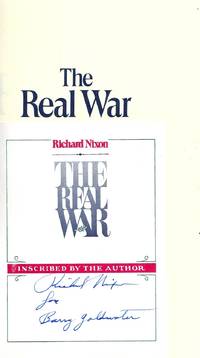
1980019025New York: Warner Books 1980. First Edition. Hardcover. Near Fine in a Very Good dustwrapper with a closed tear and crease at the rear. INSCRIBED and SIGNED by Nixon as usual for this book on a tipped-in publisher's bookplate. This copy however is INSCRIBED to Barry Goldwater. <br/><br/>Barry Goldwater a five-term United States Senator from Arizona 1953-1965 1969-1987 and the Republican Party's nominee for President in the 1964 election is the politician most often credited for sparking the resurgence of the American conservative political movement in the 1960s. His landslide defeat to Lyndon Johnson which also brought down many other Republican candidates opened the door for Johnson and a Congress dominated by Democrats to pass the Great Society programs. Goldwater returned to the Senate in 1969 but his role as a leader of the conservative movement had been transferred to Ronald Reagan. In 1974 Goldwater successfully urged President Richard Nixon whom he called "the most dishonest individual I have ever met in my life" to resign at the height of the Watergate scandal. Goldwater retired in 1987 and was succeeded in office by John McCain. Acquired from the Goldwater family. Warner Books hardcover
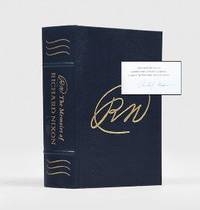
190685Norwalk Connecticut Easton Press 1988. The 38th President's copy of the 37th President's memoirs First Easton Press edition signed as issued with a superb provenance: the copy of Nixon's successor as President Gerald Ford with his bookplate on the front pastedown. It is no exaggeration to say that each was the most important man in the other's life - Nixon appointing Ford as Vice President resulted in Ford becoming President and Ford's pardoning of Nixon saved him from an ignominious trial and potential prison term. Their relationship was of profound consequence in American history. Nixon's memoirs charts his life from his childhood to his leaving the White House and defends his presidency and his actions in Watergate. Ford plays a central role throughout the book. The pair were friends from early in their political careers. This combined with Ford's bipartisan support in Congress led to Nixon choosing him as Vice President and consequently placing him in the White House upon his resignation. Ford's pardon of Nixon may have ended "the long national nightmare" but also tanked Ford's own popularity and led to his defeat in the 1976 presidential election. Repeatedly in his memoirs Nixon commends Ford's loyalty character and ability. Octavo. Original blue bonded leather spine lettered in gilt patterned endpapers gilt edges. Housed in a blue quarter morocco box by the Chelsea Bindery. Two publisher's prospectuses loosely inserted. Slight rubbing to spine else a fine copy. hardcover
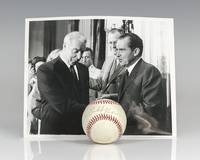
95226Rawlings Official Ball National League. Rare baseball signed by President Richard Nixon on the sweetspot. From the personal collection of Baseball Hall of Famer Joe DiMaggio. Accompanied by an original black and white photograph of DiMaggio and Nixon shaking hands in the White House also from DiMaggio's personal collection. In near fine condition. Included is letter of provenance from DiMaggio's estate signed by his two granddaughters. An exceptional association linking two American icons. President Richard Nixon was an avid baseball fan he attended 11 games while serving in office and in 1985 he arbitrated the dispute between the Major League Baseball owners and umpires over expanded league playoff bonuses. Nixon made headlines when on June 22 1972 a reporter covering the upcoming national election asked the President to name his all-time favorite ballplayers. Nixon's long list of great players inspired the reporter to make a unique request: the first ever presidential All-Star team. With the assistance of his son-in-law David Eisenhower Nixon put together the team and it appeared in national newspapers on June 30 1972. American baseball legend Joe DiMaggio is widely considered one of the greatest baseball players of all time and is best known for his 56-game hitting streak May 15 - July 16 1941 a record that still stands. DiMaggio was one of the first sportsmen recognized in the Presidential Sports Award Program created by Richard Nixon in 1972. Rawlings Official Ball National League unknown books
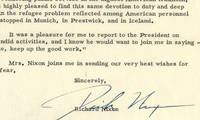
88223/1/57. <p>On October 23 1956 a student demonstration against the Soviet-dominated regime in Hungary became the first serious challenge to Communist authority since the Soviet Union drove the Nazis out and occupied Eastern Europe at the end of World War II. The demonstrators marched to the Parliament building in Budapest where Hungarian State Security Police detained a group of them who attempted to enter the radio building to broadcast the students_ demands. The police then fired on a group of demonstrators who demanded their release and killed a student. When demonstrators wrapped the body in a flag and paraded it in central Budapest violence erupted and news of the event provoked unrest throughout the country. The pro-Soviet government collapsed and a new government disbanded the State Security Police and announced its intention to withdraw from the Soviet-run Warsaw Pact and to hold free elections.</p><p style=""background-color: #222; background-image: url'/sites/default/themes/rcollection/images/main-title-bg-top.png'url'/sites/default/themes/rcollection/images/main-title-bg-bottom.png'; background-repeat: no-repeat; background-position: center 10%center 90%; background-size: 95%; padding: 60px 40px; font-family: palatino; font-style: italic; width: 560px; text-align: center; margin: 0 auto 20px; color: rgba2051941671;"">The Hungarian Revolt was one of the crucial events of the Cold War</p><p>On October 31 the Moscow newspaper “Pravda†stated that the Soviet government was “prepared to enter into the appropriate negotiations with the government of the Hungarian People’s Republic and other members of the Warsaw Treaty on the question of the presence of Soviet troops on the territory of Hungary.â€Â That same day though unwilling to appear weak to the United States Soviet leaders reversed course and decided to take military action to crush the rebellion. In the early morning hours of November 4 Soviet troops invaded Hungary. The free Hungarian government fled and by November 7 the Soviets installed János Kádár as the new Prime Minister. In six days the Soviet military completely crushed the revolution. More than 2500 Hungarians and 700 Soviet soldiers were killed. By January the new Soviet puppet government had suppressed the opposition. However meanwhile large numbers of Hungarians were fleeing the country mostly headed for Austria.</p><p>This unfolding drama received hour-by-hour press coverage throughout the world with film footage appearing every evening on the news in the U.S. and elsewhere. The invasion with its graphic depiction of Soviet tanks on the city streets in Hungary clashing with demonstrators destroyed the Soviet argument that Eastern Europe was voluntarily within the Soviet sphere. It also confirmed to those in the West that there was a real Cold War at hand and that the Soviets were the aggressors as they could only hold their people by force. Strong anti-Communists like Richard M. Nixon then Vice President in the Eisenhower Administration seemed confirmed in their judgments.</p><p>By the time Hungary’s borders were sealed 200000 refugees had fled the country. Of those approximately 180000 went to Austria and another 20000 went to Yugoslavia. The refugees needed care and resettlement and this required a massive effort led by the office of the United Nations High Commissioner for Refugees. 37 nations on five continents accepted refugees with the plurality - 40000 - going to the United States. Llewellyn E. Thompson was U.S. Ambassador to Austria so to him fell the main responsibility for managing the American effort to care for them and arrange their resettlement.</p><p>Lewellyn Thompson was one of the most important American diplomats of the 20th Century. After two years at his post in Vienna he would become the United States Ambassador to the Soviet Union at the height of the Cold War serving two separate tours in the administrations of Presidents Dwight D. Eisenhower John F. Kennedy and Lyndon B. Johnson and then acting as advisor to Richard M. Nixon. Few Ambassadors faced as many crises as Thompson did in Moscow - the shooting down of a U.S. U-2 reconnaissance aircraft over Russia the great confrontation between the U.S. and Soviet Union over Berlin and the building of the Berlin Wall very difficult summits between Soviet Premier Khruschev and Presidents Eisenhower and Kennedy the August 1968 Soviet invasion of Czechoslovakia and tensions over the Vietnam War. But there were also steps toward better relations. At Thompson's suggestion Nikita Khrushchev became the first Soviet leader to visit the U.S. in 1959. Thompson helped arrange and was present for the 1967 summit in the U.S. between President Johnson and Premier Alexei Kosygin in Glassboro New Jersey after the Six-Day War in the Middle East exacerbated tensions. Also in 1967 the Soviet Union and U.S. agreed to begin cooperation in space with the joint Soyuz-Apollo program. The first treaty on Non-Proliferation of Nuclear Weapons was signed on July 1 1968.</p><p>Thompson’s stint as Ambassador to the Soviet Union began in 1957 when President Eisenhower appointed him to the post. President Kennedy reappointed him in 1961 which was a tribute to Thompson as new presidents usually name their people to the top diplomatic posts. He ended his first tour in Moscow in 1962 when President Kennedy brought him home to Washington to become his Ambassador-at-Large as a member of the Executive Committee of the National Security Council advising the President on Soviet affairs. Shortly after returning to Washington Thompson provided President Kennedy with advice that was crucial to avoiding nuclear war during the Cuban Missile Crisis. President Johnson reappointed him to the ambassadorship to Moscow in 1967 and he served until 1969. He came out of retirement to advise President Nixon on the Strategic Arms Limitation Treaty SALT negotiations with the Soviet Union and represented the United States in the SALT talks from 1969 until his death in 1972. He thus was able to provide valuable insight into Soviet thought to four American presidents. Secretary of State William P. Rogers called him “one of the outstanding diplomats of his generation.â€</p><p>From December 18-24 1956 Nixon traveled to Austria to get first hand accounts from Hungarian refugees and inspect their conditions and aid requirements. Thompson aided him during that trip and Nixon was grateful.</p><p style=""background-color: #222; background-image: url'/sites/default/themes/rcollection/images/main-title-bg-top.png'url'/sites/default/themes/rcollection/images/main-title-bg-bottom.png'; background-repeat: no-repeat; background-position: center 10%center 90%; background-size: 95%; padding: 60px 40px; font-family: palatino; font-style: italic; text-align: center; margin: 0 auto 20px; width: 560px; color: rgba2051941671;"">“You can be proud of the magnificent job being done under your able direction to discharge American responsibility in meeting the needs of the Hungarian refugees in Austria.""</p><p><strong>Typed Letter Signed</strong> on Office of the Vice President letthead Washington January 3 1957 to Thompson.</p><p><em>“This is just a note to tell you how deeply I appreciated the generous hospitality which you and Mrs. Thompson extended to me and the members of my party during my recent visit to Austria. Due to your efforts and those of your staff I was able to accomplish my inspection mission in a limited period of time and I am grateful for the many courtesies which were extended to me.</em></p><p>“You can be proud of the magnificent job being done under your able direction to discharge American responsibility in meeting the needs of the Hungarian refugees in Austria. This compliment is meant for you and your permanent staff of all nationalities and agencies as well as those who have come from other countries on short notice to meet the need for additional help the wives and families who have been working long hours as volunteers to relieve hardship and the hundreds of American and international relief agency workers. All of you have shown a wonderful spirit of dedication in rendering public service in the highest American tradition and I was highly pleased to find this same devotion to duty and deep interest in the refugee problem reflected among American personnel when we stopped in Munich in Prestwick and in Iceland.</p><p>“It was a pleasure for me to report to the President on your splendid activities and I know he would want to join me in saying – “well done keep up the good work.â€</p><p><em>""Mrs. Nixon joins me in sending our very best wishes for the New Year.â€</em> The accompanying envelope which is still present bears Nixon_s printed free frank. It was not mailed and therefore evidently was delivered by diplomatic pouch.</p><p>This letter comes directly from the Thompson descendants.</p> unknown
196025343E1960. Original Autograph Letter Signed by former U.S. President Harry S. Truman to Dean Acheson who served as his Secretary of State from 1949 to 1953 regarding the 1960 presidential election between John F. Kennedy and Richard M. Nixon. With an Autograph Letter from Dean Acheson to Harry S. Truman. Both letters are written and dated before the 1960 Democratic National Convention and concern how how to handle the press. The first is a 4 page letter from Dean Acheson to Truman handwritten on yellow legal paper 8 inches by 12 5/8 inches double-spaced single-side only dated June 28 1960. In the letter Acheson who was arguably Truman’s greatest admirer and devoted friend writes to clarify for Truman the positive benefit to the party and the nation in favoring Kennedy over the other likely contenders including California Governor Pat Brown former Illinois Governor Adlai Stevenson Senator Hubert Humphrey of Minnesota and Senator Lyndon B. Johnson of Texas. He begins: “Dear Boss As the Convention approaches we partisans are likely to become shall we say emphatic in our statements to the press. Could we make a treaty on what we shall not sayâ€. In his conclusion he writes “We have got to beat Nixon. We shall probably have to do it with Kennedy.†On July 2 1960 a week before Truman’s written reply he spoke at a dramatic televised press conference at the Truman library during which he lashed out at Kennedy citing his relative inexperience specifically doing exactly what Acheson had urged him never to do. After the press conference on a 2 page letter dated July 9 1960 written on his imprinted personal stationery Truman writes in part to Acheson: “Dear Dean:- You’ll never know how very much I appreciated your call and good letter. I tried my best to profit by both. Whether I did or not is up to you to decide. Anyway it looks as if things have to some extent slowed down and the band wagon isn’t running so fast. I’ve never been so wrought up and if you and the ‘Madam’ - the ‘Boss’ had not put the brakes on I’d have blown my top - maybe!†The letter closes with “Again thanks to a real friend and a real standby. My best to Alice Sincerely Harryâ€. In response to Truman’s criticism Kennedy responded noting that if fourteen years in major elective office was insufficient experience then that would have ruled out all but a handful of presidents including Wilson Roosevelt and Truman himself. In the end Truman opted to support Kennedy and his running mate Lyndon B. Johnson campaigning for them across nine states making thirteen speeches. These letters make a remarkable association referencing an historic moment in American presidential history. unknown
5478Large color photograph of Presidents Ronald Reagan Gerald Ford Jimmy Carter and Richard Nixon. Signed and dated by each President below their likeness. The photograph measures 16 inches by 20 inches. Matted and framed. The entire piece measures 22 inches by 27 inches. Uncommon in such a large format. unknown books
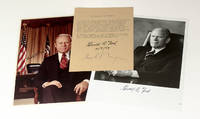
134249Typescript reproduction of the final paragraphs of Ford's 1974 Proclamation of Pardon granting a full and unconditional pardon to Richard Nixon his predecessor for any crimes that he might have committed against the United States as president. One page typescript. Signed and dated by Gerald Ford "Gerald Ford 11/5/79" and Richard Nixon. Accompanied by two glossy photographs signed by Ford. In fine condition. The signed pardon measures 7.5 by 5.5 inches. The photographs measure 8 inches by 10 inches. Exceptionally rare. Gerald Ford issued Proclamation 4311 on September 8 1974 granting a full and unconditional pardon to Richard Nixon his predecessor for any crimes that he might have committed against the United States as president. In particular the pardon covered Nixon's actions during the Watergate scandal. In a televised broadcast to the nation Ford who had succeeded to the presidency upon Nixon's resignation explained that he felt the pardon was in the best interests of the country and that the Nixon family's situation was "a tragedy in which we all have played a part. It could go on and on and on or someone must write the end to it. I have concluded that only I can do that and if I can I must." unknown
1959884698Washington D.C. 1959. To columnist and television reporter of Meet the Press Lawrence E. Spivak on Vice Presidential stationery with a 5 page memo carbon unsigned describing his recent meeting with Fidel Castro. Nixon admires Castro's charisma and bravery here in this memorandum summarizing his discussion with the Cuban leader on April 19 1959. Nixon characterizes him as having" those indefinable qualities which make him a leader of men." But there was also much that disturbed him. Everything that Castro was doing from suspending elections to the executions of political opponents he justified as carrying out "the will of the people." Nixon says: "this almost slavish subservience to prevailing majority opinion - the voice of the mob - rather than his naive attitude toward Communism and his obvious lack of understanding of even the most elementary economic principles which concerned me most in evaluating what kind of a leader he might eventually turn out to be." In his conclusion Nixon says that because Castro has "the power to lead.we have no choice but at least to try to orient him in the right direction." Together 6 pages attached memo on carbons with some small glue remnant on the lower left corners fifth page of memo laid down with some glue residue showing. An historically important set of documents. 4to. unknown
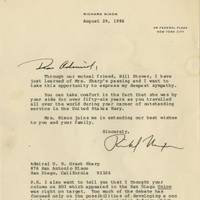
1986941029/08/1986. <blockquote><p>""Too much of the debate has focused only on the possibilities of developing a one hundred percent leak-proof population defense which even the strongest proponents agree could not be developed until next century.""</p></blockquote><p>President Nixon made his mark in the area of foreign policy. Although he had made his own career as a militant opponent of Communism Nixon saw opportunities to reduce the temperature of the Cold War by improving relations with the Soviet Union.</p><p>One of these was the Strategic Arms Limitation Talks negotiations which were a series of meetings beginning in Helsinki that lasted from November 17 1969 until May 1972. After a long deadlock the first results of SALT I came in May 1971 when an agreement was reached over anti-ballistic missiles systems. Further discussion brought the negotiations to an end in Moscow on May 26 1972 when Richard Nixon and Leonid Brezhnev signed both the Anti-Ballistic Missile Treaty and the Interim Agreement Between The United States of America and The Union of Soviet Socialist Republics on Certain Measures With Respect to the Limitation of Strategic Offensive Arms. These served to slow the growth in nuclear weapons and halt extensive proliferation.</p><p>A premise of the Cold War mutually assured destruction meant simply that neither the US nor the USSR would attack the other because it would ensure that both would be obliterated. You could get the first shot in but unless you wiped out the entire capacity of the other side in one blow you would ensure your own demise. In 1969 Nixon announced an anti-ballistic missile defense system called Safeguard which aimed to protect the deterrent nuclear force of the United States its missile fields to maintain that deterrent capacity. This happened at the same time as the country was publicly debating the possibility of protecting entire US cities in a shield the technology of which did not exist. Safeguard never fully operated at its intended capacity and in fact was shut down soon after it launched.</p><p>Ronald Reagan was not an active proponent of mutually assured destruction MAD. In 1983 he proposed the Strategic Defense Initiative SDI to use ground-based and space-based systems to protect the United States from attack by ballistic strategic nuclear weapons. The initiative focused on strategic defense rather than the prior strategic offense doctrine of MAD. It was dubbed ""Star Wars"" by critics. The goal was to neutralize the Soviets' nuclear capacity regardless of the success of ongoing negotiations. The Soviets strongly opposed the Strategic Defense Initiative as they could not afford to match the U.S. in this area and they felt that if successful the concept of mutually assured destruction would be lost and the U.S. would be in a dominant position.</p><p>In November of 1985 Gorbachev and Reagan were to meet in Geneva for a major summit. Both the Soviet Union and the United States were seeking to cut the number of nuclear weapons with the Soviets seeking to halve the number of nuclear-equipped bombers and missiles and the U.S. desiring to ensure that neither side gained a first-strike advantage and to protect rights to the Strategic Defense Initiative. These ideas of arms limitations and strategic defense were the cornerstones to the Cold War negotiations between the two global powers in a bi-polar world.</p><p>One of those who joined the debate was U.S. Grant Sharp a 4-star admiral who was Commander in Chief of the US Pacific Fleet and of US Pacific Command including during the Gulf of Tonkin Incident. He wrote a piece in the San Diego papers which advocated the protection of US-based counter-force assets which touched on a subject central to Nixon's presidency and close to his heart missiles that would serve as a first-strike deterrent.</p><p><strong>Typed letter signed</strong> August 29 1986 New York City to Admiral U.S. Grant Sharp. <em>""Through our mutual friend Bill Stover I have just learned of Mrs. Sharp's passing and I want to take this opportunity to express my deepest sympathy. You can take comfort in the fact that she was by your side for over fifty-six years as you traveled all over the world during your career of outstanding service in the United States Navy. Mrs. Nixon joins me in extending our best wishes to you and your family. Sincerely Richard Nixon.</em></p><p>""P.S. I also want to you that I thought your column on SDI which appeared in the San Diego Union was right on target. Too much of the debate has focused only on the possibilities of developing a one hundred percent leak-proof population defense which even the strongest proponents agree could not be developed until next century. On the other hand a defense of our counter-force missile silos which presently are vulnerable to a first strike from Soviet Union's SS-18s could be deployed in the near future. Unless the Soviet Union agrees to offensive cuts which would remove its first-strike capability we have no choice but to go forward with an SDI program which would deny them that capacity.""</p> unknown
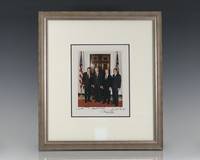
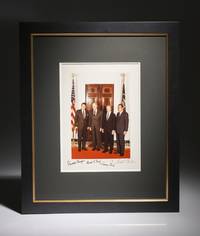
95277Color photograph of Presidents Ronald Reagan Gerald Ford Jimmy Carter and Richard Nixon. Signed by each President below their likeness. A striking image with the Presidents flanked by an American flag on either side. Matted and framed. The entire piece measures 19 inches by 17 inches. In 1973 President Richard Nixon appointed Gerald Ford to replace Spiro Agnew who resigned his position as vice president before pleading no contest to charges of bribery and tax evasion. The following year the former House minority leader became the 38th U.S. president succeeding Nixon who faced impeachment proceedings for his involvement in the Watergate scandal. Jimmy Carter succeeded Ford as the 48th President of the United States on January 20 1977 and was in turn succeeded by Ronald Reagan on January 20th 1981. unknown books
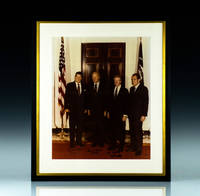
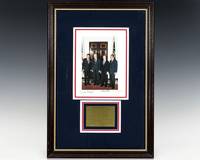
19811882Washington DC: The White House 1981. Framed. Fine. White House Photograph signed by President Ronald Reagan Jimmy Carter Gerald Ford and Richard Nixon. With the assassination of Egyptian President Anwar Sadat there was concern that sending a sitting United States President would be too dangerous. Protocol demanded that a high level delegation from the United States was needed for the trip but sending less senior officials would be viewed as a lack of engagement by the United States. Secretary of State Alexander Haig suggested that the 3 former living Presidents attend which all three accepted. With Richard Nixon in political exile since Watergate President Carter having just lost an election and President Ford getting pressure from his family to avoid dangerous situations all three had their reasons not to attend. This trip also marked a thawing in relations between the living former presidents with President Carter and President Ford striking up a lifelong friendship afterwards. This photograph marked the first time that 4 sitting Presidents had joined together at the White House. Photograph signed by President Ronald Reagan along with former presidents Jimmy Carter Gerald R. Ford and Richard Nixon. Framed in contemporary black frame gold edge museum archival glass. A fine signed copy. Provenance: From the office of Katherine Shepherd White House Correspondence office staff. Known as "Charley" Ms. Shepherd had a long career in Washington DC from Capitol Hill to the White House. In the 1980s she worked in the White House Correspondence office and was tasked outreach for President Reagan to constituents in his native Illinois and California. The White House unknown books
57002Color photograph of Presidents Ronald Reagan Gerald Ford Jimmy Carter and Richard Nixon. This photograph was taken of President Ronald Reagan with Gerald Ford Richard Nixon and Jimmy Carter before they left to attend the funeral of President Anwar El- Sadat of Egypt who was assassinated October 6 1981. Countersigned by Gerald Ford James Carter and Richard Nixon as President Reagan's representatives for the funeral. A striking image with the Presidents flanked by an American flag on either side. Triple matted and framed. The photograph measures 7.5 inches by 10 inches. The entire piece measures 15 inches by 22 inches. A very attractive piece rare and desirable signed by all four Presidents. unknown books
1378New York: Arbor House 1985. First Edition First Printing. Hardcover. Near Fine/Near Fine. 5 3/4 X 8 1/2 Inches. 240 PP. Signed and inscribed to General "Jimmy" Doolittle by President Richard Nixon directly on the half title-page. Signed "To General James Doolittle with appreciation for his years of dedicated service to the nation - far beyond the call of duty Love Richard Nixon 4-11-85." First printing copy with full and complete numberline to the "1" on the copyright page. Original price of $14.95 intact on front flap of DJ. <br /> <br /> General James "Jimmy" Doolittle was a career officer in the US Air Corps and Air Force. His service to the country began as a flight and gunnery instructor during WWI and continued through the WWII years. He is most widely recognized as the leader and namesake of the famous "Doolittle Raiders" of 1942. This raid of 16 B-25 bombers was the first air attack on the Japanese after the bombing of Pearl Harbor in late 1941. Doolittle was the recipient of the Congressional Medal of Honor and the Presidential Medal of Freedom among many other accolades. His is one of the most widely recognized names in United States military history.<br /> <br /> An association copy of this magnitude is a true rarity. Arbor House hardcover