45 067 résultats
163846402371Paris, Au Bureau d’Adresse, rue de la Calandre au grand Coq., 1638-41 ; 4 volumes, veau fauve marbré, encadrement de doubles filets dorés, dos ornés. (Reliures de l’époque) I) Titre, 1 f. blanc, 2 ff. n. ch. (avis au lecteur et table), 408 pp. (conférences 1 à 50.)II) Titre (daté 1654), 4 ff. n. ch. (dédicace et table), 420 pp. (conférences 51 à 100.)III) Titre (daté de 1654), 2 ff. de table, pp. 9 à 524 (conférences chiffrées 101 à 185, plusieurs renfermant 2 conférences par numéro.)IV) Quatrième centurie... titre (daté 1641), 1 f. blanc, 2 ff. de table, 460 pp. (100 conférences chiffrées 186 à 295.) Rarissime publication donnée par Théophraste et Eusèbe Renaudot. Il s’agit, dit E. Hatin dans Th. Renaudot et ses “innocentes inventions” p. 137 de NOTRE PREMIER RECUEIL SCIENTIFIQUE.Dès 1633, Renaudot tenait à son Bureau d’adresse une “académie ouverte à tous les bons esprits, qui venaient conférer en public de toutes les plus belles manières de physique, de morale, mathématiques et autres disciplines, et laquelle était une des plus belles et plus utiles institutions qu’eût faites Renaudot au jugement même de plusieurs de ses ennemis.” Les comptes-rendus de cette académie suivent de près la célèbre Gazette et les Petites Affiches, débuts du journalisme en France. Le goût des réunions littéraires était alors fort répandu. On se réunissait chez Melle de Gournay, Balzac et Ménage pour parler de langue et de littérature. Renaudot, le premier, organisa des conférences scientifiques tous les lundis de 2 à 4 heures. Le programme était donné à l’avance et le compte rendu était publié en livraisons. Les sujets étaient variés. Pour n’en citer que quelques uns : la matière première, le mouvement perpétuel, le feu, l’air, l’eau, deux frères monstrueux dans un même corps, petite fille velue, les 3 soleils, les mélancoliques sont-ils les plus ingénieux ou prudents ?, du siège de la folie, l’homme est-il plus enclin à l’amour que la femme ?, l’écho, l’origine des vents, le flux et reflux de la mer, astrologie judiciaire, le cocuage, embaumements, somnambulisme, cabbale, comètes, pierre philosophale, du vide, si les couleurs sont réelles, le sommeil, la goutte, les fards, le tabac, la rosée, remèdes chimiques, talismans, volcans, eaux minérales, mal de mer, incubes et succubes, origine des pierres précieuses, métempsychose, noblesse commerçante, truffes et champignons, si la musique fait plus de bien que de mal, sterilité, ivrognerie, hiéroglyphes, feux follets, hermaphrodites, nègres, licornes, plantes sensitives, mandragore, etc.Physique, chimie, ésotérisme, philosophie, médecine, pharmacie, histoire naturelle, métaphysique, morale, politique, hygiène, tous les sujets sont abordés dans ce recueil extraordinaire qui est l’ancêtre de toutes les annales scientifiques.Reliure du tome IV abimée, mouillures sur ce même tome.
1905c2410150320xbvkU.S.A., St. Paul - Minnesota, Ingersoll View Company, 1905. 100 colour-stereograph plates (ca. 9 x 18 cm) with captions under the photographs and extensive description on the rear, loose in the publisher's black cardboard box (ca. 9,5 x 19 x 7,5 cm).
Signed and inscribed by Gary Webb upon half-title page. xxviii, 548 pages. Footnotes, glossary and index. "Shows how the L.A. crack market flourished through a breathtaking combination of government negligence, greed, and criminal conduct... Demonstrates that U.S. government agencies, including the CIA, DEA and FBI, were aware of the activities of this well-connected drug network and did little or nothing to stop it. Indeed, in several instances documented here, the Justice Department, the CIA, and the secret National Security Council unit run by Oliver North, took extraordinary steps to protect the ring from public exposure. In the final chapters Webb reveals the conflict that led to his newspaper's stunning repudiation of its own series - and at what cost he stood by his story." - from dust jacket. Webb was found dead in his home in 2004 with two gunshot wounds to his head. Curiously, his death was ruled a suicide. Clean and unmarked with light wear. Dust jacket now in archival-grade mylar. A quality signed copy of this heroic work. Book
153682Paris, 1827-1829 19 plaquettes en un vol. in-8, basane fauve racinée, dos lisse orné, tranches marbrées (reliure de l'époque). Coiffes rognées, mais bon exemplaire.
A very rare copy of this, the first appearance of The War on the Rebate, Chapter 1 of Part 2 of Ida Tarbell's ground-breaking History of the Standard Oil Company. This 14-page chapter includes a one-page illustration of J.D. Rockefeller by George Varian, plus photos of William C. Scofield, Daniel Shurmer, John Teagle, George Rice, and Benjamin Butler. This chapter deals with organized espionage, the Scofield-Shurmer-Teagle Case, and related matters. With this work, Tarbell invented what we know today as investigative journalism. She was motivated to expose the methods of J.D. Rockefeller's Standard Oil as she felt he had unfairly damaged her father's oil business. The New York University Department of Journalism ranked this study as the fifth best work of 20th-century American journalism. Also contained in this issue is an intersting article entitled The Lone Fighter, by Ray Stannard Baker, which argues the U.S. is not a free country and Americans are not free, due to labor bosses, and government by and for 'The Bosses". Binding intact. Unmarked. Above-average but not excessive external wear. Moderate moisture exposure. Dozens of pages of glorious illustrated ads. A sound vintage copy. Book
A very rare copy of this, the first appearance of Cutting to Kill, Chapter 3 of Part 2 of Ida Tarbell's ground-breaking History of the Standard Oil Company. This 14-page chapter deals with J.D. Rockefeller's fervent desire to learn every detail of the oil trade, to be able to reach its remotest point, to control even its weakest factor - as this was his ideal of doing business. Illustrated with facsimiles of documents. With this work, Tarbell invented what we know today as investigative journalism. She was motivated to expose the methods of J.D. Rockefeller's Standard Oil as she felt he had unfairly damaged her father's oil business. The New York University Department of Journalism ranked this study as the fifth best work of 20th-century American journalism. Also included is an intersting article by Ray Stannard Baker which examines the corner in labor in San Francisco, where unions hold undisputed sway. The Owl Drug Co. boycott is discussed and photos of Walter Mac Arthur, Eugene E. Schmitz, and P.H. McCarthy are included. Also included is war correspondent Frank H. Schell's personal account of his experience at the Battle of Antietam, the bloodiest day in American history. Binding intact. Unmarked. Above-average external wear. Moderate moisture exposure. Dozens of glorious illustrated ads. A worthy vintage copy. Book
A very rare copy of this, the first appearance of A Modern War For Independence, Chapter 6 of Part 2 of Ida Tarbell's ground-breaking History of the Standard Oil Company. This 18-page chapter deals with the united opposition of producers which developed against J.D. Rockefeller's heavy-handed dominance of their industry. Illustrated with photos of A.D. Wood, Lewis Emery Jr., Thomas W. Phillips, Peter Theobald, E.H. Jennings, David Kirk, Michael Murphy, James W. Lee, Hugh King, and Clarence Walker. With this work, Tarbell invented what is known today as investigative journalism. She was motivated to expose the methods of J.D. Rockefeller's Standard Oil as she felt he had unfairly damaged her father's oil business. The New York University Department of Journalism ranked this study as the fifth best work of 20th-century American journalism. Also included is a fascinating illustrated article by P.T. McGrath entitled The Peril of the Icebergs which discusses the horrors of ships colliding with icebergs, strongly foreshadowing the Titanic disaster eight years later. Dozens of glorious illustrated ads. Binding intact. Unmarked. Average wear. Lacking covers, backstrip, and half of page 85 which contained ads. A worthy vintage copy. Book
A very rare copy of this, the first appearance of chapter seven, The Crisis of 1878, of Ida Tarbell's ground-breaking History of the Standard Oil Company. This feature of 16 pages includes photos of: the company's tank farm at Olean, NY; John L. McKinney; Torpedoed oil wells with side-flow and upright flow; A.J. Cassatt; M.N. Allen; a 25,000 oil tank on fire; and a one-page illustration of the hanging in effigy of "Buck" McCandless. With this work, Tarbell invented what we know today as investigative journalism. She was motivated to expose the methods of J.D. Rockefeller's Standard Oil as she felt he had unfairly damaged her father's oil business. The New York University Department of Journalism ranked this study as the fifth best work of 20th-century American journalism. Also contained in this issue is a most scathing 15-page photo-illustrated article on the corruption pervasive in Pittsburgh, PA. Also included is a 9-page article entitled Waifs of the (New York) Street which describes, with illustrations, the heart-breaking life of children forced to work as 'newsboys, peddlers, messengers, and bootblacks that swarm by day and night through every crowded street of busy New York.' Binding intact. Unmarked. Above-average wear. This copy lacks: covers; backstrip; pages 1-2 (title page and first half of table of contents); Advertising pages 133-136. Book
1996RO80056462IMPRESSIONS CEPI. 1965 - 1996. In-4. Cartonné. Bon état, Couv. convenable, Dos satisfaisant, Intérieur frais. 24 à 36 pages par numéros. Nombreuses illustrations et photos en noir et blanc, dans le texte. Revues rangées dans des classeurs .. . . . Classification Dewey : 70-Journalisme, édition. Journaux
40x28. 352p. 416p. 512p. 3 Vols. Tres primeros años de publicación. Cada año, cosido pero sin encuadernación. El tomo de 1852 corte en últimas páginas. Ilstr.
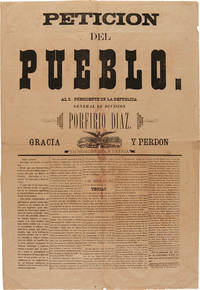
1890WRCAM55735N.p. but Puebla: Tip. Rinconada de Manzanares 1890. Broadside 23 1/2 x 15 3/4 inches printed in five columns with masthead showing a version of Mexico's coat of arms with eagle holding rattlesnake perched on crossed pikes above a cannon. Uniformly toned. Old folds and wrinkles short splits and minor loss at crossfolds mild staining. Overall good plus. An apparently-unrecorded broadside from Mexico printed during the reign of President Porfirio DÃÂaz who served a total of thirty- one years as the chief executive and effectively the dictator of Mexico. As with other dictatorial regimes DÃÂaz had a contentious and sometimes violent relationship with the press. He is known to have very occasionally condoned if not initiated the murder and imprisonment of journalists though he also often courted journalists to give them the impression that he was on their side expecting support in return. As a result Diaz often favored imprisonment over the outright assassination of journalists. During his dictatorship DÃÂaz sent numerous dissident politicians and journalists to the prisons of Belén or San Juan de Ulúa though being sent to the former was widely considered tantamount to a death sentence anyway. Journalists and political enemies were just two groups subject to DÃÂaz's theory of rule - that cruel means though unfortunate were justified by the end result of national progress. <br> <br> The present broadside calls for clemency from DÃÂaz in his dealings with imprisoned journalists and politicians. The author of the broadside mentions past injustices related to journalists and political prisoners. In the first column the text mentions Ignacio Ramirez and his pen name "el Nigromante;" Ramirez was a liberal writer and thinker who often defended the rights of indigenous peoples in Mexico. Here the author accuses the conservative party of trying to intimidate Ramirez and many others like him by putting "the hand of an enraged hitman on the neck of the liberal journalist." a rough translation. The text also references the Third Battle of Puebla fought on April 2 1867 and won by Porfirio DÃÂaz. At the conclusion of that battle instead of executing the imperialist Mexican prisoners DÃÂaz released them after they signed a promise not to take up further arms against the Mexican republic. The text appeals to DÃÂaz's demonstrated sense of mercy and reads in part and in English translation: <br> <br> "We the members of the working class know well and have witnessed your energetic courage in the battlefields as an intrepid and worthy son of Mars but now also this time we do not demand but we beg to have the happiness and satisfaction to see and admire him as a hero of clemency for imprisoned journalists.and more so for his afflicted families who at this moment endure the crying and perhaps even the misery and fatal consequences of that prison in which the heads of those anguished families reside." The text also calls for clemency or pardons for a long list of political prisoners. The names of the prisoners held at Belén occupy the last column-and-a-half of the broadside. At the conclusion of the text there is a notice that indicates the petitioners have 4000 signatures in their favor for the demands made here. <br> <br> OCLC is silent on this broadside. It is at least an exceedingly rare if not a unique surviving example of the political tensions between President DÃÂaz and his political opponents and journalists in Mexico at the end of the 19th century and a powerful and important entry in the ever-present struggle for the freedom of the press. Tip. Rinconada de Manzanares unknown books
Folio (Large); 1st edition. Period Cloth, Folio (newspaper), ca 600 pages. Bound volume of the ACWA's Yiddish paper. (Its English language counterpart was called ADVANCE) The Amalgamated Clothing Workers of America originalted as a heavily Jewish & Italian union out of the successful 1910 strike against Hart, Schaffner & Marx in Chicago, aided by middle class progresssives like Jane Addams and the Women's Trade Union League. "Among it's founding cadre, " note Buhle, Buhle & Georgakas (Encyclopedia of the American Left, pp. 16-18) , "nearly every variety of left-wing politics was represented: Lithuanian revolutionary nationalism, Bohemian free-thought, Italian syndicalism, the revoltionary unionism of the IWW, Jewish and Italian anarchism, the orthodox socialism of the American Socialist Party...and thetactically bolder socialism of the Jewish Bund. " This political rainbow is cleary evident in the pages of the FORTSCHRITT.SUBJECT(S): Jews -- Employment -- Periodicals. Labor unions. OCLC: 40576795. OCLC lists 5 holdings, of unclear completeness, worldwide (JTS, U of I, Dept of Labor, YIVO, IISH). Front board has edgewear, paper is browning and somehwat fragile, but with minimal wear . Good Condition thus. (yid-35-2)
1882RO80047769IMP. MENETIERE A.. Sept 1880 - Fév 1882. In-4. Cartonné. Etat d'usage, Couv. défraîchie, Mors fendus, Intérieur frais. 1120 pages (8 pages par numéro, soit 140 numéros). Nombreuses illustrations en noir et blanc, dans le texte (en 1ère page de chaque numéro). Textes sur 2 colonnes. Dos toilé rouge. Coins et tranches des plats frottés. Quelques déchirures, traces d'humidité et légers manques sur les premières pages altérant légèrement la lecture du texte. Quelques marges usées. Manque sur la couverture du n°140, dans le texte de la page 605 à 616.. . . . Classification Dewey : 70-Journalisme, édition. Journaux
Mérida de Yucatán, Imprenta de Castillo y Compañía. 1845. 484p. 8º mayor. Holandesa algo rozada. Lomo de piel con dorados, con corte. Puntos de óxido. Buen ejemplar
Very Good Turkish, Ottoman (1500-1928) Original wrappers. No bdg. Wear spine, dispersed pages. Roy. 8vo. (24 x 17 cm). In Ottoman script (Old Turkish with Arabic letters). 197, 6 p., 5 panoramic folded huge b/w plates (Including the photographic plts.; 1-) Turkish Convention May, 13, 1923, Detroit, Mich by Photo Craft Byallen -23x39 cm-; 2-) [Among the Young Turks in Detroit, -23x106 cm-; 3-) In the White House with the President, -23x106 cm-; 4-) Islamic Society in the US, -32x40 cm-; 5-) Among the Young Turkish people in Chicago, -23x26 cm-). First and only edition of this exceedingly rare travel account of America by Dr. Mehmed Fuad [Umay], (1885-1963), who was a Turkish doctor and the founder of Himâye-i Etfâl [i.e. Society for the Protection of Orphans], a society that was established in 1921 to provide orphanages to children of the deceased soldiers in the Turkish War of Independence; began visiting many of the Turkish colonies in the US, giving lectures and raising a considerable amount of money for the establishment of these orphanages in Turkey. On 21 March 1923, Fuad Bey was granted permission from the Grand National Assembly of Turkey to go to the US in order to raise funds among the Ottoman immigrants for immediate war relief. Thus, for the first time, humanitarian action became an organized effort by fostering diaspora mobilization. Fuad Bey arrived in Ellis Island on 6 April 1923 on a ship named SS Aquitania and headed to the Ottoman Welfare Association at 35 Rivington Street. In the first meeting held by the Ottoman Welfare Association for the benefit of Turkish Orphan Society, Fuad Bey notes that a total of USD 17,500 was raised in just six hours. To those who donated over USD 1,000, a personally autographed picture of Mustafa Kemal was given by Fuad Bey. He visited the Turkish colonies in Wisconsin, Illinois, Michigan, New York, New Jersey, Massachusetts and Rhode Island. He lectured about the Turkish War of Independence (1919-1922) and the success of the struggle, and many Turkish and Kurdish workers residing in these cities donated their life savings to support the construction of orphanages and the reconstruction of the entire country. Fuad's visit to Peabody, Massachusetts aroused exceptional excitement among the Turkish and Kurdish immigrants. It was the first chance for the Muslim Anatolian immigrants to manifest their national pride and attachment to the homeland. At the same time, their socioeconomic achievement was evidenced with the arrival of Fuad Bey in Peabody in an auto decorated with a large American flag and followed by a dozen autos filled with Turks, the machines decorated with American and Turkish flags.". A day before his arrival, the Turks refrained from work and "went around with badges in honor of his coming. Mehmed Fuad noted that there were around 600 Turks when he visited Peabody in 1923. Despite their small number, they had established Kizilay [i.e. Turkish Red Crescent] society. After being shown some of the tanneries in Peabody and Salem, Fuad gave an address to the Turks and Kurds at the Peabody Institute. The scene was described as: "All the Turks in town were present. They made a spectacle of the doctor's visit, many of them taking a day off. They wore badges in his honor and displayed in front of the Institute the American and Turkish flags. Great enthusiasm was shown. Baskets of roses were carried down the aisles and the flowers were bought at any price, bunches of money being put in the baskets. It was said that USD 8,000 was raised among the Turks of this city for Dr. Fuad Bey to take back with him.". Fuad Bey visited Peabody for a second time on 14 August 1925, as he came for the National Conference of Social Workers held in Denver, Colorado in June, 1925. When he arrived in Massachusetts, he was met by a delegation of Turkish people from [.]". (Source: Ottoman Immigrants and the Formation of Turkish Red Crescent Societies in the United States). No printed copy in OCLC.; Özege 727.; TBTK 11126.
Folio (Large); 1st edition. Period Cloth, Folio (newspaper), ca 600 pages. Bound volume of the ACWA's Yiddish weekly. (Its English language counterpart was called ADVANCE) The Amalgamated Clothing Workers of America originalted as a heavily Jewish & Italian union out of the successful 1910 strike against Hart, Schaffner & Marx in Chicago, aided by middle class progresssives like Jane Addams and the Women's Trade Union League. "Among it's founding cadre, " note Buhle, Buhle & Georgakas (Encyclopedia of the American Left, pp. 16-18) , "nearly every variety of left-wing politics was represented: Lithuanian revolutionary nationalism, Bohemian free-thought, Italian syndicalism, the revoltionary unionism of the IWW, Jewish and Italian anarchism, the orthodox socialism of the American Socialist Party...and the tactically bolder socialism of the Jewish Bund. " This political rainbow is cleary evident in the pages of the FORTSCHRITT. Subjects:Jewish labor unions -- United States -- Periodicals. Yiddish newspapers -- United States -- Periodicals. Labor movement -- New York -- Periodicals. OCLC: 40576795. OCLC lists 5 holdings, of unclear completeness, worldwide (JTS, U of I, Dept of Labor, YIVO, IISH). Paper very brown and fragile, lacking 2 leaves from the first issue and the remaining first 6 leaves loose with some loss. otherwise Good Condition.(yid-35-3)
Folio (Large); 1st edition. Period Cloth, Folio (newspaper), ca 600 pages. Bound volume of the ACWA's Yiddish paper. (Its English language counterpart was called ADVANCE) The Amalgamated Clothing Workers of America originalted as a heavily Jewish & Italian union out of the successful 1910 strike against Hart, Schaffner & Marx in Chicago, aided by middle class progresssives like Jane Addams and the Women's Trade Union League. "Among it's founding cadre, " note Buhle, Buhle & Georgakas (Encyclopedia of the American Left, pp. 16-18) , "nearly every variety of left-wing politics was represented: Lithuanian revolutionary nationalism, Bohemian free-thought, Italian syndicalism, the revoltionary unionism of the IWW, Jewish and Italian anarchism, the orthodox socialism of the American Socialist Party...and thetactically bolder socialism of the Jewish Bund. " This political rainbow is cleary evident in the pages of the FORTSCHRITT.SUBJECT(S): Jews -- Employment -- Periodicals. Labor unions. OCLC: 40576795. OCLC lists 5 holdings, of unclear completeness, worldwide (JTS, U of I, Dept of Labor, YIVO, IISH). Aproximately 25 leaves are loose, with occational text loss at the edges. Paper is browning and somehwat fragile, but generally with minimal wear otherwise. Good Condition thus. (yid-35-2A )
8vo., First Edition, on laid paper, half-title and title lightly spotted; handsomely bound in full burgundy crushed morocco, sides with gilt frame border, back with raised bands, second and fourth compartments lettered and ruled in gilt, all other compartments tooled in gilt, gilt top, gilt edges, hand-made endpapers, ribbon marker, custom-made slip-case, a most attractive copy ideal as a gift or for presentation.
Very Good Turkish, Ottoman (1500-1928) Contemporary burgundy cloth. Fading and foxing on boards, stains on pages. Overall a good copy. Cr. 8vo. (19 x 13 cm). In Ottoman script (Old Turkish with Arabic letters). 184 p. Extremely rare first edition of this last utopian work, printed before the proclamation of the Republic in 1923, by the Turkish / Ottoman Women Magazine publishing house, including an enthusiastic call for the political unity of the Turks outside Anatolia. Müfide Ferid Tek was one of the first female representatives of the Turkism and Turanism movement in the novel genre and she would later support the Turkish War of Independence (1919-1922) with her literary works. Özege 1343.; 10 copies worldwide located in OCLC: 314528178 (5 copies), 1030064092 (1 copy), 49367479 (4 copies). (Utopias from the Middle East 4).
Very Good Urdu Extremely rare first and only edition (not in institutional catalogues and market) of this travel book to America in the mid 20th century by Pakistani journalist and intellectual Sharif Farooq, who was invited to visit the USA on the Leader Specialist Programme in 1958. Sharif Farooq visited America in 1958. In his travelogue, he highlights the lifestyle, educational system, and foreign policy of America in detail. He also introduces the economical situation of the country, economical trends, and the condition of different institutions. Reports of press conferences are also a part of this travelogue. (Source: Travelogues of America in the Urdu Language: Trends and Tradition). "Wherever the Americans deserve appreciation for their intense patriotism and enthusiasm for labor, the author has given unstinted praise but where criticism is due he has not spared them, though the language used is very sober and moderate. I am confident that this book will be widely read and aimed as one of the good travel books written about America". (From the preface of the book by advocate-general Muhammad Ali). In original boards with lettering in both Latin and Arabic, spine missing. Otherwise a good copy. Demy 8vo. (22 x 14 cm). Text is in Urdu with a one-page English preface. 387, [1] p. In the Land of Lincoln. First Edition. No copy in OCLC.
Paperback. First issue of radical underground newspaper. Includes contributions by John Wieners, Joel Oppenheimer, John Sinclair, Andre Breton and others. Pages are very tanned. Minor foxing on front page. Several tears and nicks on pages. Text and illustrations remain clear. AF Used
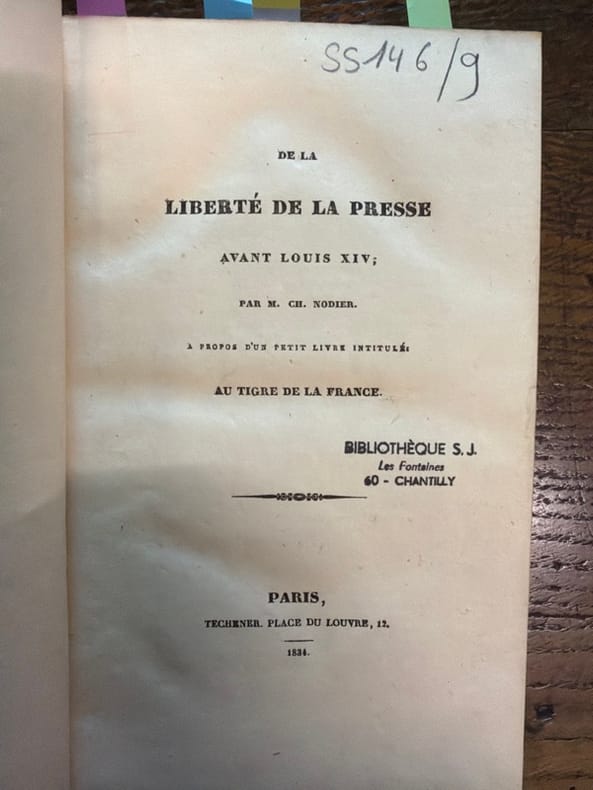
244209Paris, Techener [Imprimerie de Brun], 1834 in-8, 12 pp., typographie en petit corps, demi-basane cerise, dos à nerfs orné de pointillés et filets dorés, tranches marbrées (reliure de l'époque). Dos uniformément insolé et passé. Étiquette de bibliothèque au dos.
1894RO20172376"IMP. PAUL DUPONT. 1887-1894. In-8. Relié. Etat d'usage, Couv. convenable, Dos satisfaisant, Quelques rousseurs. 28 TOMES: 576 + 544 + 576 + 576 + 576 + 672 + 672 + 672 + 672 + 672 + 672 + 672 + 672 + 672 + 672 + 672 + 672 + 672 + 672 + 672 + 672 + 672 + 672 + 672 + 672 + 672 + 672 + 672 pages - plats jaspés - quelques rousseurs dans le texte sans consequence pour la lecture - frontispice en noir et blanc ""EMILE ZOLA""sur le tome 7 - frontispice en noir et blanc ""M. GEORGES OHNET""sur le tome 8 - frontispice en noir et blanc ""M. J. BARBEY D'AUREVILLY""sur le tome 9 - frontispice en noir et blanc ""M. LUDOVIC HELEVY""sur le tome 10 - frontispice en noir et blanc ""M. FRANCOIS COPPEE""sur le tome 11 - frontispice en noir et blanc ""M. JULES SIMON""sur le tome 12 - frontispice en noir et blanc ""M. PIERRE LOTI""sur le tome 13 - frontispice en noir et blanc ""M. ERNEST LEGOUVE"" desolidarisé sur le tome 14 - frontispice en noir et blanc ""M. ALPHONSE DAUDET""sur le tome 15 - frontispice en noir et blanc ""M. GUY DE MAUPASSANT""sur le tome 16 - frontispice en noir et blanc ""M. PAUL BOURGET""sur le tome 17 - frontispice en noir et blanc ""M. HENRI MEILHAC"" et dos partiellement desolidarisé sur le tome 18 - frontispice en noir et blanc ""M. JEAN RICHEPIN""sur le tome 19 - frontispice en noir et blanc ""M. LECONTE DE LISLE""sur le tome 20 - frontispice en noir et blanc ""M. PAUL MARGUERITTE""sur le tome 21 - frontispice en noir et blanc ""M. ANDRE THEURIET""sur le tome 22 - frontispice en noir et blanc ""M. HECTOR MALOT""sur le tome 23 - frontispice en noir et blanc ""M. JULES VERNE""sur le tome 24 - frontispice partiellement desolidarisé en noir et blanc ""GYP"" sur le tome 25 - frontispice en noir et blanc ""M. ANATOLE FRANCE""sur le tome 26 - frontispice en noir et blanc ""M. VICTORIEN SARDOU""sur le tome 27 - frontispice en noir et blanc ""M. LEON DE TINSEAU""sur le tome 28 - 4 photos disponibles.. . . . Classification Dewey : 70-Journalisme, édition. Journaux"
1851RO30082443AU BUREAU DU JOURNAL. 1850 - 1851. In-Folio. Relié demi-cuir. Etat d'usage, Coins frottés, Dos abîmé, Intérieur frais. 4 pages par numéros. Journal quotidien. Tampon sur les premières pages. Des manques sur le dos.. . . . Classification Dewey : 70-Journalisme, édition. Journaux
1791AMO-3515par Pierre Manuel, l'un des Administrateurs de 1789. Avec gravure et tableaux. A Paris, chez Garnery, libraire, à Strasbourg chez Treuttel, à Londres, chez de Boffe, l'an second de la liberté (1791) [de l'imprimerie de Fiévée, rue Serpente, n°17 - qui est aussi l'adresse du libraire Garnery]. 2 volumes in-8 (21,5 x 14 cm) brochés de 402-(3) et 330 (mal chiffrée 230)-(3) pages. Frontispice gravé. Tableaux dépliants. Couvertures d'époque de papier rose. Couverture usagée avec manques et en partie détachées, dos fendillés, non rogné. Quelques coins roulés en début et en fin des volumes. Intérieur frais. Complet. Édition originale. La plupart des catalogues (y compris le catalogue de la Bnf / Gallica et d'anciens catalogues de vente) ont confondu l'an second de la liberté (1791) avec l'an second de la République (1793). La Police de Paris dévoilée a paru à la fin du mois de juin 1791 (voir les Révolutions de Paris qui en informe ses lecteurs après la date du 22 juin). Louis Prudhomme écrit alors : "Cet ouvrage attestera à la postérité l'infamie des rois, et tout l'odieux d'un gouvernement pourri. Le seul règne et Louis XVI fournit une carrière de seize années de crimes et de lettres de cachet qui, presque toutes, ont eu pour objet la proscription de têtes innocentes. Tantôt ce sont d'honnêtes gens, [...], Pierre Manuel a eu besoin de tout son courage pour fouiller dans la sentine de la police, et en tirer des noms flétris, qui naguère étaient encore respectés. L'article de la police sur la librairie suffirait seul pour prouver à quel degré d'avilissement était tombé le gouvernement français. Au soin qu'on prenait pour enchaîner la presse, étouffer la voix de ceux qui avaient encore la force de se plaindre, on sent que le crime était sur le trône, et que le peuple avait la gorge sous le couteau des tyrans. Le plus léger soupçon suffisait pour exposer l'asile d'un imprimeur, d'un libraire, à être pillé par une brigade d'espions, de voleurs et de commissaires. [...]. La police des prêtres et des moines est un objet de scandale et de turpitudes, qui justifie pleinement la réforme du clergé [...]." Après avoir participé activement aux événements de juillet 1789, il devient membre de la municipalité provisoire de Paris, et « administrateur de la police, du département de la librairie, des spectacles et attributions accessoires » ; il intègre le club des Jacobins. En septembre 1791, il est élu procureur syndic de la municipalité de Paris, responsable de l’exécution des lois et arrêtés. Suspendu un temps par le directoire du département de Paris, il est défendu par la Législative qui lui rend sa place. Bras droit du maire Pétion, il l'accompagne de son action. Il est ainsi l'un des instigateurs de la journée du 20 juin 1792. Le 30 juillet, la Législative décrète la suppression de la Commune, mais, menacée d'une insurrection par Manuel, elle n'en fait rien. Il soutient toujours l'action de Pétion et des 47 sections lors des journées du 3 au 10 août 1792 comme membre de la commune insurrectionnelle. Le 13 août, il est nommé procureur syndic de la Commune de Paris et après en avoir fait proposition devant l'Assemblée, il escorte Louis XVI à la prison du Temple. Il est jusqu'à sa mort en fréquente relation avec le souverain déchu auquel il apprend en personne l'instauration de la République. Chargé par le conseil général de l'Assemblée d'assurer la tranquillité du Temple le 3 septembre, son rôle dans les massacres de Septembre est controversé. Certains témoignages l'accusent de laxisme, d'autres, comme celui de Pierre-Jean-Baptiste Nougaret, lui prêtent une complicité avec les massacreurs. Selon d'autres sources, peu avant les Massacres, il requiert la sortie des prisonniers pour dette ainsi que celle de Mme de Tourzel et de Jean-Jacques Duval d'Éprémesnil. Il se défend avec véhémence de toute responsabilité dans les événements, accuse la ville de Paris d'être complice, selon ses termes, de cette « Saint-Barthélémy des Français » et ses propos suscitent une dispute au club des Jacobins avec son collègue Jacques Alexis Thuriot. Élu à la Convention nationale, comme député de la Seine, il est nommé « commissaire chargé de rendre compte de l'état de la ville de Paris », puis suppléant au Comité d’instruction publique. Il obtient la suppression de la croix de Saint-Louis mais sa proposition de vente du château de Versailles est refusée. Son attitude envers le roi se modifie ouvertement dès le 7 novembre lorsque le député Mailhe présente un projet de décret sur le jugement du roi et les formes pour y procéder. Manuel propose que tout défenseur de Louis XVI soit sous la sauvegarde de la loi. Le 3 décembre, il donne son avis sur le sort de Louis XVI et le 6, il déclare à la Convention : « La Convention nationale ne peut commettre un assassinat. Je demande que Louis XVI soit entendu. » Ses interventions en faveur du roi font croire un moment qu’il est devenu fou. Le 15 décembre, il est exclu du Club des Jacobins. Un mois plus tard, en dépit de ses positions affichées, il vote la culpabilité du roi comme tous ses collègues. Le lendemain, il vote pour la ratification du jugement du peuple, le 17 janvier, pour la détention dans un fort ailleurs qu’à Paris, puis la déportation. Aussitôt que la peine de mort fut prononcée contre le roi Louis XVI, il quitta la salle et envoya sa démission par lettre. Les membres de la Montagne l’accusent en tant que secrétaire de séance, d’avoir tenté de falsifier les résultats de l’appel nominal. Il se retire à Montargis, où il est l'objet d'une tentative d'assassinat en mars 1793. Retiré de la vie politique, il se serait rendu selon Nougaret dans un château à Fontainebleau. Il est finalement arrêté le 20 août 1793 à Montargis où il se tenait caché. Transféré à Paris, à la prison de l'Abbaye. il comparaît devant le Tribunal révolutionnaire. Condamné à la peine de mort pour avoir voulu sauver le roi et coupable de conspiration contre la République, il est guillotiné le 24 brumaire an II (14 novembre 1793). Il était âgé de 42 ans. Il a été l'éditeur des Lettres originales de Mirabeau : écrites du donjon de Vincennes [à] Sophie Ruffey, marquise de Monnier (Paris, Garnery, 1792). Bon exemplaire conservé dans son brochage de l'époque de cet ouvrage passionnant.