863 résultats
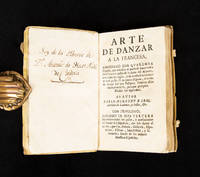
175834566Madrid: The Author 1758. 16mo. ca. 150 x 103 cm. Full contemporary vellum with manuscript titling to spine leather ties. 1f. recto title verso blank 1f. "Al Lector i privileges dated July 2 9 and 10 1737 iii "Advertencia" 72 pp. text 20 engraved plates of choreographic notation of dances including those by Feuillet and Pecour with music with alternate rectos and versos blank as issued. With one folding plate of engraved music between pp. 35 and 37.<br/><br/>With charming woodcut depictions of both male and female dancers one with an accompanying musician illustrating positions of the arms and feet and dance etiquette including bowing and managing one's hat. Diagrams and choreographic notation within text. <br/><br/>The final textual section "Explicacion del Danzar a la Española" offers detailed definitions of 46 steps used in Spanish dance followed by descriptions of "Danzas a la Española ." including the pabana the gallarda the españoleta the villano the impossibles and the hermosa. <br/><br/>Plates include:<br/>- Explicn. de la Chorographia<br/>- Movimentos de los Brazos Codos etc.<br/>- Demonstracion de la Bretaña<br/>- Rigodon ô Allegro de la Bretaña<br/>- El Amable con otra Chorographia<br/>- La Pastoril demonstda. redonda y larga<br/>- La Diligenta delinda. â lo largo ô larga<br/>- La Cortesana Cont. quadrada ô en quadro<br/><br/>Free front endpaper with elaborate contemporary paraph verso with contemporary inscription: "Soy de la Libreria de Dn. AntonÃo de Hozes Ferñz de Cordova."<br/><br/>Binding slightly worn; ties partially lacking; endpapers slightly worn; free front endpaper slightly stained. Minor internal wear and soiling; some leaves browned; occasional foxing; several small virtually invisible professional archival repairs. Rare third edition of the work demonstrating the foundations of dancing in the French style considered of greater elegance than the Spanish first published in 1737. Derra de Moroda 1856 edition of 1758. Malkin 79 edition of 1737. Niles & Leslie pp. 360-361 edition of 1758. Waterloo p. 144 RISM Écrits p. 587 editions of 1758 and 1768. All with variant titles no recorded copies with this title. <br/><br/>Minguet's manual incorporates material from two other important early 18th century dance treatises Feuillet's Chorégraphie Paris 1700 and Rameau's Le Maître de danser Paris 1726.<br/><br/>"A compilation of Feuillet Rameau and De la Cuisse. His engravings however are superior to the originals of the fore-mentioned and make his Arte de Danzar perhaps the most important treatise in 18th century Dance literature in Spanish." Niles & Leslie<br/><br/>"Spain was one of the first countries to record its social dances in a system of dance notation and notation was to be an important element in dance manuals of the eighteenth century. The first Spanish book devoted entirely to dance was Discursos sobre el arte de danzado 1642 by Juan de Esquivel Navarro dancing master to Philip IV. The next dance book by Bartolemé Ferriol y Boxeraus did not appear until a century later in 1745. Pablo Minguet e Irol a famous engraver as well as an author and translator published works on a wide range of subjects; his dance books included several important works which incorporated the French dance notation of Raoul-Auger Feuillet." International Encyclopedia of Dance 5 p. 670. <br/><br/>"A particularly lovely set of illuminations can be found in Pablo Minguet e Yrol's Arte de danzar à l a francesca." op. cit. 6 p. 124. <br/><br/>Antonio de Hoces Fernández de Córdoba 1722-1782 was a "Master of Seville" and served as mayor of Cordoba. [The Author] unknown books
WALTER-FILM000325No binding. Very Good. Fine Art Print Vintage original 41 x 27 103 x 68 cm. one sheet poster USA. Gene Tierney Clifton Webb Dana Andrews Judith Anderson Vincent Price dir: Otto Preminger; Twentieth Century Fox. One of the rarest and most desirable of all posters for this classic film noir one of the finest and best remembered of the genre. Perhaps the most romantic and one of the most haunting of all noir posters. Story of a beautiful girl in a painting who is believed to have been murdered the police investigator who falls in love with her image and her jealous Svengali. Lovely portrait of the iconic Tierney. On linen there has been touch-up to the fold lines and touch-up to one tiny tear near the right edge middle fold near Vincent Price shoulder. Immaculate colors a really clean copy ABOUT FINE. unknown books
1810WRCLIT67042Japan 1810. Folio 33 x 27.5 cm. Late 19th or early 20th century marbled calf raised bands spine gilt extra gilt label a.e.g. with watercolor river scenes on paper onlaid as doublures. Binding extremities rubbed images offset a bit to interleaves occasional patches of darkening to backgrounds of a few images one corner of an interleaf creased and a bit torn but otherwise very good to near fine. A lovely collection of watercolor images on silk of birds moths and butterflies the artist unknown but the paintings executed with great skill. The twenty-two individual panels vary somewhat in size but approximate 24 x 20 cm to 20 x 16cm and each includes several specimens: in the case of the birds 2-4 in the case of the Lepidoptera 5-10. The individual panels are mounted to heavy stock via blue silk bordering. The birds are identified via manuscript captions next to each bird; the Lepidoptera are not captioned. A pencil note on the free endsheet in an early hand dates the paintings somewhat earlier 1700-1750 Shijo School than do those later in its most recent provenance: tipped in unidentified mid-20th century auction description dating the paintings to early 19th century - private collection. hardcover books
2221848<p>"Ike" 3 pages to wife Mamie no date but ca. 1944. 9" x 6". Fine.</p><p>Eisenhower pens a heartfelt letter to Mamie while in the depths of war: "The Russian fight continues to stir me to the depths of my soul. They're hitting so hard that no one can fail to admire them. I hope they kill a million Huns -- even more! And I wish we could be hammering at the d--- Germans this instant just as hard and on as big a scale as the Russians."</p><p>Dwight D. Eisenhower 1890-1969 was the 34th President of the United States from 1953 until 1961. He was a five-star general in the United State Army during World War II and served as Supreme Commander of the Allied Forces in Europe.</p> unknown books
181633472France 1816. 15 watercolors each with an accompanying manuscript text leaf plus watercolor and gold title leaf on sheets approximately 14 1/2 x 11 inches. Contemporary green morocco spine gilt lettered all edges gilt. Boards a bit scuffed edges somewhat worn spine faded. Occasional faint foxing.<br/> <br/>A lovely album of botanical watercolours.<br/> <br/>An exceptional album of fifteen botanical watercolors which are accompanied by an expertly accomplished manuscript description within blue and gilt borders. Each image depicts a different class of plant life while the text describes families of plants within that class. The images range from agarics mushrooms to ornate roses and camellias and include watercolors of honeysuckle blueberries azalias oaks and marvels-of-peru. Every text leaf contains a detailed analysis of the different families of the depicted plant in a neat and legible French hand. A beautiful example of an amateur artist's book of botanical scholarship. unknown books
36596Birmingham England late 18th century. Oblong quarto. 7 1/2 x 11 inches. 113 engraved plates on laid paper priced throughout in manuscript. Later calf backed marbled paper covered boards flat spine ruled and lettered in gilt.<br/> <br/>A rarely encountered pattern book or trade catalogue of 18th century English furniture hardware including drawer pulls keyholes hinges locks castors bolts and more.<br/> <br/>By 1770 over thirty different brass foundries operated in Birmingham England making it the epicenter of furniture hardware design in the last quarter of the 18th century. At roughly the same period trade catalogues like the present began to be issued by both furniture and hardware makers alike. In all over 500 designs are shown on the 113 consecutively numbered plates from rather simple hinges to incredibly ornate pulls. Although no engravers' names are identified it has been suggested that the foundries themselves produced such plates utilizing the talents of their own craftsmen who by their very occupation would have been highly skilled at etching on metal. Such pattern books "illustrate the beginning of what was then a new movement in the conditions of the crafts namely the growth of the organised factory as a means of production and distribution as compared with the earlier limitation of these functions to the efforts of individuals" Young.<br/> <br/>Cf. Hummel Charles F. "Samuel Rowland Fishers Catalogue of English Hardware." Winterthur Portfolio Vol 1 1964: 188-197; cf. Symonds R. W. "An Eighteenth-Century English Brassfounders Catalogue." Magazine Antiques Feb. 1931: 102-105; Young W. A. comp. Old English pattern books of the metal trades: a descriptive catalogue of the collection in the V&A Museum. London: HMSO 1913. unknown books
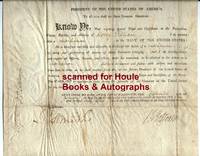
18092221587<p>RARE MIDSHIPMAN APPOINTMENT</p><p>"Th: Jefferson" Partly-printed vellum DS as president 1 page 10" x 10 1/2" January 16 1809. President Jefferson issues a naval appointment for Henry Pilliam. In part: "That reposing special Trust and Confidence in the Patriotism Valour Fidelity and Abilities of Henry Pilliam I do appoint him a midshipman in the Navy of the United States." Neatly signed at the conclusion by President Jefferson and countersigned by Secretary pf the Navy Robert Smith. The document bears an embossed Navy Department seal to the upper left. Intersecting folds overall wrinkling and light staining otherwise fine condition. Such appointments by Thomas Jefferson are quite scarce as he and the Republican party opposed a strong navy. However as Jefferson's term neared its conclusion the naval forces were beginning to grow out of necessity in order to protect the maritime interests of the United States as merchant vessels were  frequently being interfered with during their voyages on the high seas. Ultimately these disputes would culminate in the War of 1812 during President Madison's administration. A desirable and well-preserved example of a Jefferson appointment. Very good.</p> unknown books
179728174Birmingham England 1797. Oblong quarto. 7 1/2 x 11 inches. 143 engraved plates 13 folding on laid paper priced throughout in manuscript. Period calf-backed marbled paper covered boards<br/> <br/>Provenance: W. G. & Co. inscription on front endpaper<br/> <br/>A rarely encountered pattern book or trade catalogue of 18th century English furniture hardware including drawer pulls keyholes hinges locks castors bolts watch stands and more.<br/> <br/>By 1770 over thirty different brass foundries operated in Birmingham England making it the epicenter of furniture hardware design in the last quarter of the 18th century. At roughly the same period trade catalogues like the present began to be issued by both furniture and hardware makers alike. Although most of the brass foundry trade catalogues of this early period have no indication of the foundry the present pattern book is inscribed W. G. & Co. on the front pastedown. In all nearly 1000 designs are shown on the 143 plates from rather simple hinges and hooks to incredibly ornate pulls knockers watchstands etc. Although no engravers's names are identified it has been suggested that the foundries themselves produced such plates utilizing the talents of their own craftsmen who by their very occupation would have been highly skilled at etching on metal. Such pattern books "illustrate the beginning of what was then a new movement in the conditions of the crafts namely the growth of the organised factory as a means of production and distribution as compared with the earlier limitation of these functions to the efforts of individuals" Young.<br/> <br/>Cf. Hummel Charles F. "Samuel Rowland Fishers Catalogue of English Hardware." Winterthur Portfolio Vol 1 1964: 188-197; cf. Symonds R. W. "An Eighteenth-Century English Brassfounders Catalogue." Magazine Antiques Feb. 1931: 102-105; Young W. A. comp. Old English pattern books of the metal trades: a descriptive catalogue of the collection in the V&A Museum. London: HMSO 1913. unknown books
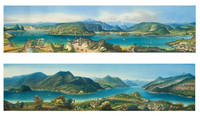
185020181Italy 1850. Pair of views gouache over faint etched line black gouache border. Period gilt and faux bois frames. Two splendid panoramic views of Lake Como and Lake Maggiore.<br/> <br/>Catering to the foreigners flocking to the region on The Grand Tour this pair of hand-painted prints beautifully depict the famed picturesque lakes with rich bands of blue highlighting the water and sky with the surrounding hills and mountains dotted with luxurious villas. In the view of Lake Maggiore we see from a very high vantage point the Borromean Islands: Isola Bella Isola Madre and Isola dei Pescatoriwith their extraordinary gardens. The view of Lake Como looks north up the lake towards Switzerland from above Bellagio which occupies the point at which the lake divides in two. The paintings are clearly intended as a pair the images being almost identical in size with matching black painted margins. The prints are as issued with black labels covering the original printed titles. unknown books
15465968Venice: Cornelio Adelkind for Daniel Bomberg 1546. First edition. Very Good/First printed edition editio princeps of the 11th century commentary on portions of the pentateuch by the Bulgarian poet and Talmudist Tobiah ben Eliezer. Published by the house of the seminal printer of Hebrew books Daniel Bomberg under the supervision of his scholar-in-residence extraordinaire Cornelio Adelkind. Venetian law at this time limited Hebrew publishing to Gentile printers. Bomberg a protestant from Antwerp entered this lucrative market and with Adelkind's help became its prime exponent until his death in 1549. . Folio 32 cm; 93 leaves. Text in Hebrew. Title within architectural border reproduced in Amram "Makers of Hebrew Books in Italy" p. 215 also in the Jewish Museum's 1989 exhibition catalogue "Gardens and Ghettos: the Art of Jewish Life in Italy" page 50. Some section headings within ornamental borders. Bound in c19 or c20 dark red crushed morocco ruled in gilt and decorated with arabesques on both boards; spine with raised bands and compartments tooled and titled in gilt; green polished leather doublures with red crushed morocco dentelles bordered in pointillé accented with arabesques; green moiré free endleaves. Edges gilt. Binding not signed. Joints and crown adroitly reinforced with Japanese paper; corners somewhat worn down. Occasional contemporary notes in manuscript in text; brief stain on leaf mem-tet and lightly along the bottom edge of leaves nun-bet and nun-gimmel. Text otherwise pristine. Title page light possibly washed. Old library ink stamps from an institution in Warsaw on title page. Red morocco ex-libris of mining magnate and philanthropist Adolph Lewisohn 1849-1938. References: Adams T-766; BM Italian 674; Steinschneider 7304 #1; Amram 215 illustration and 222. Cornelio Adelkind for Daniel Bomberg hardcover books
3892Watercolour and gouache on vellum signed 'Gablle Fontaine'. An exceptionally large scale work by this talented but apparently unrecorded artist probably executed in the 1830s or early 1840s. The composition includes roses bi-colour pinks/carnations morning glory dahlias auriculas flowering quince or prunus hollyhock plums and peaches. In addition a clouded yellow and two red admiral butterflies are shown. unknown books
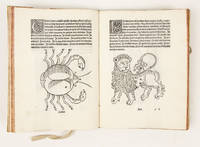
14823785Venice:: Erhard Ratdolt 14 October 1482. FIRST ILLUSTRATED EDITION of Hyginus' "Poeticon Astronomicon". Quarto:. 19 x 14 cm. Collation: a-f8 g10 a1 blank a2r dedication to M. Fabius Quintilianus a3r text g9r commendatory poem by Jacobus Sentinus g10r poem and verse colophon by Johannes Santritter g10v blank. 58 leaves. 31 lines. Types 3:91G text 7:92G heading on a2r 91 Gk a few words. Title on a2r printed in red 11- 7- 5- and 3-line white-on-black woodcut initials. 47 half-page woodcuts probably designed by Johannes Santritter of the constellation and planet figures. Illustrated with 47 half-page woodcuts of the constellations and the planets personified. The text of Hyginus was first published in an unillustrated edition in Ferrara in 1475. A very good copy in 18th c. stiff vellum. The initial blank is soiled and stained. Light stains to top of second leaf and leaves d1-2. Soiling to f1 and blank verso of final leaf with faded inscription. The "Poeticon Astronomicon" more correctly the "Astronomica" is an ancient Roman work on the constellations chiefly based on the work of the Greek scientist Eratosthenes 3rd c. B.C. The work was traditionally attributed to the first century writer C. Julius Hyginus the Director of the Palatine Library under the Emperor Augustus but the extant text is now believed based on stylistic analysis to be an abridgement of Hyginus' work made in the late second century. The fact that the order of the constellations in the poem follows precisely that of Ptolemy's "Almagest" further strengthens the case for a second century date. A remarkable aspect of Hyginus' text is his insistence on the use of astronomical models in particular a celestial globe as an aid to teaching or explaining astronomical principles and phenomena particularly for "discussions on the inter-relationships between the constellations and especially between the constellations and the celestial circles."Lippincott p.4Like Manilius' "Astronomicon" and Proclus' "Sphaera" a text that Hyginus sought to improve upon the "Poeticon Astronomicon" was of special interest to Renaissance astronomers who desired accurate editions of ancient texts from which they might derive a clear understanding of the astronomical knowledge of the Romans and Greeks thereby establishing a firm foundation upon which to undertake astronomy's "renewal".Hyginus' text which gives detailed accounts of the myths associated with each of the constellations served as source material for artists in the Middle Ages and Renaissance one of the most famous examples of the text's influence being the splendid ceiling painted around 1511 by Peruzzi for Agostino Chigi in the Sala di Galatea of the Villa Farnesina See Förster Farnesina-Studien 1880 p. 40.One of the chief interests in Ratdolt's editions of Hyginus 1482 and 1485 lies in the illustrations of the constellations the first such illustrations to appear in a printed book. These images derive from medieval manuscript and other artistic sources –though a specific source has not been identified. The figures appear in medieval European costume and in the words of Redgrave "There is a vigour and quaintness about these woodcuts which merit recognition." These images proved enormously influential serving as models for the representation of the constellations in stellar atlases and celestial maps for centuries to come."In many instances these medieval European often mythological constellation figures differed notably from those used by Ptolemy and his Islamic successors . Several stylistic conventions first published in Ratdolt's woodcuts endured for several centuries both in the numerous editions of Hyginus and in the various maps derived therefrom . Ratdolt's figures led directly to those of Jacob de Gheyn 1600 and through him to those of Johannes Bayer 1603." Warner The Sky ExploredThe Contents of Hyginus' "Poeticon Astronomicon"Hyginus tells us that he intends to give a better description of the celestial sphere than Aratus had done in his "De Sphaera". Book I gives a brief overview of the cosmography of the universe the celestial sphere the Earth and its zones and the Zodiac. Book II is a compendium of myths related to the constellations the five planets Mercury Venus Mars Saturn and Jupiter as well as the Sun Moon and Milky Way.Book III is Hyginus' star catalogue. It is in this book that Ratdolt's woodcuts appear. "Each constellation is described in the same order as in Book II in terms of its location relative to the surrounding constellations and the celestial circles with some indications being given as to the overall shape and disposition of the figure. In addition Hyginus provides a list of the positions of the stars relative to the figure itself describing the placements in terms of 'left' and 'right' and 'above' and 'below' in line with the tradition of descriptive star catalogues. Moreover he tends to list the stars from the top of a figure downwards or from the head to the feet regardless of the orientation of the figure within the sky. This is very different from the way the more mathematically-oriented astronomers such as Hipparchus or Ptolemy describe the constellations."Book IV returns to the subject of cosmology and to astronomical topics such as the position of the constellations on each celestial circle the unequal division of the night and day and the risings and settings of the constellations relative to the signs of the zodiac. He discusses the movements of the Sun and the Moon and the five planets and touches upon Pythagorian notions of the harmony of the spheres." Lippincott Kristen "The textual tradition of the De Astronomia of Hyginus" pp. 10-11 BMC V 286; BSB-Ink H-459; CIBN H-334; Essling 285; Goff H-560; HC 9062; Hind II p. 462; IGI 4959; Klebs 527.2; Pollard/Perrins 31; Redgrave 30; Sander 3472 Erhard Ratdolt, 14 October, books
1690BB005<p>A remarkable collection of 62 engraved copperplates representing the earliest impressions of fantastic figures composed of the tools or attributes of their trades created and produced about 1690 onwards thru 1694 enhanced at the time with brilliant hand-coloring silver and gold paint. These prints are a marvel of inventiveness showing the inspiration and influence of the 16th century painter Giuseppe Arcimboldo 1527-1593 who chiefly imagined only heads now extended and re-invented for the Court of Louis XIV. </p><p>Amongst the most famous prints of the late 17th century their printing history is rather complicated. Nicolas I de Larmessin or L'Armessin 1632-1694 designed engraved and published approximately 62 plates in his lifetime. His widow Marie Bertrand added 14 plates from his unfinished designs and his younger brother Nicolas II c.1645-1725 engraved a further 21 plates from 1695 to 1720s. All of the prints were individually published with re-engravings in reverse by the younger brother which often simplified these earlier designs by omitting background details. Altogether it has been suggested that a total of 97 images were eventually issued. </p><p>From the Beauvillain library ex-libris by Jouas. Colas 1779 Lipperheide 1971.</p> chez N. de L'Armessin [or for 7 sheets] ou chez la Veuve de N. de l'Armessin, rue St Jacques, Ã la Pomme d'Or, circa circa hardcover books