863 résultats
1690BB005<p>A remarkable collection of 62 engraved copperplates representing the earliest impressions of fantastic figures composed of the tools or attributes of their trades created and produced about 1690 onwards thru 1694 enhanced at the time with brilliant hand-coloring silver and gold paint. These prints are a marvel of inventiveness showing the inspiration and influence of the 16th century painter Giuseppe Arcimboldo 1527-1593 who chiefly imagined only heads now extended and re-invented for the Court of Louis XIV. </p><p>Amongst the most famous prints of the late 17th century their printing history is rather complicated. Nicolas I de Larmessin or L'Armessin 1632-1694 designed engraved and published approximately 62 plates in his lifetime. His widow Marie Bertrand added 14 plates from his unfinished designs and his younger brother Nicolas II c.1645-1725 engraved a further 21 plates from 1695 to 1720s. All of the prints were individually published with re-engravings in reverse by the younger brother which often simplified these earlier designs by omitting background details. Altogether it has been suggested that a total of 97 images were eventually issued. </p><p>From the Beauvillain library ex-libris by Jouas. Colas 1779 Lipperheide 1971.</p> chez N. de L'Armessin [or for 7 sheets] ou chez la Veuve de N. de l'Armessin, rue St Jacques, Ã la Pomme d'Or, circa circa hardcover books
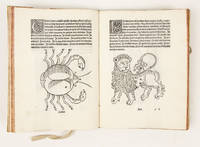
14823785Venice:: Erhard Ratdolt 14 October 1482. FIRST ILLUSTRATED EDITION of Hyginus' "Poeticon Astronomicon". Quarto:. 19 x 14 cm. Collation: a-f8 g10 a1 blank a2r dedication to M. Fabius Quintilianus a3r text g9r commendatory poem by Jacobus Sentinus g10r poem and verse colophon by Johannes Santritter g10v blank. 58 leaves. 31 lines. Types 3:91G text 7:92G heading on a2r 91 Gk a few words. Title on a2r printed in red 11- 7- 5- and 3-line white-on-black woodcut initials. 47 half-page woodcuts probably designed by Johannes Santritter of the constellation and planet figures. Illustrated with 47 half-page woodcuts of the constellations and the planets personified. The text of Hyginus was first published in an unillustrated edition in Ferrara in 1475. A very good copy in 18th c. stiff vellum. The initial blank is soiled and stained. Light stains to top of second leaf and leaves d1-2. Soiling to f1 and blank verso of final leaf with faded inscription. The "Poeticon Astronomicon" more correctly the "Astronomica" is an ancient Roman work on the constellations chiefly based on the work of the Greek scientist Eratosthenes 3rd c. B.C. The work was traditionally attributed to the first century writer C. Julius Hyginus the Director of the Palatine Library under the Emperor Augustus but the extant text is now believed based on stylistic analysis to be an abridgement of Hyginus' work made in the late second century. The fact that the order of the constellations in the poem follows precisely that of Ptolemy's "Almagest" further strengthens the case for a second century date. A remarkable aspect of Hyginus' text is his insistence on the use of astronomical models in particular a celestial globe as an aid to teaching or explaining astronomical principles and phenomena particularly for "discussions on the inter-relationships between the constellations and especially between the constellations and the celestial circles."Lippincott p.4Like Manilius' "Astronomicon" and Proclus' "Sphaera" a text that Hyginus sought to improve upon the "Poeticon Astronomicon" was of special interest to Renaissance astronomers who desired accurate editions of ancient texts from which they might derive a clear understanding of the astronomical knowledge of the Romans and Greeks thereby establishing a firm foundation upon which to undertake astronomy's "renewal".Hyginus' text which gives detailed accounts of the myths associated with each of the constellations served as source material for artists in the Middle Ages and Renaissance one of the most famous examples of the text's influence being the splendid ceiling painted around 1511 by Peruzzi for Agostino Chigi in the Sala di Galatea of the Villa Farnesina See Förster Farnesina-Studien 1880 p. 40.One of the chief interests in Ratdolt's editions of Hyginus 1482 and 1485 lies in the illustrations of the constellations the first such illustrations to appear in a printed book. These images derive from medieval manuscript and other artistic sources –though a specific source has not been identified. The figures appear in medieval European costume and in the words of Redgrave "There is a vigour and quaintness about these woodcuts which merit recognition." These images proved enormously influential serving as models for the representation of the constellations in stellar atlases and celestial maps for centuries to come."In many instances these medieval European often mythological constellation figures differed notably from those used by Ptolemy and his Islamic successors . Several stylistic conventions first published in Ratdolt's woodcuts endured for several centuries both in the numerous editions of Hyginus and in the various maps derived therefrom . Ratdolt's figures led directly to those of Jacob de Gheyn 1600 and through him to those of Johannes Bayer 1603." Warner The Sky ExploredThe Contents of Hyginus' "Poeticon Astronomicon"Hyginus tells us that he intends to give a better description of the celestial sphere than Aratus had done in his "De Sphaera". Book I gives a brief overview of the cosmography of the universe the celestial sphere the Earth and its zones and the Zodiac. Book II is a compendium of myths related to the constellations the five planets Mercury Venus Mars Saturn and Jupiter as well as the Sun Moon and Milky Way.Book III is Hyginus' star catalogue. It is in this book that Ratdolt's woodcuts appear. "Each constellation is described in the same order as in Book II in terms of its location relative to the surrounding constellations and the celestial circles with some indications being given as to the overall shape and disposition of the figure. In addition Hyginus provides a list of the positions of the stars relative to the figure itself describing the placements in terms of 'left' and 'right' and 'above' and 'below' in line with the tradition of descriptive star catalogues. Moreover he tends to list the stars from the top of a figure downwards or from the head to the feet regardless of the orientation of the figure within the sky. This is very different from the way the more mathematically-oriented astronomers such as Hipparchus or Ptolemy describe the constellations."Book IV returns to the subject of cosmology and to astronomical topics such as the position of the constellations on each celestial circle the unequal division of the night and day and the risings and settings of the constellations relative to the signs of the zodiac. He discusses the movements of the Sun and the Moon and the five planets and touches upon Pythagorian notions of the harmony of the spheres." Lippincott Kristen "The textual tradition of the De Astronomia of Hyginus" pp. 10-11 BMC V 286; BSB-Ink H-459; CIBN H-334; Essling 285; Goff H-560; HC 9062; Hind II p. 462; IGI 4959; Klebs 527.2; Pollard/Perrins 31; Redgrave 30; Sander 3472 Erhard Ratdolt, 14 October, books
3892Watercolour and gouache on vellum signed 'Gablle Fontaine'. An exceptionally large scale work by this talented but apparently unrecorded artist probably executed in the 1830s or early 1840s. The composition includes roses bi-colour pinks/carnations morning glory dahlias auriculas flowering quince or prunus hollyhock plums and peaches. In addition a clouded yellow and two red admiral butterflies are shown. unknown books
15465968Venice: Cornelio Adelkind for Daniel Bomberg 1546. First edition. Very Good/First printed edition editio princeps of the 11th century commentary on portions of the pentateuch by the Bulgarian poet and Talmudist Tobiah ben Eliezer. Published by the house of the seminal printer of Hebrew books Daniel Bomberg under the supervision of his scholar-in-residence extraordinaire Cornelio Adelkind. Venetian law at this time limited Hebrew publishing to Gentile printers. Bomberg a protestant from Antwerp entered this lucrative market and with Adelkind's help became its prime exponent until his death in 1549. . Folio 32 cm; 93 leaves. Text in Hebrew. Title within architectural border reproduced in Amram "Makers of Hebrew Books in Italy" p. 215 also in the Jewish Museum's 1989 exhibition catalogue "Gardens and Ghettos: the Art of Jewish Life in Italy" page 50. Some section headings within ornamental borders. Bound in c19 or c20 dark red crushed morocco ruled in gilt and decorated with arabesques on both boards; spine with raised bands and compartments tooled and titled in gilt; green polished leather doublures with red crushed morocco dentelles bordered in pointillé accented with arabesques; green moiré free endleaves. Edges gilt. Binding not signed. Joints and crown adroitly reinforced with Japanese paper; corners somewhat worn down. Occasional contemporary notes in manuscript in text; brief stain on leaf mem-tet and lightly along the bottom edge of leaves nun-bet and nun-gimmel. Text otherwise pristine. Title page light possibly washed. Old library ink stamps from an institution in Warsaw on title page. Red morocco ex-libris of mining magnate and philanthropist Adolph Lewisohn 1849-1938. References: Adams T-766; BM Italian 674; Steinschneider 7304 #1; Amram 215 illustration and 222. Cornelio Adelkind for Daniel Bomberg hardcover books
179728174Birmingham England 1797. Oblong quarto. 7 1/2 x 11 inches. 143 engraved plates 13 folding on laid paper priced throughout in manuscript. Period calf-backed marbled paper covered boards<br/> <br/>Provenance: W. G. & Co. inscription on front endpaper<br/> <br/>A rarely encountered pattern book or trade catalogue of 18th century English furniture hardware including drawer pulls keyholes hinges locks castors bolts watch stands and more.<br/> <br/>By 1770 over thirty different brass foundries operated in Birmingham England making it the epicenter of furniture hardware design in the last quarter of the 18th century. At roughly the same period trade catalogues like the present began to be issued by both furniture and hardware makers alike. Although most of the brass foundry trade catalogues of this early period have no indication of the foundry the present pattern book is inscribed W. G. & Co. on the front pastedown. In all nearly 1000 designs are shown on the 143 plates from rather simple hinges and hooks to incredibly ornate pulls knockers watchstands etc. Although no engravers's names are identified it has been suggested that the foundries themselves produced such plates utilizing the talents of their own craftsmen who by their very occupation would have been highly skilled at etching on metal. Such pattern books "illustrate the beginning of what was then a new movement in the conditions of the crafts namely the growth of the organised factory as a means of production and distribution as compared with the earlier limitation of these functions to the efforts of individuals" Young.<br/> <br/>Cf. Hummel Charles F. "Samuel Rowland Fishers Catalogue of English Hardware." Winterthur Portfolio Vol 1 1964: 188-197; cf. Symonds R. W. "An Eighteenth-Century English Brassfounders Catalogue." Magazine Antiques Feb. 1931: 102-105; Young W. A. comp. Old English pattern books of the metal trades: a descriptive catalogue of the collection in the V&A Museum. London: HMSO 1913. unknown books
185020181Italy 1850. Pair of views gouache over faint etched line black gouache border. Period gilt and faux bois frames. Two splendid panoramic views of Lake Como and Lake Maggiore.<br/> <br/>Catering to the foreigners flocking to the region on The Grand Tour this pair of hand-painted prints beautifully depict the famed picturesque lakes with rich bands of blue highlighting the water and sky with the surrounding hills and mountains dotted with luxurious villas. In the view of Lake Maggiore we see from a very high vantage point the Borromean Islands: Isola Bella Isola Madre and Isola dei Pescatoriwith their extraordinary gardens. The view of Lake Como looks north up the lake towards Switzerland from above Bellagio which occupies the point at which the lake divides in two. The paintings are clearly intended as a pair the images being almost identical in size with matching black painted margins. The prints are as issued with black labels covering the original printed titles. unknown books
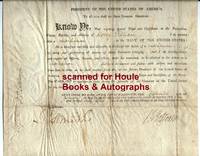
18092221587<p>RARE MIDSHIPMAN APPOINTMENT</p><p>"Th: Jefferson" Partly-printed vellum DS as president 1 page 10" x 10 1/2" January 16 1809. President Jefferson issues a naval appointment for Henry Pilliam. In part: "That reposing special Trust and Confidence in the Patriotism Valour Fidelity and Abilities of Henry Pilliam I do appoint him a midshipman in the Navy of the United States." Neatly signed at the conclusion by President Jefferson and countersigned by Secretary pf the Navy Robert Smith. The document bears an embossed Navy Department seal to the upper left. Intersecting folds overall wrinkling and light staining otherwise fine condition. Such appointments by Thomas Jefferson are quite scarce as he and the Republican party opposed a strong navy. However as Jefferson's term neared its conclusion the naval forces were beginning to grow out of necessity in order to protect the maritime interests of the United States as merchant vessels were  frequently being interfered with during their voyages on the high seas. Ultimately these disputes would culminate in the War of 1812 during President Madison's administration. A desirable and well-preserved example of a Jefferson appointment. Very good.</p> unknown books
36596Birmingham England late 18th century. Oblong quarto. 7 1/2 x 11 inches. 113 engraved plates on laid paper priced throughout in manuscript. Later calf backed marbled paper covered boards flat spine ruled and lettered in gilt.<br/> <br/>A rarely encountered pattern book or trade catalogue of 18th century English furniture hardware including drawer pulls keyholes hinges locks castors bolts and more.<br/> <br/>By 1770 over thirty different brass foundries operated in Birmingham England making it the epicenter of furniture hardware design in the last quarter of the 18th century. At roughly the same period trade catalogues like the present began to be issued by both furniture and hardware makers alike. In all over 500 designs are shown on the 113 consecutively numbered plates from rather simple hinges to incredibly ornate pulls. Although no engravers' names are identified it has been suggested that the foundries themselves produced such plates utilizing the talents of their own craftsmen who by their very occupation would have been highly skilled at etching on metal. Such pattern books "illustrate the beginning of what was then a new movement in the conditions of the crafts namely the growth of the organised factory as a means of production and distribution as compared with the earlier limitation of these functions to the efforts of individuals" Young.<br/> <br/>Cf. Hummel Charles F. "Samuel Rowland Fishers Catalogue of English Hardware." Winterthur Portfolio Vol 1 1964: 188-197; cf. Symonds R. W. "An Eighteenth-Century English Brassfounders Catalogue." Magazine Antiques Feb. 1931: 102-105; Young W. A. comp. Old English pattern books of the metal trades: a descriptive catalogue of the collection in the V&A Museum. London: HMSO 1913. unknown books
2221848<p>"Ike" 3 pages to wife Mamie no date but ca. 1944. 9" x 6". Fine.</p><p>Eisenhower pens a heartfelt letter to Mamie while in the depths of war: "The Russian fight continues to stir me to the depths of my soul. They're hitting so hard that no one can fail to admire them. I hope they kill a million Huns -- even more! And I wish we could be hammering at the d--- Germans this instant just as hard and on as big a scale as the Russians."</p><p>Dwight D. Eisenhower 1890-1969 was the 34th President of the United States from 1953 until 1961. He was a five-star general in the United State Army during World War II and served as Supreme Commander of the Allied Forces in Europe.</p> unknown books
181633472France 1816. 15 watercolors each with an accompanying manuscript text leaf plus watercolor and gold title leaf on sheets approximately 14 1/2 x 11 inches. Contemporary green morocco spine gilt lettered all edges gilt. Boards a bit scuffed edges somewhat worn spine faded. Occasional faint foxing.<br/> <br/>A lovely album of botanical watercolours.<br/> <br/>An exceptional album of fifteen botanical watercolors which are accompanied by an expertly accomplished manuscript description within blue and gilt borders. Each image depicts a different class of plant life while the text describes families of plants within that class. The images range from agarics mushrooms to ornate roses and camellias and include watercolors of honeysuckle blueberries azalias oaks and marvels-of-peru. Every text leaf contains a detailed analysis of the different families of the depicted plant in a neat and legible French hand. A beautiful example of an amateur artist's book of botanical scholarship. unknown books
WALTER-FILM000325No binding. Very Good. Fine Art Print Vintage original 41 x 27 103 x 68 cm. one sheet poster USA. Gene Tierney Clifton Webb Dana Andrews Judith Anderson Vincent Price dir: Otto Preminger; Twentieth Century Fox. One of the rarest and most desirable of all posters for this classic film noir one of the finest and best remembered of the genre. Perhaps the most romantic and one of the most haunting of all noir posters. Story of a beautiful girl in a painting who is believed to have been murdered the police investigator who falls in love with her image and her jealous Svengali. Lovely portrait of the iconic Tierney. On linen there has been touch-up to the fold lines and touch-up to one tiny tear near the right edge middle fold near Vincent Price shoulder. Immaculate colors a really clean copy ABOUT FINE. unknown books
1810WRCLIT67042Japan 1810. Folio 33 x 27.5 cm. Late 19th or early 20th century marbled calf raised bands spine gilt extra gilt label a.e.g. with watercolor river scenes on paper onlaid as doublures. Binding extremities rubbed images offset a bit to interleaves occasional patches of darkening to backgrounds of a few images one corner of an interleaf creased and a bit torn but otherwise very good to near fine. A lovely collection of watercolor images on silk of birds moths and butterflies the artist unknown but the paintings executed with great skill. The twenty-two individual panels vary somewhat in size but approximate 24 x 20 cm to 20 x 16cm and each includes several specimens: in the case of the birds 2-4 in the case of the Lepidoptera 5-10. The individual panels are mounted to heavy stock via blue silk bordering. The birds are identified via manuscript captions next to each bird; the Lepidoptera are not captioned. A pencil note on the free endsheet in an early hand dates the paintings somewhat earlier 1700-1750 Shijo School than do those later in its most recent provenance: tipped in unidentified mid-20th century auction description dating the paintings to early 19th century - private collection. hardcover books
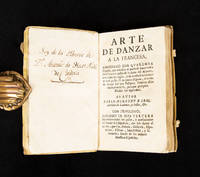
175834566Madrid: The Author 1758. 16mo. ca. 150 x 103 cm. Full contemporary vellum with manuscript titling to spine leather ties. 1f. recto title verso blank 1f. "Al Lector i privileges dated July 2 9 and 10 1737 iii "Advertencia" 72 pp. text 20 engraved plates of choreographic notation of dances including those by Feuillet and Pecour with music with alternate rectos and versos blank as issued. With one folding plate of engraved music between pp. 35 and 37.<br/><br/>With charming woodcut depictions of both male and female dancers one with an accompanying musician illustrating positions of the arms and feet and dance etiquette including bowing and managing one's hat. Diagrams and choreographic notation within text. <br/><br/>The final textual section "Explicacion del Danzar a la Española" offers detailed definitions of 46 steps used in Spanish dance followed by descriptions of "Danzas a la Española ." including the pabana the gallarda the españoleta the villano the impossibles and the hermosa. <br/><br/>Plates include:<br/>- Explicn. de la Chorographia<br/>- Movimentos de los Brazos Codos etc.<br/>- Demonstracion de la Bretaña<br/>- Rigodon ô Allegro de la Bretaña<br/>- El Amable con otra Chorographia<br/>- La Pastoril demonstda. redonda y larga<br/>- La Diligenta delinda. â lo largo ô larga<br/>- La Cortesana Cont. quadrada ô en quadro<br/><br/>Free front endpaper with elaborate contemporary paraph verso with contemporary inscription: "Soy de la Libreria de Dn. AntonÃo de Hozes Ferñz de Cordova."<br/><br/>Binding slightly worn; ties partially lacking; endpapers slightly worn; free front endpaper slightly stained. Minor internal wear and soiling; some leaves browned; occasional foxing; several small virtually invisible professional archival repairs. Rare third edition of the work demonstrating the foundations of dancing in the French style considered of greater elegance than the Spanish first published in 1737. Derra de Moroda 1856 edition of 1758. Malkin 79 edition of 1737. Niles & Leslie pp. 360-361 edition of 1758. Waterloo p. 144 RISM Écrits p. 587 editions of 1758 and 1768. All with variant titles no recorded copies with this title. <br/><br/>Minguet's manual incorporates material from two other important early 18th century dance treatises Feuillet's Chorégraphie Paris 1700 and Rameau's Le Maître de danser Paris 1726.<br/><br/>"A compilation of Feuillet Rameau and De la Cuisse. His engravings however are superior to the originals of the fore-mentioned and make his Arte de Danzar perhaps the most important treatise in 18th century Dance literature in Spanish." Niles & Leslie<br/><br/>"Spain was one of the first countries to record its social dances in a system of dance notation and notation was to be an important element in dance manuals of the eighteenth century. The first Spanish book devoted entirely to dance was Discursos sobre el arte de danzado 1642 by Juan de Esquivel Navarro dancing master to Philip IV. The next dance book by Bartolemé Ferriol y Boxeraus did not appear until a century later in 1745. Pablo Minguet e Irol a famous engraver as well as an author and translator published works on a wide range of subjects; his dance books included several important works which incorporated the French dance notation of Raoul-Auger Feuillet." International Encyclopedia of Dance 5 p. 670. <br/><br/>"A particularly lovely set of illuminations can be found in Pablo Minguet e Yrol's Arte de danzar à l a francesca." op. cit. 6 p. 124. <br/><br/>Antonio de Hoces Fernández de Córdoba 1722-1782 was a "Master of Seville" and served as mayor of Cordoba. [The Author] unknown books
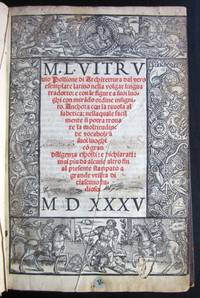
1535SAV123Venice: Nicolo de Aristotele detto Zoppino 1535. Hardcover. Very Good. Folio 295 x 190mm. 12 I-CX 110ff. Signatures: AA6-BB6; A8-N8; O6. Title printed in red and black with woodcut block border depicting strewn armor and dueling knights with wreathed portrait of Cicero at top and plaques with monogram initials of Roman Emperors Fabius Maximus Julius Caesar and Alexander Magnus. 136 woodcut in-text illustrations depicting lives of primitive humans the famous Vitruvian Man on p. XXII constellations rules for perspective and other mathematical figures and diagrams of architecture. Woodcut historiated chapter initials throughout of repeating portraits. Translated by Benedetto Giovio 1471-1545. Edited by Francesco Lutio Durantino. 19th-century calf with decorative stamps spine stamped in gilt TRAT DE ARCH endpapers renewed; loose in binding some margins trimmed close some light worming at least six early cancelled inscriptions on title leaf CX with significant excision otherwise an crisp and clean text block with wonderful woodcut impressions. 19th-century inscription on fly-leaf Famoza Archi-tectura. Another 19th-century inscription on front flyleaf Presented to the Mercantile Library Association of New York by Philip A Reach .Consul/ Lisbon Jan. 7 1848. Sold in 1958 on removal of Architecture Books from the Library pencil note. Rare illustrated Durantino edition of Vitruvius printed in Venice by Zoppino in 1535. This Vitruvius work was first printed in 1521 for Como. As it gained notoriety another edition in the vernacular Italian was prepared by Giovanni Antonio and Pietro de Nicolino da Sabbio in 1524. It incorporated woodcuts from a 1511 Latin edition produced by Giovanni Giocondo in Venice Tacuino. This Zoppino printing had a newly redesigned title-leaf with an elaborate woodcut border of chivalric battle scenes between Augustus Caesar Julius Caesar and Alexander the Great. The 136 in-text woodcuts are an all too interesting miscellany of late-medieval life nature and architecture and are characteristic of Vitruvian ideals in regards to proportion ornament language space place and beauty. The famous figure of Symmetria Vitruvian Man is present on p. XXII. Both the 1524 and 1535 editions were widely read by an Italian public. Vitruvian principles deeply influenced early Renaissance artists thinkers and architects who believed they were rediscovering an ancient discipline which would be the foundation of their culture. <br/><br/>Rare illustrated Durantino edition of Vitruvius printed in Venice by Zoppino in 1535. This Vitruvius work was first printed in 1521 for Como. As it gained notoriety another edition in the vernacular Italian was prepared by Giovanni Antonio and Pietro de Nicolino da Sabbio in 1524. It incorporated woodcuts from a 1511 Latin edition produced by Giovanni Giocondo in Venice Tacuino. This Zoppino printing had a newly redesigned title-leaf with an elaborate woodcut border of chivalric battle scenes between Augustus Caesar Julius Caesar and Alexander the Great. The 136 in-text woodcuts are an all too interesting miscellany of late-medieval life nature and architecture and are characteristic of Vitruvian ideals in regards to proportion ornament language space place and beauty. The famous figure of Symmetria Vitruvian Man is present on p. XXII. Both the 1524 and 1535 editions were widely read by an Italian public. Vitruvian principles deeply influenced early Renaissance artists thinkers and architects who believed they were rediscovering an ancient discipline which would be the foundation of their culture. Nicolo de Aristotele detto Zoppino hardcover books
WALTER-FILM000093No binding. Very Good. Fine Art Print Vintage original 41 x 81"" 102 x 202 cm. three sheet poster style A USA. Ronald Colman Joan Bennett Colin Clive Nigel Bruce Montagu Love dir: Stephen Roberts; Twentieth Century Fox. The title for the film originated in the popular 1892 song of the same name. This is the story of Paul Gallard Colmen a once artistocratic Russian prince called White Russian displaced during World War I who is living in Paris and earns his living driving a taxi. Traveling to Monte Carlo he gambles with money supplied to him by his compatriots. Fortunately he wins breaking the bank. The casino loves the publicity it could bring them particularly should he return to the tables but instead he warns the public of the hazards of gambling. The film was highlighted by Colin Clive's villainous performance. Film was made at the time of the merger between Twentieth Century and Fox Pictures. Stunning portraiture of Coleman and Bennett with scenario of Coleman at the gambling table. On linen NEAR FINE. unknown books
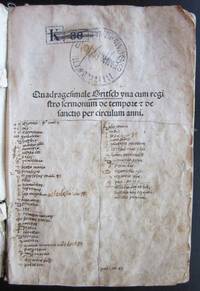
1495SAV133Venice: Lazarus de Suardis 1495. Paperback. Very Good . Venice: Lazarus de Suardis 21 March 1495. 8vo 173 x 116 mm. 284 leaves. Collation: 1-84 a-H in 34 gatherings of 4. Woodblock monogram printers device on colophon leaf. 48 lines double column Gothic type with printed guide letters. Stamp of the St. Charles Borromeo Seminary Library deaccessioned and two library shelfmarks pasted in Q83 and K30. Contemporary limp vellum; lightly soiled with some dampstains backstrip partly perished with partial ms. title and light edgewear; lower outer corner of l5 and D2 torn affecting a few words but in remarkable shape given its extensive use; cloth folding case. Title extensively inscribed in Latin with two columns of a subject index for sermons. The annotator was interested in indexing themes like heaven paradisus and hell infernus or Virgin Mary and Evangelists and easily being able to locate sermons for certain medieval virtues and vices or sins like luxury patience love anger and justice. Early biographical inscriptions on rear blank date to probably to the mid-sixteenth century and venetis gives this book a probable Venice home at one point. There are further scattered annotations notes and references to the index which reflect on sermons of interest. This book likely once belonged to preaching Franciscan monk from northern Italy. This monastic association is further evident with an ownership inscription in the lower margin of a1 Iste Liber est fratus dominici. Preaching was most closely associated with the Franciscans who also traveled extensively to reach audiences. The compact octavo format and lightweight wrappers of this volume would have made transportability much easier. Incunable edition of Johannes Gritschs register of medieval sermons called the Quadragesimale with an interesting period index of subjects probably added by a Franciscan scribe. Johannes Gritsch of Basel himself a Franciscan monk delivered his sermons in German and translated them in simple Latin ready for translation and adaptation to the vernacular. He used scriptural passages supporting texts from classics and fables and exemplary stories to prove moral grounds. Two main themes have been recognized to dominate the medieval sermon: the awareness of death and the need for contrition. Preachers would have relentlessly implored their audience to come to repentance. Brother Dominic the early modern friar who heavily used this book was no exception. He leaves evidence of his moral preaching interests throughout the book. The preliminary subject index is an invaluable glimpse into a composing preachers mindset at the dawn of the sixteenth century. This is the twenty-first edition of Gritschs Quadrigesimale which included fifty numbered sermons and additional sermons for specific church feasts; the first appeared in 1468 and a succession of printings appeared well into the sixteenth century. In fact a Lyons edition of the "Quadragesimale" was produced just one month later after this one in 1495 by Joannes Treschel. Printed sermon compilations were especially popular in monastic communities where volumes of model sermons would have enjoyed wide circulation. ISTC ig00506000. <br/><br/>Incunable edition of Johannes Gritschs register of medieval sermons called the Quadragesimale with an interesting period index of subjects probably added by a Franciscan scribe. Johannes Gritsch of Basel himself a Franciscan monk delivered his sermons in German and translated them in simple Latin ready for translation and adaptation to the vernacular. He used scriptural passages supporting texts from classics and fables and exemplary stories to prove moral grounds. Two main themes have been recognized to dominate the medieval sermon: the awareness of death and the need for contrition. Preachers would have relentlessly implored their audience to come to repentance. Brother Dominic the early modern friar who heavily used this book was no exception. He leaves evidence of his moral preaching interests throughout the book. The preliminary subject index is an invaluable glimpse into a composing preachers mindset at the dawn of the sixteenth century. This is the twenty-first edition of Gritschs Quadrigesimale which included fifty numbered sermons and additional sermons for specific church feasts; the first appeared in 1468 and a succession of printings appeared well into the sixteenth century. In fact a Lyons edition of the "Quadragesimale" was produced just one month later after this one in 1495 by Joannes Treschel. Printed sermon compilations were especially popular in monastic communities where volumes of model sermons would have enjoyed wide circulation. ISTC ig00506000. Lazarus de Suardis paperback books
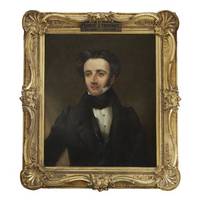
1837690621837. 29 inches x 24 1/4 inches. 29 inches x 24 1/4 inches. An Important Nineteenth-Century Pennsylvania Jurist American School 19th Century. Troubat Francis Joseph 1802-1868. Portrait of Francis Joseph Troubat. Philadelphia c.1837. 29" x 24-1/4" image size. Oil on canvas in ornate nineteenth-century gilded wood frame small plaque reading "Francis J. Troubat/ Born 1802-Died 1868" to head of frame. Some minor nicks and chips to frame gilding slightly dulled otherwise fine. $5000. A prolific writer of legal texts Troubat is best known as the co-author with William W. Haly of The Practice in Civil Actions and Proceedings in the Supreme Court of Pennsylvania in the District Court and Court of Common Pleas for the City and County of Philadelphia and in the Courts of the United States 1837. This portrait belonged to the Philadelphia Bar Association. Founded in 1802 it is the oldest association of lawyers in the United States. Its library where this portrait was last displayed was renamed the Theodore F. Jenkins Memorial Law Library in 1967. unknown books
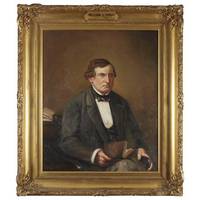
1876690691876. 39-1/2" x 31-1/4. 39-1/2" x 31-1/4" A Notable Nineteenth-Century Philadelphia Lawyer and Democratic Politician American School 19th Century. Hirst William L. 1804-1876. Portrait of William L. Hirst. 31-1/4" x 39-1/2" image size. Oil on canvas in ornate nineteenth-century gilded wood frame. Some minor nicks and chips to frame gilding slightly dulled otherwise fine. $3750. Hirst had a thriving private law practice and was active in Democratic politics. In 1853 Hirst was elected President of the Democratic State Convention. He was an early proponent of the City of Philadelphia consolidation. This portrait belonged to the Philadelphia Bar Association. Founded in 1802 it is the oldest association of lawyers in the United States. Its library where this portrait was last displayed was renamed the Theodore F. Jenkins Memorial Law Library in 1967. unknown books
59115Photograph albums. Oblong folio. 2 volumes: 401 mounted photographs 4 3/8 x 2 to 3 1/2 x 5 3/4 inches; 102 mounted photographs 2 3/4 x 1 7/8 to 3 1/2 x 5 3/4 inches predominantly of the larger size in both volumes and with nearly all of the images captioned in white. Included are sections dedicated to Pinehurst North Carolina 75 images Lake Placid New York 37 Detroit Michigan 68 and several other eastern United States locales where Bigelow and his family lived and vacationed and depictions of the Sound Beach Golf Club of Old Greenwich Connecticut in its inaugural year of 1905 6 the Detroit Country Club in 1905 4 the Pinehurst Golf Club in 1905 16 identifying golfers George Low Sr. Alex Findlay Andrew Kirkaldy Alan Lard and Donald and Alec Ross photo-essays on the 1906 and 1910 Vanderbilt Cup Automobile Races at Westbury Long Island 13 Dyker Meadow Golf Club in 1907 Brooklyn New York 6 the White Mountain Express train wreck of 1908 4 Salisbury Golf Links & Club in 1911 Garden City New York 6 a 1911 Lake Placid fire department drill 7 and the Ann Arbor and Detroit Golf Clubs in 1915 and 1925 8. Scattered through the text are images of other golf courses and country club buildings a baseball game and cricket match horseback riding and other outdoor sporting activities making a total of about 130 in the album 25 per cent of the total. Covers very worn but images for the most part are bright and sharp. Original gilt-stamped suede rear cover detached spine eroded yapped edges chipped and gilt-stamped brown fabrikoid tied original ties replaced. #6114. Of particular interest is the 75-image section documenting the early days of the Pinehurst development a photo-essay examining the relatively new golf resort which had opened its first course in 1899 and saw Donald Ross appointed golf pro there in 1900 a position he would hold until his death in 1948 productive decades that would find him designing over 400 courses in the United States; this section of the first album includes in addition to the 16 images of the golf course and golfers photographs of the train depot a "Negro cabin" 'possum hunting elaborate cottages the town hall an African-American with his wagon pulled by the "oldest mule in the state" sand hills pine stands and other scenery quail hunting the deer park owl cage and hennery the golf club house and an old turpentine mill. Other sections of the albums picture Bigelow and his family living vacationing and participating in various outdoor activities as they moved from Brooklyn to Greenwich and Farmington Connecticut Long Island Grosse Point Michigan and Philadelphia and visited a wide range of cities and outdoor destinations in the south middle Atlantic and upper midwest states. The Vanderbilt cup race was the first major trophy in American auto racing; the inaugural race in 1904 and the next two were held on winding dirt roads in Nassau County Long Island suspended for a year and then held 1908-1910 on the Long Island Motor Parkway the first specially built racetrack in America. We have not found much information on Bigelow; apparently he studied at Cornell in the 1880s playing on the baseball team competed in tennis and golf tournaments around New York in the 1890s and 1900s and was a member of the Brooklyn Boat Club in the 1910s. Nevertheless his photograph albums offered here provide an expansive look at the leisure activities of the well-to-do in the early decades of the 20th century especially revealing for the views of American golf courses clubs and play just at the time when the wave of professionals from Scotland began to make their presence felt with improved course design and instruction. <br/><br/> unknown books
192121397El Paso Texas: Not Published 1921. The collection includes over 150 dated and signed letters written to and a few items from Dr. Lucinda DeLeftwich Templin 1888-1969 author historian & collector ".one of El Paso's best-loved and most distinguished educators - in 1916 she took her undergraduate and Master's at U. of Missouri and became Dean of Lindenwood College in St. Charles MO. did doctoral work at Harvard and Columbia and took over as principal at the Radford School in 1927 at the time called El Paso School for Girls; Dr. Templin interested Mr. and Mrs. G. A. Radford of Webster Grove Mo. in the school and the Radfords paid off the mortgage provided an endowment fund that insured the institution's stability and the name of the school was changed in honor of these benefactors. During Dr. Templin's administration Radford School grew to a nationally accredited school for girls in the Southwest and when she retired in 1967 the 22-acre campus had more than $1000000 in physical improvements and was debt-free. Dr. Templin had also completed plans for construction of a $400000 library and museum on property owned by the school; she was a member of the nation's leading educational organizations and honorary societies named consistently to Who's Who in America and Who's Who in American Education; author of numerous publications most of which were concerned with the field of education. The above material from her obituary; This wide-ranging diverse collection has three intertwining themes - letters concerning Dr. Templin's ongoing interest in education and educational materials for her school letters which relate to the business and academic part of Radford and letters of reference for applicants and correspondence which relates to the creation of her War Museum where she collected military autographs uniforms photographs paraphernalia weapons from around the world. A sampling of what is found here chronological order: 1921 Dr. James G. Kiernan writing about some autographs he was sending to Templin - he was famous for the earliest-known use of the word heterosexual in the United States; 1921 Ellen Shaw Barlow writing in relation to the national Committee on Prisons and Prison Labor requesting Templin's presence for a meeting of the Committee on the Care and Training of Delinquent Women and Girls; 1926 Roy Franklin Nichols 1896-1973 American historian and a Pulitzer Prize winner writing regarding one of Templins' publications; 1928 Breckinridge Long 1881 - 1958 diplomat and politician served in the administrations of Woodrow Wilson and Franklin Delano Roosevelt on Democratic National Committee letterhead - regarding a portrait of Rev. John Breckinridge his great-grandfather Templin was sending in appreciation of his " defense of Religious Freedom "; Federico de Onis Sánchez 1885 - 1966 Spanish writer and literary critic taught Spanish literature at Columbia University in New York concerning a recommendation of one of his students for a position at Radford ; educator John L. Bergstresser; Jessie H. Humphries Associate Dean Texas Womens University; Butler Ames 1871-1954 American politician engineer soldier and businessman; Richard Fenner Burges 1873-1945 Texas legislator and conservationist; Alice Mildred Burgess; William Blair Roberts 1881-1964 Episcopal Suffragan Bishop South Dakota; Katharine Denworth president of Bradford Academy regarding an article on sororities in colleges; N. Floyd Templin of the Ohio House of Representatives writing on Templin family genealogical matters; John G. Barry consulting mining geologist and engineer of El Paso regarding an educational alliance between the Radford School and the Texas College of Mines; Arthur L Burroughs publisher writing about the subject of grammar in education; Harriet M. Chase of the National Education Assoc.; Jack Braveheart regarding a talk on the American Indian; Ivan Lee Holt Methodist bishop of St. Louis; Cornelia McKinne Stanwood of the Sarah Dix Hamlin School San Francisco; Joseph Dorfman economic historian at Columbia Univ. asking Templin about her studies with Thorstein Veblen; an interesting 2-page letter from Dr. J. Travis Bennett of El Paso regarding the setting-out of a chart for the physical examination and reportage on condition of applicants to Radford with suggestions; Bertha Baur 1858-1940 directed the Cincinnati Conservatory of Music; A.F. Kuhlman Assoc. Dir. University of Chicago regarding research work on childrens' reading habits information; Dr. William S. Gray 1885-1960 American educator and literacy advocate also of U. of Chicago on the same subject; Sallie Caldwell Teachers College Columbia University regarding early learning & English curriculum materials; Mrs. Florence F. Osgood of the Neshobe camp for girls in Vermont requesting an alliance with Radford School; U.S. Army major later colonel Livingston Watrous; Colonel D.C. Pearson New Mexico Military Institute; Ruth Elliott of Wellesley College; Chris P. Fox sheriff El Paso regarding falling down on the job for police protection near the school; Brent N. Rickard American Smelting & Refining Works; Louise Traxell Greeley Dean of Women at U. of Wisconsin Madison; Lieutenant Colonel Joseph P. Aleshire Fort Bliss Texas; Mrs. L.J. Calvocoressi Chairman of the Women's Auxiliary of the Greek War Relief Assoc.; Lt. Col. later major-general Ray. T. Maddocks; Robert E. McKee Sr. 1889-1964 major U.S. contractor engineer builder; Columbia Broadcasting System program press information director George Crandall; Colonel later Brig. General Charles G. Sage; Elmer Davis 1890 1958 news reporter author the Director of the United States Office of War Information during World War II and a Peabody Award recipient; William McChesney Martin Jr. 1906-1998 ninth and longest-serving Chairman of the United States Federal Reserve serving from April 2 1951 to January 31 1970 under five Presidents; Bernard Hoffman 1913 - 1979 American LIFE magazine photographer and documentary photographer first American photographer on the ground at Hiroshima and Nagasaki after the atomic bomb was dropped in 1945; Alfred E. Stearns Chairman Overseas Schools Committee; Colonel Hugh J. Deeney Chief of the Adjutant General Division; Col Harold R. Turner first commander of White Sands Missile Proving Ground; Guy Sylvestre Jean-Guy Sylvestre OC FRSC 1918 -2010 Canadian literary critic librarian and civil servant; Rear Admiral Barry Kennedy Atkins 1911 -2005 officer of the United States Navy best known for his achievements as a destroyer captain in World War II; R. Burdell Bixby prominent Republican of NY State; Robert W. Hamilton justice of the Texas Supreme Court regarding a Radford school girl reference; Colombian world federalist Santiago Gutiérrez; M.S. Sundaram Head of Education Indian embassy; Raymond L. Telles Jr. b. 1915 was the first Mexican-American Mayor of a major American city El Paso Texas 3 letters; Ángela Acuña de Chacón Chilean who served as commissioner 1960-1972 on the Inter-American Commission on Human Rights; William G. Stark Consul General of Canada; Rene Mascarenas Miranda Municipal President mayor of Juarez; Gordon Llewellyn Allott 1907-1989 Republican politician; Mrs. William Barclay Parsons president of the National Council of Women of the United States; John Koehler Gerhart 1907 - 1981 United States Air Force four star general; J. T. Rutherford 1921 - 2006 United States Representative from Texas; R. G. Follis Chairman of Board. Standard Oil Company of California; Robert John Morris 1914-1996 President of the University of Dallas American anti-Communist activist 2 notes; Karl Robin Bendetsen 1907 -1989 remembered primarily for his role as architect of the internment of Japanese Americans during World War II; Elmer Ellis 1901 - 1989 American educator and fourteenth president of the University of Missouri; historian C.L. Sonnichsen; Marshall S. Carter Deputy Director of Central Intelligence CIA; Millicent C. McIntosh 1898-2001 fourth dean of Barnard College 1947-1952 and the College's first president - this is the last letter dated 1962 and in it Dr. Templin is asking for McIntosh to help with providing a successor to the headship at Radford - Templin was soon to retire and died relatively soon afterwards. Some of the letters and notes are very short with limited content; others more voluminous.Additional materials include: letters to another Templin family member from Scott Wike Lucas 1892 - 1968 two-term Democratic United States Senator 1939-1951 from Illinois and Joel Bennett Clark 1890 -1954 better known as Bennett Champ Clark Democratic United States Senator from Missouri from 1933 until 1945 later a United States federal judge; and a few other letters; an undated letter to Templin from pianist Ola Gulledge; a two -page undated letter on The American School Foundation Mexico letterhead; a few letters from Frank S. Ross Major Gen. U.S. Army regarding the Templin War Museum project; a clipped signature of Alvan Tufts Fuller 1878 -1958 and one of John Kieran; and a unidentified sepia-tone matte-finish photograph circa 1920s that may be Dr. Templin or perhaps a friend; a few of the items with the original mailing envelopes; many letters with old adhesive residue from being mounted at some time some with old tape marks in the corners some of the items trimmed as if to accommodate in a smaller frame or album not here; old fold lines ageing; some with corner-attrition due to being removed; in overall good to very good condition and an interesting group of material encompassing the rich educational business and personal life of this well-known Texas woman educator whose contacts spanned the United States and the world. . Unique. Not Bound. Very Good. Not Published Paperback books
161037309Etonae: In Collegio Regali excudebat M. Bradwood for Ioannes Norton in Graecis &c. regius typographus 1610. 4to 22.8 cm; 9". 4 ff. 73 1 pp. 4 ff. <br><br>One of the first two books printed at Eton both in Greek and both printed in 1610. The Byzantine poetry here is from the pen of John Mauropus an 11th-century teacher hymnographer orator Byzantine Greek poet and correspondent of scholars.<br>Â Â Â Â This the editio princeps was edited by and has the notes of Matthew Bust 1543 or 15441613 Fellow of Eton College and father of his namesake who was Master of Eton 161130. The prefatory matter and notes are printed in Latin in italics and the main text is in a large greek face; the actual printer's name is from STC.<br>Â Â Â Â Searches of STC WorldCat and ESTC locate many copies in Britain and even Europe but only five in U.S. libraries.<br>Â Â Â Â Provenance: 18th-century ownership inscription at top of title-page: "Petri Bonifantii." Most recently in the library of American collector Albert A. Howard small booklabel "AHA" at rear.<br>Â Â Â Â => An amazing early English schoolbook! <br>Â Â Â Â <br>Â Â Â Â STC rev. 14622; ESTC S103427. 20th-century quarter red morocco with red cloth sides. Light age-toning and some stray ink spots. In fact very good. In Collegio Regali, excudebat [M. Bradwood for] Ioannes Norton, in Gr[a]ecis, &c. regius typographus hardcover books
1744D4448France 1744. Hardcover. Very Good. Manuscript book on paper in French. c.1744. 8vo 166 x 106mm. 8 355pp. written in brown ink in a clear humanist script with some calligraphic aspects between framed pages in a single column of approximately 28 lines headings in Roman majuscules. With 89 full-page diagrams and technical illustrations of sundial construction and usage and other supporting images three are on plates and two of which are folding at rear. Contemporary mottled calf spine gilt in compartments labeled Gnomonique on gilt red morocco lettering piece marbled endpapers & edges; edges uniformly toned occasional stains; expertly rebacked preserving the original spine somewhat worn. Full contents listed on first 6 pages for this expertly executed and comprehensive compendium on the sundial. The objective of this manual is to enable the 18th century audience to understand the operating principle of sundials by describing the construction and manipulation of different forms of sundials including the planet-sundial moon-clock celestial houses-clock polar-clock ancient Babylonian and Jewish clocks as well as the construction of quadrants and astronomical tables. The suns position in the sky has always been an obvious means to keep track of time. The use of shadows of sticks cast by the sun were a natural means of indicating the time of day by the direction of the shadow and the time of year by its length. Although town squares began constructing clocks beginning somewhere in the 14th century sundials remained in the picture well into the 18th century. Mechanical clocks were expensive and could be found only in the most noble of homes. They were also more of a curiosity at first; most people still used their sundials or just estimated the time of day by the height of the sun in the sky. In 1777 when the French General Lafayette wanted to express his admiration for his ally and friend General George Washington during the American Revolution he chose a silver Explorer sundial as his gift. But by the close of the 18th century clocks and watches began to supersede sundials. They had one huge advantage- they worked all day long and were not dependent on weather. However they were also notoriously unreliable- telling time only approximately within an hour and needing to be reset frequently of course with the help of a sundial. Although the work of this study is anonymous an ownership entry at the foot of the title helps to date the work: Hic est Thorridon Rectoris Laurentii Moussault 1744. This wide-ranging study of the sundial appears at a time when the mechanical clock was on its way into popular fashion. A unique scholarly work that may well be one of the last close studies of such an ancient and important time-telling tool. <br/><br/> hardcover books
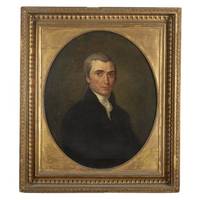
1815690611815. 25 inches x 20 inches. 25 inches x 20 inches. A Great Nineteenth-Century Pennsylvania Jurist American School 19th Century. Read John Meredith 1797-1874. Portrait of John Meredith Read. Philadelphia c.1815. 25" x 20" image size. Oil on canvas in ornate nineteenth-century gilded wood frame. Some minor nicks and chips to frame gilding slightly dulled otherwise fine. $3000. Read was elected to the Pennsylvania House of Representatives in 1822 and 1823 and served as City Solicitor of Philadelphia from 1830 to 1833. He was appointed District Attorney of the Eastern District of Pennsylvania in 1837 and held the office until 1845. Read became Justice of the Supreme Court of Pennsylvania in 1858 and Chief Justice of the Supreme Court of Pennsylvania in 1872. Read gained an international reputation for the depth of his knowledge eloquence and masterly arguments in the courtroom. Active in politics Read was an early supporter and organizer of the Republican Party. This portrait belonged to the Philadelphia Bar Association. Founded in 1802 it is the oldest association of lawyers in the United States. Its library where this portrait was last displayed was renamed the Theodore F. Jenkins Memorial Law Library in 1967. unknown books
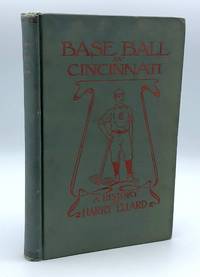
1907403892Cincinnati: Johnson & Hardin for the Author 1907. 8vo. 252 pp. Frontispiece portrait of the author 57 plates. Original grey cloth blocked in red on front cover lettered on spine. A very good copy hinges cracked light wear at extremities. As-issued without jacket. SCARCE FIRST EDITION one of 500 copies of the "Subscriber's Edition" this copy out-of-series. Inscribed on the front free endpaper: "To my friend Henry Taylor Birch Captain of Antioch College Base Ball Team 1867-8 from Alfred K. Nippert Cincinnati O Oct 17th 1937." Birch was the pitcher in the historic first game between the Cincinnati Red Stockings and Antioch College. He later became a prominent Chicago attorney and philanthropist. A public park in Ft. Lauderdale FL bears his name and he donated paintings to the Art Institute of Chicago. Nippert was one of the most prominent judges in Cincinnati his wife was Maud Bamble Nippert heir to the Proctor & Gamble Company. Nippert traveled to Germany in 1916 with an unofficial message from President Wilson: he met with Kaiser Wilhelm stating that while Wilson did not doubt the sincerity of the German leaders he felt he had the support of the American people in his controversy with the Germans over submarine warfare. "In 1869 when the Cincinnati Red Stockings began their inaugural season as history's first professional baseball team they played a preseason game at the site of what is now the Grand Union Terminal in Cincinnati against the Antiochs who were regarded as one of the finest amateur clubs in Ohio. The game was played on May 15 1869 and Cincinnati defeated Antioch 41-7. Antioch had been scheduled to host the first game of this professional tour on May 31 1869 but pouring rain and an unplayable field kept the teams off the diamond. So while Antioch was not a part of the first professional baseball game the college does hold claim to hosting the first ever rainout in professional baseball" Guschov Stephen D. The Red Stockings of Cincinnati: Base Ball's First All-Professional Team and its Historic 1869 and 1870 Seasons Jefferson NC.: McFarland & Co. 1998 p. 45. Ellard writes of the game with Antioch on page 154 though he gets the details wrong see Dan Hotaling "The Antioch Connection The First Professional Game". Ellard's father had been a founding member of the Red Stockings often cited as the first professional club. Most of the book is dedicated to the Red Stockings of 1866-1870 which went undefeated for 1869 and much of 1870. The author had unique access to the original records of the club. . <br/><br/> Johnson & Hardin for the Author hardcover books
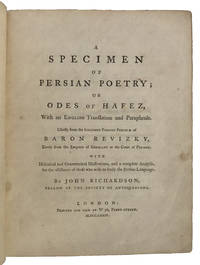
1774ME1081London:: Printed and Sold at No. 76 Fleet-Street 1774. 1774. 4to. iv xv 1 68 pp. Original full calf gilt spine; neatly rebacked to style preserving original endsheets. Inscribed by an early owner "This Book belonging to Monsieur Pierre Monneron." Extremely rare. This is the first edition in English of the ghazals of Hafez translated by one of the leading Persian orientalists of his day John Richardson FAS of Wadham College Oxford and famous for his seminal work written in conjunction with Sir William Jones the work being A Dictionary Persian Arabic and English 1777. / Hafez was previously unknown to the western world until Count Karl Emerich Reviczky von Revisnye 1737-1793 the Hungarian Orientalist and bibliophile 'discovered' him and brought his poetic classic to Europe with this Vienna printing. The work features an extensive text on Hafez and a translation of selected ghazals . Reviczky von Revisnye also issued in 1784 1794 a catalogue of his Greek and Latin library using the pseudonym of "Periergus Deltophilus". In the prefatory essay for that volume he shows an interest in the printing of Nicolas Jenson Aldus Manutius and the Estiennes. / Hafez was born in Shiraz Persia and lived approximately from 1325/26–1389/1390. He is considered a mystic and poet. His life and poems are the subject of much analysis commentary and interpretation influencing post-fourteenth century Persian writing more than any other author. FULL TITLE: A Specimen of Persian Poetry; or Odes of Hafez With an English Translation and Paraphrase. Chiefly from the Specimen Poeseos Persicae of Baron Revizky Envoy from the Emperor of Germany to the Court of Poland. With Historical and Grammatical Illustrations and a complete Analysis for the assistance of those who wish to study the Persian language. Printed and Sold at No. 76, Fleet-Street, 1774. unknown books