274 résultats
181040869Philadelphia: C. and A. Conrad and Co. of Philadelphia; Somervell and Conrad of Petersborough; Bonsal Conrad and Co. of Norfolk; and Fielding Lucas Jr. of Baltimore. Printed by John Binns 1810. Text: 8vo 8 1/2 x 4 3/4 inches. Atlas: 4to 10 1/2 x 11 inches. Text: 2 1-277 5 1-65 1 1-53 1 1-87 1. 492 pp. Engraved frontispiece portrait of Pike Letterpress Title Deposit Statement To the Public To the President Pike's Expeditions Part I-III Appendices to Parts I-III. Atlas: 6 engraved maps 5 of which are folding. 3 folding tables. Text volume in contemporary tree calf expertly re-backed to style spine in six gilt-ruled compartments with gilt calf lettering-piece in second gilt date in sixth and blind center tool in rest. Atlas volume in contemporary quarter calf with tips over original blue paper boards with printed paper label spine in seven gilt-ruled compartments with gilt red morocco lettering-piece in second gilt date in sixth and blind center tool<br/> <br/> One of the most important of all American travel narratives; Pike's account contains the first maps to incorporate geographical knowledge of the Southwest based on first-hand exploration. It is a milestone in the mapping of the American West. Wheat Here in the rarest and most desirable form with the plates and maps in a quarto atlas.<br/> <br/> Pike's narrative along with that of Long and Lewis and Clark is one of the most significant early books on the exploration of the American West. As such it is a cornerstone of Western Americana. In particular Streeter felt its "description of Texas is excellent." Hill gives the following summary of its contents: "In 1805 Pike was given the difficult assignment of conducting a reconnaissance of the upper Mississippi region. He was ordered to explore the headwaters of that river to purchase sites from the Indians for further military posts and to bring a few influential chiefs back to St. Louis for talks. The trip was only moderately successful as a mission to the tribes but Pike was able to convey important geographical information to President Jefferson and other Washington officials. On Pike's second expedition 1806-1807 he was assigned to explore the headwaters of the Arkansas River then proceed south and descend the Red River from its source. Pike and his men were taken into custody by a Spanish patrol and Pike was able to observe many areas in New Mexico Chihuahua and Texas. His book created interest in the Southwest and stimulated the expansionist movement in Texas." The atlas volume consists of the following maps plus three tables: 1. "Falls of St. Anthony." 2. "Map of the Mississippi River from its Source to the Mouth of the Missouri laid down from the notes of Lieutn Z. M. Pike by Anthony Nau. Reduced and Corrected by Astronomical observations of Mr. Thompson at its source; and of Captn. M. Lewis where it receives the waters of the Missouri." 3. "The First Part of Captn. Pike's Chart of the Internal Parts of Louisiana. 40 miles to the inch by Anthony Nau." 4. "Map of the Internal Provinces of New Spain. The outlines are from the Sketches of but corrected and improved by Captain Zebulon M. Pike who was conducted through that Country in the year 1807 by Order of the Commandant General of those Provinces." 5. "A Chart of the Internal Part of Louisiana. Including all hitherto unexplored Countries lying between the River La Platte of the Missouri on the N: and the Red River on the S: the Mississippi East and the Mountains of Mexico West; with a part of New Mexico and the Province of Texas. By Z. M. Pike Captn U. S." 6. "A Sketch of the Vice Royalty Exhibiting the several Provinces and its Approximation to the Internal Provinces of New Spain." Tables: 1. "Recapitulation of Furs and Peltries Fond du Lac department Marks and Numbers as per margin. North West Company 1804-5." 2. "Abstract of the number &c. of the Nations of Indians residing on the Mississippi and its confluent streams from St. Louis Louisiana to its source including Red lake and Lower Red river." 3. "A Statistical Abstract of the nations of Indians who inhabit that part of Louisiana visited by captain Z. M. Pike in his tour of discovery in that country in the years 1806 and 1807."<br/> <br/> Bradford 4415. Braislin 1474. Field 1217. Graff 3290. Hill 1357 2004. Howes P373 "Best Issue." Jones 743. Rittenhouse 467. Sabin 62836. Schwartz and Ehrenberg p.225. Streeter sale 3125. Streeter Texas 1047C. Wagner-Camp 9:1. Wheat Transmississippi 297 298 299. C. and A. Conrad, and Co. of Philadelphia; Somervell and Conrad of Petersborough; Bonsal, Conrad, and Co. of Norfolk; and Fieldi unknown
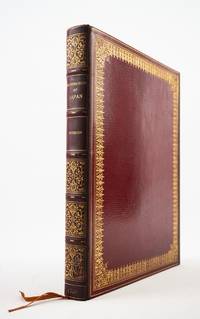
1822ST20877London: Printed for R. Ackermann 1822. First English Edition. 300 x 235 mm. 11 3/4 x 9 1/2". xvi 325 1 pp.Translated by Frederic Shoberl. <br/> Imposing contemporary crimson straight-grain morocco gilt covers with filigree frame with densely massed scrolling fleurons raised bands spine gilt in compartments with radiating viny scrolls surrounded by leaves and annular dots marbled endleaves all edges gilt. WITH 13 HAND-COLORED PLATES in etching and aquatint many after Japanese artworks one folding. Bookplate removed from front flyleaf. Bookseller's ticket of J. L. Thompson & Co Kobe Japan on front pastedown. Abbey Travel 557; Tooley 489; Martin Hardie "English Coloured Books" pp. 113-14. See also E. F. Strange "Japanese Illustration" pp. xxiii-xxiv. Spine and fore-edge of upper board slightly darkened a few minute flakes to lowest spine compartment but the binding extremely well preserved with very lustrous boards. Final 10 leaves slightly creased one repaired marginal tear but still A FINE COPY INTERNALLY exceptionally bright smooth and entirely fresh and clean.<br/> <br/> This generously proportioned production illustrated with 13 vibrant colored plates is a rare European account of Japan during the period in which the country was "closed" to the west offered here in its first English edition. Originally published in French in 1820 "Illustrations of Japan" is comprised of a history and description of the Tokugawa shogunate which Titsingh had translated from the Japanese plus Titsingh's own observations on the language customs and ceremonies of the Japanese people. The present English edition is accompanied by plates in etching and aquatint enhanced with hand coloring. Our author Dutch diplomat Isaac Titsingh 1745-1812 spent 14 years in Nagasaki for the Dutch East India company and between 1779-84 he served as trade director-cum-ambassador travelling to Edo now Tokyo for audiences with the shogun and other high officials in the shogunate. Unlike most of his Western contemporaries Titsingh was open-minded and curious about the people he encountered engaging with their art and culture; in fact art historian and Victoria & Albert Museum keeper Edward F. Strange tells us that Titsingh is the earliest known European collector of Japanese prints of which a number appear in the present volume. Our publisher Rudolph Ackermann 1764-1834 made his living issuing sumptuously illustrated books such as the present volume and was an early adopter of color aquatint and lithography technologies; Hardie writes that he was "the great presiding genius before whose magic wand so many pictorial books sprang into existence." In very attractive period morocco this is a particularly appealing copy of the work free of the foxing and offsetting that often plague copies of this and other large-format color illustrated books. Printed for R. Ackermann unknown
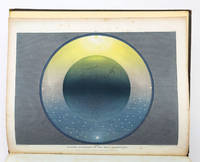
1846ST19286London: Printed by Catchpool & Trent for Simpkin Marshall & Co 1846. FIRST EDITION. 320 x 255 mm. 12 1/2 x 10". xiii 3 96 pp. <br/> Publisher's original blind-decorated dun-colored cloth gilt titling to upper cover smooth spine newer endpapers. WITH 11 COLOR ENGRAVINGS after Frost by W. P. Chubb & Son printed in oil colors by George Baxter all with original tissue guards. Front free endpaper with small ink signature of John Hill. See: Francis Reid "Isaac Frost's 'Two Systems of Astronomy' 1846: Plebeian Resistance and Scriptural Astronomy" in "The British Journal for the History of Science" Vol. 38 No. 2 Jun. 2005 pp. 161-177. Cloth rather spotted corners bumped but the binding solid with no wear to joints or hinges. A few spots of foxing to title page half of the tissue guards with overall very faint foxing/browning the illustrations with minor foxing at edges and in margins but the images themselves clean and bright and all in all a really excellent copy the text wide-margined and quite clean and fresh and the plates with rich coloring.<br/> <br/> Illustrated with beautiful color plates this anti-Newtonian work promotes a view of the universe based on the backward-looking beliefs professed by a Protestant sect known as the Muggletonians. Named after co-founder Lodowicke Muggleton the Muggletonians emerged in London in 1651 based on the claims of two tailors who professed to be the "Last Witnesses" described in the Book of Revelation. Rejecting the new directions in philosophical reason Muggletonians believed in a purely scriptural interpretation of the universe. According to E. P. Thompson's 1994 "Witness Against the Beast" the Muggletonians had curious notions quite contrary to other Protestant denominations: they believed that the soul is mortal that Jesus and God are one and the same that Heaven was left without divine supervision from Jesus' death until the day of judgment that Heaven resides six miles above the Earth that God stands between five and six feet tall and other unconventional things. Although the sect initially avoided both worship and evangelizing during the 19th century some followers became more outspoken about their beliefs and even published books appealing to the general public. Our author Isaac Frost 1793-1858 was a prominent Muggletonian and successful owner of a brass foundry who along with his brother Joseph invested large sums to promote their belief system--the present work being an especially notable example. Divided into two main sections the text first describes the Newtonian system of heliocentric astronomy and then turns to Frost's scriptural interpretation and geocentric views. As Reid tells us "According to Frost Scripture clearly states that the Sun the Moon and the Stars are embedded in a firmament made of congealed water and revolve around the Earth that Heaven has a physical reality above and beyond the stars and that the planets and the Moon do not reflect the Sun's rays but are themselves independent sources of light. Our book was apparently written as a reaction against the lecturers who expressed Newtonian astronomy--which was often for them and their audiences simply shorthand for heliocentrism." The 11 plates that illustrate these extraordinary ideas are the work of George Baxter a pioneering printer who revolutionized color printing techniques by combining metal engravings with woodblock printing using oil-based inks to produce high-quality affordable prints. The plates here are appropriately ethereal and otherworldly utilizing a beautiful palette with subtle gradations and esoteric figures to create memorable pseudo-scientific imagery. Although this work appears at auction with some regularity it is almost always incomplete no doubt because the attractiveness of its plates encourages harvesting. Useful price comparisons include a complete copy said to be in fine condition selling for £7500 in 2016 and six loose prints from the book fetching £6875 in 2015. [Printed by Catchpool & Trent for] Simpkin, Marshall, & Co unknown
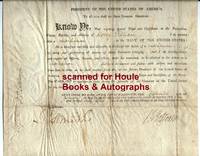
18092221587<p>RARE MIDSHIPMAN APPOINTMENT</p><p>"Th: Jefferson" Partly-printed vellum DS as president 1 page 10" x 10 1/2" January 16 1809. President Jefferson issues a naval appointment for Henry Pilliam. In part: "That reposing special Trust and Confidence in the Patriotism Valour Fidelity and Abilities of Henry Pilliam I do appoint him a midshipman in the Navy of the United States." Neatly signed at the conclusion by President Jefferson and countersigned by Secretary pf the Navy Robert Smith. The document bears an embossed Navy Department seal to the upper left. Intersecting folds overall wrinkling and light staining otherwise fine condition. Such appointments by Thomas Jefferson are quite scarce as he and the Republican party opposed a strong navy. However as Jefferson's term neared its conclusion the naval forces were beginning to grow out of necessity in order to protect the maritime interests of the United States as merchant vessels were frequently being interfered with during their voyages on the high seas. Ultimately these disputes would culminate in the War of 1812 during President Madison's administration. A desirable and well-preserved example of a Jefferson appointment. Very good.</p> unknown
187341043Paris: Rothschild 1873. Large folio. 17 1/8 x 12 5/8 inches. Two volumes comprising 200 collotypes printed by G. Arosa et Cie. each approx. 9¼ x 7¼ in. or the reverse printed titles with publishers' and printers' credits on mounts with letterpress titles and text. Contemporary half black morocco<br/> <br/> One of the first books illustrated with collotypes rather than photolithography or photogravure.<br/> <br/> The present work stands out as one of the few publications that unequivocally attribute the collotype plates to the exceptionally rare Motay and Maréchal process. Cyprien Tessié du Motay and Charles-Raphaël Maréchal pioneers in the field are widely recognized as the trailblazers behind the practical implementation of the collotype process in 1865. By adopting what was then a new process De Gayffier's project holds a unique position as one of the early examples of works featuring illustrations created through the innovative collotype process setting it apart from the prevalent techniques of photolithography and photogravure of the time. The Motay and Maréchal process played a pivotal role in advancing the art of photography. The process involved the meticulous transfer of an image onto a sensitized lithographic stone using a multi-step process that allowed for the creation of detailed and high-quality prints. Collotype's distinct characteristic was its exceptional ability to reproduce fine tonal gradations and intricate details making it particularly well-suited for capturing the nuances of forest foliage as is evident in the beautifully detailed plates in this work. De Gayffier's project is also notable for its pioneering approach to documenting true forest foliage a departure from the more conventional choice at the time of documenting large parks. This endeavor represented a significant shift in the subject matter of early photography focusing on the richness of natural environments and their botanical diversity. Léon de Gayffier who was appointed by the Minister of Agriculture for the specific purpose of undertaking "special photographic operations" in 1867. Complete copy of this rare work. The Musée français de la Photographie has an album of only 54 plates.<br/> <br/> Voignier Répertoire des Photographes de France au Dix-Neuvième Siècle p.113; Eder Josef M and Edward Epstean translator History of Photography by Josef Maria Eder. p. 617; Hanson David Checklist of photomechanical processes and printing 1825-1910 p. 133. Rothschild unknown
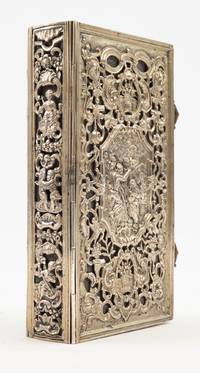
1885ST20549cOxford: Printed at the University Press for Peacock Mansfield and Britton London ca. 1885. 146 x 80 mm. 5 3/4 x 3 1/8". 536 pp. <br/> IN A LOVELY 18TH CENTURY SILVER BINDING over contemporary brown morocco DONE IN THE FRENCH RÉGENCE STYLE combining piercing with repoussé ornamentation the covers with central cartouche depicting a scene from the life of Christ in repoussé that on the front cover showing the Baptism of Christ with two hallmarks at the upper left an "A" and a rooster that on the lower cover showing the Ascension this surrounded by a pierced frame of rocaille drawer handles vases of flowers swans a leafy fronds spine pierced with rocaille and flowers separating three allegorical putti ornaments representing Faith Hope and Charity two openwork rocaille clasps. Endpapers rather worn at fore edge isolated very faint foxing otherwise A FINE COPY the text clean and fresh and THE SILVER BINDING SPARKLING AND UNMARRED.<br/> <br/> This glittering binding is a lovely example of 18th century silverwork in nearly flawless condition. While we have been unable to identify the maker the binding is probably French. A silver binding on a 1686 copy of a Rotterdam "Speculum Poenitentiae" catalogued by Antiquariat Roo is identical to ours in size and design except for the content in the large central frames and is identified by them as French. They find a master's mark of "T. G" beneath the front scene not present on our binding. In any case the delicate symmetrical ornamentation featured on our binding is typical of French Régence decorative arts with scrolls studded with naturalistic embellishments that reward close inspection. Many charming details are hidden within the sea of volutes such as the swans stealing treats from overflowing baskets of fruit. The central scenes from the life of Christ come to life through meticulous execution as our silversmith has taken great care with the details: water trickles from John the Baptist's outstretched arm and voluminous curls of cloud frame Christ's Ascension. The later Book of Common Prayer the binding now contains is a testament to the binding's enduring appeal as a precious devotional object. Printed at the University Press for Peacock, Mansfield, and Britton, London unknown
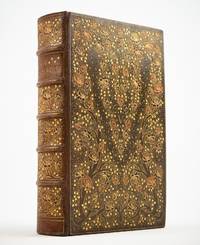
1885ST20626-1London: Printed at the Chiswick Press for Elliot Stock 1885. FIRST EDITION. 181 x 111 mm. 7 1/8 x 4 3/8". xxvi ii 274 i.e. 276 including text leaf marked as pp. 223-224 2 pp. <br/> ANIMATED CONTEMPORARY OLIVE BROWN MOROCCO ELABORATELY GILT AND INLAID covers with two climbing roses with 70 gilt and inlaid blossoms of wine red or salmon pink morocco and dozens of tiny heart-shaped leaves rising from the lower corners and winding up the sides before curving toward the center of the board in a heart shape the branches on a pointillé ground accented with tiny droplets upper cover with monogram of Eleanor Vere Boyle raised bands spine panels with rose branch featuring three inlaid blooms on a pointillé ground gilt lettering wide turn-ins with gilt rose sprays at corners yellow watered silk endleaves top edge gilt. With original front wrapper bound in at rear. Front joint replaced with great skill. With floral vignettes on title and half title decorative headpieces and initials and 11 full-page wood engravings by Boyle EXTRA-ILLUSTRATED with 28 engravings by Eisen Mariller Gravelot and many others. Spine lightly sunned to a hazel brown some extra-illustrations a little foxed occasional light to moderate offsetting from plates but the contents in excellent condition clean and bright throughout and the binding with only the most negligible signs of wear.<br/> <br/> The subject here is roses--on the extremely charming and exuberant binding in the text and in the illustrations. They were the favorite flower of author and illustrator Eleanor Vere Boyle 1825-1916 who planted them on a large scale in her garden at Huntercombe Manor. The popular illustrator of 14 children's books Boyle used most of her income to support charitable works in the parish where her husband was vicar. In her 50s she turned from illustrating to writing focusing primarily on nature and gardens as her subjects. Here she has collected English poems as well as translations in English of excerpts from poems in Greek Latin Persian Italian and French all of them celebrating the rose. Her illustrations show either close-ups of a flower or an adorable cupid accompanied by the flower of Venus. The press work in the present volume is first rate as one expects from the Chiswick Press and the binding is a riot of floral glimmering. Although the binding is unsigned the animated unconventional design is reminiscent of the work of the Guild of Women Binders while the execution is of exceptional quality equal to the productions by leading London workshops like Riviere and Zaehnsdorf. [Printed at the Chiswick Press for] Elliot Stock unknown
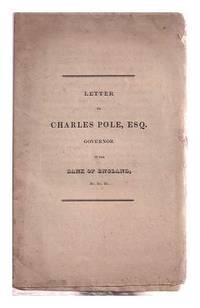
1820342776Publisher; Unknown 1820. First edition. Softcover. Specimen color/red plates 1 5 & 10 pound notes printed on single and double sides loosely inserted. Good copy; edges slightly nicked and dust-dulled as with age. An unread example with unopened pages. Remains particularly well-preserved overall; bright and clean. Additional scans and bibliographic detail on request. Date of publication is suggested. Physical description; 14 pp. Dis-bound as issued. Subjects; Bank of England.1800-1850. Bank notes - original currency samples -Great Britain. Banks and banking Central Great Britain. Currency - counterfeit and fraudulent - currency - forgery - nineteenth century. Currency printing - authentic registers. Pole served as Bank governor from 1820-1822 only. Publisher; Unknown paperback
184441372Milsom Street Bath and 26 Haymarket London: Edmund Francis English Jr. and Thomas McLean. Lithographed and printed at 79 St. Martin's Lane and by Moyes and Barclay Castle Street Leicester Square London 1844. Folio. 24 1/4 x 16 1/2 inches. First Edition. 8 1-10. 18 pp. 12 leaves of plates. Title with hand-colored vignette mounted on card lithographed dedication to Princess Emilia of Baden and the Marchionesses Douglas and Clydesdale List of Subjects and List of Vignettes on Letterpress List of Subscribers "To the Reader" by English Lithograph letter from Beckford to English that is not mentioned in Abbey 6 tinted lithograph "Illustrations of Lansdown Tower Bath" with text on each room of the tower and Beckford's obituary and woodcut epitaph errata note 13 tinted and hand-colored lithograph plates mounted on 12 card leaves with pencilled titles underneath plates. Dark red straight-grained half morocco over publisher's brown moiré cloth title stamped and lettered in gilt on front and on spine with bookplate on pastedown<br/> <br/> Grand first edition folio volume of a fantastical folly with 13 hand-colored lithographs of Beckford's unimpeachable decor.<br/> <br/> Shortly after the eccentric novelist collector bibliophile and plantation-owner William Beckford died in May of 1844 the book Views of Lansdown Tower was published revealing Beckford's extraordinary retreat its luxurious interiors and the exquisite art collection he had assembled inside this fantastical architectural folly just outside Bath in Somerset England. Views was initiated by Willes Maddox under the patronage of Beckford who is found in the book's subscribers list. Beckford had moved to Bath from his estate Fonthill Abbey in Wiltshire in 1822 and remained there until his death. In 1826 Beckford employed a young architect named Henry Goodridge 1797-1864 to build the tower and its adjoining library about a mile away from Beckford's residence in Crescent. Beckford's Tower known initially as Lansdown Tower was built in Italianate neo-classical style on Lansdown Hill. The Tower and its attached railings are now designated as a Grade I listed historic building by the UK. It is the only standing example of Beckford's architecture. Though he did not live there Beckford used the tower as a showcase for his collection of art and fine books and its crowning cupola as a belvedere for taking in picturesque vistas of the surrounding landscape. The book reproduces drawings by Maddox in lithographs by C. J. Richardson. Maddox later gained a reputation for painting the portraits of eminent Turks and took up an invitation from the Sultan to work in Istanbul. Four of the book's 13 plates illustrate some of Beckford's objets d'art including ceramics ivories and metalware alongside his immaculate parlor furniture. The colored plates in order: I. Ornamental Title with View of Tower. II. Exterior of LansdownTower. III. The Vestibule. IV. The Scarlet Drawing Room. V. The Staircase. VI. View of the Belvedere. VII. Objects of Vertu No.1 in Mr. Beckford's Collection. VIII. The Sanctuary. IX. The Crimson Drawing Room. X. Black Cabinet in Crimson Drawing Room. XI. Objects of Vertu No.2 in Mr. Beckford's Collection. XII. The Library. XIII. Objects of Vertu No.3 in Mr. Beckford's Collection. XIV. Ornamental Furniture in Mr. Beckford's Collection. And the Vignettes in Letterpress: XV. Embattled Gateway in Garden. XVI. Italian Cottage. XVII. The Grotto. XVIII. View in Garden where the Sarcophagus stood before removed. XIX. The Tomb of Mr. Beckford. XX. The Tomb of Mr. Beckford's favourite Dog.<br/> <br/> Abbey Scenery 420. Bobins II 682. SP Lohia 626. Edmund Francis English Jr. and Thomas McLean. Lithographed and printed at 79 St. Martin's Lane, and by Moyes and Barclay, Castle unknown
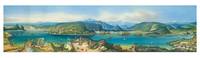
185042495Italy 1850. Gouache over faint etched line black gouache border. Period gilt and faux bois frame. A splendid panoramic view of Lake Como.<br/> <br/> Catering to the foreigners flocking to the region on The Grand Tour this hand-painted print beautifully depicts the famed picturesque lake with rich bands of blue highlighting the water and sky with the surrounding hills and mountains dotted with luxurious villas. The view looks north up the lake towards Switzerland from above Bellagio which occupies the point at which the lake divides in two. unknown
185042496Italy 1850. Watercolour over faint etched line black gouache border. Period gilt and faux bois frames. A splendid panoramic view of Lake Maggiore.<br/> <br/> Catering to the foreigners flocking to the region on The Grand Tour this hand-painted print beautifully depicts the famed picturesque lake with rich bands of blue highlighting the water and sky with the surrounding hills and mountains dotted with luxurious villas. In this view of Lake Maggiore we see from a very high vantage point the Borromean Islands: Isola Bella Isola Madre and Isola dei Pescatori with their extraordinary gardens. unknown
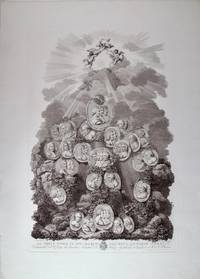
180740691Firenze: La Societa Rainaldi 1807. Each print features small circular engraved portraits and includes mythological elements at the upper portion amongst clouds and rays of sunlight with a background of a rocky outcrop including elements including vegetation and a running stream. The scenes evoke the celestial qualities of music and a reverence for the musicians depicted. <br /> <br /> On good quality laid paper sheet size 695 x 505 mm; plate impression 650 x 365 mm.<br /> <br /> Plate 1<br /> With printed dedication "Al Nobil uomo il Sig: March: Cav: Gius: Antonio Corsi Comandante del R. Corpo dei Cacciatori di Firenze e Gentlehome di Camera di S. M. il Re d'Etruria." <br /> <br /> Subjects include:<br /> Abel d'Arezzo Bach Bertoni Caffaro Campioni Cimarosa Clari Corelli Durante Fux Galilei Galuppi Gluck Handel Jomelli Ligneville Manna Leo Marcello Martini Miers Morales Palestrina Pena Perez Pergolesi Piccinni Poli Porpora Rameau Redi Rousseau Sacchini Sala San Martino Scarlatti Schuster Stefani Traetta Valotti and Zarlino.<br /> <br /> Plate 2<br /> With printed dedication "Al Nobil Uomo il Sig: Giovanni di Poggio Baldovinetti Patrizo Fiorentino. La Societa Rainaldi D.D.D." <br /> <br /> Subjects include:<br /> Albinoni Anfossi Arrighi Asoli Basili Bianchi Borghi Bornei Brunetti Buonvicini Caruso Cherubini Cicchi Colla ERgizio Domenico Gizzi Gazzaniga Gretry Guglielmi Hasse Haydn Lully Manfredini Mariani Mayer Méhul Mozart Paër Paisiello Paolucci Pleyel Porta Prati Puccini Righini Sabbatini Salieri Saratelli Sarti Schüster Tarchi Tozzi Trillo Vinci and Zingarelli.<br /> <br /> Plate 3<br /> With printed dedication "Al nobil uomo il sig: Conte Priore Ant: Colombani Verzeri Amatore delle Belle Arti e Professore dilettante della Musica."<br /> <br /> Subjects include:<br /> Capuzzi Cervetto Chabrand Clememnti Cramer Sr. Cramer Jr. Creuzer Kreutzer Dragonetti Dussek Ferrari Galeotti Geminiani Giardini Janevitz Janovich Krunpholtz Krumpholtz Mad. Krumpholtz La Motte Locatelli Lully Manfredi Mastrino Nardini Piantanida Pugnani Rodhe Roda Rolla Salomon Somis Steibelt Tartini Veracini and Viotti <br /> <br /> Several small marginal tears professionally repaired. Light horizontal crease to each plate hardly visible. <br /> <br /> A highly attractive set of important figures in the musical pantheon. Arrigoni & Bertarelli 2053 2097 and 3264. Rare. La Societa Rainaldi unknown
1890List01108Mostly Patagonia 1890. Printing-out paper prints the images measuring 3 1/4x4 1/2 to 4 1/4x6 inches and the reverse each with a caption written on a label affixed to the mount below the prints. 4to blue pictorial cloth. 1890s. In this bound photo album forty-six photographs document a group traveling from pastoral locations in northern Argentina to breathtaking views at the southern tip of the continent. The photographs were taken by an accomplished photographer and handwritten captions in English provide brief descriptions of the locations and people documented. Apparently a member of an exploration commission the photographer and his team travel first from Bahia Brazil to Buenos Aires and La Pláta then on to the southern tip of the continent and back up the continent through remote lakes and mountains on both sides of the Chilean/Argentinian border.<br /> <br /> While the photographer’s name and nationality are not clear from the album there are two photographs with a Sr. Moreno who is likely the Argentinian explorer Francisco ‘Perito’ Moreno. The photographs of “Sr. Moreno†bear a clear resemblance to photographs of Francisco Moreno and they are taken in La Plata which is where Moreno was the first director of the natural history museum Museo de La Plata. On the album page following the one with photographs of Sr. Moreno there are photographs of the Museo de La Plata building and grounds. Museo de La Plata was established in 1884 and Moreno’s personal collection of 15000 pieces formed the core of the original collections Farro. In order to fill the exhibit rooms he sought more materials and carried out collecting campaigns in Patagonia. At times he hired naturalists to travel into remote parts of Patagonia to gather samples of flora fauna geology and artifacts of indigenous people’s culture Farro. Museo de la Plata was exhibiting anthropological remains and indigenous material culture at the same time that Argentina was expanding into indigenous territory Farro. In this way Museo de la Plata was not just a natural history museum it was also a force of colonialism. <br /> <br /> Not only was Argentina in the process of colonizing Patagonia but also it sought to claim and maintain territory in relation to Chile. A sixty year boundary controversy between Argentina and Chile resulted in the Treaty of 1881 in which the two countries agreed for the first time on the boundaries in Patagonia Perry. Even after 1881 vague language in the treaty that the boundary be “the most lofty peaks that divide the waters†extended the dispute until 1902 Perry. Because Patagonia had not been colonized extensively scientific exploration of the region was tied with nation-building and establishing these borders. In 1896 the Argentinean government appointed Moreno as the Expert Representative in the border dispute with Chile. He led commissions of naturalists and surveying engineers through the disputed border regions along the Andes Mountains Museo de La Plata n.d. Moreno’s work had parallels in Chile’s attempts to establish borders too: “Through the work of these explorers the state was able to.draw up laws and decrees regarding environmental destruction and more effectively defend its position in the limits conflict with Argentina†Etchegaray 2018. <br /> <br /> We do not know whether the exploration commission in this photo album was affiliated with Moreno the collections of Museo de la Plata or the boundary controversy. However given the route to the tip of the continent and the back up along the newly established border it seems possible that this commission could have played some role – whether directly or indirectly – in the process of exploration and nation building occurring at that time. <br /> <br /> References<br /> <br /> Etchegaray J. L. 2018. Cataloging the nation: Explorations and the incorporation of North Patagonia into the Chilean National Ordering 1856-1902 Thesis San Francisco State University. In AS36 2018 HIST .E83. http://dspace.calstate.edu/handle/10211.3/213510<br /> <br /> Farro Máximo E. n.d. The Business of Museums: Towards a History of Collections in La Plata’s Museum 1888-1906 – World Archaeological Congress. Retrieved June 15 2021 from https://worldarch.org/world-archaeological-bulletin/the-business-of-museums-towards-a-history-of-collections-in-la-platas-museum-1888-1906/<br /> <br /> Ryan C. 2011. Indigenous possessions: Anthropology museums and nation-making in Argentina 1862–1943 Ph.D. The University of Wisconsin - Madison. Retrieved June 15 2021 from http://www.proquest.com/pqdtglobal/docview/885379045/abstract/E55A419FE8D54C0DPQ/1<br /> <br /> Museo de La Plata. n.d. Retrieved July 2 2021 from https://www.museo.fcnym.unlp.edu.ar/museo. unknown
1801055966Istanbul: Darü't-Tibaatü'l-Âmîre Mühendishâne Istanbul AH 1216 1801 CE. 1801. 1st Edition . Leather. Very Good. 8vo - over 7¾ - 9¾" tall. Contemporary brown half calf both boards marbled. Demy 8vo. 21 x 14 cm. In Ottoman script Old Turkish with Arabic letters. 33 1 blank p. Many marginal notes underlined words by red ink stains between pp. 15-18 stained margins two ownership period seals some notes and calculations on the front pastedown and the boards. Hand-coloured and decorated headpiece. Otherwise a good copy. Exceedingly rare first edition of this foundational textbook traditionally attributed to Mahmud el-Rûmî hence known as the 'Mahmudiye' which served for centuries as the primary resource for teaching Arabic to children in Ottoman madrasahs and was reprinted in numerous subsequent editions. Between 1801 and 1900 the book was published 30 times after this first edition. First composed in the 16th century and widely used in Ottoman madrasahs it was the principal introductory text for children beginning their study of Arabic. Its pedagogical structure and clarity made it a standard in elementary religious and linguistic education for centuries. The book offers a concise and accessible introduction to Arabic grammar and morphology especially tailored for young learners. It includes basic Arabic vocabulary introduction to Arabic letters and pronunciation noun and verb conjugations with emphasis on common forms simple sentence structures essential grammatical rules and inflection patterns i'râb. Written in rhymed prose or verse the text was designed to be easily memorized. It laid the groundwork for more advanced studies in the Arabic language Quranic recitation and Islamic sciences in the Ottoman madrasahs. Professor Müderris Abdurrahman Efendi was the first director of the "Engineering School Printing House" Mühendishâne Matbaasi established in 1797 in Üsküdar Istanbul. A professor of algebra and geometry Abdurrahman Efendi had studied fortification techniques for ten years under French experts before the founding of the Mühendishâne-i Berrî-i Hümâyûn also known as Mühendishâne-i Cedide in 1793 during the Nizam-i Cedid reform period. While managing the printing house he also taught engineering courses at the newly founded school. Commonly known among the public as the "Üsküdar Printing House" the Mühendishâne Matbaasi under his direction published several important works including the famous Cedîd Atlas. Despite this the press was regarded as a public-interest institution and lacked sufficient capital which hindered its development. Due to the lack of progress Abdurrahman Efendi stepped down on December 2 1807 and was succeeded by Seyyid Hüseyin Beyefendi former deputy chief clerk of the registry Defteremini. The Mühendishâne Printing House 1797 was founded under the chairmanship of Mühendishane teacher Abdurrahman Efendi with the printing sets inherited from Ibrahim Müteferrika who published the first Turkish book in the Ottoman Empire. Until 1824 66 works were printed including the important publications of the period such as Bashoca Hüseyin Rifki Tamani's Usûl-i Hendese 1797-98 Atlas-i Kebîr Tercümesi 1803 author: William Faden translated into Turkish by Resmî Mustafa Aga and Mahmut Raif Efendi's Cedveli-Tableau des nouveaux reglemens de I'Empire Ottoman 1798 printed in French in the Ottoman Empire. The printing house which was inactive for almost 45 years between 1826 and 1870 started operating again especially in 1878 and 38 works were printed here until 1906. Source: ITÜ online. Beydilli 15. Özege 18418. Türkmen 29.; Yazmadan Basmaya: Mühendishâne 11.; As of May 2025 we can't trace any copies in OCLC. <br/> <br/> Darü't-Tibaatü'l-Âmîre [Mühendishâne], Istanbul, AH 1216 [1801 CE]. hardcover
18306526London 1830. Aquatints coloured by hand. A fine complete series of four anonymous prints of hunting scenes possibly after the Alkens.<br/> <br/> The style and naming of these prints suggests an Alken origin for the series. Siltzer records a number of series by the Alken family in which the first plate is titled "Unkennelling." This title appears to be unique to them and supports the supposition that the present series are after the Alkens. Henry Thomas Alken was born into what became an artistic dynasty. He studied under the miniature painter J. T. Barber and exhibited his first picture a miniature portrait at the Royal Academy when he was sixteen. From about 1816 onwards he "produced an unending stream of paintings drawings and engravings of every type of field and other sporting activity. He is best remembered for his hunting prints many of which he engraved himself until the late 1830s.To many sporting art is "Alken" and to describe his work or ability is quite unnecessary." Charles Lane British Racing Prints pp. 75-76<br/> <br/> Cf. Siltzer pp.57-76. unknown
1849055266Istanbul Constantinople: Darü't-Tibaatü'l-Âmîre. AH 1265 1849. 1st Edition . Hardcover. Very Good. 8vo - over 7¾ - 9¾" tall. Contemporary cloth marbled boards. Slight chippings on the panels' extremities fading on board and slightly stained front pastedown overall a very good copy. Demy 8vo. 21 x 15 cm. In Ottoman script Old Turkish with Arabic script. 101 p. Framed text. First printed edition of this extremely rare description and account of Jerusalem narrated through the earliest Islamic Jewish and Christian legends and sources by a 17th-century Islamic scholar. As stated in the preface of the book the author came to Jerusalem in 1635 AH 1051 and wrote this book based on his own observations in first-hand style for three years gathered from the scholars and saints from the oldest Arabic sources written in the Jerusalem where he came as a "contiguous" Tr. mücâvî and an observer. This early Islamic work offers an invaluable insight into the early Jewish culture of the region in and around Jerusalem the Christian culture and the arrival of Islam in the region the Islamic history of the city architecture scholars the legends formed around and the history of religions here the prophets and most importantly the social structure of the region is compiled from unnamed sources. Several manuscripts of the work are also available in important libraries such as Vatican Cairo Kastamonu and Konya. Demirci. Not in Özege.; Eight copies in the US libraries in OCLC in University of Michigan Concordia Theological Seminary Virginia Tech Butler University Libraries Concordia College Library Morningside University Dallas Theological Seminary and Library of Congress Karl Süssheim Collection 756161183 933219362. <br/> <br/> Darü't-Tibaatü'l-Âmîre., [AH 1265] hardcover
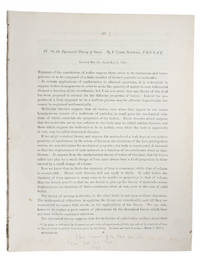
186743456London Taylor and Francis 1867. 4to. No wrappers as extracted from "Philosophical Transactions" Vol. 157 - Part I. Titlepage to volume 155 and pp. 49-88. Titlepage with minor light browning at corners. Internally clean. A small stamp on verso of titlepage. <br/><br/><em>First appearance of this seminal paper in its full version from "Transactions" representing the announcement of Maxwell's final "Theory of Gases" and introduces the "Maxwell Distribution" in its final form a statistical means of describing aspects of the kinetic theory of gases a theory together with his electromagnetic theory are considered to be SOME OF THE GREATEST ADVANCES IN PHYSICS OF ALL TIMES. Everett considers this paper 1868 to be Maxwell's greatest single paper. Maxwell's discoveries laid the foundations of special relativity and quantum mechanics.One of Maxwell's major investigations was on the kinetic theory of gases. Originating with Daniel Bernoulli this theory was advanced by the successive labours of John Herapath John James Waterston James Joule and particularly Rudolf Clausius to such an extent as to put its general accuracy beyond a doubt; but it received enormous development from Maxwell who in this field appeared as an experimenter on the laws of gaseous friction as well as a mathematician.In 1866 he formulated statistically independently of Ludwig Boltzmann the Maxwell-Boltzmann kinetic theory of gases. His formula called the Maxwell distribution gives the fraction of gas molecules moving at a specified velocity at any given temperature. In the kinetic theory temperatures and heat involve only molecular movement. This approach generalized the previously established laws of thermodynamics and explained existing observations and experiments in a better way than had been achieved previously. Maxwell's work on thermodynamics led him to devise the Gedankenexperiment thought experiment that came to be known as Maxwell's demon. </em> unknown
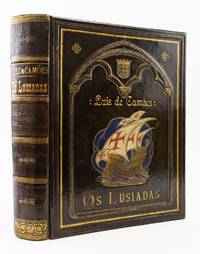
1880ST17890eLeipzig: Typographia Giesecke & Devrient for Emilio Biel Portugal 1880. 400 x 305 mm. 15 3/4 x 12". 2 p.l. LVI 375 1 XCII pp. <br/> IMPOSING CONTEMPORARY BLACK CALF upper cover with sunken central panel framed by gilt and blind rules raised gothic window frame with gilt tooling large ship embossed and painted at center gilt lettering above and below lower cover gilt-stamped "Companhia Portugueza Editora / Porto" raised bands spine panels with blind-stamped floral frames gilt lettering patterned endpapers apparently later hinges all edges gilt and elaborately gauffered. In a later green felt-lined cloth slipcase. Illustrated half title engraved portrait frontispiece dedication and portrait of the dedicatee engraved decorative half frames at beginning of each Canto and tailpiece at the end 10 section titles printed in colors and 19 plates all with original tissue guards. Front pastedown with modern color-printed bookplate dated 1980. ◆Spine slightly sunned leather with a few minor scrapes scratches and other small signs of wear plates variously foxed because of paper used usually mildly or moderately though occasionally more noticeably; nevertheless a striking volume with its main attractions the front cover and shimmering gauffered edges retaining all of their appeal.<br/> <br/> This is an impressive commemorative edition of the masterpiece of the Portuguese language's greatest poet in a binding that celebrates that country's history of exploration. First published in 1572 the epic poem "Os Lusíadas" relates the adventures of Portuguese explorer Vasco da Gama ca. 1460s - 1524 the first European to reach India by sea. Sailing via the Cape of Good Hope in 1497 he established the first ocean route from Europe to India landing in Calicut in 1498. His navigation skills provided Portugal with more than bragging rights for accomplishing a feat attempted for decades at the cost of hundreds of sailors' lives: the Portuguese now had unprecedented access to the spices of the East and came to dominate that market. A master of verse whose skills have been compared to those of Shakespeare Milton and Dante Luís de Camões ca. 1524/25 - 1580 also had firsthand experience of the voyage: he travelled to India on the carrack São Bento in 1553. He composed parts of this work while dwelling in a cave in Macau and managed to save the manuscript when he was shipwrecked in the Mekong delta. After 17 years in the East Camões returned to Portugal and completed "Os Lusíadas." When it was published two years later he was rewarded with a royal pension. The binding here depicts a Portuguese caravel--the small very maneuverable ship Portugal's explorers used in the Age of Discovery--at full sail on choppy seas in a sunken space framed within a Moorish-style arch bearing the Portuguese Coat of Arms. Dedicated to Dom Pedro II Emperor of Brazil this luxurious production was issued to commemorate the 300th anniversary of Camões' death. Typographia Giesecke & Devrient [for] Emilio Biel, Portugal unknown
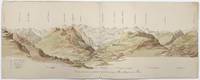
184023481840. Watercolor graphite and grayish ink on two sheets of cream laid paper with an 1836 M and smiling sun watermark 10 1/4 x 25 7/8 inches 260 x 658 mm the full sheet. Titled in ink in French on the recto. In very good condition with minor edge wear including creasing and nicks. A splendid panorama with each of the major peaks and point of interest labeled and identified in French. The iconic symbol of the Swiss resort the "Sun of St. Moritz" was adopted from early European heraldic marks and rebranded around 1930 by graphic designer Walter Herdeg. The image was patented in 1937 by spa director Walter Amstutz becoming the world's first visual trademark for a tourist destination. unknown
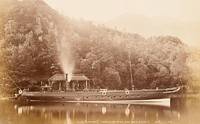
188229153AB1882. Scotland / England 1882-1885. Quarto. 53 photographs on original boards. Original Hardcover. Very good condition with only minor signs of external wear. Some minor signs of foxing only. Images include: - Buxton - The Lovers Leap / Buxton Public Pavilion Gardens / Buxton Ashwood Dale / - Hastings - Lovers Seat and Fairlight Glen in the year 1881 / The Dripping Well / - Hollington Church / Ecclesbourne Glen / Filey Brig in 1881 / - Sir Walter Scott's Monument in Edinburgh in 1881 / Edinburgh Castle from the Esplanade / Holyrood / - Ellens Isle in Loch Katrine / S.S.Rob Roy / Falls of Inversnaid from the Loch Lomond / Callander Bridge and Ben Ledi / - Falls of Bracklinn / Loch Lomond / The Trossachs / Loch Achray and Ben Venue / - Nelson's Mount on Carlton Hill / Peterborough Cathedral in 1882 / Peterborough Cathedral Interior / - Glossop Road in December 1882 with snow / The Priory Church - Bridlington 1883 / - Battle Abbey in 1883 / Guest Chamber / Court Gate / - Abbots Hall at Battle Abbey with Modern Library / Abbots Hall - The Cloisters / Battle Church / Old Hastings / Normanhurst / - Cambridge in 1883: Kings College and Chapel / Kings Chapel - Interior / Cambridge - Caius College / Cambridge - New Courts / - Trinity College Cambridge / Old Court / Clare College / Clare Bridge / Trinity Gate / John's New Buildings / Bridge of Sighs - Cambridge - Trinity Hall Chapel / - Stonehenge in 1884 / Christ Church Cathedral / in Oxford in 1884 / - Magdalen College Oxford Chapel and Window / Magdalen Tower / Court at Magdalen College / The Broad Walk / All Saints Chapel / - Window in the New College Chapel / The Major Oak at Sherwood Forest in 1885 // hardcover
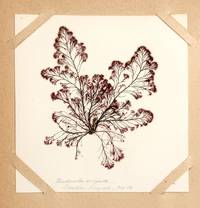
188423391884. A unique quarto 15 x 12 1/2 inches 382 x 318 mm; 30 double-sided sheets containing approximately 80 preserved specimens of seaweed and sea mosses which are individually dried mounted to card stock and tipped-in; each with the genus in Latin and the date and location of collection handwritten in pencil in the lower mount. Approximately 1 to 5 specimens per page. Binding is broken and significantly worn with some pages loose. Specimens are intact and separated by blotting paper and remain in very good to excellent condition with some exhibiting only minor losses. <br /> <br /> While seaweed collecting was a popular Victorian pastime in Britain this rare herbarium is filled with a profusion of north American specimens primarily from Bay Ridge Brooklyn to Nantucket island as well as some from California and Bermuda. In the Victorian era seaweed collecting or algology was far more than a casual beach activity; it was a massive cultural trend that married scientific curiosity artistic expression and social freedom. While the Victorians were obsessed with all things natural history a trend called "natural theology" seaweed held a unique appeal especially for women. While studying animal anatomy was seen as "unladylike" at the time collecting seaweed was considered a genteel and healthy outdoor activity. As a result several women used the opportunity to make significant scientific contributions.<br /> <br /> Often called "Ocean Flowers" or "Sea Mosses" these specimens became the focus of elaborate scrapbooks and pioneered some of the world's first photographic techniques Anna Adkins's Produced Photographs of British Algae: Cyanotype Impressions 1843 was the first book ever illustrated with photographs. Today these Victorian albums are more than just relics of a cultural fad; they are vital biological records. Scientists utilize the DNA from these 150-year-old pressed samples to track how ocean temperatures and species distributions have changed since the Industrial Revolution.<br /> <br /> Creating a seaweed album was a meticulous process. Collectors didn't just dry the weeds; they "resurrected" them to look alive on the page. This album demonstrates the incredible skill of the maker. unknown
1841DEMO016689ILondon: Published by the Author 1841. First edition. Hardcover. Very Good. George Catlin engravings. Octavos 264 266pp. 19th C red half morocco edgeworn extra gilt spines 1 board tender. <br/><br/>Howes C241; Wagner-Camp-Becker 84:1; Pillling 681 q.v.'; Sabin 11536; not in Field's Indian bibliography . Uncited variant: This edition was printed by "W. and A.K. Johnston printers Edinburgh and London." I have not found another copy so described nor are the maps identified as being engraved by Tosswill & Myers; also this does not have the mistake of "Frederick" for "Zedekiah" on p.104. Note: the collation appears to match the Siebert copy Siebert Catalogue of 1999 vol.2 no. 838 altho I count 75102= 177 leaves of plates not 176 plus the 3 maps one folding in v.1. William Clark the famed co-explorer and later the Indian Agent headquartered in St. Louis testified that "I have seen Mr. Catlin's Collection of Portraits of Indians east of the Rocky Mountains many of which were familiar to me and painted in my presence: and as far as they have included Indians of my acquaintance the likenesses are easily recognized baring the most striking resemblances to the originals as well as faithful representations of their costumes." Illustrated with George Catlin's engravings. Published by the Author hardcover
188151851New York: The Century Co. As New. 1881. Hardcover. FREE UPGRADE to Courier/Priority Shipping Upon Request IN STOCK AND IMMEDIATELY AVAILABLE FOR SHIPMENT - Tight to spine - More than 50 black and white plates with engravings of works byThomas Cole Whistler Millet Thomas Moran William M. Chase Mary H. Foote and others. Gold-embossed coverboards with leather binding and trim; decorated endpapers. -- with a bonus offer-- . The Century Co. hardcover
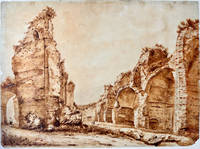
185212381852. Ink wash in brown ink on cream wove paper 9 7/8 x 13 inches 250 x 330 mm titled and dated in brown ink lower right. In fair condition with minor scattered soiling uniform age tone and edge 'nics;' all consistent with age. Laid down to archival mat board. unknown
1860535891860. Softcover. Good- to good condition. 1. Discrimination in Switzerland. Washington D.C. House of Representatives. 1860. Octavo. 101pp. Original tan wraps with black lettering on cover. Collection of correspondence between US officials and Theodore S. Fay among others at the time secretary of the US legation in Bern Switzerland. In 1859 Fay had delivered a report to the Swiss Federal Council Memorandum concerning the admission of North American Israelites to settle in Switzerland that was important in the struggle for emancipation of Jews in Switzerland. It had provided an overview of discriminatory Swiss laws against Jews in Switzerland while going to great depth to refute arguments that supported these laws. As a result small steps were taken in the Swiss cantons contributing to the eventual emancipation of Jews in Switzerland in 1866. Missing wraps but for most of spine. Very lightly age-toned.<br /> <br /> 2. Address "To the President of the United States." Single light blue printed leaf. Not dated. Memorial of Subscribers of the commonwealth of Pennsylvania protesting against the Swiss laws discriminating against Jews in Switzerland. An attempt to influence the President to take steps to abolish the discrimination against Jews in Switzerland. Light wear along edges of leaf small chips and folded several times. Undated.<br /> <br /> 3. This Memorial. 1857. Printed Octavo circular 4pp. Protest addressed to the President of the United States against the Swiss for their restrictive laws against American Jews. Vigorous protest to President James Buchanan against blatant anti-Semitism in Switzerland. "It so happens that certain Cantons of the Swiss Confederation among which Basle and others have laws prohibiting Israelites from sojourning temporarily domiciliating or establishing themselves permanently. The treat. has clearly failed. for we are met by a dark age prescriptive law declaring us unworthy of participating in the rights of our fellow citizens on account of our professing the Israelitisch religion." This demand illustrates the disparity between the United States Constitution which protects freedom of religion and yet is not doing enough to protect these same freedoms for its citizens when they travel abroad. Signed by various Jewish petitioners including Isaac M. Wise of Ohio. Scarce: Singerman 1515 cites two other known copies of this pamphlet. With some wear along edges small chips and folded three times. Lightly age-toned. unknown