Koch, Johann Philipp (um 1740-1796)Antiquariat.de

559 résultats
175091416Um 1750. Mit gestoch. deutsch-lateinischen Textzeilen unter d. Darstellung. Bildgröße 25 x 32 cm. Feinkartonpassepartout.
18001316030Berlin, G. A. Lange, 1800. Titelkupfer (Bildnismedaillon Kosegartens in Punktiermanier), Drucktitel, 6, 515, (1) S. u. 2 Bl., 507, (1) S. auf bläulichem Bütten. Interims-Broschuren d. Zeit (unbeschnitten, Umschläge fleckig, innen durchgehend etwas braunfleckig).
177726884London England: Printed for the Company of Stationers 1777. Twenty-two issues of this yearly British almanac bound in one volume; consecutive and inclusive from the 1777 issue to 1797. These are printed in red & black have the tax stamps on the margins of the title pages and are of 32 pages' length with exceptions or notes as below: 1782: On page 31 the section "VI Rebus by Mr. R. Richardson of Frosterly" has been solved with the manuscript letters & names of clues neatly written at the margins. 1786: pgs 1-2 15-32; However another issue is bound after this incomplete issue that is entire in 48 pages. These almanacs are noted on the title pages as printed for the Company of Stationers; and this "extra" issue is noted on the title page as "Printed for T. Carnan in St. Paul's Church Yard; who after an expensive Suit in Law and Equity by the unanimous Opinion of the Judges of the Court of Common Please dispossessed the Stationers' Company of their pretended exclusive Privilege of Printing Almanacks which they had usurped for two Centuries; a convincing Proof that no unjust Monopoly will ever stand the Test of an English Court of Justice." 1788: pgs 1-2 15-32 only. 1793 Misbound pages out of order and complete 32 pages. 1795: A name of "Old Batholomew" has been added in ms. at the 4th Sept. in the monthly almanac pages section. 1797 pgs 1-16 only. "The existence of the Ladies' Diary or the Woman's Almanack an 18th century English magazine devoted largely to problems and puzzles in mathematics indicates that stereotypes about the inability of women to understand and enjoy mathematics were less strongly believed in the 18th century than they are today.The Ladies' Diary became one of the widely read 18th century magazines devoted to the popularization of science and mathematics; these were addressed mainly to readers with no specialized training in the subjectsThe Ladies' Diary differed from these others primarily in the language used in some of the problems--language which reminds the reader that the problems were addressed to women" from the excellent overview of the magazine its influence & impact by Teri Perl San Francisco State Univ. Historia Mathematica 6 1979 article on the 'Diary' Indecipherable by us previous owner name on back endpaper.Approx. 4" x 6 3/8" size; bound in marbled-paper covered boards leather corners edges tinted yellow; spine covering gone; wear to the edges tips of the binding; bottom cord of top board let go; the block still solidly sewn some edges trimmed close; contents generally clean and in good condition. . First Edition. Hard Cover. Good. Printed for the Company of Stationers hardcover books
179878607Königsberg, Friedrich Nicolovius, 1798. 1 Bl., VIII, 464 S., 1 Bl. (20,5 x 13). Ln. d. Zeit mit RVergoldung.
180078549Reutlingen, J. U. Mäcken u. Compagnie, 1800. X, 280; VI, 224 S.Kl.-8vo (17,5 x 11 cm). Marmor. Pp. mit RSch.
17761046537[I] Barby, Christian Friedrich Laux. - [II] Barby, Brüdergemeinde. - [III] Barby, [Brüdergemeinde]. [I] 1781. - [II] 1784. - [III] 1776. [I] 224 Seiten. - [II] 152 Seiten. - [III] 176 Seiten. - Mit einigen Titel-, Text- und Schlußvignetten in Holzschnitt, 8° (18 x 11,5 cm). Pappband der Zeit mit nachtblauem Papierbezug, dunkelbraunem, goldgeprägtem Rückenschild und gelb gefärbtem Schnitt.
17221045261[Salzburg, Mayr 1722]. (28), 436 Seiten, 38 Seiten Index. Mit einigen Vignetten und Kopfstücken in Holzschnitt. 2° (33,5 x 22,5 cm). Schöner Pergamentband der Zeit mit durchgezogenen Bünden, spanischen Deckelkanten, handschriftlichem Rückentitel und rot gefärbten Schnitten.
17481046453[I+II] Frankfurt/Main, auf Kosten des Autors. - [III] Frankfurt/Main, ohne Verlag [I+II] 1743. - [III] 1748. [I+II] Titel, (14), 288; 366, (8) Seiten. - [III] Titel, (14), 246, (8) Seiten. - Mit einigen Kopfstücken, Vignetten und Initialen in Holzschnitt, 8° (18 x 10,5 cm). Pergamentband der Zeit mit fünf durchgezogenen Bünden, goldgeprägtem orangefarbigem Rückentitel und blau gefärbtem Schnitt.
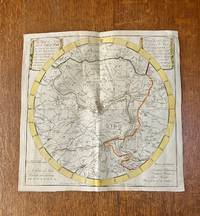
17483100614810xbvk(Paris), 1748. 1 sheet, formerly folded; ca. 24 x 38 cm (sheet), ca. 17 x 21 cm (engraved map).
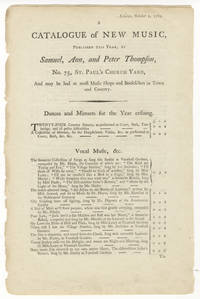
178936363London: Samuel Ann and Peter Thompson No. 75 St. Paul's Church Yard And may be had at most Music Shops and Booksellers in Town and Country 1789. Folio. Disbound. 4 pp. <br /> <br /> Contains announcements of newly-published "Dances and Minuets for the Year ensuing; Vocal Music &c.; Psalmodia Evangelica; New Editions of the following Music; New Editions of Instruction Books and Pocket Companions for the following Instruments" and announcements of publications forthcoming in December.<br /> <br /> Slightly worn and browned; outer edge slightly chipped; leaves loose; binder's holes and chipping to inner margins with minor paper loss. "Peter Thompson was the founder of the important business carried on by the Thompson family for half a century. They were the last survivors of the music trade which once thronged St. Paul's Church Yard and their place of business had very likely been one of the shops held by members of the trade a century or more previously . In 1780 Peter . a grandson of the original founder is added to the firm which now stands as Samuel Ann & Peter and the business prospers still more." Kidson: British Music Publishers Printers and Engravers pp. 125-26. Samuel, Ann, and Peter Thompson, (No. 75) St. Paul's Church Yard, And may be had at most Music Shops and Booksellers in Town and unknown
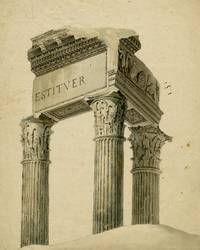
180010251800. Ink and wash in black ink with pen in black ink on watermarked C & I Honig cream laid paper 14 7/8 x 12 1/4 inches 378 x 311 mm the full sheet. In very good condition with some minor areas of light brown spotting in the right-center sheet margin. An excellent drawing with fine detail. The ruins of the Temple of Vespasian and Titus are located in the Roman Forum in Rome. The temple is a marble ruin that honors the deified emperors Vespasian and Titus. Located near the Temple of Saturn all that remain standing are three Corinthian columns that formed part of the colonnade. The temple was also dedicated to the son of Vespasiano Titus. Construction started on this temple in 79 AD. unknown
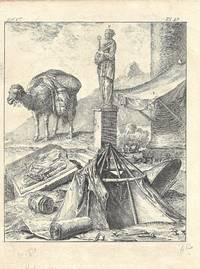
178022271780. Engraving on lightweight laid paper with an small indiscernible alphabetic watermark 9 x 7 1/2 230 x 188 mm; sheet 11 1/4 x 8 1/2 inches 284 x 215 mm wide margins. In very good condition with some light inscriptions in pencil in the lower margin outside of the image area. unknown
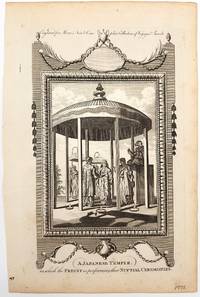
17781964London 1778. Engraving on cream laid paper 11 1/2 x 7 1/2 inches 290 x 190 mm full margins. In good condition with minor age tone and an unevenly trimmed left sheet edge. Ink inscription in the left margin recto and pencil inscription in the right margin recto both well outside of the image area. unknown
179911699<p>Printed for and sold by A. Taylor & W. Meyler. Bath. 1799. A fine and bright example of this rare map. 17.3 x 17.2 inches. Hand coloured. Paper watermarked 1797. Loosely folded into four but with no damage to the creases or edges. A remarkable survivor in such nice condition. Loosely housed in a modern marbled paper covered drop top box. ---- William Smith created his first geological map around Bath in 1799 widely regarded as the beginning of modern geological mapping and this was the map he used.</p> Printed for and sold by A. Taylor & W. Meyler. Bath. 1799
1795312011Philadelphia: by and for Colerick & Hunter 1795. First American Edition. a2 B-Z6 Aa-Kk6 Ll4. 399pp. 12mo 6 1/2 x 3 3/4 inches. Original sheep both boards detached ex libris George Vaux with his signature on pastedown and first leaf of preface. First American Edition. a2 B-Z6 Aa-Kk6 Ll4. 399pp. 12mo 6 1/2 x 3 3/4 inches. by and for Colerick & Hunter unknown
1795312011Philadelphia: by and for Colerick & Hunter 1795. First American Edition. a2 B-Z6 Aa-Kk6 Ll4. 399pp. 12mo 6 1/2 x 3 3/4 inches. original sheep both boards detached ex libris George Vaux with his signature on pastedown and first leaf of preface. First American Edition. a2 B-Z6 Aa-Kk6 Ll4. 399pp. 12mo 6 1/2 x 3 3/4 inches. by and for Colerick & Hunter unknown books
1726ST15736cLondon: Printed for Tho. Woodward by William Bowyer 1726. FIRST EDITION. One of 1000 copies according to Bowyer's ledgers per ESTC. 360 x 222 mm. 14 x 8 3/4". 12 p.l. 456 i.e. 452 pp. 4L2v is numbered 316-320. <br/> Contemporary calf covers with gilt roll frame oblique floral cornerpieces rebacked in olive-brown calf raised bands flanked by scrolling gilt rolls panels with decorative gilt centerpiece red morocco label marbled endpapers and edges neat repairs to head edge and to corners. With engraved frontispiece five small engravings in the text and two engraved plates of plants. Front pastedown with armorial bookplate of Charles Gresley; pp. 286 288-290 with contemporary ink annotations to folded fore margins. Henrey 945; ESTC T146573. ◆Boards with a number of small abrasions but the restored binding sound and perfectly agreeable; isolated faint dust-soiling to head margins other trivial imperfections but the text in very fine condition especially clean crisp and bright and with ample margins.<br/> <br/> Very fresh and bright internally especially for a book expected to incur use in an unprotected context this practical and comprehensive work would have been an indispensable resource for any 18th century husbandman interested in raising livestock and cultivating trees vegetables and fruit. Although the frontispiece depicts the stately Richmond home of the Prince of Wales with its manicured grounds and rows of neatly spaced trees the contents are just as useful to the everyman including "Husbandman Grazier Planter Gardener and Florist." John Laurence 1668-1752 was a fellow at Cambridge before becoming rector of Yelvertoft Northamptonshire where he developed a passion for horticulture while renewing a dilapidated garden there DNB tells us he was especially skilled at growing pears. Laurence wrote three books on the pleasures of gardening while living in Yelvertoft; he later moved to Bishopwearmouth Durham where he wrote the present work--his last and according to Henrey "most ambitious literary project." The author explains how to improve and maintain the land in book I with advice on planting crops and raising different kinds of livestock from cattle to silkworms. He even devotes a few chapters to using land for mines and quarries revealing the "hidden Treasures which lie couched in Nature's Bowels." Book II is devoted to forest and timber trees and books III-V offer a catalogue of fruit trees vegetables and decorative plants to grow in the Fruit Garden Kitchen Garden and Flower-Garden respectively. This is a pleasurable book to leaf through being wonderfully clean throughout and accessible to the modern reader with familiar plants that might be growing in one's backyard today. Printed for Tho. Woodward [by William Bowyer] unknown
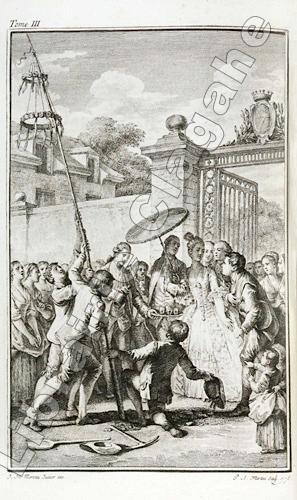
17767597Sans lieu (Paris), sans nom, 1776 ; deux tomes ; suivi de "Les A propos de la Folie ou chansons grotesques, grivoises et annonces de parades". Sans lieu (Paris), sans nom, 1776. Ensemble de trois tomes in-8 ; demi-basane havane, dos à faux-nerfs dorés, pièces de titre et de tomaison vert-sapin, plats de papier imitation cuir havane raciné, tranches marbrées (reliure début XIXe) ; (2) ff. blancs, X (dont titre gravé), 302 pp., (1) f. blanc ; 316 ; VI, 319, (1) pp. et en tout pour les tomes 1 et 2 : 1 titre gravé dessiné et gravé par Moreau, identique aux tomes 1 et 2, 2 figures hors-texte par Moreau, gravées par De Launay et Simonet, 2 vignettes et 2 culs-de-lampe par Moreau, gravés par Duclos, Martini et De Launay ; et au tome 3 : titre-frontispice, 1 figure, 1 vignette et 1 cul-de-lampe par Moreau, gravés par Martini.
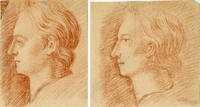
179014111790. Red crayon on cream laid paper 3 3/4 x 4 inches 95 x 102 mm ; 3 3/4 x 3 1/8 inches 95 x 80 mm. Each with scattered early repairs done with non-archival tape on the verso; the smaller of the two drawings has a repaired corner upper-right with in-drawing in red crayon. Condition issues are all consistent with age and the versos remain largely uneffected. A lovely duo. unknown
173996461London, James Hodges, at the Looking-Glass on London-Bridge, 1739. Titel in Rot- und Schwarzdruck, [4] Bl., 299 S., XXIX gefalt. Kupferstich-Tafeln, [5] S. Anzeigen, 20 cm. Ldr d. Zeit auf 5 Bünden m. Rückenvergold., goldgeprägtem Rückentitel u. Goldfileten auf den Deckeln.
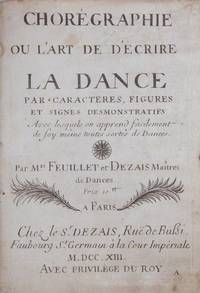
170940499Paris 1709. FEUILLET and DEZAIS<br /> Chorégraphie ou l'art de décrire la dance par caractères figures et signes démonstrifs avec lesquels on apprend facilement de soy-même toutes sortes de dances. ouvrage très utile aux maîtres à dancer et à toutes les personnes qui s'appliquent à la dance. Par Mrs. Feuillet et Dezais Maîtres de Dances. Prix: . <br /> <br /> Paris: Chez le Sr. Dezais Ruë de Bussi Faubourg St. Germain à la Cour Impériale . Avec Privilége du Roy 1713.<br /> <br /> 1f. recto title verso blank i dedication "A Monsieur Pécour Pensionnaire des Menus Plaisirs du Roy et Compositeur des Balets de l'Académie Royale de Musique de Paris" ii Préface i "Extrait du Privilege du Roi" 95 i blank pp. Engraved throughout. <br /> <br /> The revised fourth edition of this seminal work first published in 1700. RISM Écrits Imprimés p. 314 2 copies only of all editions in the U.S.: one of the first 1700 edition at the NYPL and one of the present edition at the Library of Congress. Beaumont p. 72. De Moroda 938. Schwartz and Schlundt 21. This edition not in Cortot Hirsch or Malkin.<br /> <br /> "A rather less known choreographer is Jacques Dezais. He lived in the first half of 18th century and regarded himself as a follower of R. A. Feuillet. In 1726 he published a collection of dances named Premier Livre de Contre-Dances à Quatre à six & à Huit. Unfortunately the publication was lost when the famous Anna-Amalie Library in Weimar burned in 2004." earlydance/news/8138-les-cotillons-de-jacques-dezais<br /> <br /> Bound with:<br /> FEUILLET<br /> Recueil de Dances Composées par Mr. Feuillet Maître de Dance. <br /> <br /> Paris: Chez l'Auteur rue de Bussi Faubourg St. Germain à la Cour Imperiale Avec Privilége du Roy 1709. <br /> <br /> 1f. recto title verso blank 84 pp. Engraved throughout.<br /> <br /> Contains 18 dances in Feuillet notation with melody for each at head as follows:<br /> <br /> - Le Rigaudon de la Paix pp. 1-2<br /> - 2e Rigaudons pp. 3-7<br /> - Gigue à deux Gigue de Roland pp. 8-11<br /> - Entrée a deux Rigaudon pp. 12-16<br /> - Autre Entrée a deux Rigaudon pp. 17-20<br /> - Sarabande pour femme Sarabande pp. 21-24<br /> - Sarabande pour homme Sarabande pp. 25-28<br /> - Sarabande Espagnole pour homme Sarabande Espagnole pp. 29-32<br /> - Folie d'Espagne pour femme Folie d'espagne pp. 33-38<br /> - Canary à deux Canary pp. 39-40<br /> - Gigue pour homme Gigue pp. 41-44<br /> - Entrée pour homme pp. 45-48<br /> - Autre entrée pour homme entree pp. 49-52<br /> - Entrée grave pour homme pp. 53-59<br /> - Entrée d'Apolon Entrée Apolon pp. 60-66<br /> - Balet de neuf Danseurs entre graue pp. 67-72<br /> - Canary pp. 73-74<br /> - second canary p. 75-84 with pp. 77-84 folding<br /> <br /> First published in 1700. Little and Marsh 1709-Feu p. 103 for a list of editions and issues see 1700-Feu. De Moroda 938. This edition not in Malkin Niles & Leslie Schwartz & Schlundt or RISM<br /> <br /> "All but one of the dances in Feuillet's collection are solos or duets ranging from easy to difficult; the single exception is a piece for eight dancers and a soloist - the only known example in Feuillet notation of a French ballet entry for more than two persons." Little and Marsh p. 91.<br /> <br /> Bound with: <br /> FEUILLET<br /> Recueil de Dances Composées par M. Pecour Pensionnaire des menus Plaisirs du Roy et Compositeur des Balets de l'Academie Royale de Musique de Paris et mise sur le Papier par M. Feuillet. Maître de Dance. <br /> <br /> Paris: Chez l'Auteur rue de Bussi Faubourg St. Germain à la Cour Impériale Avec Privilege du Roy 1709. 1f. recto title verso blank 72 pp. Engraved throughout.<br /> <br /> Contains 15 dances in Feuillet notation with melody for each at head as follows:<br /> <br /> - la Bourée d'Achille Bourée pp. 1-3<br /> - menuet pp. 4-11<br /> - La Mariée la Mariée pp. 12-21<br /> - le Passepied passepied pp. 22-23<br /> - 2e. Passepied pp. 24-31<br /> - la Contredance Gigue pp. 32-36<br /> - le Rigaudon des Vaisseaux Rigaudon pp. 37-39<br /> - 2e. Rigaudon pp. 40-42<br /> - la Bourgogne Courant pp. 43-44<br /> - Bourée pp. 45-46<br /> - Sarabande pp. 47-48<br /> - PassePied pp. 49-53<br /> - la Savoye Bourée pp. 54-61<br /> - la Forlana la Forlana pp. 62-67<br /> - la Conty Venitienne pp. 68-72 <br /> <br /> First published in 1700. Little and Marsh 1700-Péc p. 93. De Moroda 1341. This edition not in Malkin Niles & Leslie Schwartz & Schlundt or RISM.<br /> <br /> "Pecour's Recueil was bound and sold with Feuillet's Chorégraphie and Feuillet's Recueil . for a survey of editions and issues see comments under 1700-Feu. This collection contains a variety of pieces for ball dancing in vogue in 1700; many of them are quite difficult. According to the preface to Feuillet's Chorégraphie Pécour himself went over the proofs to eliminate errors in notation." Little and Marsh p. 93.<br /> <br /> Louis Guillaume Pécour 1651-1729 was an important French dancing-master and choreographer. He worked closely with celebrated royal choreographer Pierre Beauchamp 1631-1705 Louis XIV's personal dancing master.<br /> <br /> Octavo. Full dark brown mottled calf with raised bands on spine in decorative compartments gilt dark brown title label gilt. <br /> <br /> Binding worn rubbed and bumped with some abrasions; head of spine joints and edges chipped with minor loss; endpapers slightly worn soiled and foxed. Occasional minor signs of wear soiling and foxing; several titles very slightly cropped. <br /> <br /> Very good copies overall of all three works. Feuillet was a highly important French choreographer dancing-master and author. "He worked at the court of Louis XIV. His fame rests on his Chorégraphie a book describing a system of dance notation that was used in Europe throughout the 18th century. He probably did not invent the system himself although he said he had but derived it from the original work of Pierre Beauchamps Louis XIV's personal dancing-master. Unlike previous methods which describe movement verbally and use letters to refer to the sequence of steps Feuillet's system is a track notation. It represents symbolically not only the steps of the dancer with his turns leaps and slides but also the floor pattern in which he is to travel. The dance music is printed at the top of the page and the steps are marked off in a manner corresponding to the structure of the music. .<br /> <br /> The publication of the Beauchamp-Feuillet notation meant that specific dances could easily be distributed throughout Europe. It also added to France's pre-eminence in the world of dance. Today the system makes it possible for scholars to study some of the dances in use in the late 17th and early 18th centuries an important period for the development of the classical French ballet style and technique." Meredith Ellis Little in Grove Music Online<br /> <br /> "With the invention of his dance notation system in the eighteenth century Raoul-Auger Feuillet revolutionized the dance world. Published in 1700 his Chorégraphie . was conceived as a self-teaching device not a way of preserving dance. Yet owing to its immense popularity throughout Europe even today a large body of theatrical and ballroom dances from that period in both printed and manuscript forms can still be found in most archives. . Chorégraphie was reprinted three times in thirteen years translated into English by John Weaver in 1706 and appeared in various "improved" versions in France Germany Spain and Portugal. Voltaire 1751 ranked the invention among the "achievements of his day" and Denis Diderot 1763 devoted ten pages to the subject in his Encyclopédie." International Encyclopedia of Dance Vol. 2 p. 588.<br /> <br /> An extraordinary presentation of three of the most important early choreographic works all major factors in confirming France's preeminence in the world of 18th century ballet. unknown
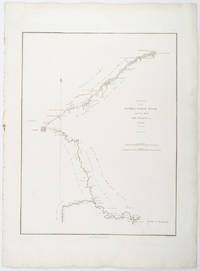
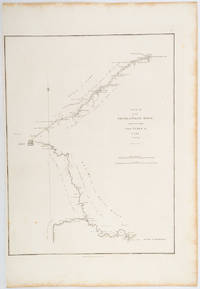
1796209283London.: George Nicol. 1796. Engraved copperplate map on Whatman paper 43.8 x 33.6 cm; 57 x 42 cm sheet including plate markscale in nautical and English miles; light undulation to sheet marginal toning and edgewear but in very good condition. Finely engraved and detailed map of two routes to Pekin Beijing along the White River Baihe from the Gulf of Petcheli and along the Imperial Highway from Jehol and includes commentary locating palaces and gardens type of cultivation "many barges" and "the road shaded by willow trees". The map elegantly drawn by Henry William Parish was published in George Staunton's account of Earl Macartney's embassy to China 1792-1794. . George Nicol. unknown
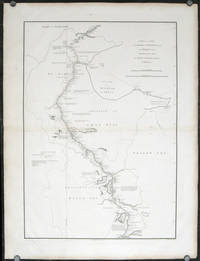
1796207049London.: George Nicol. 1796. Double-sheet engraved copperplate map 63.2 x 44.8 cm; 75 x 57 cms sheet including platemark central fold the sheet toned at the edges and central fold a couple of minor spots and edge wear but in very good condition. An exquisitely engraved map with fine detail of the route taken by George Macartney on the first official British embassy to China 1792-1794 undertaken with the aim of gaining trade concessions from the Chinese Emperor and published in George Staunton's officall account. <br> <br>While the official purpose was not successful much was learned about China and the Chinese as is evident from this map with its explanatory texts. To the west of Pekin just below the starting point at Zhe-hol Jehol which is situated at the top of this map the commentary reads: "A great part of the country around Pekin is employed in the production of culinary vegetables and a variety of fruits." At the lower edge of the map just north of the ending point of Hangzhou is the lake Tai Hoo: "The western side of the Tai-hoo is bounded by a very romantic and fertile country whose mountains are clutivated to their very tops. A great part of the province of Tche-tchiang appears to be cultivated with Mulberry trees for the food of the Silk worms." Cities of the 1st 2nd and 3rd orders "considerable towns" and villages are marked along with "Halting places" etc. Fascinating Western documentation of the area around the Imperial Canal of the late Eighteenth Century. . George Nicol. unknown
1796197217London.: George Nicol. 1796. Engraved copperplate map on Whatman paper 43.8 x 33.6 cm; 57 x 38.5 cm sheet scale in nautical and English miles; light undulation to sheet marginal toning and edgewear a couple of rust spots to the blank of the map's lower corner trimmed to the border on the inner margin but in very good condition. Finely engraved and detailed map of two routes to Pekin Beijing along the White River Baihe River from the Gulph of Petcheli and along the Imperial Highway from Jehol and includes commentary locating palaces and gardens type of cultivation "many barges" and "the road shaded by willow trees". The map elegantly drawn by Henry William Parish was published in George Staunton's account of Earl Macartney's embassy to China 1792-1794. . George Nicol. unknown
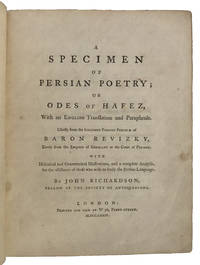
1774ME1081London:: Printed and Sold at No. 76 Fleet-Street 1774. 1774. 4to. iv xv 1 68 pp. Original full calf gilt spine; neatly rebacked to style preserving original endsheets. Inscribed by an early owner "This Book belonging to Monsieur Pierre Monneron." Extremely rare. This is the first edition in English of the ghazals of Hafez translated by one of the leading Persian orientalists of his day John Richardson FAS of Wadham College Oxford and famous for his seminal work written in conjunction with Sir William Jones the work being A Dictionary Persian Arabic and English 1777. / Hafez was previously unknown to the western world until Count Karl Emerich Reviczky von Revisnye 1737-1793 the Hungarian Orientalist and bibliophile 'discovered' him and brought his poetic classic to Europe with this Vienna printing. The work features an extensive text on Hafez and a translation of selected ghazals . Reviczky von Revisnye also issued in 1784 1794 a catalogue of his Greek and Latin library using the pseudonym of "Periergus Deltophilus". In the prefatory essay for that volume he shows an interest in the printing of Nicolas Jenson Aldus Manutius and the Estiennes. / Hafez was born in Shiraz Persia and lived approximately from 1325/26–1389/1390. He is considered a mystic and poet. His life and poems are the subject of much analysis commentary and interpretation influencing post-fourteenth century Persian writing more than any other author. FULL TITLE: A Specimen of Persian Poetry; or Odes of Hafez With an English Translation and Paraphrase. Chiefly from the Specimen Poeseos Persicae of Baron Revizky Envoy from the Emperor of Germany to the Court of Poland. With Historical and Grammatical Illustrations and a complete Analysis for the assistance of those who wish to study the Persian language. Printed and Sold at No. 76, Fleet-Street, 1774. unknown books