154 résultats
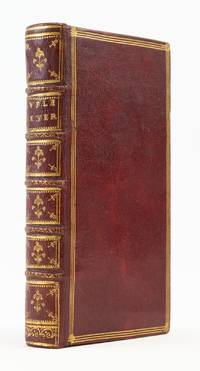
1683ST20461-2Paris: Pierre le Petit 1683. 203 x 127 mm. 8 x 5". 4 p.l. first blank xxxii 629 3 pp. <br/> REGAL CONTEMPORARY RED MOROCCO GILT covers with French fillet border central field semé with alternating fleur-de-lys and Louis XIV's stylized "L" topped with a crown raised bands spine compartments with crowned "L" at center oblique fleur-de-lys at corners marbled endpapers olive green morocco label all edges gilt. Printer's device on title page and four engraved plates depicting the Entry into Jerusalem the Crucifixion the Descent into Hell and the Resurrection. Front pastedown with morocco bookplate of Hans Fürstenberg; verso of front free endpaper with book label of the Fondation Fürstenberg. USTC 6098649. For the binding: Olivier Pl. 2493 Fer no. 8. Top inner corner of covers a shade darker but apparently not from moisture boards tending to splay slightly corners a bit bumped endpapers with offsetting from binder's glue but the binding lustrous with very little wear to the joints and generally pleasing. About a quarter of the leaves with small faint dampstain at upper gutter intermittent minor browning and foxing more pronounced on a couple of quires other unserious signs of devout use but the text with nothing approaching a fatal defect.<br/> <br/> Bound for a distinguished library--and perhaps for a member of the French royal household--and with an illustrious modern provenance this is a pleasing copy of a 17th century Parisian edition of the Office of Holy Week. The attractive engravings that accompany these paschal hours demonstrate the lush graceful style that distinguished the fine late baroque printmakers. The scenes of the Crucifixion and Resurrection were engraved by Jean Morin ca. 1605-50 whose innovation of combining engraving and etching on the same plate ushered in a new popular style of printmaking and the depiction of the Entry into Jerusalem by Flemish artist Peter Paul Bouche fl. ca. 1685-1702 is especially pleasing. But the story of this volume is its period binding. The owner who commissioned the binding may well have been a member of the noted Lamoignon family whose celebrated library was built over several generations but particularly by Chrétien-François de Lamoignon I 1644-1709 a cultivated man of letters and friend to writers such as Boileau and Racine. The "L" surmounted by a crown appears typically on the family bindings though normally accompanied by the same cypher stamped in the margin of the third leaf of text a stamp that is not present here. The impressive library was sold to bookseller Thomas Payne and auctioned off in 1791-92. Equally or really unequally the repeating motif of Louis XIV's crowned "L" monogram could well indicate that this was the property of royalty. We have not been able to identify its specific owner but this style of semis was not uncommon for royal bindings; the Russian National Library has two late 17th century examples with Louis XIV's own arms over an identical ground. According to Olivier the semis repetition alternating the monarch's initial with a fleur-de-lys or with a specific royal's cipher became popular during the reign of Louis XIII and continued under his successors; "the result for royal bindings is a sort of uniformity in the ornamentation which seems to reflect in the field of art the unification and centralization of France." Our binding's crisp precise tooling has survived beautifully despite apparent dedicated devotional use by its early owner. Our copy is further distinguished by coming from the collection of Hans or Jean Fürstenberg 1890-1982 a bibliophile of refined discrimination who assembled one of the great collections of the 20th century and whose books were noted for their outstanding condition. He put together one of the finest collections of 18th century French books ever assembled and his library contained a discriminating selection of bindings from other periods such as the present example. Pierre le Petit unknown
1643ST19567-147Lvgd. Batavorvm Leyden: Ex Officina Elzeviriana 1643. Second Elzevier Edition. 132 x 75 mm. 5 1/4 x 3". 1 p.l. 3-312 315-329 9 pp. <br/> FINE CONTEMPORARY BURGUNDY MOROCCO covers with gilt triple ruled border spine gilt in compartments with broad and stippled bands fleuron cornerpieces and floral centerpiece marbled endpapers turn-ins and all edges gilt. Woodcut initials headpieces and tailpiece engraved title page depicting St. Martin slicing his cloak in two with his sword to share with the beggar. Front pastedown with a cardinal's large 17th century engraved armorial bookplate rotated and trimmed to fit. Front pastedown and free endpaper with the morocco bookplates of Mortimer L. Schiff and of H. V. Ingram respectively. Initial blank and last leaf each with small ownership stamp that at rear of C. H. F. Curnillon that at front hard to decipher though perhaps reading "EBH." Willems 560; Rahir 552. ◆A few instances of light foxing and other trivial imperfections internally but A REMARKABLY WELL-PRESERVED COPY the binding bright and scarcely worn and the text very fresh and clean with virtually no signs of use.<br/> <br/> This is a most appealing little book containing the works of Severus the fourth century ecclesiastical historian who gave up great wealth in exchange for Christian seclusion and holy exercises and who became an ardent follower of St. Martin of Tours. Our volume includes Severus' most famous work his "Life of St. Martin" with its unforgettable pictures of this much venerated saint whose compassionate life includes the famous episode in which Martin cuts his cloak in half to share it with a beggar. Along with the "Life" are the "Dialogi Duo" which contains a reasoned review of the then prevailing bitter ecclesiastical feuds and provides information about these controversies not supplied from any other source. Also included is Severus' "Sacred History" a less original work summarizing events from creation to his own day but one much used in the Middle Ages when the author's correct and limpid Latin was greatly admired. Willems says this is the second Elzevier edition containing the same material as the 1638 edition but with the added continuation of the sacred history by Johannes Sleidanus 1506-56; Willems adds that the printing is "beautifully executed." This is a particularly lovely copy with distinguished provenance: it was previously in the library of the distinguished American bibliophile Mortimer Schiff 1877-1931 whose collection included works by great printers important illustrated books works printed on vellum and fine and historic bindings; it was later owned by H. V. Ingram a collector of fine bindings in the mold of Schiff a large number of whose books Ingram subsequently possessed. Ex Officina Elzeviriana unknown
1651138867Bremae (Bremen), Typis Berholdi de Villiers, ibid Gymnasii illustris typographi, An. 1651. 32 Seiten. Ohne Einband. (Papier teils fleckig u. an den Rändern teils mit geringeren Gebrauchsspuren). 30x19 cm
1628623584Jena, Reiffenberger, 1628. 5 Bl., 976 S. Mit illustriertem Kupfertitel mit kleiner Stadtansicht von Jena von Wolfgang Kilian. Pergament d. Zeit mit Gold- u. Blindprägung, Wappen-Supralibros u. gepunztem Farbschnitt mit kleinen goldenen Lilien, Rosen u. Eckstücken (angestaubt, Vergoldung teilw. abgerieben u. oxydiert). [3 Warenabbildungen]
16061264845Köln, A. Hierat, 1605 - 1606. 11 (statt 12) Bl., 318 S., 1 Bl. (weiß); 8 Bl. (die beiden letzten weiß), 219 S., 2 Bl. (weiß); 90 S., 3 Bl. (weiß); 300 S. Pgtbd d. Zeit (Einbd fleckig, Kanten beschabt, teilw. stärker gebräunt u. gebrauchsspurig, Unterstreichungen u. Marginalien von alter Hand, 1 Bl. der Vita Mureti fehlt, das vorhergehende Bl. mit Klebespur u. etwas Textverlust, S. 95/96 doppelt paginiert, dafür S. 174/75 übersprungen, 2 Bl. am Ende von Teil 4 lose, Bibl.-Schild, alte Besitzvermerke u. Stempel auf Vorsatz bzw. Titel).
1694139126Neo - Pragae bzw. Vetero - Pragae. Verschieden Drucker. 1686, 1688, 1692 und 1694. Vier Teile in einem Band. (8), 213, (32) Seiten; (6), 124, LXIV, (14) Seiten; (8), 390, XIV, (24) Seiten und (8), 168, XIII, (10) Seiten. Mit einem halbseitigen Kupferstich im ersten Teil. Alter Pergamenteinband. (Einband stärker fleckig u. am Rücken oben teils eingerissen. Papier durchgend gewellt u. teils fleckig bzs. gebräunt). 31x20x9 cm
16471192983Köln, J. Kalckhoven, 1647. 12mo. 4 Bl. (letztes weiß), 182 S. Hpgtbd d. Zeit (berieben u. bestoßen, Rückensign., kl. Wurmspuren im Bund außerhalb des Textes).
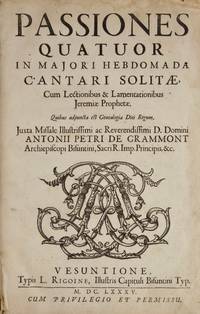
168541147Vesuntione Besançon: Typis L. Rigoine Illustris Capituli Bisuntini Typ 1685. Folio. Full contemporary dark tan speckled calf. 1f. recto title with striking woodcut geometric-floral device verso blank 3-131 i blank pp.<br /> <br /> With neumatic notation typeset on 4-line staves throughout scored for solo voice. <br /> <br /> Binding worn rubbed bumped; upper board quite warped; upper approximately 1/2" of head of spine lacking. Occasional minor staining worming and dampstaining; minor loss to upper outer corners and gutter of first several leaves. OCLC 1119128101. <br /> <br /> "The story of the Crucifixion as recorded in the Gospels of Matthew xxvi-xxvii Mark xiv-xv Luke xxii-xxiii and John xviii-xix. In the Roman liturgy the Passion texts are recited as Gospel lessons during Mass on Palm Sunday Matthew Tuesday of Holy Week Mark Wednesday of Holy Week Luke and Good Friday John. At a very early date special lesson tones were developed for reciting the Passion and polyphonic settings of its texts have been made since the 15th century." Kurt von Fischer and Werner Braun in Grove Music Online<br /> <br /> "Along with the great responsories the Lamentations are musically the most important texts of Tenebrae ." Günther Massenkeil in Grove Music Online. Typis L. Rigoine, Illustris Capituli Bisuntini Typ unknown
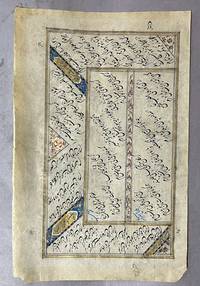
16500071451650. No Binding. Good. Single manuscript leaf size approx. 217 x 133 mm in Persian written on both recto and verso in elegant black nasta'liq script on buff paper. The text is arranged in ruled panels with a central vertical floral divider and enlivened by diagonal gilt cartouches and triangular cornerpieces illumintated in gold deep blue and polychrome floral decoration. The text is composed in refined Persian literary prose with rhythmic cadence consistent with ethical and didactic writing in the tradition of Sa'di of Shiraz and is very likely drawn from the Golestan or a closely related classical prose work. The confident calligraphy and balanced design are characteristic of Safavid-period book production intended for cultivated private readership. The illuminated cartouches with reserved script together with the delicate floral ornamentation reflect a mature Safavid aesthetic while later marginal or interlinear annotations in blue attest to continued reading and use. Condition is consistent with age and use. The paper shows overall toning and surface wear with areas of rubbing and discoloration including a noticeable rubbed patch affecting text on one side. Minor losses at lower corners and abrasions. Gold and pigments remain largely intact and visually effective. The calligraphy throughout remains clear and legible. Preserved as a single detached leaf. Ships unmounted and unframed <br/> <br/> unknown
1684621432Tübingen, G. Kerner für G. F. Blifer, 1684. 12mo. 24 Bl., 104 (recte 204) S., 6 Bl. Register. Moderner Pappband.
170057616[Ca. 1700]. Ca. 13,5 x 8,5 cm. Unter Feinkartonpassepartout mit Farblinieneinfassung.
168057667[Ca. 1680]. Ca. 5,5 x 5,5 cm. (Blattgröße ca. 7,5 x 6,5 cm). Unter Feinkartonpassepartout.
167584652[ca. 1675]. Bildgröße 11,3 x 8 cm Feinkartonpassepartout.
169057714[Ca. 1690]. Ca. 9,5 x 7,5 cm. Blattgröße 13,5 x 10.5 cm. Feinkartonpassepartout.
168084653[ca. 1680]. Bildgröße 12, 5 x 7 cm.
170078775[ca. 1700]. Bildgröße 14,4 x 8,5 cm, Blattmaß 15,1?x?9,5 cm. Unter Feinkartonpassepartout.
160557578[Ca. 1605]. Ca. 12,5 x 8,5 cm. Feinkartonpassepartout.
168057571[Ca. 1680]. Ca. 14 x 12 cm. (Blattgröße ca. 22 x 16 cm). Unter Feinkartonpassepartout.
169057615[Ca. 1690]. Ca. 13 x 11,5 cm. Feinkartonpassepartout.
168057665[Ca. 1680]. Ca. 5,5 x 5,5 cm. (Blattgröße ca. 7,5 x 6,5 cm). Unter Feinkartonpassepartout.
161697638Amsterdam, Johann Janssonius, 1616. Bildmaß 14 x 18,8 cm. Gerahmt (Rahmen 28 x 34 cm).
16721307499O.O. o. Vlg, (1672). Kl.-4to. 8 Bl. Rücken-Broschur.
16441385129Various publishers 1644-1645. Hardcover. 18mo Three volumes bound as one. In Good plus condition. Spine is cream without print. Boards in cream vellum. Spine has raised bands with string binding visible at hinges light toning/shelfwear to vellum light wear to spine caps and corners. Text block has library stamp on verso of first title page small stain to fore edge light age-toning to paper. Text in German gothic/fraktur print.<br /> <br /> CONTENTS: 1 Pupillen schilt; das ist Gründtliche Aussfüerung wie vermüg der Rechten die Pupillen und Minderiährigen auch ihre haab und güetter zubeschutzen und dess erlittnen schadens sowol vor-als nach ihrer Vogtbarheit Widerumb zuentledigen / durch Johann Wendle Michael Wagner 1644 407 pages - 2 Weit darvon ist gut fürm Schuß. Das ist: Ein nützliches nothwendiges und annemliches Tractätlein. Wider alle bevorab aber muthwillige oder doch sonsten ohnnötige Rechtfertigungen umb itziger unruhiger Zeit und Leut willen ernstmüthig an Tag gegeben / durch Georgen am Wald und Conradum Pertam Christian Siegesfrieden Franckfurt am Mann 1645 344 pages - 3 Regenten Spiegel : gerichtet Auff alle und jede Obrigkeiten hohes- und niedriges Standes/ worauff Sie fürnemlich zusehen/ wann sie Christlich und nützlich regieren wollen / durch M. Urbanum Titium Clemens Berger Wittemberg 1644 377 pages.<br /> <br /> <p>NOTE: Shelved in Netdesk office Case #3. 1385129. FP New Rockville Stock. Various publishers hardcover
1684142056München, Johann Hermann von Gelder 1684. (20), 495, (11) Seiten. Mit gestochenem Frontispiz. Pergament-Einband der Zeit mit handgeschriebenem Rückentitel. (Einband fleckig. Papier sauber, jedoch etwas wellig). 20x16 cm