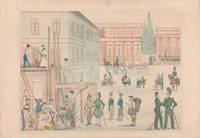
European School, 19th centuryBiblio.com

8 059 résultats
184023481840. Watercolor graphite and grayish ink on two sheets of cream laid paper with an 1836 M and smiling sun watermark 10 1/4 x 25 7/8 inches 260 x 658 mm the full sheet. Titled in ink in French on the recto. In very good condition with minor edge wear including creasing and nicks. A splendid panorama with each of the major peaks and point of interest labeled and identified in French. The iconic symbol of the Swiss resort the "Sun of St. Moritz" was adopted from early European heraldic marks and rebranded around 1930 by graphic designer Walter Herdeg. The image was patented in 1937 by spa director Walter Amstutz becoming the world's first visual trademark for a tourist destination. unknown
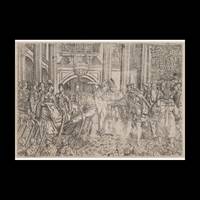
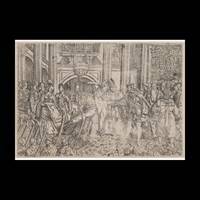
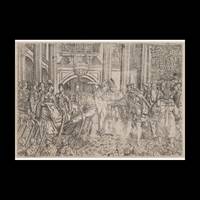
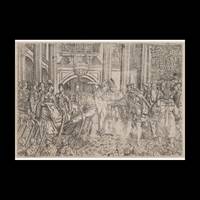
441749Contentum Ltd. Loose sheet. New. High-quality art print based on an original work from the Ycba. Created in the 1th century undated. Professionally printed on premium fine-art paper Photo Rag 308 premium quality in size A2. The artwork is printed with a white border museum-style presentation. Contentum Ltd. unknown
441750Contentum Ltd. Loose sheet. New. High-quality art print based on an original work from the Ycba. Created in the 1th century undated. Professionally printed on premium fine-art paper Museum Etching museum quality in size A2. The artwork is printed with a white border museum-style presentation. Contentum Ltd. unknown
441747Contentum Ltd. Loose sheet. New. High-quality art print based on an original work from the Ycba. Created in the 1th century undated. Professionally printed on premium fine-art paper Museum Etching museum quality in size A3. The artwork is printed with a white border museum-style presentation. Contentum Ltd. unknown
441748Contentum Ltd. Loose sheet. New. High-quality art print based on an original work from the Ycba. Created in the 1th century undated. Professionally printed on premium fine-art paper Photo Rag Bright White in size A2. The artwork is printed with a white border museum-style presentation. Contentum Ltd. unknown
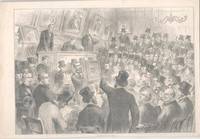
71-4428London: The Illustration London News 27 April 1872. Wood engraving. 26 x 38 cm. sheet. Very Good. Light toning along sheet edges. London: The Illustration London News, 27 April 1872. unknown
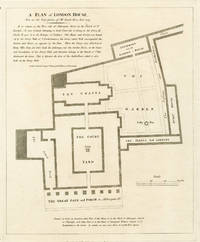
1814948London: Robert Wilkinson 1814. Copperplate engraving on watermarked Smith wove paper 12 1/4 x 9 3/4 inches 310 x 245 mm full margins. There is some minor marginal toning and handling wear that is consistent with age otherwise in very good condition. Robert Wilkinson unknown
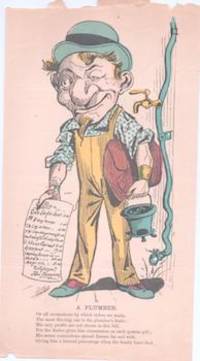
71-6615London: Punch Magazine circa 1900. Color lithograph. 19.5 x 16 cm sheet. Good short tears along sheet edges sheet lightly toned. [London: Punch Magazine, circa 1900]. unknown
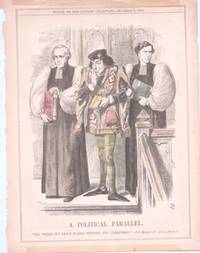
71-8746London: Punch or The London Charivari 1868. Hand-colored illustration. 27 x 21 cm sheet. Good light toning tears and a hole along sheet edges horizontal tear at left center extending into the image. London: Punch, or The London Charivari, 1868. unknown
68-7907Oxford UK: Munday 1809. Folio. Broadside. Letterpress on deckled wove. Very Good. Scarce. Oxford, UK: Munday, 1809. unknown
345126Contentum Ltd. Loose sheet. New. High-quality art print based on an original work from the Met. Created in the 17th century late 16th century. Professionally printed on premium fine-art paper Photo Rag Bright White premium quality in size A2. The artwork is printed with a white border museum-style presentation. Contentum Ltd. unknown
345127Contentum Ltd. Loose sheet. New. High-quality art print based on an original work from the Met. Created in the 17th century late 16th century. Professionally printed on premium fine-art paper Museum Etching museum quality in size A2. The artwork is printed with a white border museum-style presentation. Contentum Ltd. unknown
345124Contentum Ltd. Loose sheet. New. High-quality art print based on an original work from the Met. Created in the 17th century late 16th century. Professionally printed on premium fine-art paper Museum Etching museum quality in size A3. The artwork is printed with a white border museum-style presentation. Contentum Ltd. unknown
345125Contentum Ltd. Loose sheet. New. High-quality art print based on an original work from the Met. Created in the 17th century late 16th century. Professionally printed on premium fine-art paper Photo Matt Fibre in size A2. The artwork is printed with a white border museum-style presentation. Contentum Ltd. unknown
192829455HBDJ 1928 1ST EDITION THUS VG/VG- AS-IS Used - minor bumping to corners; pages clean; binding very good. Jacket condition Dust jacket: worn chipped and faded FOXED AT SPINE.Small blue cloth Gold gilt titl.es on Spine Cvr The story of the awakening of a London financier who after long years spent in the amassing of a fortune reverts to his early dream of becoming a great philanthropist. Sequel to the Education of Uncle Paul and the bases for The Starlight Express play produced in 1915. Blackwood became "Uncle Paul" to children in his own family and those of his friends. He delighted in having the fun of the children without the responsibility. Blackwood was of the opinion that children like animals had not lost their instinctive closeness to nature or their innocence both of which became dulled with age. A Prisoner in Fairyland reflects this youthful closeness to the natural and supernatural world he old vicar spoke to him strangely. "We've not forgotten you as you've forgotten us" he said. "And the place though empty now for years has not forgotten you either I'll be bound." Rogers brushed it off. Just silliness -- that was all it was. But after St. John's the conductor shouted "Take your seats Take your seats The Starlight Express is off to Fairyland Show your tickets Show your tickets " And then the forgotte<br /><br /> Macmillan & CO Ltd, London CARAVAN LIBRARY UK hardcover
71-3159London: British Publisher circa 1842. Steel engraving. 161 x 180 mm. sheet. Good vertical tear at top edge of sheet two vertical creases margins trimmed.Provenance: From the collection of the Late Frederick G. Ruffner Jr. founder of Gale Research Detroit. [London: British Publisher, circa 1842]. unknown
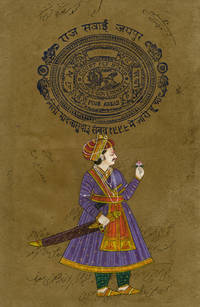
189013401890. Ink and gouache with gold heightening on fibrous brown laid paper with a Jaipur Court Fee tax stamp in purple ink on the recto 12 1/2 x 9 inches 318 x 230 mm. Toning handling creases and minor scattered surface soiling throughout. There are scattered coeval inscriptions in ink on the recto and verso. The first revenue stamps in India were issued in the mid-nineteenth century during the Raj and they are still being issued to this day. Apart from issues for the whole of India many princely states provinces and other states also had or still have their own revenue stamp issues. Before independence Indian revenue stamps were closely modeled on similar designs from Great Britain as is the case with this carriage motif stamp from Jaipur. <br /> <br /> The stamps were issued to denote various denominations including rupees and annas. An anna or Änna was a currency unit formerly used in British India equal to 1â„16 of a rupee. It was subdivided into four old Paisa or twelve pies thus there were 192 pies in a rupee. When the rupee was decimalized and subdivided into 100 new paise one anna was therefore equivalent to 6.25 paise. This particular stamp was used as evidence of court taxes remitted for property dealings. unknown
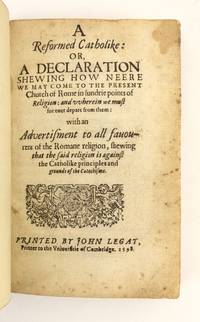
1598ST16441Cambridge: John Legat 1598. Second Printing. 153 x 98 mm. 6 x 3 7/8". 4 p.l. 375 1 pp. <br/> Modern sprinkled calf blind-ruled covers raised bands flanked by double gilt rules brown morocco label remnants of paper library shelf label at tail of spine. Printer's device on title page. Front pastedown with bookplate of the Fox Pointe Collection; rear pastedown with deaccession stamp of Bradford City Libraries. STC 19736; ESTC 19736. ◆Spine just faintly sunned leaves lightly browned due to paper quality and trimmed a bit close at head grazing headline on a couple of leaves isolated marginal stains or tiny rust spots but an excellent copy fresh and clean in a sympathetic binding with few signs of wear.<br/> <br/> This was an important work in establishing distinctions in liturgy and doctrine between the Catholic Church and the Church of England written by a moderate puritan whom DNB considers "perhaps the most significant English theologian of his age." Perkins 1558-1602 was one of the most popular voices of his time speaking from a Calvinist puritan point of view; while he could be virulently anti-Catholic he did not believe in repudiating the English church only in reforming it. According to DNB "The genius of Perkins's work did not lie in its originality—his theology represents a conventional recital of Calvinist scholasticism in virtually every respect. His gift lay rather in bringing to a broad audience a variety of theological and moral issues popularizing essentially technical discussions and therefore as Fuller observed humbling 'the towering speculations of philosophers into practice and morality.'" The present work spread his polemical influence beyond England to the Continent; even the Catholic bishop William Bishop admitted he had "not seene any book of like quality published by a Protestant to contain either more matter or delivered in better method." Both the 1597 first edition and our 1598 second printing are rare: no other copies of either edition are recorded at auction by RBH or ABPC in the past 50 years. John Legat unknown
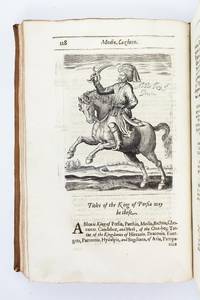
1634ST20186London: printed by William Stansby and Jacob Bloome 1634. FIRST EDITION. 290 x 195 mm. 11 1/2 x 7 3/4". 6 p.l. 225 15 pp. <br/> Contemporary sprinkled calf raised bands traces of old paper label to spine pastedowns lifted to reveal leather bands and manuscript document fragments used as sewing guards all edges sprinkled red expert repair to rear joint. With additional engraved title page featuring two figures of Persian dignitaries and three small travel vignettes signed at foot by William Marshall and 36 engravings in the text the majority vignettes but one full-page and nine more than half a page tall. Front endpaper with ink armorial stamp of Sir Walter John Trevelyan 8th Baronet of Nettlecombe and High Sheriff of Cornwall. Price inked in a contemporary hand to the front endpaper. Sabin 31471; STC 13190.3; ESTC S92948. Front board a bit splayed covers with three old dampstains and a few scars and tiny wormholes but a very pleasing original binding with almost no wear to the joints. A very few marginal smudges made during printing other quite trivial imperfections but AN ESPECIALLY FRESH BRIGHT AND CLEAN COPY INTERNALLY with rich impressions of the engravings.<br/> <br/> This is a contemporary copy in remarkably fresh internal condition of an important and entertaining account of the travels of a 17th century Englishman in exotic Asian and African territories particularly Persia. It is significant both for the ways it is accurate and for the ways it is fictitious. Sir Thomas Herbert 1606-82 left for Persia on a diplomatic mission to Shah Abbas in 1626 as part of the entourage of Sir Dodmore Cotton. The mission was not successful: Cotton and the mission's other leader Sir Robert Shirley both died in 1628 leaving their retinue at loose ends with the increasingly unimpressed Shah. Herbert made a slow return to England traveling through a large portion of Asia and Africa and even sailing up the coast of North America. He finally returned to England in 1630; four years later he published this account of his adventures. The text describes meetings with people of many cultures as well as encounters with exotic animals including the dodo flamingoes and flying fish. Herbert's accounts are of great importance for their details of early Asian travel by Westerners. At the same time the author was unable to resist the urge to embellish a good story and according to DNB gave implicitly first-person accounts of places he had not in fact visited. One such detour into the fanciful comes in the chapter involving the author's apparent visit to America. In it Herbert discusses the belief that the mythical Welsh king Madoc ap Owen-Gwyned had settled in North America in the 9th century for which he provides linguistic evidence that Sabin calls "entirely fanciful." DNB tells us that "this segment was apparently included to please the earl of Pembroke's own Welsh nationalist fancies. It also continued to help fuel various theories about Madoc's colonies and Welsh Indians in North America until the early years of the nineteenth century." Herbert's tale is profusely illustrated by William Marshall fl. 1617-49 with engravings that are sometimes more imaginative than accurate see for example the depiction of the shark on page 6 or the penguin on page 13. Despite these rather amusing inaccuracies the illustrations are lively and detailed providing a sense of the awe the early readers must have felt when imagining foreign places. Our copy in a period binding with part of a manuscript ledger used in the binding process visible is from the library of Walter John 1866-1933 8th baronet Trevelyan who as his inkstamp suggests served as High Sheriff of Cornwall from 1906-07. printed by William Stansby, and Jacob Bloome unknown
20072110502151108278Not Available 2007. Soft Cover. Fine. Number of books: 1 Not Available paperback
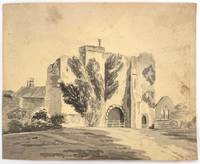
184025111840. Ink and wash on wove paper 5 1/8 x 6 1/2 inches 130 x 165 mm the full sheet. In very good condition with uniform toning some minor surface soiling and with the right sheet edge creased. unknown
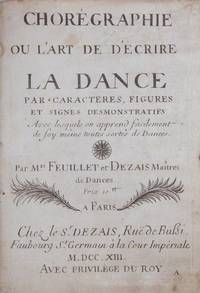
170940499Paris 1709. FEUILLET and DEZAIS<br /> Chorégraphie ou l'art de décrire la dance par caractères figures et signes démonstrifs avec lesquels on apprend facilement de soy-même toutes sortes de dances. ouvrage très utile aux maîtres à dancer et à toutes les personnes qui s'appliquent à la dance. Par Mrs. Feuillet et Dezais Maîtres de Dances. Prix: . <br /> <br /> Paris: Chez le Sr. Dezais Ruë de Bussi Faubourg St. Germain à la Cour Impériale . Avec Privilége du Roy 1713.<br /> <br /> 1f. recto title verso blank i dedication "A Monsieur Pécour Pensionnaire des Menus Plaisirs du Roy et Compositeur des Balets de l'Académie Royale de Musique de Paris" ii Préface i "Extrait du Privilege du Roi" 95 i blank pp. Engraved throughout. <br /> <br /> The revised fourth edition of this seminal work first published in 1700. RISM Écrits Imprimés p. 314 2 copies only of all editions in the U.S.: one of the first 1700 edition at the NYPL and one of the present edition at the Library of Congress. Beaumont p. 72. De Moroda 938. Schwartz and Schlundt 21. This edition not in Cortot Hirsch or Malkin.<br /> <br /> "A rather less known choreographer is Jacques Dezais. He lived in the first half of 18th century and regarded himself as a follower of R. A. Feuillet. In 1726 he published a collection of dances named Premier Livre de Contre-Dances à Quatre à six & à Huit. Unfortunately the publication was lost when the famous Anna-Amalie Library in Weimar burned in 2004." earlydance/news/8138-les-cotillons-de-jacques-dezais<br /> <br /> Bound with:<br /> FEUILLET<br /> Recueil de Dances Composées par Mr. Feuillet Maître de Dance. <br /> <br /> Paris: Chez l'Auteur rue de Bussi Faubourg St. Germain à la Cour Imperiale Avec Privilége du Roy 1709. <br /> <br /> 1f. recto title verso blank 84 pp. Engraved throughout.<br /> <br /> Contains 18 dances in Feuillet notation with melody for each at head as follows:<br /> <br /> - Le Rigaudon de la Paix pp. 1-2<br /> - 2e Rigaudons pp. 3-7<br /> - Gigue à deux Gigue de Roland pp. 8-11<br /> - Entrée a deux Rigaudon pp. 12-16<br /> - Autre Entrée a deux Rigaudon pp. 17-20<br /> - Sarabande pour femme Sarabande pp. 21-24<br /> - Sarabande pour homme Sarabande pp. 25-28<br /> - Sarabande Espagnole pour homme Sarabande Espagnole pp. 29-32<br /> - Folie d'Espagne pour femme Folie d'espagne pp. 33-38<br /> - Canary à deux Canary pp. 39-40<br /> - Gigue pour homme Gigue pp. 41-44<br /> - Entrée pour homme pp. 45-48<br /> - Autre entrée pour homme entree pp. 49-52<br /> - Entrée grave pour homme pp. 53-59<br /> - Entrée d'Apolon Entrée Apolon pp. 60-66<br /> - Balet de neuf Danseurs entre graue pp. 67-72<br /> - Canary pp. 73-74<br /> - second canary p. 75-84 with pp. 77-84 folding<br /> <br /> First published in 1700. Little and Marsh 1709-Feu p. 103 for a list of editions and issues see 1700-Feu. De Moroda 938. This edition not in Malkin Niles & Leslie Schwartz & Schlundt or RISM<br /> <br /> "All but one of the dances in Feuillet's collection are solos or duets ranging from easy to difficult; the single exception is a piece for eight dancers and a soloist - the only known example in Feuillet notation of a French ballet entry for more than two persons." Little and Marsh p. 91.<br /> <br /> Bound with: <br /> FEUILLET<br /> Recueil de Dances Composées par M. Pecour Pensionnaire des menus Plaisirs du Roy et Compositeur des Balets de l'Academie Royale de Musique de Paris et mise sur le Papier par M. Feuillet. Maître de Dance. <br /> <br /> Paris: Chez l'Auteur rue de Bussi Faubourg St. Germain à la Cour Impériale Avec Privilege du Roy 1709. 1f. recto title verso blank 72 pp. Engraved throughout.<br /> <br /> Contains 15 dances in Feuillet notation with melody for each at head as follows:<br /> <br /> - la Bourée d'Achille Bourée pp. 1-3<br /> - menuet pp. 4-11<br /> - La Mariée la Mariée pp. 12-21<br /> - le Passepied passepied pp. 22-23<br /> - 2e. Passepied pp. 24-31<br /> - la Contredance Gigue pp. 32-36<br /> - le Rigaudon des Vaisseaux Rigaudon pp. 37-39<br /> - 2e. Rigaudon pp. 40-42<br /> - la Bourgogne Courant pp. 43-44<br /> - Bourée pp. 45-46<br /> - Sarabande pp. 47-48<br /> - PassePied pp. 49-53<br /> - la Savoye Bourée pp. 54-61<br /> - la Forlana la Forlana pp. 62-67<br /> - la Conty Venitienne pp. 68-72 <br /> <br /> First published in 1700. Little and Marsh 1700-Péc p. 93. De Moroda 1341. This edition not in Malkin Niles & Leslie Schwartz & Schlundt or RISM.<br /> <br /> "Pecour's Recueil was bound and sold with Feuillet's Chorégraphie and Feuillet's Recueil . for a survey of editions and issues see comments under 1700-Feu. This collection contains a variety of pieces for ball dancing in vogue in 1700; many of them are quite difficult. According to the preface to Feuillet's Chorégraphie Pécour himself went over the proofs to eliminate errors in notation." Little and Marsh p. 93.<br /> <br /> Louis Guillaume Pécour 1651-1729 was an important French dancing-master and choreographer. He worked closely with celebrated royal choreographer Pierre Beauchamp 1631-1705 Louis XIV's personal dancing master.<br /> <br /> Octavo. Full dark brown mottled calf with raised bands on spine in decorative compartments gilt dark brown title label gilt. <br /> <br /> Binding worn rubbed and bumped with some abrasions; head of spine joints and edges chipped with minor loss; endpapers slightly worn soiled and foxed. Occasional minor signs of wear soiling and foxing; several titles very slightly cropped. <br /> <br /> Very good copies overall of all three works. Feuillet was a highly important French choreographer dancing-master and author. "He worked at the court of Louis XIV. His fame rests on his Chorégraphie a book describing a system of dance notation that was used in Europe throughout the 18th century. He probably did not invent the system himself although he said he had but derived it from the original work of Pierre Beauchamps Louis XIV's personal dancing-master. Unlike previous methods which describe movement verbally and use letters to refer to the sequence of steps Feuillet's system is a track notation. It represents symbolically not only the steps of the dancer with his turns leaps and slides but also the floor pattern in which he is to travel. The dance music is printed at the top of the page and the steps are marked off in a manner corresponding to the structure of the music. .<br /> <br /> The publication of the Beauchamp-Feuillet notation meant that specific dances could easily be distributed throughout Europe. It also added to France's pre-eminence in the world of dance. Today the system makes it possible for scholars to study some of the dances in use in the late 17th and early 18th centuries an important period for the development of the classical French ballet style and technique." Meredith Ellis Little in Grove Music Online<br /> <br /> "With the invention of his dance notation system in the eighteenth century Raoul-Auger Feuillet revolutionized the dance world. Published in 1700 his Chorégraphie . was conceived as a self-teaching device not a way of preserving dance. Yet owing to its immense popularity throughout Europe even today a large body of theatrical and ballroom dances from that period in both printed and manuscript forms can still be found in most archives. . Chorégraphie was reprinted three times in thirteen years translated into English by John Weaver in 1706 and appeared in various "improved" versions in France Germany Spain and Portugal. Voltaire 1751 ranked the invention among the "achievements of his day" and Denis Diderot 1763 devoted ten pages to the subject in his Encyclopédie." International Encyclopedia of Dance Vol. 2 p. 588.<br /> <br /> An extraordinary presentation of three of the most important early choreographic works all major factors in confirming France's preeminence in the world of 18th century ballet. unknown
71-2114France: French Publisher circa 1856. Hand-colored etching. 10 x 13 1/2 in. image. Good tears along sheet edges some toning.Provenance: From the Collection of the late Frederick G. Ruffner Jr. founder of Gale Research Detroit. [France: French Publisher, circa 1856]. unknown
68-0521London UK: ca. 1790. . Engraving. 9.5 x 16 cm. Very Good.From the Collection of Hon.Gerald Henry Brabazon Ponsonby 1829 - 1908 Private Secretary to the Lord-Lieutenant of Ireland; son of the 4th Earl of Bessborough. [London, UK: ca. 1790?]. unknown