A. TKALECMareMagnum
Livre Rare Book
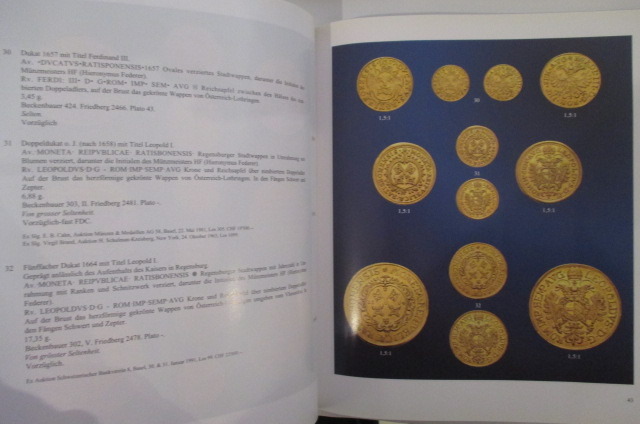
100 GOLD COINS OF REGENSBURG. AUCTION 60.
NUM029M14 September 2004. Zurich. 103 Pages. Broché. Langue : Anglais / Allemand.
Librairie du Levant · Bayonne, France20,00 €
1 618 résultats
328 lots illustrés en coul., 4 pl. d'aggrandissements. Inv. 44348
New English Paperback. Pbo. 4to. (31 x 24 cm). In Turkish and summary in English. 413 p., b/w and color ills. 10. yilinda Laodikeia (2003-2013 yillari). (Laodikeia çalismalari: 3).
NUM029M14 September 2004. Zurich. 103 Pages. Broché. Langue : Anglais / Allemand.
200702719Roanne, C.P.R., 1980 ; in-8, 160 pp., broché.
New English Paperback. Pbo. Large 8vo. (20 x 20 cm). In Turkish. [6], iv, 422 p., b/w ills., 10 folding maps. A general view of Islamic coins: 150 States 1500 Sultans. 150 devlet 1500 sultan. Islam sikkeleri.
Fine English Original bdg. 4to. (32 x 24 cm). In Turkish. [xiv], 113, [2] p., 14 b/w plates. 1947-1967 yillari Side kazilari sirasinda elde edilen sikkeler. Coins found in excavations in Side between 1947-1967. ARCHEOLOGY Anatolian civilizations Numismatics Coins Adalia Pamphylia Collection Antiquity.
590479Conservation départementale des Musées de la Meuse, (1992). In-8 br., couv. ill. en couleurs, 54pp., nombreuses figures photographiques.
Very Good Turkish, Ottoman (1500-1928) Original 1/3 black leather bdg. Five compartments on spine, second gilt. Roy. 8vo. (24 x 16 cm). In Ottoman script (Old Turkish with Arabic letters). [31], 143 p., 5 b/w unnumbered leaves of 173 numbered coins, ills. and tables. First edition of this first and very rare catalogue of Seljukite coins, by the father of modern Turkish numismatics. Ismail Galib was the son of Ibrahim Edhem Pasha and the pioneer numismatist in the Ottoman Empire, who is considered the father of modern numismatics in Turkey. "Ismail Galib, his brother and a pioneering numismatist in his own right studied coins from the Seljuks of Rum and published a catalog entitled 'Takvîm-i meskûkât-i Selçûkiyye'..." (Ottoman/Turkish Visions of the Nation, 1860-1950). The Seljuk Sultanate of Rum was a Turko-Persian Sunni Muslim ruled state, established over conquered Byzantine territories and peoples (Rûm) of Anatolia by the Seljuk Turks following their entry into Anatolia after the Battle of Manzikert (1071). The sultanate's monetary sphere of influence lasted long and coins of Seljuk mint, generally considered to be of reliable value, continued to be used throughout the 14th century, once again, in the Islamic world including by the Ottomans. OCLC 1008462309.; Özege 19392.
597067sl, sn, [1789]. In-4, rel. post. (début XXe), demi basane fauve, dos à nerfs, titre doré. Recueil de 153 planches de monnaies gravées (chiffrées 1 à 173, incluant les 22 titres intermédiaires dans la pagination), une pl. suppl. volante, 14 pages de tables in-fine.
9427In 8 reliure éditeur pleine toile marron à la bradel. Titre doré, fers et filets à froid sur les plats. Frontispice, sous serpente, titre, 412 pages, 1 tableau dépliant, 27 planches hors-texte J. B Lippincok & Co Philadelphia 1860. Rare édition originale. Très bon état
Fine English Paperback. Roy. 8vo. (24 x 17 cm). Articles in English and Turkish. [viii], 278 p., numerous b/w plts. A festschrift presented to Ibrahim Artuk on the occasion of the 20th Anniversary of the Turkish Numismatic Society.= Türk Nümismatik Derneginin 20. kurulus yilinda Ibrahim Artuk'a armagan. Cevriye Artuk: Ibrahim Artuk'un biyografisi ve eserleri / The biography and bibliography of Ibrahim Artuk - Jean- Louis Bacque-Grammont: Deux Ordres d'Ibrahim Pasha / Ibrahim Pasanin Iki Emirnamesi - N. Beldiceanu et Iréne Baldiceanu - Steinherr: Les Informations Les Plus Anciennes sur les florins Ottomans / Osmanli Altinlari Üzerine En Eski Bilgiler - Siyret Gözalan: 1314 Yunan Harbi Madalyasi - Cüneyt Ölçer: Mentese Beyi Ilyas oglu Leys in 823 tarihli akçeleri / The Akches Dated 823 Belonging to Leys The son of Menteshe Bey Ilyas - Rudi P Lindner: A Silver Age in Seljuk Anatolia. NUMISMATICS Coins Referance Islamic numismatics Ottoman culture Seljuks Anatolian Emirates Collection.
3760London, Sotheby's and RNS, 1986 19 x 24, 143 pp., broché, bon état
197327476Centre De Recherches Archéologiques Du Vexin Français 1973 In-8 16 pp tapuscrites
New English Paperback. 4to. (28 x 20 cm). In English and German. 496 p., color and b/w ills. Vorwort (Felix Pirson - Katja Piesker) Vorwort der Herausgeberinnen (Ursula Quatember - Ute Lohner-Urban) Einleitung: Architektur in Kleinasien am Übergang vom Hellenismus zur römischen Kaiserzeit (Ursula Quatember - Ute Lohner-Urban) Ursula Quatember / Zur Erforschung der Architektur Kleinasiens am Übergang vom Hellenismus zur römischen Kaiserzeit Gina Alajmo / Global versus lokal. Zur Gestaltung und Entwicklung von Heiligtümern in Karien und Pisidien nach ihrer Eingliederung in das Imperium Romanum Orhan Bingöl / Hermogenes. Das Glas halbleer betrachtet Emanuela Borgia / The Roman Temple at Elaioussa Sebaste (Cilicia) as a Case of Transition between Hellenism and Romanization Sara Bozza / The Adoption of Roman Building Techniques in Asia Minor, 30 Years Later Laurence Cavalier / Xanthos at the Turn of the 1st Century A.D.: Becoming Roman Hüseyin Cevizoglu / Die Heilige Stra?e in Didyma. Der aktuelle Forschungsstand zu ihrer baulichen Entwicklung im Kernheiligtum Burkhard Emme / The Lower Agora of Pergamon. A Sub-Hellenistic Building Complex in its Historical Context Beatrice Fochetti / Aspects of Continuity and Change in the Doric Order of the Province of Asia during the Imperial Period Silke Haps - Werner Oenbrink / Das Heiligtum auf dem Dülük Baba Tepesi bei Doliche in hellenistisch-römischer Zeit Tommaso Ismaelli / Shaping the Sacred Space in Early Imperial Asia Minor. The Pseudomonopteros Temple of Hierapolis and Roman Influence on the Sacred Architecture Musa Kadioglu / Vorbericht über das Dionysos-Heiligtum von Teos im Licht der neuen Grabungen Dominique Krüger / Römisch, lokal oder orientalisch? Kilikien am Übergang vom Hellenismus zur Kaiserzeit Monumentale Altare und ihr Bildschmuck vom Hellenismus bis in die Kaiserzeit am Beispiel des Altars des Domitian-Tempels von Ephesos Eric Laufer / Folgen einer Provinzialisierung. Stadtebauliche Veranderungen im Lykien des 1. Jhs. n. Chr. Ute Lohner-Urban / Das Osttor von Side. Entwicklungslinien der pamphylischen Hoftore am Übergang vom Späthellenismus zur römischen Kaiserzeit Ulrich Mania / Zur Badekultur in Kleinasien zwischen Hellenismus und Kaiserzeit Julia Martin / Gebrannte Ziegel im westlichen Kleinasien. Das 1. Jahrhundert n. Chr. Ibrahim Hakan Mert / Hellenistische und kaiserzeitliche Grabbauten von Priene Elisabeth Rathmayr - Veronika Scheibelreiter-Gail / Kontinuitaet und Wandel in Wohnbau und Wohnkultur in Ephesos vom spaten Hellenismus bis in die hohe Kaiserzeit Christopher Ratte - Felipe Rojas - Angela Commito / New Research at Notion Martin Seyer - Ursula Quatember / Zur Urbanistik und Architektur Limyras im Hellenismus und in der frühen Kaiserzeit Marcello Spanu / Honorary Arches and Gates in Asia Minor up to the Reign of Trajan Hilke Thür / Brunnenanlagen und Wasserversorgung in Ephesos in hellenistischer und frührömischer Zeit Rhys F. Townsend / Politics, Patronage, and Architectural Style in Augustan Asia Minor Rosangela Ungaro / Architecture and Architectural Decoration in Asia Minor. Continuity of Hellenistic Models in the Early Imperial Period, from the Augustan to the Neronian Age Inge Uytterhoeven / Following "Western" Fashion Trends. The Impact of "Italian" Elements on Private Housing in Roman Imperial Asia Minor
New English Original bdg. 4to. (28 x 20 cm). In English. 232 p. Color ills. "Situated in Central Anatolia, Hattusa remained the capital city of the Hittites from 1650/1600 to around 1200 BC. Here, as recently as 2003 to 2005, the German Archaeological Institute has rebuilt one stretch of the mudbrick city wall. The funding for the endeavor -the first of its kind worldwide- has been generously provided by JT International. The scope of this project in experimental archaeology has been to recreate a part of the wall using the same materials the Hittites had at hand when they built their original walls so long ago. Each step necessary for the construction was fully documented so as to enable us to assess not only the amount of building materials required but also the manpower and time the Hittites must have invested in the various tasks of construction. This volume presents the results gleaned from this documentation. From the production of the first mudbrick to the dedication of the finished structure, each and every undertaking has been described in detail and is presented here accompanied by 573 illustrations".
Very Good French Paperback. Roy. 8vo. (24 x 17 cm). In English and Turkish. 12 p., (4 p. in English, 4 p. in French, and 4 p. in Turkish text), 1 b/w plate. A silver Seldjoucide coin unknown until now Djimri Sultan Siyavush.= Une monnaie Seldjoucide Djimri inconnue jusqu'ici.= Simdiye kadar görülmiyen Cimri sikkesi. (Selchuk Sultan Alâeddin Siyavush, b. 1277) 'Djimri' according to the writings of Osman Ferid Saglam, the word 'Cimri' is used as a synonym for 'ephony-sultan'. Yazicioglu Ali, in his book entitled 'Tevârih-i Âl-i Selçuk' (No: 1390, Revan Library, the Topkapi Palace) argues that Cimri was not a name attributed to a vagabond who had claimed that he was Siyavus bin Izzeddin, but a derisive adjective used for him by pro-Seljuk historians. The actual meaning of the word is 'ordinary', or 'III-bred', or 'one who has sprung up from anywhere'.
New English Paperback. Pbo. Oblong 4to. Ills. 142 p. In English and Turkish. A study of Ibrahim Demirel's photographs.= Ibrahim Demirel fotograflari üzerine bir inceleme. Prep by: Jülide Demirel. Translation: Barbara Blackwell Gülen.
New English Paperback. Roy. 8vo. (24 x 17 cm). In English, abstract in Turkish. 129 p., color plts. A terracotta treasure at Assos. During the summer of 1995 Turkish archaeologists discovered a unique Late Classical tomb in the Western Necropolis of Assos. A modestly designed cist grave, Tomb 4 surprised excavators with the richest cache of grave goods ever found at the ancient city. The 62 well-preserved artifacts, which date from the 4th century BCE, when Aristotle's school of philosophy was active at Assos, consist of terracotta figurines, gold and bronze jewelry, and vases. The variety of the coroplastic group is especially striking. The types include seated female musicians and a poet, an oklasma-dancer, comic actors, goddesses, a horse-rider, a warrior, female mask protomes, miniature furniture, various animals, and a figurine vase. The main purpose of this publication is to examine the finds from Tomb 4 and to shed light on characteristics of coroplastic produc-tion and socio-cultural life at Assos during its "Golden Age" through a contextual, typological, and iconographical analysis of the terracotta figurines. The variety of the figurines not only gives clues about the identity of the tomb-owners, but also hints at the many aspects of the "Golden Age" of Assos, such as the fertility cults active in the city, the increasing importance of the theatre, the place of women in socio-religious life, and the commercial and cultural relations of Assos with the neighbouring cities, especially Athens.
Very Good English Original bdg. HC. Oblong large 8vo. (21,5 x 21,5 cm). In Turkish. 234 p., color ills. A comprehensive study on Ottoman numismatics. A'dan Z'ye Osmanli nümismatik el kitabi.
Fine English Paperback. Pbo. Roy. 8vo. (24 x 17 cm). In English and Turkish. 39 p., b/w ills., 4 b/w plts. Abaka Khan's silver coinage that bear the date as well as the month in which they were struck.= Abaka Han'in darp aylari yazili gümüs sikkeleri. M. 1265 - 1282 (H. 663 - 680).
182381100Couverture rigide. Cartonnage muet de l'époque. 186 pages. Rousseurs. Découpe à une page de garde. Tache en marge aux 20 premières pages.
New Persian Original bdg. HC. Roy. 8vo. (24 x 17 cm). Text in Persian; with bilingual title on cover in English and Persian. 195 p., many unnumbered color plates of coins. Abbasid and Aghlabid gold coins of Karaj Abû Dolaf (Astaneh, Shazand County).= Sikkah'hâ-yi talâ-yi 'Abbâsî va Aghâbilah-i Karaj Abû Dûlâf (Shahr-i Âstânah-i Shâzand).
11991Paris, Editions Klincksieck, octobre 1975. Grand in-8 broché, 153 à 331 p. Illustrations. Sommaire : Monnaie et activité économique dans l'Europe du bas Moyen Age - Rome chez les géographes arabes... Très bon état. Publication trimestrielle.
12029Paris, Diffusion De Boccard, juin 1981. Grand in-8 broché vert, 154 p. Illustrations. Sommaire : La divinité féminine souveraine chez les Celtes continentaux d'après l'épigraphie gallo-romaine et l'art celtique - En marge d'une 'rigani' gauloise, par M. Lejeune - Une tablette d'exécration de l'oppidum de Montfo (Hérault) - Le territoire de Sicca Veneria en Numibie... Bon état. Publication trimestrielle.
12032Paris, Diffusion De Boccard, février 1983. Grand in-8 broché vert, 411 à 665 p. Illustrations. Sommaire : La République des Pictons, par G.-C. Picard - Témoignages du gaulois en Poitou, par M. Lejeune - Tagalagal : un site à céramiques au Xe millénaire av. notre ère dans l'Aïr (Niger) - Peinture et art de la mémoire : le paysage et l'allégorie dans les tableaux grecs et romains - Le forum de la haute ville dans la Carthage romaine d'après les textes et l'archéologie, par P. Gros... Bon état. Publication trimestrielle.