1 618 résultats
New Persian Original bdg. HC. Roy. 8vo. (24 x 17 cm). Text in Persian; with bilingual title on cover in English and Persian. 71 p., color plates. Achaemenid kings: Numismatics.= Sikkah'shinasi-i shahan-i Hakhamanishiyan.
502720Barcelone, Societat Catalana d'Estudis Numismatis, 1994. In-8 cartonnage vert éditeur, titre et tomaison doré au dos et plat sup., 259 pp., nbr. fig. et monnaies reprod. en noir dans le texte, bibliographie.
502724Barcelone, Societat Catalana d'Estudis Numismatics, 2000. In-8 cartonnage vert éditeur, titre et tomaison doré au dos et plat sup., 228 pp., nbr. fig. et monnaies reprod. en noir dans le texte, bibliographie.
502711Barcelone, Circulo Filatelico y Numismatico,1974. In-8 cartonnage vert éditeur, titre et tomaison doré au dos et plat sup., 350 pp., nbr. fig. et monnaies reprod. en noir dans le texte, bibliographie.
195722194Paris Imprimerie Nationale 1957 In-8 245 pp et LIII planches. cette année là Masfrand a récidivé dans un article sa théorie D'un alphabet idéologique transmis par les hommes préhistoriques, il s'efforce de trouver dans les silex taillés des figures d'animaux, des coiffures féminines, bustes figurations humaines disques triangles, etc théorie echaffaudée le plus sérieusement du monde.
New New English Original bdg. Dust wrapper. Roy. 8vo. (24 x 17 cm). Proceedings in English, German, French, and Turkish. [xxii], [2], 614 p., b/w ills. Acts of the IIIrd International Congress of Hittitology.= III. Uluslararasi Hititoloji Kongresi Bildirileri. Çorum, September 16-22, 1996. Albayrak, Irfan / Koloni Çaginda Yerli bir Bayan "Madawada" Alexander, Robet L. / Contributions to the Interpretation of the Franktin Reliefs Alp, Sedat / IV. Tuthaliya'nin tahta çikmadan Önceki Diger Adi Alpman, Adil / Anadolu'da Hurriler Archi, Alfonso / The Former History of Some Hurrian Gods Arikan, Yasemin / Hitit Dualarinda Geçen Bazi Tanri Adlari Bayram, Sabahattin / Ebla Metinlerindeki Bilgilerle Kutsal Kitaplardakilerin Karsilastirilmasi Bilgi, Önder / MÖ 2. Binyilda Orta Karadeniz Bölgesi Boley, Jacqueline / Asta Vs.-Kan with Anda Carruba, Onofrio / Hethitische Dynastan zwischen altem und neuem Reich Cotticelli-Kurras, Paola / Eine lexikalische Untersuchung Çeçen, Salih / Yerli Krallarin Mabedleri Ziyareti ve Çikan Neticeler Çig, Muazzez Ilmiye / Kur'an'daki Harut Marut Meleklerinin Sümer'deki Kökeni Daddi, Franca Pecchioli / About Soma Hattic Deities Demirci, Sahinde - A. A. Akyol - A. Türkmenoglu - A. M. Özer / Studies on Some Ceramic, Soil, Mud-Brick, Plaster, Mortar and Tablet Samples Obtained from Sapinuva, Ortaköy Excavation Dinçol, Ali / The Rock Monument of the Great King Kurunta and its Hieroglyphic Inscription Dinçol, Belkis / Tönerne Siegelkopien aus Bogazköy Donbaz, Veysel / Assur Collection Housed in Istanbul - General Outlines Erkut, Sedat / Hititlerde An.Tah.Sum Sar Bitkisi ve Bayram Üzerine bir inceleme Ertem, Esen - G. D. Summers - S. Demirci / An Archaeometric Study on Plain Ware Ceramics from Hittite Period, Kizilirmak Basin Gabeskiria, Salva / The Geography of Hittite Anatolia in the Light of The Recent Epigraphical Discoveries... 1500 copies were printed.
5682Ex solius Autriae Utrriusque,iilsque aliquibus museis. Supplementum.A Julio Caes.Ad Commenos se porrigens OPERA. Jos KHELL e.s.j.In 4 cartonnage,pièce de titre manuscrite, titre, XV,314 pages.Tibère,Claude,Néron,Vespasien,Septime Sévère,Commode etc.nombreuses gravures.Vindobonae Typis Joannis Thomae nobilis de Trattnern 1767.Une déchirure sans gravité page 137.Sinon très bon exemplaire.Supplément nécessaire pour la suite des Empereurs de VAILLANT,connu pour la description qu’il a donnée,conjointement avec le P. FROELICH du cabinet des médailles de l’Empereur d’Autriche
New English Paperback. Roy. 8vo. (23 x 16 cm). In English. 174 p., b/w ills. Ages and days in Cyprus. Having decided to tell the story of the Swedish Cyprus Expedition, it is perhaps proper to begin by relating how this expedition became a reality, especially since the question "Why did you decide to undertake an expedition to Cyprus?" has often been asked of me by many persons over a number of years. There are, after all, so many archaeologically interesting countries in the world. Why then was Cyprus chosen in preference to others? To answer that question I must tell a story, which by now is rather well known. The following scene took place during the month of March 1922. Professor Axel W. Persson of Uppsala was travelling to Greece. In a railway station in Serbia he struck up a conversation with a lively and nervous, somewhat oriental-looking man in his fifties. He asked the professor's destination, and was told that Persson was on his way to Asine in Greece to conduct archaeological excavations. "I am absolutely mad about archaeology", exclaimed this new found acquaintance. "What nationality are you, Professor?" When he learned that Professor Persson was from Sweden, he became a volcano of cordiality, embraced Persson and cried: "Well then we are almost compatriots. You see I am the Swedish consul in Cyprus! My name is Luke Zenon Pierides. My father was also the Swedish Consul, and when Norway and Sweden separated, he was offered the position of consul for Norway. This he refused and remained faithful to Sweden to his death. What a privilege and pleasure to meet a representative of this noble and high-minded nation!" After some further conversation, the consul suddenly asked: "Could you let me borrow five pounds, Professor Persson? I ran into some bad luck. The Serbian Customs took all my money and I can't get any more until I reach Constantinople." Professor Persson made a mental calculation: "Five pounds is five pounds, and quite possibly I will never see the money again. Of course there is a chance that this man is telling the truth, and if he is indeed the Swedish Consul, it would be an insult to deny him the loan." Persson thus lightened his wallet by five pounds sterling and gave them to Pierides. Pierides started to talk about Cyprus, about his home in Larnaca, containing a magnificent collection of Cypriot antiquities, he further inquired if the Swedes had considered any excavations on Cyprus and urged Persson to persuade a young Swedish archaeologist to travel to Cyprus in order to start some thorough archaeological research. After a few more minutes of archaeology and Sweden, Pierides asked to borrow another five pounds. He promised that Professor Persson would have the money without fall on his arrival in Athens. The Professor, who was not only an optimist, but also had a big heart, complied this time also with Pierides' request, but he confessed that he did not feel very optimistic when he went to inquire for his money in Athens. However, the money had indeed arrived, together with a letter from Pierides, again urging Persson to arrange for the Swedes to undertake an archaeological invasion of Cyprus. One pleasant summer-night in Asine in Greece, the kind of night when anything seems possible, Professor Persson discussed the issue with me, and recommended that I accept Pierides' invitation. I really did not know anything about Cyprus and so said, yes, without too much deliberation. The unknown beckoned.In October 1923 my wife and I travelled to Cyprus, landing in Larnaca, where Pierides received us with open arms. The unknown met me in the shape of an enormous material from the Bronze Age ready to be studied. The curator of the Cyprus Museum, Menelaos Markides, a scholar who had been archaeologically trained in England, had shortly before my arrival excavated numerous tombs from the Bronze Age. The poor man, however, fell ill with Parkinson's disease and was incapable of doing scientific work. Generously he left
New English Original bdg. HC. 4to. (30 x 23 cm). In German and abstract in Turkish. [xviii], 199 p. 77 ills., 2 folding tableau, 2 color and 71 b/w plates. Orientalising ceramics of Aiolis has always been a question mark due to lack of excavations and publications in the field. New light now can be shed by the help of finds from Pitane Necropolis excavation and Gryneion rescue excavations. The Geometric pottery of Aiolis is studied and formed into three main chronological phases of Wild Goat Style and influences from Ionia are also studied.
Fine Fine English Original bdg. Dust wrapper. 4to. (28 x 23 cm). In English and Turkish. 222 p., color b/w ills. 1500 copies were printed. Ak akçe: Mongol and Ilkhanid coins.= Ak akçe: Mogol ve Ilhanli sikkeleri. The work covers the Mongol and Ilkhanid coins from the Yapi Kredi Coin Collection. The work starts with introductory chapters on Mongol and Ilkhanid numismatics and their monetary history and the catalogue has 892 coins with color pictures. Money, history and numismatics., SEVKET PAMUK.; The monetary history of the Mongols and the Ilkhanids., TUNCAY AYKUT.; The Yapi Kredi Coin Collection., TUNCAY AYKUT.; The coins., TUNCAY AYKUT.
Fine English Paperback. 4to. (28 x 23 cm). In English and Turkish. 222 p., color b/w ills. 1500 copies were printed. Ak akçe: Mongol and Ilkhanid coins.= Ak akçe: Mogol ve Ilhanli sikkeleri. The work covers the Mongol and Ilkhanid coins from the Yapi Kredi Coin Collection. The work starts with introductory chapters on Mongol and Ilkhanid numismatics and their monetary history and the catalogue has 892 coins with color pictures. Money, history and numismatics., SEVKET PAMUK.; The monetary history of the Mongols and the Ilkhanids., TUNCAY AYKUT.; The Yapi Kredi Coin Collection., TUNCAY AYKUT.; The coins., TUNCAY AYKUT.
New English Original bdg. 272 p., 380 color ills. In Turkish. Akdeniz'de Islam sanatini kesfedin.
New English Paperback. Roy. 8vo. (24 x 17 cm). In English and Turkish. Ills. Akhisar and its environment in the Middle Bronze Age (with contribution of Hastane Höyügü excavation results).= Orta Tunç Çagi'nda Akhisar ve çevresi (Hastane Höyügü kazi sonuçlarinin da katkilariyla). "Akhisar and its surroundings in the Middle Bronze Age with the contributions of the excavations of the Hastane Höyügü consists of five sections. The general geographical characteristics of the region mentioned, the information given by the travelers of the 17th, 18th and 19th century about the region and previous researches are explained. Hastane Höyügü located in Akhisar district is the only Protohistoric settlement where excavation works were carried out in the area. Hastane Höyügü was taken as the centre in determining the geography covered in this book. The other settlements come from a total of 104 mounds detected as a result of surface surveys of the above-mentioned scientists. Among these mounds are 10 mounds dated to the Middle Bronze Age. In this context, the location of each mound, research history, SGT status and the dates of the meetings of the SIT are explained. Each of the finds of the mound were given the necessary technical information about the catalog, especially compared to other Western Anatolian centers which are contemporary of the profiles of the ceramics. Thus, it is understood that Akhisar, which forms the connection between the north and south regions of the Aegean due to its geography, has similar finds found in many centers in Panaztepe, Limantepe, Baglararasi, Beycesultan and Troia in Western Anatolia...".
New German Paperback. Roy. 8vo. (24 x 17 cm). In German. 207 p., ills. Akkulturation in Pisidien. Acculturation in Pisidia. "..Das Hauptinteresse, welches die Pisidier die Karier bieten, liegt in ihrer Abstammung und Verwandtschaft; darum musste diesen Verhaltnissen ein etwas breiterer Raum gegönnt werden.".
New New English Original bdg. Dust wrapper. 4to. (28 x 20 cm). Edition in English. 269 p., ills. Alakent church: A Byzantine monument at Myra 12th-13th centuries. The presence of this small Byzantine church in the Alakent neighborhood of Demre has been known to archaeologists and art historians for quite some time. Revealing the structure from under the five meter deep alluvial fill in which it was buried was only possible as a result of the excavation work carried out in 2010 as part of the Myra-Andriake Excavations. The alluvial fill kept most of the aspects of the building such as mural paintings, roof tiles, facade decorations and spolia intact. The book was edited by the GABAM's director and member of Koç University Archaeology and Art History Department, Engin Akyürek. "The chapters of book are 'The Story of the Excavation' by Nevzat Çevik, the director of the Myra-Andriake Excavations, 'Myra: The Metropolis of Lycia', 'Alakent Church: Location And Architecture' and 'Conclusion' by Engin Akyürek, 'Architectural Sculpture' by Ayça Tiryaki, 'Wall Paintings' by Nilay Çoragan, 'Ceramic Finds' and 'Burials' by Özgü Çömezoglu Uzbek, 'Inscriptions' by Hüseyin Sami Öztürk and Christof Schuler, 'Conservation Treatments' by Sebahattin Küçük.".
New English Original bdg. HC. 4to. (30 x 24 cm). In Turkish. 206 p., color ills. Alaturkadan alafrangaya zaman: Osmanli'da mekanik saatler. Mechanical watches and clocks in the Ottoman Empire. Contents: OSMANLI'DA ve ISLAM TOPLUMLARINDA ZAMAN: Zamanin Tik Taklari: Mekanik Saatler. Osmanli'da Zaman Ölçümü, Takvimler ve Günün Saatleri. Islam Dininde Zamanin Dogru Ölçülmesinin Önemi. Islam Dininde ibadet Vakitleri. Osmanli'da ve Islam Toplumlarinda Kullanilan Zaman Ölçüm Araçlari. OSMANLI'NIN MEKANIK SAATLE BULUSMASI: Islam Dünyas¿ndaki Çarkli Saatler. Avrupa'da Mekanik Saatler. Osmanli'nin Mekanik Saatle Karsilasmasi. OSMANLI'DA MEKANIK SAATLERIN YAYGINLASMASI: Kiymeti Bilinmeyen Bir Bilgin: Takiyüddin ibn Marûf. Saatçiyan Esnafi. Bir Saheserin Hazin Öyküsü: Org Ustasi Thomas Dallam'in Org Saati. SAATÇILIK MERKEZLERI ve GALATA: Avrupa'daki Saatçilik Merkezleri. Dogu ile Bati'nin Arasinda Bir 'Saatçilik Merkezi': Galata. Galata'yi Mesken Tutan Cenevreli Bir Saatçi: Anthoine Arlaud. Osmanli'da Saat Çesitlerinin Bollugu. 17. Yüzyildan Günümüze Kalan Türk Rakamli Saatler. SAATÇILIKTEKI GELISMELER: Teknik Alandaki Gelismeler. Isbölümünün ve Ticaretin Gelismesi. TÜRK SAAT PAZARI: Osmanli'daki Ba¿slica Avrupa Saat Markalari. Türk Saat Pazari ve Voltaire. Türk Saat Pazari için Üretilen Cep Saatlerinin Genel Özellikleri. Saray'daki Durum. Gündelik Yasamda Saatlerin Yayginlasmasi ve Galata'daki Üretimin Sonu. OSMANLI'DA MODERNLESME ÇABALARI: Demiryollari. Telgraf. Deniz Ta¿¿maciligi. Endüstri. ALATURKADAN ALAFRANGAYA ZAMAN: Osmanli Camilerindeki Tik Taklar. Tarifeler, Toplanti Saatleri, Gözlemler vs. Çift Kadranli Saatler. Memurlarin Mesai Saatleri. Saat Kuleleri ve Meydan Saatleri. Orduda ve Devlet Dairelerinde Alafranga Saat Kullaniminin Resmilesmesi. Uluslararasi Saat Birligi. SONSÖZ, KAYNAKÇA, GÖRSEL KAYNAKÇASI, ARSIV BELGELERI, KISALTMALAR, DIZIN.
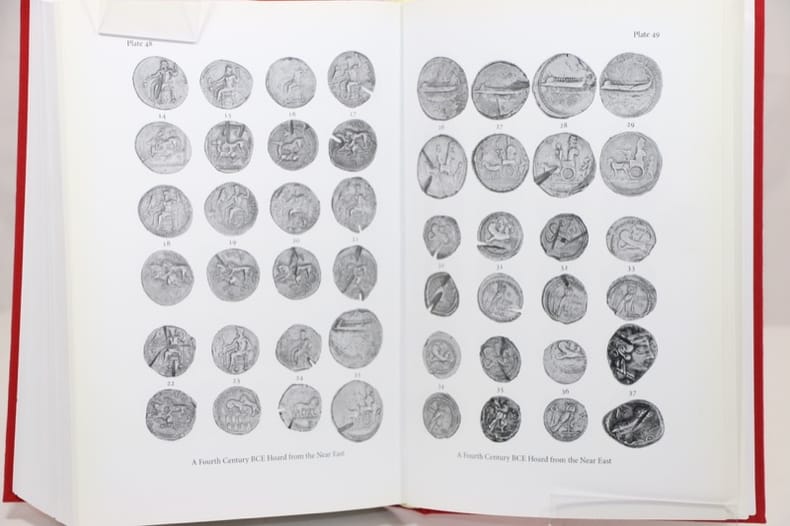
556374New-York, The American Numismatic society, 2008. 1 vol. in-8, reliure pleine toile rouge d'édition, VI-615pp., 117 planches, nombreuses ill. in-texte en noir.
New English Original bdg. 4to. (32 x 22 cm). 532 p. Very heavy volume. Color ills. Contents: Forward Acknowledgements. Check-List of Amorium Publications. General Introduction: Archaeological Introduction. E.A. Ivison, Excavations at the Lower City Enclosure, 1996-2008. Finds Reports. B. Böhlendorf-Arslan, The Pottery from Destruction Contexts in the Enclosure. E. Lafli, Roman and Late Roman Terracotta Unguentaria: 1988-2005. E. Schoolman, Middle Imperial, Late Roman, and Early Byzantine. Terracotta Oil Lamps: 2002-2005. C.S. Lightfoot, Middle Byzantine Terracotta Lamps: 1993-2005. C.S. Lightfoot, Hellenistic and Roman Terracotta Figurines and Architectural Fragments. J. Witte, Counters and Stoppers in Terracotta and Stone. C.S. Lightfoot, Small Finds in Bone and Ivory. J. Witte, Toys, Game Pieces, and Boards: 1988-2005. J. Witte, Roman and Byzantine Bricks and Tiles: 1988-2004. C.S. Lightfoot, Byzantine Weights and Related Material. Technical and Scientific Studies. A. Demirel, Two Weapon-Related Skull Traumas from the Enclosure, 2008 J. Giorgi, The Plant Remains. E. Ioannidou, Animal Husbandry. D.S. Reese, Inventory of Marine and Freshwater Shells A.M. Shedrinsky and C.S. Lightfoot, A Byzantine Amber Bead 17. M.G. Drahor, Results from the Geophysical Survey conducted in the Lower City Enclosure, Appraisal, C.S. Lightfoot, Amorium: Facts, Myths, and Misconceptions, Abbreviations, Bibliography
New English Original bdg. HC. 4to. (30 x 21 cm). In English and abstract in Turkish. 220 p., b/w ills. Preface.; Acknowledgements.; Turkish Abstract.; Introduction.; Epigraphical Research at Amorium.; Abbreviations and.; Bibliography.; The Roman Inscriptions at Amorium.; Site Plan.; Map of.; Eastern Phrygia.; Section 1: Roman Stone Inscriptions, cat. nos. 1-133.; Honorific Inscriptions.; Dedications.; Funerary Inscriptions.; Section 2: Byzantine Stone Inscriptions, cat. nos. 134-210.; Funerary Inscriptions Sarcophagi.; Monograms and Masons' Marks.; Appendix: cat. no. 147.;(Nikos Tsvikis).; Section 3: Stone Inscriptions from the Territory of Amorium, cat. nos. 211-389.; Doorstones.; Epigrams.; Varia.; Section 4: Graffiti and Stamps on Terracotta, cat. nos. G1-G70.; Section 5: Miscellanea, cat. nos. M1-M22.; Indices.; Personal Names.; Ethnics and.; Toponyms.; Deities.; Provenances.; Concordances.; Check-list of Amorium Publications.
5325391994 In-4, broché, 48 p., nombreuses figures.
New Persian Original bdg. HC. Roy. 8vo. (24 x 17 cm). Text in Persian; title on cover bilingual in English and Persian. 687 p., b/w ills. An encyclopedic dictionary of Bushehr.= Farhangnamah-'i Bushihr: Hamil-i vazhah'ha-yi shahr va a'lam-i ustan-i Bushihr. Pizhuhish-i tashviqi-i hay'at-i davaran dar panjumin dawrah-i intikhab va mu'arrifi-i pizhuhish-i farhangi-i sal (Azar mah 1379). Vol. 1: A-D. Vol. 1st of 2.
New English Paperback. Demy 8vo. (21 x 14 cm). In English. 211 p., color ills. An epigraphic guide to Hierapolis of Phrygia (Pamukkale). The epigraphic guide to Hierapolis of Phrygia (Pamukkale) aims to present visitors to the site and the museum with some of the most interesting Greek inscriptions that they will encounter, helping to both read and understand them. The excavations conducted by the Italian Archaeological Mission have trebled the number of documents that were known at the end of the nineteenth century, now totalling over 1000. Starting in Hellenistic times, the inscriptions from Hierapolis shed light on all aspects of urban life, and provide information on the composition of the population, on institutions and government, on municipal and provincial roles, as well as on religion, productive sectors and the organisation of gilds, Greek-type contests and amphitheatre games, the activity of public benefactors, funerary rites, the Jewish community and the expressions of Christianity. The majority of the most significant documents have been published, and work is now directed towards producing a scientific corpus of all epigraphic material. ARCHEOLOGY Anatolian civilizations Excavations Phrygia Hierapolis Epigraphy.
1373298Ocala: First Impressions Printing, Inc., 2000 in-4, 411 pages, très nombreuses illustrations. Index, bibliographie. Reliure d'éd., jaquette. PREMIERE EDITION.
19543122609Paris: The Organisation for European Economic Co-Operation 1954. 203 Seiten. Gr. 8° (22,5-25 cm). Orig.-Leinenband mit Orig.-Schutzumschlag. [Hardcover / fest gebunden].
New New Turkish Original bdg. Dust wrapper. 4to. (32 x 24 cm). In Turkish. 439 p., ills., color ills. Anadolu agirlik ölçüleri. Weights in Turkish and Islamic, especially Ottoman Empire.