697 résultats
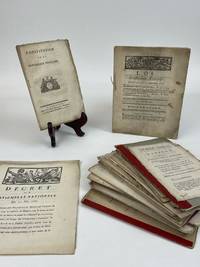
157113619101571 - 1947. <p style="margin-top:0pt; margin-bottom:0pt; text-indent:36pt;">The Russell Collection contains over 300 books broadsides and pieces of ephemera produced between the waning decades of the ancien regime and the fall of Napoleon Bonaparte. The collection was assembled in the early 1950s by William F. Russell 1890 – 1956 President of Columbia University’s Teacher’s College from 1949 to 1954. With material spanning the 16th to the early 20th century the majority of the collection was produced between 1775 and 1800. Highlights include early editions of the 1791 and 1793 French Constitutions letters written and signed by pioneering economist Anne Robert Jacques Turgot and official documents signed by Robespierre and other members of the Comite du Salut Public. </p> <br /> <p style="margin-top:0pt; margin-bottom:0pt; text-indent:36pt;">The Collection is comprised of the following components: 1 The French Monarchy and the Ancien Regime; 2 Ideological Roots of Revolution; 3 The Transition to Republicanism and Collapse of the Monarchy; 4 The National Convention and the Committee for Public Safety; 5 Historical and Contemporary Context; and 6 Miscellanea Ephemera Manuscripts and Books.</p> <br /> <p style="margin-top:0pt; margin-bottom:0pt; text-indent:36pt;">Most of the printed material was published by one of the two major publishing houses in Limoges. This concentration of material from a single city offers perspective on the publication and distribution of political and governmental texts in a particular city or departement one which was especially impacted by the Crown’s frequently shifting tax and trade policies. It also provides important insight into the early work and career of Anne Robert Jacques Turgot who served as intendant of Limoges from 1761 – 1774. </p> <br /> <p style="margin-top:0pt; margin-bottom:0pt; text-indent:36pt;">Limoges was home to several printing houses which at various times during the Monarchy and Revolution were designated as official printers of government documents for the region. Most notable among these were the Barbou and Dalesmes families. Both families had been established printers for centuries but the Barbou appear to have been too closely aligned with the ecclesiastical hierarchy – after 1791 all of the officially published material printed in Limoges was released by members of chez Dalesme. </p> <br /> <p style="margin-top:0pt; margin-bottom:0pt;"> </p> <p><br /> <p style="margin-top:0pt; margin-bottom:0pt;">1 The French Monarchy and the Ancien Regime</p> <br /> <p style="margin-top:0pt; margin-bottom:0pt; text-indent:36pt;">A significant portion of the collection is made up of documents from the reign of Louis XVI issued by the crown members of the regime and the Parisian Parlement in the two decades leading up to the Revolution. These items ranging from royal decrees to trial testimonies illustrate governmental practice under the monarchy especially as it relates to trade policy and criminal justice. </p> <br /> <p style="margin-top:0pt; margin-bottom:0pt;"> </p> <br /> <p style="margin-top:0pt; margin-bottom:0pt;"> </p> <p><br /> <p style="margin-top:0pt; margin-bottom:0pt;">2 Ideological Roots of Revolution</p> <br /> <p style="margin-top:0pt; margin-bottom:0pt; text-indent:36pt;">The Russell Collection includes a number of books and tracts from writers crucial to the development of revolutionary thought and discourse in France during the 18th-century. First or early editions by Mirabeau Raynal Mounier Marat and Condorcet written before and during the upheavals of the early 1790s reveal the increasingly liberal and radical intellectual currents among France’s intelligentsia. First or early editions of works by Jacques Necker and Turgot also appear shedding light on abortive efforts at modernization during the various governments under Louis XVI.</p> <br /> <p style="margin-top:0pt; margin-bottom:0pt;"> </p> <p><br /> <p style="margin-top:0pt; margin-bottom:0pt;">3 The Transition to Republicanism and Dissolution of the Monarchy</p> <br /> <p style="margin-top:0pt; margin-bottom:0pt; text-indent:36pt;">The full span of the National Assembly from its foundations during the Brienne and Necker governments to its ceding of legislative authority to the National Convention is captured through official printed documents Royal and republican periodicals regionally-drafted complaints and instructions and published addresses. Also included are first or early editions of the French Constitutions of 1791 and 1793 as well as various edicts and documents issued by Louis XVI during l’Assemblee Nationale. The formal inauguration of the National Convention and the removal of all executive powers from the King is represented both by an Extrait of the relevant Assembly session and in an officially published broadside explaining “des motif d’apres lesquels l’Assemblee Nationale a proclame la convocation d’un Convention nationale et prononce la suspension su Pouvoir executive dans les mains du Roi.â€</p> <br /> <p style="margin-top:0pt; margin-bottom:0pt;"> </p> <p><br /> <p style="margin-top:0pt; margin-bottom:0pt;">4 The National Convention and the Committee for Public Safety;</p> <br /> <p style="margin-top:0pt; margin-bottom:0pt; text-indent:36pt;">A substantial component of the Russell Collection is comprised of material created by or related to the Convention Nationale and the Comite du Salut Public. Nearly 90 official decrees from the legislative body are present in addition to numerous printed addresses departmental complaints and two officially published broadsides related to the trial of Louis XVI. Other highlights include printed decrees and orders from the Committee for Public Safety a document issued by the Parisian Communards and an order signed by seven members of the Committee. </p> <br /> <p style="margin-top:0pt; margin-bottom:0pt;"> </p> <p><br /> <p style="margin-top:0pt; margin-bottom:0pt;">5 Historical and Contemporary Context;</p> <br /> <p style="margin-top:0pt; margin-bottom:0pt; text-indent:36pt;">A subset of the Collection is made up of books and pamphlets responding to the events of the Revolution from contemporaneous accounts to late 19th-century histories. The works published during the 1790s and early 1800s whether biographies of revolutionaries or socio-political commentaries reveal the mix of horror regret enthusiasm and hope stirred up among emigres international observers and participants in the revolutionary melee. The texts printed after 1840 reflect the intensive documentary approach of the French historians in the latter half of the century. </p> <br /> <p style="margin-top:0pt; margin-bottom:0pt;"> </p> <p><br /> <p style="margin-top:0pt; margin-bottom:0pt;">6 Miscellaneous Documents regional subject-specific etc.</p> <br /> <p style="margin-top:0pt; margin-bottom:0pt; text-indent:36pt;">Also included are a number of items ephemera and manuscripts that are either subject specific and tangentially related to the French Revolution i.e.; treatises on the French language moral philosophy deduced from botanical studies 17th century medicine or specific to Limoges and the Haute-Vienne. The latter includes several 16th and 17th century manuscripts from Limoges and Orleans. Several 20th century books inscribed to the collector W.F. Russell appear in the collection as well. </p> <br /> <p style="margin-top:0pt; margin-bottom:0pt;"> </p> <p><br /> <p style="margin-top:0pt; margin-bottom:0pt;">All items are in good or better condition unless otherwise stated.</p> <br /> <br /> <p style="margin-top:0pt; margin-bottom:0pt;">To view the full inventory please click HERE.</p> . 1361910. Special Collections. unknown
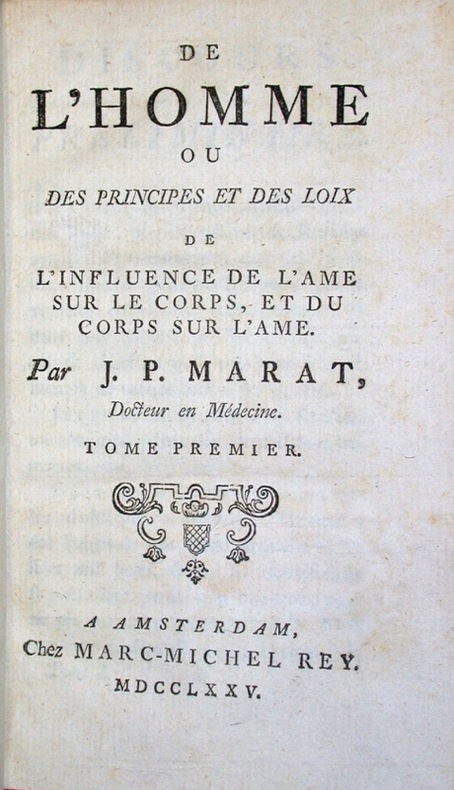
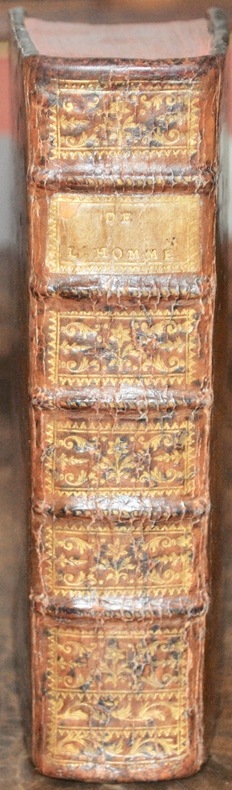
17752819Amsterdam, Marc-Michel Rey , 1775-1776. 3 tomes en 3 volumes in-12 de (4)-XXXIV-323-(3) pp. ; (8)-379-(1) pp. ; (8)-220 pp. 2 planches dépliantes, veau havane marbré, dos à 5 nerfs très richement ornés, tranches rouges (reliure de l'époque).
175515507Amsterdam, Marc-Michel Rey, 1755-1776. 3 tomes en 1 volume in-12 de (4)-XXXIV-323-(3) pp. ; (8)-379-(1) pp. ; (8)-220 pp., veau havane marbré, dos à 5 nerfs ornés, tranches rouges (reliure de l'époque).
8736Paris, chez Cl. Antoine Jombert, fils aîné, libraire du Roi pour le génie & l'artillerie [et] chez N.-T. Méquignon, 1780 [et] 1784. 2 ouvrages reliés en un volume in-8 de [4]-202-[2] et 8-111 pages, plein veau moucheté brun, dos à nerfs orné de filets et fleurons dorés, pièce de titre noire, roulette dorée sur les coupes, tranches marbrées, deux coins un poil frottés.
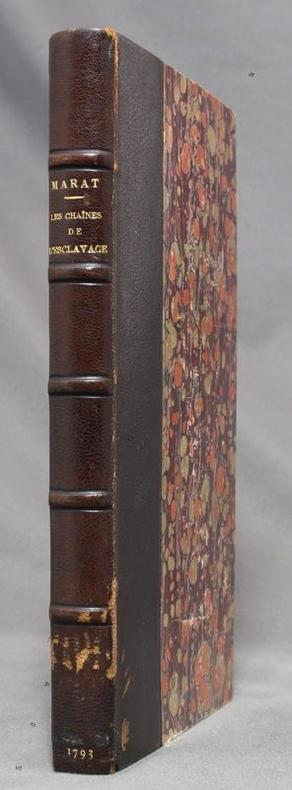
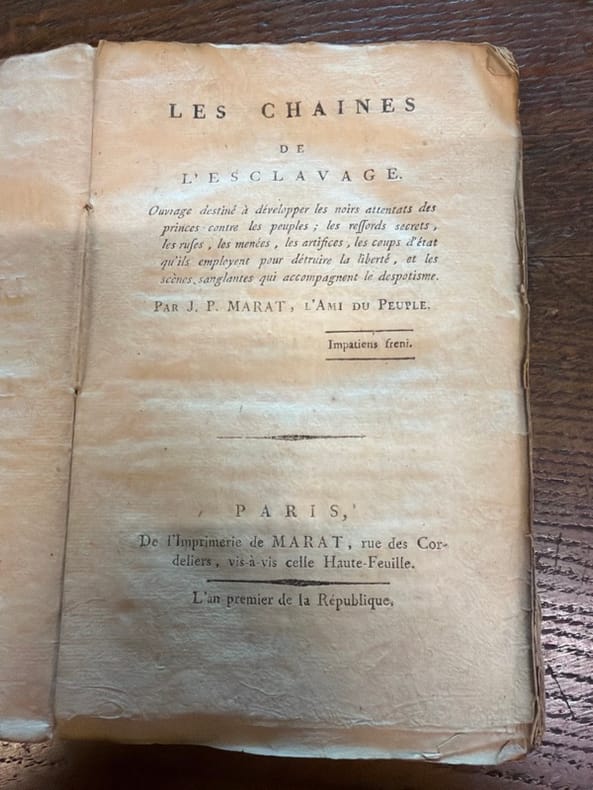
12677Paris, de l'imprimerie de Marat, l'an premier de la République [1792]. In-8 de 364 pages, demi-chagrin marron, dos à 5 nerfs avec titre doré, couvertures d'attente conservées. Non rogné.
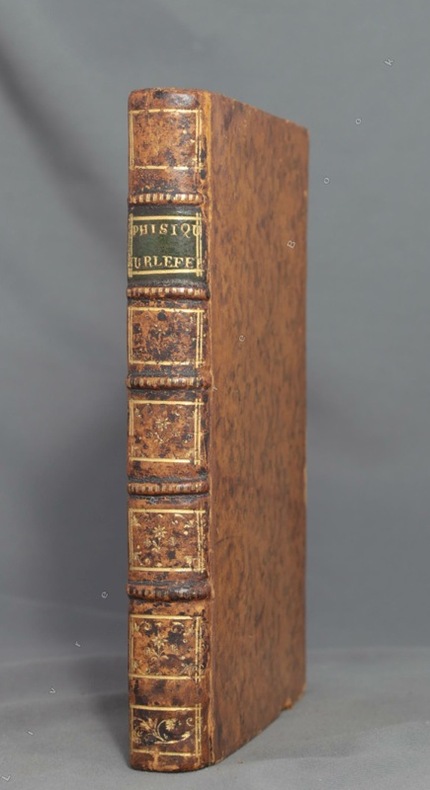
19618Paris et Londres, chez Jombert, fils aîné, 1780. In-8 de 6-141 pages, plein veau brun moucheté, dos à nerfs joliment orné, tranches rouges.
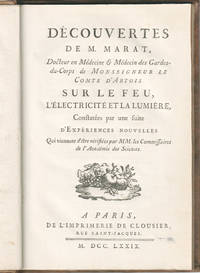
177912883Paris: Clousier 1779. 207x136mm. 8¼x5¼". Paris Clousier 1779. En 4º 207 x 136mm. 6 38 pp. Encuadernación de mediados del siglo veinte en piel. Primera edición del primer trabajo publicado de Marat sobre el fuego la electricidad y la luz presentado a la Academia de las Ciencias y a cuyos experimentos acudieron varios académicos entre ellos Benjamin Franklin. Jean-Paul Marat 1743-1793 fue un cientÃfico y médico francés que realizó gran parte de su carrera en Inglaterra; sobresalió como polÃtico durante la Revolución francesa: identificado con el ala izquierdista de la Revolución los jacobinos su apasionada defensa del Terror le llevó a ser asesinado por Charlotte Corday una joven girondina. Marat presentó esta <em>Memoria</em> para su ingreso en la Academia aunque no consiguió ser aceptado como miembro pues los académicos estaban horrorizados por su osadÃa al disentir de Isaac Newton. Sus experimentos interesaron sobremanera a Benjamin Franklin quien solÃa visitarle y Goethe siempre consideró el rechazo de la academia como una clara muestra de despotismo cientÃfico. Clousier unknown
237682Bruxelles, Pôle Nord, 1989 - 1995 10 vol. in-8, bradel skyvertex bleu, dos et plats ornés (rel. de l'éditeur).
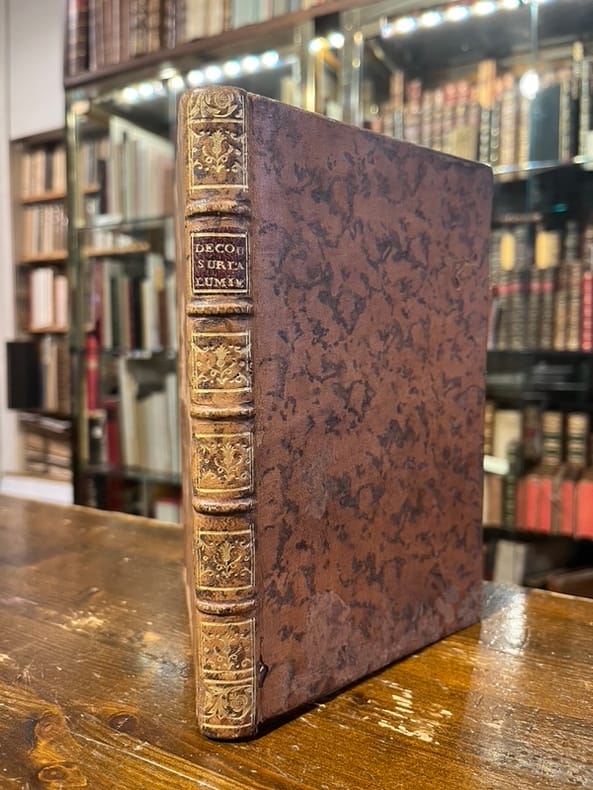
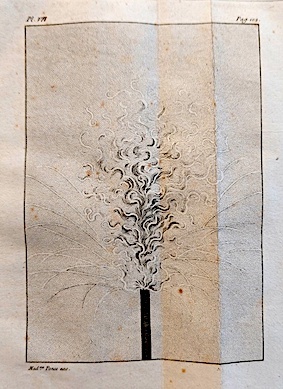
1780S14167Paris :: Cl. Ant. Jombert 1780. 1780. 8vo. 4 202 2 pp. Half-title engraved frontispiece portrait tipped-in title vignette 7 folding engraved plates by Madame Ponce; some waterstaining. Contemporary full mottled calf raised bands spine tooled spine compartments maroon leather label; spine ends worn front joint starting rubbed. Very good. 290 First edition. Marat "practiced in Paris well-known for his activities in the French Revolution; Benjamin Franklin was interested in his electrical experiments but his works especially on fire and heat were discredited." – Cole. / There is apparently one known copy with a portrait plate perhaps spurious or added to the work and yet most every copy does not mention a portrait. Cole notes two copies without a portrait and one at Oklahoma University he saw only in microprint where a portrait was present – Cole says "appears to have a portrait." Of several copies found for sale none had a correct portrait. I inquired about the Oklahoma copy and they verified that it does not in fact have a portrait see above. Net result: the book was not issued to the public with a portrait. Copies mentioning a portrait will thus be referencing a tipped-in plate from another source presumably an unknown source. / "In this book Marat attempts to give a mechanical explanation of the phenomena of heat by the use of his theoretical 'fluide igne.' Some 166 experiments are described in support of his views." – Cole. / NOTE: "Jean-Paul Marat was a leader of the French Revolution along with others like Danton and Robespierre. In 1793 he was assassinated while soaking in a bath—one of the most famous murders in French history. While there is no question about who killed him the reason he was in the bath has confounded historians for centuries. And this mystery may have just been solved." "Marat bled profusely when he was stabbed and his blood soaked the papers he was working on. These were kept by his sister and eventually found their way to the National Library of France. / French forensic scientist Philippe Charlier working with a team of specialists was recently able to extract DNA from these centuries-old papers. As well as finding DNA that confirmed Marat's ancestry French and Italian the team found a number of non-human DNA fragments. / These fragments ruled out many of the popular theories—no syphilis no scabies no leprosy or tuberculosis. But there was strong evidence of an advanced fungal infection of Malassezia restricta. This would explain his pain and sores and would probably have damaged his immune system as well leaving him open to other infections. / While the answer can't be known for sure modern technology seems to have validated the belief of Marat—ever the scientist—that the sewers of Paris were his undoing." – Keith van Sickle The Good Life. REFERENCES: Bolton 1899 284; Cajori History of physics 1929 p. 122; Chevremont p. 14; Cole 909 without portrait; Duveen 388 without portrait; Ferchl 337; Partington III p. 607; Poggendorff II 39; Waller 11396. See: C. Connor Jean Paul Marat: Scientist and Revolutionary. Atlantic Highlands NJ: Humanities Press International 1997. Cl. Ant. Jombert, 1780. hardcover
238751Paris, de l'Imprimerie de Marat, l'an I (1793) in-8, 364 pp., demi-basane caramel, dos lisse, roulettes dorées et décor à froid (reliure du XIXe).
Z1-F-048-00515Gmb Pub Ltd. Used - Acceptable. Used - Acceptable. Ships from UK in 48 hours or less usually same day. Your purchase helps support Sri Lankan Children's Charity 'The Rainbow Centre'. Ex-library with wear and barcode page may have been removed. 100% money back guarantee. We are a world class secondhand bookstore based in Hertfordshire United Kingdom and specialize in high quality textbooks across an enormous variety of subjects. We aim to provide a vast range of textbooks rare and collectible books at a great price. Our donations to The Rainbow Centre have helped provide an education and a safe haven to hundreds of children who live in appalling conditions. We provide a 100% money back guarantee and are dedicated to providing our customers with the highest standards of service in the bookselling industry. Gmb Pub Ltd unknown
178010334Jombert Paris 1780 1 vol. In-8 broché de 2 ff.n.ch., 202 pp. 1 f. n.ch., couverture muette papier coquille (non rogné, grandes marges).
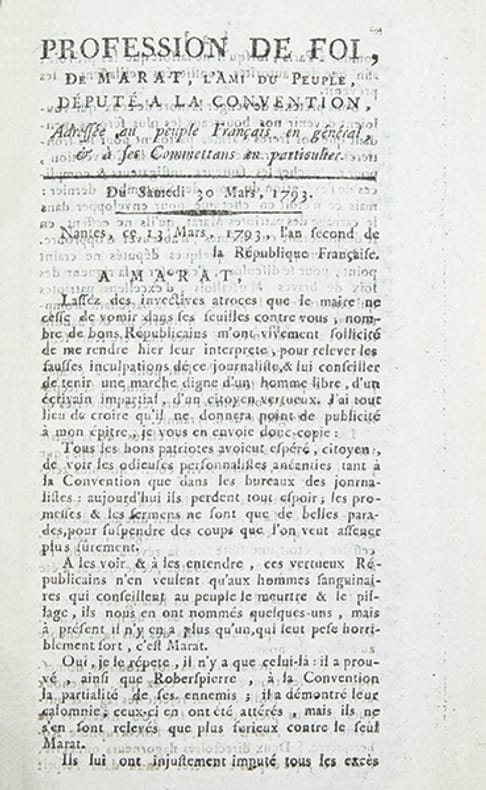
38666In-8 (188 x 120 mm), cartonnage marbré bleu à la Bradel, pièce de titre de maroquin bordeaux doré en long (reliure Laurenchet), 8 pages. [Paris], De l'Imprimerie de Marat, rue des Cordelier ..., s.d. [1793].
2022Manohar-9780367178406Routledge 2022. Hardcover. New. Routledge hardcover
2022Manohar-9780367178406Routledge 2022. Hardcover. New. Routledge hardcover
179224099De l’imp. de Marat, l’an premier de la République 1792 In-8, plein veau époque, dos lisse, filets et fleurons dorés, 364 pp. Reliure frottée, coiffe sup. arrachée. Sans les faux-titre et titre, le premier feuillet défectueux délié, deux petits adhésifs, un manque en coin sup. avec atteinte sur 4 lignes. On joint une photocopie copie de ses 3 ff.
235934Paris, de l'Imprimerie de Marat, l'an I (1793) in-8, 364 pp., broché, couverture papier bleu de l'époque. Manque au dos.
178497089Paris, Pierre-François Didot, 1784, in-8, [2]-IV-44, pp. V-VII-[1], Cartonnage postérieur à la bradel, couverture d'attente conservée, Bien complet des deux planches de figures géométriques. Rare première édition de cet opuscule, qui fait suite aux Découvertes sur la lumière. Le faux-titre indique Oeuvre de Marat; ces dernières paraîtront en 1788. Marat (1743-1793), que l'on connait surtout comme Montagnard à la Convention, avait tenté de former une vaste entreprise de démystification à l'égard du système newtonien, en publiant plusieurs ébauches qui aboutiront à la publication de ses Oeuvres (Mémoires académiques ou nouvelles découvertes sur la lumière relatives aux points les plus importants de l'optique. Paris, Méquignon, 1788). Il consigne ici sa théorie des couleurs avec des expériences détaillées, qu'il mena avec sa méthode d'observation en chambre obscure, et donne la liste des instruments nécessaires à les répéter. Une partie de ces expériences avait été décrite dans ses précédentes Recherches physiques sur le feu (1780). Marat était alors médecin des gardes du corps du comte d'Artois. Il avait ouvert un cabinet dans lequel il faisait ses expérimentations. Il attira l'attention de Benjamin Franklin, dont il reçut la visite. Il fit la traduction de l'Optique de Newton en 1787. Lacunes comblées en tête des deux derniers feuillets, avec atteinte au texte. Une auréole en pied de volume. Bonne reliure moderne. Blake 287. Poggendorff II, 39. Couverture rigide
1790CLL-104Paris, Rochette, 1790 In-8 de 157 pp., demi-basane havane mouchetée à coins, dos lisse orné de filets dorés, pièce de titre de maroquin noir, tranches paille (reliure de l'époque).
19619Paris, Jombert fils, 1780. In-8 de [4]-202-[2] pages, demi-maroquin brun à la Bradel, dos lisse.
2022Adhya-9780367178406T&F/ROUTLEDGE 2022. Hardcover. New. T&F/ROUTLEDGE hardcover
2022Adhya-9780367178406T&F/ROUTLEDGE 2022. Hardcover. New. T&F/ROUTLEDGE hardcover
7694A Paris, de l’Imprimerie de Clousier, 1782. In 8, VIII-461 pp.-(1ff.), cinq planches hors texte dépliantes.
112625A Paris, Chez Leroy, Libraire, 1787, 2 tomes reliés en 1 volume de 130x200 mm environ, (1) f., xxxiv pages (Epître, Préfaces), 192 pp., (1) f., 308 pp., (1) f. Complet des 21 planches dépliantes. Reliure en demi basane havane, dos lisse orné d'un titre et de motifs dorés, tranches marbrées. Reliure en mauvais état (coiffe de tête manquante, manques de cuir importants, cuir du dos partiellement décollé, mors fendus, plats dénudés à de nombreux endroits), rares rousseurs, défaut p. 25 et 31 de la première partie, marges roussies sur les derniers feuillets, sinon intérieur frais.
1792334974Paris: De L'Imprimerie de Marat 1792. First edition; see Martin & Walter III No. 22896; Hayden. 'French Revolutionary Pamphlets' No. 2425. 32pp. Small 8vo. Pamphlet has been rebound with early leather spine stamped in gilt and early marbled endpapers present lacking boards; text is lightly foxed otherwise fresh and clean a very good copy. First edition; see Martin & Walter III No. 22896; Hayden. 'French Revolutionary Pamphlets' No. 2425. 32pp. Small 8vo. Jean-Paul Marat 1743-1793 Swiss-born French scientist and physician was the editor of 'L'Ami du Peuple' and an advocate of the September 1792 massacre of jailed "enemies of the Revolution" launching the Reign of Terror.<br /> <br /> Scarce; OCLC locates only a few holdings. Martin & Walter III No. 22896; Hayden. 'French Revolutionary Pamphlets' No. 2425 De L'Imprimerie de Marat unknown