726 résultats
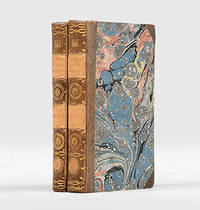
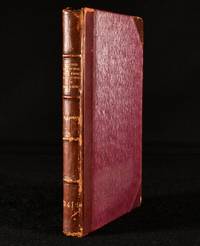
1785751L23London: W Faden 1785. First edition. Leather. Very Good. 9" by 5.5". Not Stated. A very scarce English language edition of this political writing regarding the free navigation of the Scheld. Written by one of the leaders of the early stages of the French revolution Honore Gabriel Riqueti. ESTC reference no: T83504. A very scarce work This translation is of Mirabeau's 'Doutes sur la liberte de l'Escaut reclamee par l'empereur'. Engraved vignette to the title page. With the folding map which has been rebacked with linen. Bookplate of the City of Westminster to the front pastedown. The Scheldt river flows through northern France Western Belgium and southwestern part of the Netherlands with its mouth at the North Sea. Access to this river was the subject of the brief Kettle War of 1784 and during the French Revolution. This book looks at this issue of access to the river. In a half morocco binding. Externally generally smart. Patches of rubbing to the spine and extremities. Small loss to the head and tail of spine. Bookplate to the front pastedown. Internally firmly bound. Pages are bright. A few chips to the title page and to a2 and A1. Pages are clean. Very Good W Faden hardcover
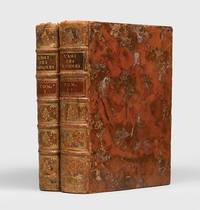
17588067Paris 1758. Second Edition of parts I-III first Edition of part IV. 8 192; 2 266 4; 6 264; 8 278 81pp. 2 vols. 4to. Contemporary mottled calf with gilt spines red morocco labels; covers a bit rubbed spine extremities and corners worn with slight chipping otherwise a very good copy internally crisp and clean. Frontispiece lacking as is often the case. Bookplates of A. de Seville. Second Edition of parts I-III first Edition of part IV. 8 192; 2 266 4; 6 264; 8 278 81pp. 2 vols. 4to. A work of fundamental importance whose appearance created a sensation throughout Europe was widely translated and reprinted and earned its author an international reputation "greater than that of any other economist before or after not excluding Adam Smith or Karl Marx." Schumpeter p. 175n Mirabeau argues that wealth is the product of population -- in particular agriculture -- and that a large populartion is desirable that religious toleration free enterprise a more equitable system of taxation and distribution of wealth were necessary components of a vital economy. The first three parts appeared in 1756; by 1758 Mirabeau had fallen under the influence of Quesnay and issued the fourth part in which the latter's influence is very much felt. The two between them it may be said founded the school of the physiocrats. A fifth and sixth part were added in 1760. Kress 5735; Higgs 1631; Goldsmith 9317 unknown
1788263089Londres 1788. hardcover. very good. 3 titles bound together. 183 72 142. 8vo 3/4 vellum backed green boards covers worn. Londres: 1788. Very good . Scarce.<br/> <br/> unknown
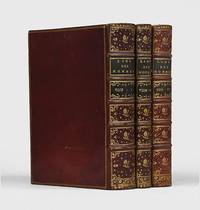
1798D7144Paris 1798. Hardcover. Very Good. Contemporary tan calf boards ornately gilt-ruled gilt-stamped detail in spine compartments gilt-stamped lettering in black leather spine label a.e.g.; 3 volumes large 8vo 148 x 234 mm; with half-titles and 15 engraved plates each in 2 states uncolored and color-printed. Latin text with French translation and notes by Victor de Riquetti Marquis de Mirabeau. Lovely bindings in excellent condition just a few small scuff marks here and there. And equally lovely plates -- some light dampwrinkling along top edge of some leaves in Volume 2; a few leaves toned in Volume 3. A handsome set. Cohen-de Ricci 993. <br/><br/> hardcover
1776015882Londres Paris: se 17761788. Tre opere riunite in un volume 12x20 cm legatura coeva in piena pelle dorso liscio ornato e dorato; risguardie con carta marmorizzata tagli marmorizzati. 1- ESSAI sur le despotisme. Londres 1776. Di 214pp. Ristampa della prima edizione. 2- OBSERVATIONS d'un voyageur anglais sur la maison de force appelé Bicetre; suivies des réflexions sur les effets de la sévérité des peines et sur la la législation criminelle de la Grande-Bretagne. Avec une lettre de M. Benjamin Franklin. Sl ma Paris 1788. Di 2-VIII-128pp. Prima edizione. Einaudi 393- 3- SUR LA LIBERTÉ de presse. Imité de l'anglois de Milton. Londres. 1788. Di 66 pagine. Ma gli ultimi 8 fogli sono interessati da una vecchia erosione circolare che sebbene restaurata comporta la PERDITA di varie parole del testo. se unknown
1760018551Avignon Hambourg: Se Herold 1760. Otto parti in sette volumi in 12° piena pelle del tempo dorso a nervi ornato e dorato. Paginazioni: Vol.1: Avignon 1760; pp.290. Vol.2: Avignon 1760; pp.389. Vol.3: Avignon 1760; pp.378. Vol.4: Avignon 1760; pp.208336. Vol.5: Memoire sur lAgriculture Hambourg Herold 1760; VI281pp. Vol.6: Reponse a lEssai sur les Ponts et Chaussées Hambourg Herold 1760; 205pp. Vol.7: Tableau économique avec ses explications Hambourg Herlod 1760; 192pp con 6 tavole ripiegate Huitième partie Lettres pour servir de suite a lAmi des Hommes Hambourg Herold 1760; 184pp. Lultima parte con le Lettres pour servir. è in edizione originale. Gli ultimi tre volumi sono dello stesso anno delledizione originale. Bell' insieme in ottime condizioni di questa opera capitale per la storia dell'economia politica testo fondatore della scuola fisiocratica. Se, Herold unknown
1788GRALMIRA19London: 1788. 1788. 7 Volumes of text in 8 in 8vo. plus folio atlas. with half-titles. engraved frontis. portrait & 1 other engraving in text volumes. atlas containing 10 double-page engraved maps 93 engraved plates some folding & 60 tables some folding. text volumes bound in 19th century quarter sheep spines defective one cover detached several joints cracked internally very good except for some faint embrowning. the atlas uncut in original bds. spine wanting covers worn some dampstaining to plates & tables. First Octavo Edition of the text also published in quarto format. An exhaustive work published following Mirabeau's secret mission to the court of Prussia at Berlin in 1786 dealing with geography population agriculture natural resources manufactures commerce revenues and expenses military affairs religion &c. Mirabeau was assisted in its compilation by Jakob Mauvillon and J.Thibault de Laveau. The numerous statistical tables are separately bound in the atlas volume together with ninety-three engraved military diagrams and ten double-page engraved maps by Edme Mentelle. An extensive bibliography of eighty-nine works is given in Volume I. Kress B1448-49. Cioranescu 45224. 1st Edition. Hardcover. Fair. London: 1788. Hardcover
1758EIRAm[MI39<p>Parts I-III: Avignon: 1756 & Part IV: np: 1758. 1758. 4 Parts in 5 Volumes. 12mo. pp. 431 1; 578 1 leaf; 577 1; 4 p.l. 285; 1 p.l. 313 1 150 1 leaf. engraved frontis. in Vol. I. woodcut initials. An attractive set bound in 19th century tree sheep slight worming to lower front joint of Vol. I & lower front cover of Vol. III. First Duodecimo Edition; originally published in quarto format the same year. Fourth present here fifth and sixth parts containing material by other writers including Quesnay were published in 1758 and 1760. Mirabeau's treatise created a sensation throughout Europe and was widely reprinted and translated earning for its author "though only for a few years a.fame much greater than that of any other economist before or after not excluding Adam Smith or Karl Marx.". Schumpeter p. 175n In it Mirabeau intended to show that agriculture is the great source of subsistence and must be encouraged that a large population is desirable and that religious toleration free trade a more equal distribution of wealth and lower and equitable taxation are needed for the economic improvement of the country. The work attracted the attention of Quesnay and the meeting of the two men led to the formation of the physiocratic school. Quesnay contributed to the continuations including a portion of the fourth part and the Tableau Économique in part six. Goldsmiths' 9093 Vols. I-III. Higgs 1143 & 2160. Kress 5545. Quérard VI 154. Stourm p. 100n. Tchemerzine VIII 750 Vols. I-III. Coquelin & Guillaumin II pp. 190-91. cfEinaudi 3941.</p> [Parts I-III:] Avignon: 1756 & [Part IV:] np: 1758.
1788010138A Londres; et se trouve A Paris: Chez Le Jay & Maradan 1788. Book. Very Good Plus. Vellum. First Edition. 4to - over 9¾" - 12" tall. Four volumes bound in contemporary full vellum red morocco labels back with gilt lettering and devices marbled end papers. Provenance; with the bookplates of Francesco Rizzo Patarol 1749-1807 front paste downs of Vols. I III and IV whose noble family built the Rizzo Patarol palace in Venice which was at one time the seat of the Savoy embassy then the French embassy. A Very Good Plus set light soiling to vellum uniform browning. Vol. I: xliv 522 pp. 8 tables 7 of them fold-out. Vol. II: 2 566 4 pp. 34 tables 25 fold-out. Vol. III 710 pp. 2 fold-outs at p. 34 plus engraved Metropolis of Scotland Colledge fold-out plate tipped in at p. 449. Vol. IV: 4 560 1 pp. 14 fold-outs. An oversize and heavy set extra postage will be requested for priority mail or international orders. Chez Le Jay & Maradan Hardcover
1769126597Amsterdam et se trouve à Paris: Lacombe 1769. Scarce complete thus attractively bound First duodecimo edition of Mirabeau's Les économiques also printed in a single quarto volume format the same year. A further volume was published in 1771 also in both quarto and 2-volume duodecimo formats. Complete sets are very scarce. Mirabeau who seems to have taken the title of this work from the Économiques of Xenophon here gives various methods of economic instruction for the various levels of society; he also suggests the method of approach in the instruction of heads of government. 2 vols duodecimo 162 x 95 mm. Engraved head- and tailpieces. Near-contemporary half calf twin morocco labels spine elaborately tooled in gilt red morocco onlay roundels with vol. numbers to foot of spine marbled paper boards. Ownership signature to title pages of both vols of one H. Wrangel possibly a descendant of the Swedish Governor General Hermann Wrangel 1584-1653 whose crest incorporates a turret as stamped at the head of each spine. Extremities lightly rubbed two neat paper repairs to title leaf of volume 1 else a very good set attractively bound. Einaudi 3943; Higgs 4568; INED 3196; Mattioli 2432 hardcover
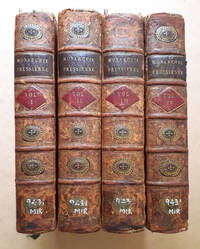
#BIBLIO-1316<p>De la Monarchie Prussienne sous Frédéric le Grand; avec un appendice contenant des recherches sur la situation actuelle des principales contrées De L'allemagne. Par le Comte de Mirabeau. Tome I-IV.</p> On the Prussian Monarchy under Frederick the Great; with an appendix containing research on the current situation of the principal countries of Germany. By Honoré Gabriel Riqueti the Count of Mirabeau. Volume I-IV. Four-volume set. First edition. Quarto/4to. Each volume measures around 8" x 10 1/4" x 2" 203mm x 260mm x 50mm. Pagination: 4 xliv 522 2; 4 566 6; 4 710; 4 560 3 pp. Published in London 1788. Hardback full mottled calf. Raised bands. Gilt-tooled borders to boards gilt decoration to spines and gilt-blocked titles with brown title labels and red volume labels. All page edges gilt. Marbled endpapers. Frontispiece portrait of Frederick the Great to first volume engraved by H. Marais in 1788 after A. Graf and a plate of the "Metropolis of Scotland Colledge" opposite page 489 of the third volume. Contains numerous foldout tables. Notes of errata at rear. Green silk ribbon markers to volumes I II and IV lacking in volume III.Ex-library books containing typical markings including white library numbering to spines labels and cards to front pastedowns and endpapers and stamps to titles & final leaves. A little pencil writing to endpapers. Scuffing and marking to binding some tearing. Other signs of wear rubbing at edges and on hinges. Bumped and torn corners and some chipping and loss to heads and tails of spines. Some cracking to hinges but binding quite firm. Some scuffing and marking to page edges but gilt detail still vivid. A little tearing to the odd page. Some toning foxing soiling and staining to endpapers. A little grub here and there and minor toning to outer edges throughout but otherwise page surfaces generally quite clean with no underlining marginalia etc. A lovely set. See pictures for further information. About the author:<em>Honoré Gabriel Riqueti Count of Mirabeau French: miÊabo; 9 March 1749 – 2 April 1791 was a French writer orator statesman and a prominent figure of the early stages of the French Revolution.</em><em>A member of the nobility Mirabeau had been involved in numerous scandals that had left his reputation in ruins. Well-known for his oratory skills Mirabeau quickly rose to the top of the French political hierarchy following his election to the Estates-General in 1789 and was recognized as a leader of the newly organized National Assembly. Among the revolutionaries Mirabeau was an advocate of the moderate position of constitutional monarchy built on the model of Great Britain. He was also a leading member of the Jacobin Club.</em><em>Mirabeau died of pericarditis in 1791 and was regarded as a national hero and a father of the Revolution. He received a grand burial and was the first to be interred at the Panthéon. During the 1792 Trial of Louis XVI the discovery that Mirabeau had secretly been in the pay of the king brought him into posthumous disgrace and two years later his remains were removed from the Panthéon. Historians are split on whether Mirabeau was a great leader who almost saved the nation from the Terror a venal demagogue lacking political or moral values or a traitor in the pay of the enemy.</em> Source: Wiki hardcover
1791015877Paris: Lejay e poi Devaux 1791-92. .Precedée de tous les Discours et Ouvrages du meme Auteur prononcés ou publiés en Provence pendant le cours des élections. Par M. Etienne Méjan. - 5 volumi 125x21 cm in mezza pelle coeva dorso liscio ornato e dorato con tassello di titolo rosso fenditura alla cerniera del vol 1 e in coda la dizione Bibliothèque de Michel Chevalier. Ex libris di Chevalier anche all'interno di ognuno dei 5 volumi. Piatti con carta marmorizzata usure tagli gialli -Paginazioni: Vol 1: 4-396-IV pagine; ritratto di Mirabeau in antiporta. Una tavola ripiegata di tabelle fuori testo che si riferisce però al tomo 5. Vol 2: 4-514-IV pagine. Vol 3: 4-436-VII pagine. Vol 4: 4-362-II pagine. Vol 5: 538 pagine. Ricercata raccolta -sconosciuta allEinaudi e al Kress- degli interventi di Mirabeau allAssemblea Nazionale dal 1789 al 1791 pubblicata subito dopo la sua morte. Contiene numerosi pezzi di soggetto economico e finanziario per esempio: "Sur la proposition faite par M. Necker douvrir un emprunt de 30 millions"; "Sur le nouveau imprunt de 80 million proposé par M. Necker"; Discours sur la caisse descompte in polemica con Necker; Sur le papier monnoie; Motion pour létablissement dune caisse nationale; Discours sur le projet de banque nationale présenté par M. Necker; Discours sur le retour des Indes; numerosi interventi soprattutto nel IV vol. sulla emissione di assignats. Ma i discorsi potevano toccare naturalmente altri argomenti come "Sur les droits à donner aux Juifs et aux comediens" sic; "Discours sur le droit de paix et de guerre"; Eloge funebre de Franklin". Il 5° volume contiene per la prima volta in edizione completa uno dei più importanti lavori economici di M. le Observations préliminaires sur le premier rapport du comité des monnoies presentate il 12 dicembre 1790. Pp.11-224. Un errore del rilegatore ha spostato le pagg. 209-224 quaderno O dopo pag. 368. Inoltre la tabella fuori testo sui saggi delloro è stata per errore inserita allinizio del tomo 1. Proprio il saggio di Mirabeau venne poi ripreso e ripubblicato da Michel Chevalier nel suo "De la baisse probable de lor." Paris Capelle 1859 Einaudi 1050. Esemplare quindi di straordinaria provenienza. Mirabeau avait à cette date 41 ans. Il avait en finances des connaissances etendues mai sourtout dexcellents conseillers qui lui preparaient ses papiers. Ses idées en matière monétaire mériteraient une étude trés attentive: on sait che sa volumineuse Constitution monetarire a passé longtemps pour un classique de la littérature monetaire et Michel Chevalier la publiait encore en 1859: Guy Thuillier Les idées monetaires au debut de la Révolution: Mirabeau et la réforme monetaire de 1785 Roma Accademia dei Lincei 1979 pp.7. Lejay e poi Devaux unknown
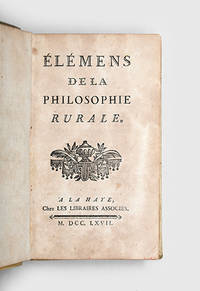
1767164209The Hague: chez les Libraires associés 1767. Handbook of Physiocracy including the Tableau économique First edition of Mirabeau's own abridgement of his and Quesnay's Philosophie rurale 1763 the first textbook of the physiocratic school. The Philosophie rurale presented "perhaps the most complete and magisterial account of the views of the Physiocratic school" Higgs p. 57. The Eléméns condenses the work into a more manageable textbook format aiming at a broader dissemination and understanding of the system. Importantly the Eléméns contains as a folding plate the Tableau économique first published in 1758 in a minute number of copies and reproduced in Mirabeau's L'Ami des hommes in 1760 and in the Philosophie rurale. The Tableau économique is cited as the earliest attempt to visualize a comprehensive model of the economic system illustrating the flow of goods and money and the interdependence of the agricultural manufacturing and commercial sectors. It is credited as "the most important and famous work of Physiocracy and has often been regarded as a summary of the entire corpus of Physiocratic economics" New Palgrave IV p. 23. Provenance: 19th-century bookplate of Isaac Iselin to the front pastedown; 20th-century note of authorship to front free endpaper; half-title with 20th-century library stamps of the Basel section of Schweiz Vereinigung für Sozialpolitik noted as bequeathed by the Austrian labour economist Stephan Bauer 1865-1934 and of the political science seminar of the University of Basel. Duodecimo 162 x 89 mm. Engraved folding Tableau économique at rear. Contemporary vellum spine lettered in gilt red sprinkled edges. Slight browning half-title loosening a little short closed tear to inner margin of table. A very good copy. Einaudi 3948; Goldsmiths' 10275; Higgs 3977; INED 3197; Kress 6477. Henry Higgs The Physiocrats 1963. hardcover
1760322182Paris 1760. First complete edition. Frontispiece. 192; 266 4; 6 263 1; 6 1-278; 80; viii 1-167 1; 279 5pp. Six parts in three volumes. 3 vols. 4to. Contemporary mottled french calf gilt spines red edges. Some wear at edges and joints. First complete edition. Frontispiece. 192; 266 4; 6 263 1; 6 1-278; 80; viii 1-167 1; 279 5pp. Six parts in three volumes. 3 vols. 4to. The first three parts constituting L'Ami des Hommes were first published by Mirabeau in 1756 before his meeting with Quesnay and his conversion to the physiocratic theses. In 1758 the work was reissued as a new edition with a fourth part added and in 1760 the fifth and sixth parts. Thus the present edition is the first complete one.<br /> <br /> Notably the final volume of the work includes Quesnay's Tableau Economique the first work attempting to describe the workings of the economy in an analytical way. Portions of Quesnay's work had been privately printed in a few copies only at the palace at Versailles in 1758 and 1759 but is here more widely and fully published.<br /> <br /> An important work on economic thought and political theory. Higgs 1628; Goldsmiths 9317; Kress 5735 unknown
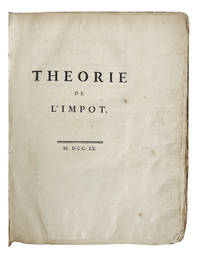
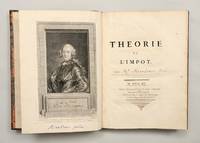
352620<p>Théorie de l'impôt. 4to. VIII 336 pp. Publisher's original boards untrimmed. Covers somewhat foxed spine strenghtened in the time with vellum slightly worn corners worn some minor foxing few small stains in outer margins edges lightly dust-soiled. - Paris o. Dr. 1760.</p><p>Very rare first edition in quarto of Mirabeau's chief work which led to the author's arrest at Vincennes. Assisted by François Quesnay Mirabeau's first book of his own after his conversion to Physiocracy offers an exposition of his economic ideas. On fiscal matters the Physiocrats famously pushed for their "single tax" l'impôt unique on landed property. The logic as laid out by Mirabeau seemed compelling. Any taxes levied throughout the economy will just passed from sector to sector until they fall upon the net product. As land is the only source of wealth then the burden of all taxes ultimately bears down on the landowner. So instead of levying a complicated collection of scattered taxes which are difficult to administer and can cause temporary distortions it is most efficient to just go to the root and tax land rents directly. This book was published the same year also in a duodecimo edition which is fare more current than the present quarto edition. - Untrimmed copy with wide margins</p><p>Provenance: From the collection of Basel economics professor Edgar Salin 1892-1974 with his handwritten entry on the first flyleaf.</p><p>References: Tchemerzine VIII 285; Barbier IV 702; Kress 5883; Humpert 13028; Higgs 2297; INED 3209; Goldsmith 9602.</p> Paris 1760
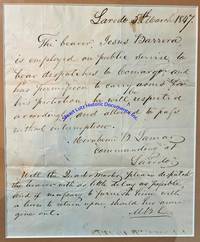
5857MIRABEAU LAMAR 1798-1859. Lamar served as the Second President of the Republic of Texas from 1838-1841. A protg of Sam Houston Lamar later served in the Texas Senate and as U.S. ambassadors to Costa Rica and Nicaragua under President James Buchanan. ALS.1 pg. 8 x 10. March 5 1847. Laredo Texas. An autograph letter signed Mirabeau B. Lamar Commanding at Laredo and initialed MBL. The letter grants the following: The bearer Jesus Barrera is employed on public serviceand has permission to carry arms for his protection; he will be respected accordingly and allowed to pass without interference Mirabeau B. Lamar Commanding at Laredo. The letter includes a postscript: Will the Quartermaster please dispatch the bearer with as little delay as possible and if necessary to furnish him with a horse to return upon should his own give out. Volume VI of the Lamar Papers within the Texas History Trust describe a Jesus Barrera who was captured in 1840 fighting on behalf of the Republic of the Rio Grande. This declared republic with several other northern Mexican states sought to break away from the centralized authoritarian Mexican government of General Santa Anna during the Texas Revolution to form a federal system modeled after the United States. Their revolution was brutally suppressed but received covert support from Lamar while he was President of Texas. Now almost a decade later Lamar was fighting for the United States Army at Laredo Texas and supported his one-time ally. His order to furnish a gun and horse during war-time to a Mexican citizen is very striking for how it complicates portrayals of loyalty during the Mexican-American War. This letter within its historical context is an excellent example of the ideological divisions that plagued Mexico around the time of Texas independence and the war with America. The letter is in fine condition with a few folds that do not hinder understanding. The letter is framed in brown wood and matted in tan with a hand-colored portrait of Lamar. unknown
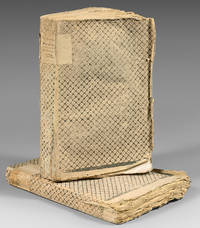
ABAA25-33<p>Hambourg n.n. 1782.</p><p>2 parts in 2 volumes 8vo of : I/ xiv pp. 1 l. 366 pp. 1 l. of errata; II/ 237 pp. ll. of the first quire interchanged wet stamp of a religious library repeated on the title p. 121 and on the last page of each volume.</p><p>Preserved untrimmed in its "dominoté paper" wrappers title labels on spines plexiglas box. <em>Original wrappers</em>.</p><p>217 x 142 mm.</p><p><strong>First edition of Mirabeau's Virulent work written during his detention in the Dungeon of Vincennes and speaking out against despotism.</strong></p><p>Graesse IV 535; Einaudi 3932; Cioranescu 45191; Conlon 82; Bûcher 573.</p><p>Mirabeau 1749-1791 was the son of the economist Victor Riquetti de Mirabeau. A French politician he was one of the most prominent figures of the Revolution and the most brilliant speaker of the Constituent Assembly. He had a very difficult relationship with his father and led a life of debauchery where he accumulated many debts. To get out of these debts he was locked up in prison by letters of seal at the request of his father on several occasions.</p><p>Mirabeau wrote the <em>Lettres de cachet</em> in the dungeon of Vincennes where he remained locked up for three and a half years at the same time as the Marquis de Sade. An eloquent work in which he vigorously denounced the abuses of arbitrary power <em>Les Lettres de cachet</em> is a veritable indictment beginning with a history of French criminal law; Mirabeau goes on to denounce violently the organization of the prison administration at the end of the Old Régime.</p><p><em>"Des Lettres de cachet' is not only an eloquent protest against despotism a warm advocacy in favor of individual freedom but also a real work of scholarship filled with historical examples and which implies immense reading".</em> Barbier.</p><p><em>"It is by history and by reason that Mirabeau fights against arbitrary detentions"</em> P. Negrin.</p><p><em>"Des Lettres de cachet deserves great praise. </em><em>The principles of natural law the basis of all society and all civilization are exposed and developed with as much force as clarity. Mirabeau already shows himself to be a great publicist and the writer gives a foretaste of the orator".</em> A. de Montor.</p><p><em>"This work new denunciation of the arbitrary power plea in favor of the individual freedom defense of justice and humanity against despotism had such a repercussion at the time that Vergennes asked Prussia to stop the publication of this licentious writing to seize it and to destroy the manuscript."</em> H. Aureole Bibliographie sur Mirabeau.</p><p><strong>A superb copy preserved as issued untimmed in its original wrappers in "dominote paper".</strong></p><p><strong>One of the largest copies known</strong> height: 217 mm.</p><p>The second volume is considered as rare because it was destroyed by the Prussian authorities at the request of the French government.</p><p>Provenance: the copy comes from the library of <em>Mr. Bidault</em> Gentleman of the Count of Artois future Charles X.</p><p><strong>FR</strong></p><p>Hambourg s.n. 1782.</p><p>2 tomes en 2 volumes in-8 de : I/ xiv pp. 1 f. 366 pp. 1 f. d'errata ; II/ 237 pp. ff. du premier cahier intervertis cachet humide d'une bibliothèque religieuse répété sur le titre la p. 121 et en dernière page de chaque volume.</p><p>Conservé non rogné dans ses brochures d'attente de papier dominoté étiquettes avec titre aux dos boite de plexiglass. <em>Brochures de l'époque.</em></p><p>217 x 142 mm.</p><p><strong>Edition originale du virulent ouvrage de Mirabeau écrit pendant sa détention au donjon de Vincennes et s'élevant contre le despotisme.</strong></p><p>Graesse IV 535 ; Einaudi 3932 ; Cioranescu 45191 ; Conlon 82 ; Bûcher 573.</p><p>Mirabeau 1749-1791 est le fils de l'économiste Victor Riquetti de Mirabeau. Homme politique français il est l'un des personnages les plus marquants de la Révolution et l'orateur de plus brillant de l'assemblée constituante. Il a des relations très difficiles avec son père et mène une vie de débauche où il accumule de nombreuses dettes. Pour le soustraire à ces dernières il sera enfermé par lettres de cachet en prison sur demande de son père à plusieurs reprises.</p><p>Mirabeau rédigea les Lettres de cachet dans le donjon de Vincennes où il resta enfermé pendant 3 ans et demi au même moment que le Marquis de Sade. Œuvre éloquente où il flétrit énergiquement les abus du pouvoir arbitraire Les Lettres de cachet sont un véritable réquisitoire débutant par une histoire du droit pénal français ; Mirabeau poursuit par l'organisation de l'administration pénitentiaire à la fin de l'Ancien Régime qu'il dénonce violemment.</p><p>" <em>'Des Lettres de cachet' n'est pas seulement une éloquente protestation contre le despotisme un plaidoyer chaleureux en faveur de la liberté individuelle mais encore un véritable travail d'érudition rempli d'exemples historiques et qui suppose d'immenses lectures</em> ". Barbier.</p><p>" <em>C'est par l'histoire et par la raison que Mirabeau combat les détentions arbitraires</em> " P. Negrin.</p><p>" <em>Des Lettres de cachet mérite de grands éloges. Les principes du droit naturel base de toute société et de toute civilisation y sont exposés et développés avec autant de force que de netteté. Mirabeau s'y montre déjà grand publiciste et l'écrivain y fait pressentir l'orateur</em> ". A. de Montor.</p><p>" <em>Cet ouvrage nouvelle dénonciation du pouvoir arbitraire plaidoyer en faveur de la liberté individuelle défense de la justice et de l'humanité contre le despotisme eut un tel retentissement à l'époque que Vergennes demanda à la Prusse d'arrêter la publication de cet écrit licencieux de le saisir et de détruire le manuscrit…</em> " H. Aureole Bibliographie sur Mirabeau.</p><p><strong>Superbe exemplaire conservé tel que paru à toutes marges car non rogné dans ses brochures d'attente de papier dominoté.</strong></p><p><strong>L'un des plus grands exemplaires connus</strong> hauteur : 217 mm.</p><p>Le second volume est considéré comme rare car il aurait été détruit par les autorités prussiennes à la requête du gouvernement français.</p><p>Provenance : l'exemplaire provient de la bibliothèque de <em>Mr. Bidault</em> Gentilhomme du Comte d'Artois futur Charles X.</p> hardcover
176083935No place: no printer 1760. First edition of a spirited and able attack upon the financial administration of France and especially upon the "fermiers généraux" whom Mirabeau regarded as parasites preying upon the vitals of the nation. The work highlights the problems and injustices of the French system of taxation and added fuel to the fire of the coming revolution. The king disapproved of the work; Mirabeau was imprisoned on 16 December 1760 but through the efforts of Madame de Pompadour and others was released on Christmas Eve under orders to leave Paris for his estate at Bignon. The work proposes a reorganization of financial administrative machinery the abolition of the "Fermes" a reduction in the taxation upon salt with the object of increasing the total yield and a special tax upon tobacco farms. The domaine the post and the mint were to be further sources of revenue. The author ranks as one of the earliest important writers on taxation. Higgs notes that the book is "of real importance in the history of financial theory" The Physiocrats p. 57. Quarto 257 x 192 mm. Additional engraved frontispiece portrait of the author. Contemporary sprinkled calf spine ruled and decorated gilt in compartments red morocco label sprinkled edges. Spine ends and corners skilfully repaired. Manuscript note to title-page "par Mr Mirabeau père" with a short verse "helas dans le Siècle ou nous sommes / pour avoir dit la vérité / Mirabeau cet ami des hommes vient de perdre la liberté" in a neat calligraphic hand. Occasional light foxing. A very good copy. Goldsmiths' 9836; Higgs 2881; INED 3204; Kress 6120. unknown
6142Six parts bound in two vols. Large 4to cont. polished mottled calf spines nicely gilt. Avignon 1756-1758-1760.<br/> <br/> First edition of all six parts and a fine copy of one of the great classics of political economy. This work marks the birth of the physiocratic school and contains the first appearance on a large scale of the “Tableau Economique†of Quesnay portions of Quesnay’s work had been privately printed in a few copies only at the palace at Versailles in 1758 and 1759. <br/> <br/> In this work Mirabeau made the ideas of Cantillon known and the book had a very great influence in the years before the Revolution. <br/> <br/> Fine set. unknown
1756131625Avignon: n.p. 1756-60. The first public appearance of Quesnay's Tableau économique First edition of all six parts containing the first public appearance of Quesnay's Tableau économique. The first to follow Quesnay in the foundation of the Physiocratic circle Mirabeau was familiar with and influenced by Cantillon's theories. As well as fully articulating the principles that were to mark the school of physiocrats and expounding their implications regarding population agriculture and commerce the Ami des Hommes contained a reproduction of Quesnay's Tableau économique vol. VI previously published separately in very small numbers in 1758 and 1759. Mirabeau's reproduction made the essay obtainable thus bringing the founding document of the school of physiocrats to the attention of a wide public. "This remarkable treatise created the greatest sensation throughout the whole of Europe. It is said to have gone through forty editions and was translated into several languages. Its anonymous author soon discovered became the idol of the day and was generally referred to by the soubriquet which he had chosen for the title of his book" Palgrave II p. 775. Following the publication of the first three parts Mirabeau made the acquaintance of Quesnay who had been greatly impressed by his book. "Mirabeau now became the fervent admirer of Quesnay and between them they founded the school of the Physiocrats" ibid. In 1758 a fourth part was published in which Quesnay's influence is clearly visible. The remaining two parts were published in 1760. The final part is of particular importance as it contains the first obtainable appearance of Quesnay's Tableau économique which was previously published separately in tiny numbers in 1758 and 1759. An English translation was first published in 1766. 6 parts in 2 vols quarto 246 x 188 mm. Contemporary French mottled calf spines ruled and decorated gilt in compartments all edges red. Joints and extremities expertly restored scattered foxing to contents; a handsome copy. Einaudi 3941; Goldsmiths' 9092; Higgs 1143 1631 & 2160; INED 3194; Kress 5543 & 5736; Mattioli 2426 2428 & 2429. unknown
176084111No place: no printer 1760 & 1761. OF REAL IMPORTANCE IN THE HISTORY OF FINANCIAL THEORY" - a BEAUTIFUL COPY First edition of both works pairing Mirabeau's Théorie de l'Impôt his spirited and able attack upon the financial administration of France especially the "fermiers généraux" whom Mirabeau regarded as parasites preying upon the vitals of the nation with Pesselier's counterattack notable for its terse affirmation of the characteristically Physiocratic doctrine that agriculture holds a privileged place in the economic system. Mirabeau's work highlights the problems and injustices of the French system of taxation and added fuel to the coming fire of the revolution. The king disapproved of the work; Mirabeau was imprisoned on 16 December 1760 but was released on Christmas Eve through the efforts of Madame de Pompadour and others under orders to leave Paris for his estate at Bignon. The work proposes a reorganization of financial administrative machinery the abolition of the "fermes" a reduction in the taxation upon salt with the object of increasing the total yield and a special tax upon tobacco farms. The domaine the post and the mint were to be further sources of revenue. Mirabeau ranks as one of the earliest important writers on taxation. Higgs notes that the book is "of real importance in the history of financial theory" The Physiocrats p. 57. Pesselier was one of the most forceful critics of the physiocrats. Of the products of the soil Pesselier here writes "Elles procurent un profit net et durable puisqu'elles sont à l'abri de l'imitation" "They provide a net and lasting profit since they are safe from imitation". Two works bound in a single vol. quarto 255 x 193 mm. Contemporary French mottled calf spine decorated gilt in compartments red morocco label marbled endpapers. Housed in a brown morocco-backed book-form case. Engraved armorial bookplate to front pastedown. Lower edge a little rubbed with corners worn very occasional spotting; very good copies. Mirabeau: Einaudi 3946; Goldsmiths' 9602; Higgs 2297; INED 3209; Kress 5883. Pesselier: Brunet I 1118; Einaudi 4409; Goldsmiths' 9695; Higgs 2534; INED 3524; Kress 5964. unknown
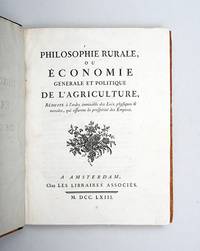
1763153616Amsterdam: Chez les Libraires Associés 1763. The new science of economics Rare first edition presenting "perhaps the most complete and magisterial account of the views of the Physiocratic school" Higgs. "Quesnay collaborated very substantially in preparing this last major work contributing the final chapter with further explanations and manipulations of his Tableau Économique analysis" The New Palgrave. Schumpeter calls the work "the first of the four textbooks of physiocrat orthodoxy" p. 225. It contains for the first time Quesnay's masterful explanation of his Tableau Économique "one of those works in the history of economics which have often been regarded as an anticipation of modern theories" Schumpeter p. 242. Originally printed as a pamphlet of 16 pages in 1758 in a minute number of copies Quesnay's Tableau Économique was first revealed to the public as the final part of Mirabeau's L'Ami des Hommes in 1760. In the Philosophie rurale Quesnay for the first time gives a full explanation of his system. The Tableau économique is credited as the "first precise formulation" of interdependent systems in economics and the origin of the theory of the multiplier in economics. An analogous table is used in the theory of money creation under fractional-reserve banking by relending of deposits leading to the money multiplier. In a letter to Mirabeau written late in 1758 Quesnay remarks "J'ai taché de faire un tableau fondamental de l'ordre économique pour y représenter les dépenses et les produits sous un aspect facile à saisir et pour juger clairment des arrangemens et des dérangemens que le gouvernement peut y causer" translated: "I have tried to make a fundamental table of the economic order in order to represent the expenses and the products in an aspect easy to grasp and to judge clearly of the arrangements and disturbances that the government can cause there". "A most remarkable analysis of the economic condition of his country" Palgrave the Tableau économique "is the most important and famous work of Physiocracy and has often been regarded as a summary of the entire corpus of Physiocratic economics. The Tableau has also been regarded as the analytical synthesis of the logical structure of Quesnay's economics or at least as its most relevant aspect. The Tableau économique is one of those works in the history of economics which have often been regarded as an anticipation of modern theories. The Tableau has been considered a first rough presentation of Keynes's multiplier and as a sort of general equilibrium system of a Walrasian type. For others the Tableau is an input-output table. Because of the Tableau Quesnay has been regarded as an early econometrician. The Tableau has also been interpreted as the first classical system of price determination thus anticipating Marx's reproduction schemes and Sraffa's price system" Giovanni Vaggi in The New Palgrave. Quarto 260 x 192 mm. With 3 engraved plates including the Tableau économique. Contemporary quarter marbled sheep orange paste paper sides light blue endpapers. Housed in a black cloth flat-back box by the Chelsea Bindery. Neatly restored at extremities insect abrasion to spine slight cockling to paste paper sides contents clean and fresh. A very good copy. Goldsmiths' 9836; Higgs 2881; INED 3204; Kress 6120; Mattioli 2435. hardcover
1758153197Avignon: no publisher 1758-60. The first public appearance of Quesnay's Tableau Économique First complete edition of all six parts containing the first public appearance of Quesnay's Tableau Économique; a superb copy in contemporary French red morocco very uncommon thus. The first to follow Quesnay in the foundation of the Physiocratic circle Mirabeau was familiar with and influenced by Cantillon's theories. As well as fully articulating the principles that were to mark the school of physiocrats and expounding their implications regarding population agriculture and commerce the Ami de l'Homme contained a reproduction of Quesnay's Tableau Économique vol. 6 previously published separately in very small numbers in 1758 and 1759. Mirabeau's reproduction made the essay obtainable thus bringing the founding document of the school of physiocrats to the attention of a wide public. "This remarkable treatise created the greatest sensation throughout the whole of Europe. It is said to have gone through forty editions and was translated into several languages. Its anonymous author soon discovered became the idol of the day and was generally referred to by the soubriquet which he had chosen for the title of his book" Palgrave II p. 775. Following the publication of the first three parts Mirabeau made the acquaintance of Quesnay who had been greatly impressed by his book. "Mirabeau now became the fervent admirer of Quesnay and between them they founded the school of the Physiocrats" ibid. With this new edition of the first three parts a fourth part was published in 1758 in which Quesnay's influence is clearly visible. The remaining two parts were published in 1760. The final part is of particular importance as it contains the first obtainable appearance of Quesnay's Tableau Économique which was previously published separately in tiny numbers in 1758 and 1759. An English translation was first published in 1766. 6 parts in 3 vols quarto 252 x 195 mm. Engraved frontispiece in part I engraved head- and tailpieces initials. Contemporary French red morocco spines elaborately decorated gilt in compartments twin green morocco labels raised bands triple gilt rule border to sides gilt inner dentelles marbled endpapers gilt edges green silk ribbon bookmarkers. Authorship attribution to first title in ink in an early hand. Bar a few trivial marks to sides the binding in beautiful condition corners a touch rubbed; vast majority of contents bright crisp and clean with very occasional spotting third volume with some light browning and foxing; loss to lower corners of leaves vol. 1 Hh2 and vol. 3 Aa3 not affecting text; patch of dampstain to last two leaves and final blank of vol. 2. A near-fine set. Einaudi 3941; Goldsmiths' 9317; Higgs 1628 1631; INED 3194; Kress 5735 & 5736; Mattioli 2427 2428 2429 & 2430. hardcover
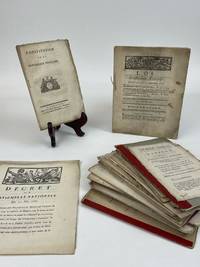
157113619101571 - 1947. <p style="margin-top:0pt; margin-bottom:0pt; text-indent:36pt;">The Russell Collection contains over 300 books broadsides and pieces of ephemera produced between the waning decades of the ancien regime and the fall of Napoleon Bonaparte. The collection was assembled in the early 1950s by William F. Russell 1890 – 1956 President of Columbia University’s Teacher’s College from 1949 to 1954. With material spanning the 16th to the early 20th century the majority of the collection was produced between 1775 and 1800. Highlights include early editions of the 1791 and 1793 French Constitutions letters written and signed by pioneering economist Anne Robert Jacques Turgot and official documents signed by Robespierre and other members of the Comite du Salut Public. </p> <br /> <p style="margin-top:0pt; margin-bottom:0pt; text-indent:36pt;">The Collection is comprised of the following components: 1 The French Monarchy and the Ancien Regime; 2 Ideological Roots of Revolution; 3 The Transition to Republicanism and Collapse of the Monarchy; 4 The National Convention and the Committee for Public Safety; 5 Historical and Contemporary Context; and 6 Miscellanea Ephemera Manuscripts and Books.</p> <br /> <p style="margin-top:0pt; margin-bottom:0pt; text-indent:36pt;">Most of the printed material was published by one of the two major publishing houses in Limoges. This concentration of material from a single city offers perspective on the publication and distribution of political and governmental texts in a particular city or departement one which was especially impacted by the Crown’s frequently shifting tax and trade policies. It also provides important insight into the early work and career of Anne Robert Jacques Turgot who served as intendant of Limoges from 1761 – 1774. </p> <br /> <p style="margin-top:0pt; margin-bottom:0pt; text-indent:36pt;">Limoges was home to several printing houses which at various times during the Monarchy and Revolution were designated as official printers of government documents for the region. Most notable among these were the Barbou and Dalesmes families. Both families had been established printers for centuries but the Barbou appear to have been too closely aligned with the ecclesiastical hierarchy – after 1791 all of the officially published material printed in Limoges was released by members of chez Dalesme. </p> <br /> <p style="margin-top:0pt; margin-bottom:0pt;"> </p> <p><br /> <p style="margin-top:0pt; margin-bottom:0pt;">1 The French Monarchy and the Ancien Regime</p> <br /> <p style="margin-top:0pt; margin-bottom:0pt; text-indent:36pt;">A significant portion of the collection is made up of documents from the reign of Louis XVI issued by the crown members of the regime and the Parisian Parlement in the two decades leading up to the Revolution. These items ranging from royal decrees to trial testimonies illustrate governmental practice under the monarchy especially as it relates to trade policy and criminal justice. </p> <br /> <p style="margin-top:0pt; margin-bottom:0pt;"> </p> <br /> <p style="margin-top:0pt; margin-bottom:0pt;"> </p> <p><br /> <p style="margin-top:0pt; margin-bottom:0pt;">2 Ideological Roots of Revolution</p> <br /> <p style="margin-top:0pt; margin-bottom:0pt; text-indent:36pt;">The Russell Collection includes a number of books and tracts from writers crucial to the development of revolutionary thought and discourse in France during the 18th-century. First or early editions by Mirabeau Raynal Mounier Marat and Condorcet written before and during the upheavals of the early 1790s reveal the increasingly liberal and radical intellectual currents among France’s intelligentsia. First or early editions of works by Jacques Necker and Turgot also appear shedding light on abortive efforts at modernization during the various governments under Louis XVI.</p> <br /> <p style="margin-top:0pt; margin-bottom:0pt;"> </p> <p><br /> <p style="margin-top:0pt; margin-bottom:0pt;">3 The Transition to Republicanism and Dissolution of the Monarchy</p> <br /> <p style="margin-top:0pt; margin-bottom:0pt; text-indent:36pt;">The full span of the National Assembly from its foundations during the Brienne and Necker governments to its ceding of legislative authority to the National Convention is captured through official printed documents Royal and republican periodicals regionally-drafted complaints and instructions and published addresses. Also included are first or early editions of the French Constitutions of 1791 and 1793 as well as various edicts and documents issued by Louis XVI during l’Assemblee Nationale. The formal inauguration of the National Convention and the removal of all executive powers from the King is represented both by an Extrait of the relevant Assembly session and in an officially published broadside explaining “des motif d’apres lesquels l’Assemblee Nationale a proclame la convocation d’un Convention nationale et prononce la suspension su Pouvoir executive dans les mains du Roi.â€</p> <br /> <p style="margin-top:0pt; margin-bottom:0pt;"> </p> <p><br /> <p style="margin-top:0pt; margin-bottom:0pt;">4 The National Convention and the Committee for Public Safety;</p> <br /> <p style="margin-top:0pt; margin-bottom:0pt; text-indent:36pt;">A substantial component of the Russell Collection is comprised of material created by or related to the Convention Nationale and the Comite du Salut Public. Nearly 90 official decrees from the legislative body are present in addition to numerous printed addresses departmental complaints and two officially published broadsides related to the trial of Louis XVI. Other highlights include printed decrees and orders from the Committee for Public Safety a document issued by the Parisian Communards and an order signed by seven members of the Committee. </p> <br /> <p style="margin-top:0pt; margin-bottom:0pt;"> </p> <p><br /> <p style="margin-top:0pt; margin-bottom:0pt;">5 Historical and Contemporary Context;</p> <br /> <p style="margin-top:0pt; margin-bottom:0pt; text-indent:36pt;">A subset of the Collection is made up of books and pamphlets responding to the events of the Revolution from contemporaneous accounts to late 19th-century histories. The works published during the 1790s and early 1800s whether biographies of revolutionaries or socio-political commentaries reveal the mix of horror regret enthusiasm and hope stirred up among emigres international observers and participants in the revolutionary melee. The texts printed after 1840 reflect the intensive documentary approach of the French historians in the latter half of the century. </p> <br /> <p style="margin-top:0pt; margin-bottom:0pt;"> </p> <p><br /> <p style="margin-top:0pt; margin-bottom:0pt;">6 Miscellaneous Documents regional subject-specific etc.</p> <br /> <p style="margin-top:0pt; margin-bottom:0pt; text-indent:36pt;">Also included are a number of items ephemera and manuscripts that are either subject specific and tangentially related to the French Revolution i.e.; treatises on the French language moral philosophy deduced from botanical studies 17th century medicine or specific to Limoges and the Haute-Vienne. The latter includes several 16th and 17th century manuscripts from Limoges and Orleans. Several 20th century books inscribed to the collector W.F. Russell appear in the collection as well. </p> <br /> <p style="margin-top:0pt; margin-bottom:0pt;"> </p> <p><br /> <p style="margin-top:0pt; margin-bottom:0pt;">All items are in good or better condition unless otherwise stated.</p> <br /> <br /> <p style="margin-top:0pt; margin-bottom:0pt;">To view the full inventory please click HERE.</p> . 1361910. Special Collections. unknown