Victor De Riqueti MirabeauBiblio.com

726 résultats
B9781166059811New. unknown
B9781166108861New. unknown
1798D7144Paris 1798. Hardcover. Very Good. Contemporary tan calf boards ornately gilt-ruled gilt-stamped detail in spine compartments gilt-stamped lettering in black leather spine label a.e.g.; 3 volumes large 8vo 148 x 234 mm; with half-titles and 15 engraved plates each in 2 states uncolored and color-printed. Latin text with French translation and notes by Victor de Riquetti Marquis de Mirabeau. Lovely bindings in excellent condition just a few small scuff marks here and there. And equally lovely plates -- some light dampwrinkling along top edge of some leaves in Volume 2; a few leaves toned in Volume 3. A handsome set. Cohen-de Ricci 993. <br/><br/> hardcover
1798211771Paris: Rue S. Andre Des Arts No. 46 1798. Brown leather boards scuffed and chipped on edges with heavy rubbing. Pages still white but foxing. Spinecover has chipped off 5" laid in book. Sheet edges gilt all sides. Text in French. Full-Leather. Fair/No Jacket. 8vo - over 7¾" - 9¾" tall. Rue S. Andre Des Arts No. 46 Hardcover
17987041405Paris: rue S. Andre-des-Arts No. 46 An 6 = 1798. Full leather marbled endpapers. Ex-Library light foxing and occasional small marginal stains spine tops of volumes 1 & 2 chipped 1 is light all hinges intact but leather is somewhat weak in many with some resultant cracking some rubbing of extremities esp. corners: VG. 8vo. Frontispiece engravings in each volume 12 additional engravings. There are 3 more engravings than described in the preliminary text. TEXT IN FRENCH. TEXTE EN FRANCAIS. Cette edition contient 3 estamples plus que celles demandees par le texte preliminaire. rue S. Andre-des-Arts, No. 46 hardcover
1795009014Tours and Paris: chez Letourmy and Berry 1795. Book. Very Good. Hardcover. First Translated Edition. 8vo - over 7¾" - 9¾" tall. "traduction nouvelle adresse´e du Donjeon de Vincennes par Mirabeau l'aine´ a` Sophie Ruffey." No dates published 1795-96. A portrait of Mirabeau engraved by Voysard after Borel frontispiece to volume I; portrait of Sophie engraved by Elluin after Borel frontispiece of volume II; engraving by Dupreel after Marillier frontispiece of volume III 12 figures out of text engraved by Elluin after Borel. Finely bound in contemporary green straight-grain morocco all edges gilt gilt inner dentelles with added ruling and decorative gilt acorn motifs at corners on paste downs & flyleaves armorial book plate. Very Good corners and spine ends rubbed spines darkened light soiling to boards modest scattered toning. Laid into Vol. I an engraved portrait of Mirabeau engraved by Mariage after F. Bonneville that appears to have been taken from another publication. A handsome set in period binding. chez Letourmy and Berry Hardcover
1333184107.Gpaperback. Good. Access codes and supplements are not guaranteed with used items. May be an ex-library book. paperback
381341787. VIII 114 pages 13x20cm. Broché. Manques de papier au dos. Plats en partie déreliés. Exemplaire non rogné. Mouillures. Petits trous de vers dans la marge. Manques de papier dans la marge inférieure des premiers feuillets. Edition Originale. Economie. Politique. 1787. unknown
178957115Paris Chez Baudouin Imprimeur de l'Assamblée Nationale 1789. 8vo. Bound in an exquisite later red half morocco with gilt spine. Top edge gilt. 1 f. title-page 8 pp. "Déclaration des droits de l'Homme en société" 6 pp. "Articles de Constitution" 1 f. "Réponse du Roi" 1 f. blank. Woodcut head-pieces. Title-page slightly bowned otherwise in excellent condition. A truly excellent copy. <br/><br/><em>The exceedingly scarce true first printing in an incredibly rare form of off-print/separate printing of one of the most important and influential documents in the history of mankind namely the French Human Rights Declaration containing also the articles for the first French Constitution. This groundbreaking publication constitutes a monumental change in the structure of the human world providing all citizens with individual rights that we now take for granted. This monument of humanist thought appeared in the "Procès verbal de l'Assemblée Nationale" copies of which are also very difficult to obtain. There however the two parts appeared without a title-page and without the final blank which together constitute a form of wrappers for this off-print/separate printing of which only five or six other copies are known and which is present in merely one or two libraries world-wide. As far as we now only one other copy has been on the private market and that did not have the blank back wrapper. This exceedingly rare separate printing of the Human Rights Declaration with the Constitution was intended for the inner circle of those participating in its creation and was limited to a very restricted number of copies - all of which will have been owned by the creators of the Declaration. This epochal document is just as important today as it was when it was formulated during the French Revolution in 1789 and since 2003 the Declaration has been listed in the UNESCO Memory of World Register - "This fundamental legacy of the French Revolution formed the basis of the United Nations Declaration of 1948 and is of universal value". Few other documents in the history of mankind has done as much to determine the way we live and think the way Western societies are structured and governed and few other documents have had such a direct impact upon our constitutional rights and the way we view ourselves and others in society. It is here that we find the formulation of liberty and equality upon which so much of Western political and moral thought is based - that all "men are born and remain free and equal in rights" Article 1 which were specified as the rights of liberty private property the inviolability of the person and resistance to oppression Article 2; that all citizens were equal before the law and were to have the right to participate in legislation directly or indirectly Article 6; no one was to be arrested without a judicial order Article 7; Freedom of religion Article 10 and freedom of speech Article 11 were safeguarded within the bounds of public "order" and "law" etc. etc.The content of the document that were to change the Western world for good emerged largely from the ideals of the Enlightenment. "The sources of the Declaration included the major thinkers of the French Enlightenment such as Montesquieu who had urged the separation of powers and Jean-Jacques Rousseau who wrote of general will-the concept that the state represents the general will of the citizens. The idea that the individual must be safeguarded against arbitrary police or judicial action was anticipated by the 18th-century parlements as well as by writers such as Voltaire. French jurists and economists such as the physiocrats had insisted on the inviolability of private property." Encycl. Britt.The key drafts were prepared by Lafayette working at times with Thomas Jefferson. In August 1789 Honoré Mirabeau played a central role in conceptualizing and drafting the Declaration. On August 26 1789 in the midst of The French Revolution the last article of the Declaration was adopted by the National Constituent Assembly as the first step towards a constitution for France. "In 1789 the people of France brought about the abolishment of the absolute monarchy and set the stage for the establishment of the first French Republic. Just six weeks after the storming of the Bastille and barely three weeks after the abolition of feudalism the Declaration of the Rights of Man and of the Citizen French: La Déclaration des Droits de l'Homme et du Citoyen was adopted by the National Constituent Assembly as the first step toward writing a constitution for the Republic of France.The Declaration proclaims that all citizens are to be guaranteed the rights of "liberty property security and resistance to oppression." It argues that the need for law derives from the fact that ".the exercise of the natural rights of each man has only those borders which assure other members of the society the enjoyment of these same rights." Thus the Declaration sees law as an "expression of the general will" intended to promote this equality of rights and to forbid "only actions harmful to the society." www.humanrights.com. This sensational document became the crowning achievement of the French Revolution; it came to accelerate the overthrow of the "Ancien Régime" and sowed the seed of an extremely radical re-ordering of society. The Declaration interchanged the pre-revolutionary division of society -in the clergy the aristocracy and the common people- with a general equality - "All the citizens being equal in the eyes of the law are equally admissible to all public dignities places and employments according to their capacity and without distinction other than that of their virtues and of their talents" From Article VI upon which today's society is still based. It is hard to imagine a work that is more important to the foundation of the society that we live in today. </em> unknown
1906787L6Paris: Librairie Nilsson 1906. First edition. Paperback. Very Good Indeed. 7.5" by 5.5". None. The first edition of this novel by Sibylle Riquetti de Mirabeau. A very scarce work particularly in the original wraps.Illustrated by photographs throughout. 'GYP' was a pseudonym for Sibylle Riquetti de Mirabeau. She was noted for writing humorous sketches which denounced French high society and the French republic's political class. She hated republicanism and populist democracy. Her bibliography is extensive with over 120 works including the successful 'Petit Bob' and 'Autour de Mariage'. Publishers often competed to publish the works of GYP due to their controversial nature. In the publisher's original paper wraps. Externally generally smart. Loss to the spine. Joints are torn. Internally firmly bound. Pages are bright. Occasional light spots to pages. Very Good Indeed Librairie Nilsson paperback
1785751L23London: W Faden 1785. First edition. Leather. Very Good. 9" by 5.5". Not Stated. A very scarce English language edition of this political writing regarding the free navigation of the Scheld. Written by one of the leaders of the early stages of the French revolution Honore Gabriel Riqueti. ESTC reference no: T83504. A very scarce work This translation is of Mirabeau's 'Doutes sur la liberte de l'Escaut reclamee par l'empereur'. Engraved vignette to the title page. With the folding map which has been rebacked with linen. Bookplate of the City of Westminster to the front pastedown. The Scheldt river flows through northern France Western Belgium and southwestern part of the Netherlands with its mouth at the North Sea. Access to this river was the subject of the brief Kettle War of 1784 and during the French Revolution. This book looks at this issue of access to the river. In a half morocco binding. Externally generally smart. Patches of rubbing to the spine and extremities. Small loss to the head and tail of spine. Bookplate to the front pastedown. Internally firmly bound. Pages are bright. A few chips to the title page and to a2 and A1. Pages are clean. Very Good W Faden hardcover
1148785337.Gpaperback. Good. Access codes and supplements are not guaranteed with used items. May be an ex-library book. paperback
1334657130.Gpaperback. Good. Access codes and supplements are not guaranteed with used items. May be an ex-library book. paperback
0484116916.Ghardcover. Good. Access codes and supplements are not guaranteed with used items. May be an ex-library book. hardcover
1271434105.Gpaperback. Good. Access codes and supplements are not guaranteed with used items. May be an ex-library book. paperback
1820014714Paris: Chez Kleffer et Aug. Caunes 1820. Book. Good-VG. Buckram. 8vo - over 7¾" - 9¾" tall. Rebound in brown buckram retaining original gilt on burgundy title label remounted on spine. Binding moderately soiled with minor rubbing at corners and extremities. lx533 pp. frontis. portrait of author. Foxed text block generally light ranging in places to moderate edges likely slightly trimmed. Two areas of paper loss on title page from eraser rubbing no loss to text and small burn hole in page after title i/ii between which the foldout facsimile manuscript is fully intact. Vol. I only of 3. Chez Kleffer et Aug. Caunes Hardcover
2812437979.Gpaperback. Good. Access codes and supplements are not guaranteed with used items. May be an ex-library book. paperback
0260814628.Ghardcover. Good. Access codes and supplements are not guaranteed with used items. May be an ex-library book. hardcover
2011DADAX6131588821Omniscriptum 2011-07-27. paperback. New. 5.91x0.45x8.66. Buy with confidence. Excellent Customer Service & Return policy. Omniscriptum paperback
6131588821.Gpaperback. Good. Access codes and supplements are not guaranteed with used items. May be an ex-library book. paperback
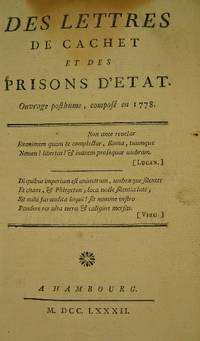
#[11107]Hambourg 1782. 2 volumes in 1. Modern half vellum. XIV323; 203 pp. First edition. - The French political thinker and statesman Mirabeau 1749-1791 went to the United Provinces where he lived by writing hack work for the booksellers; meanwhile Mirabeau had been condemned to death at Pontarlier for sedition and abduction and in May 1777 he was seized by the Dutch police sent to France and imprisoned by a lettre de cachet in the castle of Vincennes. His Lettres de cachet exhibits an accurate knowledge of French constitutional history skillfully marshaled to demonstrate that the system of lettres de cachet was not only philosophically unjust but constitutionally illegal. A plea in favor of the individual freedom defense of justice and humanity against despotism. - Small brown stain at top of first 70 pages. hardcover
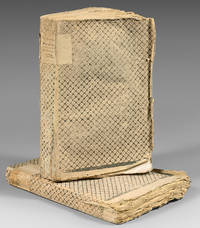
ABAA25-33<p>Hambourg n.n. 1782.</p><p>2 parts in 2 volumes 8vo of : I/ xiv pp. 1 l. 366 pp. 1 l. of errata; II/ 237 pp. ll. of the first quire interchanged wet stamp of a religious library repeated on the title p. 121 and on the last page of each volume.</p><p>Preserved untrimmed in its "dominoté paper" wrappers title labels on spines plexiglas box. <em>Original wrappers</em>.</p><p>217 x 142 mm.</p><p><strong>First edition of Mirabeau's Virulent work written during his detention in the Dungeon of Vincennes and speaking out against despotism.</strong></p><p>Graesse IV 535; Einaudi 3932; Cioranescu 45191; Conlon 82; Bûcher 573.</p><p>Mirabeau 1749-1791 was the son of the economist Victor Riquetti de Mirabeau. A French politician he was one of the most prominent figures of the Revolution and the most brilliant speaker of the Constituent Assembly. He had a very difficult relationship with his father and led a life of debauchery where he accumulated many debts. To get out of these debts he was locked up in prison by letters of seal at the request of his father on several occasions.</p><p>Mirabeau wrote the <em>Lettres de cachet</em> in the dungeon of Vincennes where he remained locked up for three and a half years at the same time as the Marquis de Sade. An eloquent work in which he vigorously denounced the abuses of arbitrary power <em>Les Lettres de cachet</em> is a veritable indictment beginning with a history of French criminal law; Mirabeau goes on to denounce violently the organization of the prison administration at the end of the Old Régime.</p><p><em>"Des Lettres de cachet' is not only an eloquent protest against despotism a warm advocacy in favor of individual freedom but also a real work of scholarship filled with historical examples and which implies immense reading".</em> Barbier.</p><p><em>"It is by history and by reason that Mirabeau fights against arbitrary detentions"</em> P. Negrin.</p><p><em>"Des Lettres de cachet deserves great praise. </em><em>The principles of natural law the basis of all society and all civilization are exposed and developed with as much force as clarity. Mirabeau already shows himself to be a great publicist and the writer gives a foretaste of the orator".</em> A. de Montor.</p><p><em>"This work new denunciation of the arbitrary power plea in favor of the individual freedom defense of justice and humanity against despotism had such a repercussion at the time that Vergennes asked Prussia to stop the publication of this licentious writing to seize it and to destroy the manuscript."</em> H. Aureole Bibliographie sur Mirabeau.</p><p><strong>A superb copy preserved as issued untimmed in its original wrappers in "dominote paper".</strong></p><p><strong>One of the largest copies known</strong> height: 217 mm.</p><p>The second volume is considered as rare because it was destroyed by the Prussian authorities at the request of the French government.</p><p>Provenance: the copy comes from the library of <em>Mr. Bidault</em> Gentleman of the Count of Artois future Charles X.</p><p><strong>FR</strong></p><p>Hambourg s.n. 1782.</p><p>2 tomes en 2 volumes in-8 de : I/ xiv pp. 1 f. 366 pp. 1 f. d'errata ; II/ 237 pp. ff. du premier cahier intervertis cachet humide d'une bibliothèque religieuse répété sur le titre la p. 121 et en dernière page de chaque volume.</p><p>Conservé non rogné dans ses brochures d'attente de papier dominoté étiquettes avec titre aux dos boite de plexiglass. <em>Brochures de l'époque.</em></p><p>217 x 142 mm.</p><p><strong>Edition originale du virulent ouvrage de Mirabeau écrit pendant sa détention au donjon de Vincennes et s'élevant contre le despotisme.</strong></p><p>Graesse IV 535 ; Einaudi 3932 ; Cioranescu 45191 ; Conlon 82 ; Bûcher 573.</p><p>Mirabeau 1749-1791 est le fils de l'économiste Victor Riquetti de Mirabeau. Homme politique français il est l'un des personnages les plus marquants de la Révolution et l'orateur de plus brillant de l'assemblée constituante. Il a des relations très difficiles avec son père et mène une vie de débauche où il accumule de nombreuses dettes. Pour le soustraire à ces dernières il sera enfermé par lettres de cachet en prison sur demande de son père à plusieurs reprises.</p><p>Mirabeau rédigea les Lettres de cachet dans le donjon de Vincennes où il resta enfermé pendant 3 ans et demi au même moment que le Marquis de Sade. Œuvre éloquente où il flétrit énergiquement les abus du pouvoir arbitraire Les Lettres de cachet sont un véritable réquisitoire débutant par une histoire du droit pénal français ; Mirabeau poursuit par l'organisation de l'administration pénitentiaire à la fin de l'Ancien Régime qu'il dénonce violemment.</p><p>" <em>'Des Lettres de cachet' n'est pas seulement une éloquente protestation contre le despotisme un plaidoyer chaleureux en faveur de la liberté individuelle mais encore un véritable travail d'érudition rempli d'exemples historiques et qui suppose d'immenses lectures</em> ". Barbier.</p><p>" <em>C'est par l'histoire et par la raison que Mirabeau combat les détentions arbitraires</em> " P. Negrin.</p><p>" <em>Des Lettres de cachet mérite de grands éloges. Les principes du droit naturel base de toute société et de toute civilisation y sont exposés et développés avec autant de force que de netteté. Mirabeau s'y montre déjà grand publiciste et l'écrivain y fait pressentir l'orateur</em> ". A. de Montor.</p><p>" <em>Cet ouvrage nouvelle dénonciation du pouvoir arbitraire plaidoyer en faveur de la liberté individuelle défense de la justice et de l'humanité contre le despotisme eut un tel retentissement à l'époque que Vergennes demanda à la Prusse d'arrêter la publication de cet écrit licencieux de le saisir et de détruire le manuscrit…</em> " H. Aureole Bibliographie sur Mirabeau.</p><p><strong>Superbe exemplaire conservé tel que paru à toutes marges car non rogné dans ses brochures d'attente de papier dominoté.</strong></p><p><strong>L'un des plus grands exemplaires connus</strong> hauteur : 217 mm.</p><p>Le second volume est considéré comme rare car il aurait été détruit par les autorités prussiennes à la requête du gouvernement français.</p><p>Provenance : l'exemplaire provient de la bibliothèque de <em>Mr. Bidault</em> Gentilhomme du Comte d'Artois futur Charles X.</p> hardcover
1345317263.Ghardcover. Good. Access codes and supplements are not guaranteed with used items. May be an ex-library book. hardcover
0243047916.Gpaperback. Good. Access codes and supplements are not guaranteed with used items. May be an ex-library book. paperback