141 résultats
1991x-0792312813Kluwer Academic Pub 1991. Hardcover. New. 1st edition. 182 pages. 9.56x6.52x0.66 inches. Kluwer Academic Pub hardcover
19292111902160500459Not Available 1929. Soft Cover. Fine. Number of copies: Central Employment Placement Secretariat Not Available paperback
19302111902160500460Not Available 1930. Soft Cover. Fine. Number of copies: Central Employment Placement Secretariat Not Available paperback
19312111902160500875Not Available 1931. Soft Cover. Fine. Number of copies: Secretariat Not Available paperback
1938013125Paris N.R.F., Editions Gallimard 1938 In-12 Broché Ed. originale
1935189931935. Women's Employment World-War II McConnell Dorothy. Women War and Fascism. New York: The American League Against War and Fascism 1935. 18 pages. Bound in brown cardstock wrappers. Measuring 5.5" x 8". McConnell presents a "protest against the use of women as cheap labor in factories and offices in the U.S. as well as in the fascist states" asserting that "Munitions plants employ women at dangerous tasks with long hours and low wages. Discriminatory laws against women should be defeated and women's wages made equal with men's for equal work". Wrappers are vibrant and unworn. Small penciled inscription on the title page not affecting text. An interesting pamphlet promoting the fight for women's labor safety and equal pay during WWII. Very clean and bright pages in very good condition. unknown
19942081502111907407Employment 1994. Soft Cover. Fine. Number of pages: 229p Size: A4 fine Employment paperback
19352111902160500458Not Available 1935. Soft Cover. Fine. Number of copies: Central Employment Placement Secretariat Not Available paperback
1919163201919. Women Employment:: This document was created with the intent of finding employment and for women contracted on temporary terms to work in government-appointed positions during World War I. The Committee advised that women have options to become permanent members of the government workforce and be treated equally with male colleagues i.e. equal pay not having additional clerical duties etc. Ministry of Reconstruction. Women's Advisory Committee. Report of the Sub-Committee Appointed to Consider the Position after the War of Women Holding Temporary Appointments in Government Departments. Presented to Parliament by Command of His Majesty. London: Published by his Majesty's Stationery Office 1919.Modern blue card wrappers with paper label. 8 page folio. Very good condition. The sub-committee which wrote this was composed of six women and two men demonstrating the interest and respect for women's work and labor contributions during World War I. unknown
1911182771911. Imperial size albumen portraits of faculty and students at American Medical College. St. Louis Missouri 1911. Large photo measures 24 x 20 inches. 40 subjects every one of them male except for a single female student listed below as "F Heflin." Photographed by Hays Studio. Mounted to photographer's board. The American Medical College a medical school founded in 1873 graduated its first woman in 1888. In 1911 the American Medical College combined with the Barnes Medical College. The following year the combined school became the Medical Department of the National University of Arts and Sciences in St. Louis. The National University then merged with the St. Louis College of Physicians and Surgeons around 1915. Female students like this one would have come in at a significant disadvantage proving her qualifications against skepticism in a field notorious for gender discrimination. The value of female doctors for female patients in particular has been profound. Board scuffed on one side does not affect images or text. Chipped at corner and top does not affect images or text. Overall very good condition. Expressions and details in images clear. unknown
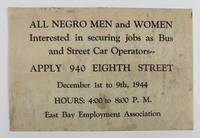
19443081N.p. but perhaps Oakland or Berkeley 1944. Very good. Printed broadside 5.25 x 8 inches. Minor foxing and staining light edge wear penciled note covering most of verso. A small and apparently unrecorded broadside calling for African Americans interested in working as bus drivers and street car operators in the San Francisco Bay Area during the latter portion of World War II. The notice calls for interested parties to apply at the offices of the East Bay Employment Association between 4:00 and 8:00 PM between December 1 and 9 1944. We could locate no information on the East Bay Employment Association but it was almost certainly located in either Oakland or Berkeley. This employment advertisement was perhaps the result of a wartime shortage of bus drivers and street car operators in the Bay Area. We could locate no other copies of this interesting and somewhat mysterious broadside. unknown
19312111902160500999Not Available 1931. Soft Cover. Fine. Number of copies: Central Employment Placement Secretariat Not Available paperback
19542092902143800092Japan Public Employment Security Association Hokkaido Branch Kaboro City 1954. Soft Cover. Fine. Number of books: 2 Japan Public Employment Security Association Hokkaido Branch (Kaboro City) paperback
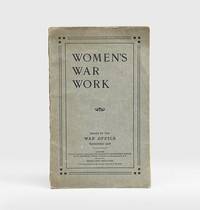
1916183494London: Chiswick Press 1916. First edition of this illustrated government publication promoting women's wartime employment. Women's War Work contains a detailed list of several hundred roles left vacant by men that women successfully fulfilled. Several of these are demonstrated by characterful photographs which show women employed in a range of professions including the postal service factories breweries and shops. The War Office recruited women into the workplace to maintain productivity produce munitions and ensure that as many men as possible were available for the Armed Forces. By July 1916 it was estimated that 750000 women across Britain had taken up such work and the War Office produced Women's War Work in September to further increase their numbers. The preface asserts that employers who had women in their workface would "readily admit that the results achieved by the temporary employment of women far exceed their original estimates and even so are capable of much further extension" p. 5. Women's contributions to the war effort drastically changed public perception of their capabilities and helped women over 30 to achieve enfranchisement in 1918. Provenance: from the collection of the suffrage historian Elizabeth Crawford. Quarto. 72 black and white photographs. Drab paper wrappers front and rear cover printed in black. Library sticker of the Women's Service Library and withdrawal stamp on front inside cover former shelfmark to front cover in pencil former bookseller's price to half-title. Spine repaired loss to ends wrappers lightly toned extremities a little creased extending to outer leaves at bottom corner occasional light finger-soiling to contents but otherwise clean: a very good copy of a fragile publication. unknown
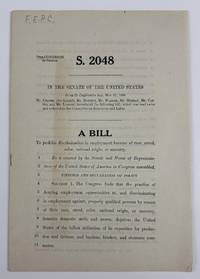
19445698Washington DC 1944. Very good. 16pp. Gathered signatures stapled. Minor creasing light discoloration to outer leaves. Pencil note on last page reads "From Natl Council for a Permanent FEPC Wash DC." A rare slip-bill printing of Senator Dennis Chavez's first attempt at legislation intended "to prohibit discrimination in employment because of race creed color national origin or ancestry." New Mexico Senator Dennis Chavez 1888-1962 was a lawyer and only the second Mexican-American to serve in the United States Senate. The present document represents a critical moment in Chavez's career in the Senate which occurred near the end of World War II. Chavez saw the need to protect fair employment practices for minorities returning home from war or for those who had worked in the defense industry during the conflict. FDR's Executive Orders 8802 which forbid discrimination in hiring practices within the defense industry and 9346 which created a five-member Fair Employment Practices Committee FEPC to ensure fairness helped during the war but were only a temporary fix. During its three-year run Senator Chavez reported hundreds of cases of discrimination to the FEPC with regard to unfair hiring practices wage differentials and discrimination in public accommodations but he wanted a more permanent and broader-ranging solution.<br /> <br /> The present document is Senator Chavez's first shot across the bow. In it he proposes to end employment discrimination across the whole of American life through the establishment of a permanent Federal Employment Practices Commission. In addition to defining the composition and other details of the commission membership salaries reporting duties location of offices etc. the bill stipulates that the commission's chief duty is the "Prohibition of Unfair Employment Practices" defines the commission's investigative powers gives it authority to make or change regulations to align with this act requires non-discriminatory language in government contracts stipulates penalties for persons resisting impeding or interfering with the commission's work and so forth. Of course Chavez's bill did not pass into law in 1944. Through a series of procedural gymnastics including a Senate filibuster opponents killed the bill a few different times in the years to come. When Chavez finally withdrew his bill following a failed cloture vote in February 1946 he commented that it was only the beginning of the struggle for civil rights and that the country would indeed move forward.<br /> <br /> In his article entitled "Dennis Chavez and the National Agenda: 1933-1946" Roy Lujan concludes: "Chavez's failure in civil rights legislation may be attributed to the fact that his vision and goals were too far-reaching. In the mid 1940s the United States was not ready to accept civil rights. Many people throughout the country and some of his Senate colleagues could not or would not recognize or correct discriminatory practices. Nevertheless through Chavez's fight for civil rights legislation he challenged southerners longstanding control of the Senate on this issue. Chavez's strong commitment to fight racial intolerance laid the groundwork and encouraged and inspired other congressmen to introduce civil rights legislation which finally came to pass under the Lyndon Johnson administration. In 1964 twenty years after Chavez first introduced his bill to create a permanent Fair Employment Practices Commission Congress invoked cloture to cut off debate after a fifty-seven-day southern-run filibuster and then enacted the 1964 Civil Rights Act. A provision of that act prohibits employers and labor unions from discriminating because of race color sex religion or national origin." <br /> <br /> Sadly Chavez died in 1962 and thus did not live to see many of the ideas in the present document passed into law as part of the Civil Rights Act of 1964. The present document defines what could have been.twenty years earlier. <br /> <br /> Roy Lujan: "Dennis Chavez and the National Agenda: 1933-1946" New Mexico Historical Review Vol. 74 No. 1 1999 pp.55-74. unknown
19542091202132802401Employment Security Bureau Ministry of Labor 1954. Soft Cover. Fine. Number of pages: 394 pages Size: 25cm Number of books: 1 Employment Security Bureau, Ministry of Labor paperback