44 résultats
16576Woman Employment Vigilance Association for the Defence of Personal Rights. "Legislative Restrictions on Women's Labour." Extract Reprinted by kind permission from the "Manchester Examiner and Times" of Saturday June 20th 1874. First edition Extract. 4 pages. Original paper wrappers. 8 1/2 x 5 in. "Who in thousands of cases where there is no helper will assure them and their children bread" This report criticizes a proposed labor bill that would ban women from working in factories for a period of 6 months after having a child. They find fault in the over-regulation of poor women as opposed to women from wealthy families and the fact that there is no social support for married women who cannot work: ".many married women deserted or uncared for by their husbands.no marriage law secures to the wife a share in the earnings of the father of her children." They compel women to raise their voices against this proposed regulation. The Vigilance Association for the Defence of Personal Rights was a British organization dedicated to watching restraining and influencing legislation especially in matters affecting the interests of women and the personal rights and liberties of the people. No institutions or libraries in the US hold a copy of this book according to OCLC Worldcat. . unknown books
16260Broadside that calls for women's participation in a mass demonstration to protest cuts to the WPA Workers Progress Administration. 8.5 x 11 in. The WPA provided jobs for thousands of Americans as part of FDR's New Deal to revitalize the American economy after the Great Depression. Funds were cut in 1937 and this broadside documents one demonstration to protest cuts to this program. It specifically calls on women to not only think of their relationship to WPA but the greater societal impacts that cuts to these programs will have such as lowering overall wages as unemployment rises. Very fragile document with small tears and chips along top and right edge. Good condition. An interesting document that shows women's important role in social and political mobilization. unknown books
16188Original vintage photograph of a large group of women seamstresses and tailors at their sewing machines in a factory setting. Sepia. Approximately 5" x 8" with back matting. Rows and rows of women sitting in front of sewing machines gaze into the camera. While single women faced barriers to employment wives and mothers confronted prejudice that put their jobs at risk after marriage and childbirth. As women took advantage of expanded access to jobs with the advent of factory lines a new push was made for job security and upward mobility. The women's employment movement first picked up traction in the industrial revolution as women fought to secure fair hours and wages for female factory workers; In the late 1870s and 80s women's organizations lobbied for safe conditions and job protection for married women and mothers; and through the 20th century expansion of skilled female labor including civil service publishing and medicine. Some of the most radical labor organizing in the West happened thanks to women in the textiles industry as women fought to secure prosperity and safety under new work conditions. A beautiful photograph of the spirited women young and old at the front lines of the changing workplace. Baxandall "America's Working Women" p. 94-96 158. Papachristou "Documents of the Women's Movement" p. 126-39. Hunt Oxford Dictionary of National Biography 2004-2005. The Women's Library London School of Economics. Krichmar 2423 2610 2766 2839. unknown books
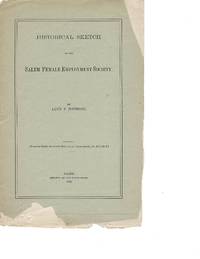
16738Women's Fight for Employment Equality Pamphlet. ''Historical Sketch of the Salem Female Employment Society" 1880. The Salem Female Employment Society was founded in Salem Massachusetts on January 15 1861 by members of the North Church Sewing Circle as the Society for the Employment of the Poor. The purpose of the society was to produce sewing work for poor women who were unable to gain employment elsewhere Manufactured garments were sold by members at a store they owned and operated at 366 Essex Street. By April 22 1867 the society had incorporated as the Salem Female Employment Society. OCLC reports only 2 other known copies among Institutional or library Collections according to OCLC Worldcat. unknown books
16565To the Right Honorable Richard Assheton Cross M.P. Secretary of Sate for the Home Department. 4 pages. 8 x 5 in. In this document women workers express fears regarding proposed labor regulations that would limit their ability to earn and would "restrict the paid labour of all women.or even make all married women half-timers." They claim it is unjust treatment that would harm women workers and pit their marriages at odds with their ability to work: "Your Memorialists assert that it is unjust to place restriction son the labour of unmarried women for the presumed protection of married women or mothers and further that any special restrictions upon the labour of married women is practically a penalty imposed on marriage as regards to the woman." Document that reveals the competing priorities for women factory workers between workplace safety and their earning power. Chipping with small losses along top and right edge. Repairs to two tears on page 2. Loss to top left corner. Good condition. unknown books
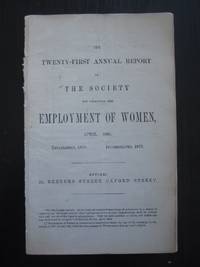
1657119 cent Women Employment The Twenty-First Annual Report of the Society for Promoting the Employment of Women April 1880. London: Printed by John Bale & Sons 1880. First edition. 8 x 5 in. Original paper wrappers. 30 pages. No other copies in institutional or library collections according to OCLC Worldcat. "The Society is formed for promoting the Training of Women and their employment in industrial pursuits." Includes reports on training needed to participate in different sectors of the workforce including wood carving hospital nursing and hairdressing among others. The Society for Promoting the Employment of Women was established in 1859 by women's rights leaders Jessie Boucherett Barbara Bodichon and Adelaide Anne Proctor to promote the training and employment of women. Light pencil marks in margins. Very good condition. No other copies in institutional or library collections according to OCLC Worldcat. unknown books
16568Bessie Rayner Parkes. The Market for Educated Female Labor. 1859. First Edition. 8 1/4 x 5 in. Unbound. 6 pages missing last 2 pages. No other copies in institutional or library collection in the US according to OCLC Worldcat. "The daughter may may marry but her husband may die.or be too poor to support her and her children; let her at least be trained beforehand to some possible way of getting her bread." Bessie Rayner Parkes one of the most prominent women's rights activist of her day writes that girls and young women must receive an education or a useful trade in the same way that boys do. "We lay it down as a primary social law conceded by all political economists that a father ought to provide for all his children or give them the means of providing for themselves." She emphasizes how common it is for middle-class women to join the workforce: "Probably every person present has a female relative or intimate friend whom trade-failure the exigencies of a numerous household or the early death of husband or father has compelled to this course; it is the experience of every family." An argument for the importance of skilled and educated women in the work force their place in the market and the challenges that they faced. Repairs to top right corner and right edge of page 1. Small repair to left edge page 6. Good condition. unknown books
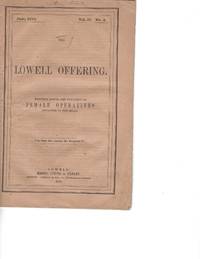
16739Women's Fight for Employment Equality. "Lowell Offering. Written Edited and Published by Female Operatives Employed in the Mills." 1844. Pamphlet. The Lowell Offering was a monthly publication run by women working in the Lowell Textile Mill from 1840-1845. Featuring the women's poetry essays and other literary efforts the magazine gave female factory workers the opportunity to share their creative endeavors; for the women who edited and published the periodical the Lowell Offering also provided demonstrable and employable skills in publishing and journalism. This 1844 edition comes from the penultimate year of the publication. It is the earliest piece in the collection. <br/><br/>Lowell solved the problem of labor at his mills by employing young women between the ages of 15 and 35 who became known as "mill girls". Unlike European industries which had access to "large landless urban populations whose reliance on the wage system gave them few economic choices" American companies had to grapple with a small labor supply because the population was small and most preferred farming their own land and the economic independence that came with it. In order to persuade these young women to work at a mill they were paid in cash once "every week or two weeks". In line with the Boston Associates' worldview the mill girls were encouraged to educate themselves and pursue intellectual activities. They attended free lectures by Ralph Waldo Emerson and John Quincy Adams and read books they borrowed from circulating libraries. They were also encouraged to join "improvement circles" that promoted creative writing and public discussion. unknown books
606580"Dick Jaeckel on Twentieth Century Fox employment form when he worked in the Fox mailroom at age 16 April 15 1943. Jaeckel signed and accomplished in his hand. 8 1/2" x 4" fine. Rare thus!. Signed by Authors. No Binding. Very Good. unknown books
16569Women Employment J. B. Remarks on the Obstacles to the More General Employment of Women and on the Means of Removing Them. London: Published at the Office fo the English Woman's Journal Company Limited 1860. First edition. 16 pages. Original paper wrappers. 8 1/4 x 5 1/4 in. A pamphlet supporting strategies for the expansion of women's employment opportunities. It outlines current obstacles to women's work such as hostility from male employees: "Women however cannot be employed in England in this manner because of the jealousy of their fellow workmen. If a master were to employ women in any part of the business the whole of his workmen would strike at once." The document also lists sad consequences of the current work climate: "Workhouses were found to be overcrowded with able-bodies females while charities were besieged with women praying to be provided either with employment or bread." Stain to upper left edge front. Toning to last page. Light pencil marks in margin. Very good condition. Only 2 copies held in library or institutions in the US according to OCLC Worldcat. unknown books
16566The Employment of Married Women in Manufacture. A Paper read at the Social Science Congress held at Norwich October 1873 by Whately Cooke Taylor Esq. London: Frederick Bell & Co. Steam Printers King's Rd. Chelsea 1874. First edition. 12 pages. Original paper wrappers. 8 x 5 1/4 in. "It is at first sign a very humane sentiment no doubt to assert that married women should be relieved from all hard work because of the duties which maternity casts upon them; but when as that the same time you relieve them of some fifteen shillings a-week without providing any substitute you must not be surprised if they themselves do not view your condescension in the same light." In this document many arguments are made against regulating married women factory workers as women working in agriculture and domestic roles did not face the same restrictions. Very good condition. unknown books
16567John Boyd Kinnear. The Right of Women to Labour. Being portions of an essay re-printed by permission form "Woman's Work and Woman's Culture." London: Printed by Frederick Bell & Co. Chelsea S.W. 1873. First edition. 14 pages. Original paper wrappers. 8 x 5 1/4 in. Kinnear a radical Scottish politician and lawyer advocates for the integration of women's labor wherever appropriate: "there are other things which women can do at least as well as men.Then why should women not do it" He brings up the need to defend women workers in the changing atmosphere as they were prevented from "forming effective trade unions to secure their rights" at the same time that increased industrialization was displacing them from factory labor jobs. Very good condition. unknown books
16577Jessie Boucherett. Legislative Restrictions on Women's Labour. Vigilance Association for the Defence of Personal Rights. Reprinted by kind permission from the "Englishwoman Review." London: Frederick Bell & Co. 1873. First edition. 12 pages. Original paper wrappers. 8 x 5 in. "Another objection is that the Bill confirms the principle that women are not capable of deciding for themselves." This report criticizes regulations proposed to limit the hours that new mothers may work in factories. "It has caused some surprise that Bills framed for so benevolent a purpose should have met with opposition from an unexpected quarter." A major issues Boucherett raises is the fact that there is no social support for married women who cannot work; she reasons that the decrease in hours would leading to "much suffering and some crime" as "it would always be difficult and sometimes impossible for a woman to provide sufficient food for herself and four or five little children." Toning to front cover. Few chips losses along right edge. In good condition. unknown books
16320This document was created with the intent of finding employment and for women contracted on temporary terms to work in government-appointed positions during World War I. The Committee advised that women have options to become permanent members of the government workforce and be treated equally with male colleagues i.e. equal pay not having additional clerical duties etc. Ministry of Reconstruction. Women's Advisory Committee. Report of the Sub-Committee Appointed to Consider the Position after the War of Women Holding Temporary Appointments in Government Departments. Presented to Parliament by Command of His Majesty. London: Published by his Majesty's Stationery Office 1919.Modern blue card wrappers with paper label. 8 page folio. Very good condition. The sub-committee which wrote this was composed of six women and two men demonstrating the interest and respect for women's work and labor contributions during World War I. unknown books
16574Women Employment Lucy Wilson. "Women and Legislation." Vigilance Association for the Defence of Personal Rights. June 20 1874. Original paper wrappers. 4 pages. First edition. 8 1/2 x 5 in. A Letter addressed to the Editors of the Leeds Mercury. "These measures all point to one conclusion that motherhood is a crime. The woman who is guilty of it unless.she is rich and independent shall not eat bread for six months thereafter or twelve as the House may determine." In this open letter Wilson decries legislation which would forbid new mothers from working yet fails to provide any public assistance for them to care for their families. "No Act has been passed decreeing that such women shall not suffer cold or hunger or to 'deem that they commit an offence' if they are hungry." Vigilance Association for the Defence of Personal Rights was a British organization dedicated to watching restraining and influencing legislation especially in matters affecting the interests of women and the personal rights and liberties of the people. Small losses along spine. Very good condition. unknown books
16266Circular of the Working Girls' Society. Bylaws for one of the first organizations in New York that was created specifically to support women workers. Extremely rare.Two very light horizontal fold marks. Light thumb-soiling. 2" tear at bottom of center fold. Very good condition. <br/><br/>The Working Girls' Society was designed to provide space for girls and women to gather take classes and socialize after working hours; it was dedicated to providing working women with a safe and clean space that could help them advance their professional lives. Information in the bylaws related to membership and to members' uses of the organization's library and rooms at 222 West 38th Street. Perks of joining the society the club even include special vacation benefits and discounted train tickets. An extremely rare early document that details the social communities which developed around a larger urban female workforce in the late 19th century. Extremely scarce OCLC Worldcat lists no other known copies of this document in any institution of library worldwide. unknown books
15644Early Women's Liberation and the Automobile in the Age of Suffrage. Collection of 4 pieces tracing the new path to independence gained by women with the invention of the automobile. Coming of age at the same time as the suffrage movement was reaching full swing the new technology offered by the automobile allowed women not only a newfound sense of freedom but the ability to travel unimpeded to demonstrate mastery of a new technology and even opened careers in mobility. This collection's vintage pieces include rare printed material on women and the automobile a signed license letters and photos from women who drove right over gender barriers explore the new world opening to women in the 20th century. <br/><br/>Leading up to the 20th century automobiles became a symbol of women's increasing social mobility and financial independence. Car makers and dealers realized that a significant number of women wanted and were capable of purchasing their own cars; and so they developed vehicles and marketing campaigns specifically for the female population. This collection's early 1913 brochure "To the American Woman" represents this trend and it declares that "the automobile . is of the greatest use to the woman.because of the importance of her work a woman's need for saving time and effort is imperative." The car saved wives and mothers time as they executed familial duties. It also provided some single women with independent incomes. As young women purchased their own vehicles some used the technology to support themselves by becoming mechanics and chauffeurs. These women are represented in this collection by a 1923 "Motor Magazine" with coverage on women car owners a vintage photo of the first woman to motor from Africa to London and an original 1929 Professional Chauffeur's License for Vivian Pickard. Pioneering women like those in this collection overcame gender barriers by increasing their mobility taking advantage of opportunities for mechanical and technical education thus opening new possibilities for women in transportation technology. unknown books
16265Woman's Work For Woman A Union Illustrated Magazine Published Monthly by the Women's Foreign Missionary Societies of the Presbyterian Church. Vol. XI No. 1. January 1896. New York. 28 pages. Vertical fold down the center of the booklet with soiling on the front and back cover water damage on the top and right edge of the front cover and small losses on the bottom edge of the back cover. Very rare; OCLC locates no other known copies.<br/><br/>Woman's Work for Woman was published from 1890-1904. The magazine contains articles and updates about life in different missionary locations in Asia South America and the Middle East. With most of the submissions by women and with an all women Editorial Committee this magazine is indicative of some of the most acceptable ways for women to participate in public life in the late 19th century. Women were not allowed to participate in Presbyterian church councils or leadership until the mid-twentieth century but working with the Women's Missionary Societies gave new opportunities for writing organizing and leadership positions. In the late 19th century women who sought work outside the home were often criticized for abandoning family and domestic responsibilities but women who pursued religious work did not face this same criticism since they had an altruistic motive. Working on religious causes allowed women agency and independence that they would not be able to access in other occupations. Very rare; OCLC Worldcat locates no known copies at any library or institution. unknown books
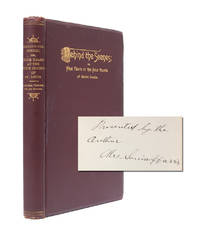
18934179St. Louis: A. R. Fleming & Co 1893. First edition. Near Fine. Original publisher's cloth binding with gilt to spine and front board. Brown coated endpapers. A square tight copy with just a bit of rubbing to extremities and light shelfwear to bottom edges of boards. Some cracking to hinges but both holding firm. Internally clean and unmarked collating viii 9-220: complete including frontis. Inscribed on the front endpaper: "Presented by the Author Mrs. Louisa Harris." The first book published by a policewoman in America it is scarce both institutionally and in trade. OCLC reports 23 copies and the modern auction record shows only three; of these only one was signed. <br /><br />Despite assumptions to the contrary "women have served in organized law enforcement in the U.S. almost from the beginning. The first police departments in America were established in the 19th century and in 1845 women began working as matrons in New York City jails" Smith. The practice rapidly spread across the country where police forces needed assistance in supervising female prisoners and dealing with the specific challenges faced by this population. Women's clubs -- particularly the American Female Moral Reform Society and the Women's Christian Temperance Union -- urged recognition for the widespread violence perpetrated on female prisoners and called for meaningful change. "It was these women's groups that fought for these distinctly female positions demanding there was a need for women to take care of women.and they provided police departments with funds for paid matron positions until the government could be convinced of the necessity of having women in the police force" Maiorano.<br /><br />Louisa Harris having served in the prisons and courts of Missouri for nearly a decade became the first of these women to publish about her experience. The resulting narrative reflects an awareness of the social forces that often put women at a disadvantage driving them toward arrests or recidivism. Domestic violence poverty and the stigma placed on sex work all do damage to women; and according to Harris these women should not be treated as or placed with violent offenders when they could with proper assistance find safety or build more secure lives. This is the motivation for Harris' memoir. In the introduction she explains that while she hesitated to publish the book which might in some readers awaken a "morbid curiosity" she ultimately moved ahead because "I reasoned that if the world knew more about the unfortunate and their revolting experiences together with the causes that promote misfortune there might be more true sympathy exhibited.While I have from personal observation become familiar with so-called criminals I have had the opportunity to learn many of the causes of the committal of crimes. The law seldom recognizes the palliating influences but humanity should." Harris calls for reforming the handling of juvenile offenders advocates for therapeutic programs for young women and taps into a number of other systemic issues of concern within policing today. Near Fine. A. R. Fleming & Co books