Vert Brigitte Bourdais SandrineLivre Rare Book

642 résultats
2020500120115PRAT EDITIONS 2020 238 pages 13x19 8x1 8cm. 2020. Broché. 238 pages.
2004100138892Edward Elgar Publishing Ltd 2004 141 pages 16 2x2 2x23 4cm. 2004. Cartonné jaquette. 141 pages.
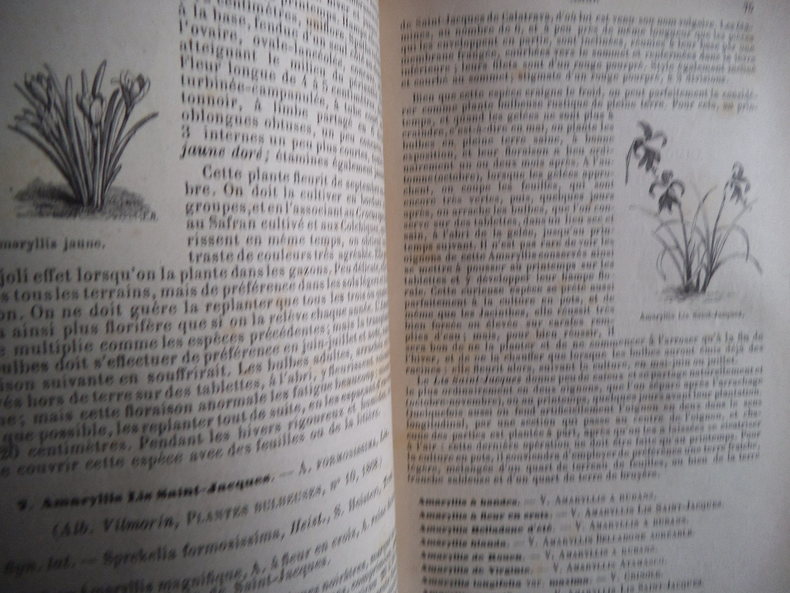
10146comprenant la description des fleurs annuelles, vivaces et bulbes de pleine terre, suivies de classements divers indiquant l’emploi de ces plantes et l’époque de leur floraison. Avec des exemples de leur ornementation en divers genres. In 8 demi-toile muette. Faux-titre, VII, 1563 pages, plus de 1300 figures dans le texte, 3 plans dépliants dont un en couleurs. Paris chez Vilmorin-Andrieux & Cie, sans date. Un petit angle supérieur droit page de faux de titre. Bon état d’ensemble
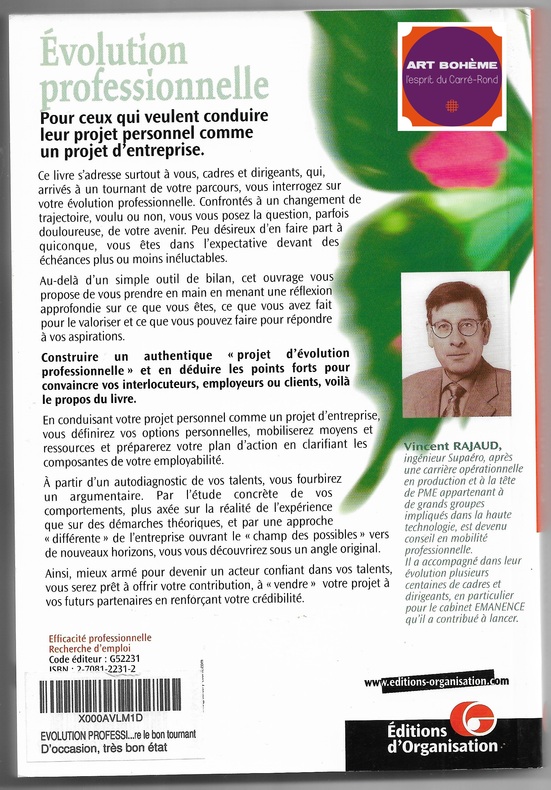
19990947Editions dOrganisation 1999 Broché Couverture glacée illustrée éditeur 178 pages Bon état - 1er plat corné 260 g
1950100139Couverture souple. Brochure. 16 pages.
0880992328.Ghardcover. Good. Access codes and supplements are not guaranteed with used items. May be an ex-library book. hardcover
0880992093New. paperback. New. Satisfaction Guaranteed or your money back. paperback
0880992093.Gpaperback. Good. Access codes and supplements are not guaranteed with used items. May be an ex-library book. paperback
19283495322Berlin, Hobbing, 1928. XVI, 301 S. Mit Tabellen und graphischen Darstellungen. Hlwd (Stempel auf Titel).
in-8°, 294 pp., broche, couv. illustree. Bel exemplaire (pli a la couv.). [DV-16]
library sticker on spine; library stamp on title page and catalogue page; text tight and bright. A practical guide to getting back to work after redundancy or early retirement, aimed at the 40-55 age group, which offers advice on deciding what direction to take, with ideas for how to look for a job, how to retrain, when to consider self-employment, and how to adjust to change Ex-Library
Previous owner's name and slight foxing to front end paper. No other marks or inscriptions to contents. No creasing to covers or to spine. A very clean very tight copy with unmarked black cloth boards, slightly dusty page edges and minor rubbing to corners. 256pp. Over eighty professions for the boys of the 1950s. Illustrated with black & white photographs. A scarce book.
No marks or inscriptions. No creasing to covers or to spine. A lovely clean very tight copy with bright unmarked boards and no bumping to corners. 248pp. A practical effective program to transform managers into skilled facilitators.
No marks or inscriptions. No creasing to covers or to spine. A very clean very tight copy with bright unmarked slightly foxed boards and no bumping to corners. 40pp. A discussion of the means needed to further the aims of the proletariat.
1441566902.Ghardcover. Good. Access codes and supplements are not guaranteed with used items. May be an ex-library book. hardcover
36289aafDresden, Zahn & Jaensch, 1896, in-8°, 40 S., Stempel a.d. Titelbl., Hlwd. (Bibl.).
4389524-nnew. unknown
2007Q-1405134089Wiley-Blackwell 2007-11-12. Paperback. New. In shrink wrap. Looks like an interesting title! Wiley-Blackwell paperback
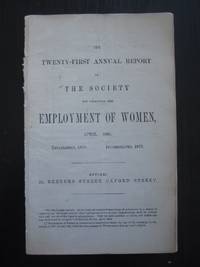
1657119 cent Women Employment The Twenty-First Annual Report of the Society for Promoting the Employment of Women April 1880. London: Printed by John Bale & Sons 1880. First edition. 8 x 5 in. Original paper wrappers. 30 pages. No other copies in institutional or library collections according to OCLC Worldcat. "The Society is formed for promoting the Training of Women and their employment in industrial pursuits." Includes reports on training needed to participate in different sectors of the workforce including wood carving hospital nursing and hairdressing among others. The Society for Promoting the Employment of Women was established in 1859 by women's rights leaders Jessie Boucherett Barbara Bodichon and Adelaide Anne Proctor to promote the training and employment of women. Light pencil marks in margins. Very good condition. No other copies in institutional or library collections according to OCLC Worldcat. unknown books
16577Jessie Boucherett. Legislative Restrictions on Women's Labour. Vigilance Association for the Defence of Personal Rights. Reprinted by kind permission from the "Englishwoman Review." London: Frederick Bell & Co. 1873. First edition. 12 pages. Original paper wrappers. 8 x 5 in. "Another objection is that the Bill confirms the principle that women are not capable of deciding for themselves." This report criticizes regulations proposed to limit the hours that new mothers may work in factories. "It has caused some surprise that Bills framed for so benevolent a purpose should have met with opposition from an unexpected quarter." A major issues Boucherett raises is the fact that there is no social support for married women who cannot work; she reasons that the decrease in hours would leading to "much suffering and some crime" as "it would always be difficult and sometimes impossible for a woman to provide sufficient food for herself and four or five little children." Toning to front cover. Few chips losses along right edge. In good condition. unknown books
16576Woman Employment Vigilance Association for the Defence of Personal Rights. "Legislative Restrictions on Women's Labour." Extract Reprinted by kind permission from the "Manchester Examiner and Times" of Saturday June 20th 1874. First edition Extract. 4 pages. Original paper wrappers. 8 1/2 x 5 in. "Who in thousands of cases where there is no helper will assure them and their children bread" This report criticizes a proposed labor bill that would ban women from working in factories for a period of 6 months after having a child. They find fault in the over-regulation of poor women as opposed to women from wealthy families and the fact that there is no social support for married women who cannot work: ".many married women deserted or uncared for by their husbands.no marriage law secures to the wife a share in the earnings of the father of her children." They compel women to raise their voices against this proposed regulation. The Vigilance Association for the Defence of Personal Rights was a British organization dedicated to watching restraining and influencing legislation especially in matters affecting the interests of women and the personal rights and liberties of the people. No institutions or libraries in the US hold a copy of this book according to OCLC Worldcat. . unknown books
1709419th c. Women Education Handwritten letter between female friends at different women seminaries. Jan. 19 1855. "Emily" a teacher at Neversink Seminary in Port Jervis NY writes to a friend Anna Atwood in Elmira NY about starting a Literary Society and raising funds for it. 4 pages folded on a single sheet with 1 page of cross-writing. With original Mailing envelope. Atwood was working at Elmira Collegiate Seminary chartered 1853 just as it was being renamed Elmira College later in 1955; it is the oldest college still in existence which as a women's college granted degrees to women that were the equivalent of those given to men. Regarding the changes at Elmira Collegiate Seminary:"I have been thinking that perhaps I should not be able to recognize your Seminary now for I remember your writing to me some time ago of some improvements that had been made. I presume a change would be less apparent in the persons that occupy it; there are some however whom I think I would recognize as friends." <br/><br/>Emily also gives updates on her school Neversink Seminary: "We have just commenced another term of school. Our last closed on the 11th of Jan. We had only a week vacation; just time enough to see the folk at home without making any visits.I must tell you something about our school last term. You will remember it marked an important era in my life. I like teaching very well though I think I have found more pleasure in studying.  I like it so long as I can keep my class interested. Sometime I can easily do this at other times I find it more difficult then it is that I get discouraged and think that it would be easier for me to learn a lesson and recite it myself than to see that a half dozen mischievous girls get theirs. I have a class of little boys in the Infant Department just learning to read. I enjoy teaching them very much for I can easily keep their attention beside it is encouraging to me to watch their improvement. We had last term fifteen family scholars. I think one will seldom find so pleasant a company of girls as were gathered here." She also writes about creating a literary society for her students: "Miss Jennings who is ever planning something for the benefit of the pupils suggested last term that we should form a "Literary Association" whose object should be the improvement of its members in the arts of Reading Writing Criticism and Conversation.".She generally appoints for each evening one young lady to write an essay another a tale another a criticism and another to prepare a review of some book. She also appoints one to recite a piece of poetry and another to read an extract from some book. Two are also appointed to open the discussion of some question; after the discussion has been opened any member has a right to present her arguments. It is in the discussion that the conversational powers are cultivated. The members are called upon for their criticisms upon the compositions as they are read.The meetings have thus far been very pleasant and I think very profitable. At the close of the term the Society gave a public entertainment. An admission was charged that funds might be raised for the purpose of furnishing a reading room with papers periodicals etc. for the benefit of the members of the Society. Beside the money taken in at the door several donations were made to the Society." She adds a few lines on the subjects which she is teaching: "I am going now to commence a course of Historical Reading. I commenced French last term but one teacher who was a German and who also taught music took French.and since then I have not taken it up again though we have a very good teacher." Original crease lines from mailing folds tender. In very good condition. An excellent piece of of history regarding women's education in the United States. unknown books
1887174331887. Women's Employment MABEL Robert F. Our Working Women and Their Earnings. United States 1887. First Edition. 13 pages measuring approximately 6" x 10" inches. At the time that this description is being written no copies are recorded in American institutions. OCLC search results are at best an estimate and can vary over time. The article begins "We as a nation have made no effort to teach our redundant female population to support itself although our position as a mother of colonies leaves us with a steadily increasing proportion of women who through the emigration of their male relatives are forces to provide for themselves." and concludes that "a woman's technical training will have still done her a good service in quickening her intelligence and in thus making her a wiser mother to her children and a more sympathetic companion to her husband above all in banishing much care by ensuring to her a means of livelihood in case of need." A compassionate thoughtful appraisal of the state of women's labor and financial prospects in the United States backed up by employment and pay statistics from the end of the 19th century. Cleanly disbound. Chipped along top edge. Toning. Pages clean and uncreased. Overall in good condition. unknown
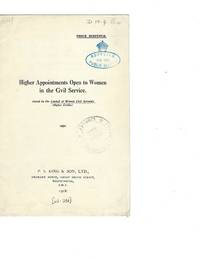
1928162621928. Women Employment "Higher Appointments Open to Women in the Civil Service." Issued by the Council of Women Civil Servants Higher Grades.P.S. King & Son Ltd. 1928. Paper wrappers 8 page 8 ½ x 5 ½ in. Pamphlet advertising upper-level positions open to women in the British Civil Service. Light thumb-soiling. Stamps on front and library sticker on back. Staple binding is rusty. Good condition. This public service document was created with the hopes of promoting more women to apply for higher appointments in the Civil Service by educating women on the application process and opportunities available in administrative executive and clerical roles. A fine piece of history that documents advancements in women's employment opportunities. unknown
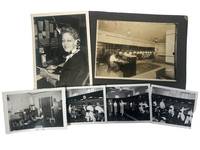
1900200911900. Telephone operator photo archive circa 1900 to 1958 documents women's labor within telephone exchange systems showing how urban communications depended on trained female operators seated at switchboards connecting calls handling information and maintaining the human infrastructure behind early and mid twentieth century telephone service. The material documents telephone communication labor through photographs of switchboard rooms operators wearing headsets plug boards supervisory presence and grouped clerical activity revealing how connection work operated in practice before automated dialing fully displaced manual exchange work. The archive supports research into women's wage labor communications history gendered office work New York telephone service and the disciplined workplace culture that positioned young women as the public voice and operational center of the telephone network.<br /> The archive consists of six black-and-white photographs including five silver gelatin photographs and one early albumen photograph with images measuring from approximately 3.5 x 4.25 inches to 7 x 9 inches. The date range appears to extend from the early twentieth century to 1958 based on the later dated images. Several photographs show women seated in tight rows facing large switchboards wearing heavy headsets with horn mouthpieces and working among dense arrangements of cords and plugs. The early albumen photograph shows a row of women facing the switchboards while a female supervisor watches over the room indicating both the gendered hierarchy and procedural discipline of the exchange floor. One image shows an operator turning toward the camera with a plug in hand smiling while gesturing toward the board. Four smaller photographs dated 1958 show teams of women moving between boards and a small group with paperwork behind the operating area; pencil inscriptions on the versos identify the location as New York.<br /> The photographs are valuable because they make visible the labor system behind telephone service: rows of operators standardized equipment supervisors paperwork and the coordinated manual routing of calls. They also record the gendered character of communications work in which women's voices posture speed and manner were made part of the service itself. Light handling wear minor edge wear and expected age toning; images remain crisp with equipment and personnel details clearly visible; overall very good. Strong women's labor and communications history archive documenting the human operation of telephone exchange systems across the first half of the twentieth century and into the postwar period. unknown