Antiquariat.de

353 résultats
1795490138Hamburg, Fauche, 1795. XXVIII S. Moderner Umschlag.
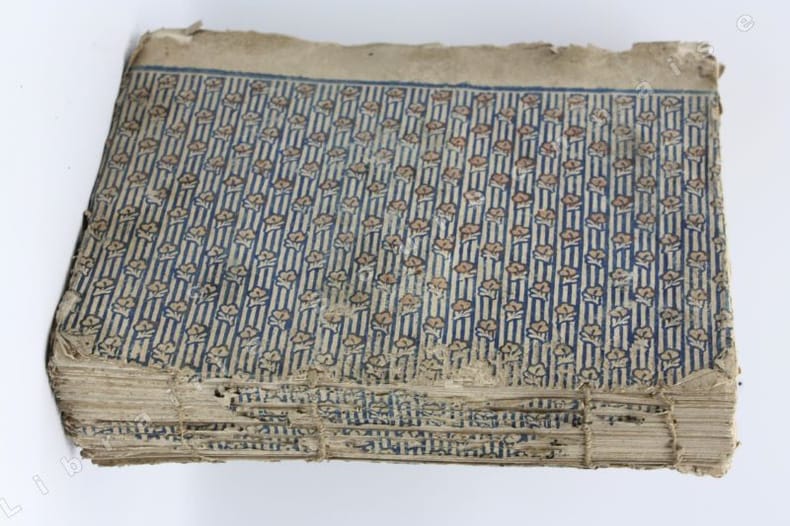
13985Clermont, Antoine Delcros, 1787 ; in-4, broché. 407 pp.-6 pp. (table)-2 ff. (errata). Couverture d'attente de l'époque en papier dominoté, manques au dos. Déchirures marginales sur la couverture. Exemplaire assez frais à grandes marges, non rogné.
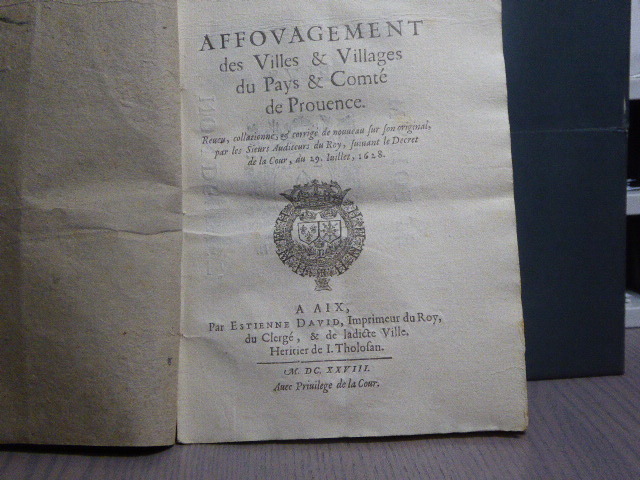
125464Estienne David, Imprimeur Du Roi Aix 1628 In-8 carré ( 200 X 150 mm ) de 32 pages, broché sous couverture muette de l'époque. Très bel exemplaire, non rogné.
151143 pièces imprimées et remplies : 1, Taille : Saint-Flour, 4 septembre 1777 ; pièce imprimée complété à la main. In-folio. 10 pp. Signatures autographes de Charles-Antoine-Claude de Chazerat, Intendant d'Auvergne, François de Varennes, seigneur de Bienassis, Grand-voyer au Bureau de la Généralité de Riom, et de Serlut et Mathieu, Commissaires vérificateurs des Rôles. Les noms manuscrits des consuls de la commune ont été portés à la fin du document : Antoine Viccal, du Moulin, et Antoine Bonhomme, des Effendous. Pli horizontal. Pâle mouillure en fond. Imprimé sur papier vergé d'Auvergne au filigrane "B SERVE FIN" (famille de papetiers actifs à Chamalières de 1750 à 1838).2, Second Brevet : Saint-Flour, 4 septembre 1777 ; 2 ff. in-folio. Signatures autographes de Chazerat et de Varennes. Moitié inférieure du second feuillet déchirée et remplacée par un papier vierge. 3, Capitation : Election de Saint-Flour, 16 octobre 1777 ; 4 ff. in-folio. Impôt de 626 livres, et autres impositions. Signature autographe de Chazerat. Liste manuscrite avec le montant de l'impôt de chaque personne redevable inscrite sur le dernier feuillet. (Sur papier vergé d'Auvergne au filigrane de G. Dourif avec fleur de lys couronnée).
19410187421941 Algemeene landsdrukkerij Soft cover
2553Paris Durand Pissot 1756 in 12 1 volume reliure pleine basane fauve de l'époque, dos à nerfs orné, 368 pages, le dernier cahier est légèrement et uniformément jauni. Bon exemplaire ( Photographies sur demande / We can send pictures of this book on simple request )
13370No place, (1787) (Paris, EDHIS, 1976). 31, (1) pp. 8vo. Boards. Not in INED; not in Goldsmiths; not in Kress; Conlon 87:1288. Reprint of this very rare and important little work, editon limited to 150 numbered copies and 30 not destined for the trade, and since long out-of-print. The unknown author of this tract brings up the question of the defense of the interests of the lower classes of the population, those who have no property nor any other wealth, no status, no rights and who ask only this: to have work to do, the certainty that this work will enable them to live and not to be robbed by the taxes.
25544A Paris, Chez la veuve Saugrain et Pierre Prault, 1730. (4) pp. 4to. Folded leaf. Conlon 30:140. Original edition. Alphabetical list with addresses of the officers.
Book has possible been rebound in black leatherette boards with banding and gilt lettering to spine. Very attractive copy. Mild scuffing to boards. Very light wear to corners and spine ends. Gift inscription in latin in pen to ffep by Vasilius Alexei F. Rudich and latin note: "et dilecto Vassiae d. Romae MCMLXXXXI" to dedication page. Very light pencil marginalia on a few pages. ; Ristampa anastatica dell'edizione Petropoli 1910. Unchanged reprint of the 1910 edition. ; Studia Historica 87; 132 pages
911TMS. Atkinson was an American industrialist and economist. He wrote "Cheap Cotton by Free Labor" "The Collection of Revenue" and "Argument for the Conditional Reform of the Legal-Tender Act". TMS. 7pg. 8 " x 11". Dec. 29 1899. Boston. A typewritten manuscript signed "Edward Atkinson" and accompanied by a slew of handwritten notes between lines and in margins. The manuscript is entitled "A Single Tax Parable. A very simple story" and reads in part: ". Away down to the West of the Indian Territory there lies a bit of land of exceedingly uniform and fertile character named 'No Man's Land' belonging to the United States. It was set apart when opened to settlement for an experiment in collecting the entire revenue due from settlers for any purpose by a 'single tax'. John Doe and Richard Roe were two New England mechanics. without the possibility of accumulating gain. They concluded to better their conditions by accepting under the Government grant each a quarter section in 'No Man's Land' on a single tax or ground rent at an assessment of two 2 per cent. making the single tax. on the whole parcel eighty dollars $80.; a seemingly high valuation but a low rate. John Doe and Richard Roe each had a thousand dollars $1000 in capital. Each built a small house putting the rest of their money into tools. Each put into wheat one hundred 100 acres. land of uniform fertility. Each kept a set of books valuing their own time. At the beginning of the second year John Doe bought a piano for the use of his daughter and bought a trotting horse and buggy for himself. Richard Roe was satisfied with a parlor organ. and put the rest of his profits into some good dairy stock. ". The manuscript continues along these lines and ends with the less frugal Doe working as an employee of the smarter Roe. There are over a handwritten hundred words and his signature appears at the end. The manuscript is in excellent condition with horizontal folds and a paper clip mark throughout unknown
172828719Paris: Chez Pierre Prault 1728. 1 vols. 8vo. Contemporary sprinkled sheep maroon morocco label. Some light rubbing of extremities short tear along lower portion of upper joint light spotting and browning else very good. 1 vols. 8vo. Goldsmith's Kress Library of Economic Literature no. 4102.7 suppl. for the 1704 edition. Goldsmith's Kress Library of Economic Literature no. 4102.7 suppl. for the 1704 edition <br/><br/> Chez Pierre Prault unknown
911Atkinson was an American industrialist and economist. He wrote "Cheap Cotton by Free Labor" "The Collection of Revenue" and "Argument for the Conditional Reform of the Legal-Tender Act". TMS. 7pg. 8 ½" x 11". Dec. 29 1899. Boston. A typewritten manuscript signed "Edward Atkinson" and accompanied by a slew of handwritten notes between lines and in margins. The manuscript is entitled "A Single Tax Parable. A very simple story" and reads in part: ". Away down to the West of the Indian Territory there lies a bit of land of exceedingly uniform and fertile character named 'No Man's Land' belonging to the United States. It was set apart when opened to settlement for an experiment in collecting the entire revenue due from settlers for any purpose by a 'single tax'. John Doe and Richard Roe were two New England mechanics. without the possibility of accumulating gain. They concluded to better their conditions by accepting under the Government grant each a quarter section in 'No Man's Land' on a single tax or ground rent at an assessment of two 2 per cent. making the single tax. on the whole parcel eighty dollars $80.; a seemingly high valuation but a low rate. John Doe and Richard Roe each had a thousand dollars $1000 in capital. Each built a small house putting the rest of their money into tools. Each put into wheat one hundred 100 acres. land of uniform fertility. Each kept a set of books valuing their own time. At the beginning of the second year John Doe bought a piano for the use of his daughter and bought a trotting horse and buggy for himself. Richard Roe was satisfied with a parlor organ. and put the rest of his profits into some good dairy stock. ". The manuscript continues along these lines and ends with the less frugal Doe working as an employee of the smarter Roe. There are over a handwritten hundred words and his signature appears at the end. The manuscript is in excellent condition with horizontal folds and a paper clip mark throughout unknown books
190614017Leipzig, Duncker & Humblot, 1906. XLIII, 304, 215 S. Halbleder der Zeit.
184020238Boston : Commonwealth of Massachusetts 1840. Broadside. Near Fine. Single folio sheet printed recto approximately 17.5 x 13.675 inches; one horizontal and three vertical folds; near fine. Broadside. An Act passed by both the Massachusetts House of Representatives and the Senate Governing the valuing of poll and property taxes in Massachusetts. The first section tasks Assessors to submit to the Secretary of the Commonwealth's office a "true and perfect list" of all male polls age sixteen and up together with "all rateable estate both real and personal lying within their Cities Towns and Districts" with a value of more than twenty dollars. A poll tax is a tax on a person. The Act also establishes an oath which each Assessor must agree to swear by along with penalties for either refusing the oath or not abiding by its terms. Section Seven of the Act details the correct type of form on which information for listing polls and property must be recorded. Even by today's standards this form might be considered comprehensive to the point of being intrusive. To give a few examples: "Number of ounces of plate of all kinds exceeding twenty dollars in value. Number of bushels of wheat. of rye. of Indian corn. of flax. of hemp. of hops. of tons of hay. of cow rights. of horses one year old and upwards. of mules and asses. of oxen. of steers and heifers. of sheep. of swine." and much much more. It was during this decade that Henry David Thoreau was jailed for not paying his taxes ostensibly on the grounds of his objection to slavery and the Mexican war. Signed in type by Robert C. Winthrop Speaker of the Massachusetts House; Daniel P. King President of the Senate and John P. Bigelow Secretary of the Commonwealth. <br /> <br /> WorldCat records only one institutional holding AAS of a four-page pamphlet of the same title with very similar although not identical content. No broadside printings are recorded by WorldCat. Commonwealth of Massachusetts unknown
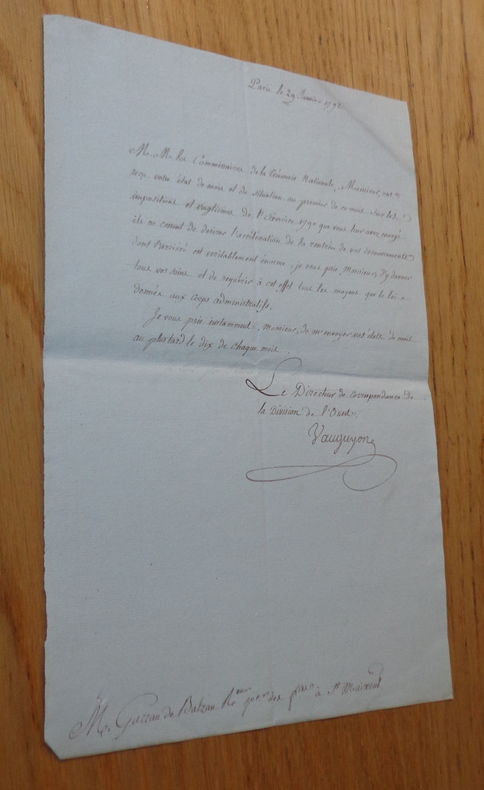
1791UUI-5914Bel ensemble de 19 documents de 1791-1792 reçus par M. Garrau de Balzan, receveur à Saint-Maixent, concernant les impôts, les règlements, les bordereaux qu'il doit ou non remplir, les sommes qu'il doit, et avec lesquelles il semble avoir quelque problème ("Vos recouvrements, dont l'arriéré est véritablement énorme...", dit une des lettres). Alternent les bordereaux, récépissés, lettres manuscrites, clarifications sur les lois et règlements. Les courriers sont principalement signés Proust et Vauguyon. Un extrait de règlement du 23 juin 1792 a été légèrement brûlé (manque d'un cm au milieu de la feuille, sans perte de texte), un bordereau est en partie déchiré avec manques (sans perte de texte non plus) et noirci, l'ensemble est en excellent état. Beau document sur l'administration révolutionnaire, ses règlements, son style - on passe brusquement au tutoiement du Citoyen dans l'un des courriers... Informations supplémentaires sur demande. Poids total 100 g. Frais d'envoi 3,20 euros sur la France, 5 euros UE et Suisse, 6,25 euros pour le reste du monde (tarifs de base hors envois suivis). Possibilité de remise en mains propres ou de consultation des documents sur Paris, n'hésitez pas à me contacter avant de passer commande.
26195(Paris), De l'Imprimerie de Georges Jouvenel, (1721). With woodcut head-piece. 12 pp. 4to. Modern boards. Not in Conlon. Printed in the upper inner margin above the head-piece "Regie de Cordier. Deuxième année" and handwritten the date and the word "Gabelles". Deals in 17 articles with these taxes, article 14, covering the pages 8-11, gives details of the bonusses to be received by the collectors of these taxes: they range from 300 to 600 livres.
25594No place (Paris), no date (ca 1750). 15, (1 blank) pp. 4to. Disbound. Not in Kress; not in Goldsmiths. Gives detailed instructions as to how to declare, how to handle, and how to settle the debts of communities including instructions with regards to the drafting of contracts concerning loans.
ORD-10769Avesnes. Imprimerie Viroux. Mars 1847. In-8 (153 x 236mm) broché, couverture verte imprimée, 15 pages. Exemplaire un peu froissé mais correct. Très rare.
193020835Berlin, Hobbing, 1930. XXIII, 494; XI, 594 S. Mit 5 mehrfach gefalteten Tabellen. OLwd.
1503Grand in 8broché couverture rempliée illustrée en couleurs,illustrations hors-texte en couleurs de Albert DUBOUT,Un des exemplaires numérotés sous double emboitage avec une suite en noir au trait.M.Gonon éditeur 1958 proche de l’état de neuf
183011831830 DESSIN ORIGINAL HUMORISTIQUE (FORMAT 18 X 30 CENTIMETRES ENVIRON), A L'ENCRE DE CHINE, REHAUSSE A L'AQUARELLE, SIGNE EN BAS A GAUCHE. REPRESENTE UN COQ PERCHE A L'AUBE SUR UN REVERBERE, COIFFE D'UN CHAPEAU EN PAPIER JOURNAL TITRE "LE NOUVEAU REVEIL", DEVANT UN BATIMENT DE LA DIRECTION GENERALE DES IMPOTS ET LEGENDE DANS UNE BULLE : "...VOUS LA SOUHAITE BIEN ORGANIGRAMMEE, SNADGIQUE ET NOUVELLEMENT REVEILLEE !".TRES BON ETAT.
17820Paris Honoré Champion 1906 in 8 (25x16,5) 1 volume broché, 298 pages, avec 1 carte noir et blanc. ''Contribution à l'histoire de l'impôt sous l'ancien régime''. Bon exemplaire
1903612532Wien, Frick, 1903. VIII, 497; IV, 343; III, 473 S. Halbleder der Zeit/Halbleinwand. 4to.
In-12°, pp.264, legatura in mezza pelle con titolo al dorso in oro, buono stato. Il presente lavoro è un trattato sulla Francia sotto Luigi XIV. Esamina la monarchia, l'aristocrazia, il clero, l'economia francese e le relazioni estere. L'autore condanna la persecuzione degli Ugonotti, considera i modi per ridurre il numero eccessivo di monaci e monache e favorisce le riforme fiscali al fine di ridurre la povertà e aumentare la popolazione. Il re fu offeso da quest'opera e l'autore fu mandato in prigione quando fu scoperta la sua identità. Paul Hay du Chastelet (n. 1630 circa) era il figlio di un illustre avvocato francese con lo stesso nome, che è stato il primo segretario dell'Accademia di Francia. Venne considerato come uno dei più grandi strateghi del XVII secolo. In-12°, pp.264, half calf binding, golden title at the spine, good copy. The present work is a treatise on France under Louis XIV. It examines the monarchy, the aristocracy, the clergy, the French economy, and foreign relations. The author condemns the persecution of the Huguenots, considers ways to reduce the excessive number of monks and nuns, and favors tax reforms in order to reduce poverty and increase the population. The king was offended by this work, and had the author sent to prison when his identity was discovered. Paul Hay du Chastelet (b. ca. 1630) was the son of an illustrious French lawyer of the same name, who served as the first secretary of the French Academy. He is considered to be one of only two major strategists in Europe in the middle of the 17th century
18596A Caen, Chez Gilles le Roi, 1765. (2), 57, (1) pp. 4to. Modern marbled boards. INED 2728; not in Kress; not in Goldsmiths; not in Einaudi; not in Conlon. First edition. 'Mémoire historique et économique exprimant la misère des curés 'portionnaires' et les moyens d'y remédier' (INED). - Two small holes in inner margin of title-page.