667 résultats
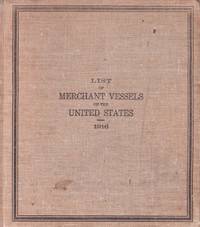
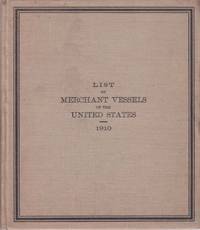
191039455Washington: GPO 1910. viii 443 pp. <br /><br />Signal letters rig name measurments where built home port. Front inner hinge cracked else very good condition. GPO books
19081338690Washington: Government Printing Office 1908. Softcover. Quarto; Fair; Paperback; Spine brown without print; Cover is brown paper with tan title label on front folded over stiff paper cover wear to spine caps corners edges small tear at top of spine edges of title label taped to cover slight stain on rear; Text block separated from cover exposed binding is weak clean text; 426 pages frontispiece folded map. <br /> <br /> Oversized books. Additional postage necessary for expedited/international orders. Economy International shipping unavailable due to size/weight restrictions. For international/expedited customers please inquire for rates. 1338690. FP New Rockville Stock. Government Printing Office unknown books
191739473Washington DC: GPO 1917. 4to 484 pp. <br/><br/>Our merchant fleet as it existed at the time of the first world war. Scarce. Light cover soiling else very good condition. GPO unknown books
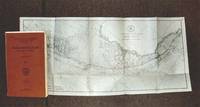
192238531Washington: GPO 1922. 95 pp. plus 10 page supplement <br/><br/>Fifth edition. New York to Key West. With 8 folding charts in back pocket showing courses marked in red. Laid in front is "Supplement to Inside Route Pilot. 1923" Very good condition in original wrappers which are lightly worn. GPO unknown books
189639477Washington: GPO 1896. 4to. vi 405 pp. <br/><br/>Some cover wear. Text clean. GPO unknown books
18721427091872. TRADE CATALOGUE -- NURSERYMAN'S GUIDE. DEWEY D.M. Nurseryman's Specimen Book of American Horticulture and Floriculture Fruits and Flowers Ornamental Trees Shrubs Roses &c. D.M. Dewey's American fruit & flower plates colored from nature 2300 varieties. With a chromolithographic title page and 56 stencillled plates of fruits flowers and 9 chromolithographic plates plates of fruits flowers and trees. 8vo. 220 x 140 mm bound in contemporary morocco rebacked. Rochester N.Y.: D.M. Dewey n.d. ca. 1872. An early American trade catalogue of Fruit Flowers Trees and Nursery stock issued according to the Smithsonian Library "ca. 1872" by the firm of D.M. Dewey Rochester N.Y. Many of the plates have captions giving name of variety of plant and brief information on main characteristics and growing season. The Smithsonian copy contains only 24 plates compared to the 40 in the above copy. "Nurserymen's plates were an American innovation. They were made by various methods the most distinctive being painted in watercolors. In design and coloring these plates were more akin to folk painting than to the commercial art of their time" Charles von Ravenswaay "Drawn and Colored from Nature" in Antiques Magazine March 1983 pp. 594-599. Some minor wear overall in excellent condition. See Raphael. An Oak Spring Pomona Nos 63 to 66. unknown books
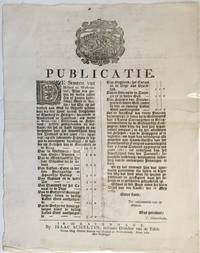
17852954The Hague: Isaac Scheltus 1785. Very Good. Broadside. Text in two columns. Large woodcut of coat of arms of the Dutch Republic along with the arms of all member states woodcut initial also with modified Dutch Republic arms. Crease down the vertical and horizontal middle other small creases in the lower half ink offsetting from folding on lower half small tears and chips along edges small dark stain just above top woodcut. The origins of the Dutch Naval College. <br/><br/>Fascinating broadside detailing tax duties on ships trading in the East and West Indies America the Cape of Good Hope and elsewhere levied for - and applied towards - the newly founded Dutch Royal Naval College "Kweekschool voor de Zeevaart" or Seminary for Navigation which produced officers for the Dutch Sea Service. Notably these officers were not trained at sea but in the classroom -- and in the courtyard where the navy erected large model training ship for the ultimate experiential learning. The vessel was large enough for young students to climb the rigging. It is with good reason that graduates were described as "paper sailors." <br/><br/>According to this broadside the Dutch Republic approved and consented to the establishment and maintenance of the Kweekschool in the year 1781 for which the bespoke taxes were collected. The academy was officially opened in 1785 the same year that this "Publicatie" was printed. Taxes were only levied on ships of the East Indies Oostindien and the Cape of Good Hope Kaap.<br/><br/>It was with some urgency that the Kweekschool was developed: at this time there was a radical shift in the balance of maritime power: the power of the Dutch East India Company was in gradual decline in deference to the rising British East India Company which came to dominate global trade. In particular 1785 marks the first full year following the end of the Fourth Anglo-Dutch War which broke out over British and Dutch disagreements on the legality and conduct of Dutch trade with Britain's enemies during the War of American Independence. <br/><br/>The broadside is signed in print by Caspar Clotterbooke 1711-1791 who was Secretary of the States of Holland at the time.<br/><br/>OCLC shows no copy in any institution outside of the Netherlands. Our copy appears to be the only one on the market; it is probable that this is the only one in private hands.<br/><br/>Literature: See especially Margaret E. Schotte Sailing Schools: Navigating Science and Skill 1550-1800 JHU Press 2019 passim. Isaac Scheltus unknown books
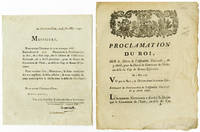
1790WRCAM51521Rouen: L. Oursel 1790. 3pp. with: PRINTED FORM LETTER COMPLETED IN MANUSCRIPT CONCERNING THE PROCLAMATION. N.p. 1790. 1p. Quarto on a folded folio sheet. Light wear and soiling. Very good. Proclamation by the Revolutionary government of France abolishing the monopoly of the French East India Company on trade beyond the Cape of Good Hope and declaring it open to all Frenchmen. The Compagnie des Indes Orientales was established in 1664 to compete with the British and Dutch East India companies. It had considerable difficulty maintaining itself financially through its long history and it was finally liquidated in 1769. In 1785 it was reconstituted and granted a seven-year monopoly on trade beyond the Cape of Good Hope but the French Revolution and the democratic zeal that accompanied it put an end to that with the present decree. The brief proclamation is accompanied by a transmittal form from the Bureau Intermediane du Departement de Montivilliers indicating that one copy of the proclamation was sent to the recipient. L. Oursel unknown books
3384Paris: Imprimerie et Librairie Administratives de Paul Dupont 1858. . Small folio late 19th century marbled boards cloth spine slightly abraded; original blue printed wrappers bound in; blindstamp of the Boston Public Library on the first page; unopened. The July 1858 issue of "Annales du Commerce Exterieur". The immediate cause of the 1857 panic was the failure of the New York branch of the Ohio Life Insurance and Trust Co. a major financial force that collapsed following widespread embezzlement. Others causes included the removal of funds from U.S. banks by British investors which raised questions about the overall U.S. economy. The fall of grain prices which spread economic misery into rural areas. The collapse of land speculation programs that depended on new rail routes ruining thousands of investors. Investor confidence was further shaken in mid-September when 30000 pounds of gold were lost at sea in a shipment from the San Francisco Mint to eastern banks. The gold and SS Central America sank during the North Carolina Hurricane of 1857. Public confidence in the government's ability to back its paper currency with specie was shaken as well. Eventually the panic and depression spread to Europe South America and the Far East. No recovery was evident in the United States for a year and a half and the full impact did not dissipate until the Civil War. The South was hurt less than the other regions of the country and many there concluded that the superiority of their economic system had been vindicated this has been posited as a contributing factor to the secession of many of the Southern States resulting in the Civil War. Pages 57-62 outline the trade between France and the United States during the years 1856-1857 with a retrospective look at past trade. Paris: Imprimerie et Librairie Administratives de Paul Dupont, 1858. hardcover books
19303346<p>The Edwards Manufacturing Co. New York. Circa 1930 A magazine size trade catalog of sheet metal and building materials. Edwards was the largest maker of sheet metal building material in the world and this catalog of 40 pages is a great example of their offerings. Included are metal roofing materials shingles skylights ventilators doors windows iron fence and ornamental work guards even motion picture machine booths and theatre equipment. This is catalog #74 and has 10-15 illustrations on almost every page measurements and many times excellent photographs. Scarce and unusual. A fine copy with no wear or marks.</p> Edwards Manufacturing Co. paperback books
19203351<p>Oversize quarto bound in the original printed wrappers. A fine copy with no wear or marks. 184 pages profusely illustrated with sheet metal building materials such as metal Spanish tile metal shingles roofing siding gutters awnings stamped and spun zinc and copper doors widows metal ceilings portable buildings etc. Great black and white photographs drawings and some color. An excellent reference source for the restorer.</p> The Edwards Manufacturing Co. books
17944016Leeds 1794. Large 4to 308 x 240 mm. 12 leaves text comprising 3 printed titles each with a 6-page description of the items in the catalogue in German French and English and 45 engraved plates of which one folding containing 186 designs numbered 1-152 with an additional 34 numbered and lettered designs for "tea-ware" tea- and coffee-ware in the French and English descriptions. Paper watermarked with a fleur-de-lys and shield with capital letters L V G below Lubertus van Gerrevink. Some light scattered foxing and offsetting plate 20 with closed tear to top margin just entering plate area without loss folding plate 26 torn across and repaired. Modern retrospective calf gilt edges red-stained extremities very lightly rubbed. Provenance: contemporary notes in Portuguese on the blank verso of the last plate; Duncan Grant Warrand loosely inserted ex-libris; Martin Woolf Orskey bookseller 1925-2018 signature at end with purchase date 1972. A multi-lingual catalogue of pottery produced by Hartley Greens and Co. for the use of traveling salesmen. Founded circa 1756 at Hunslet south of Leeds the company gained a reputation for its elegant cream-colored earthenware in the classical style known as creamware a type of earthenware made from white Cornish clay combined with a translucent glaze to produce a characteristic pale cream color. Hartley Greens and Co. so dominated the market that their products came to be referred to as Leedsware or Leeds pottery. Although some of the pieces in this catalogue are for display or special use Leeds pottery was generally a more everyday pottery than that of Wedgewood their principal rival and hence its survival rate is low. The earlier pieces before around 1775 were furthermore unmarked making attribution uncertain thus rendering the firm's printed catalogues all the more important. The present catalogue was "one of the earliest pattern books published in England by pottery manufacturers for the use of their travellers with illustrations of all the articles produced by the firm" Solon. It shows the creamware as issued from the studios before jobbers and importers added colored glazes. Shown are terrines sauce boats salts jugs egg cups covered terrines and bowls cake plates cruet stands candlesticks urns tea services and a remarkable tulip vase among other useful objects of the table many with ornaments some in the characteristic openwork or perforated style. All 186 designs are numbered and identified in the accompanying plate lists. The variety is impressive. Copies of the Leeds catalogues were often cut up by jobbers who relied on the illustrations to transmit orders accurately rather than trusting to written descriptions of the forms. Their consequent rarity makes the publishing history of the catalogues difficult to unravel. The earliest catalogue appeared in 1783 with the text in English only and 41 plates. The Danish National Library has a copy with the text in English and French and the English title dated 1786. Another copy of the present 1794 edition is held by the V&A but it has only 41 plates. Meanwhile there are also copies of a 1794 edition at Yale and RISD with the English text only but with 71 plates. The plates were reissued in 1795 and 1814 or 1815 these undated issues are identified by the watermarked dates of the paper they are printed on. Most of the variously dated copies seem to be reissues of the same plates. Most of the variously dated copies seem to be reissues of the same plates. A comparison of this copy to the Winterthur copy from 1814 which is digitized shows that the same plates were used with the addition of an engraved oval label " Leeds Pottery" on each plate up to and including plate 38 a compotier from which emerges a large cross after which the designs diverge. The editions or issues after 1795 do not have the very useful text with gives the name function and size of each piece: "As the price lists and the general title had been printed independently from the plates and not in sufficient quality to accompany the sets of engravings these late copies are generally found without the title and the printed description of the objects. These price lists now very rare were printed in English French German and Spanish. As the prices were subject to constant revision prices are added with pen and ink" Solon. Our copy is unpriced. Altogether OCLC locates fewer than a dozen copies some incomplete of various issues or editions of the Leeds pottery catalogue. Cf. M.-L. Solon Ceramic Literature 1910 p. 196. unknown books
189051050Various places 1890. mostly boys with simple tackle as pictured on nine advertising trade cards most 3 x 4 inches for New England businesses one from New Jersey primarily clothing concerns but including an organ manufacturer soap manufacturers a confectioner and a dye house; advertising copy printed on the verso of four cards. Some rubbing but a very good lot. For the nine trade cards $100. <br/><br/> hardcover books
1914011202Michigan: Detroit Publishing Co 1914. Book. Very Good. Soft cover. 1st Edition. Promotional to promote growth and business in Redlands California. Includes images of birds-eye views mountain views railway station inns churches schools University of Redlands library opera house municipal water system orange groves olive groves apple and apricot orchards parks street views residences resorts and Redlands Chamber of Commerce. ---------- Carefully handled. mild toning. Oblong; 21 x 29 cm; Unpaginated 33 pages. Photomechanical reproductions of photographs of Redlands and accompanying text. Blue illustrated wrappers illustrations printed in dark blue. 5 copies in OCLC. OCLC: 1083527691. Detroit Publishing Co Paperback books
1930789341930. Hardcover. Very Good. First item: illustrations some color photos 332p. Second item: illustrations some color photos 324p. Original matching red cloth bindings. 25cm. Former owner's name a Presbyterian missionary in Thailand in both volumes. Calling card of Rear Admiral Mom Chao Thavara Mongolwongse first President of the Medical Association of Siam mounted on front pastedown of the second volume. Moderate scuffing and wear. No Jackets. Both volumes were issued for the Medical congress. <br/><br/> hardcover books
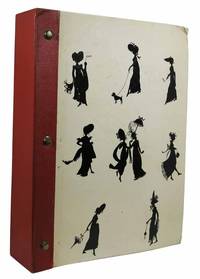
195742918Paris: Societe Paritys / Lebotys 1957. Post binder with 3 brass posts decorative screw tops. Publisher's color pictorial glazed boards blue spine and joints. Board edges rubbed and worn; short split to rear outer joint; inner joints tender paper splitting though cloth reinforcement beneath is intact. Page block foxed occasional foxing/spotting throughout; light offsetting from fabric samples to some pages. Fabric sample generally clean and bright with occasional creasing/fraying. Overall Gd. 97 pp. 16 color fashion drawings; ~ 740 pasted or tipped-in fabric samples. 16-1/8" x 12-1/8" <br/><br/>A mid-century salesman's sample catalogue from the winter collection of Parisian firm Société Paritys a haberdashery and fabric supplier established in 1946 and still in operation today. The fabric samples have been supplied by Lebotys a couture design firm in its own right and highly regarded for the quality of its textiles. As we find record of Lebotys having issued catalogues of its own collections in both the 1930s and 1960s we speculate that the two firms collaborated for a limited time possibly due to continuing post-war shortages and the need to adapt to the rapidly changing clothing market of the 1950s. The late 1950s saw a revolution in French fashion — and by extension Western fashion in general — due in no small part to the influence of material factors underlying the purely aesthetic side of the industry: availability of fabric continuing technological advances in synthetics and the surging post-war economies of America and Europe. The reluctant expansion of haute couture into the ready-to-wear market during the latter half of the century and the increasing reliance on synthetic fabrics to meet the demand would ultimately spell a major shift in the industry one that would impact fashion trends for decades to come. Some fashion houses like Dior whose “New Look” revitalized fashion at the beginning of the decade successfully managed to adapt by issuing couture ready-to-wear lines. Some however even long-established houses survived the war only to be undone by the prosperity that followed. The collaboration here of Société Paritys and Lebotys as well as the fabrics offered and styles displayed leads us to infer that the two firms were likely targeting the growing ready-to-wear market. The fabrics include a variety of silks cottons wools mohair etc. as well as nylon fibranne rayon Rhodia tergal crylor acetate and other “Matieres Synthètiques” often in blends and advertising their washable and/or antiwrinkling qualities. The styles in the illustrations still heavily influenced by the “New Look” emphasize wasp-waisted dresses hourglass silhouettes etc. No copies located on OCLC nor the major French institutions as searched on KVK. Societe Paritys / Lebotys hardcover books
195842919Paris: Societe Paritys / Lebotys 1958. Post binder with 3 brass posts. Publisher's pictorial glazed boards red cloth joints. Light extremity wear to boards; bumping to upper corner of front board; short split to front and rear joints. Page block lightly foxed foxing/spotting scattered throughout. Few white nylon fabric samples discolored by paste beneath. Fabric samples otherwise clean and bright with only minor occasional creasing/fraying. Overall VG. 80 pp. 12 color fashion drawings; ~590 pasted and tipped-in fabric samples 16-1/8" x 12-1/8" <br/><br/>A mid-century salesman's sample catalogue from the winter collection of Parisian firm Société Paritys a haberdashery and fabric supplier established in 1946 and still in operation today. The fabric samples have been supplied by Lebotys a couture design firm in its own right and highly regarded for the quality of its textiles. As we find record of Lebotys having issued catalogues of its own collections in both the 1930s and 1960s we speculate that the two firms collaborated for a limited time possibly due to continuing post-war shortages and the need to adapt to the rapidly changing clothing market of the 1950s. The late 1950s saw a revolution in French fashion — and by extension Western fashion in general — due in no small part to the influence of material factors underlying the purely aesthetic side of the industry: availability of fabric continuing technological advances in synthetics and the surging post-war economies of America and Europe. The reluctant expansion of haute couture into the ready-to-wear market during the latter half of the century and the increasing reliance on synthetic fabrics to meet the demand would ultimately spell a major shift in the industry one that would impact fashion trends for decades to come. Some fashion houses like Dior whose “New Look” revitalized fashion at the beginning of the decade successfully managed to adapt by issuing couture ready-to-wear lines. Some however even long-established houses survived the war only to be undone by the prosperity that followed. The collaboration here of Société Paritys and Lebotys as well as the fabrics offered and styles displayed leads us to infer that the two firms were likely targeting the growing ready-to-wear market. The fabrics include a variety of silks cottons wools mohair etc. as well as nylon fibranne rayon Rhodia tergal crylor lurex viscose imitation fur and other “Matieres Synthètiques” often in blends and advertising their washable and/or antiwrinkling qualities. The styles in the illustrations still heavily influenced by the “New Look” emphasize wasp-waisted dresses hourglass silhouettes etc. No copies located on OCLC nor the major French institutions as searched on KVK. Societe Paritys / Lebotys hardcover books
195942920Paris: Societe Paritys / Lebotys 1959. Post binder with 3 brass posts. Publisher's pictorial glazed boards white cloth joints. Light extremity wear to boards; short split to rear joint. Page block lightly foxed occasional foxing/spotting to margins throughout. Few white nylon fabric samples discolored by paste beneath. Fabric samples otherwise clean and bright with only minor occasional creasing/fraying. Overall VG. 108 pp. 16 color fashion drawings; ~800 pasted and tipped-in fabric samples. 16-1/4" x 12" <br/><br/>A mid-century salesman's sample catalogue from the summer collection of Parisian firm Société Paritys a haberdashery and fabric supplier established in 1946 and still in operation today. The fabric samples have been supplied by Lebotys a couture design firm in its own right and highly regarded for the quality of its textiles. As we find record of Lebotys having issued catalogues of its own collections in both the 1930s and 1960s we speculate that the two firms collaborated for a limited time possibly due to continuing post-war shortages and the need to adapt to the rapidly changing clothing market of the 1950s. The late 1950s saw a revolution in French fashion — and by extension Western fashion in general — due in no small part to the influence of material factors underlying the purely aesthetic side of the industry: availability of fabric continuing technological advances in synthetics and the surging post-war economies of America and Europe. The reluctant expansion of haute couture into the ready-to-wear market during the latter half of the century and the increasing reliance on synthetic fabrics to meet the demand would ultimately spell a major shift in the industry one that would impact fashion trends for decades to come. Some fashion houses like Dior whose “New Look” revitalized fashion at the beginning of the decade successfully managed to adapt by issuing couture ready-to-wear lines. Some however even long-established houses survived the war only to be undone by the prosperity that followed. The collaboration here of Société Paritys and Lebotys as well as the fabrics offered and styles displayed leads us to infer that the two firms were likely targeting the growing ready-to-wear market. The fabrics include a variety of silks cottons wools mohair muslin cashmere and others as well as nylon fibranne rayon Rhodia tergal crylor acetate Albène and other “Matieres Synthètiques” often in blends and advertising their washable and/or antiwrinkling qualities. The styles in the illustrations although still influenced by the “New Look” also show the influence of Dior's successor the young Yves St. Laurent who debuted his "trapeze line" in 1958. No copies located on OCLC nor the major French institutions as searched on KVK. Societe Paritys / Lebotys hardcover books
195741355Paris: Societe Paritys 1957. 1st printing thus. Publisher's color pictorial glazed boards post binder; 3 brass posts decorative screw tops. Red cloth joints. Some general extremity wear to binder with slightly bumped corners. Occasional dust soiling. Minor foxing. Overall VG with cloth samples generally VG to Nr Fine with the occasional crease to the odd sample or two. 104 pp printed in red on stiff-stock paper. 16 color fashion drawings; 897 of 898 tipped-in fabric samples. Folio. 16-1/4" x 12-1/8" <br/><br/>A mid-century salesman's sample catalogue from the summer collection of Parisian firm Société Paritys a haberdashery and fabric supplier established in 1946 and still in operation today. The fabric samples have been supplied by Lebotys a couture design firm in its own right and highly regarded for the quality of its textiles. As we find record of Lebotys having issued catalogues of its own collections in both the 1930s and 1960s we speculate that the two firms collaborated for a limited time possibly due to continuing post-war shortages and the need to adapt to the rapidly changing clothing market of the 1950s. The late 1950s saw a revolution in French fashion — and by extension Western fashion in general — due in no small part to the influence of material factors underlying the purely aesthetic side of the industry: availability of fabric continuing technological advances in synthetics and the surging post-war economies of America and Europe. The reluctant expansion of haute couture into the ready-to-wear market during the latter half of the century and the increasing reliance on synthetic fabrics to meet the demand would ultimately spell a major shift in the industry one that would impact fashion trends for decades to come. Some fashion houses like Dior whose “New Look” revitalized fashion at the beginning of the decade successfully managed to adapt by issuing couture ready-to-wear lines. Some however even long-established houses survived the war only to be undone by the prosperity that followed. The collaboration here of Société Paritys and Lebotys as well as the fabrics offered and styles displayed leads us to infer that the two firms were likely targeting the growing ready-to-wear market. The fabrics include a variety of silks cottons wools mohair etc. as well as nylon fibranne rayon Rhodia tergal crylor acetate and other “Matieres Synthètiques” often in blends and advertising their washable and/or antiwrinkling qualities. The styles in the illustrations still heavily influenced by the “New Look” emphasize wasp-waisted dresses hourglass silhouettes etc. Of particular note are the designs and fabrics for wedding dresses. No copies located on OCLC nor the major French institutions as searched on KVK. Societe Paritys hardcover books
196048320Washington DC: Federal Trade Commission n.d. ca. 1960s. First Edition. Octavo ca. 23cm. bifolium. Old fold lines and some dust-soil small tear to upper panel fore-edge not approaching text else Very Good. Guidelines for fighting against false advertising. Federal Trade Commission unknown books
19183696Washington DC: Government Printing Office 1918. Octavo 103 pages. First edition. A detailed report on the history and state of canning in the U.S. includes sections on the process itself detailed info on costs and more. A bit of wear to printed wrappers otherwise near fine. Government Printing Office unknown books
192248464Washington DC: Government Printing Office 1922. First Edition. Octavo ca. 25cm.; publisher's grey wrappers printed within single rule; v1222pp.; tables throughout. Ex-Bureau of Public Administration Library with their usual markings wrappers a bit toned small chip at spine foot else Very Good internally fine. Government Printing Office unknown books
19317822New York 1931. Stapled printed wrappers. VG lower 2" front wrapper separating at spine/occasional pencil tick mark. 36 pp 8vo. <br/><br/>An excellent reference source for anyone collecting the publications of Rudge. unknown books
19873620bdTallahassee: Florida Department of Commerce Division of Tourism 1987. Quarto stiff printed wrappers stapled 99 pp. Generally Very Good with some ink notes on front cover and two other pages in text. Florida Department of Commerce, Division of Tourism, 1987. unknown books
19783619bdTallahassee: Florida Department of Commerce Division of Tourism 1978. Quarto stiff illustrated wrappers spiral bound 41 leaves. Photos. Very Good. Florida Department of Commerce, Division of Tourism, 1978. unknown books