Büsch, Johann GeorgAntiquariat.de

104 résultats
178458163 Bände. Hamburg u. Kiel, C. E. Bohn, 1780 u. 1784. 8vo. (20,0 x 11,5 cm). 1: 16 Bl., 511 S., (1 S. Verbesserungen). 2: 2 Bl., 599 S., (1 S. Verbesserungen). 3: 1 Bl., X S., 484 S. Halblederbände d. Zt. mit Sprenkelpapierbezug u. goldgeprägtem Rückenschild.
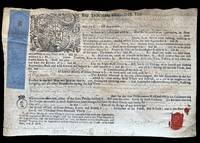
17363222Lichfield England 1736. Oblong document on vellum upper edge scallopped 143 x 214 mm. recto with letterpress form accomplished in manuscript in brown ink slightly faded but legible one passage erased large woodcut armorial initial and 2 pence duty mark strip of three blue sixpence stamps red wax seal paper stamp on verso. Slight soiling to corners and part of top edge.<br /> <br /> A bookseller joins the toy trade: Robert Shaw son of the Lichfield bookseller of the same name agrees to an apprenticeship of seven years during which he promises to serve his master keep his secrets to not waste or lend his Goods; and “Taverns Inns or Ale-houses he shall not haunt At Cards Dice Tables or any other unlawful Game he shall not playâ€. For this the toymaker Richard Robinson agrees to pay 5 pounds into the public charity pledges to feed and lodge his new Apprentice and added in manuscript promises his father Robert Shaw Sr. “to fund and provide for his said Son wearing apparell of all sorts as well Linens as Woolens during the said term.â€<br /> <br /> Lichfield Staffordshire was the childhood home of Samuel Johnson 1709-1784 whose father Michael Johnson was also a bookseller; as a boy Johnson sometmes bound books for his father to help earn money. Contemplation of the latter’s debt-ridden career may throw light on the motives of his colleague Shaw Sr. in sending his son out to learn another profession. <br /> <br /> A bookseller Robert Shaw is known from archival sources including a payment to him in 1737 by Lichfield Cathedral for lettering books in the library cf. Peter Hanks The Bookbinder and Historical Invisibility: Bookbinding and the Staffordshire book trade 1750-1850 thesis University of Wolverhampton 2024. Booksellers in this period were more involved in actual book production and their duties included supplying bookbindings. <br /> <br /> A colleague who previously owned this document remarked: “I have not been able to determine how Robert Shaw the Younger fared in the toy trade or if he was able to follow the indenture’s commandment `Taverns Inns or Ale-houses he shall not haunt’ which he never could have done if he’d followed his father into bookselling.†unknown
175723082Roma : Nella Stamperia di Pallade, Presso Niccolò, e Marco Pagliarini, 1757. xx, 154, [1] p. ; 22 cm Halbleder, gebundene Ausgabe, ausgemustertes Bibliotheksexemplar mit Bibliotheks-Signatur, sonst Exemplar in gutem Erhaltungszustand
1773604855Riga, Hartknoch, 1773-77. 1 Bl., 573 S., 12 Bl.; 1 Bl., 656 S., 7 Bl. Halbleder d. Zeit (beschabt, Ecken stark bestoßen). [2 Warenabbildungen]
17692095552A Londres, et se trouve à Paris chez Merlin 1769. (4), 337, (1) Seiten. Mit einer floralen Titelvignette und etwas arabeskem Buchschmuck. 8° (18 x 10 cm) Lederband der Zeit mit goldgeprägtem Titel auf grünem Lederrückenschild, blaugefärbtem Schnitt und Kammarmor-Vorsätzen. [Hardcover / fest gebunden].
1727204Original 1727 disbound series of Acts of Parliament totalling 4-pages in Good condition;<br /><p><i>Anno decimo tertio Georgii Regis</i><i><br /></i></p><p><i>"An Abstract of the Act for enlarging the Times for hearing and determining Claims by the Truftees for raifing Money upon the Eftates of the late Directors of the South Sea Company and others : and for Relief of the Creditors of Robert Knight Efq; late Cafhire to the faid Company ; and for Relief of Perfons who have entered Claims for contingent Debts and Incumbrances ; and for giving time to Ralph Gulfton and other Creditors of Edward Gibbon ; and for impowering the Truftees to difmifs Claims for want of Profecution ; and for applying the Produce of the faid Eftates for the Benefit of the South Sea Company</i><i>." 1.5 pages</i><br /></p><p></p><p><i>"An Abstract of the Act for the better Regulation of the Woollen Manufacture and for preventing Difputes among the Perfons concerned therein ; and for limiting a Time for profecuting for the Forfeiture appointed by an Act of the Twelfth Year of His Majesty's Reign in case of Payment of the Workmens Wages in any other Manner than in Money."</i> 1.5 pages</p><p></p><p><i>"An Abstract of the Act for preventing Frauds and Abufes in the Dying Trade"</i> 1 page</p> Not stated paperback
1741AQ25221London: Sold by J. Roberts 1741. 40pp. Uncut. Stitched as issued. A trifle dusty. Scattered spotting. The sole edition of an anonymous pamphlet written in reply both to Samuel Webber's An account of a scheme for preventing the exportation of our wool London 1740 and William Webster's 1689-1758 The consequences of trade. London 1740 which called for reforms to woollen manufactory. ESTC T46871. First edition. 8vo. Sold by J. Roberts unknown
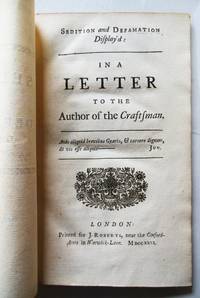
1731825London: Printed for J. Roberts near the Oxford Arms in Warwick-Lane 1731. First edition. Very good. <p data-pm-slice="1 1 ">Octavo. approx. 20 cm. 2 viii 48 pp. Complete with half-title. Disbound; woodcut title vignette initials and ornaments. Notation in 18th century hand on half-title referring to the Dedication "Suppos'd by Lord Harvey sic." Very good or better. <br /> <br /> First edition. The dedication preface contains a scathing attack on William Pulteney who then mistakenly attributed authorship to John Lord Hervey and responded with A Proper Reply culminating in a duel both combatants were uninjured. The true author was Sir William Yonge Sir Robert Walpole's lieutenant notoriously disliked by George II. The text includes a pointed reference to losses sustained by British merchants in the West Indies on the lower quarter of page 13.</p> . ESTC T47414. Printed for J. Roberts, near the Oxford Arms in Warwick-Lane unknown
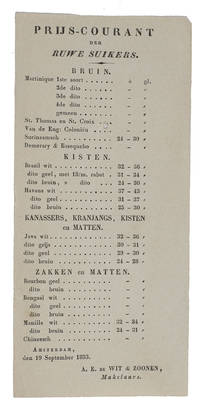
1721LC4D1MQ3QGJ6Amsterdam 1721. 1 leaf 21 x 8 cm; 1 leaf 20.5 x 8 cm; 1 leaf 17.5 x 8 cm. Jacobus van Egmond Ad 1: Text printed on both sides each in a border built up from typographic ornaments. Ad 2: Text printed on one side. Ad 3: Text printed on one side. 3 documents. Ad. 1: Rare VOC ships manifest for cargo shipped from the East Indies - Batavia and Ceylon Sri Lanka - on 22 East-Indiamen sailing on 1 December 1720 from Batavia and on 15 November from Ceylon. The list includes more than 100 different colonial wares and gives the weights in pounds or the lengths in feet: from pepper more than 6.5 million pounds cloves 694000 pounds cinnamon 604000 pounds and coffee more than 1.77 million pounds to 962 pounds of Javanese cardamom some jewels and rariora and many feet of silk and linen cloth. Small wormhole affecting two characters otherwise in good condition.Ad. 2: Rare list of the results of the auctions of colonial wares organized in 1781 by the Chambers of the VOC Amsterdam 30 April 1781; Zeeland 7 May; Delft 15 May; Rotterdam 17 May; Hoorn 22 May; Enkhuizen 23 May including pepper cinnamon nutmeg etc. with the prices fetched. With a small tear not affecting the text. Still in good condition.Ad. 3: Price list of the various varieties of raw sugar: brown sugar from Martinique Surinam etc.; sugar packed in chests from Brazil Havana; in bales from Bengal Manilla etc.Small hole not affecting the text.l Ad. 1: cf. Landwehr VOC 1123-1134 other manifests. hardcover
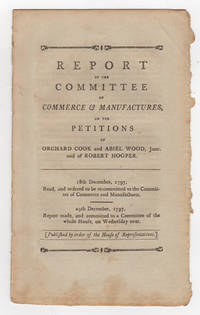
179743741Philadelphia: Printed by William Ross 1797. First edition. Removed. Very good mostly unopened uncut untrimmed copy minor browning at lower edge. 3 226-232 2 pp. 8vo. Evans dated it both 1797 and 1798. two petitions both concerning a waving of taxes on spirits the Orchard Cook and Abiel Wood case claiming the ship was wrecked on an island and the cost of recovering the cargo exceeded the cost of the mechandise and that their insurance had lapsed. In the second case Hooper claimed he was lax in filing papers for re-shipping a cargo overseas. Wisely both were declined as the committee felt the government is not in the business of insuring that a business is successful and well run. Ah to return to those days. Orchard Cook 1763-1819 and Abiel Wood 1772-1834 had a better idea. They both became U.S. Representatives from Massachusetts. OCLC locates eight copies. Evans 33015. Evans 34753. ESTCW15017. [Printed by William Ross] unknown
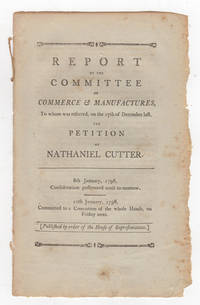
179843744Philadelphia 1798. First edition. Removed. A very good copy lightly soiled and edge worn. 4 pp. 8vo. Nathaniel Cutter wanted relief from being re-taxed on goods that left Massachusetts where he had paid tax and then returned to the same port with the same goods because he was harrassed by the British and French and turned away in the Dominican Republic. The committee wisely wrote: "Your Committee however cannot find any good reason for relieving him against consequences of a risque which every exporter ought to calculate for himself." Cutter would continue to take risks suppling the French in Saint-Domingue and a claim was allowed him in 1803 by the American Commission in Paris for unpaid costs by the French See Greg H. Williams: The French Assault on American Shipping 1793-1813: A History p. 154. Evans 34754. ESTCW25464. unknown
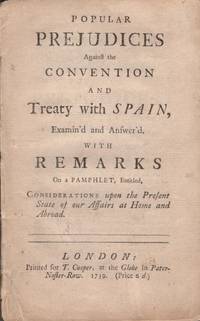
173934763London: Printed by T. Cooper 1739. First Edition. Wraps. Fair. Disbound trimmed wraps. Approx. 7.5" x 5". 30 pages 1. Front wrap mostly detached. Pages 29 30 and the rear wrap have a small chip upper edge resulting in loss of a couple of letters. <br /> <br /> This pamphlet was published shortly before "The War of Jenkins Ear" with Spain. Contents cover trade issues in the new American colonies; sale of "Negroes"; Native Americans; European countries etc. <br /> <br /> Sabin 64143. From wikipedia:<br /> <br /> The War of Jenkins' Eara was fought by Great Britain and Spain between 1739 and 1748. The majority of the fighting took place in New Granada and the Caribbean Sea with major operations largely ended by 1742. It is considered a related conflict of the 1740 to 1748 War of the Austrian Succession. The name derives from Robert Jenkins a British sea captain whose earb was allegedly severed in April 1731 by Spanish coast guards searching his ship for contraband. In 1738 opposition politicians in the British Parliament used the incident to incite support for a war against Spain.2<br /> <br /> The most significant operation of the war was a failed British attack on Cartagena in 1741 which resulted in heavy casualties and was not repeated.3 Apart from minor actions in Spanish Florida Georgia and Havana after 1742 Britain and Spain focused their efforts on the War of the Austrian Succession in Europe. Printed by T. Cooper unknown
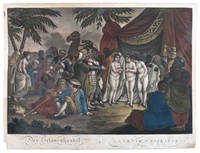
1800I7DD3T6LJ6QQNo place 1800. 27 x 40 cm. Aquatint in contemporary hand colour engraved by "J. L. T." after "J. R. P." Three partly exposed women before a large tent being advertised and inspected by several men dressed in fine oriental garb. On the left is another woman whose price is under discussion while the background shows date palms and two dromedaries.Rather severe water stains and a few small holes in the blank margin; some scuff marks in the image; trimmed closely with loss to lower left corner. A very appealing print. Rare. unknown
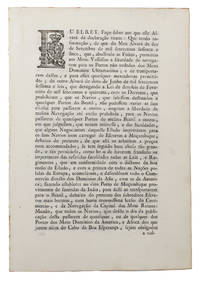
1772ABC_48853Lisbon 1772. Folio ca. 29 x 20 cm. Na Regia Officina Typografica Disbound and subsequently mounted in a modern black stiff paper folder with a printed label mounted on the front wrapper. With a large decorated woodcut initial E incorporating the Portuguese royal coat of arms. 3 1 blank pp. Very rare first issue of two of a late 18th-century decree by the Portuguese King José I 1714-1777 dealing with difficulties in the transportation of enslaved people from Mozambique to Brazil. This text dated 12 December 1772 and signed Rey King at the end is also signed by the notorious Portuguese nobleman and diplomat Marquez de Pombal. Sebastião José de Carvalho e Melo 1st Marquis of Pombal 1699-1782 who was the Secretary of State of the Kingdom during the reign of Dom José I in the period of 1750-1777. It is concluded with a formal text dated 18 December 1772 and signed by João Baptista de Araújo a senior officer of the Secretariat of State.In 1761 Marquez de Pombal prohibited the importation of enslaved people in Portugal and Portuguese India not for humanitarian reasons but because they were needed for labour in Brazil. He stimulated the trade of mostly African enslaved people for that colony and with his support two companies for slave trade were founded the Companhia Geral de Comércio do Grão-Pará e Maranhão and the Companhia Geral de Comércio de Pernambuco e Paraíba. Both companies were privileged and had a monopolistic character. Their lists of shareholders included many Portuguese noblemen and clergy. Between 1757 and 1777 more than 25000 enslaved people were imported to Pará and Maranhão from West African ports.The two issues can be identified by their catchwords on p. 1: issue one shows the catchword as a vol- that catchword was changed in the second issue to a.The inner margin shows some signs of the previous binding. Otherwise in very good condition.l Gauz Portuguese and Brazilian books in the JCB 772/1; WorldCat 1045359449 3 copies; cf. Porbase 2301650 and no copies. unknown