[COMMERCE].Biblio.com
299 résultats
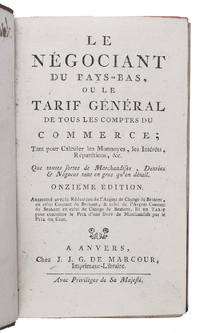
178095L94ST53226Antwerp 1780. 12mo. Johannes Judocus Gerardus de Marcour Contemporary mottled tanned sheepskin gold-tooled spine with olive title-label red edges. XXIII 1 543 1 pp. Corrected and augmented eleventh edition of a handbook for merchants and traders in the Southern Netherlands here in a French edition but also available in Dutch Den Nederlandschen negociant . All editions appear to be very rare. It consists of numerous tables giving information for the conversion of monetary units weights and measures.The privilege p. XXIV is issued in the name of Maria Theresa who died in 1780 and De Marcour was active from 1764 to 1797. The many unnumbered editions no doubt confused publishers who probably numbered their editions to follow the highest number they had seen: the University of Kansas has a ninth edition Liege 1784 the Hendrik Conscience library a ninth Antwerp De Marcour 1792; ; and there is a tenth Antwerp Grangé 1798.With some early 19th-century annotations on endpapers. Spine slightly rubbed one leaf party detached but otherwise in very good condition.l Groote Vijftig jaar boekdrukkunst te Antwerpen p. 31; Anet 3 copies; STCV 1 of the same copies; WorldCat 2 of the same copies. unknown
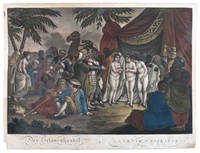
1800I7DD3T6LJ6QQNo place 1800. 27 x 40 cm. Aquatint in contemporary hand colour engraved by "J. L. T." after "J. R. P." Three partly exposed women before a large tent being advertised and inspected by several men dressed in fine oriental garb. On the left is another woman whose price is under discussion while the background shows date palms and two dromedaries.Rather severe water stains and a few small holes in the blank margin; some scuff marks in the image; trimmed closely with loss to lower left corner. A very appealing print. Rare. unknown
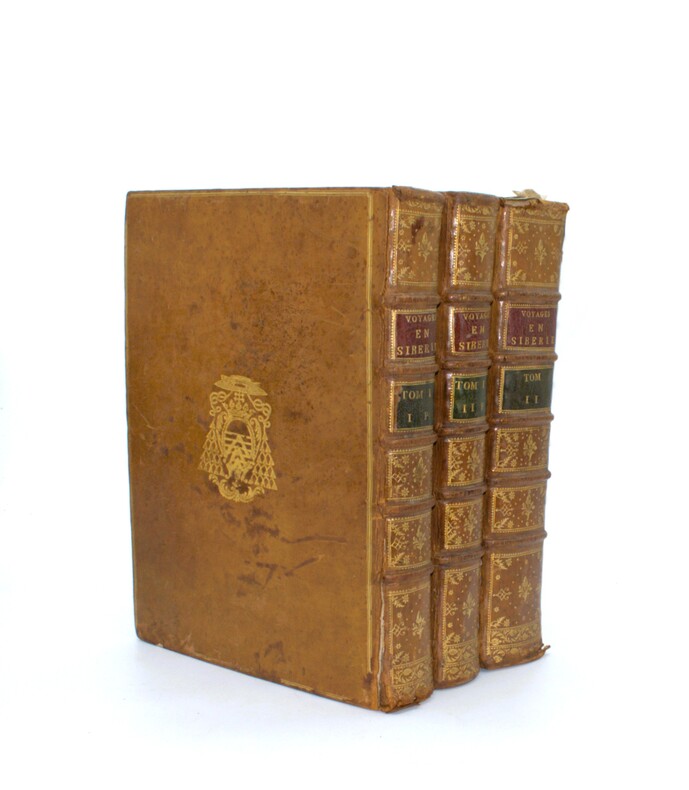
1768PHO-2449Paris, Chez DEBURE père, 1768, 3 volumes in-folio (sur 4) (35x26cm), 3ff.-XXX-347pp., 1f.-348pp.-767pp., X-627pp.-2ff., plein veau glacé lavallière, dos à nerfs, caissons ornés de fleurons dorés, pièces de titre et de tomaison en maroquin rouge et vert, plats frappés aux armes de Dominique de la Rochefoucauld dans un triple encadrement doré, toutes tranches dorées, double filet doré sur les coupes, frise intérieure, doublures et gardes de papier marbré (reliure de l'époque). Épidermures, coiffes abimées, coins usés certains avec manque, charnières fendillées, quelques cahiers brunis, très petite mouillure marginale au tome 2 sur quelques feuillets.
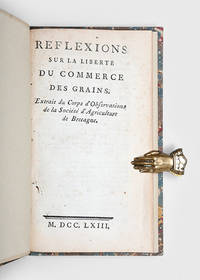
17631730471763. Grain policy in the ancien régime First edition of this exceptionally scarce economic tract on the grain trade. We trace only two institutional copies worldwide: at the University of Chicago and the BnF. The recent spine label attributes this work to Louis Paul Abeille 1719-1807 an early convert to physiocracy and a friend of Quesnay and Mirabeau. Abeille served as secretary of commerce under Louis XV & XVI from 1769-83. A series of subsistence crises brought concerns over public access to grain to the forefront of French economic debate in the mid-18th century. In the absence of public granaries government policy was to regulate more strictly the distribution of grain by private commercial interests but periodic subsistence crises revealed the inadequacy of this policy. Over the next decade the physiocrats continued to promote deregulation of the grain trade which contributed to spiralling prices and the Flour War of 1775. The attribution to Abeille is presumably based on his publication in 1760 of the Corps d'observations de la Société d'agriculture de commerce et des arts établie par les États de Bretagne années 1757 & 1758 which brought him to the attention of Quesnay and Mirabeau in Paris. Abeille was the secretary of the Agricultural Society of Brittany a learned society for agricultural improvement. Duodecimo 159 x 92 mm. Recent marbled paper boards gilt label to spine edges sprinkled red. Minor foxing and browning: a very good copy. Not in Black Goldsmiths' or Kress. hardcover
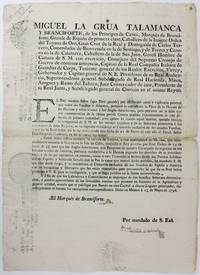
17965074Mexico City: May 13 1796. About very good. Broadside 17 x 12.25 inches. Old fold lines. Slight separation and loss at center fold slightly affecting a few letters. Minor wear else. Proclamation made by the Viceroy of New Spain authorizing trade between Cuba and the United States. The Caribbean was in tumult in the 1790s with Toussaint L'Ouverture overthrowing the French colonial government and outlawing slavery. Likewise in Cuba there was a similar revolt against slavery demanding abolition and equality -- both revolutions were of substantial concern to slaveholders in the American South. Specifically the present decree mentions flour and other vital foodstuffs as a measure against shortages in Cuba intended to prevent further trouble. "Para precaver la escasez de viveres y con especialidad de harinas que verosimilmente causaria la guerra concedio El Rey Permiso por Real Orden de 25 Junio de 93. para que los Anglo-Americanos.pudiesen conducirlos a la Havana pagando los derechos los puertos habilitados de España." The Viceroy at the time was Don Miguel de la Grua Talamanca de Carini y Branciforte First Marques de Branciforte. The Marques was notoriously corrupt even for colonial Spain having gained position through marriage to the Prime Minister's sister. He made sure to make some profit on everything that passed through his hands including taking advantage of the War in Cuba to remove the French from their lands and sell them to his benefit. A rare and interesting decree. We locate a single copy in OCLC at the University of Minnesota. May 13 unknown
1775AMO-3759A Genève, chez les libraires associés, 1775 3 volume in-4 (26 x 20 cm) de (4)-IV-III-VIII-719, (4)-VIII-662 et (4)-VIII-658 pages. Portrait de l'auteur en frontispice du premier volume (dessiné par Cochin et gravé par L. Le Grand). Au tome I : 1 gravure hors-texte (livre I) + 1 grande carte repliée + 1 bandeau à l'eau-forte par Marillier + 1 gravure hors-texte (livre IV). Au tome II : 1 gravure hors-texte (livre VII) + 2 cartes repliées + 1 bandeau à l'eau-forte par Marillier + 1 gravure hors-texte (livre X). Au tome III : 1 gravure hors-texte (livre XIV) + 1 carte repliée + 1 bandeau à l'eau-forte par Marillier + 1 gravure hors-texte (livre XV) + 1 gravure hors-texte (livre XVIII). Soit 1 portrait, 7 gravures hors-texte (avant la lettre), 3 bandeaux et 4 cartes. Collationné complet. Reliure de l'époque plein veau caramel, dos à nerfs orné aux petits fers, pièce de titre de maroquin rouge, pièce de tomaison de maroquin olive. Reliures très décoratives et solides. Usures de surface sur les plats du premier et deuxième volume (épidermures stoppées), petits manques de cuir et petite galerie sans gravité, petites piqûres de vers en queue du dos du premier volume. Malgré ces quelques défauts l'ensemble reste très décoratif et parfaitement solide. Intérieur très frais. A noter une mouillure en marge intérieure des trois premiers feuillets du premier volume et les derniers feuillets du même volume avec mouillure marginale saine (à quelques feuillets seulement). Exemplaire relié à l'époque aux armes (en queue) d'un membre de la famille de Damas (?) ou d'Aubusson (?). Première édition au format in-quarto. Cette édition est bien complète en 3 volumes in-quarto (il n'y a pas d'atlas pour cette édition). Elle reprend le corpus de l'édition en 7 volumes in-8, avec les passages supprimés réintégrés ici au bas des pages sous forme de variantes. La première édition de ce magistral ouvrage a paru pour la première fois en 1770. "Véritable encyclopédie de l’anticolonialisme au XVIIIe siècle" ce texte entre dans la catégorie des "Voyages philosophiques" et représente un prétexte à des réflexions sur la "loi naturelle" et dénonce tout à la fois despotisme, cléricalisme, esclavage et colonialisme. L'ouvrage est toujours décrit par les commentateurs comme une « machine de guerre » contre le pouvoir en place. Pour la rédaction de cette encyclopédie Raynal eut recours à la collaboration de nombreux informateurs et collaborateurs écrivains tels que le Baron d'Holbach ou Diderot, à qui on attribue une part importante des textes. Interdite en 1772, l’Histoire des deux Indes sera à nouveau publiée par l’abbé Raynal dans une nouvelle édition en 1774 qui est immédiatement mise à l’Index par le clergé. C’est en 1780 qu’il publie sa troisième édition de l'Histoire des deux Indes, encore plus virulente que les deux précédentes et qu’il avoue implicitement comme étant de lui en y faisant graver son portrait en frontispice. Condamné par le Parlement de Paris, l’ouvrage est brûlé par le bourreau en place publique, ce qui lui assure un succès considérable. L’Histoire des deux Indes a également été l’occasion de la Lettre apologétique de l’abbé Raynal à Monsieur Grimm (1781) de Diderot (qui aurait écrit au moins un tiers de l'ouvrage, selon Grimm). Dans cette lettre Diderot écrit : « Raynal est un historien comme il n'y en a point encore eu, et tant mieux pour lui, et tant pis pour l'histoire. Si l'histoire avait, dès les premiers temps, saisi et traîné par les cheveux les tyrans civils et les tyrans religieux, je ne crois pas qu'il en fussent devenus meilleurs; mais ils en auraient été plus détestés, et leurs malheureux sujets en seraient peut-être devenus moins patients... Le livre que j'aime et que les rois et leurs courtisans détestent, c'est le livre qui fait naître des Brutus... » Dans notre exemplaire une note manuscrite de l'époque révolutionnaire indique : "Le Parlement de Paris proscrivit, le 25 mai 1781, l'Histoire philosophique de l'abbé Raynal, et ordonna que cet ouvrage fût brûlé. Il décréta même l'auteur de prise de corps. L'abbé Raynal se vit donc forcé de s'enfuir précipitamment de France. Le 15 août 1790, l'Assemblée nationale, sur la rédaction proposée par les députés Voidel et Maloüet, annula, comme contraire aux droits naturels et imprescriptibles de l'homme, le décret lancé par le Parlement de Paris contre l'abbé Raynal et son Histoire philosophique (v. Oeuvres d'André Chénier, 2e vol., p. 119)." (note manuscrite ancienne sur le faux-titre du premier volume). "It became a key text of the American Revolution, and Raynal became a correspondent of Franklin, Jefferson, and Adams." "Un des ouvrages clefs de la crise de l'Ancien Régime" (Michel Delon, in En Français dans le texte) "Celui qui abdique lâchement sa liberté, se voue au remords et à la plus grande misère qu’un être pensant et sensible puisse éprouver. S’il n’y a, sous le ciel, aucune puissance qui puisse changer mon organisation et m’abrutir, il n’y en a aucune qui puisse disposer de ma liberté. [...] L'esclavage est l'état d'un homme qui, par la force ou des conventions, a perdu la propriété de sa personne, et dont un maître peut disposer comme de la chose. [...] La liberté est la propriété de soi; on distingue trois sortes de libertés: la liberté naturelle, la liberté civile, la liberté politique; c'est-à-dire la liberté de l'homme, celle du citoyen et celle d'un peuple. [...] L'homme est aux prises avec la nature; sans cesse il la modifie, et sans cesse il est modifié. [...]." (extraits). Provenance : A. Leclerc, 1885 (étiquette). Armes dorées en queue des dos (mariage - non identifiées - non reconnu par O.H.R. qui les cite pourtant sous la planche n°888, figure n°3). Armoiries peut-être d'une ancienne famille de Bourgogne ? (provenance bourguignonne pour les volumes concernés). Par ailleurs O.H.R. les mentionne sur une Histoire de Bourgogne), peut-être les armes d'une branche de la famille de Damas (à la croix ancrée) ou d'Aubusson. Les présents volumes de Raynal ont été acquis également en Bourgogne ce qui laisserait supposer l'hypothèse "de Damas" plus pertinente. Références : A. Feugère, Bibliographie critique de l'abbé Raynal, 40 ; En français dans le texte, 166 ; Bel exemplaire relié aux armes à l'époque de cet ouvrage très important du Siècle des Lumières, dans son format le plus majestueux.
17745521Marseille 1774. No Binding. Very Good. Folio - over 12 - 15" tall. Two folio bifolia 43.1 x 27.7 cm each with letterpress text woodcuts and manuscript text on the first leaf. Retaining deckle edge on all sides folded and annotated as typical of such documents one of the documents a bit weak at the folds otherwise very well preserved. Two rare folio-size maritime insurance policies from 1770s Marseille relating to mercantile voyages to France's American colonies in the Caribbean and valuable witnesses to the more practical bureaucratic aspects of maritime trade in late 18th-century France. Each document is illustrated with the three large woodcut seals of the city and carries in letterpress the standard legal formulas particular to Marseille as well as extensive manuscript notes and signatures completing the policy. The earlier of the two policies signed in May of 1774 relates to the vessel La Gentille likely the frigate later recorded as having taken part in the 1780 Battle of Martinique a stalemate between the French and British navies during the American War of Independence. The second policy signed on 3 November 1777 concerns the Bon Pasteur a ship under the command of captain Pierre Antoine Massier. Historical records show that this policy was nearly redeemed: Returning from Martinique in late December the Bon Pasteur was fired upon by the British frigate Westmoreland off the coast of Cabo de Gata in Spain boarded by six men each armed with a brace of pistols and a saber and Captain Massier roughly handled. The English suspected that the Bon Pasteur was not carrying goods from Martinique but from New England tobacco rice which would have been in violation of the protectionist economic policies common in both the French and British colonies in the Americas. After several sailors aboard the Bon Pasteur were thoroughly questioned the ship was sent on its way and its insurers in Marseille breathed a sigh of relief. OCLC does not locate any institutional copies of Marseille policies of this sort. B.-M. Emerigon and P. S. Boulay-Paty Traité des assurances et de contrats à la grosse vol. 1 pp. 54-5; Bulletin de la Socété archéologique historique et artistique vol. 3 pp. 277-8; Observations sur le Mémoire justificatif de la cour de Londres 1780 pp. 12-3. books
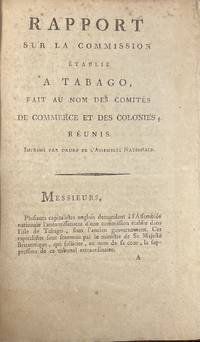
17913649Paris: Imprimerie Nationale 1791. First edition. Bound in later hardpaper boards covered with pastepaper spine with red gilt leather title vignette. Untrimmed. Paper tanned. Otherwise in very good condition. First edition. Bound in later hardpaper boards covered with pastepaper spine with red gilt leather title vignette. 18 2 blank p. <p><br /> Official report on the 1786 “Commission de Tabago†an extraordinary tribunal established to examine debts between British creditors and settlers after the French conquest of the island.<br /> <p><p><br /> First edition of the National Assembly’s official report on the controversial “Commission de Tabago†an extraordinary tribunal established in 1786 under the ancien régime to review debts between British capitalists and settlers after the French conquest of Tobago.<br /> <p><p><br /> The report reconstructs the background of the island’s transfer: originally ceded to Britain in 1763 Tobago had been largely settled and financed by British investors who lent capital for the development of sugar estates secured by mortgages. Following the French conquest 1781 and definitive cession Treaty of Paris 1783 the treaty guaranteed the inhabitants’ property rights under English law. Nevertheless in 1786 the Conseil du Roi created a special commission at Tobago to investigate alleged usury and excessive interest rates in these mortgage contracts. The commission—presided by the governor and ordonnateur—confiscated titles annulled or reduced debts and declared most English claims void provoking losses estimated at over 13 million livres.<br /> <p><p><br /> This Rapport examines the legality of the tribunal under both French and English law concluding that it was arbitrary unconstitutional and in violation of the 1783 peace treaty. The committees show that English statutes were misquoted that the island’s existing courts Common Pleas and Chancery already had proper jurisdiction and that no disputes existed before the commission was imposed. The report also denounces the suppression of trial by jury and the disregard of due process. It recommends—and the Assembly accepted—that the entire commission and its judgments be annulled thereby restoring lawful jurisdiction in the colony. The episode marked one of the last acts of French administration on Tobago which was recaptured by Britain in April 1793 returned to France in 1802 under the Treaty of Amiens and formally surrendered under the Treaty of Paris in 1814.<br /> <p><p><br /> An important Revolutionary document reflecting early attempts to reconcile French constitutional principles with colonial administration and international treaty obligations.<br /> <p><p><br /> Not in Sabin. No records on RBH. WorldCat locates 6 copies.<br /> <p>. [Imprimerie Nationale] unknown
17600041101760 Sans lieu d'édition [Paris], ni nom d'éditeur [Chaubert et Hérissant], 1760. In-quarto (206 X 265 mm) demi-basane fauve à coins, dos cinq nerfs, pièce de titre chagrin grenat, tranches rouges (reliure de l'époque) ; (1) f. blanc, VIII (dont titre)-336 pages, (1) f. blanc. Pièce de titre renouvelée. Ex-libris ancien collé sur le premier contreplat.
17599039A Copenhague, chez les Frères Cl. & Ant. Philibert, 1759-1765. 5 tomes en 3 vol. in-folio, veau, dos orné à nerfs, pièces de titre en maroquin rouge et de tomaison en maroquin vert, tranches rouges (reliure de l'époque).
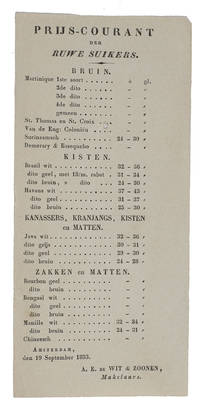
1721LC4D1MQ3QGJ6Amsterdam 1721. 1 leaf 21 x 8 cm; 1 leaf 20.5 x 8 cm; 1 leaf 17.5 x 8 cm. Jacobus van Egmond Ad 1: Text printed on both sides each in a border built up from typographic ornaments. Ad 2: Text printed on one side. Ad 3: Text printed on one side. 3 documents. Ad. 1: Rare VOC ships manifest for cargo shipped from the East Indies - Batavia and Ceylon Sri Lanka - on 22 East-Indiamen sailing on 1 December 1720 from Batavia and on 15 November from Ceylon. The list includes more than 100 different colonial wares and gives the weights in pounds or the lengths in feet: from pepper more than 6.5 million pounds cloves 694000 pounds cinnamon 604000 pounds and coffee more than 1.77 million pounds to 962 pounds of Javanese cardamom some jewels and rariora and many feet of silk and linen cloth. Small wormhole affecting two characters otherwise in good condition.Ad. 2: Rare list of the results of the auctions of colonial wares organized in 1781 by the Chambers of the VOC Amsterdam 30 April 1781; Zeeland 7 May; Delft 15 May; Rotterdam 17 May; Hoorn 22 May; Enkhuizen 23 May including pepper cinnamon nutmeg etc. with the prices fetched. With a small tear not affecting the text. Still in good condition.Ad. 3: Price list of the various varieties of raw sugar: brown sugar from Martinique Surinam etc.; sugar packed in chests from Brazil Havana; in bales from Bengal Manilla etc.Small hole not affecting the text.l Ad. 1: cf. Landwehr VOC 1123-1134 other manifests. hardcover
1798PHO-1092Deuxième reliure de la première édition. Édition originale in-4 sur grand papier, remise en circulation en 1841 avec un nouveau titre avec la mention fictive "nouvelle édition" (quelques exemplaires imprimés en 1798 n'avaient toujours pas trouvé preneur). Une édition octavo en six volumes a également été publiée. in-4 ,y compris l'atlas. Avec 16 (10 dépliantes) dont 15 cartes gravées, 1 planche gravée et table dépliante. - Beau demi-cuir contemp , dos lisse avec titre et tomaison , petits manques au dos , quelques mouillures intermittentes et vieille trace d’humidité (T1), déchirure carte hydrographique sans manque. xii, cxliv, 628, [3] ; xvi, 676, [2] ;[xi], 431, [1];[2],viii, 158pp.
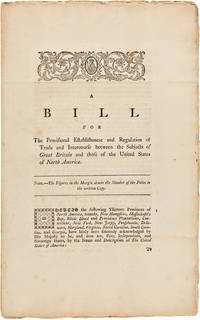
1788WRCAM47396London 1788. Paginations given below. Folio. Four of the titles string-tied as issued. First title lightly foxed and toned. Very good. In a half morocco and marbled boards box spine gilt. An interesting assemblage of British legislation from the period immediately following the Revolutionary War documenting British efforts to allow only very limited trade with the newly independent United States. British trade policy during this period is an excellent example of a foreign power taking advantage of the weak structure of the American Articles of Confederation which made it difficult for the thirteen states to act in concert and out of a any position of strength through unity. <br> <br> By 1783 the United States had formal trade relations with only two nations: France secured through the 1778 Treaty of Amity and Commerce; and the Netherlands via a Commercial Treaty negotiated by John Adams in 1782. Before the Revolution British merchants had relied heavily on exports sent to the British colonies in North America which greatly outweighed goods imported to Britain from the colonies. After the war the British government was reluctant to sign a formal commercial treaty with the United States. The states at the time were operating under the relatively weak structure of the Articles of Confederation and the British felt that they could secure the benefits of trade with the American states without making any treaty concessions. <br> <br> Britain opted instead for a series of acts that established limited trade with the United States and between the United States and Canada and the British colonies in the West Indies. The first of these laws was passed in 1783 and the evolution of that law is reflected in the first three items below. In all these British laws severely circumscribed American trade with England and with English colonies though they did allow some markets for American exports and did facilitate the flow of much needed imports into the United States. In 1784 British exports to the United States were valued at more than £3.5 million while American exports to England were less than one-fifth of that sum. The United States and Great Britain would not sign a formal trade treaty until the Jay Treaty which was approved in 1795 and which gave the United States limited trading rights in the British West Indies. <br> <br> The first second third and fifth titles below were printed in very small numbers for the use of members of Parliament during debate and action on the bills. Known as "slip bills" they are a snapshot of the legislation as it proceeded through the legislative process. The first and fifth titles contain blank spaces in the text where dates and tariff rates would be filled in later and all four of the slip bills have printed docketing on the final page. The first and fifth items also contain a printed note before the text of the bill reading "the figures in the margin denote the Number of the Folios in the written copy" which indicates just how early in the legislative process these bills were printed. <br> <br> The four bills and one act included in this group are: <br> <br> 1 A BILL FOR THE PROVISIONAL ESTABLISHMENT AND REGULATION OF TRADE AND INTERCOURSE BETWEEN THE SUBJECTS OF GREAT BRITAIN AND THOSE OF THE UNITED STATES OF NORTH AMERICA caption title. London. 1783. 31pp. This bill gives the United States the same trading status as other independent sovereign states but restricts American exports to Great Britain only to those goods that are "the growth produce or manufacture of the said United States." It thus forbad the "triangular" trade in which American merchants liked to engage while not imposing the same restriction on British exporters. ESTC locates only five copies. ESTC N32490. BELL G578 ref. <br> <br> 2 A BILL AS AMENDED IN THE COMMITTEE FOR THE PROVISIONAL ESTABLISHMENT AND REGULATION OF TRADE AND INTERCOURSE BETWEEN THE SUBJECTS OF GREAT BRITAIN AND THOSE OF THE UNITED STATES OF NORTH AMERICA caption title. London. 1783. 51pp. This bill expands on and further defines the previous bill clearly spelling out the limitations on American trade with England while imposing no such restrictions on English merchants and in fact making every provision to facilitate British exports to America. ESTC locates six copies. ESTC N32061. <br> <br> 3 A BILL AS AMENDED IN THE COMMITTEE TO WHOM THE SAME WAS RE-COMMITTED FOR THE PROVISIONAL ESTABLISHMENT AND REGULATION OF TRADE AND INTERCOURSE BETWEEN THE SUBJECTS OF GREAT BRITAIN AND THOSE OF THE UNITED STATES OF NORTH AMERICA caption title. London. 1783. 51pp. As with the previous two versions of this bill the language here explains that it would be "highly expedient" to have a trade treaty with the United States but until that point England would make due with legislation regulating Anglo- American commerce. The same restrictive language regarding exports from America is carried over. ESTC locates only five copies. ESTC N32016. <br> <br> 4 AN ACT TO EXTEND THE POWERS OF AN ACT.FOR GIVING HIS MAJESTY CERTAIN POWERS FOR THE BETTER CARRYING ON TRADE AND COMMERCE BETWEEN THE SUBJECTS OF HIS MAJESTY'S DOMINIONS AND THE INHABITANTS OF THE UNITED STATES OF AMERICA TO THE TRADE AND COMMERCE OF THIS KINGDOM WITH THE BRITISH COLONIES AND PLANTATIONS IN AMERICA.caption title. London: Printed by Charles Eyre and William Strahan 1784. 2715-716pp. This law specifically relates to British exports of iron hemp and sail cloth from the Baltic states to the United States. ESTC locates only three copies. ESTC N58431. BELL G585. <br> <br> 5 A BILL FOR REGULATING THE TRADE BETWEEN THE SUBJECTS OF HIS MAJESTY'S COLONIES AND PLANTATIONS IN NORTH AMERICA AND IN THE WEST INDIA ISLANDS AND THE COUNTRIES BELONGING TO THE UNITED STATES OF AMERICA; AND BETWEEN HIS MAJESTY'S SAID SUBJECTS AND THE FOREIGN ISLANDS IN THE WEST INDIES caption title. London. 1788. 91pp. This bill essentially prohibits American trade with Britain's colonies in the West Indies and prohibits American exports to Canada as well. The sole exemption is with regard to salt from the Turks Islands a product the English wanted to encourage. The bill allows American ships to receive salt on the islands. It also limits exports from the West Indies to America on such goods as sugar molasses coffee etc. to British ships only. ESTC locates only four copies. ESTC T201245. RAGATZ p.95. BELL G618 ref. <br> <br> An important group of rare working drafts of British legislation. hardcover books
17687223Amsterdam & Paris, Desaint, 1768. Cinq ouvrages en un volume in-8 (195 x 124 mm), IV pp., 162 pp., 3 tables dépl.; 48 pp.(interversion du texte avec le quatrième ouvrage à partir du cahier C); 8 pp.; 8 pp.; un tableau dépl., 147 pp. et 1 p. n. ch.; 2 ff. n. ch., 314 pp., 1 f. n. ch. Veau porphyre, triple filet doré en encadrement sur les plats, dos à nerfs orné de caissons avec pièce d'armes au cerf doré répété, pièces de titre vert foncé et rouge, coupes filetées, tranches marbrées, habiles restaurations (reliure de l’époque).
17640041111764 Avignon, sans nom d’éditeur, 1764. Deux volumes in-quarto (211 X 260 mm) basane fauve marbrée, dos cinq nerfs ornés, caissons ornés aux petits fers, pièces de titre et tomaison maroquin rouge et vert, tranches rouges (reliure de l'époque). Tome I: titre illustré, (4) ff. de titre, avertissement et table des chapitres, 615 pages, (1) page d'errata, 7 cartes et 7 planches hors-texte; Tome II: titre illustré, (4) ff. de titre, avertissement et table des chapitres, 618 pages, (1) page d'errata, 3 cartes et 5 planches hors-texte. Quelques pointes de rousseurs et piqures.
178976951789 (vers 1789-1793). 7 volumes in-8, cartonnage orange de l'époque. Infimes rousseurs.
172341374A Paris, chez Jacques Estienne, 1723. 2 vol. in-folio de (8)-XXVIII pp. 2002 col. (2) pp. pour le tome I; (4)-1956 col. pour le tome II, maroquin rouge, dos orné à nerfs, triple filet doré sur les plats, armes frappées au centre, tranches dorées sur marbrure (reliure de l'époque).
1796WRCAM54712Mostly at sea from New York with stops in Calcutta Saint Helena Ascension Island and Cornwall England 1796. 246pp. Square folio. Original crude burlap covers stab-sewn with thick string. A bit toned and foxed occasional ink or tobacco burns. Very good. A remarkable artifact of early American naval commerce containing the sailing directions and shipboard activities of the "Ship Washington of Philadelphia" which sailed from New York to Calcutta rounding the southern tip of Africa and visiting Saint Helena and Ascension Island before crashing on the rocks at Cornwall England on the way to Hamburg Germany. The log contains a navigational ledger with locations headings wind and weather remarks along with occasional sick lists names of men "unfit for duty" those put on light duty temperatures and other information. The remarks are quite detailed and specific regarding shipboard work and activity. <br> <br> The captain of this final voyage of the ship WASHINGTON was Samuel Hubbart but the identity of the sailor who kept this log is unknown. The ship departed New York on July 4 1795 and reached Calcutta on August 31. Without the need for recording navigational data while in port the log's author switches from the ledger-style format and writes longer more-detailed daily entries describing the crew's activities. The crewmen mentioned include pilots boatswains carpenters coopers caulkers sailmakers and others. Most of the entries pertain to the maintenance of the ship while anchored in the bay. Numerous mentions are made of crew on board fixing various equipment including types and amounts of supplies. A few entries note the employment of Indian "Cooleys" on board the ship making various repairs. An interesting incident of September 17 bears relating: <br> <br> "Hearing a noise upon the main Deck Mr. Naylor went to see what was the matter - upon engaging found Abraham Moor had struck Thomas Williams the Cook as Moor said for wanting to trouble a girl which Moor had on board - Mr. Naylor told him he should not ill use that man for he had every reason to believe it to be false what he alledged against the Cook. Moor said he did not come here to be jawd by a black Man.S." <br> <br> After swearing he would "never go home" on the WASHINGTON Moor literally jumped ship just after this confrontation and hid on another ship before being found and brought back to the WASHINGTON "in irons." <br> <br> In early November a few entries mention the ship receiving a supply of sugar taking on "Three Burr Load of Sugar" on November 7 and two more "Burr Load" two days later. Subsequent entries detail the loading of several "Burr Load of Bales" and "one hundred bags of ginger." <br> <br> Over the course of the ship's time at Calcutta the author mentions encounters with at least four other American ships: the GANGES the HAMILTON the MAJOR PINKNEY of Charleston and the "American Ship Camilla of New York arriv'd here from London." <br> <br> By early February the WASHINGTON left Calcutta for the voyage to Hamburg spelled variously here as "Hamborough" and "Hamburgh" though the ship would never make it to Germany. On March 15 and again on April 6 the recordist notes an inventory of the ship's water supply. By March 23 the ship reaches a point "prependicular on Cape Lagulas Bank" the southernmost point of Africa. About a week later the punishment of a drunken sailor is reported: <br> <br> "Joseph Gonrabbysp who has for some time past been addicted to Drunkeness and no person on board having given him any liquor he was discovered this morning to have taken from the Ships stores about half a Gallon of rum and from his being frequently very drunk there is no doubt of his having been Guilty of the same offence before for which Capt. Hubbart is necessitated to order his Boatswain to flog him. Accordingly mustered all hands aft and give him one and a half dozen lashes." <br> <br> On April 16 the WASHINGTON arrived at the remote island of Saint Helena in the South Atlantic Ocean sending "the Boat on shore with an Officer to the Governor for permission to Anchor." Here the WASHINGTON restocked supplies including water potatoes & other vegetables rice and bread before embarking for Ascension Island which they reached on April 25. The author remarks on the "number of remarkable rocks like pyramids" and "a low point of black Rocks with a fine white sandy beach back of it" witnessed at Ascension Island. The WASHINGTON spent one night at Ascension where a group of men went ashore in order to "spend the Night in Catching Turtle in the different Bays." The crewmen caught twelve turtles and brought them aboard ship before continuing their journey. <br> <br> While heading north to Europe the WASHINGTON was boarded on May 17 by the "Quebec British Frigate Cap J Cook in Company with the Carnatic 74 Rear Admr Powel with a convoy of 21 sail of Transports & Gun boats with 10000 Troops on board bound for Martinico Martinique." On June 7 they again encounter another ship "a Spaniard from some port in South America bound for Cadiz out 3 months & 10 days - we cannot understand rightly what port she was from." <br> <br> Then on June 18 disaster struck the WASHINGTON as it ran aground at the Lizard Rocks off Cornwall England. The log book records the ship's demise: <br> <br> "The weather still very thick and hazy. At 9PM hearing the Surf break on shore took in all the studding sails Braced the Yards sharp and hauled to the Southward finding ourselves in amongst the Rocks off the Lizard have all aback and endeavored to get her out from among them but the Flood tide making very strong drove the Ship so hard upon the Rocks that with every endeavour we found it impracticable to get her off she having settled on them & the strength of the tide Thumping her very hard upon the Rocks sounded the Pump and found she made water very fast. Fired several Guns as a signal of Distress which brought several boats off from the Shore to our assistance." <br> <br> For the next couple of weeks the crew of the WASHINGTON participated in "discharging the cargo" from the ship so that it is not "plundered by the natives" sending everything to Falmouth "where the Goods are deposited under the protection of a Custom house Yaught." The log book mentions one crewman of the WASHINGTON "threatening revenge on Captain Hubbart." Another crewman is put "under a Guard of Soldiers" after selling off some of the muslin stored in the bales rescued from the wreck. Here the ship's log ends along with the career of the Ship WASHINGTON. <br> <br> A unique record of the last voyage of an early American trading vessel with insight into late 18th-century navigational methods and the commercial interests of Federal-era America. unknown books
1787162443London: Printed by Charles Eyre and Andrew Strahan 1787 i.e. 1788. Among the earliest Parliamentary responses to the British slave trade First edition of the first British law to regulate slave shipping preserved in its original volume of yearly parliamentary acts. The law bound 54th in this volume pioneered techniques of popular abolitionist appeal. The Slave Trade Act 1788 limited the number of enslaved persons that could be transported on British ships. It also required that all ships carried a doctor to monitor the conditions of the enslaved persons. The Act was supported through Parliament by Sir William Dolben 1727-1814 and Charles Stanhope 1753-1816. LoGerfo notes of their campaign that "the machinery used to appeal to the literate public would also be used in the future" p. 450. This volume collects 57 acts passed by the 16th Parliament of Great Britain which met from November 1787 to July 1788 and was led by Pitt the Younger. Like all Parliamentary statutes of this period the Slave Trade Act was separately printed with a general title page for inclusion in the yearly volumes of acts. Most of these statutes were printed with their own title pages included in the signatures and pagination - here all such pages have been removed. These laws were printed in limited numbers usually estimated at around 1100 copies only. The volume includes laws against chimney sweeps and child labour and measures to compensate dispossessed American loyalists in the years after the Revolution. Folio 304 x 191 mm pp. 1012 = 900 title pages of individual acts removed. Woodcut device to title page woodcut head- tailpieces and initials to contents. Contemporary quarter sheep spine lettered and with black morocco label in gilt marbled paper sides. Bumping and wear minor loss to spine ends joints cracked but holding firm slight browning and foxing to endpapers and contents slight marking to edges: a good copy. ESTC N58828; N58797 Slave Trade Act. James W. LoGerfo "Sir William Dolben and "The Cause of Humanity": The Passage of the Slave Trade Regulation Act of 1788" Eighteenth-Century Studies Vol. 6 No. 4 Jun. 1973. unknown
17944016Leeds 1794. Large 4to 308 x 240 mm. 12 leaves text comprising 3 printed titles each with a 6-page description of the items in the catalogue in German French and English and 45 engraved plates of which one folding containing 186 designs numbered 1-152 with an additional 34 numbered and lettered designs for "tea-ware" tea- and coffee-ware in the French and English descriptions. Paper watermarked with a fleur-de-lys and shield with capital letters L V G below Lubertus van Gerrevink. Some light scattered foxing and offsetting plate 20 with closed tear to top margin just entering plate area without loss folding plate 26 torn across and repaired. Modern retrospective calf gilt edges red-stained extremities very lightly rubbed. Provenance: contemporary notes in Portuguese on the blank verso of the last plate; Duncan Grant Warrand loosely inserted ex-libris; Martin Woolf Orskey bookseller 1925-2018 signature at end with purchase date 1972. A multi-lingual catalogue of pottery produced by Hartley Greens and Co. for the use of traveling salesmen. Founded circa 1756 at Hunslet south of Leeds the company gained a reputation for its elegant cream-colored earthenware in the classical style known as creamware a type of earthenware made from white Cornish clay combined with a translucent glaze to produce a characteristic pale cream color. Hartley Greens and Co. so dominated the market that their products came to be referred to as Leedsware or Leeds pottery. Although some of the pieces in this catalogue are for display or special use Leeds pottery was generally a more everyday pottery than that of Wedgewood their principal rival and hence its survival rate is low. The earlier pieces before around 1775 were furthermore unmarked making attribution uncertain thus rendering the firm's printed catalogues all the more important. The present catalogue was "one of the earliest pattern books published in England by pottery manufacturers for the use of their travellers with illustrations of all the articles produced by the firm" Solon. It shows the creamware as issued from the studios before jobbers and importers added colored glazes. Shown are terrines sauce boats salts jugs egg cups covered terrines and bowls cake plates cruet stands candlesticks urns tea services and a remarkable tulip vase among other useful objects of the table many with ornaments some in the characteristic openwork or perforated style. All 186 designs are numbered and identified in the accompanying plate lists. The variety is impressive. Copies of the Leeds catalogues were often cut up by jobbers who relied on the illustrations to transmit orders accurately rather than trusting to written descriptions of the forms. Their consequent rarity makes the publishing history of the catalogues difficult to unravel. The earliest catalogue appeared in 1783 with the text in English only and 41 plates. The Danish National Library has a copy with the text in English and French and the English title dated 1786. Another copy of the present 1794 edition is held by the V&A but it has only 41 plates. Meanwhile there are also copies of a 1794 edition at Yale and RISD with the English text only but with 71 plates. The plates were reissued in 1795 and 1814 or 1815 these undated issues are identified by the watermarked dates of the paper they are printed on. Most of the variously dated copies seem to be reissues of the same plates. Most of the variously dated copies seem to be reissues of the same plates. A comparison of this copy to the Winterthur copy from 1814 which is digitized shows that the same plates were used with the addition of an engraved oval label " Leeds Pottery" on each plate up to and including plate 38 a compotier from which emerges a large cross after which the designs diverge. The editions or issues after 1795 do not have the very useful text with gives the name function and size of each piece: "As the price lists and the general title had been printed independently from the plates and not in sufficient quality to accompany the sets of engravings these late copies are generally found without the title and the printed description of the objects. These price lists now very rare were printed in English French German and Spanish. As the prices were subject to constant revision prices are added with pen and ink" Solon. Our copy is unpriced. Altogether OCLC locates fewer than a dozen copies some incomplete of various issues or editions of the Leeds pottery catalogue. Cf. M.-L. Solon Ceramic Literature 1910 p. 196. unknown books
177097Birmingham or Sheffield 1770. Oblong folio. 390 x 220 mm. 15 1/4 x 8 3/4 inches. Vellum spine over decorative blue paper wrappers paper label with title in Italian on upper board and ink title in Italian on spine. Paper stock toned with age a few leaves with staining in the margin otherwise in good condition. Silversmith model book containing 80 full-page engravings of candles sticks and holders candelabra pitchers plates salt and pepper shakers serving utensils silverware and other household pieces. Each image is beautifully and careful engraved with rich detail and ornamentation. Each includes a printed product number as well as one in ink with a different item number and a price. Although there is no title-page or signatures of engravers this large sales catalogue appears to be English as some of the engravings have English words of explanation engraved in the text. The binding is definitely Italian and the paper label is in an Italian hand. The watermark is a "fleur de lis" pattern suggesting an international company manufacturing the silver. There were only a few English companies with the capacity to export at this time including silver works in Sheffield and Birmingham both of which by 1770's had established networks of dealers selling their wares across the continent. This catalogue with specific Italian connections is very unusual and suggests the scope of the business had reached export capacity by the third quarter of the century. The most important Italian silver makers at this time were Giardini of Rome and Venuti of Naples. unknown books
177097Birmingham or Sheffield 1770. <p>Oblong folio. 390 x 220 mm. 15 1/4 x 8 3/4 inches. Vellum spine over decorative blue paper wrappers paper label with title in Italian on upper board and ink title in Italian on spine. Paper stock toned with age a few leaves with staining in the margin otherwise in good condition.</p> <br /> <p>Silversmith model book containing 80 full-page engravings of candles sticks and holders candelabra pitchers plates salt and pepper shakers serving utensils silverware and other household pieces. Each image is beautifully and careful engraved with rich detail and ornamentation. Each includes a printed product number as well as one in ink with a different item number and a price.</p> <br /> <p>Although there is no title-page or signatures of engravers this large sales catalogue appears to be English as some of the engravings have English words of explanation engraved in the text. The binding is definitely Italian and the paper label is in an Italian hand. The watermark is a "fleur de lis" pattern suggesting an international company manufacturing the silver. There were only a few English companies with the capacity to export at this time including silver works in Sheffield and Birmingham both of which by 1770's had established networks of dealers selling their wares across the continent. This catalogue with specific Italian connections is very unusual and suggests the scope of the business had reached export capacity by the third quarter of the century. The most important Italian silver makers at this time were Giardini of Rome and Venuti of Naples.</p> . unknown
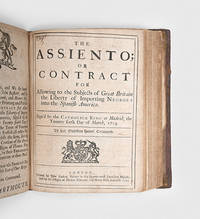
1713186652London: Printed for John Baskett Printer to the Queens most Excellent Majesty And by the Assigns of Thomas Newcomb and Henry Hills deceas'd 1713. A foundational document in the transatlantic slave trade First edition of a major development of the transatlantic slave trade which greatly expanded the market for British slave traders in the Americas and helped establish Britain as the predominant slave trading power. After the War of the Spanish Succession Spain ceded to Britain the exclusive right to import African slaves into Spanish America. This monopoly the Assiento was delegated to the newly formed South Sea Company and held until 1750. The supposed value of the Assiento was the basis of the South Sea Bubble. In fact the restrictive terms - slave numbers were capped and all shipments were heavily taxed by the Spanish Crown - resulted in the South Sea Company never making substantial profit from the agreement. Nonetheless the Assiento played a major role in boosting and consolidating Britain's role in the Atlantic slave trade. The front free endpaper contains a detailed contemporary owner's note naming the binder of the volume - John Worrall - the price paid how it was constructed and how the book should be used: a very unusual survival. The notes state "This book Intituled State Pamphlets was bound by John Worrall for 2s. 2d. and containes 425 leaves". Little is recorded of John Worrall. He was apprenticed from 1674 to 1682 and was working at Warwick Court in 1709 and at Fleet Ditch in 1722. He died in 1726 all from Howe p. 103. The notes continue that the contents are consecutively numbered in manuscript and to use that numbering not the pagination of the original pamphlets. It specifies that "Remarks" are to be "entred in the proper cleane leaves as the observation thereof sees best" - blanks are bound between the tracts. It then notes that the manuscript table should be placed as the second leaf as is found. It refers the reader to another volume with more detailed instructions - it is evident the volume was held in a library which anticipated wide use. The nine other works bound in the volume - an inventory is available on request - date from 1688 to 1714 and are tracts on religion law and politics alongside the Treaty of Utrecht. It includes Jonathan Swift's first political work A Discourse of the Contests and Dissensions between the Nobles and Commons in Athens and Rome 1701 - this copy is the second issue with most of the first edition type corrected and reset. 10 works bound in 1 vol. quarto 206 x 156 mm. Contemporary calf red morocco label to style covers ruled in blind edges sprinkled red. 19th-century ownership signature "S. Louise Langdon" to verso of manuscript contents leaf. Joints and extremities restored slight staining to endpapers a little browned occasional trimming to pagination. Overall very good. ESTC T4476 another issue only has Baskett in the imprint; Kress 5020; Sabin 2227. Ellic Howe A List of London Bookbinders 1648-1815 1950. unknown
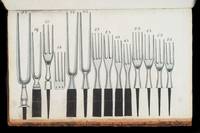
179212195Düsseldorf: s.n. 1792. Contemporary mottled calf rebacked restored marbled endleaves. <p>      ILLUSTRATED PATTERN AND PRICE BOOK OF STEEL KNIVES AND FORKS MANUFACTURED AT SOLINGEN with the strict governmental guidelines for craftsmen and their commercial partners.<br />       The “City of Blades†Solingen was the largest sword knife and scissor manufacturer in the West. It employed over four thousand workers and exported globally. Through their rigid guild system est. 1571 the knife makers protected their trade secrets. Legal standards and strictures ensured the Solingen bladesmiths dominated the market and were the sole suppliers to elite merchants who commissioned bulk orders and custom products. Ordinary tradesmen — like the owner of this book — could only purchase ready-made items and had to pay cash.<br />       KNIVES FOR COBBLERS WOOD- AND LEATHERWORKERS BUTCHERS HUNTERS FARMERS TAILORS GARDENERS WEAVERS AND COOKS form the largest section in the volume. Each blade has a schematic manuscript illustration with separate costs for the work of smiths and for grinders. Many models adopt Dutch English French Flemish and Portuguese designs for the local chic and for export. Only the leatherwork knives are illustrated in watercolor 95 pieces marking a specialty of the owner of this sample book.<br />       THE SECTION ON FORKS HAS ONE HUNDRED THIRTY-EIGHT WATERCOLOR ILLUSTRATIONS and price lists of large carving tools to dainty ones for desserts 65 models. This other house specialty addressed the increasing adoption of forks by upper- and middle-class families in later 18th-century Europe.<br />       ANOTHER SECTION SHOWS HANDLES. These were exclusively manufactured by artisans called Reyder. Each of the two hundred three models listed was available in a range of specified styles and materials. The cost of each type of custom work like turning polishing and coloring is itemized. THE MOST PRIZED EXAMPLES ARE OF FINELY DECORATED BONE EBONY ANTLER GOAT HORN GUAIAC OR PALM WOOD. Look-alikes of “false deer horn†“false guaiac wood†etc. fit other budgets with imitation luxury finishes and less expensive materials. The illustrated examples of knives showcase eighteen different handle decoration options including black red white yellow or green dye black marbling and fine lacquer painting in abstract or foliate patterns. Seven handles are inscribed with German verse. In good condition some light staining hand soiled throughout.<br /> ¶Daniels Vollständige Beschreibung der Schwert-Messer- und übrigen Stahl-Fabriken zu Solingen 30-62.</p> s.n. unknown