4 743 résultats
191498381914. Presentation album promoting the work of the pioneering printing firm including unpaginated 16 pp. introductory text printed in blue black silver and white within elaborately ornamented borders and 12 mounted samples of work by the firm including publicity brochures advertisements pamphlets stationery and other items most in striking colors compositions and formats with descriptions on decorative tissue guards. Folio. Orig. ornamental cloth front cover a bit warped. Berlin n.d. circa 1914. A spectacular publication reflecting the firm's originality creativity and great attention to detail presenting striking designs for publicity material epitomizing later manifestations of Jugendstil aesthetics. hardcover books
19082080202102900126Not Available 1908. Soft Cover. Fine. Books: 13 books Not Available paperback
195421470Paris, Chez Grasset, 1954 ; in-quarto tellière broché, chemise-étui moderne ; 140 pp., [2]ff., couverture granitée jaune rempliée, imprimée en noir et chocolat ; page de titre imprimée en noir et vert printemps.
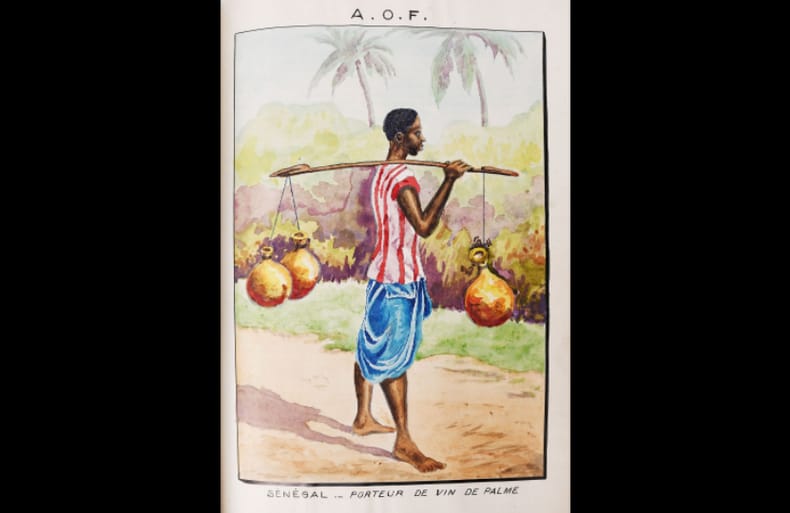
193823642Sans lieu, sans nom, 1938. Fort in-4 (21 x 30 cm) maroquin marron, premier plat orné des lettres dorées A. O. F. dans un contour dessinant l'Afrique de l'Ouest avec petit décor d'instruments de musique, dos à nerfs avec filets dorés, plats et doublures de maroquin marron, chemise de maroquin marron à bandes doublée de suédine de couleur noisette, étui bordé. 662 pages.
193019955Leicester UK: Cascelloid ca. 1930s. Very good . Oblong 4to. album. Blue leather-covered boards. Contains 29 color photographs all 9" by 6.5" approx. mounted on rectos one each of light-gray cardboard leaves. About very good plus overall. Moderate rubbing and edgewear to boards. Several pages display mild soiling and offsetting from photos. Prints just a bit yellowed but remain sharp vivid and clean. <br/><br/>Beautifully-produced trade catalogue from the Cascelloid "Palitoy" company displaying a wide range of baby dolls and other toys. Several uncomfortable designs of black children with pitch-dark skin date this catalogue at roughly the 1930s when the Cascelloid company was dubbed the "House of Constant Progress" by the industry press for its material innovations with the plastics Bexoid and Plastex. One page features a celluoid model by the noted designer Mary Lucie Attwell a doll named "Diddums." The catalogue also displays the company's offerings of animal dolls die-cast trucks pool toys golf and ping-pong sets rattles pinwheels and more. Needless to say color photography was not the norm at this time and this catalogue comprises a beautiful set of vivid and sharp photographic prints. A truly exceptional example unlike anything we've seen: simultaneously surreal and nostalgic. [Cascelloid] hardcover books
1934180258Japan: 1934. A last-ditch attempt to repair Anglo-Japanese relations A well-preserved photo album presented by the Japanese government to members of the Barnby mission. This delegation was "unofficial and supposed to deal solely with commercial issues but the Japanese government and media treated it as if it had a political purpose much to the embarrassment of the British Embassy" Cortazzi p. 141. WorldCat lists no other examples. After the invasion of Manchuria and Japan's withdrawal from the League of Nations in 1933 a pro-Japanese group in Britain centred on Neville Chamberlain attempted to repair relations between the two countries. The group was led by Colonel Lord Barnby the former president of the Federation of British Industries and staffed by representatives of the Iron and Steel Federation and the banking firm Seligman Brothers. Officially its goal was to investigate business opportunities in the new colony but as the Japanese ambassador Matsudaira Tsuneo wrote "its real aim is to promote friendly relations between Japan and Britain and between Britain and Manchukuo" Nish p. 19. The delegation was greeted by an audience with the emperor much to the horror of the British ambassador Robert Clive who suspected that their friendliness was simply a ruse to persuade the British to "accept a subordinate position in East Asia" Cortazzi p. 142. The mission caused such a stir that it was debated in parliament on 7 November 1934 where Viscount Cecil of Chelwood asked whether the Japanese government had been properly informed of its non-political nature. The first photograph shows the mission meeting with the Japanese delegation and the final photograph shows the interior of a railway car. There are also many photographs of traditional Japanese sports and performing arts as well as the scenery of famous places like Nara Hakone and Kyushu. Oblong folio. With 60 gelatin silver photographs landscape or portrait approximately 105 x 152 mm mounted recto and verso on grey card with captions in English. Original patterned brocade white thread musubi-toji binding spine ends capped with patterned brocade gilt-speckled endpapers gilt edges. Brocade fresh a little frayed at edges a few leaves sometime strengthened with tape at the gutter photographs bright with a little toning and silvering at edges: a very good example. Hugh Cortazzi British Envoys in Japan 1859-1972 2021; Ian Nish Anglo-Japanese Alienation 1919-1952: Papers of the Anglo-Japanese Conference on the History of the Second World War 1982. unknown
193042850Leicester UK: Cascelloid 1930. Very good . Beautifully-produced trade catalogue from the Cascelloid "Palitoy" company displaying a wide range of baby dolls and other toys. Several uncomfortable designs of black children with pitch-dark skin date this catalogue at roughly the 1930s when the Cascelloid company was dubbed the "House of Constant Progress" by the industry press for its material innovations with the plastics Bexoid and Plastex. One page features a celluoid model by the noted designer Mary Lucie Attwell a doll named "Diddums." The catalogue also displays the company's offerings of animal dolls die-cast trucks pool toys golf and ping-pong sets rattles pinwheels and more. Needless to say color photography was not the norm at this time and this catalogue comprises a beautiful set of vivid and sharp photographic prints. A truly exceptional example unlike anything we've seen: simultaneously surreal and nostalgic. Oblong 4to. album. Blue leather-covered boards. Contains 29 color photographs all 9" by 6.5" approx. mounted on rectos one each of light-gray cardboard leaves. About very good plus overall. Moderate rubbing and edgewear to boards. Several pages display mild soiling and offsetting from photos. Prints just a bit yellowed but remain sharp vivid and clean. [Cascelloid] hardcover
19391729691939. INK TRADE CATALOGUE. Kraski. Trest 'Poligraf'. 173 unnumbered leaves of text and illustrations. Vertical 4to 265 x 175 mm publisher's cloth fastened with string. Moscow: Nauchno-issledovatel'skii institut poligraficheskoi i izdatel'skoi tekhniki 1939. The State Trust of the All-Union Economic Council of National Economy "Poligraf" existed since 1924 and produced movable types. They also produced printing inks. In this sample book they are divided by the techniques they were intended for: movable-type printing lithography offset lithography mezzotint. The samples are on different kinds of papers to show the differences for printing. At the end is an overview of complementary mixtures and drying oils including fatty printing pastes to increase the capacity of printed forms. One of 300 copies only. Of the greatest rarity and not listed on OCLC. hardcover
19361714361936. SOVIET TRADE CATALOGUE. Kolbasy i myasokopchenosti. Sausages and smoked meats. Soviet Union. Glavnoe upravlenie miasnoi promyshlennosti. 3 volumes. 1: Livernyye i krovyanyye kolbasy. Liverwurst and Blood Sausages. 32 pp. 1936. 2: Kopchenyye kolbasy. Smoked sausages. 68 pp. 1937. 3. Zil'tsy i studni. Brawns and Aspics. 32 pp. 1937. Illustrated throughout. Oblong 8vo 146 x 214 mm. publisher's blind-stamped wrappers. Moscow; Leningrad: Pishchepromizdat 1936 & 1937. These three surreal homages to the sausage are a modest forerunner to the massive work produced in 1938 by the same publisher. While far smaller the plates each with an individual sausage still have a somewhat surreal quality. While they do not have the avant-garde sensibility of Telingater's ball bearing catalogue or Piet Zwart's wire catalogue these odes to the sausage can certainly lay claim to a place in surrealist literature. These are rare books and are not listed on OCLC. unknown
1936015728Paris EDITION ORIGINALE. Tirage à 1012 exemplaires numérotés. Un des 35 sur Hollande van Gelder mis dans le commerce, second papier après vingt-cinq Japon . Bel exemplaire relié à l'époque : demi-maroquin noir à coins et filets or, dos à nerfs et pièce de titre rouge et lettre or, tête dorée, couverture et dos conservés. 1936 fort in-8 Broché Edition originale
1959015858Copenhague L'Internationale situationniste 1959 In-4 Broché, couverture à rabats
19422091502135500375Manzhou Yingkou Chamber of Commerce 1942. Soft Cover. Fine. Number of pages: 2 2 23 364 118p Size: 16x22cm Manzhou Yingkou Chamber of Commerce paperback
19422091502135500132Yingkou Chamber of Commerce 1942. Soft Cover. Fine. Number of pages: 2 2 23 364 118p Size: 16x22cm Yingkou Chamber of Commerce paperback
195742918Paris: Societe Paritys / Lebotys 1957. Post binder with 3 brass posts decorative screw tops. Publisher's color pictorial glazed boards blue spine and joints. Board edges rubbed and worn; short split to rear outer joint; inner joints tender paper splitting though cloth reinforcement beneath is intact. Page block foxed occasional foxing/spotting throughout; light offsetting from fabric samples to some pages. Fabric sample generally clean and bright with occasional creasing/fraying. Overall Gd. 97 pp. 16 color fashion drawings; ~ 740 pasted or tipped-in fabric samples. 16-1/8" x 12-1/8" <br/><br/>A mid-century salesman's sample catalogue from the winter collection of Parisian firm Société Paritys a haberdashery and fabric supplier established in 1946 and still in operation today. The fabric samples have been supplied by Lebotys a couture design firm in its own right and highly regarded for the quality of its textiles. As we find record of Lebotys having issued catalogues of its own collections in both the 1930s and 1960s we speculate that the two firms collaborated for a limited time possibly due to continuing post-war shortages and the need to adapt to the rapidly changing clothing market of the 1950s. The late 1950s saw a revolution in French fashion — and by extension Western fashion in general — due in no small part to the influence of material factors underlying the purely aesthetic side of the industry: availability of fabric continuing technological advances in synthetics and the surging post-war economies of America and Europe. The reluctant expansion of haute couture into the ready-to-wear market during the latter half of the century and the increasing reliance on synthetic fabrics to meet the demand would ultimately spell a major shift in the industry one that would impact fashion trends for decades to come. Some fashion houses like Dior whose “New Look” revitalized fashion at the beginning of the decade successfully managed to adapt by issuing couture ready-to-wear lines. Some however even long-established houses survived the war only to be undone by the prosperity that followed. The collaboration here of Société Paritys and Lebotys as well as the fabrics offered and styles displayed leads us to infer that the two firms were likely targeting the growing ready-to-wear market. The fabrics include a variety of silks cottons wools mohair etc. as well as nylon fibranne rayon Rhodia tergal crylor acetate and other “Matieres Synthètiques” often in blends and advertising their washable and/or antiwrinkling qualities. The styles in the illustrations still heavily influenced by the “New Look” emphasize wasp-waisted dresses hourglass silhouettes etc. No copies located on OCLC nor the major French institutions as searched on KVK. Societe Paritys / Lebotys hardcover books
195842919Paris: Societe Paritys / Lebotys 1958. Post binder with 3 brass posts. Publisher's pictorial glazed boards red cloth joints. Light extremity wear to boards; bumping to upper corner of front board; short split to front and rear joints. Page block lightly foxed foxing/spotting scattered throughout. Few white nylon fabric samples discolored by paste beneath. Fabric samples otherwise clean and bright with only minor occasional creasing/fraying. Overall VG. 80 pp. 12 color fashion drawings; ~590 pasted and tipped-in fabric samples 16-1/8" x 12-1/8" <br/><br/>A mid-century salesman's sample catalogue from the winter collection of Parisian firm Société Paritys a haberdashery and fabric supplier established in 1946 and still in operation today. The fabric samples have been supplied by Lebotys a couture design firm in its own right and highly regarded for the quality of its textiles. As we find record of Lebotys having issued catalogues of its own collections in both the 1930s and 1960s we speculate that the two firms collaborated for a limited time possibly due to continuing post-war shortages and the need to adapt to the rapidly changing clothing market of the 1950s. The late 1950s saw a revolution in French fashion — and by extension Western fashion in general — due in no small part to the influence of material factors underlying the purely aesthetic side of the industry: availability of fabric continuing technological advances in synthetics and the surging post-war economies of America and Europe. The reluctant expansion of haute couture into the ready-to-wear market during the latter half of the century and the increasing reliance on synthetic fabrics to meet the demand would ultimately spell a major shift in the industry one that would impact fashion trends for decades to come. Some fashion houses like Dior whose “New Look” revitalized fashion at the beginning of the decade successfully managed to adapt by issuing couture ready-to-wear lines. Some however even long-established houses survived the war only to be undone by the prosperity that followed. The collaboration here of Société Paritys and Lebotys as well as the fabrics offered and styles displayed leads us to infer that the two firms were likely targeting the growing ready-to-wear market. The fabrics include a variety of silks cottons wools mohair etc. as well as nylon fibranne rayon Rhodia tergal crylor lurex viscose imitation fur and other “Matieres Synthètiques” often in blends and advertising their washable and/or antiwrinkling qualities. The styles in the illustrations still heavily influenced by the “New Look” emphasize wasp-waisted dresses hourglass silhouettes etc. No copies located on OCLC nor the major French institutions as searched on KVK. Societe Paritys / Lebotys hardcover books
195942920Paris: Societe Paritys / Lebotys 1959. Post binder with 3 brass posts. Publisher's pictorial glazed boards white cloth joints. Light extremity wear to boards; short split to rear joint. Page block lightly foxed occasional foxing/spotting to margins throughout. Few white nylon fabric samples discolored by paste beneath. Fabric samples otherwise clean and bright with only minor occasional creasing/fraying. Overall VG. 108 pp. 16 color fashion drawings; ~800 pasted and tipped-in fabric samples. 16-1/4" x 12" <br/><br/>A mid-century salesman's sample catalogue from the summer collection of Parisian firm Société Paritys a haberdashery and fabric supplier established in 1946 and still in operation today. The fabric samples have been supplied by Lebotys a couture design firm in its own right and highly regarded for the quality of its textiles. As we find record of Lebotys having issued catalogues of its own collections in both the 1930s and 1960s we speculate that the two firms collaborated for a limited time possibly due to continuing post-war shortages and the need to adapt to the rapidly changing clothing market of the 1950s. The late 1950s saw a revolution in French fashion — and by extension Western fashion in general — due in no small part to the influence of material factors underlying the purely aesthetic side of the industry: availability of fabric continuing technological advances in synthetics and the surging post-war economies of America and Europe. The reluctant expansion of haute couture into the ready-to-wear market during the latter half of the century and the increasing reliance on synthetic fabrics to meet the demand would ultimately spell a major shift in the industry one that would impact fashion trends for decades to come. Some fashion houses like Dior whose “New Look” revitalized fashion at the beginning of the decade successfully managed to adapt by issuing couture ready-to-wear lines. Some however even long-established houses survived the war only to be undone by the prosperity that followed. The collaboration here of Société Paritys and Lebotys as well as the fabrics offered and styles displayed leads us to infer that the two firms were likely targeting the growing ready-to-wear market. The fabrics include a variety of silks cottons wools mohair muslin cashmere and others as well as nylon fibranne rayon Rhodia tergal crylor acetate Albène and other “Matieres Synthètiques” often in blends and advertising their washable and/or antiwrinkling qualities. The styles in the illustrations although still influenced by the “New Look” also show the influence of Dior's successor the young Yves St. Laurent who debuted his "trapeze line" in 1958. No copies located on OCLC nor the major French institutions as searched on KVK. Societe Paritys / Lebotys hardcover books
195741355Paris: Societe Paritys 1957. 1st printing thus. Publisher's color pictorial glazed boards post binder; 3 brass posts decorative screw tops. Red cloth joints. Some general extremity wear to binder with slightly bumped corners. Occasional dust soiling. Minor foxing. Overall VG with cloth samples generally VG to Nr Fine with the occasional crease to the odd sample or two. 104 pp printed in red on stiff-stock paper. 16 color fashion drawings; 897 of 898 tipped-in fabric samples. Folio. 16-1/4" x 12-1/8" <br/><br/>A mid-century salesman's sample catalogue from the summer collection of Parisian firm Société Paritys a haberdashery and fabric supplier established in 1946 and still in operation today. The fabric samples have been supplied by Lebotys a couture design firm in its own right and highly regarded for the quality of its textiles. As we find record of Lebotys having issued catalogues of its own collections in both the 1930s and 1960s we speculate that the two firms collaborated for a limited time possibly due to continuing post-war shortages and the need to adapt to the rapidly changing clothing market of the 1950s. The late 1950s saw a revolution in French fashion — and by extension Western fashion in general — due in no small part to the influence of material factors underlying the purely aesthetic side of the industry: availability of fabric continuing technological advances in synthetics and the surging post-war economies of America and Europe. The reluctant expansion of haute couture into the ready-to-wear market during the latter half of the century and the increasing reliance on synthetic fabrics to meet the demand would ultimately spell a major shift in the industry one that would impact fashion trends for decades to come. Some fashion houses like Dior whose “New Look” revitalized fashion at the beginning of the decade successfully managed to adapt by issuing couture ready-to-wear lines. Some however even long-established houses survived the war only to be undone by the prosperity that followed. The collaboration here of Société Paritys and Lebotys as well as the fabrics offered and styles displayed leads us to infer that the two firms were likely targeting the growing ready-to-wear market. The fabrics include a variety of silks cottons wools mohair etc. as well as nylon fibranne rayon Rhodia tergal crylor acetate and other “Matieres Synthètiques” often in blends and advertising their washable and/or antiwrinkling qualities. The styles in the illustrations still heavily influenced by the “New Look” emphasize wasp-waisted dresses hourglass silhouettes etc. Of particular note are the designs and fabrics for wedding dresses. No copies located on OCLC nor the major French institutions as searched on KVK. Societe Paritys hardcover books
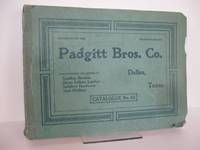
191757734Dallas TX: printed by Egan Printing Co. for the company 1917. Trade catalogue. Oblong 4to. 526 pp. Frontispiece trademark illustration and numerous other illustrations from line drawings and photographs. Padgitt Brothers Company was established in 1869 and incorporated in 1900; the company's success "in supplying the needs of the saddlery trade of the Southwest gave them first-hand knowledge of materials and design that were recognized as standard wherever good goods are sold." Their catalogues were "a veritable encyclopedia of saddlery facts classified for your convenience . there is no reason why this book should not prove a 'silent partner' in the success of every dealer who will utilize its pages freely." The profusely illustrated catalogue with pricing information is organized into sections for saddles and varieties of tack down to spurs buckles hobbles canvas wagon covers buggy tops blankets and feedbags. The Padgitt "Bronco Brand" saddle and accessories were widely known throughout the Southwest. OCLC locates two copies of this number National Cowboy & Western Heritage Museum San Jacinto Museum of History. Owner's name on front wrapper a very good copy. Printed green wrappers original printed cloth tape spine some soiling and chipping to wrappers tape repair to verso of rear wrapper chipping to margin of final blank. #6216. <br/><br/> (printed by Egan Printing Co., for the company) hardcover books
1932307823Seattle Shiatoru: Hokubei nihonjinkai shogyo kaigisho North American–Japanese Chamber of Commerce 1932. Third Edition. The third edition after much shorter versions published in 1928 and 1929. This is a promotional publication printed at a Japanese-language press in Seattle intended to encourage pan-Pacific trade through the port of Seattle. Chapters are devoted to manufacturing commercial business the current state of Seattle trade trade with Japan and Seattle's municipal administration education and media outlets.<br /> <br /> Notably the English introduction from the Seattle mayor makes no mention of the local Japanese community emphasizing only mutual trade between Seattle and Japan. The half-tone plates depict views of Seattle and accommodations for Japanese merchants. The supporting ads mostly at the back however are from many Japanese-owned businesses in the region.<br /> <br /> 6 2 110 2 1 2 23 pages plus 14 pages of half-tone photographic plates including one folding plate and a folding chart.<br /> <br /> OCLC: 1020884327 Japan 835589810 Japan 20869632 University of Washington for this 1932 edition. Similar holdings for the 1929 edition. No recorded holdings for the 1928 edition. Third edition. A very good copy in the original wrappers. With professional conservation by ECS to remove rusted staples and infill holes in the paper sheets left by the staples. The binding was then sewn through the original staple holes. The conservation report will be supplied with this copy. Hokubei nihonjinkai shogyo kaigisho (North American–Japanese Chamber of Commerce) unknown
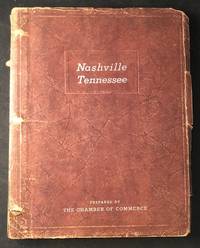
19372527Nashville TN: The Chamber of Commerce Nashville TN 1937. First Edition First Printing. Original wraps. Good . 9 X 11 1/4 Inches. 62 PP Folding Map. Original February 5 1937 Portfolio created by the Nashville Chamber of Commerce. A fairly incredible "time-capsule" glance and 20th Century Nashville in the making. This unique book was created specifically for the purpose of garnering the business of the Norvell & Wallace Lumber factory. We assume that other similar copies were created on an individual basis when the city saw fit to "scout" major companies for the area. We have located "0" copies on OCLC and "0" auction records. The summary states "The principal advantages Nashville offers to industry and other lines of business is summarized from this survey." <br /> <br /> The index includes: agricultural resources altitude area assessed valuation building and construction city government civic and social data building permits churches civic-fraternal and welfare organizations education golf courses hospitals and medical facilities hotels newspapers office buildings parks and playgrounds Parthenon postal receipts public buildings radio stations streets theatres Tennessee State Fair climate financial instituions living conditions location manufacturing attitude toward new industries industrial development in Nashville Labor costs Labor relations Labor Laws and Regulations Labor Supply Workmen's Compensation Law markets mineral resources population public utilities state and local taxes transportation facilities airlines express freight local passenger service interurban service motor truck railroads river transportation vital statistics wholesale and retail establishments.<br /> <br /> A few of the stats that immediately jumped out at me - 1 The report predates any television station in Nashville 2 When polling races in the city the report denotes 111025 white citizens 42836 negro citizens and 5 of "other" races 3 only two airlines American and Eastern service the city and the municipal airport was dedicated only a few months before this report. <br /> <br /> 21 tables and graphs including rail distance and hours by train to other US cities flying hours from Nashville power rates gainful workers condition of the banks of Nashville and more. The folding map mounted at rear measures roughly 25 X 30 inches. Origianl stab binding intact. Pages and text clean. Covers are separated from the text. The map does exhibit a few closed tears and a bit of wear at folds. The Chamber of Commerce (Nashville, TN) unknown
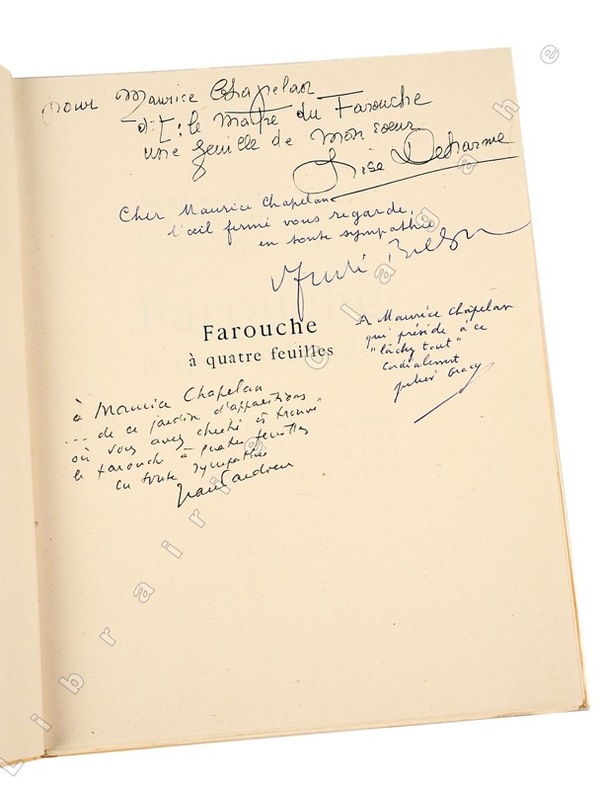
1951014789Paris Editions Jeanne Bucher 1951 En feuilles, couverture rempliée illustrée Dédicacé par l'illustrateur
191722395Paris Pierre Lafitte 1917 -in-8 demi-Maroquin mosaïqué 1 volume, reliure demi-maroquin cerise in-octavo carré à coins (half morocco binding in-8 with corners) (17 x 21,4 cm), EXCEPTIONNELLE RELIURE D'EPOQUE MOSAÏQUEE SIGNEE : (JEAN) STROOBANTS, dos long (spine without raised band), décoré or et mosaïque de cuir bleu-foncé, Auteur et titre frappés "or" avec un filet arrondi "or" de part et d'autre, orné d'une branche de laurier "or" tout au long du dos avec un casque de poilu mosaïqué bleu-marine comme accroché à la branche en partie moyenne basse du dos, le tout dans un encadrement d'un filet "or", date "or" en pied dans un encadrement d'un filet "or", plats décorés "or" d'un filet "or" au mors et aux coins, papier peigné vieux rose et vert aux plats, tête lisse dorée, gouttière et tranche de queue non-rognées, dos imprimé en noir et couverture imprimée en bleu ciel et noir et illustrée en couleurs par SEM conservée, Exemplaire sur grand papier "NON DESTINE AU COMMERCE", avec un dessin original à l'encre brune signé SEM, Exemplaire illustré de 150 Dessins par Sem, la plupart aquarellés en couleurs, 247 pages + 1 p. de Table, 1917 Paris, Pierre Lafitte Editeur,
19252091502135500562Mukden Chamber of Commerce 1925. Soft Cover. Fine. Number of pages: 5 Size: 19x26 cm Mukden Chamber of Commerce paperback
19222091502135500790Not Available 1922. Soft Cover. Fine. Size: A6 size 11x15 cm Number of books: 8 Not Available paperback
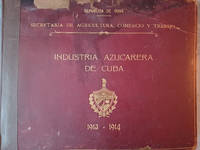
19153017<p>Portafolio azucarero de la industria azucarera de cuba 1912-1914 primera edicion libreria e imprenta la moderna poesia 1915 esta obra ha sido realizada siendo presidente de la republica de cuba dr mario garcia menocal y secretario de agriculturacomercio y trabajo el general emilio nunez caratulas originalesrestauradasgran libro ilustrado 424 pgs mas graficos libro con peso de 13 librascon 16 cm de largo por 12.5 cm de anchoes una obra super rarade colecciondonde se describen todos los centrales azucareros de cubacon fotos y sus caracteristicas publicada en el ano 1915 por la libreria e imprenta la moderna poesiaes una de las rarezas de la bibliografia cubana</p> Libreria e imprenta la moderna poesia hardcover