15 923 résultats
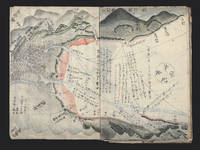
5611"Hishu" today Saga Prefecture: 1841-45. A very rare Japanese manuscript sea chart of the sea routes from Saga Prefecture a major trading area in the west to Osaka through the Inland Sea which is more than 400 km. long and includes in excess of 3000 islands. The Inland Sea one of the main trade routes for the Japanese in the Edo period has numerous areas of turbulence and navigating through the numerous islands and rocky outcroppings presented enormous problems in the era before modern navigation systems. In the early 1840s the central government in Edo ordered each fiefdom to prepare maps of coastal routes to facilitate trade and shipping. Our manuscript was prepared by Tsugihei Miyachi a high level sea pilot "mite kako" in the Saga Prefecture shipping office as an employee of the Nabeshima Clan. The map were it to be unbound is about 11340 mm. long about 37 feet depicting Saga in the west to Osaka in the east. It is finely drawn in black ink heightened with wash in green purple blue grey and red. Five of the openings have folding extension sections pasted onto the lower margins of the leaves. Blue lines depict safe sailing routes for smaller ships. The map depicts in very great detail areas of turbulence there are famous whirlpools in the Inland Sea numerous islands rock formations and landscapes for orientation anchorages harbors and fishing areas. Each section of the map has been annotated by the compiler with notes on distances characteristics of rivers landmarks for navigation tidal activities the route to Nagasaki etc. The first map opening depicts Saga and the final opening Osaka. The sea chart is prepared with considerable local knowledge of castles and temples. A series of notable castles each is labeled with name of the lord assets etc. are depicted along the shores and Miyachi describes harbors for anchoring and to get fresh water. The routes are drawn from a "bird's-eye view" perspective with lovely vistas of mountains and islands and villages and towns. The two leaves of manuscript text at the beginning in the style of a dedicatory letter to the fiefdom lord describes the compiler's efforts over a five-year period to prepare the map. He writes that it is based on his own personal experiences as a sea pilot. He states that purple denotes routes he has taken red denotes shallows blue lines denote the routes for large ships grey for land and green for mountains and forests. The eleven pages of text at the end provide details on prevailing weather patterns and how to prepare for inclement weather how to navigate by landmarks and the stars wind and tidal patterns and the history of the preparation of this map "it took me five years of daily observation to prepare this work". He provides a list of his voyages to different cities on this route. On the final page the author states that three copies were made: the first for the fiefdom lord the second for a cabinet member and the third for Miyachi's divisional chief. A modern scholar has laid-in a note describing this sea chart as one of those three. Japanese sea charts are rare survivals and we know of no other similar example outside of Japan. ❧ The sea pilot Miyachi's log books are preserved in the Nabeshima clan's archives see the Saga kenritsu toshokan database. unknown books
24854A Londres, Chez Fletcher Gyles, dans Holborn, 1755. (4), 430, (6, Table des Chapitres) pp. 12mo. Contemporary half calf, spine gilt in compartments, gilt lettering, floral ornament in each compartment, green paper covered boards, all edges red. Kress 5423; Goldsmiths 8989; Einaudi 846; INED 933; Higgs 938; En Français dans le Texte, 159; Leblanc 57; Antoin E. Murphy, Richard Cantillon: entrepreneur and economist; T. Hutcheson, Before Adam Smith, pp. 163-178. First edition of Cantillon's great work, 'the most systematic statement of economic principles before Adam Smith's Wealth of Nations' (Roll, p. 121). 'The economic repute of Cantillon, for a time completely obscured by the glory of Adam Smith, can never have rested upon the popularity of his little book, now one of the scarcest works in economic literature .. The influence of the book is evidenced not only by the number but by the distinction of its students, including Gournay, Quesnay, Mirabeau, Turgot, and Adam Smith. It gave birth to Mirabeau's l'Ami des Hommes and apparently suggested much of the Tableau Oeconomique of Quesnay and parts of the Wealth of Nations .. Cantillon avoided, as Jevons has pointed out, the one-sidedness of the Physiocrats; and yet has been marked out as a Physiocrat .. Jevons thought Cantillon wrote 'with the scientific precision of a Cairnes or a Cournot,' and Prof. Marshall refers to his 'thoroughly scientific manner of discussion' .. In France the Essai has been pretty continuously read (see e.g. Ganilh, Des Systèmes d'Economie Politique, 2d. ed. 1821), and so stimulating and suggestive does it remain that its direct influence may be found to be not yet exhausted' (Palgrave, i, pp. 214f). Roll has called this work 'the most systematic statement of economic principles, before the Wealth of Nations' (History of Economic Thought, p. 121).Cantillon, a French banker of Irish extraction, was influenced by Petty, but his own influence was principally felt by the Physiocrat school: Higgs maintains that Quesnay took his fundamental principle of Physiocracy from the Essai. The Essai was written about 1730 and circulated in manuscript. Cantillon died in 1734 and the work was first published in 1755 in French, not in English, as stated on the title.The Essai has been quoted by Smith, Condillac, and Quesnay, plagiarised by Harris and Postlethwayt, and called by Jevons 'more emphatically than any other single work the cradle of political economy'. The work is divided into three sections: a general introduction to political economy, a treatise on currency, and a study of foreign commerce and exchange.'Since the 'discovery' of Cantillon by the English-speaking world following Jevons's enthusiastic article (1881), no less than justice has been done to the merits of the Essay .. Jevons himself noted that Cantillon had presented a treatment of currency, foreign exchanges, banking and credit which, judged against the work of its period, he felt to be 'almost beyond praise' .. It was likewise recognized as early as Jevons that Cantillon had set out the leading ideas of Adam Smith's 'important doctrine concerning wages in different employments' .. and that the Essay contained .. 'an almost complete anticipation of the Malthusian theory of population' (The New Palgrave, i, p. 318). - A very good copy.
179212195Düsseldorf: s.n. 1792. Contemporary mottled calf rebacked restored marbled endleaves. <p>      ILLUSTRATED PATTERN AND PRICE BOOK OF STEEL KNIVES AND FORKS MANUFACTURED AT SOLINGEN with the strict governmental guidelines for craftsmen and their commercial partners.<br />       The “City of Blades†Solingen was the largest sword knife and scissor manufacturer in the West. It employed over four thousand workers and exported globally. Through their rigid guild system est. 1571 the knife makers protected their trade secrets. Legal standards and strictures ensured the Solingen bladesmiths dominated the market and were the sole suppliers to elite merchants who commissioned bulk orders and custom products. Ordinary tradesmen — like the owner of this book — could only purchase ready-made items and had to pay cash.<br />       KNIVES FOR COBBLERS WOOD- AND LEATHERWORKERS BUTCHERS HUNTERS FARMERS TAILORS GARDENERS WEAVERS AND COOKS form the largest section in the volume. Each blade has a schematic manuscript illustration with separate costs for the work of smiths and for grinders. Many models adopt Dutch English French Flemish and Portuguese designs for the local chic and for export. Only the leatherwork knives are illustrated in watercolor 95 pieces marking a specialty of the owner of this sample book.<br />       THE SECTION ON FORKS HAS ONE HUNDRED THIRTY-EIGHT WATERCOLOR ILLUSTRATIONS and price lists of large carving tools to dainty ones for desserts 65 models. This other house specialty addressed the increasing adoption of forks by upper- and middle-class families in later 18th-century Europe.<br />       ANOTHER SECTION SHOWS HANDLES. These were exclusively manufactured by artisans called Reyder. Each of the two hundred three models listed was available in a range of specified styles and materials. The cost of each type of custom work like turning polishing and coloring is itemized. THE MOST PRIZED EXAMPLES ARE OF FINELY DECORATED BONE EBONY ANTLER GOAT HORN GUAIAC OR PALM WOOD. Look-alikes of “false deer horn†“false guaiac wood†etc. fit other budgets with imitation luxury finishes and less expensive materials. The illustrated examples of knives showcase eighteen different handle decoration options including black red white yellow or green dye black marbling and fine lacquer painting in abstract or foliate patterns. Seven handles are inscribed with German verse. In good condition some light staining hand soiled throughout.<br /> ¶Daniels Vollständige Beschreibung der Schwert-Messer- und übrigen Stahl-Fabriken zu Solingen 30-62.</p> s.n. unknown
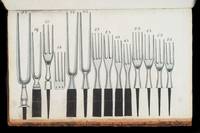
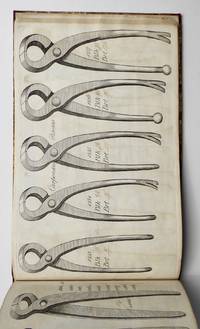
18124628<p>TRADE CATALOGUE - STEEL GOODS. Book of Steel Toys. Birmingham n.p. c.1812. </p><p>A remarkable trade catalogue of steel goods for the household ladies and gentlemen's personal effects gardening tools and instruments for trades and professions. This is a treasure trove of visual information about a vast range of now obsolete tools and the objects required for daily life in the age of Jane Austen: spinet tuning keys muffin toasters cheese tasters sugar hatchets teeth cleaning sets netting vices boot hooks and so on. Particularly fascinating is the distinction between tradesmen's tools and those specifically marketed for amateurs. These are described in the individual engravings as well as in the engraved and letterpress leaf after the index leaf where the contents of 9 oak chests of tools for gentlemen are itemised as well as chests of garden tools turners tools and mahogany chests of tools for cleaning gentlemen's guns. Among the articles listed in the index are 'Lady's hammers' and 'Lady's sets of garden tools' but these do not seem to be the articles engraved on the corresponding plates. </p><p>Engraved trade catalogues of this sort were used by salesmen to solicit orders from retailers. The prices entered in manuscript are selling prices on which the retailer received a discount probably 25% see below. Stamped brass and silverware catalogues turn up from time to time but catalogues of steel goods are much rarer. Unusually too this catalogue is provided with a letterpress index. Normally the engraved leaves would be gathered up in different combinations for individual salesmen hence the plates are numbered in manuscript. In this example they do not exactly follow the printed index so the 'missing' engravings 49 and 50 may never have been present but the presence of stubs suggests that pls. 35–40 which from the index showed corkscrews were once present and have been removed from the volume.</p><p>There is a similar volume in the Public Library of Cincinnati and Hamilton County also with a printed index and 51 leaves of plates. There is a printer's imprint W. Tolley and Son on the first plate. This may be the William Tolley engraver and copperplate printer active in Birmingham from before 1790 to 1830. The name of the agent is on a label on the upper cover: 'Muntz & Purden Book no. 29 discount 25%' indicating that the MS prices are retail prices.</p><p><i>Oblong folio 235 x 375mm; letterpress 'Index to book of steel toys' folding letterpress and engraved leaf 'Gentlemen's Tool Chests' and 46 leaves of plates many printed recto and verso from 80 engraved plates. There is a gap in the pagination and stubs between 34 and 41 and these leaves have presumably been removed; pls 49 and 50 are also missing but there are no stubs so may never have been present.</i></p><p><i>Manuscript additions. The index leaf is annotated 'Livre 64456 W&L' this has been varnished over; every item is neatly priced and in some cases additional products are described for example the ice skates 48 shillings plain or 60 shillings hollow ground could be had with leather straps and buckles for another 18 shillings per dozen pl. 70; small marginal tears in first two and last leaf strengthened with tissue on verso; recent half morocco and marbled boards; from the Forschungsinstitut für Geschichte der Zahnheilkunde with stamp on index leaf and several plates. </i></p> n.p. hardcover
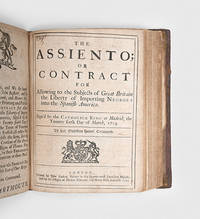
1713186652London: Printed for John Baskett Printer to the Queens most Excellent Majesty And by the Assigns of Thomas Newcomb and Henry Hills deceas'd 1713. A foundational document in the transatlantic slave trade First edition of a major development of the transatlantic slave trade which greatly expanded the market for British slave traders in the Americas and helped establish Britain as the predominant slave trading power. After the War of the Spanish Succession Spain ceded to Britain the exclusive right to import African slaves into Spanish America. This monopoly the Assiento was delegated to the newly formed South Sea Company and held until 1750. The supposed value of the Assiento was the basis of the South Sea Bubble. In fact the restrictive terms - slave numbers were capped and all shipments were heavily taxed by the Spanish Crown - resulted in the South Sea Company never making substantial profit from the agreement. Nonetheless the Assiento played a major role in boosting and consolidating Britain's role in the Atlantic slave trade. The front free endpaper contains a detailed contemporary owner's note naming the binder of the volume - John Worrall - the price paid how it was constructed and how the book should be used: a very unusual survival. The notes state "This book Intituled State Pamphlets was bound by John Worrall for 2s. 2d. and containes 425 leaves". Little is recorded of John Worrall. He was apprenticed from 1674 to 1682 and was working at Warwick Court in 1709 and at Fleet Ditch in 1722. He died in 1726 all from Howe p. 103. The notes continue that the contents are consecutively numbered in manuscript and to use that numbering not the pagination of the original pamphlets. It specifies that "Remarks" are to be "entred in the proper cleane leaves as the observation thereof sees best" - blanks are bound between the tracts. It then notes that the manuscript table should be placed as the second leaf as is found. It refers the reader to another volume with more detailed instructions - it is evident the volume was held in a library which anticipated wide use. The nine other works bound in the volume - an inventory is available on request - date from 1688 to 1714 and are tracts on religion law and politics alongside the Treaty of Utrecht. It includes Jonathan Swift's first political work A Discourse of the Contests and Dissensions between the Nobles and Commons in Athens and Rome 1701 - this copy is the second issue with most of the first edition type corrected and reset. 10 works bound in 1 vol. quarto 206 x 156 mm. Contemporary calf red morocco label to style covers ruled in blind edges sprinkled red. 19th-century ownership signature "S. Louise Langdon" to verso of manuscript contents leaf. Joints and extremities restored slight staining to endpapers a little browned occasional trimming to pagination. Overall very good. ESTC T4476 another issue only has Baskett in the imprint; Kress 5020; Sabin 2227. Ellic Howe A List of London Bookbinders 1648-1815 1950. unknown
1838List601Most Latin America 1838. Mostly Latin America 1809 - 1838. Over 150 pieces comprising over 280 pages .5 linear feet. The Massachusetts merchant Captain Eliphalet Smith Jr. 1780-1838 was a merchant trading primarily in Latin America during the Revolutionary Period. Described by the Chilean historian Diego Barros Arana as "an unscrupulous adventurer who saw in the countries struggling for independence nothing more than a field for his speculations" Smith bore witness to many seminal events in the continent's political history. These letters offer first-hand accounts of such events as the Sieges of Cadiz and Montevideo Admiral William Brown's victories in the Argentinian Independence War the Peruvian silver trade Simon Bolivar's arrival in Guayaquil and the battles of Real Felipe Fortress. <br /> <br /> Smith's business correspondence from the period sheds light on the pro-Regency networks active in the Americas during the period as his loyalties - like most merchants - were based on the Spanish Armada's control of trade. The tensions between Smith and the nascent Chilean government came to a head when goods from Smith's ship the Brig Macedonian were seized by Lord Cochrane Vice Admiral of the Chilean Squadron in two separate incidents in 1818 and 1821. The ensuing legal disputes would cast a long shadow over relations between the United States and Chile until the cases were resolved by international tribunal. The collection includes several original documents relating to the episodes including Smith's recollections of the events and several letters to investors describing the confiscated goods. <br /> <br /> Smith's efforts and their tacit support by the U.S. government make him a key figure in early relations between the United States and the new Latin American regimes. In 1822 an agent of the United States State Department acknowledged that "the Brigs Canton and Macedonian were for more than three years constantly violating blockades neutral and belligerent rights and supplying the royalists and flew the Spanish flag." Likewise historian Patricia Marks writes that Smith had business connections with Spanish merchants in Peru and refers to a quote from Viceroy to Peru JoaquÃn de la Pezuela: "Smith and the Macedonian became anathemas to the patriots. San MartÃn is reputed to have said that he did more damage to the cause of liberty than any other man." Historian Joseph Byrne Lockey points out that Smith's actions had greater implications regarding the perception of the United States in revolutionary-era Latin America: "The conduct of Captain Smith supported in so far as it was legal by the government at Washington contributed together with other incidents of a similar sort not a little to the dimming of the earlier impression of the Patriots that the United States would be in the struggle their friend and ally." <br /> <br /> The collection here consists of 153 documents from Smith's estate including letters received by Smith mercantile inventories and holograph copies of letters sent by Smith during the period. Correspondents include Smith's contacts in Latin America and his creditors in the United States. As a collection the documents relay scarce firsthand accounts of several seminal political events and map an extensive network of mercantile contacts and inventories. They are worthy of further research by scholars of the political history of Latin America and Spain and of early United States / Latin American relations as well as scholars of trade between China and Latin America. <br /> <br /> Overall the collection presents an uncommon opportunity to acquire primary source material from Latin America's Revolutionary Period. We find records from the Macedonian and Smith in the Forbes family collection at Harvard as well as some later documents relating to Smith's claims at the University of Virginia Special Collections. We find no publicly held examples of Smith's personal correspondence or papers prior to 1820. A full write-up and inventory is available in our PDF catalog. unknown books
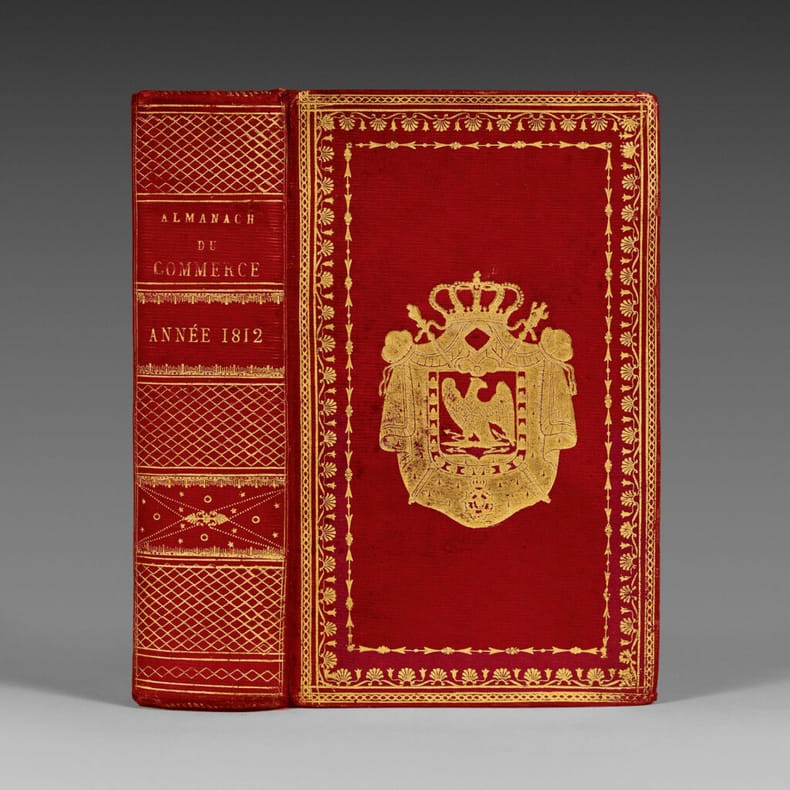
LCS-18198L’Almanach du Commerce pour l’année 1812 relié en maroquin rouge de l’époque aux armes de l’Empereur Napoléon Ier. Paris, chez J. de la Tynna, Propriétaire-Rédacteur, rue J. J. Rousseau, n° 20. In-8 de 1039 pp. Plein maroquin rouge, encadrement de filets et roulette dorés autour des plats, armoiries de l’Empereur Napoléon Ier au centre des plats, dos lisse richement orné, coupes décorées, doublures et gardes de tabis bleu, tranches dorées. Reliure armoriée de l’époque. 211 x 129 mm.
xii, 147, 2 [ads] pp. Index. "Beitrage zur Konjunkturforschung - Herausgegeben vom Osterreichischen Institut fur Konjunkturforschung nr. 1" - front cover. Text in German. In 1933 this work appeared for the first time in English as "Monetary Theory and the Trade Cycle". Hayek went on to share the Nobel Prize in Economics in 1974. Moderate wear to original brown paper wrappers. Binding sound. Small chip from top of backstrip. Top corners of last five leaves were folded. Several mostly imperceptible pencil erasures in first 66 pages. A well-preserved example of the first edition of this, Hayek's first book. Masui p.1277, Cohen 184, Cody & Ostrem B-1. Book
Oblong folio (335 x 500 mm), printed on thick laid paper, letterpress title with wood-engraved decorations, approximately 250 illustrations of architectural ornaments, including stock numbers (not in order), engraved on fifteen well executed copper plates, some printed in blue, 2 with aquatint, some light soiling, occasional spotting, a few stains, mainly to last two plates, nineteenth-century half calf, marbled boards, rubbed, foot of spine chipped, but overall a very good copy. This is not only an exceptionally rare and unrecorded provincially printed pattern book, but it is also highly unusual as being a named pattern book produced for a firm of provincial architects and builders. John Langwith Sr. (c.1723-1795) was an architect and builder who worked at Grantham in Lincolnshire. Syston Park was designed by Langwith for John Thorold, 9th baronet, and constructed between 1766-73. Syston was a fine house, built of limestone ashlar with pedimented or corniced windows. Langwith's 35-page bill for his labours survives today.1 He was also responsible for Vine House, 5 Vine Street, Grantham c.1764, as well as many local buildings of note including the George Hotel, Grantham (1780). In 1785 Langwith was one of three architects who submitted designs for the Castle Gaol at Lincoln, but those of William Lumby were accepted. By 1789, John Langwith Jr. (c. 1753-1825) was taking the lead in his father's business as a builder and surveyor at Grantham. The 1780s and early 1790s witnessed a boom in construction in Grantham. This related partly to the general economic cycle and is reflected, amongst others, in the brick tax returns. In July 1791, Langwith advertised initially for an apprentice to a carpenter and joiner and, in November, his need was for 'Twelve Journeymen joiners and carpenter wanted immediately', adding 'sober men may have constant employ.'2 He held several civic offices and eventually became an alderman, despite bankruptcy in 1803, from which he recovered. His recorded works include Grantham Vicarage, (now the Rectory) in Church Street, which he rebuilt in 1789 in a pleasant vernacular Georgian style at the cost of some 788 pounds; Barkston Rectory, Lincs., 1801; and designs (perhaps not executed) for a prison at Grantham, 1811.3 Lincoln Race Stand c.1818. Langwith was the architect and contractor for the Race Stand, this was replaced by the existing Race Stand of 1897 by William Mortimer. The architectural pattern book produced by John Langwith can thus be attributed with a high degree of certainty to John, junior, published at the height of a building boom. The location of the Manufactory is not known but is perhaps most likely to have been in the Back Lane (now Elmer Street), as an affidavit sworn by lawyer George White, dated 1836, refers to the burial of John Langwith, builder and surveyor, of Back Lane, Grantham.4 1 The invoice is summarised in Richard Wilson and Alan Mackley, Creating Paradise. The Building of the English Country House 1660-1880. (2000), p. 197. 2 Lincoln, Stamford and Rutland Mercury (LRSM), 29 July and 11 November 1791. 3 H. M. Colvin, Directory of English Architects (1995) p. 599. 4 LA: 1 FANE 11/14. Not recorded by ESTC, JISC, OCLC or any of the appropriate reference works.
177097Birmingham or Sheffield 1770. <p>Oblong folio. 390 x 220 mm. 15 1/4 x 8 3/4 inches. Vellum spine over decorative blue paper wrappers paper label with title in Italian on upper board and ink title in Italian on spine. Paper stock toned with age a few leaves with staining in the margin otherwise in good condition.</p> <br /> <p>Silversmith model book containing 80 full-page engravings of candles sticks and holders candelabra pitchers plates salt and pepper shakers serving utensils silverware and other household pieces. Each image is beautifully and careful engraved with rich detail and ornamentation. Each includes a printed product number as well as one in ink with a different item number and a price.</p> <br /> <p>Although there is no title-page or signatures of engravers this large sales catalogue appears to be English as some of the engravings have English words of explanation engraved in the text. The binding is definitely Italian and the paper label is in an Italian hand. The watermark is a "fleur de lis" pattern suggesting an international company manufacturing the silver. There were only a few English companies with the capacity to export at this time including silver works in Sheffield and Birmingham both of which by 1770's had established networks of dealers selling their wares across the continent. This catalogue with specific Italian connections is very unusual and suggests the scope of the business had reached export capacity by the third quarter of the century. The most important Italian silver makers at this time were Giardini of Rome and Venuti of Naples.</p> . unknown
177097Birmingham or Sheffield 1770. Oblong folio. 390 x 220 mm. 15 1/4 x 8 3/4 inches. Vellum spine over decorative blue paper wrappers paper label with title in Italian on upper board and ink title in Italian on spine. Paper stock toned with age a few leaves with staining in the margin otherwise in good condition. Silversmith model book containing 80 full-page engravings of candles sticks and holders candelabra pitchers plates salt and pepper shakers serving utensils silverware and other household pieces. Each image is beautifully and careful engraved with rich detail and ornamentation. Each includes a printed product number as well as one in ink with a different item number and a price. Although there is no title-page or signatures of engravers this large sales catalogue appears to be English as some of the engravings have English words of explanation engraved in the text. The binding is definitely Italian and the paper label is in an Italian hand. The watermark is a "fleur de lis" pattern suggesting an international company manufacturing the silver. There were only a few English companies with the capacity to export at this time including silver works in Sheffield and Birmingham both of which by 1770's had established networks of dealers selling their wares across the continent. This catalogue with specific Italian connections is very unusual and suggests the scope of the business had reached export capacity by the third quarter of the century. The most important Italian silver makers at this time were Giardini of Rome and Venuti of Naples. unknown books
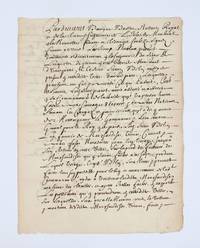
1688368775Montreal 1688. In French. 2pp. recto and verso on a single leaf. Signed by Perrot Bleinz and notary Benigne Basset. With an English transcription. Quarto. Old folds. Near fine. Provenance: Archibald de Léry MacDonald; Lawrence Lande. Exhibition: An Exhibition of Early Documents and Printed Material Relating to the Beginnings of Trade in North America from the Private Collection of Dr. Lawrence M. Lande McGill University May 30-July 15 1985 with an 8-page exhibition catalogue. In French. 2pp. recto and verso on a single leaf. Signed by Perrot Bleinz and notary Benigne Basset. With an English transcription. Quarto. Scarce seventeenth century voyageur fur trade contract for an expedition to the wilderness to trade with the Ottawa signed by one of the most important early traders and explorers of Canada and the upper midwest. "Partnership agreements such as this one of Nicholas Perrot are of great rarity" Lande.<br /> <br /> Perrot 1644-1717 was an explorer interpreter trader commandant diplomat and seigneur. He was one of the best-known figures in the early fur trade of New France particularly during the latter part of the 17th century and took possession of large tracts of land in the Great Lakes region in the name of King Louis XIV. His travels commonly took him deep into unexplored territory and he was the first Frenchman to explore the Upper Mississippi in what is now Wisconsin and Minnesota.<br /> <br /> Perrot arrived in New France about 1660 as a young donné or contracted assistant in the company of Jesuit Missionaries and travelled to the western Great Lakes region where he gained the friendship of the local First Nations people by trading guns for furs believing that they were entitled to defend themselves from their enemies. He also took the opportunity to learn several Native languages which served him well during his career. Perrot soon entered the fur trade full time and began forming business partnerships. He enlisted himself as a translator with government authorities and participated in peacekeeping missions to bring warriors of several First Nations together to sign peace treaties. By 1685 he was appointed Commandant-in-Chief at Bais des Puants present day Green Bay Wisconsin and surrounding regions and travelled to the upper reaches of the Mississippi River in the territory of the Sioux tribes where he built Fort St. Antoine in present-day Minnesota.<br /> <br /> During the spring of 1687 in preparation for taking part in raids on Indian villages in the Seneca country Perrot left his store of furs with the Jesuits at St. Francois-Xavier mission in present-day Wisconsin. While out with the raid party a fire at the mission destroyed his entire fur inventory valued at more than 40000 livres. Financially ruined Perrot returned to Montreal to deal with creditors and renew partnership agreements like the present.<br /> <br /> In the summer of 1688 Perrot partnered with Simon Bleinz to undertake an expedition to trade with the Ottawa Indians and other Nations. Perrot had always been a staunch ally of Governor Frontenac and had obtained a fur trade license from the governor for this venture to ensure that his activities were in keeping with the rules and regulations of the trade.<br /> <br /> The agreement states that Perrot would supply Bleinz with goods food provisions a canoe and other necessary supplies for the voyage and that Bleinz would convey the goods to the trading area and do all that he was able for the success of the partnership. Bleinz had the option of taking at his own expense six shirts two capots or hooded coats of blanket cloth moosehide or other material and one rifle to trade for his own personal profit. The pelts resulting from the venture were to be distributed evenly amongst Bleinz another unnamed associate of the partnership and Perrot. An "apichimon" or bonus of six beaver pelts was to be paid to Bleinz by the partnership upon the successful conclusion of the expedition. <br /> <br /> "Perrot who was often unappreciated even during his lifetime was France's best representative among the Indians of the west. His knowledge of the languages of the country his natural eloquence the happy blend of daring and coolness that were the essence of his character had made it possible for him to win the esteem confidence and even affection of the Indians. The Potawatomis the Menominees the Foxes the Miamis the Mascoutens and the Sioux granted him with the honours of the pipe of peace the rights and prerogatives enjoyed by their own chiefs. His credit was not less among the Ottawas and the Hurons. During the last four decades of the 17th century at a time when alliance with the nations of the west was indispensable in order to ward off the Iroquois peril and allow access to new territories Perrot thanks to the influence that he had acquired rendered valuable assistance to the colony" Dictionary of Canadian Biography.<br /> <br /> The present document is from the famed collection of Lawrence M. Lande 1906-1998 detailed as item 107 in his second bibliography of his collection The Founder of our Monetary System John Law Compagnie des Indes & the Early Economy of North America Montreal: 1984. Lande began collecting manuscript material relating John Law the Compagnie des Indes and the fur trade - North America's first economy - as early as the 1960s principally working with dealers Izzy Ehrlich and Alfred Van Peteghem purchasing material from the collections of Thomas Phillips Philip Sang and historian Archibald Lery MacDonald the assemblage of which Van Peteghem termed an "unparalleled feat." All of the printed material and many of the documents were donated by Lande in his lifetime; however a grouping of the manuscript items including the present document were sold by his heirs after his death. Lande Founder of our Monetary System 107 unknown
10960Scroll 385 x 8560 mm. with fine colored paintings using brush ink & various colors of wash of the route and major features along the way. Japan: mid-Edo.<br /> <BR> <BR> The route from Edo today’s Tokyo to Nagasaki and vice versa by land and by sea was one of the major thoroughfares and trade routes of Edo-period Japan. The Dutch and Chinese had been allowed to establish exclusive trading outposts in Nagasaki and Edo was the heart of domestic commerce and administration. Foreign goods especially silks other luxury items raw materials useful to the military and medicinal goods flowed through Nagasaki to Edo and the rest of Japan while Japanese goods including copper silver and porcelain were transported to Nagasaki for export. Most of the silver was sent to China to settle the trade balance. From the late 1670s to the 1740s Japan was the world’s largest copper producer and exporter. This route also carried the head of Nagasaki’s Dejima trading post to Edo for frequent mandatory ceremonial audiences with the shogun.<br /> <BR> <BR> The beginning of our scroll depicts the land route from Edo to Kyoto and then on to Osaka. The famous battleship Atake Maru is seen docked at the mouth of the Sumida River. Starting from Edo Castle in the great capital the scroll proceeds to Nagoya and Kyoto along the TÅkaidÅ road which was the most important highway of the Edo period. It depicts in great detail and with manuscript labels: stations on the route; bridges; major castles temples and shrines; the palace at Kyoto; other notable buildings; important geographical features including Mount Fuji partly shrouded in clouds; and towns and villages along the way.<br /> <BR> <BR> Distances are given and travellers are well-depicted showing their various clothing. Also shown are ships and skiffs in the nearby sea.<br /> <BR> <BR> We see more landmarks along the TÅkaidÅ road from Kyoto to the commercial hub and port city of Osaka an extension built in the 1620s. Arriving at Osaka we view the great castle the city’s canals and other sites.<br /> <BR> <BR> The rest of the scroll shows the hazardous passage from Osaka to Nagasaki through the 400 km. long Inland Sea Seto Naikai. The accomplished artist depicts the two main routes and alternate routes depending on the weather one for summertime in the open sea and the other hugging the coast for wintertime. Another route is shown that involved landing in the Bungo area of KyÅ«shÅ« island and crossing overland to Nagasaki. Navigating through the Inland Sea with its 3000 plus islands and rocky outcroppings presented enormous problems in the era before modern navigation systems. Shown in very great detail are areas of turbulence including famous whirlpools numerous islands rock formations landscapes for orientation anchorages harbors along the way and fishing areas. The route then passes through the narrow Kanmon Strait the stretch of water separating the main island of Honshu and KyÅ«shÅ« to the Sea of Japan finally arriving in Nagasaki. Dejima is prominently shown. A foreign ship is shown passing the GotÅ islands making its way to Nagasaki.<br /> <BR> <BR> Our scroll is finely drawn in black ink and heightened with wash in green blue gray pink and red. The routes are drawn from a partial “bird’s-eye†perspective with lovely vistas of mountains and islands and villages and towns.<br /> <BR> <BR> In fine condition preserved in an oldish wooden box which has the inscription on the outside of the lid 江戸長崎海陸é“ä¸çµµå›³ “From Edo to Nagasaki Travel by Land and by Sea Illustratedâ€. Inside this lid is the ownership inscription of RyÅra Gakuto. unknown
17944016Leeds 1794. Large 4to 308 x 240 mm. 12 leaves text comprising 3 printed titles each with a 6-page description of the items in the catalogue in German French and English and 45 engraved plates of which one folding containing 186 designs numbered 1-152 with an additional 34 numbered and lettered designs for "tea-ware" tea- and coffee-ware in the French and English descriptions. Paper watermarked with a fleur-de-lys and shield with capital letters L V G below Lubertus van Gerrevink. Some light scattered foxing and offsetting plate 20 with closed tear to top margin just entering plate area without loss folding plate 26 torn across and repaired. Modern retrospective calf gilt edges red-stained extremities very lightly rubbed. Provenance: contemporary notes in Portuguese on the blank verso of the last plate; Duncan Grant Warrand loosely inserted ex-libris; Martin Woolf Orskey bookseller 1925-2018 signature at end with purchase date 1972. A multi-lingual catalogue of pottery produced by Hartley Greens and Co. for the use of traveling salesmen. Founded circa 1756 at Hunslet south of Leeds the company gained a reputation for its elegant cream-colored earthenware in the classical style known as creamware a type of earthenware made from white Cornish clay combined with a translucent glaze to produce a characteristic pale cream color. Hartley Greens and Co. so dominated the market that their products came to be referred to as Leedsware or Leeds pottery. Although some of the pieces in this catalogue are for display or special use Leeds pottery was generally a more everyday pottery than that of Wedgewood their principal rival and hence its survival rate is low. The earlier pieces before around 1775 were furthermore unmarked making attribution uncertain thus rendering the firm's printed catalogues all the more important. The present catalogue was "one of the earliest pattern books published in England by pottery manufacturers for the use of their travellers with illustrations of all the articles produced by the firm" Solon. It shows the creamware as issued from the studios before jobbers and importers added colored glazes. Shown are terrines sauce boats salts jugs egg cups covered terrines and bowls cake plates cruet stands candlesticks urns tea services and a remarkable tulip vase among other useful objects of the table many with ornaments some in the characteristic openwork or perforated style. All 186 designs are numbered and identified in the accompanying plate lists. The variety is impressive. Copies of the Leeds catalogues were often cut up by jobbers who relied on the illustrations to transmit orders accurately rather than trusting to written descriptions of the forms. Their consequent rarity makes the publishing history of the catalogues difficult to unravel. The earliest catalogue appeared in 1783 with the text in English only and 41 plates. The Danish National Library has a copy with the text in English and French and the English title dated 1786. Another copy of the present 1794 edition is held by the V&A but it has only 41 plates. Meanwhile there are also copies of a 1794 edition at Yale and RISD with the English text only but with 71 plates. The plates were reissued in 1795 and 1814 or 1815 these undated issues are identified by the watermarked dates of the paper they are printed on. Most of the variously dated copies seem to be reissues of the same plates. Most of the variously dated copies seem to be reissues of the same plates. A comparison of this copy to the Winterthur copy from 1814 which is digitized shows that the same plates were used with the addition of an engraved oval label " Leeds Pottery" on each plate up to and including plate 38 a compotier from which emerges a large cross after which the designs diverge. The editions or issues after 1795 do not have the very useful text with gives the name function and size of each piece: "As the price lists and the general title had been printed independently from the plates and not in sufficient quality to accompany the sets of engravings these late copies are generally found without the title and the printed description of the objects. These price lists now very rare were printed in English French German and Spanish. As the prices were subject to constant revision prices are added with pen and ink" Solon. Our copy is unpriced. Altogether OCLC locates fewer than a dozen copies some incomplete of various issues or editions of the Leeds pottery catalogue. Cf. M.-L. Solon Ceramic Literature 1910 p. 196. unknown books
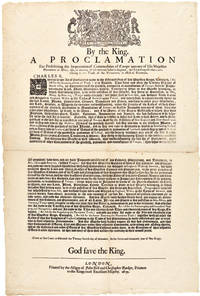
1675WRCAM45901London: Printed by the Assigns of John Bill and Christopher Barker 1675. Broadside 22 x 14 1/2 inches printed on two sheets. Old fold lines. Repaired with tissue on verso along vertical fold. A few other small tears or tissue repairs. Very good. A rare broadside announcing the decree of the English government that all foreign goods destined for British colonies must first pass through England a policy of mercantilism later termed the "triangle trade." "This program permitted the profits from colonial trade and commerce to center in England promoted British shipping and enabled the British government to support itself by taxing this trade as it flowed through England" - DAH. <br> <br> The English government began its mercantilist policies under the Commonwealth government in a series of "navigation acts" which regulated English trade. The first Navigation Act passed in 1651 targeted Dutch commerce. It stipulated that only English ships could carry freight into English territories and that if a ship was not English it could only carry goods from the country from whence it hailed i.e. Dutch ships could only import Dutch goods etc. Acts passed in 1660 and 1663 under the Restoration government of Charles II isolated trade even further mandating that British colonial goods only be imported to England and forbidding English trade on anything other than English vessels. This policy of trade which was continued for the next two hundred years marked the ascent of British colonial mercantilism and planted the seeds of discontent which resulted in the American Revolution one hundred years later. <br> <br> The present proclamation is an enforcement of the Navigation Act of 1663 An Act for the Encouragement of Trade under which "no commodities of the growth production or manufacture of Europe shall be imported into any land island plantation colony territory or place to his Majesty belonging." In other words all European trade to the American and East Indian colonies of the English had to pass through English ports en route. As the law is being disobeyed to the detriment of trade and tax revenue the proclamation extends power for enforcement to the officials of the realm. It states: <br> <br> "whereas his Majesty is well informed that notwithstanding the said Act of Parliament great quantities of other commodities.have been and are daily imported into several of his colonies plantations and territories in Asia Africa and America.and that his Majesties subjects of some of his colonies and plantations have not onely sic supplied themselves with such commodities not shipped in England.but have conveyed them by land and water to other of his Majesties colonies and plantations to the great prejudice of his Majesties customs and of the trade and navigation of this kingdom." <br> <br> An important proclamation which illustrates the difficulty in maintaining and enforcing the laws central to the first British Empire. ESTC R25339. WING C3378. GOLDSMITHS' 2112. STEELE I:3619. KRESS S1421. DAH III p.374. Printed by the Assigns of John Bill and Christopher Barker unknown books
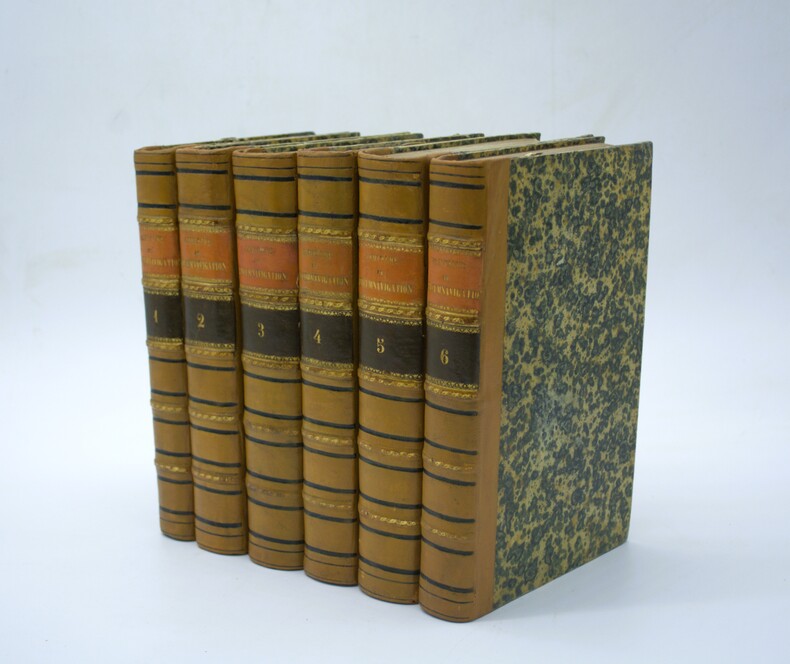
1841PHO-2262Paris, Arthus Bertrand, 1841-1842-1844-1848-1853-1854. 6 vol. in-8° de XXIX, 1 bl., 343 pp., [2] ff., Front., 6 pl. h.-t. et 1 carte dé pl. ; 467 pp., [2] ff. Font., 4 pl. h.-t. et 1 carte ; 548 pp., [1] f. Front. et 5 pl. h.-t. ; 464 pp., [2] ff. 4 pl. h.-t. ; III, 1 bl., 542, [2] pp. 4 pl. h.-t. ; 400 pp. Font. et 5 pl. h.-t. demi-basane fauve, dos à 5 faux-nerfs, p ; de t. en maroquin orange, p. de tomaison en maroquin brun, tranches mouchetées (Reliure du temps). Édition originale, bien complète du sixième volume consacré à la Californie qui manque souvent. 31 pl. gravées sur acier (complet) et 2 cartes dépliante, au Tome IV, la pl. du « Fort de Cornouailles » est reliée en frontispice du tome VI. Des rousseurs et quelques planches brunies.
1787162443London: Printed by Charles Eyre and Andrew Strahan 1787 i.e. 1788. Among the earliest Parliamentary responses to the British slave trade First edition of the first British law to regulate slave shipping preserved in its original volume of yearly parliamentary acts. The law bound 54th in this volume pioneered techniques of popular abolitionist appeal. The Slave Trade Act 1788 limited the number of enslaved persons that could be transported on British ships. It also required that all ships carried a doctor to monitor the conditions of the enslaved persons. The Act was supported through Parliament by Sir William Dolben 1727-1814 and Charles Stanhope 1753-1816. LoGerfo notes of their campaign that "the machinery used to appeal to the literate public would also be used in the future" p. 450. This volume collects 57 acts passed by the 16th Parliament of Great Britain which met from November 1787 to July 1788 and was led by Pitt the Younger. Like all Parliamentary statutes of this period the Slave Trade Act was separately printed with a general title page for inclusion in the yearly volumes of acts. Most of these statutes were printed with their own title pages included in the signatures and pagination - here all such pages have been removed. These laws were printed in limited numbers usually estimated at around 1100 copies only. The volume includes laws against chimney sweeps and child labour and measures to compensate dispossessed American loyalists in the years after the Revolution. Folio 304 x 191 mm pp. 1012 = 900 title pages of individual acts removed. Woodcut device to title page woodcut head- tailpieces and initials to contents. Contemporary quarter sheep spine lettered and with black morocco label in gilt marbled paper sides. Bumping and wear minor loss to spine ends joints cracked but holding firm slight browning and foxing to endpapers and contents slight marking to edges: a good copy. ESTC N58828; N58797 Slave Trade Act. James W. LoGerfo "Sir William Dolben and "The Cause of Humanity": The Passage of the Slave Trade Regulation Act of 1788" Eighteenth-Century Studies Vol. 6 No. 4 Jun. 1973. unknown
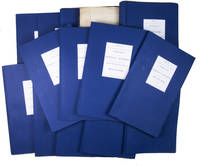
1837ABC_47982London 1837. Folio 32 x 20.5 cm. William Clowes 1837-1845; T. R. Harrison 1848-1872. Later stiff blue paper wrappers with white title-label on the front cover blue sprinkled edges. Ad. 11 in beige paper wrappers. With several tables of data. 14 volumes. Rare collection of 14 volumes containing transcriptions of British diplomatic correspondence with other countries relating to the slave trade in the 19th century printed for the British government. Although slavery in the British Empire was abolished in 1807 enslaved people in the colonies were not freed until 1838. In the present volumes which mostly date from 1837-1846 directly after slavery was abolished in most British colonies the British government urges other countries to help put a halt to the now illegal slave trade. The present collection contains the correspondence between Britain and numerous countries in Europe the Americas and North Africa especially France Spain the United States and Austria. The letters describe the ships carrying enslaved people in detail also mentioning their ports of call so they could be more easily found and stopped. Of particular interest are the transcriptions of slave trade acts from various countries as well as the treaties between France and chiefs in African colonies which are difficult to find in print anywhere else.The letters reveal the profound change in attitude towards slavery in the middle of the 19th century. The tone of the correspondence with countries that were quick in abolishing slavery like Denmark is very different than that of the countries that were much slower like the Netherlands and various countries in Latin America. However the letters especially make clear how difficult it must have been to find and stop the ships that were illegally carrying enslaved people. The owners of the vessels often hid their illegal practices behind obscure transactions and renamings which made finding them arduous and sometimes dangerous. It was the task of British commissioners and naval officers to try to uncover the network behind the Atlantic slave traders and bring them to justice. By collaborating with other countries the courts succeeded in the condemnation of over 600 vessels engaged in the slave trade and the liberation of nearly 80000 enslaved people.Ad 11 with blue library stamp on the title-page "Bibliothèque du palais de la paix". All volumes in good to very good condition some very slight browning and foxing some marginal notes in most volumes. unknown
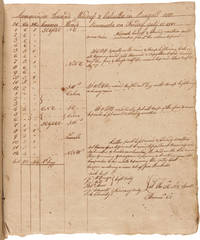
1796WRCAM54712Mostly at sea from New York with stops in Calcutta Saint Helena Ascension Island and Cornwall England 1796. 246pp. Square folio. Original crude burlap covers stab-sewn with thick string. A bit toned and foxed occasional ink or tobacco burns. Very good. A remarkable artifact of early American naval commerce containing the sailing directions and shipboard activities of the "Ship Washington of Philadelphia" which sailed from New York to Calcutta rounding the southern tip of Africa and visiting Saint Helena and Ascension Island before crashing on the rocks at Cornwall England on the way to Hamburg Germany. The log contains a navigational ledger with locations headings wind and weather remarks along with occasional sick lists names of men "unfit for duty" those put on light duty temperatures and other information. The remarks are quite detailed and specific regarding shipboard work and activity. <br> <br> The captain of this final voyage of the ship WASHINGTON was Samuel Hubbart but the identity of the sailor who kept this log is unknown. The ship departed New York on July 4 1795 and reached Calcutta on August 31. Without the need for recording navigational data while in port the log's author switches from the ledger-style format and writes longer more-detailed daily entries describing the crew's activities. The crewmen mentioned include pilots boatswains carpenters coopers caulkers sailmakers and others. Most of the entries pertain to the maintenance of the ship while anchored in the bay. Numerous mentions are made of crew on board fixing various equipment including types and amounts of supplies. A few entries note the employment of Indian "Cooleys" on board the ship making various repairs. An interesting incident of September 17 bears relating: <br> <br> "Hearing a noise upon the main Deck Mr. Naylor went to see what was the matter - upon engaging found Abraham Moor had struck Thomas Williams the Cook as Moor said for wanting to trouble a girl which Moor had on board - Mr. Naylor told him he should not ill use that man for he had every reason to believe it to be false what he alledged against the Cook. Moor said he did not come here to be jawd by a black Man.S." <br> <br> After swearing he would "never go home" on the WASHINGTON Moor literally jumped ship just after this confrontation and hid on another ship before being found and brought back to the WASHINGTON "in irons." <br> <br> In early November a few entries mention the ship receiving a supply of sugar taking on "Three Burr Load of Sugar" on November 7 and two more "Burr Load" two days later. Subsequent entries detail the loading of several "Burr Load of Bales" and "one hundred bags of ginger." <br> <br> Over the course of the ship's time at Calcutta the author mentions encounters with at least four other American ships: the GANGES the HAMILTON the MAJOR PINKNEY of Charleston and the "American Ship Camilla of New York arriv'd here from London." <br> <br> By early February the WASHINGTON left Calcutta for the voyage to Hamburg spelled variously here as "Hamborough" and "Hamburgh" though the ship would never make it to Germany. On March 15 and again on April 6 the recordist notes an inventory of the ship's water supply. By March 23 the ship reaches a point "prependicular on Cape Lagulas Bank" the southernmost point of Africa. About a week later the punishment of a drunken sailor is reported: <br> <br> "Joseph Gonrabbysp who has for some time past been addicted to Drunkeness and no person on board having given him any liquor he was discovered this morning to have taken from the Ships stores about half a Gallon of rum and from his being frequently very drunk there is no doubt of his having been Guilty of the same offence before for which Capt. Hubbart is necessitated to order his Boatswain to flog him. Accordingly mustered all hands aft and give him one and a half dozen lashes." <br> <br> On April 16 the WASHINGTON arrived at the remote island of Saint Helena in the South Atlantic Ocean sending "the Boat on shore with an Officer to the Governor for permission to Anchor." Here the WASHINGTON restocked supplies including water potatoes & other vegetables rice and bread before embarking for Ascension Island which they reached on April 25. The author remarks on the "number of remarkable rocks like pyramids" and "a low point of black Rocks with a fine white sandy beach back of it" witnessed at Ascension Island. The WASHINGTON spent one night at Ascension where a group of men went ashore in order to "spend the Night in Catching Turtle in the different Bays." The crewmen caught twelve turtles and brought them aboard ship before continuing their journey. <br> <br> While heading north to Europe the WASHINGTON was boarded on May 17 by the "Quebec British Frigate Cap J Cook in Company with the Carnatic 74 Rear Admr Powel with a convoy of 21 sail of Transports & Gun boats with 10000 Troops on board bound for Martinico Martinique." On June 7 they again encounter another ship "a Spaniard from some port in South America bound for Cadiz out 3 months & 10 days - we cannot understand rightly what port she was from." <br> <br> Then on June 18 disaster struck the WASHINGTON as it ran aground at the Lizard Rocks off Cornwall England. The log book records the ship's demise: <br> <br> "The weather still very thick and hazy. At 9PM hearing the Surf break on shore took in all the studding sails Braced the Yards sharp and hauled to the Southward finding ourselves in amongst the Rocks off the Lizard have all aback and endeavored to get her out from among them but the Flood tide making very strong drove the Ship so hard upon the Rocks that with every endeavour we found it impracticable to get her off she having settled on them & the strength of the tide Thumping her very hard upon the Rocks sounded the Pump and found she made water very fast. Fired several Guns as a signal of Distress which brought several boats off from the Shore to our assistance." <br> <br> For the next couple of weeks the crew of the WASHINGTON participated in "discharging the cargo" from the ship so that it is not "plundered by the natives" sending everything to Falmouth "where the Goods are deposited under the protection of a Custom house Yaught." The log book mentions one crewman of the WASHINGTON "threatening revenge on Captain Hubbart." Another crewman is put "under a Guard of Soldiers" after selling off some of the muslin stored in the bales rescued from the wreck. Here the ship's log ends along with the career of the Ship WASHINGTON. <br> <br> A unique record of the last voyage of an early American trading vessel with insight into late 18th-century navigational methods and the commercial interests of Federal-era America. unknown books
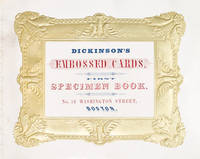
1842232013Boston: Samuel N. Dickinson 1842. Printed title in blue and red within an embossed gilt ornamental frame one printed "Notice" from the publisher dated June 1842 49 specimens of embossed cards many tinted some printed all mounted to stiff card stock; and 7 sheets of "Embossed Specimens of Printed Billets" sewn to a stiff printed card. Oblong 4to. Bound in an album of contemporary half calf and marbled paper boards with red leather label on upper cover stamped in gilt "Dickinson's Embossed Cards" calf shows much deterioration and corrosion although the sewing is still intact 28 specimen cards have been removed and are no longer present some minor soiling and foxing but generally vey clean and sound internally custom morocco backed folding box. Printed title in blue and red within an embossed gilt ornamental frame one printed "Notice" from the publisher dated June 1842 49 specimens of embossed cards many tinted some printed all mounted to stiff card stock; and 7 sheets of "Embossed Specimens of Printed Billets" sewn to a stiff printed card. Oblong 4to. With a very interesting presentation note from a previous Philadelphia owner Alfred Darrach dated 1928 affixed to the front pastedown identifying the original owner his grandfather as Christian Gobrecht 1785-1844 artist engraver embosser inventor engraver to the U.S. Mint and from 1840-1844 the 4th United States Engraver of the Mint where he was responsible for the creation of several new models and designs including the famous Seated Liberty design which appeared on a variety of American coins from 1836 through 1890. <br /> Gobrecht designed many notable medals coins and dies during his career but he also "invented a speaking doll and later a camera lucida. He also produced engravings for calico printers and dies for bookbinders. He engraved the brass dies for embossing the Morocco covers of the Boston Token from 1831 - 1836 as well as the eagle cover of the Philadelphia Token. Among the medals he engraved were the Charles Willson Peale medal the Franklin Institute medal etc ." - DAB.<br /> A remarkable specimen album in and of itself all the more so for having belonged to one of America's most important engravers. We cannot say for sure but it is entirely likely that if Gobrecht himself did not design many of the dies for this embosser he may have used the album for his own work and possibly removed the cards which are no longer present. Samuel N. Dickinson unknown
1842232013Boston: Samuel N. Dickinson 1842. Printed title in blue and red within an embossed gilt ornamental frame one printed "Notice" from the publisher dated June 1842 49 specimens of embossed cards many tinted some printed all mounted to stiff card stock; and 7 sheets of "Embossed Specimens of Printed Billets" sewn to a stiff printed card. Oblong 4to. Bound in an album of contemporary half calf and marbled paper boards with red leather label on upper cover stamped in gilt "Dickinson's Embossed Cards" calf shows much deterioration and corrosion although the sewing is still intact 28 specimen cards have been removed and are no longer present some minor soiling and foxing but generally vey clean and sound internally custom morocco backed folding box. Printed title in blue and red within an embossed gilt ornamental frame one printed "Notice" from the publisher dated June 1842 49 specimens of embossed cards many tinted some printed all mounted to stiff card stock; and 7 sheets of "Embossed Specimens of Printed Billets" sewn to a stiff printed card. Oblong 4to. Christian Gobrecht's Copy. With a very interesting presentation note from a previous Philadelphia owner Alfred Darrach dated 1928 affixed to the front pastedown identifying the original owner his grandfather as Christian Gobrecht 1785-1844 artist engraver embosser inventor engraver to the U.S. Mint and from 1840-1844 the 4th United States Engraver of the Mint where he was responsible for the creation of several new models and designs including the famous Seated Liberty design which appeared on a variety of American coins from 1836 through 1890. <br/>Gobrecht designed many notable medals coins and dies during his career but he also "invented a speaking doll and later a camera lucida. He also produced engravings for calico printers and dies for bookbinders. He engraved the brass dies for embossing the Morocco covers of the Boston Token from 1831 - 1836 as well as the eagle cover of the Philadelphia Token. Among the medals he engraved were the Charles Willson Peale medal the Franklin Institute medal etc ." - DAB.<br/>A remarkable specimen album in and of itself all the more so for having belonged to one of America's most important engravers. We cannot say for sure but it is entirely likely that if Gobrecht himself did not design many of the dies for this embosser he may have used the album for his own work and possibly removed the cards which are no longer present. Samuel N. Dickinson unknown books
191498381914. Presentation album promoting the work of the pioneering printing firm including unpaginated 16 pp. introductory text printed in blue black silver and white within elaborately ornamented borders and 12 mounted samples of work by the firm including publicity brochures advertisements pamphlets stationery and other items most in striking colors compositions and formats with descriptions on decorative tissue guards. Folio. Orig. ornamental cloth front cover a bit warped. Berlin n.d. circa 1914. A spectacular publication reflecting the firm's originality creativity and great attention to detail presenting striking designs for publicity material epitomizing later manifestations of Jugendstil aesthetics. hardcover books
19082080202102900126Not Available 1908. Soft Cover. Fine. Books: 13 books Not Available paperback
172341374A Paris, chez Jacques Estienne, 1723. 2 vol. in-folio de (8)-XXVIII pp. 2002 col. (2) pp. pour le tome I; (4)-1956 col. pour le tome II, maroquin rouge, dos orné à nerfs, triple filet doré sur les plats, armes frappées au centre, tranches dorées sur marbrure (reliure de l'époque).
17209An X - 1802. Bound in 8 volumes. 8vo. Seven volumes bound in contemporary half calf, with gilt lettering, contrasting labels with gilt lettering, one volume in modern boards. Under the Bourbon's the controller-general's office had long sought quantative information about the French population and economy. By mid-eighteenth century, it was receiving from the intendant's subdelegates bi-weekly reports of the market prices of grains, bread, vegetables, meat, wool, linen, and iron and from the inspectors of manufactures semiannual reports on the production of woolen, cotton, and linen cloth. From time to time it conducted also special statistical inquiries on mining, metallurgical industries, paper manufactures, tanneries, forests, and hemp and on population (births, marriages and deaths). After many interruptions during the Revolution, the governments of the Directory, the Consulate and Empire intensified this statistical effort. Lucien Bonaparte and Jean Chaptal, Bonaparte's second and third ministers of interior, established the Bureau of Statistics, which lasted until 1812. Under an imaginative minister of interior, Chaptal, and a zealous bureau chief, Alexander de Férrière, it launched a massive statistical description of France in 1801. Prefects of each department were instructed to secure from subprefects, mayors, and local savants and societies of agriculture detailed descriptive (verbal) and quantative data on the topography, population, agriculture, industry, and commerce of their jurisdiction in 1789 and 1801. This was to be a vast cooperative inquiry with a twofold purpose: to discover what change had occured during the Revolution and to establish for 1801 a cross-sectional description of France from which later demographic and economic movement could be measured. However, the reports came in slowly or not at all. Only thirty-five were ultimately submitted, and they were uneven in completeness and accuracy. Contains: Seine-et-Oise, par Garnier. (2), 39, (1) pp. (Perrot 658).Orne, par Lamagdeleine. (2), 56 pp. (Perrot 483).Sarthe par, L.M. Auvray. With 4 folding tables. (2), 254 pp. (Perrot 613).Ille-et-Villaine, par Borie. (2), 56 pp. (Perrot 288).Loire-Inférieure, par J.B. Huet. (2), 70 pp. (Perrot 351).Deux-Sèvres, par Dupin. With 2 folding tables. (2), 177 pp. (Perrot 666).Vendée, par P.L.C. Labretonnière. With 8 folding tables. 130 pp. (Perrot 706).Lot-et-Garonne, par Pieyre fils. (2), 64 pp. (Perrot 365).Gers, par Balguerie (2), 61 pp. (Perrot 256).Tarn, par Lamarque. (2), 101 pp. (Perrot 683).Aude, par Barande. With one folding table. (2), 26 pp. (Perrot 79).Lozère, par Jerphanion. (2), 79 pp. (Perrot 370).Var, par Fauchet. With 3 folding tables. 121 pp. (Perrot 691).Drôme, par Colin. (2), 48 pp. (Perrot 193).Hautes-Alpes, par Bonnaire. (2), 113 pp. (Perrot 32).Mont-Blanc, par Saussay. (2), 126 pp. (Perrot 423).Rhône, par Verninac. With one folding table. (2), 129 pp. (Perrot 566).Allier, par Huguet. (2), 68 pp. (Perrot 20).Cher, par Luçay. (2), 84 pp. (Perrot 149).Aube, par Bruslé. With one folding table. 116 pp. (Perrot 70).Marne, par Bourgeois-Jessant. (2), 129 pp. (Perrot 390).Aisne, par Dauchy. With 13 folding tables. (2), 144 pp. (Perrot 14).Bas-Rhin, par Laumond. 284 pp. (Perrot 536).Vosges, par Desgouttes. With 4 folding tables. 111 pp (lacks the title). (Perrot 723).Vienne, par Cochon. (2), 97 pp. (Perrot 714).