5 414 résultats
24854A Londres, Chez Fletcher Gyles, dans Holborn, 1755. (4), 430, (6, Table des Chapitres) pp. 12mo. Contemporary half calf, spine gilt in compartments, gilt lettering, floral ornament in each compartment, green paper covered boards, all edges red. Kress 5423; Goldsmiths 8989; Einaudi 846; INED 933; Higgs 938; En Français dans le Texte, 159; Leblanc 57; Antoin E. Murphy, Richard Cantillon: entrepreneur and economist; T. Hutcheson, Before Adam Smith, pp. 163-178. First edition of Cantillon's great work, 'the most systematic statement of economic principles before Adam Smith's Wealth of Nations' (Roll, p. 121). 'The economic repute of Cantillon, for a time completely obscured by the glory of Adam Smith, can never have rested upon the popularity of his little book, now one of the scarcest works in economic literature .. The influence of the book is evidenced not only by the number but by the distinction of its students, including Gournay, Quesnay, Mirabeau, Turgot, and Adam Smith. It gave birth to Mirabeau's l'Ami des Hommes and apparently suggested much of the Tableau Oeconomique of Quesnay and parts of the Wealth of Nations .. Cantillon avoided, as Jevons has pointed out, the one-sidedness of the Physiocrats; and yet has been marked out as a Physiocrat .. Jevons thought Cantillon wrote 'with the scientific precision of a Cairnes or a Cournot,' and Prof. Marshall refers to his 'thoroughly scientific manner of discussion' .. In France the Essai has been pretty continuously read (see e.g. Ganilh, Des Systèmes d'Economie Politique, 2d. ed. 1821), and so stimulating and suggestive does it remain that its direct influence may be found to be not yet exhausted' (Palgrave, i, pp. 214f). Roll has called this work 'the most systematic statement of economic principles, before the Wealth of Nations' (History of Economic Thought, p. 121).Cantillon, a French banker of Irish extraction, was influenced by Petty, but his own influence was principally felt by the Physiocrat school: Higgs maintains that Quesnay took his fundamental principle of Physiocracy from the Essai. The Essai was written about 1730 and circulated in manuscript. Cantillon died in 1734 and the work was first published in 1755 in French, not in English, as stated on the title.The Essai has been quoted by Smith, Condillac, and Quesnay, plagiarised by Harris and Postlethwayt, and called by Jevons 'more emphatically than any other single work the cradle of political economy'. The work is divided into three sections: a general introduction to political economy, a treatise on currency, and a study of foreign commerce and exchange.'Since the 'discovery' of Cantillon by the English-speaking world following Jevons's enthusiastic article (1881), no less than justice has been done to the merits of the Essay .. Jevons himself noted that Cantillon had presented a treatment of currency, foreign exchanges, banking and credit which, judged against the work of its period, he felt to be 'almost beyond praise' .. It was likewise recognized as early as Jevons that Cantillon had set out the leading ideas of Adam Smith's 'important doctrine concerning wages in different employments' .. and that the Essay contained .. 'an almost complete anticipation of the Malthusian theory of population' (The New Palgrave, i, p. 318). - A very good copy.
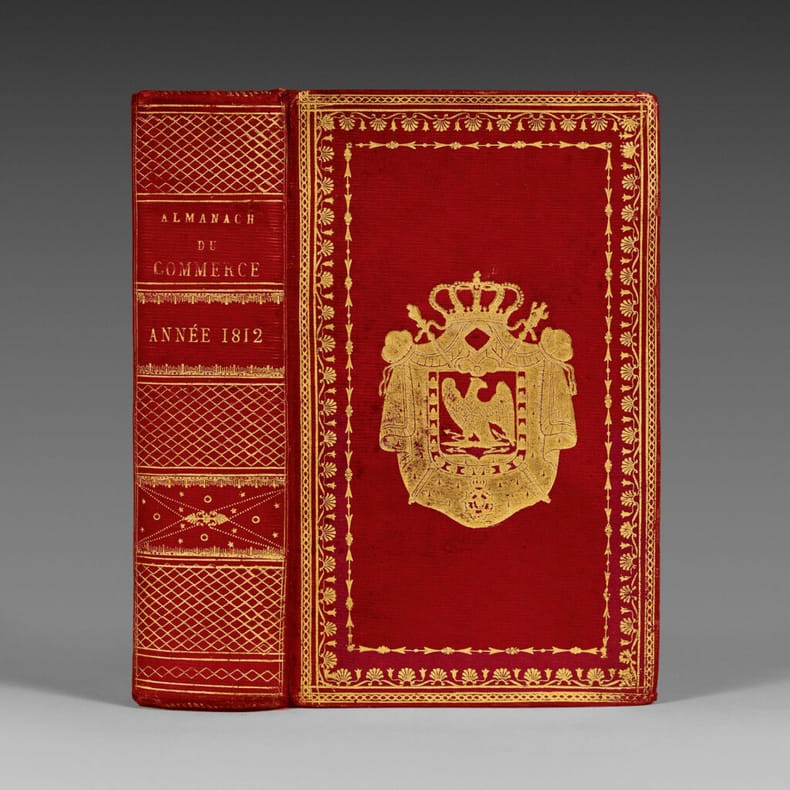
LCS-18198L’Almanach du Commerce pour l’année 1812 relié en maroquin rouge de l’époque aux armes de l’Empereur Napoléon Ier. Paris, chez J. de la Tynna, Propriétaire-Rédacteur, rue J. J. Rousseau, n° 20. In-8 de 1039 pp. Plein maroquin rouge, encadrement de filets et roulette dorés autour des plats, armoiries de l’Empereur Napoléon Ier au centre des plats, dos lisse richement orné, coupes décorées, doublures et gardes de tabis bleu, tranches dorées. Reliure armoriée de l’époque. 211 x 129 mm.
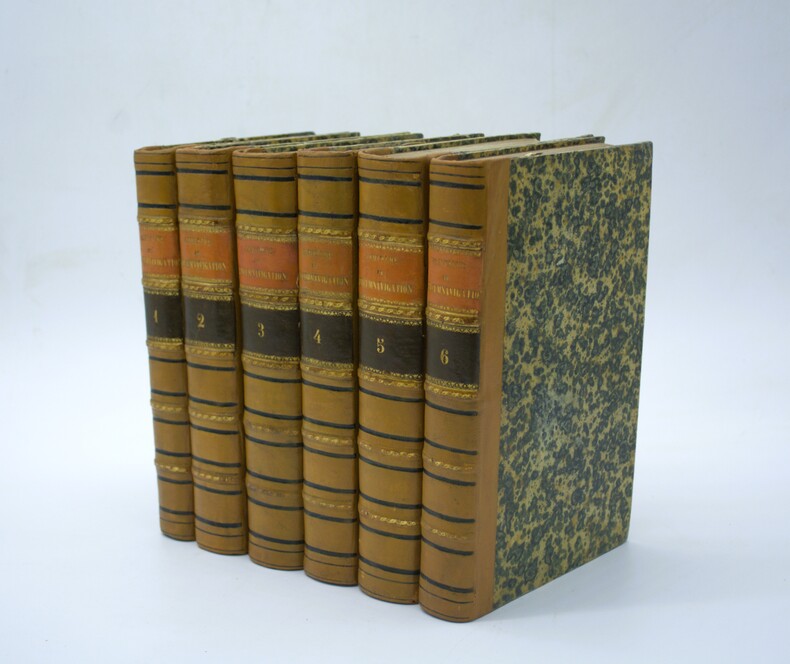
1841PHO-2262Paris, Arthus Bertrand, 1841-1842-1844-1848-1853-1854. 6 vol. in-8° de XXIX, 1 bl., 343 pp., [2] ff., Front., 6 pl. h.-t. et 1 carte dé pl. ; 467 pp., [2] ff. Font., 4 pl. h.-t. et 1 carte ; 548 pp., [1] f. Front. et 5 pl. h.-t. ; 464 pp., [2] ff. 4 pl. h.-t. ; III, 1 bl., 542, [2] pp. 4 pl. h.-t. ; 400 pp. Font. et 5 pl. h.-t. demi-basane fauve, dos à 5 faux-nerfs, p ; de t. en maroquin orange, p. de tomaison en maroquin brun, tranches mouchetées (Reliure du temps). Édition originale, bien complète du sixième volume consacré à la Californie qui manque souvent. 31 pl. gravées sur acier (complet) et 2 cartes dépliante, au Tome IV, la pl. du « Fort de Cornouailles » est reliée en frontispice du tome VI. Des rousseurs et quelques planches brunies.
178976951789 (vers 1789-1793). 7 volumes in-8, cartonnage orange de l'époque. Infimes rousseurs.
172341374A Paris, chez Jacques Estienne, 1723. 2 vol. in-folio de (8)-XXVIII pp. 2002 col. (2) pp. pour le tome I; (4)-1956 col. pour le tome II, maroquin rouge, dos orné à nerfs, triple filet doré sur les plats, armes frappées au centre, tranches dorées sur marbrure (reliure de l'époque).
17209An X - 1802. Bound in 8 volumes. 8vo. Seven volumes bound in contemporary half calf, with gilt lettering, contrasting labels with gilt lettering, one volume in modern boards. Under the Bourbon's the controller-general's office had long sought quantative information about the French population and economy. By mid-eighteenth century, it was receiving from the intendant's subdelegates bi-weekly reports of the market prices of grains, bread, vegetables, meat, wool, linen, and iron and from the inspectors of manufactures semiannual reports on the production of woolen, cotton, and linen cloth. From time to time it conducted also special statistical inquiries on mining, metallurgical industries, paper manufactures, tanneries, forests, and hemp and on population (births, marriages and deaths). After many interruptions during the Revolution, the governments of the Directory, the Consulate and Empire intensified this statistical effort. Lucien Bonaparte and Jean Chaptal, Bonaparte's second and third ministers of interior, established the Bureau of Statistics, which lasted until 1812. Under an imaginative minister of interior, Chaptal, and a zealous bureau chief, Alexander de Férrière, it launched a massive statistical description of France in 1801. Prefects of each department were instructed to secure from subprefects, mayors, and local savants and societies of agriculture detailed descriptive (verbal) and quantative data on the topography, population, agriculture, industry, and commerce of their jurisdiction in 1789 and 1801. This was to be a vast cooperative inquiry with a twofold purpose: to discover what change had occured during the Revolution and to establish for 1801 a cross-sectional description of France from which later demographic and economic movement could be measured. However, the reports came in slowly or not at all. Only thirty-five were ultimately submitted, and they were uneven in completeness and accuracy. Contains: Seine-et-Oise, par Garnier. (2), 39, (1) pp. (Perrot 658).Orne, par Lamagdeleine. (2), 56 pp. (Perrot 483).Sarthe par, L.M. Auvray. With 4 folding tables. (2), 254 pp. (Perrot 613).Ille-et-Villaine, par Borie. (2), 56 pp. (Perrot 288).Loire-Inférieure, par J.B. Huet. (2), 70 pp. (Perrot 351).Deux-Sèvres, par Dupin. With 2 folding tables. (2), 177 pp. (Perrot 666).Vendée, par P.L.C. Labretonnière. With 8 folding tables. 130 pp. (Perrot 706).Lot-et-Garonne, par Pieyre fils. (2), 64 pp. (Perrot 365).Gers, par Balguerie (2), 61 pp. (Perrot 256).Tarn, par Lamarque. (2), 101 pp. (Perrot 683).Aude, par Barande. With one folding table. (2), 26 pp. (Perrot 79).Lozère, par Jerphanion. (2), 79 pp. (Perrot 370).Var, par Fauchet. With 3 folding tables. 121 pp. (Perrot 691).Drôme, par Colin. (2), 48 pp. (Perrot 193).Hautes-Alpes, par Bonnaire. (2), 113 pp. (Perrot 32).Mont-Blanc, par Saussay. (2), 126 pp. (Perrot 423).Rhône, par Verninac. With one folding table. (2), 129 pp. (Perrot 566).Allier, par Huguet. (2), 68 pp. (Perrot 20).Cher, par Luçay. (2), 84 pp. (Perrot 149).Aube, par Bruslé. With one folding table. 116 pp. (Perrot 70).Marne, par Bourgeois-Jessant. (2), 129 pp. (Perrot 390).Aisne, par Dauchy. With 13 folding tables. (2), 144 pp. (Perrot 14).Bas-Rhin, par Laumond. 284 pp. (Perrot 536).Vosges, par Desgouttes. With 4 folding tables. 111 pp (lacks the title). (Perrot 723).Vienne, par Cochon. (2), 97 pp. (Perrot 714).
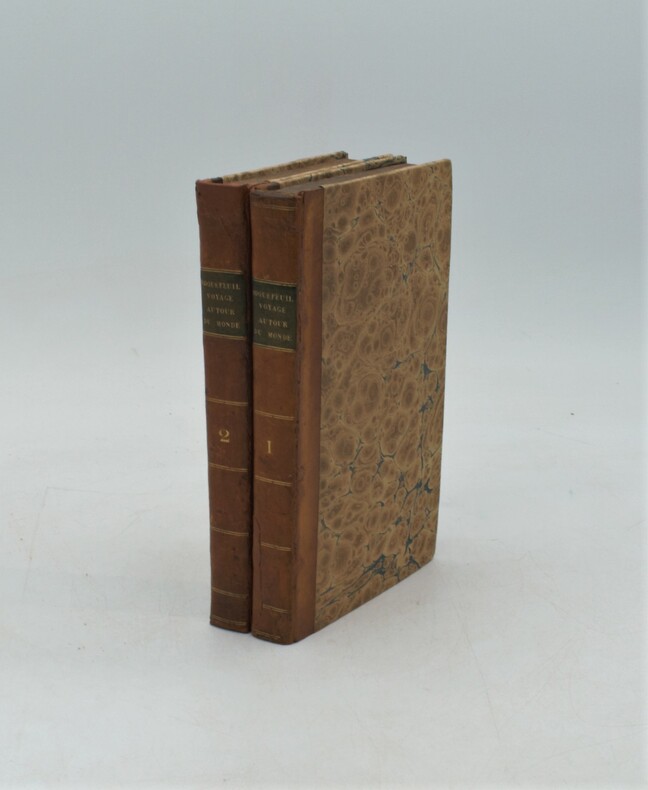
1823PHO-2006Paris, Ponthieu, Lesage, Gide fils, 1823. 2 volumes in-8, xlix, [1]. 344 ; [4], 407 pp., relié demi basane époque, dos lisse orné avec pièce de titre olive et tomaison, ex-libris Jacob Fagel, réparations, quelques rousseurs. Chadenat, n°1196. - Forbes, n°569. - Sabin, n°73149.
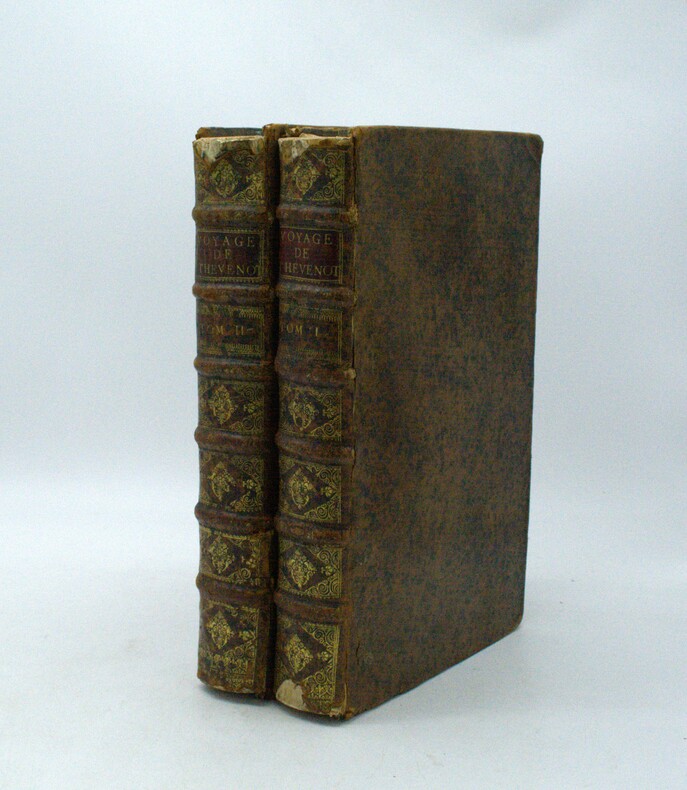
1696PHO-1981Paris, Thomas Moette, 1696 ; 5 parties en 2 vol. in-folio (37x23,5cm), veau marbré, dos à nerfs richement orné de motifs dorés avec tomaison et pièce de titre grenat, quelques frottements, charnières fendillées, manque au dos, coins usés, coiffes absentes, 8 feuillets détachés, rousseurs, qlqs feuillets brunis. L’illustration comporte de nombreuses gravures et illustrations dans et hors texte, 6 cartes dont la carte de l’Indostan, de la Colchide, du Japon (qui regarde l’Amérique), carte de la route du voyage de Canton à Péking, carte de l’Éthiopie, carte de l'Éthiopie ["Entrée de quelques ports…"]. Il manque la Carte de Bassorah, les 2 planches de caractères Chaldéens, la carte de l’Australie, la carte des côtes d’Arabie et d’Asie, la carte des Costes de Sierlionne, la carte des Philippines et Chine, la carte de Chine
46680aafGenève, Jean-Léonard Pellet, 1780 (i.e. April 1781), in-4°, 4 (de 5) front. dont le portrait de l'auteur, avec atlas de 2 ff. + 28 p. + 23 tables dont 12 repl., 50 doubles cartes (num. 1 à 49 plus 17bis), qqs traces d'eau et de lég. taches princip. marginales plus fortes vers la fin du tome 4, belles reliures en veau marbré à nerfs, dos richement ornés en or, pièces de titre et tomaison bordeaux et vertes aux dos, encadrement d'un triple filet doré sur les plats, qqs frottements , tranches marbrées, restaurations professionelles aux reliures.
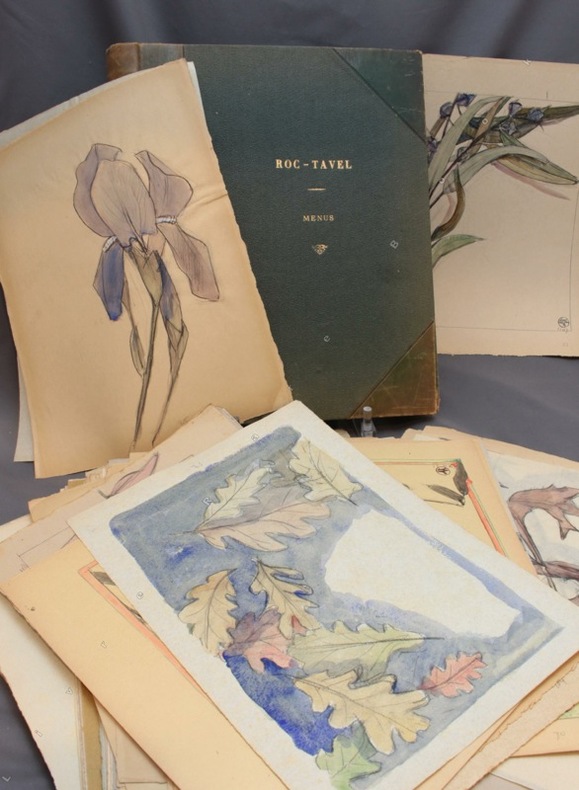
10630[Le Cannet], [1901 - 1927]. Important ensemble de 330 aquarelles, empreintes et dessins originaux d'Auguste Tavel, ayant pour motifs des compositions végétales. La plupart devaient servir pour des menus. Ainsi 74 feuillets sont non seulement décorés, mais ils sont datés, le menu y est inscrit à l'aquarelle, et les noms des invités figurent souvent au verso, avec le plan de table. L'artiste a utilisé des papiers de différentes teintes et textures. Presque chaque feuillet porte le tampon de Tavel. L'ensemble n'est pas relié, mais conservé sous une reliure portant la mention "Roc-Tavel - Menus" au dos et sur le premier plat.
15440A La Haye, Chez Pierre de Hondt, 1739. Titles printed in red and black, with folding table on two sheets and 1 engraved plate. 6 volumes in 3. (2), 204 pp.; (2), 312 pp.; (2), 208 pp.; (2), 286 pp.; (14), 294 pp.; (18), 246 pp. Small 8vo. Modern overlapping vellum, red morocco labels. Kress 4447; Goldsmiths 7712; Einaudi 3728; INED 1553; Mattioli, 2247; Conlon 39:427; JFBL M162; European Americana, 739/191; not in Sabin. The only edition of this important work. An account of the financial operations of John Law and his 'Compagnie des Indes', including a great number of important memoirs, letters patent, decrees, declarations, etc. Barthélemy Marmont du Hautchamp (1682 - ab. 1760) was an admirer of John Law's system and his book is not written without partiality but has yet been recognized as the best contemporary history of the system and its most precious source. John Law's operations began with the foundation in 1716 of the 'Banque Générale', soon afterwards renamed 'Banque Royale'. This was followed by the scheme of colonization known as 'Mississippi scheme' in the 'Compagnie des Indes' which, by absorbing various other chartered companies, acquired the monopoly on the trade to America, Africa and China. Moreover, the company obtained the monopoly of tobacco, the control of the mint, the payment of the national debt, and the farm of the taxes. Within a few years Law's companies thus got almost complete control over France's overseas trade, its currency and public finances, to the extend that Law's companies at one point owned more than half of the then known United States. In 1719 the 'Compagnie des Indes' and the 'Banque Royale' were united, and the promising outlooks of the new company lead to an unprecedented speculation in its shares. As known the bubble burst in 1720, cash payments were suspended and Law fled from the country, leaving behind ruined many of his former supporters.The last 2 volumes contain the full texts of the 'mémoires', 'letters patentes', 'édits', 'déclarations', 'arrêts', etc., mostly by the Conseil d'État, as well as many other documents of which many are dealing with the 'Compagnie d'Occident', and the 'Compagnie des Indes Orientales et de la Chine', on which documents the author based this thorough and important history.Marmont du Hautchamp was born in Orléans and fermier des domaines in Flanders. He was also the author of the famous and very rare Histoire générale et particulière du visa (also published in The Hague, in 1743) which also dealt with the activities of John Law and the Mississippi bubble.
17687223Amsterdam & Paris, Desaint, 1768. Cinq ouvrages en un volume in-8 (195 x 124 mm), IV pp., 162 pp., 3 tables dépl.; 48 pp.(interversion du texte avec le quatrième ouvrage à partir du cahier C); 8 pp.; 8 pp.; un tableau dépl., 147 pp. et 1 p. n. ch.; 2 ff. n. ch., 314 pp., 1 f. n. ch. Veau porphyre, triple filet doré en encadrement sur les plats, dos à nerfs orné de caissons avec pièce d'armes au cerf doré répété, pièces de titre vert foncé et rouge, coupes filetées, tranches marbrées, habiles restaurations (reliure de l’époque).
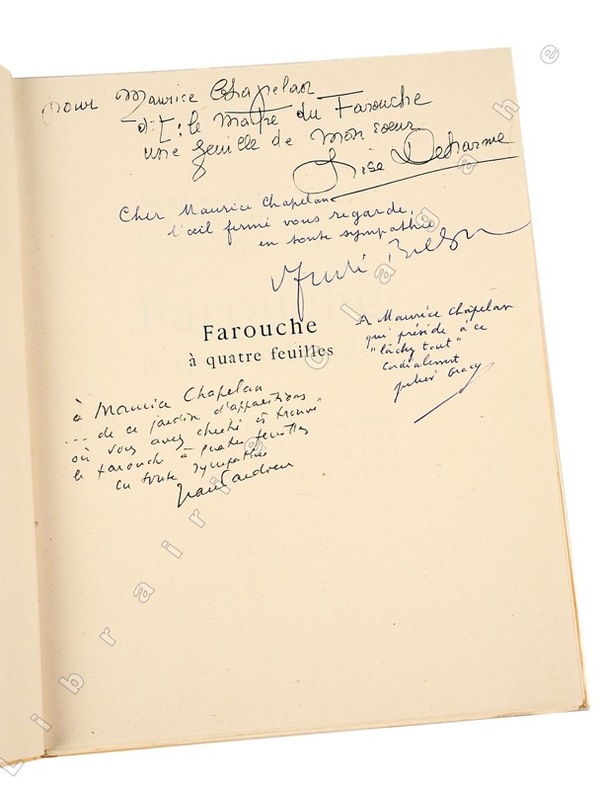
195421470Paris, Chez Grasset, 1954 ; in-quarto tellière broché, chemise-étui moderne ; 140 pp., [2]ff., couverture granitée jaune rempliée, imprimée en noir et chocolat ; page de titre imprimée en noir et vert printemps.
17640041111764 Avignon, sans nom d’éditeur, 1764. Deux volumes in-quarto (211 X 260 mm) basane fauve marbrée, dos cinq nerfs ornés, caissons ornés aux petits fers, pièces de titre et tomaison maroquin rouge et vert, tranches rouges (reliure de l'époque). Tome I: titre illustré, (4) ff. de titre, avertissement et table des chapitres, 615 pages, (1) page d'errata, 7 cartes et 7 planches hors-texte; Tome II: titre illustré, (4) ff. de titre, avertissement et table des chapitres, 618 pages, (1) page d'errata, 3 cartes et 5 planches hors-texte. Quelques pointes de rousseurs et piqures.
1665PHO-2284Leide, Jacob de Meurs, 1665. In-folio (38x25cm), titre frontispice, portrait, 290pp.-1f-134pp. erreurs de pagination, veau tacheté époque, dos à nerfs orné avec pièce de titre, réparation au dos avec caissons conservés et coins, trou sur la carte, réparations aux feuillets 93 & 188, petit trou de ver en marge, un feuillet (page 59) facsimilé manuscrit ancien, réparation à 1 planches, 2 feuillets renforcés en marge. Illustré d’un titre frontispice, un portrait de Colbert, une carte dépliante, 34 planches doubles et nombreuses vignettes
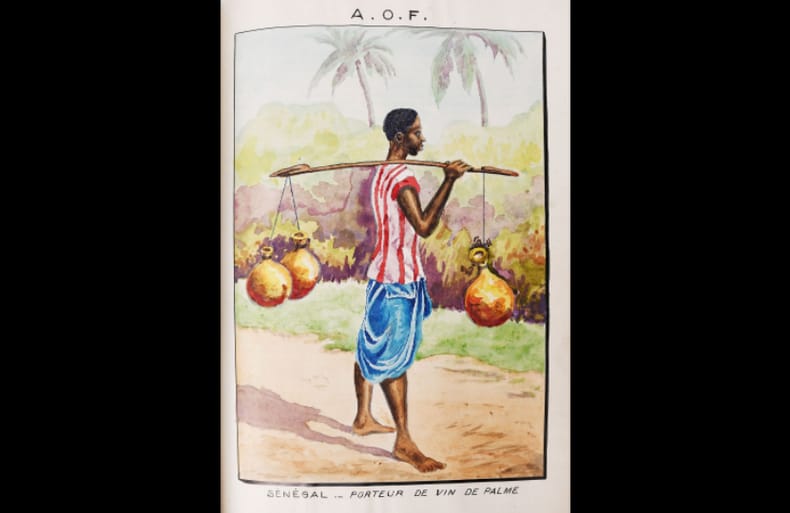
193823642Sans lieu, sans nom, 1938. Fort in-4 (21 x 30 cm) maroquin marron, premier plat orné des lettres dorées A. O. F. dans un contour dessinant l'Afrique de l'Ouest avec petit décor d'instruments de musique, dos à nerfs avec filets dorés, plats et doublures de maroquin marron, chemise de maroquin marron à bandes doublée de suédine de couleur noisette, étui bordé. 662 pages.
17699La Haye, Jean Neaulme, 1720. In-12, [8]-187-[19] pp. 1 pl., veau marbré fauve de l'époque, triple filet doré en encadrement sur les plats cantonnés de fleurons dorés, dos lisse orné de caissons et fleurons dorés, pièce de titre rouge, tranches dorées (coiffe arasée, mors fendus, épidermures, quelques rousseurs, dernier cahier relié dans le désordre).
1609PHO-11431 volume in-folio (33 x 23 cm), vélin rigide parchemin (reliure de l'époque), dos lisse titré à l'encre, nombreuses écritures manuscrites sur les plats, 5 à 53-[1] feuillets. Page de titre, 3 premiers feuillets et feuillets 51 et 52 manquants, charnière fendue ,mouillure sur 5 ff et manque de papier en marge , galerie de vers avec manque. Seconde édition française, illustrée de 55 gravures sur bois in-texte.
1798PHO-1092Deuxième reliure de la première édition. Édition originale in-4 sur grand papier, remise en circulation en 1841 avec un nouveau titre avec la mention fictive "nouvelle édition" (quelques exemplaires imprimés en 1798 n'avaient toujours pas trouvé preneur). Une édition octavo en six volumes a également été publiée. in-4 ,y compris l'atlas. Avec 16 (10 dépliantes) dont 15 cartes gravées, 1 planche gravée et table dépliante. - Beau demi-cuir contemp , dos lisse avec titre et tomaison , petits manques au dos , quelques mouillures intermittentes et vieille trace d’humidité (T1), déchirure carte hydrographique sans manque. xii, cxliv, 628, [3] ; xvi, 676, [2] ;[xi], 431, [1];[2],viii, 158pp.
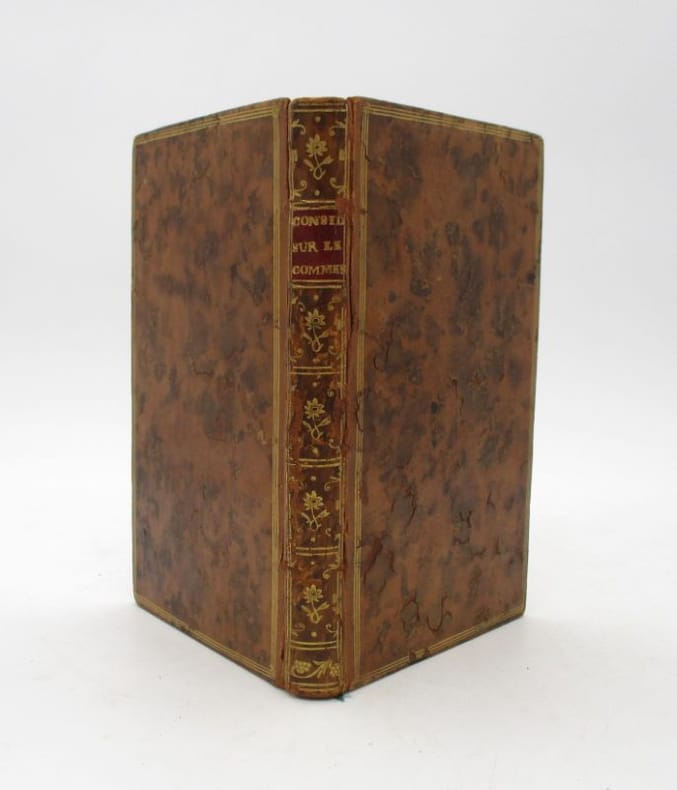
39235In-8 (157 x 95 mm), veau marbré de lépoque, dos à 5 nerfs, orné de compartiments fleuronnés et cloisonnés, palettes, tranches rouges, 427 p., (5) pages de table. Londres, Fletcher Gyles dans Holborn [i.e. Paris?], 1756.
152855S.l. [Douai], s.d. (1791) in-4, [113] pp. (seules les 21 premières sont chiffrées), couvertes d'une écriture fine et lisible (environ 40 lignes réglées par page), avec 11 figures aquarellées dans le texte, et 9 pl. hors-texte (dont deux ff. doubles volants, et une grande carte dépl. aux contours rehaussés de couleurs, représentant le tracé du cours de la Sambre depuis la frontière jusqu'à Namur), en feuilles.
222527Genève, et se trouve à Paris, Damonneville, 1758 2 vol. in-12, viij pp., 228 pp., veau fauve marbré, dos à nerfs cloisonné et fleuronné, pièces de titre et de tomaison, chaînette dorée sur les coupes, tranches marbrées (reliure de l'époque). Un mors inférieur fendu, petite galerie de vers infra-paginale à la fin du volume I.
17600041101760 Sans lieu d'édition [Paris], ni nom d'éditeur [Chaubert et Hérissant], 1760. In-quarto (206 X 265 mm) demi-basane fauve à coins, dos cinq nerfs, pièce de titre chagrin grenat, tranches rouges (reliure de l'époque) ; (1) f. blanc, VIII (dont titre)-336 pages, (1) f. blanc. Pièce de titre renouvelée. Ex-libris ancien collé sur le premier contreplat.
17599039A Copenhague, chez les Frères Cl. & Ant. Philibert, 1759-1765. 5 tomes en 3 vol. in-folio, veau, dos orné à nerfs, pièces de titre en maroquin rouge et de tomaison en maroquin vert, tranches rouges (reliure de l'époque).
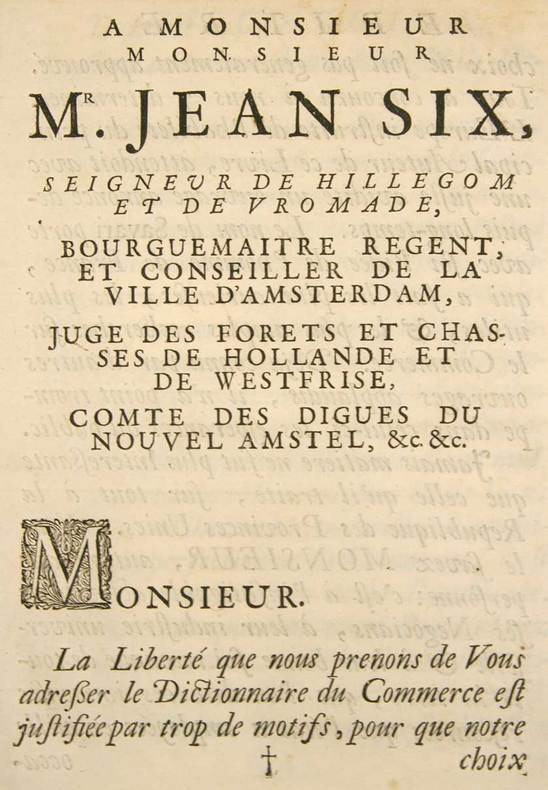
128479aafAmsterdam, chez les Jansons à Waesberge M. DCC XXVI, (Janssonius van Waesbergen), (1726), in-4to, With a folding engraved portrait of the dedicace ‘Jan Six, Heer van Hillegom en van Vromade’ bourgmestre d’Amsterdam, by Houbraken, and 2 large allegorical engraved headpieces (Pool after A. Coypel) + 2 endpieces. Main text printed in two columns. Collation: Vol. 1) XXXVIII + folded engr. front + 2030 col. ; Vol. 2) 2000 col., title-pages printed in red & black, hw ownership on free fly ‘Nunc à J. Louïs Panchaud’ à Wufflens & Appartient à Gabriel Tachenon. 1731 , avec un prix ‘coutte L 296’, reliure plein veau d’époque, qqs restaurations aux coiffes, pages de gardes en papier dominoté d’origine, bel exemplaire.