Leonardus Lessius .Livre Rare Book
5 434 résultats
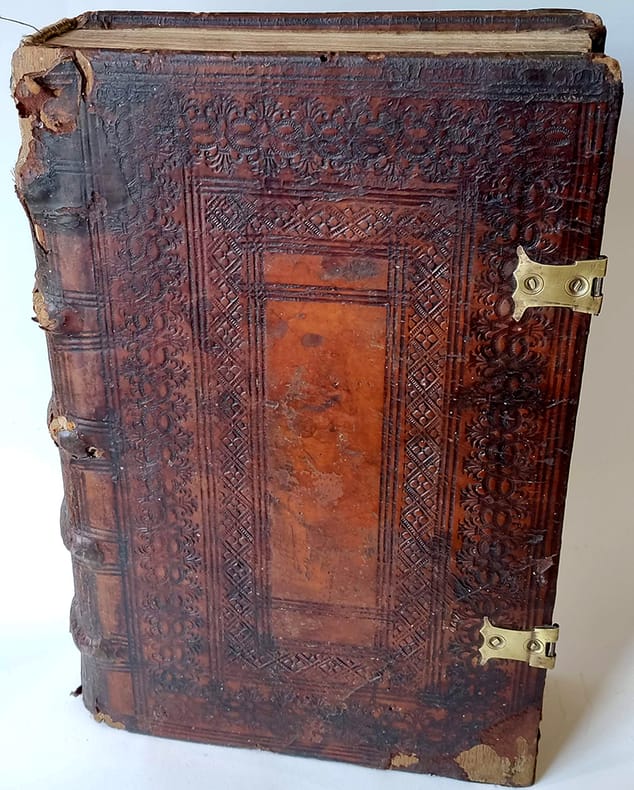
16666Ex officina Plantiniana Balthasaris Moreti "Anvers, 1626, in-folio, plein veau sur ais de bois décoré à froid, dos à cinq nerfs, restes de fermoir en laiton et de coins. Reliure de l’époque. Manque en haut du dos (de la coiffe au premier nerf) ; manque de cuir de recouvrement au coin inférieur droit du premier plat. Quelques petits manques sur les nerfs. Petit trou de vers sur les 15 premiers feuillets avec perte de quelques lettres. Mouillure très claire dans l’angle supérieur de quelques feuillets sinon intérieur propre et sain. 8ff. (dont le titre-frontispice) 825pp.-34ff. d’index-2ff. bl. Texte sur deux colonnes. Frontispice allégorique d’après Pierre Paul Rubens, gravé par Cornelis Galle (331mmx202m). Ce frontispice apparait pour la première fois avec la quatrième édition de cet ouvrage en 1617. Titre écrit dans un ovale de laurier, flanqué de personnifications féminines du sage gouvernement et de l'abondance ; La Justice assise en haut au centre entre un lion et une balance ; au-dessous du titre se trouvent un satyre et un homme aux yeux. La première édition du De Justitia est publiée à Louvain en 1605 et connaitra une vingtaine d’éditions au XVIIe siècle. Lessius est en effet le premier théologien à se pencher sérieusement sur les problèmes moraux liés à l’économie de marché et la finance. « Cette oeuvre a joué un rôle primordial dans l’histoire du droit des obligations. Plus d’une fois le prétendu fondateur du droit naturel moderne, le hollandais Hugo Grotius, se borne à donner une simple synthèse dans son Du droit de la guerre et de la paix (De iure belli ac pacis) de ce qu’il a lu dans le De iustitia et iure de Lessius, au point même d’en copier les fausses références. Pour la rédaction de son traité, Lessius fut lui-même fortement inspiré par un collègue un peu plus âgé originaire de Cuenca, Ludovic Molina (1535-1600). Ludovic Molina fut le premier jésuite à adopter le modèle du De iustitia et iure pour aborder toutes les questions juridiques concernant la propriété, les actes illicites, les contrats, les testaments, les taxes, les bénéfices ecclésiastiques, les règles monastiques etc. » (Le droit au creuset de la théologie morale Wim Decock) Provenance : Fr. Iacobivanden Berghe tertii Ordinis St. Francisci Conventus Antverpiensis filii (ex-libris manuscrit au reco du second plat.) Décédé à Anvers le 19 février 1685. Backer-Sommervogel Bibliothèque de la compagnie de Jésus T.IV-1729, N°5 / Basan, Catalogue des estampes d’après P.P. Rubens, p.178 N°30 / Judson & Van de Velde (Corpus Rubenianum XXI), 38. "
15962Chez Jean-Edme Dufour, imprimeur et libraire "A Maestricht, 1775, 7 vol. in-8 veau tacheté, dos rond sans nerf. Dos encadré d'un double filet doré, roulettes et fleurons ""soleil"" dorés. Reliure de l'époque. T.I 1f.-Frontispice-1f. De titre-3pp. Explication des estampes-Portrait de Raynal-VIIIpp.-carte-439pp (dernière chiffrée 437 par erreur) // T.II Xpp.-frontispice-carte-316pp. // T.III XIIpp.-frontispice-carte-440pp. // T.IV VIII-frontispice-carte-301pp. // T.V VIII-frontispice-carte-296pp. // T.VI VIII-fontispice-carte-287pp. // T.VII VIII-frontispice-carte-326pp. Cohen 854 (qui indique par erreur 8 vol. Tous les volumes sont par ailleurs à la date de 1775 et non 1774-1775). Tous les volumes sont à l'adresse de Maestricht, y compris le vol.V contrairement à ce qu'indique Bancarel. Exemplaire bien complet des 7 figures par Eisen non signées reproduisant celles de l'édition de Gosse fils (La Haye 1774), du portrait et des 7 cartes dépliantes dressées par Bonne. Véritable ""encyclopédie du décolonialisme"", cet ouvrage initialement publié anonymement en 1770 connu près d'une cinquantaine d'édition jusqu'en 1843. Raynal revendique la paternité de l'ouvrage à partir de la troisième édition en 1780, son nom apparaissant sous le portrait. L'ouvrage fut condamné par la censure civile et ecclésiastique et brulé en place publique. Raynal fut également comdamné à l'exil. Il faut néanmoins relativiser la part de Raynal dans la rédaction de l'ouvrage puisque la partie philosophique, quand elle n'est pas de la main de Diderot, est largement empruntée au Baron D'Holbach, à Naigeon et Péchmeja. Pour ce qui concerne le commerce, Raynal a inséré des mémoires du fermier général Paulze, des comtes d'Aranda et de Souza. Cette Histoire des deux Indes constitue l'un des plus virulent réquisitoire contre l'esclavage à l'époque des Lumière. Quelques coins frottés, tout petit manque de cuir à un mors du T.VI sinon très bel exemplaire en fine reliure de l'époque. Cette édition ne comporte pas d'atlas et est complète telle que décrite."
1965015774Veilhes G.P. [Gaston Puel] 1965 In-12 En feuilles, couverture à rabats <
47179Richard/Caille/Ravier.An VII de la république.2 vols,petits in-8,formats à l'italienne.388 et 482 p.avec Tables. Intérieurs frais.Reliures d'époque avec pièces de titre et tomaison.Tranches rouges.Coins émoussés dans le Tome 2.Coiffes absentes ou usagées.Tome 1: mors inférieurs ouverts.
1713PHO-1341A Paris, Chez Pierre Ribou et Rouen chez Jean Baptiste Machuel (tome 5), 1713. 6 volumes in-12, relié plein veau époque, dos à nerfs orné avec pièce de titre et tomaison, tranches marbrées, Tome 5, reliure légèrement différent avec tranches rouges, coins et coiffes usés .T1,27p-501p-1f(table); T2, 1f-465-1f (table);T3 ,1f-402-3f(table);T4,1f-367-2f(table);T5 ,3f(titre, épître)-467-2f(table),T6 3f(titre, épitre)244 -2f (table) .Illustré de 63 planches la plupart repliées, dont un portrait et 3 grandes cartes (manque la carte du Japon) ; quelques vignettes dans le texte , quelques planches au tome 5 volantes, 1 planche doublée.
15890A Paris, Chez Moutardier, Cerioux, (an) 8 (1799-1800). With 2 engraved plates. 2 volumes. (2), 8, 368 pp.; (2), 356 (last page misnumbered 561) pp. 8vo. Contemporary half calf, corners, green and red labels with gilt lettering. Not in Musset-Pathay; not in Kress; not in Goldsmiths; Einaudi 6099 (for the English edition). First French edition. Mainly devoted to agriculture, but also supplying useful information on population, commerce, industry. The first English edition appeared in 1780. The additional Recherches by the translator cover the pages 83-end of volume 2. For the period before 1790 the travel accounts as given by Young form an important part of the economic literature, owing to the absence of regular reporting by permanent agencies: see at length: Schumpeter, History of economic analysis. - With an engraved bookplate on the front paste-down of each volume. Copy from the library of Edmond Vallée, with his small owner's stamp on flyleaves.
94286aaf1756 / 1758 / 1802 / 1834, in-4to, brochures originales en bon état (n. 3 avec tache d’humidité).
17005A Paris, De l'Imprimerie de P.G. Le Mercier, 1766. Two works in one volume. 4, 180, lxxii, 4, 4 pp.; 8, (also numbered 242)-328, (also numbered 56)-164 (also numbered 196)-212 (also numbered 288)-306 (also numbered 168)-190 pp.; 1-56 (also numbered 328)-397, (1) pp. 4to. Contemporary marbled calf, spine gilt with raised bands, some damage to foot of spine, corners worn and bumped, some staining to binding, small damage to upper band. First work: Conlon 59:417. First edition. Contains: Exposition du sujet de la consultation. - Mémoire pour les officiers de la Conservation de Lyon & Avis des députés du commerce sur ce Mémoire. - Projet de la déclaration proposé par les députés. - Observations de MM. de Lyon sur ce projet, & réponse à ces observations. - Projet de déclaration fourni par MM. de Lyon, & réfutation de ce projet. - Consultation. - Pièces justificatives.Second work: Kress 6362; Conlon 66:321; not in Goldsmiths; not in Einaudi; not in INED.First edition.Important collection, containing many memoirs from numerous Chambers of Commerce, not published elsewhere. At the end of the Avertissement is the following announcement: 'Le lecteur est prié de n'avoir aucun égard aux chiffres des pages, quelques circonstances survenues depuis l'impression de l'ouvrage, ont exigé un nouvel ordre dans les pièces, & ont interverti celui des chiffres'.Contains, among others: Représentations des six Corps des Négocians de Paris - Représentations des Jurisdictions Consulaires de Paris - Mémoire des Syndics de la Chambre de Commerce de Normandie - Premier Avis de MM. les Députés du Commerce - Second Avis de MM. les Députés du Commerce - Mémoire des Prieur & Juge-Consuls de Rouen - Mémoire des Prieur & Controlleur des Bourges Communes de Toulouse & de Montpellier - Projet de Déclaration - etc. etc.
18576A Rennes, Chez J. Vatar; A Paris, Chez la Veuve de B. Brunet, 1760-1772. With engraved frontispiece and 4 engraved plates. 2 volumes. xxxviii, 38, 284, (6) pp.; viii, 392, (8) pp. 8vo. Contemporary marbled calf, richly gilt spines with raised bands and gilt lettering, with the gilt stamped armes of the États de Bretagne on the covers, slightly rubbed. INED 1-2 & 3243-3244 lists different issues but no second volume with the date 1772; Higgs 2179 & 5423; Goldsmiths 37378 & 10838.1; Einaudi 48 & 49; not in Kress; not in Mattioli. One of at least two editions for volume one from the year of publication, the other being in 12mo and with a completely different collation. The 12mo edition has no frontispiece and three plates. First edition of volume one, second edition of volume two, all published. The second volume is identical to the volume published in 1762 but for the date on the title-page. Louis-Paul Abeille was an economist of the Physiocratic school, inspector-general of manufactures in France and later secretary to the council of the bureau of commerce. Montaudouin was a lawyer from Nantes. These reports were the only ones published although a third report was planned. The Société d'Agriculture was the first society of this type established in France, founded through Gournay's influence. Its members were to examine the state of agriculture, commerce and manufacturing industry. For the arms see: Olivier, Hermal and Roton, Reliures Armoriées Françaises, plate 1576, nr 3.
18066A Amsterdam, Chez Jacques Coeur, à la corne d'Abondance (Paris), 1756. 3 volumes. xii, 372 pp.; 406 pp.; 350 pp. 8vo. Contemporary marbled calf, spines richly gilt in compartments, labels with gilt lettering and numbering. Mars 27; Weulersse, i, p. xxvii; Kress 5526; Goldsmiths 9082; Einaudi 2659; Mattioli 1481; INED 2079; Higgs 1145. First edition, second issue. Einaudi's copy is identical with ours, about the Kress and Goldsmiths copies not much can be said, both collections contain more than one copy and they both indicate that there is one copy with a third volume with the indication 'Nouvelle édition', as does our third volume. According to Mars, Ange Goudar, cet inconnu, essai bio-bibliographique, the third volume came from the same press as the first two volumes but with a different ornamental typography. Between the first issue and this issue, there appeared, according to Mars, a parisian contrefaçon, all published in 1756. This is the main work of Goudar. It was used by the demographer Süssmilch in his Die goetliche ordnung. Voltaire had a copy in his library and Diderot wrote about the book in a letter to Sophie Volland. Preceding Mirabeau's l'Ami des Hommes by a few months, it marks an important date in the history of political economy, and made Goudar one of the leading figures of the school of 'des agrariens et populationnistes', not to be mixed with the Physiocrats, which they preceded and with whom they disagreed on various points. 'Of the pre-physiocratic French writers who approached the population problem in terms of agricultural values and reforms, Ange Goudar (1720-1791) was the most important' (Spengler, French predecessors of Malthus, pp. 56-67.) Spengler's analysis is elaborate and shows the crucial importance of this work. - Some corners somewhat damaged.
17125A Leyde, 1754. Title printed in red and black. vi, (8), 408 pp. 12mo. Contemporary red morocco, gilt fillets on sides, spine richly gilt with gilt stamped ornaments and gilt lettering, all edges gilt, some very, very light wear, one scratch to front cover, corners lightly bumped, a beautiful copy. Kress 5381; Goldsmiths 8916; Higgs 742; Leblanc, De Thomas More à Chaptal, 123; Weulersse, i, p. xix; INED 3607; not in Einaudi (other editions); not in Menger. Second edition. In all, four editions were published in 1754. The work was being published as a translation but was actually written by Louis-Joseph Plumart (or Plumard) de Dangeul who used the pseudonym of John Nickolis. 'd'Argenson admire beaucoup cet ouvrage, qu'il place même audessus de l'Esprit des Lois de Montesquieu.' (Stourm, p. 98). 'Documentation particulièrement riche, accompagnée d'observations personnelles sur la population, les classes sociales, le commerce, l'économie.' (INED) 'Mid-eighteenth-century populationism is best represented in the works of Plumard de Dangeul, Goyon de la Plambaine and Jaubert. Dangeul was concerned primarily to combat celibacy, the principal check (in his opinion) to population growth; for he looked upon such growth as a 'certain sign' of the 'health of the body politic', as a stimulator of agriculture and manufactures, and as a partial source of relief to the taxpayers (the cost of government being relatively fixed).' 'The forces unfavorable to population growth operated more powerfully in some social classes than in others. Both the marriage rate and fertility within marriage were lower in the military class than in any other group; they increased in the following order: magistrates, financiers, merchants, artisans, comfortable laborers, and uncomfortable laborers. In general, Dangeul concluded, the French social system valued least and burdened most heavily the more useful classes, and thereby checked their increase and that of the population as a whole' (Spengler, French predeccessors of Malthus, pp. 82-86). - With a handwritten ex-dono by the author on second blank leaf, binding by Derome (?).
18392A Amsterdam, Chez Marc-Michel Rey, 1776. 2 volumes. xx, 389, (3) pp.; (4), 474, (2) pp. 8vo. Contemporary marbled calf, spine gilt with red labels and gilt lettering, red edges. INED 4116; Einaudi A.867; not in Kress; not in Goldsmiths; Leblanc 113; Mattioli 3269. First edition of this very interesting expostion dealing with the laws of society, the relation between men, man and society, natural and positive law, the role of economics, demography, luxury, property, religion, individual liberty, liberty of the press, free speech, etc. etc. and how society should be organized, governed and managed, this is both a work of sociology, economics, politics and legislation seeking the well-being and happiness of societies and population through proper and rational legislation and organization. 'Économie politique. Doctrine plus agrarienne que populationniste, très proche de celle des physiocrates' (INED, giving a long and extensive analysis of the work). There are sections discussing population (Schmid advocates a continuous increase), family life, property (he defends private ownership of land), luxury, religious toleration, (Schmid is in favour), taxation (Schmid favours direct over indirect taxation), commerce (he advocates, among other things, free trade for the colonies and an autonomous government) and war. One of the best expositions of the body of economic thought of the time.Further sections deal with: De l'Autorité souveraine; Des Forces de la Société; Des Rapports d'une Société avec les autres Sociétés; Du bonheur de la Société; Des Loix positives. George-Louis Schmid (or Schmidt), born in Avenstein in 1720, entered the service of the Duke of Saxe-Weimar and retired in 1757 to Nyon in the Vaud. He had close relations with Voltaire, Diderot and d'Alembert and the other leading philosophes of the 18th century. He belonged, together with authors such as Rillet de Saussure, Delolme and Iselin to a group of important Swiss authors actively participating in the European debates of those days and historians now believe that Swiss authors like these were unique in their attempts to reconcile traditional republican and Christian standards of social justice with the imperatives of economic growth. For this reason, they came to occupy a central position in European debates and the essay competitions of the Economic Society of Bern were closely watched elsewhere in Europe. - Some occasional browning. An excellent copy of a scarce work.
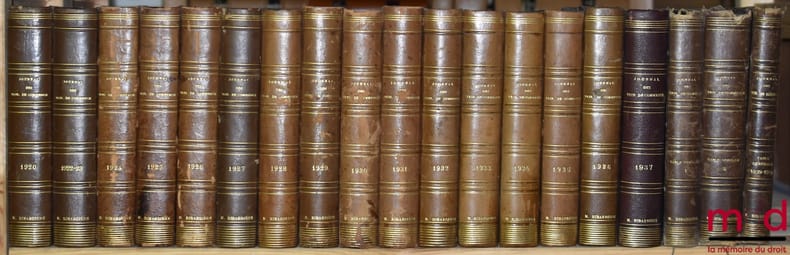
3971, Paris, Videcocq 1852 et s., 85années en 85 vol., demi-basane brune/fauve, tit. & tom. dorés sur dos à faux nerfs, filets simples et filets multiples dorés, rel. au chiffre de «M.Ribardière», (rel. très frottées avec nombreuses épidermures, accrocs et mq. de cuir, coiffes émoussées dont 5arrachées, 2dos manquants, 1vol. dérelié, papier jauni).
17046A Paris, De l'Imprimerie ordinaire du corps législatif, et se vend chez Rondonneau, mars 1806. xii, 224, iv, 164, (4, advertisments) pp. 4to. Contemporary half calf, spine gilt in compartments, gilt lettering, marbled boards, corners, very lightly rubbed. Kress B.5003; Goldsmiths 19258; Einaudi 162; INED 94 (only the last iv, 164 pp.); Martin & Walter, 545. First edition. 'Ambroise-Marie Arnould (1750-1812), a French economist, was director of the board of commerce under the Revolution. His works contain valuable information upon the theory of trade, the state of the balance of trade in Europe during the 18th century, French finances, etc. He advocated the division of France into departments according to their homogeneous economical nature; and appealed to all maritime nations to confederate against the menacing power of England' (Palgrave, i, p. 58). The last 164 pages contain the 'Notes et pièces justificatives', with tables throughout the text.
177418311Amsterdam et Paris, Fr. Ambr. Didot aîné, 1774 ; in-12 (178 mm), demi-veau caramel, dos à nerfs décorés de filets dorés, pièce de titre rouge, date en queue, non rogné (reliure du XIXe) ; 324 pp.
18480A Bruxelles, et se trouve à Paris, Chez la Veuve Esprit, 1785. 152 pp. 8vo. Modern half citron morocco, spine gilt with raised bands, gilt lettering, marbled boards, top edge gilt, a lovely copy. Kress B.820; Goldsmiths 12849; INED 735bis; Leblanc, De Thomas More à Chaptal, 132; not in Einaudi. First edition, very rare. It is a reply to Roubaud's work Representation to the Magistrates ...... The author denounces the French policies rergarding wheat and criticizes the absolute freedom of its trade and circulation. He proposes the maintenance of the legislation in force, but he tempers it by proposing the creation of companies of commerce, which will have the sole authority to import or export in the kingdom. They will have to create, in the important cities, granaries where the farmers and proprietors will be able to carry the unsold grains, which are bought for them at a fixed price. The author concludes his study with a critique of Necker's Traité de l'Administration des Finances with regard to the paragraphs relating to grains, which contradict the propositions set out in his own work (Leblanc, our translation). 'The unlimited freedom of the grain trade has many disadvantages for the economy and the population. Bourdon proposes a more moderate system: to set up a trading company entrusted exclusively with the export and import of grain, the establishment of public granaries, the fixing of the price of bread in each place, and so on. This system, moreover, would make it possible to abolish taxes without diminishing the revenues of the king: levying a duty on the quintal of wheat (INED, our translation).
1928141101928 broché in-folio (paperback in-folio), dos et première de couverture rempliée marrons imprimés et ornés de petites illustrations (brown spine and cover printed and decorated with small illustrations), quatrième de couverture fanée (chipped back cover), tranches non rognées (edges no smooth), pages de garde marrons clairs (brown endpapers), tirage limité à 1020 exemplaires - 1 des 1000 exemplaires sur papier Vélin Montgolfier d'Annonay (limited edition - 1020 copies were printed), texte à manchette (marginal note), illustrations : bandeaux - lettrines et culs-de-lampe de (headpieces - dropped initial and tailpieces of) Georges Tcherkessof - poinçons - armoieries et la carte des juridictions des monnaies par (hallmarks - Armoieries and the map of the jurisdictions of change by) René Mourre - serpente légendées pour les gravures hors-texte (tissue with legend for the illustrations full page engraving), naissances de rousseurs (beginning of the redness marks), 356 pages, 1928 à Paris Chez Louis Carré,
1753G115322Paris, chez la Veuve Estienne & fils 1753 2 parties en 1 volume physique, [2bl.] + [2] xii + 280 + 206 + [2] + [2bl.] pp., Première édition en français (traduction 'libre' de la seconde édition espagnole de 1742, la 1ère date de 1724), reliure d'époque à 5 nerfs en plein-cuir (dos orné, coins légèrement abimés, petite manque de cuir en haut du dos), tranches rouges, feuilles de garde décorées, quelques rousseurs, 26cm., bon exemplaire, [Cet ouvrage traite des divers aspects de l'économie appliquée et du commerce international comme des problèmes d'impots, de monopole, de population, etc., ainsi que de la marine espagnole et les colonies espagnoles en Amérique], poids: 1.1kg., G115322
1806PHO-2337A Paris, Colnet, 1806. 3 vol. in-8, 558pp., 469pp., 362pp., demi-basane fauve à coins parchemin ivoire, dos lisse, pièce de titre brune, dos frottés, coins et coupes usés, pièces de tomaisons incomplètes, défauts dont rousseurs, mouillure claire au début de t.3 et fin t.2, petites taches d’encre et fentes sans manque sur la carte). Ouvrage illustré d'une carte dépliante et de 3 plans illustrant la ville de Caracas, le port de la Goayre, la rade et la ville de Porto Cabello.
17791Paris, Hachette, 1895 ; grand in-8, demi-chagrin rouge et percaline, dos à nerfs très décoré et doré, tranches dorées (Ch. Magnier) ; XV, 657 pp. , 2 cartes dépliantes de l'Indo-Chine et de la Chine et portrait hors-texte de Francis Garnier.
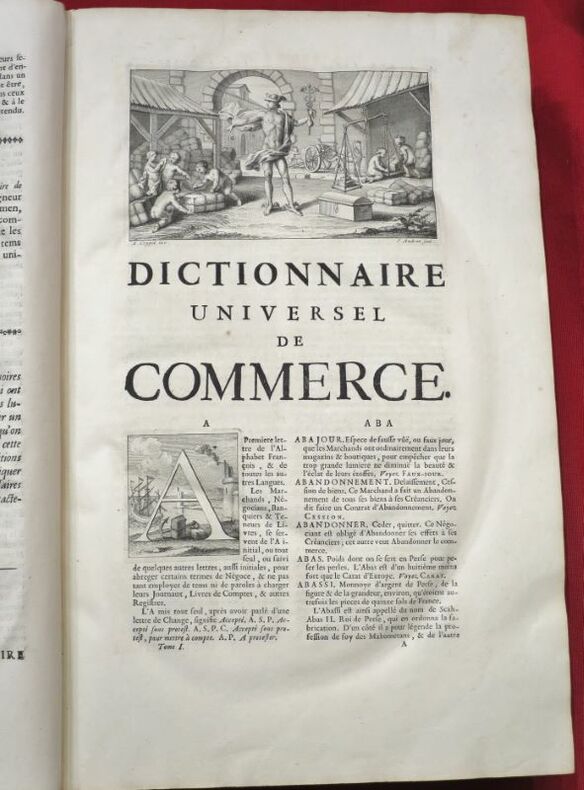
110162A Paris, chez Jacques Estienne, ruë Saint Jacques, à la Vertu, 1723, 2 volumes grand in-folio de 405x260 mm environ, Tome I, A-E : 1f.blanc, 4ff. (faux-titre,titre en rouge et noir, epistre à Monseigneur Amelot avec lettrine et large bandeau), xxviij-2002 colonnes (2 colonnes par page), Privilege, 1f. (fautes à corriger), 1f.blanc, - Tome II, F-Z : 1f.blanc, faux -titre, titre, 1956 colonnes, 1f.blanc, plein veau granité brun, dos à 6 nerfs portant titres et tomaisons dorés, ornés de caissons à riches motifs dorés, coupes dorées, tranches mouchetées de rouge. Papier un peu jauni avec avec rousseurs et taches d'encre anciennes par endroits, cuir très épidermé, rayé et frotté avec des manques et des restaurations 2 coins tapés. Edition originale parue à titre posthume.
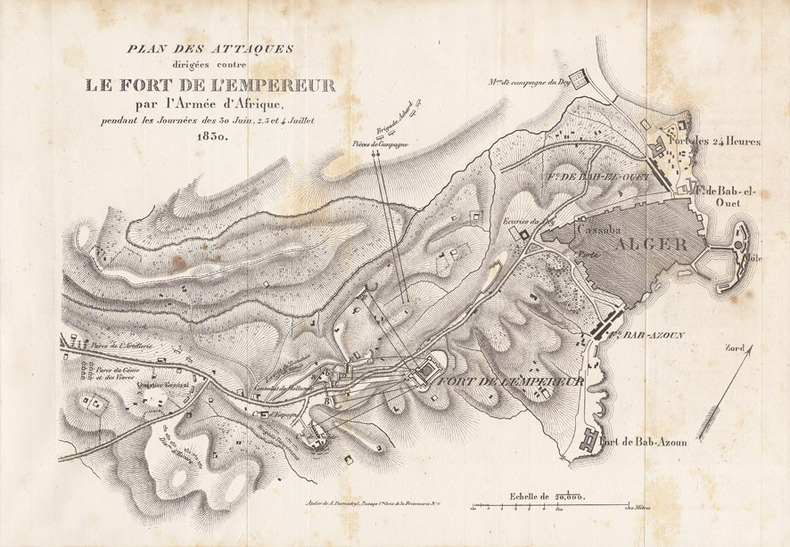
183017233Paris, Ladvocat ; Marseille, Camoin ; Toulon, Laurent, 1830 ; (4), II pp. , (1) f. blanc, 406 pp. , (1) f. errata, très grand plan dépliant lithographié de Alger, Djezair, avec le port, les fortifications, etc.suivi de : [Fernel, commandant] Campagne d'Afrique en 1830, avec le portrait du Dey d'Alger, le tableau de l'organisation de l'armée, et d'un plan des travaux du siège. Paris, Théophile Barrois et Benjamin Duprat, 1831 ; (4), VII, 133 pp. , (1) f. , 5 pp. soit 10 tableaux dépliants, plus dépliant des attaques.Reliés en un volume in-8, demi veau glacé fauve, dos lisse à faux nerfs dorés, titre et fleurons dorés (reliure de l'époque).
18731A Londres, Aux dépens de la Compagnie, 1789. Engraved title within border, 16 tables, some folding. vi, (7)-230 pp. 4to. Modern half calf, marbled boards, corners, gilt lettering to spine. Sabin 32638; Echeverria & Wilkie 789/116; not in Leclerc; not in Fay; not in Howes; cf.: Kress B.1719; cf.: Goldsmiths 13832; not in Einaudi; no French edition in JFBL. Only edition in Quarto, very rare, probably the first French edition. Both Sabin and Echeverria & Wilkie give a 4to edition printed in Rouen. A detailed exposition and statistical comparison of the imports and exports of Great Britain and the United States, from 1700 to 1783. With each edition, Sheffield substantially revised and enlarged the text. Written in opposition to the bill introduced by Pitt in 1783, proposing to relax the navigation laws in favour of the States, the work was influential in determining the abandonment of the motion. Sheffield points up the weak position of America and continually stresses the growing commercial importance and potential of the West Indies and Canada (especially Newfoundland and Nova Scotia, particularly with regard to fisheries, lumber, and ship-building). Howes writes that the work was very influential in shaping England's trade policy from 1783 to 1789, so detrimental to American commerce and shipping interests as to contribute greatly to the formation of a Federal union, better able, than were the separate federated states, to retaliate against British maritime might.The tables provide extensive statistical information, giving a comparative export and import survey of the trade between the United States and other countries. This translation from the English original was due to De Rumare, magistrate at Rouen. The later Mirabeau translation did not include the statistical tables. - Titlepage browned, some scattered spotting, but a good large paper copy.
1891001528Paris Hennuyer 1891