Livre Rare Book
5 434 résultats
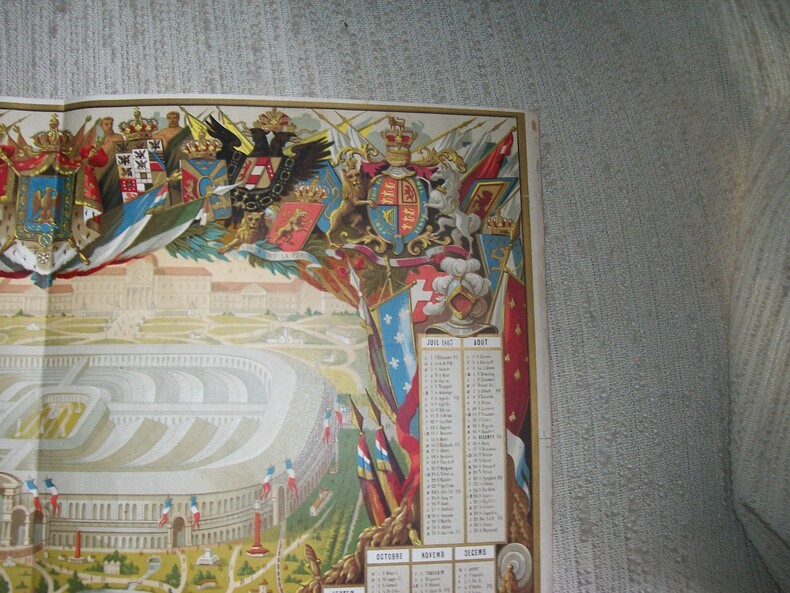
1867GITj812Paris Journal des Demoiselles 1867. Magnifique calendrier imprimé au recto d'un papier épais, mesurant 27cm de hauteur et 38,5cm de largeur. Cadre de filet doré, nom et adresse du journal de part et d'autre en bas sur fond bleu dans un cartouche doré. Les mois imprimés en noir sur fond beige dans un encadrement doré sont présentés de part et d'autre de la feuille, laissant le plus d'espace possible au décor. le centre est entièrement occupé par une vue panoramique du Palais ellipsoïdal conçu par l'architecte Léopold Hardy pour abriter les 5200 exposants d'une quarantaine de pays, présentant des innovations scientifiques, techniques, et industrielles; les pavillons des pays étrangers et des colonies qui gravitaient autour sont représentés discrètement. Les parties supérieure et latérales sont totalement consacrées aux drapeaux, écus armoriés et couronnes des pays exposants; celui de la France étant au centre. On s'amusera à identifier, dans la partie basse, les symboles des Arts, Lettres, Sciences, Industries, Commerce et Agriculture. l'ensemble présente des détails minutieux, foisonnants et très vivement colorés. petit trou d'épingle au bas et au ras de la bordure, se perdant dans le décor, pliure centrale verticale d'origine. BEAU DOCUMENT TRES RARE DANS UN EXCEPTIONNEL ETAT DE CONSERVATION ET DE FRAICHEUR.
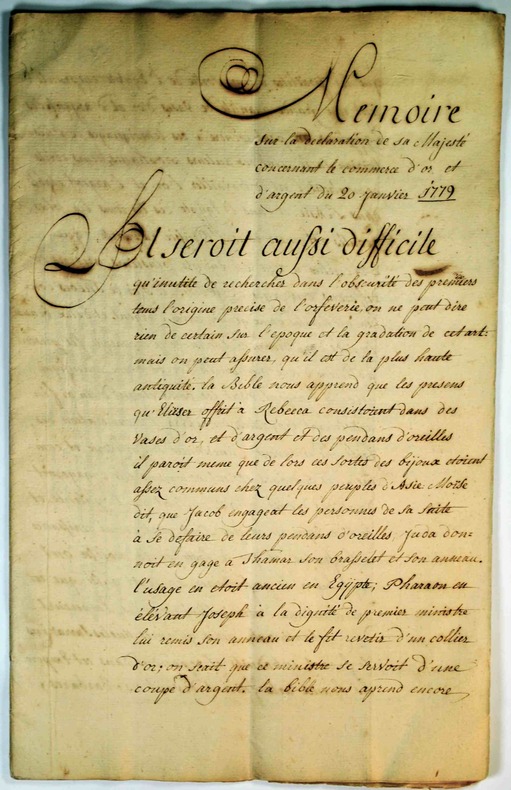
17792667, , 1779. Manuscrit in-folio broché de (24) pp. (2) f.bl.
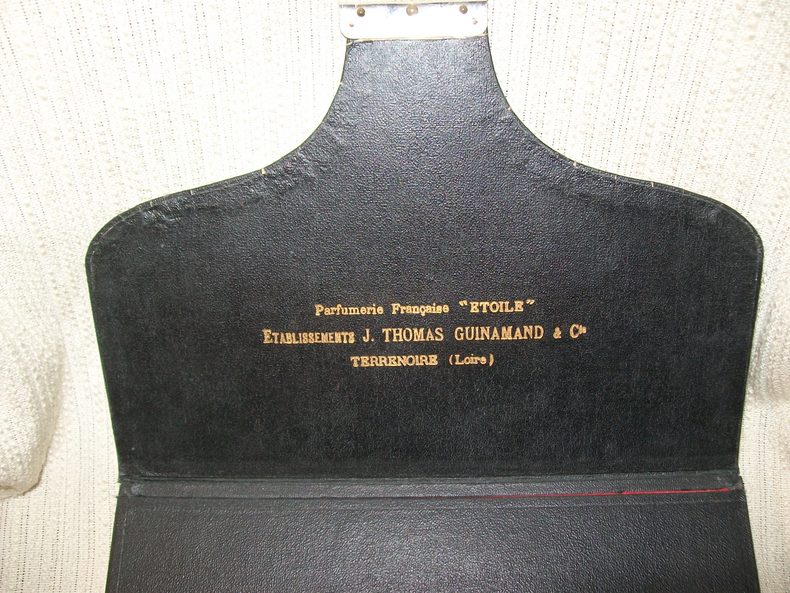
1950GITe803Sans date vers 1950. Coffret de représentant de commerce (25,5cm sur 35cm et 2,5cm d'épaisseur) à 2 rabats, en carton recouvert de toile chagrinée noire avec fermoir métallique. Nom de la parfumerie frappé en doré au verso de l'un des rabats, intérieur doublé de velours synthétique rouge vif divisé en 45 alvéoles, chacune abritant un petit flacon en verre de 7cm environ, fermé par un bouchon à vis en plastique rouge, blanc ou bleu. Les flacons, emplis de leur contenu d'origine, sont orné d'une étiquette illustrée différente pour chacun des articles commercialisés par cette Maison (à l'exception d'un seul, dont l'étiquette est dactylographiée). Bel ensemble complet en très bon état.
183810477Paris, Imprimerie Royale, 1838. In-folio de XXIV-526 pp., demi-chagrin rouge, dos orné à nerfs (reliure moderne).
16051A Marseille, Chez Pierre-Ant. Favet, 1788. (8), 105, (1) pp. Oblong 4to. Sewn in blind covers, small damage to spine. Not in Kress; not in Goldsmiths; not in Einaudi; Conlon 88:2248 (stating that the original English work is unknown). Very scarce first edition. The 'Epitre Dédicatoire' reads 'De l'Éditeur Anglais à M. Richard Frewin, Ecuyer, un des Officiers des Douanes de Sa Majesté.' Furthermore the text states that this Mr. Frewin has produced the tables, that Mr. Frewin wants to remain in the background but that he must be seen as the principal author of the work. If there ever was an English original is unknown: no English version of this work exists. However, it may be that this is a French version of the item listed under Goldsmiths 12314: "The rates of merchandize, as settled by the Acts of 12 Car. II. Cap.4, II Geo I, cap 7 . With the duties and drawbacks ." published in 1782 and of which Richard Frewin was one of the compilers. This is a nicely printed list of import and export rates, a very detailed listing in alphabetical order by product and country or source of origin, with the rates given in both English and French currency. Includes rates on paper (writing paper, copper plate paper, printing paper, whited brown, brown paper, etc.) giving various sorts of paper (Impérial; Sur-Royal, Cartouche, Bleu Royal, Lumber-main, etc.) and the dimensions of paper. - With library-stamps on front cover and a few pages: Archives. Chambre de Commerce de Marseille. Bibl. C.C.M. Échange 1934.
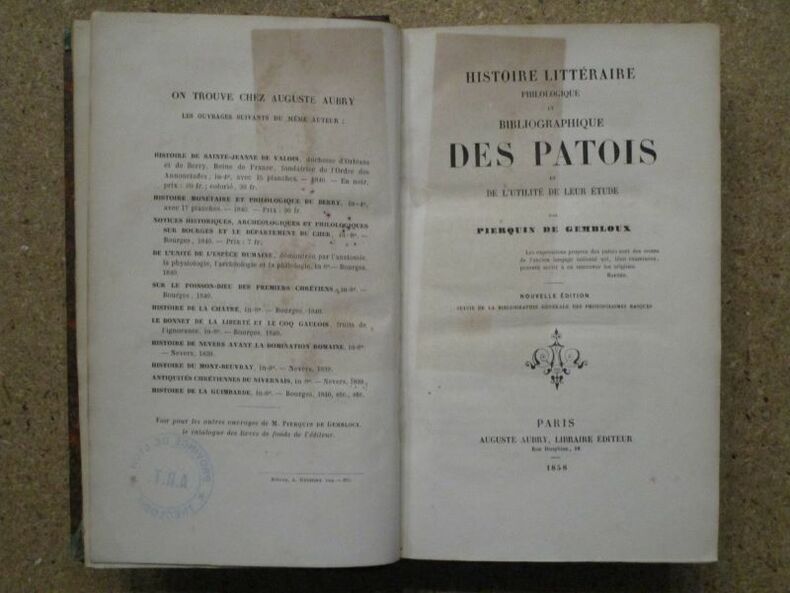
1831114116Auguste Aubry 1831 3 volumes, demi-chagrin bruns, environ 22x14cm. Dos insolés, quelques frottements d'usage sur les reliure, une étiquette sur les premiers plats, quelques pages avec des rousseurs voire roussies, bon état pour le reste.(1) Auguste Aubry, 1858, LX-335 pp / (2) 1858, 49 p. / (3) Lamarche et Drouelle, Dijon, 1856, XV-519 p. / (4) Berlin, Albert Foerstner, 1840, 294 p. / (5) Au Bureau de l'Almanch du Commerce, chez Delanay au Palais-Royal, 1831, 571 p. / (6) Librairie J.B. Dumoulin, 1870, 182 p. / (7) Librairie A. Franck, 1872, 454 p. / (8) Senlis, Ernest Payen, 1876, 12 p. / (9) Avranche, Auguste Anfray, Paris, J.B. Dumoulin, 1856, 87 p.
18827A Londres, et se vend à Paris, Chez Le Breton, Desaint, Pissot, Lambert, 1755. xxiv, 336 pp. 12mo. Modern marbled boards, red leather label with gilt lettering. Kress 5421; Higgs 1030; INED 884; Goldsmiths 9028 (without the preliminaries); not in Einaudi; Conlon 55:545; Sabin 9602; JFBL B635; Howes B.1049; Leclerc 241; Echeverria, pp. 15n and 19; not in Muller. First edition, second issue ('Italic type' as identified by Echeverria & Wilkie) and without the errata on page xxiv and with the errata corrected. Butel-Dumont argues that Great-Britain owes her power and wealth to the colonies. He analyses the commerce and trade as well as the population of the British colonies at the time of the Guerre du Canada. With the outbreak of the Seven Years War, many of whose battles were to be fought in the New World, considerable curiosity about the British colonies was excited. This was one of the books profiting from this curiosity. It emphasized the phenomenal growth and prosperity of the colonies. 'This is the first extensive French text on the British North American colonies and was occasioned by the heightened tensions preceding the Seven Years War. It gives accounts of the geography, history, religion, government, economics, trade, and products of the several colonies' (Echeverria & Wilkie). According to INED this work was also attributed to Véron de Forbonnais. - Tiny hole in half-title and title, modern ex-libris on the front paste-down.
16035No place, 1757. 2 volumes. (2), 302 pp.; (2), 392 pp. 12mo. Contemporary marbled calf, spines gilt in compartments, red labels with gilt lettering, marbled edges, small loss of calf to front cover of volume 2, very lightly rubbed. McCulloch 46; Kress 5600; Goldsmiths 9242; Higgs 1465; not in Einaudi; Conlon 57:669; not in Mattioli. First French edition, first published in 1744. The French translator, J.P. de Gua de Malves, added extensive comments and therefore this French version is sought after. Sir Matthew Decker, director of the East India Company, merchant and pamphleteer, was born in Amsterdam. In the present work he urges the replacement of all customs and excise duties by a single tax on the consumption of luxury goods - a kind of income tax with the merits, as it was conceived in the eighteenth century, that the taxpayer voluntarily assesses himself by choosing to consume such articles and to such an extent as he wishes. Decker argues strongly against restrictions on trade, emphasizing the significance of industry and trade to the welfare of the country. He would exempt the houses inhabited by the poor from all duties - not on grounds of social sympathy but because it would necessarily lower their wages and consequently increase the competitive strength of British exports; he advocates the luxury tax because it would check luxury, the bane of virtue and industry. He was opposed to monopolies and bounties and was skeptical as to whether trade can ultimately be forced into 'an unnatural channel,' thus anticipating the discussion on the operation of natural laws in the economic world. In some respects he is considered an important precursor of Adam Smith. 'The first part of the work is devoted to a detailed criticism of the fiscal difficulties under which England is labouring; the second part to showing the intricate connection between the trade of a country and the value of the land; while in the third part Decker displays the great sources of wealth and prosperity possessed by England (and over her two chief rivals, France and Holland), and shows how the references he suggests would permit her to avail herself of these, her natural strength' (Palgrave, i, p. 519).
27205A Paris, Chez Cellot & Jombert, 1778. [2], 452, [4, Privilege du Roi, Fautes à corriger, blank] pp. 12mo. Contemporary marbled calf, spine richly gilt in compartments, label with gilt lettering, red edges, a nice copy. Sabin 21037; Leclerc 868; Faÿ 11; Howes D.528; Monaghan, French Travellers in the United States, 580B; Muller 1597; not in Streeter sale; not in Kress; not in INED; Echeverria, Mirage in the West, p. 74; Echeverria & Wilkie, 778/20; Chadenat i, 813. First edition of this important work dealing with the War of Independence of the British colonies. An early French account of the Revolution, published about the time of the French entry into the war on the side of the Americans. "Day-by-day account of events from Gage's arrival at Boston until French recognition" - Howes. The author favours free trade with the American colonies, which had just been officially recognised as an independent state. Pp. 433-450 contain: Traité d'amitié et de commerce conclu entre le Roi et les Etats-Unis de l'Amérique septentrionale, le 6 février 1778 and U.S. Declaration of Independence: Declaration des Répresentans des Treize Provinces-Unies de l'Amérique, assemblées en Congrès-Général, le 4 juillet 1776 (pages 340-351.)
16124A Paris, Chez l'auteur, Moutard, Desenne, 1789. 32, 176 pp. 8vo. Modern half vellum, marbled boards, vellum corners, label with gilt lettering. Kress B.1655; Goldsmiths 13928; Stourm 190; INED 3007; Martin & Walter, i, 8288; Monglond, i, p. 244, all listing copies in which the 32 preliminary pages are lacking, as almost always. First edition. The first 32 pages which are apparently nearly always lacking contain: "Adresse à l'Assemblée nationale, ou précis des élémens du plan général." A new financial system proposed, followed by 25 projects of decrees. - First two leaves a little stained.
6184Registre de la maison Louis Comandon Cognac Kakena, copies de lettres du 8 novembre 1888 au 24 février 1889. grand in quarto : 500 feuillets et 82 pp. de répertoire, 1/2 rel. verte d'ép. Pièce de titre rouge, belle vignette illustrée noir et or sur le premier plat.
6185Registre de la maison Louis Comandon Cognac Kakena, copies de lettres du 25 février 1889 au 29 juillet 1889. grand in quarto : 500 feuillets et 82 pp. de répertoire, 1/2 rel. verte d'ép. Pièce de titre rouge, belle vignette illustrée noir et or sur le premier plat.
6186Registre de la maison Louis Comandon Cognac Kakena, copies de lettres du 21 mai 1890 au 17 novembre 1890. grand in quarto : 497 feuillets et 82 pp. de répertoire, 1/2 rel. verte d'ép. Pièce de titre rouge, belle vignette noir et or sur le premier plat.
6187Registre de la maison Louis Comandon Cognac Kakena, copies de lettres du 21 novembre au 28 février 1891. grand in quarto : 496 feuillets et 82 pp. de répertoire, 1/2 rel. verte d'ép. Pièce de titre rouge, belle vignette noir et or sur le premier plat.
6188Registre de la maison Louis Comandon Cognac Kakena, copies de lettres du 25 mars 1891 au 15 août 1891. grand in quarto : 502 feuillets et 82 pp. de répertoire, 1/2 rel. verte d'ép. Pièce de titre rouge, belle vignette illustrée noir et or sur le premier plat.
6189Registre de la maison Louis Comandon Cognac Kakena, copies de lettres du 11 juillet 1893 au 1er mars 1894. grand in quarto : 500 feuillets et 82 pp. de répertoire, 1/2 rel. verte d'ép. Pièce de titre rouge, belle vignette noir et or sur le premier plat.
6190Registre de la maison Louis Comandon Cognac Kakena, copies de lettres du 3 mars 1894 au 19 octobre 1894. grand in quarto : 491 feuillets, 1/2 rel.
237228Paris, chez l'éditeur [Imprimerie de Selligue], 1830 in-16, titre, 214 pp., demi-basane havane racinée, dos lisse, pièce de titre (reliure du XXe siècle). Rousseurs.
189577Suivant la copie de Paris, 1758 3 parties en un vol. in-12, [2]-100-84-180 pp., avec un frontispice allégorique par Charles Eisen, basane fauve marbrée, dos à nerfs cloisonné et fleuronné, pièce de titre cerise, tranches mouchetées (reliure de l'époque). Epidermures et frottis à la reliure.
234668Paris, 1701 - 1791 22 pièces in-4, en feuilles.
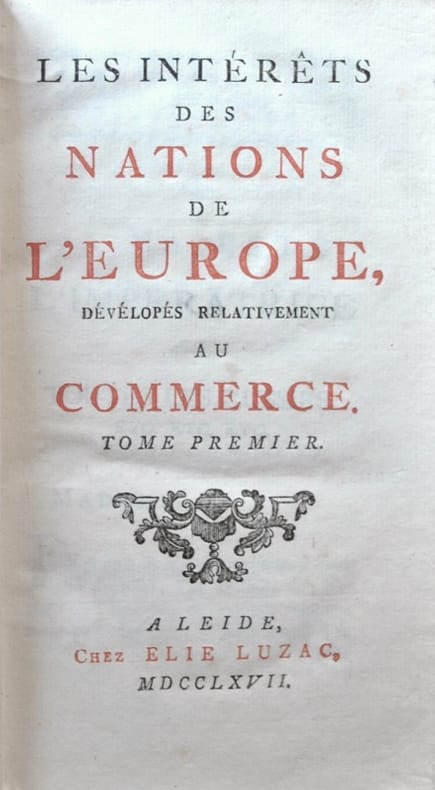
176790A Leide, chez Elie Luzac, 1767. 4 vol. in-12 de (14)-411 pp. ; (4)-343 pp. ; (4)-331 pp. ; (4)-396 pp., veau havane, dos lisse orné (reliure de l'époque).
176889361768 In-16 48 pp, titre sur pièce de cuir rouge. Relié avec ( inconnus de Barbier ) : Lettres Américainess sur les parlemens 1770 et 1 771, 1 ff blanc, 44 pp, - Letttre d'un citoyen au Roi ( 1777 ) 2 ff blancs 30 pp et la Tête leur Tourne, 48 pp (mors fendu en queue, 2 trous de vers et légers manques de cuir près des mors ; ensemble frotté. Toutes tranches mouchetées, papier très correct.Intérieur frais
1968008414Paris Editions de Minuit 1968 In-8 Broché Dédicacé par l'auteur
16642A Londres, 1765. 2 works in 1 volume. 216 pp.; (4), viii, 264 pp. 12mo. Contemporary marbled calf, spine gilt in compartments, label with gilt lettering, marbled edges, very lightly rubbed. First work: Goldsmiths 9713 (listing it under Chevrier); INED 379; Higgs 2627; Einaudi 1076 (listing an edition from 1762, also under Chevrier); Conlon 61:576 (Chevrier); not in Kress. First edition. First work: 'Politique et social. Réflexions sur l'intolérance, qui est parfois nécessaire (mais dommages causés par l'émigration des protestants); les impôts, qui sont moins lourds que mal répartis; la néfaste célibat des prêtres; la nécessité des lois somptuaires, bien que le luxe qui perd un petit état en enrichit un grand'; le duel, qui peut mener à la destruction de l'espèce humaine; l'exemption d'impôts des pères de famille qui favoriserait la population; .....' (INED). According to Querard, the work is by Chevrier where indeed several reference works list it.Second work: Kress 6305; Goldsmiths 10097; INED 4337; Higgs 3430; Leblanc 384; Conlon 65:1299; not in Einaudi.First edition. Kress states the work was published first in 1755, for which statement no evidence could be found, nor does Kress have this 1755 edition, nor does Goldsmiths and Conlon lists it under 1765 thereby indicating that there is no 1755 edition.'Cet ouvrage comporte quatre parties: Du commerce en général; Des avantages qui reviendront à la France par l'établissement d'un solide commerce; De la facilité des établissements de commerce et marine dans la France; Des obstacles qui peuvent s'opposer à un solide établissement de commerce dans la France. Cette dernière rubrique se termine par des considérations sur l'établissement du commerce propre à la monarchie française. (Leblanc). 'Economique. Réflexions sur le commerce en général et sur ces avantages. Intérêt de la France à posséder un 'solide commerce', d'autant plus que notre pays offre des conditions particulièrement favorables à son développement et à celui de la marine. Défense du systême des douanes intérieures' (INED). - With the engraved bookplate of Alexis de Lamothe, Avocat.
18032643A Paris, chez Treuttel et Würtz, 1803. 3 vol. in-8 de (8)-XXII-316-(4) pp. ; (4)-342-(2) pp. ; (4)-354-(2) pp., basane havane, dos lisse orné, pièces de titre en maroquin rouge et de tomaison en maroquin vert, tranches jaspées (reliure de l'époque).