15 990 résultats
201112813Paris, Dunod, 1926 ; in-8, 272 pp., cartonnage. Très bon état - 3e édition demi-cuir marron (notions de psychologie professionnelle et appliquée….
9100Albi, Baurens, (1791) .Placard de 37 x 45 cm sur vergé. Blason armorié en tête.
ORD-2456Edition 1921. Tome 3: Etranger. Edité par l'Exportateur Français. In-8 cartonnage de l'éditeur, 497pp. Nombreuses publicités en noir et blanc et 17 belles publicités couleurs h.-t. reproduisant pour la plupart des affiches, dont le Lion Noir en frontispice. Bon exemplaire.
ORD-2457du 31 octobre 1792, l'An premier de la République Française. Toulon. Surre. 1792. In-4 (181 x 235mm) de 6 pages imprimées.
42968Lyon, Mougin-Rusand, 1898, in 8° broché, 544 pages, non coupé.
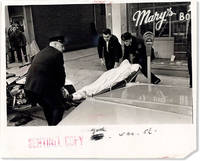
58574Milwaukee: Milwaukee Sentinel 1966. Original black and white photographic print 8" x 10". Stamps and composition notes to recto below image; clipping glued to verso with brief ink caption; small loss to bottom right corner well away from image. Very Good overall with image area clean and unfaded. <br /> <br /> Photo shows the aftermath of the attempted assassination of Fred Bassett Blair at this time Chairman of the Wisconsin Communist Party. A year earlier Blair had been singled out by FBI Director J. Edgar Hoover as the proprietor of one of "eight major communist bookstores operating in the United States." The shooting was carried out by a 17-year-old boy with a handgun inside Mary's Books a used bookshop owned and managed by Blair's wife which indeed carried a small section of Marxist books. Blair was unharmed but a bookseller colleague Ralph Sacks was injured by three bullets. Blair beat the assailant into submission with a toy baseball bat and in this photo the unidentified youth is seen being carried out of the store on a stretcher. unknown
234651S.l., 1790 in-4, 27 pp., broché sous couverture factice de papier coquille du XIXe. Salissures aux 2 premiers ff.
204628[Paris], Imprimerie de P. Prault, 1743 placard in-folio (53 x 38 cm), texte sur deux colonnes, en feuille, bords ébarbés, une déchirure à la pliure centrale.
163988S.l., 1791 in-8, 44 p., dérelié.
190785[Paris], Hacquart, s.d. (1821) in-8, 38 pp., dérelié.
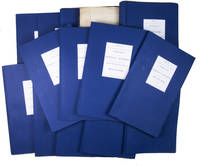
1837ABC_47982London 1837. Folio 32 x 20.5 cm. William Clowes 1837-1845; T. R. Harrison 1848-1872. Later stiff blue paper wrappers with white title-label on the front cover blue sprinkled edges. Ad. 11 in beige paper wrappers. With several tables of data. 14 volumes. Rare collection of 14 volumes containing transcriptions of British diplomatic correspondence with other countries relating to the slave trade in the 19th century printed for the British government. Although slavery in the British Empire was abolished in 1807 enslaved people in the colonies were not freed until 1838. In the present volumes which mostly date from 1837-1846 directly after slavery was abolished in most British colonies the British government urges other countries to help put a halt to the now illegal slave trade. The present collection contains the correspondence between Britain and numerous countries in Europe the Americas and North Africa especially France Spain the United States and Austria. The letters describe the ships carrying enslaved people in detail also mentioning their ports of call so they could be more easily found and stopped. Of particular interest are the transcriptions of slave trade acts from various countries as well as the treaties between France and chiefs in African colonies which are difficult to find in print anywhere else.The letters reveal the profound change in attitude towards slavery in the middle of the 19th century. The tone of the correspondence with countries that were quick in abolishing slavery like Denmark is very different than that of the countries that were much slower like the Netherlands and various countries in Latin America. However the letters especially make clear how difficult it must have been to find and stop the ships that were illegally carrying enslaved people. The owners of the vessels often hid their illegal practices behind obscure transactions and renamings which made finding them arduous and sometimes dangerous. It was the task of British commissioners and naval officers to try to uncover the network behind the Atlantic slave traders and bring them to justice. By collaborating with other countries the courts succeeded in the condemnation of over 600 vessels engaged in the slave trade and the liberation of nearly 80000 enslaved people.Ad 11 with blue library stamp on the title-page "Bibliothèque du palais de la paix". All volumes in good to very good condition some very slight browning and foxing some marginal notes in most volumes. unknown
71919Nice, L'Eclaireur de Nice, 1931, in 8° oblong broché, agrafé, 64 pages ; couvetrure illustrée.
201615Paris, Imprimerie de Mme Vve Agasse, 1817 in-4, xij-95 pp., en feuilles, cousu.
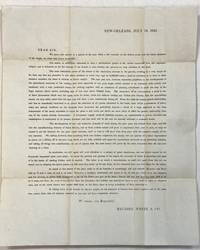
184341470New Orleans 1843. Printed folio sheet folded to 4 pp each page 9-1/4" x 11-1/4." Printed on recto of first leaf only interior pages blank addressed in ink on last page to Captain J. Keyes Florence Alabama. Old folds address page worn. Blank hole where seal was broken no text affected. Text clean. Very Good.<br /> <br /> The head of the firm Maunsel White of New Orleans was an energetic Irish immigrant. He married the daughter of a wealthy Creole merchant allied with Andrew Jackson. Wikipedia says "White maintained a lifelong friendship with Jackson for whom he served as a cotton factor from 1826 until Jackson's death in 1845." <br /> White carefully delivers hopeful but cautious news to his clients. He celebrates "the marvellous increase in the growth" of cotton "resulting in a crop larger by far than any that has preceded it." However "the next crop will show a considerable falling off. From the onset the season opened unfavorably" because of rains and other weather problems. But "new and extensive channels of trade infused fresh vigor and life into the manufacturing districts of Great Britain." The Letter demonstrates the importance of the South's commercial connection with England. <br /> He reminds his customers of "a subject of great importance and one which cannot be too frequently impressed upon your mind; we mean the picking and ginning of the staple the necessity of which is sometimes lost sight of in the desire of sending Cotton early to market." This necessity of course would be met with slave labor.<br /> We do not locate this printed letter on OCLC as of November 2025 although OCLC records several items relating to Maunsel White: a letter from Andrew Jackson to White in 1842; the firm's business records at the University of North Carolina; and a similar letter on the cotton trade from 1841 at the Library of Congress OCLC 1284917506. unknown
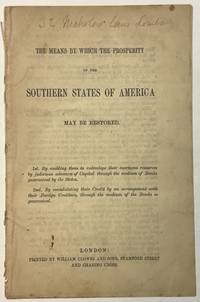
186542106London: Printed by William Clowes and Sons 1865. 4pp. Disbound with a few small fox marks. Good plus.<br /> <br /> "The old capital which consisted of slaves being destroyed new capital must be obtained in the shape of money." Bank loans guaranteed by the States with the aid of bondholders will supply the necessary funding. The author expects "that the manufacturing interests of England especially of Lancashire and Yorkshire would assist the Southern States by subscribing to the plan proposed which would enable them to procure an increased supply of cotton of which they stand so urgently in need."<br /> Not located on OCLC as of June 2026. Printed by William Clowes and Sons unknown
1742168051742 basane mouchetée, dos à nerfs. in-4, LVI-722pp., (1f.), P. Mouchet 1742
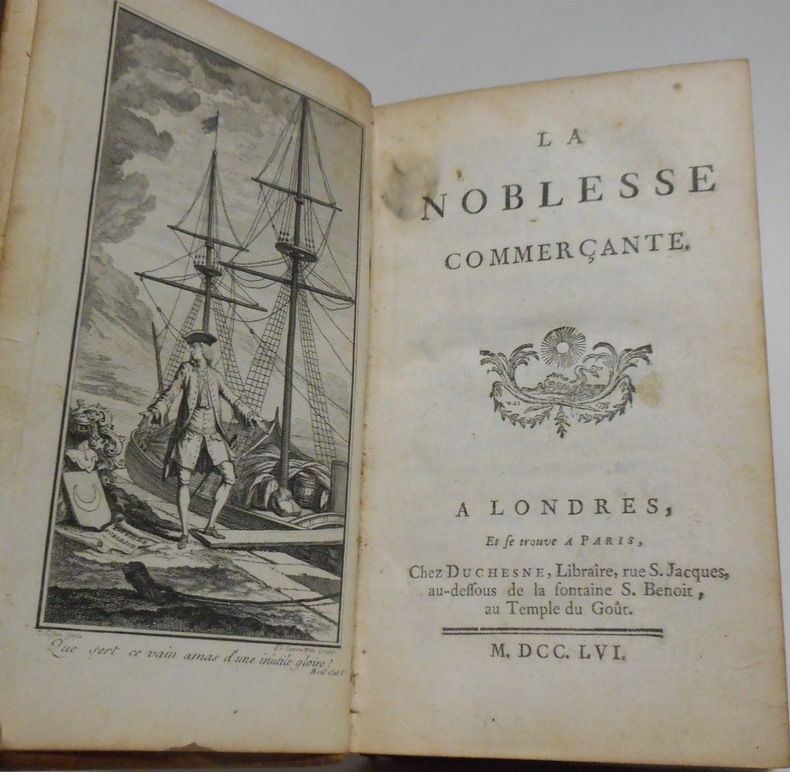
165484Londres, et se trouve à Paris, Duchesne, 1756 in-8, 215-[1] pp., avec un frontispice gravé par Sornique d'après Charles Eisen, basane fauve, dos à nerfs cloisonné et fleuronné, encadrement de simple filet à froid sur les plats, simple filet doré sur les coupes, tranches rouges (reliure de l'époque). Coiffes frottées, coins émoussés, mais bon exemplaire.
189577Suivant la copie de Paris, 1758 3 parties en un vol. in-12, [2]-100-84-180 pp., avec un frontispice allégorique par Charles Eisen, basane fauve marbrée, dos à nerfs cloisonné et fleuronné, pièce de titre cerise, tranches mouchetées (reliure de l'époque). Epidermures et frottis à la reliure.
207428Paris, Imprimerie de Laporte, rue des Poitevins, s.d. (1789) in-8, 4 pp., broché.
69638P., Berche et Tralin, 1880, in 12 broché, 316 pages ; couverture défraichie.
180326351Chantenay 1803 1 BON DE LIVRAISON document ORIGINAL d'1 page manuscrite à l'encre brune, format : 12,5 x 20 cm, sur papier crème, signature illisible (CHANTENAY) 9 FLOREAL AN 11 (29 AVRIL 1803),
179826350LORIENT CAUDAN 1798 1 REÇU document ORIGINAL d'1 page manuscrite à l'encre brune, format : 9,5 x 15,6 cm, sur papier velin crème, ligné, et filigrané,signatures manuscrites : FRANCY (fondé de pouvoir pour CRUCY FRERES CHANTIER DE CAUDAN LOUIS CRUCY- LORIENT) et EVEN, LE 17 VENDÉMIAIRE AN 7 (8 OCTOBRE 1798),
18282401Gibraltar 1828. Good. 3pp. on a bifolium. Previously folded with separations. Tanned somewhat brittle. An interesting example of official communications concerning trade between colonial Cuba and the Spanish mainland. In this manuscript letter date March 14 1828 the new Spanish Vice Consul in Gibraltar writes to the Governor General of Cuba concerning several topics. These include the regulation of shipping to Cuba and by implication the rest of the Caribbean through Gibraltar particularly of French ships leaving Mediterranean ports. Also discussed is keeping track of individuals particularly merchants going to Cuba by means of identification papers and other documents. The consul also reminds the colonial government of the importance of documenting duties and tariffs paid for shipping cargo and goods. unknown
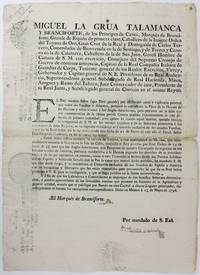
17965074Mexico City: May 13 1796. About very good. Broadside 17 x 12.25 inches. Old fold lines. Slight separation and loss at center fold slightly affecting a few letters. Minor wear else. Proclamation made by the Viceroy of New Spain authorizing trade between Cuba and the United States. The Caribbean was in tumult in the 1790s with Toussaint L'Ouverture overthrowing the French colonial government and outlawing slavery. Likewise in Cuba there was a similar revolt against slavery demanding abolition and equality -- both revolutions were of substantial concern to slaveholders in the American South. Specifically the present decree mentions flour and other vital foodstuffs as a measure against shortages in Cuba intended to prevent further trouble. "Para precaver la escasez de viveres y con especialidad de harinas que verosimilmente causaria la guerra concedio El Rey Permiso por Real Orden de 25 Junio de 93. para que los Anglo-Americanos.pudiesen conducirlos a la Havana pagando los derechos los puertos habilitados de España." The Viceroy at the time was Don Miguel de la Grua Talamanca de Carini y Branciforte First Marques de Branciforte. The Marques was notoriously corrupt even for colonial Spain having gained position through marriage to the Prime Minister's sister. He made sure to make some profit on everything that passed through his hands including taking advantage of the War in Cuba to remove the French from their lands and sell them to his benefit. A rare and interesting decree. We locate a single copy in OCLC at the University of Minnesota. May 13 unknown