SPRINGSGUTH, Christian GottfriedAntiquariat.de

299 résultats
1702605135Wittenberg, J. Hake, 1702. 4to. 8 Bl. Geheftet.
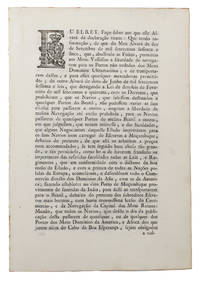
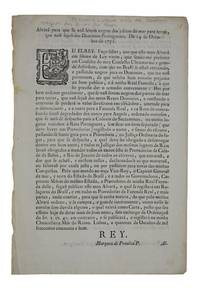
1772ABC_48853Lisbon 1772. Folio ca. 29 x 20 cm. Na Regia Officina Typografica Disbound and subsequently mounted in a modern black stiff paper folder with a printed label mounted on the front wrapper. With a large decorated woodcut initial E incorporating the Portuguese royal coat of arms. 3 1 blank pp. Very rare first issue of two of a late 18th-century decree by the Portuguese King José I 1714-1777 dealing with difficulties in the transportation of enslaved people from Mozambique to Brazil. This text dated 12 December 1772 and signed Rey King at the end is also signed by the notorious Portuguese nobleman and diplomat Marquez de Pombal. Sebastião José de Carvalho e Melo 1st Marquis of Pombal 1699-1782 who was the Secretary of State of the Kingdom during the reign of Dom José I in the period of 1750-1777. It is concluded with a formal text dated 18 December 1772 and signed by João Baptista de Araújo a senior officer of the Secretariat of State.In 1761 Marquez de Pombal prohibited the importation of enslaved people in Portugal and Portuguese India not for humanitarian reasons but because they were needed for labour in Brazil. He stimulated the trade of mostly African enslaved people for that colony and with his support two companies for slave trade were founded the Companhia Geral de Comércio do Grão-Pará e Maranhão and the Companhia Geral de Comércio de Pernambuco e Paraíba. Both companies were privileged and had a monopolistic character. Their lists of shareholders included many Portuguese noblemen and clergy. Between 1757 and 1777 more than 25000 enslaved people were imported to Pará and Maranhão from West African ports.The two issues can be identified by their catchwords on p. 1: issue one shows the catchword as a vol- that catchword was changed in the second issue to a.The inner margin shows some signs of the previous binding. Otherwise in very good condition.l Gauz Portuguese and Brazilian books in the JCB 772/1; WorldCat 1045359449 3 copies; cf. Porbase 2301650 and no copies. unknown
1751AQ31219Lisbon: s.n. 1751. Single sheet printed on both sides. A trifle creased. A rare survival of a mid-eighteenth century edict issued by King José I of Portugal forbidding traders to transport slaves from Portuguese seaports to colonial territories held by other nations. The Portuguese slave trade experienced continual growth throughout the latter half of the eighteenth century in particular from West African colony of Luanda from which between the issue of this edict in 1751 to 1760 an average of 10 940 enslaved Africans were trafficked annually. OCLC records copies at just three locations BL NYPL and UoL; COPAC adds one further Senate House. . Dimensions 200 x 300 mm. [s.n.] unknown
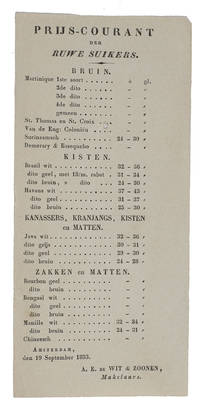
1721LC4D1MQ3QGJ6Amsterdam 1721. 1 leaf 21 x 8 cm; 1 leaf 20.5 x 8 cm; 1 leaf 17.5 x 8 cm. Jacobus van Egmond Ad 1: Text printed on both sides each in a border built up from typographic ornaments. Ad 2: Text printed on one side. Ad 3: Text printed on one side. 3 documents. Ad. 1: Rare VOC ships manifest for cargo shipped from the East Indies - Batavia and Ceylon Sri Lanka - on 22 East-Indiamen sailing on 1 December 1720 from Batavia and on 15 November from Ceylon. The list includes more than 100 different colonial wares and gives the weights in pounds or the lengths in feet: from pepper more than 6.5 million pounds cloves 694000 pounds cinnamon 604000 pounds and coffee more than 1.77 million pounds to 962 pounds of Javanese cardamom some jewels and rariora and many feet of silk and linen cloth. Small wormhole affecting two characters otherwise in good condition.Ad. 2: Rare list of the results of the auctions of colonial wares organized in 1781 by the Chambers of the VOC Amsterdam 30 April 1781; Zeeland 7 May; Delft 15 May; Rotterdam 17 May; Hoorn 22 May; Enkhuizen 23 May including pepper cinnamon nutmeg etc. with the prices fetched. With a small tear not affecting the text. Still in good condition.Ad. 3: Price list of the various varieties of raw sugar: brown sugar from Martinique Surinam etc.; sugar packed in chests from Brazil Havana; in bales from Bengal Manilla etc.Small hole not affecting the text.l Ad. 1: cf. Landwehr VOC 1123-1134 other manifests. hardcover
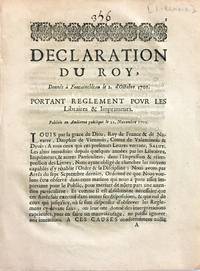
1701100900<p>Grenoble Alexandre Giroud 1701. 4to. 8pp. <br /><br />Reminder of the rules and regulations relevant to the printing trade given in VIII articles.</p>
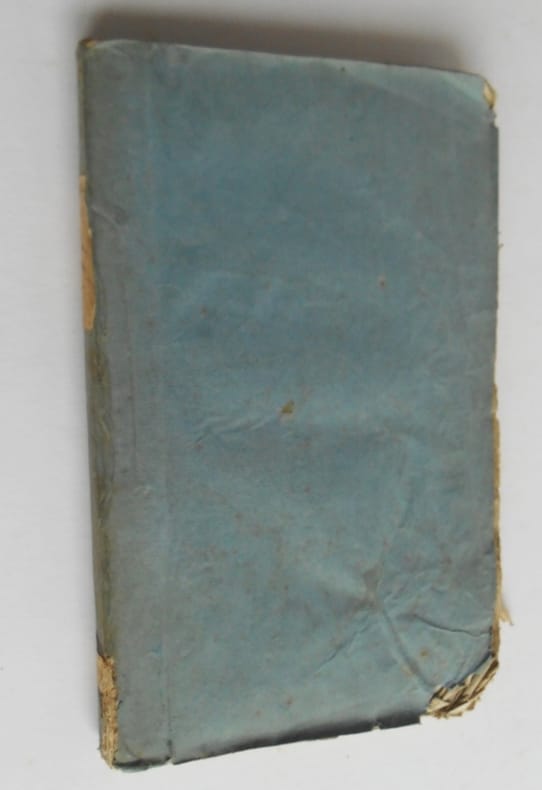
1787M53161787 Sl , 1787 , in8br couverture bleue origine , viii - 143pp - 1 feuillet d' errata. Exemplaire à grandes marges,Un cachet sur la page de titre . Coins défraichis
17726292] Practick. Iulii Caesaris, von Padua. Welche an allen Orten im Kauffen, Verkauffen und Verhandeln allerley Kauffman(n)s Waaren, auch die kleine Müntzen in grosse, und die grossen in kleine verwandeln, dienstlich ist. Jetzt wiederum aufs neu mit Fleiß corrigiret und verbessert. Ohne Ort u. Drucker. Anno 1772. Schmal-12mo. (11,8 x 6,0 cm). 114 nicht nummer. Bl. (4 Bl., A-I 12, K 1-2; letztes leer). Schwarzer Lederband d. Zt. auf drei Bünden, Rücken u. Deckel mit Streicheisenlinien, Lederschließe.
1748457492Frankfurt (Oder), Winter, 1748. 4to. XX, 108 S. Halbschafleder d. Zeit (beschabt, Kanten stark bestoßen). [2 Warenabbildungen]
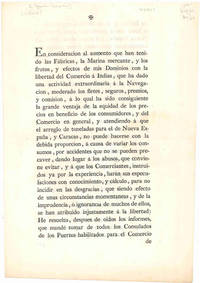
1789WRCAM47977Madrid 1789. 3pp. Folded folio sheet. Two worm holes very minor soiling else fine. This royal decree liberalized the tightly controlled trade between Spain New Spain and the Captaincy of Caracas. The Crown hoped to spur navigation and commerce and lessen the incentive for smuggling. Export duties on goods traveling to the Indies were to be slashed by ten percent but penalties against contraband would still be enforced. unknown books
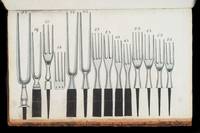
179212195Düsseldorf: s.n. 1792. Contemporary mottled calf rebacked restored marbled endleaves. <p>      ILLUSTRATED PATTERN AND PRICE BOOK OF STEEL KNIVES AND FORKS MANUFACTURED AT SOLINGEN with the strict governmental guidelines for craftsmen and their commercial partners.<br />       The “City of Blades†Solingen was the largest sword knife and scissor manufacturer in the West. It employed over four thousand workers and exported globally. Through their rigid guild system est. 1571 the knife makers protected their trade secrets. Legal standards and strictures ensured the Solingen bladesmiths dominated the market and were the sole suppliers to elite merchants who commissioned bulk orders and custom products. Ordinary tradesmen — like the owner of this book — could only purchase ready-made items and had to pay cash.<br />       KNIVES FOR COBBLERS WOOD- AND LEATHERWORKERS BUTCHERS HUNTERS FARMERS TAILORS GARDENERS WEAVERS AND COOKS form the largest section in the volume. Each blade has a schematic manuscript illustration with separate costs for the work of smiths and for grinders. Many models adopt Dutch English French Flemish and Portuguese designs for the local chic and for export. Only the leatherwork knives are illustrated in watercolor 95 pieces marking a specialty of the owner of this sample book.<br />       THE SECTION ON FORKS HAS ONE HUNDRED THIRTY-EIGHT WATERCOLOR ILLUSTRATIONS and price lists of large carving tools to dainty ones for desserts 65 models. This other house specialty addressed the increasing adoption of forks by upper- and middle-class families in later 18th-century Europe.<br />       ANOTHER SECTION SHOWS HANDLES. These were exclusively manufactured by artisans called Reyder. Each of the two hundred three models listed was available in a range of specified styles and materials. The cost of each type of custom work like turning polishing and coloring is itemized. THE MOST PRIZED EXAMPLES ARE OF FINELY DECORATED BONE EBONY ANTLER GOAT HORN GUAIAC OR PALM WOOD. Look-alikes of “false deer horn†“false guaiac wood†etc. fit other budgets with imitation luxury finishes and less expensive materials. The illustrated examples of knives showcase eighteen different handle decoration options including black red white yellow or green dye black marbling and fine lacquer painting in abstract or foliate patterns. Seven handles are inscribed with German verse. In good condition some light staining hand soiled throughout.<br /> ¶Daniels Vollständige Beschreibung der Schwert-Messer- und übrigen Stahl-Fabriken zu Solingen 30-62.</p> s.n. unknown
17439349Sans lieu, sans nom, 1743. In-8 de 176 pages, plein veau marbré, dos à nerfs orné de filets et fleurons dorés, pièce de titre rouge, filet doré sur les coupes, tranches rouges. Premiers et derniers feuillets légèrement empoussiérés.
17551031561755 A Londres, et se vend à Paris, Quai des Augustins, chez Guillyn, au Lys d'or - 1755 - Deux volumes in-12 (17 x 10,5 cm) - Plein veau blond de l'époque - Filets et fleurons dorés - Etiquette de titre et de tomaison sur fond brun, toutes tranches rouges - 24 + xlj + 460 + 472 pages - Table des chapitres en fin du tome I. Complet en deux volumes
1769PHO-2148Paris, Chez Hérissant, 1769, in-12 (17x10cm), 2ff.-360pp.-6ff., veau époque, dos à nerfs orné avec pièce de titre, triples filets aux plats, tranches rouges, quelque frottements, bon exemplaire.
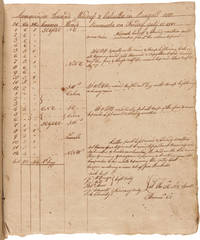
1796WRCAM54712Mostly at sea from New York with stops in Calcutta Saint Helena Ascension Island and Cornwall England 1796. 246pp. Square folio. Original crude burlap covers stab-sewn with thick string. A bit toned and foxed occasional ink or tobacco burns. Very good. A remarkable artifact of early American naval commerce containing the sailing directions and shipboard activities of the "Ship Washington of Philadelphia" which sailed from New York to Calcutta rounding the southern tip of Africa and visiting Saint Helena and Ascension Island before crashing on the rocks at Cornwall England on the way to Hamburg Germany. The log contains a navigational ledger with locations headings wind and weather remarks along with occasional sick lists names of men "unfit for duty" those put on light duty temperatures and other information. The remarks are quite detailed and specific regarding shipboard work and activity. <br> <br> The captain of this final voyage of the ship WASHINGTON was Samuel Hubbart but the identity of the sailor who kept this log is unknown. The ship departed New York on July 4 1795 and reached Calcutta on August 31. Without the need for recording navigational data while in port the log's author switches from the ledger-style format and writes longer more-detailed daily entries describing the crew's activities. The crewmen mentioned include pilots boatswains carpenters coopers caulkers sailmakers and others. Most of the entries pertain to the maintenance of the ship while anchored in the bay. Numerous mentions are made of crew on board fixing various equipment including types and amounts of supplies. A few entries note the employment of Indian "Cooleys" on board the ship making various repairs. An interesting incident of September 17 bears relating: <br> <br> "Hearing a noise upon the main Deck Mr. Naylor went to see what was the matter - upon engaging found Abraham Moor had struck Thomas Williams the Cook as Moor said for wanting to trouble a girl which Moor had on board - Mr. Naylor told him he should not ill use that man for he had every reason to believe it to be false what he alledged against the Cook. Moor said he did not come here to be jawd by a black Man.S." <br> <br> After swearing he would "never go home" on the WASHINGTON Moor literally jumped ship just after this confrontation and hid on another ship before being found and brought back to the WASHINGTON "in irons." <br> <br> In early November a few entries mention the ship receiving a supply of sugar taking on "Three Burr Load of Sugar" on November 7 and two more "Burr Load" two days later. Subsequent entries detail the loading of several "Burr Load of Bales" and "one hundred bags of ginger." <br> <br> Over the course of the ship's time at Calcutta the author mentions encounters with at least four other American ships: the GANGES the HAMILTON the MAJOR PINKNEY of Charleston and the "American Ship Camilla of New York arriv'd here from London." <br> <br> By early February the WASHINGTON left Calcutta for the voyage to Hamburg spelled variously here as "Hamborough" and "Hamburgh" though the ship would never make it to Germany. On March 15 and again on April 6 the recordist notes an inventory of the ship's water supply. By March 23 the ship reaches a point "prependicular on Cape Lagulas Bank" the southernmost point of Africa. About a week later the punishment of a drunken sailor is reported: <br> <br> "Joseph Gonrabbysp who has for some time past been addicted to Drunkeness and no person on board having given him any liquor he was discovered this morning to have taken from the Ships stores about half a Gallon of rum and from his being frequently very drunk there is no doubt of his having been Guilty of the same offence before for which Capt. Hubbart is necessitated to order his Boatswain to flog him. Accordingly mustered all hands aft and give him one and a half dozen lashes." <br> <br> On April 16 the WASHINGTON arrived at the remote island of Saint Helena in the South Atlantic Ocean sending "the Boat on shore with an Officer to the Governor for permission to Anchor." Here the WASHINGTON restocked supplies including water potatoes & other vegetables rice and bread before embarking for Ascension Island which they reached on April 25. The author remarks on the "number of remarkable rocks like pyramids" and "a low point of black Rocks with a fine white sandy beach back of it" witnessed at Ascension Island. The WASHINGTON spent one night at Ascension where a group of men went ashore in order to "spend the Night in Catching Turtle in the different Bays." The crewmen caught twelve turtles and brought them aboard ship before continuing their journey. <br> <br> While heading north to Europe the WASHINGTON was boarded on May 17 by the "Quebec British Frigate Cap J Cook in Company with the Carnatic 74 Rear Admr Powel with a convoy of 21 sail of Transports & Gun boats with 10000 Troops on board bound for Martinico Martinique." On June 7 they again encounter another ship "a Spaniard from some port in South America bound for Cadiz out 3 months & 10 days - we cannot understand rightly what port she was from." <br> <br> Then on June 18 disaster struck the WASHINGTON as it ran aground at the Lizard Rocks off Cornwall England. The log book records the ship's demise: <br> <br> "The weather still very thick and hazy. At 9PM hearing the Surf break on shore took in all the studding sails Braced the Yards sharp and hauled to the Southward finding ourselves in amongst the Rocks off the Lizard have all aback and endeavored to get her out from among them but the Flood tide making very strong drove the Ship so hard upon the Rocks that with every endeavour we found it impracticable to get her off she having settled on them & the strength of the tide Thumping her very hard upon the Rocks sounded the Pump and found she made water very fast. Fired several Guns as a signal of Distress which brought several boats off from the Shore to our assistance." <br> <br> For the next couple of weeks the crew of the WASHINGTON participated in "discharging the cargo" from the ship so that it is not "plundered by the natives" sending everything to Falmouth "where the Goods are deposited under the protection of a Custom house Yaught." The log book mentions one crewman of the WASHINGTON "threatening revenge on Captain Hubbart." Another crewman is put "under a Guard of Soldiers" after selling off some of the muslin stored in the bales rescued from the wreck. Here the ship's log ends along with the career of the Ship WASHINGTON. <br> <br> A unique record of the last voyage of an early American trading vessel with insight into late 18th-century navigational methods and the commercial interests of Federal-era America. unknown books
178224105Marseille, de l'Imprimerie de Sibié, 1782. in 4 de 26 pages, titre encadré, maroquin rouge avec filet et guirlande dorée de fleurs, dos plat orné, filet sur les coupes, tranches dorées. (Reliure de l'époque aux mors frottés, trois griffures sur le plat supérieur. Tache d'encre sur une page de garde et notes de l'époque manuscrites d'errata au verso du titre).
179628782PARIS VALADE 1796 IN-4 plein veau 1 volume, reliure plein veau havane in-quarto (binding full calfskin in-quarto) (20 x 26,4 cm), dos à nerfs (trés légèrement épidermé), pièce de titre sur fond bordeaux avec double filets "or" en encadrement, avec un filet à froid de part et d'autre des nerfs , entre-nerfs à fleuron "or" au fer plein dans un encadrement d'un filet "or" avec rinceaux "or" aux angles, roulette large "or" en pied, léger manque de cuir à l'entre-nerfs du pied (moins d'1 cm2), coiffe de tête arasée, plats épidermés avec légers manque de cuir , mors fendus sur 3 cm en haut et en bas des plats mais la reliure reste néanmoins trés solide, coins écornés, toutes tranches lisses rouges, sans illustrations excepté une gravure gravée en noir "aux armes de Monseigneur HUE DE MIROMENIL" en haut de 1ère page + un grand front de chapitre gravé en noir historié aux Armes Royales + des culs-de-lampes gravés en noir, [VI + 724] Pages, 1796 A Paris, chez Valade, libraire, rue St. Jacques, vis-à-vis celle des Mathurins.. Avec approbation, & privilége du Roi.Editeur,
17761787A Paris, chez Valade, 1776. In-4 de (8)-724 pp., basane havane, dos orné à nerfs, pièce de titre en maroquin fauve (reliure de l'époque).
177024104A Marseille , de l'Imprimerie de Sibié. 1770 in 4 de 15 pages, titre et texte encadrés, maroquin rouge aux Armes de la Ville de Marseille, frises et filets or sur les plats, dos lisse orné à la grotesque, tranches dorées.mors très légèrement frottés. Reliure de l'époque .
17610056611761 Toulouse, Imprimerie de la Veuve de Me Bernard Pijon, 1761. Deux parties reliées en un volume in-quarto (230 X 181 mm) basane fauve marbrée, dos à nerfs, caissons ornés de fleurons et fers dorés, pièce de titre basane beige, tranches mouchetées en rouge (Reliure de l'époque) ; (1) f. de titre, 229 pages, (1) f. blanc - 34 pages.
179198581791 document manuscrit à l'encre brune recto-verso sur papier ligné filigrané "A CASTRES", format : 17,5 centimètres de haut par 22,5 centimètres de large, petit scel (cachet sec) et papier timbré 3 sol, signé au recto par le frère G. Le Cun vicaire de la paroisse Notre-Dame de l'assomption du Port Au Prince, Isle et côte de Saint Domingue, "....Christophe Bachelot, trente ans, natif de Piriac (loire-atlantique) officier du navire "Le Nantais" de Nantes, capitaine Foucher, décédé chez le Sieur Robert Chirurgien en cette ville, témoins Robin et Berluchon.. à Port Au Prince le 26 juillet 1791", signé au verso par Pierre Etienne Saint Guirouer avocat au parlement, conseil du roi, Juge civil en la Sénéchaussée de Port au prince isle et côte de Saint Domingue, signature manuscrite, à Port Au Prince le 27 Juillet 1791,
178426323Nantes 1784 1 document ORIGINAL d'1 page recto-verso manuscrite à l'encre brune, format : 15 x 23 cm, sur papier velin crème, ligné, FACTURE ADRESSÉE A MR GUIBERT DE SAINT ANDRÉ (SAINT-ANDRÉ-DES-EAUX), MAITRE CHARPENTIER PAR CRUCY PÈRE ET FILS, POUR LA VENTE ET LIVRAISON DE BOIS, LE 29 MARS 1783 ET LE 17 SEPTEMBRE 1784, Nantes, LE 17 SEPTEMBRE 1784,
17884941Mit Holzschnitt-Druckermarke auf dem Titel u. großem Kopfstück in Holzschnitt (unten links monogrammiert "L. fec."). De Dato Berlin, den 20sten October 1788. Gedruckt bei J. G. Decker und Sohn, Königlichen Geheimen Oberhofbuchdruckern. Folio (34,0 x 21,7 cm). 285 (recte 273) S. Halblederband d. Zt. mit blauem Bezugspapier (Herrnhuter Papier).
176812908Paris Imprimerie Knapen pour la Gazette du Commerce 1768 -in-4 PLEIN VELIN une année complète reliée, reliure janséniste en vélin ivoire parcheminé in-quarto (jansenist's binding full vellum in-quarto), titre manuscrit sur le dos à 5 nerfs (handwritten title on the spine), plats muets (cover without text), tête lisse (top edge smooth), toutes tranches lisses (all smooth edges), texte 2 colonnes (text - 2 coloumns), sans illustration (no illustration), 1048 pages [pagination commune (paginated together) pour les 105 Numéros reliés (deux par semaine) + les 105 suppléments], 1768 Paris Imprimerie Knapen pour la Gazette du Commerce Editeur,
17825638Zweyte vermehrte und verbesserte Auflage. 2 in 1 Band. Mit 2 (wiederholten) gest. Titelvignetten (wohl von Franz Nicolaus Rolffsen). Hamburg, Fritsch und Ruprecht, 1782. 8vo. (19,2 x 12,2 cm). 2 Bl., 368 S., 1 Bl. Zwischentitel, S. 369-796. Halblederband d. Zt. mit rotem Rückenschild sowie blind- u. goldgeprägtem Rücken.
1755P2-1C-2Londres, le Breton, Desaint, pissot, Lambert, 1755. In-12, veau blond, dos lisse orné, pièce de titre maroquin rouge, endrement, filets d’or sur les plats, reliure de l’époque, tranches marbrées. XXIV-336pp. Très RARE. London, Le Breton, 1755. 12mo, XXIV-336pp. Complete with half title. Woodcut headpiece & initial. Contemporary calf, gilt back, red label. First edition of this popular work on the history of British commerce with the east coast of America written from English sources by a member of the controller-general’s staff in Paris. Included are chapters on Newfoundland, Acadia, and Hudson’s Bay. The author contends that England’s American colonies are the major source of her power and wealth. Nice copy.